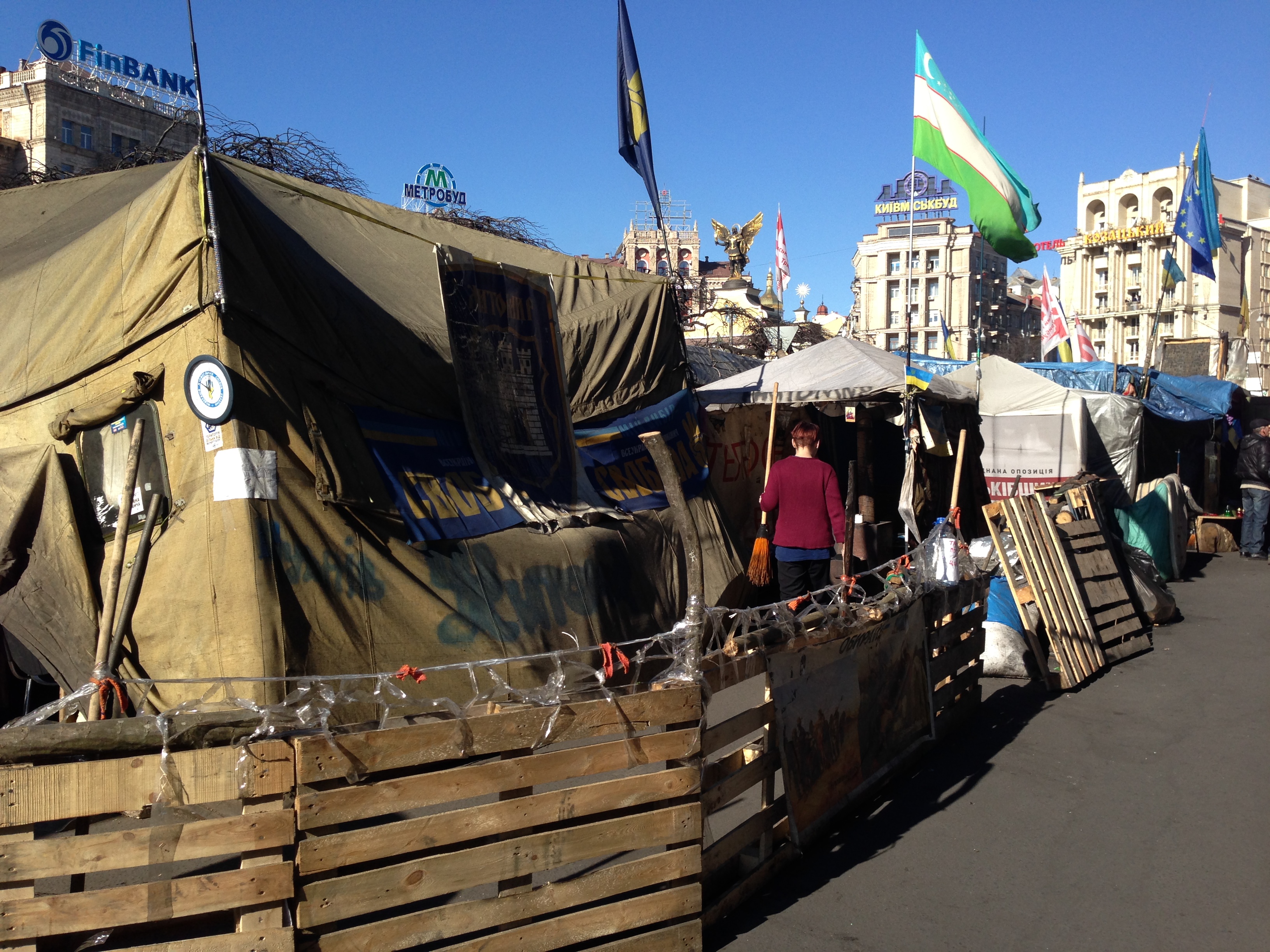
Anyone interested in current events in Ukraine should read Russian President Putin’s address to the Russian people on March 18, 2014 welcoming Crimea back into Russia: “Putin’s speech on Crimea”. It is very clever in playing to the insecurities of the Russian people while also speaking to the international community. Putin says many things we can hardly disagree with along with (and often packed in) some amazing lies and some embarrassing truths.
Here is one example of the former: “I would like to reiterate that I understand those who came out on Maidan with peaceful slogans against corruption, inefficient state management and poverty. The right to peaceful protest, democratic procedures and elections exist for the sole purpose of replacing the authorities that do not satisfy the people. However, those who stood behind the latest events in Ukraine had a different agenda: they were preparing yet another government takeover; they wanted to seize power and would stop short of nothing. They resorted to terror, murder and riots. Nationalists, neo-Nazis, Russophobes and anti-Semites executed this coup. They continue to set the tone in Ukraine to this day.” Perhaps Putin’s virtual shut down of a free press in Russia has kept the Russian people from knowing of his suppression of political opposition there. Or perhaps he thought that the recent release from prison of Mikhail Khodorkovsky (after over ten years of political incarceration) and Pussy Riot demonstrated that the “right to peaceful protest” was alive and well in Putin’s Russia. His statement that the murder of over 100 Maidan demonstrators was at their own hand is just a bald faced lie.
Examples of embarrassing truths include President Obama’s pledge not to bomb Libya. Quoting Stephen Cohen, a professor emeritus at New York University and Princeton University, on the Charlie Rose show: “The United States said to Russia, support of the United Nations’ [authorization of] a no-fly zone over Libya so that Gaddafi can’t take his planes up and attack the insurgents. Russia said, so it’s just a no-fly zone? You’re not going to bomb Gaddafi? [But] we did and it led to his assassination. From that moment on, Putin never trusted anything that came out of the White House.”
I had intended to start the previous paragraph with the often repeated claim that, to quote former U.S. defense secretary Robert McNamara, ‘‘the United States pledged never to expand NATO eastward if Moscow would agree to the unification of Germany.’’ According to this view, ‘‘the Clinton administration reneged on that commitment when it decided to expand NATO to Eastern Europe.’’ Quoted in Mark Kramer: TWQ article on Germany and NATO. Recently available documentary evidence cited by Kramer clearly refutes this “myth.”
I want to share an account of a famous meeting I attended in Tashkent on May 20-21, 1992. The account was written by me many years ago but never shared until now. It presents the truth of another mini lie in Putin’s speech contained in the following passage:
“The USSR fell apart. Things developed so swiftly that few people realized how truly dramatic those events and their consequences would be. Many people both in Russia and in Ukraine, as well as in other republics hoped that the Commonwealth of Independent States that was created at the time would become the new common form of statehood. They were told that there would be a single currency, a single economic space, joint armed forces; however, all this remained empty promises, while the big country was gone.” The following account reveals just how committed Russia was to “a single currency” for the newly independent Former Soviet Republics.
Tashkent, May 20 1992
A. Background: Monetary Babylon
The sudden formation of 15 central banks out of Gosbank in the Former Soviet Union created a strange and ultimately unsustainable situation. One monetary system suddenly had 15 suppliers of “rubles.” The ruble banknotes supplied by the new Central Bank of Russia (they were initially the USSR ruble notes that had already been printed by the Central Bank of the USSR) were issued in their respective areas by each of the 15 FSU central banks. In addition, ruble deposits with banks where used in payments throughout the entire FSU region using the settlement accounts each bank maintained with its newly independent central bank. When payment orders from FSU republics outside Russia began piling up at the Central Bank of Russia in Moscow, we were forced to start sorting out what was wrong with the “system.”
Initially the payment system continued to function as it had previously under Gosbank. The system was decentralized. All that was needed under that system was to verify that the sender (payer) had sufficient funds in its account with its bank. As there was only one bank in the Soviet system, Gosbank, there was no issue of the sender’s bank having enough money in its “settlement” account. All deposit transfer payments were in effect “on us” (i.e., intrabank transfers). Thus a valid payment order could be and was safely accepted at which ever branch or office of Gosbank it was delivered to (the one closest to the recipient of the payment). However, with the introduction of a two tiered banking system several years earlier, the adequacy of a depositor’s bank’s settlement account with the central bank potentially became important.
In early 1992 we were confused by the system being described to us. It was very difficult for us to understand how it really worked. Our counterparts who were explaining the system to us, either didn’t really understand the system either or understood it in terms of its functioning in monobank days. On top of this, the system we were trying to understand was being described to us in Russian and then being translated into English for us by interpreters with no real knowledge of the subject they were interpreting.
Under the old, inherited system, a payment order was sent directly from the central bank branch office used by the sender to the central bank branch office used by the receiver. We were concerned with the potential for credit creation by overdrafts that seemed to be automatically generated when payment orders were accepted wherever they landed without being able to verify the sending bank’s settlement balance with its respective central bank. Bruce Summers of the Federal Reserve Bank of Richmond, complained that each of the fifteen central banks created out of Gosbank needed to centralize the information on account balances if they were to avoid accepting payment orders that might result in overdrafts. Furthermore, something was needed to ensure that net payments among the fifteen central banks did not result in unauthorized overdrafts.
In a series of quick steps, the Central Bank of Russia centralized all incoming payment orders from FSU payers outside of Russia in its Regional Branches and ultimately in Moscow. Furthermore, payment orders that had earlier been sent directly from the Gosbank office servicing the payer to the Gosbank office serving the payee, were now redirected to the new central bank of the republic of the payer, which forwarded it to Moscow (if the payee was somewhere in Russia). Quite aside from whether the bank of the payer had sufficient settlement funds, the sheer volume of payment orders now directed to Moscow overwhelmed the CBR staff there. The time for processing cross border ruble payments was measured in months.
In addition, no one seemed to know the terms under which the CBR supplied its ruble bank notes to the new FSU central banks. Under the inherited system, banknotes were shipped from the mints to the regional branches and offices of Gosbank as needed. They were issued to enterprises against debits to the enterprises’ account balances with the central bank or as credits to the enterprises. The rest was just internal bookkeeping. This arrangement continued for a while until the new FSU central banks began to realize that they were no longer part of the new central Central Bank of Russia and would need to pay for the banknotes of the CBR.
I remember being told by bewildered staff of the National Bank of Kazakhstan and National Bank of Kyrgyzstan that of course the CBR would continue sending banknotes when needed because they always had. And why should they “charge” for them as they had never charged for them before. And indeed, the CBR did continue to send their banknotes for a while and no one knew what the terms for providing them was or might be. This was new territory for everyone and no one seemed to understand exactly where the system was going or how it should work.
As almost all of the new republics had a balance of payments deficit with Russia, the settlement accounts of their new central banks with the CBR in Moscow were always over drawn. The CBR periodically extended credits to these FSU central banks in order to put the overdraft credits on a more explicit basis. But in fact, as the whole process was not really understood and the CBR’s policy not yet really established, the terms of these credits were often unspecified for many months after the fact. Russia seemed to use the undefined terms for political leverage. More politically cooperative Republics negotiated better terms than others.
Resolving the settlement problem was further complicated by the fact that the system was not designed to produce up-to-date account balances. I remember when our accounting expert, Alan Vedren Lacohm from the Bank of France, reported to me that the central bank did not seem to know the current balances of the deposits banks held with it. As hard as it was for him to believe or understand, the central bank seemed to maintain separate debit and credit accounts that were only compared and balanced once a year. An enterprise could issue payment orders against its account on the basis of a central plan authorization. It didn’t matter if it had enough money in its combined debit and credit accounts, and in fact no one really knew whether it had a positive balance or not. This astounding fact mystified us because we were seeing it from the prospective of the systems familiar to us designed for market economies. When we came to understand that the Soviet system, obviously designed to serve a centrally planned economy, was really a budget tracking tool, we suddenly understood its logic. None-the-less, it would not work for a market economy. (Alan later married my assistant after they met on my second mission to Kazakhstan and Kyrgyzstan)
When a bank did not have sufficient balances in its settlement account at the central bank, the central bank could extend it credit to permit payment settlement to proceed. However, such credit did not help when “rubles” were being transferred from Kazakhstan (for example) to Russia. The National Bank of Kazakhstan could not extend credit to its own account with the CBR. The system was designed to work with one central bank and it continued to operate throughout the ruble area as if it still had one central bank when it in fact had 15. The fact that the CBR more or less automatically extended credit to the other FSU central banks and supplied them with what ever ruble bank notes they needed (a very soft budget—balance of payments—constraint), encouraged the FSU central banks to create ruble credit at an ever increasing rate.
B. A Blue print for monetary union
The emerging system was not viable. The USSR had been one economic and monetary space. With its break up, the ruble continued to circulate and to be used for payment through out the entire area. In the case of bank notes, a ruble was a ruble (until new versions were introduced later in the year and in 1993). But in the case of deposit rubles, 15 central banks now issued them. And they continued to be transferred from one account to another as if they were one currency in one system. As we more fully appreciated later, the ruble area of 1992 consisted of one cash ruble and 15 different non cash rubles. Each central bank was issuing its own ruble credits. A ruble claim on the National Bank of Kazakhstan was not the same as a ruble claim on the CBR even though they had the same name.
If an FSU central bank was going to create credit as it saw fit, it would need to introduce its own currency (bank notes as well as central bank account money). If an FSU republic wished to continue using the “traditional” ruble, it’s monetary policy would need to be subordinated to or coordinated with that of the CBR and any other central banks that remained a part of the ruble system. We developed a set of rules for central bank cooperation within a ruble area that we thought would be needed to make the system coherent and stable and invited the governors of all 15 FSU central banks to a meeting to discuss them. The meeting took place in Tashkent on May 20 and 21 following a heads of state meeting there as part of the Russian effort to organize the Commonwealth of Independent States (CIS).
This meeting was preceded by building tensions between the CBR and most of the other FSU central banks as they raced to out do one another in creating ruble credit and as payment orders piled up in Moscow. The situation was further complicated by conflicting signals from Moscow. Depending on who was speaking on any given day, Russia seemed to support the introduction by the FSU republics of their own currencies (thus leaving the ruble area) or the surrender of monetary autonomy to the CBR. Either of these Russian positions was coherent. Our own proposal was meant to provide coherence and central, but collective, control of monetary policy (along the lines of the subsequent ECB), without full surrender to the CBR (These can be found in IMF [Occasional Paper 51]). The Russian terms for staying in the ruble area were cleaner, but because they required complete subservience to the CBR, we felt they would drive out (into their own currencies) even those countries that wanted to stay in a ruble area.
After helping to develop the guidelines to be discussed, I attended the meeting. Other IMF staff attending where Malcomb Knight (later the Sr. Deputy Governor of the Bank of Canada and the General Manager and CEO of the BIS), John Oling-Smee (head of the IMF’s newly established European II Department consisting of the FSU countries), Ernesto Hernadus Catan and Ishan Kapur (both from the IMF’s European I Department). Most of us met in Geneva in order to take a charter flight on May 19. We stopped in Moscow on the way to pick up Ernesto. May 19, 1992 happened to be my 50th birthday. We celebrated on the plane with a bottle of Dom Perignon. It was a memorable birthday.
We were met at the airport in Tashkent by the Deputy Prime Minister. A caravan of three Chaikas and several police cars took us to the compound in which we would stay and our meeting would be held. It was 10:00 pm when we arrived and a formal welcoming dinner had regrettably been planned that required our attendance.
Following the dinner, sometime after midnight, I slept moderately well, despite my excitement, because I was so tired. We had no idea what the current Russian position on use of the Russian ruble would be. It had been changing back and forth in the work up to these meetings almost daily. Clearly views within the Russian hierarchy were divided. Relations between Russian and most of the FSU republics had grown increasingly tense. No one trusted anyone. I had found trying to understand the existing monetary arrangements and working out principles that could make it work intellectually very challenging and interesting. I was filled with excitement and anticipation to hear the reactions of the delegates.
The meeting on the 20th was opened by the Prime Minister, Abdulhashim Mutalov, and the Governor of the State Bank of Uzbekistan. The substantive part of the meeting, which was attended by the Governors of most of the FSU central banks and the Deputy Governors of the rest, was led by John [Odling-Smee]. After a general introduction of the purpose of the guidelines, we proceeded through the sixteen points one after the other. Questions were raised by one chair or another to clarify some of the points. The general suspicion that the IMF would take the Russian position gradually melted (this was helped by the fact that we had fielded technical assistance missions to all of the FSU central banks by then and established the beginnings of relationships of trust). Very few political statements were made and everyone kept glancing at the Russian chair trying to read their position. The Russian Chair, headed by Governor Georgy Matyukhin, said nothing at all that day. It seemed that Russia was not going to challenge our proposal, which was enthusiastically supported by all of the other central banks. At the conclusion of the day it was agreed that a communiqué signed by each of the fifteen governments would be prepared that would set out the sixteen points.
Following the long day’s meetings, we were taken in a long police escorted motorcade to a lake on the outskirts of Tashkent for a celebratory banquet. Our banquet tables were on a large wooden pontoon floating at the edge of the lake. By that time I knew the routine (toasts from each governor, lots of food and lots of vodka). Between the 15 central bank representatives, Uzbek/Tashkent government representatives, and our group, there were a guaranteed minimum of 18 toasts. And indeed, we exceed the minimum. My routine of minimal sips was again subverted by yet another Russian woman sitting across the table. Nothing but “bottoms up” was acceptable. The spirit of the group was exuberant. Each toast became more friendly and gushier than the one before it. Governor’s who were barely willing to speak to each other in the morning had become the best of friends—brothers (“comrades” was no longer a forbidden term).
We arrived back at our compound around midnight. Galinda, our translator from Washington went to work translating the draft communiqué into Russian. John had asked me to be ready to respond the next morning to any questions about inter-enterprise arrears. I started down the hall to my room to brush up on my potential presentation and the First Deputy Governor of the State Bank of Kazakhstan (Mr. Tadjeokof) grabbed me and insisted that I join him in his room for another drink. I had met him two months earlier in Alma Ata (now called Almaty) during my first mission to Kazakhstan. He wished, it seemed, to thank me for our technical assistance and to explain how much they needed lots more. Mr. Tadjiokof did not speak English and I do not speak Russian (or Kazakh), but we proceeded to speak to each other and to lift our glasses of Vodka and toast whatever warm words had been said.
I had assumed that Mr. Tadjiokof had wanted company for another drink, but he persisted in efforts to communicate. It was only possible to go on as if we understood each other for a limited time. I was soon forced to seek help from one of our interpreters. Galinda agreed to suspend her translations of the draft communiqué to interpret for us. Several toasts late, I had second thoughts about the seriousness of Mr. Tajiokof’s communications, which remained focused on his gratitude for our assistance. Galinda was complaining that she needed to return to her work on the communiqué. I was beginning to lose patience and focus. As Galinda left, I spotted Ernesto in the hall. He had been taking Russian lessons and agreed to practice on Mr. Tadjiokof. It was 3:00 am and I stagger off to my bed.
I awoke a few hours later still fully dressed where I had fallen on the bed. I had one of the worst hangovers I can remember. I had serious doubts that I could clearly explain the interrelationships between inter-enterprise arrears and monetary policy. I wanted to sleep for a few more days. But the meeting resumed. No one raised the issue of inter-enterprise arrears thank God. The Russians remained silent. The text of the communiqué was agreed on and the Uzbek hosts agreed to obtain the signatures of the fifteen FSU republics.
The communiqué was never issued nor heard of again. The Russian’s had quietly killed it. In the end, Russia required each FSU republic to choose subordination to the CBT or to introduce their own currency. All but Tajikistan chose the latter. Within several months the Baltic states introduced their own currency and one year later Kyrgyzstan became the first FSU country beyond the Baltics to introduce its own currency. Most of the rest followed before the end of 1993 and the ruble crisis came to an end. Inflation in 1992 is thought to have been several thousand percent dropping to 875% in 1993 and 307% in 1994.
*****************
The quiet disappearance of the central bank cooperation communiqué is reminiscent of the mysterious disappearance of President Yanukovych on February 22, 2014, one day after signing an EU brokered truce with opposition leaders following two days of the worst violence between demonstrators and police in 70 years in which almost 100 were killed. According to witnesses in the room, Yanukovych only agreed to sign the agreement after being instructed to do so by President Putin in a phone call during the meeting. The agreement has not been heard of since. Though Yanukovych was removed from office by an overwhelming vote of the Ukrainian Parliament on February 22, Putin and Yanukovych called it a coup.