Scoring the Iran War

What did we gain from the Iran war and what was the cost (so far)? Why did we launch this war? What was our objective and have we achieved it?

From a NYTimes article and JD Vance speech the US budgetary cost of our illegal attack on Iran was about $150 billion. This year’s conflict cost five to six thousand lives. This does not include the economic cost to the world from oil shortages and food shortages expected from the shortage of fertilizer, etc. NYTimes – Iran war costs

In evaluating what we gained from the war it is hard to know whether to treat the negative outcome as a negative gain or an additional cost. Prior to this war the Straits of Hormuz were open and passage was free. While Iran seems to have agreed to reopen them, they have now clearly demonstrated the potential to close them or charge for passage as potential future choke points. While Iran may be giving up its financing of friends in the neighborhood (Hamas, Hezbollah, Syria, Yemen), and this would be an import gain, it has established its military strength to defend itself while the US has demonstrated its vulnerability.

More importantly, Iran is now judged by many to be more likely to build an atomic bomb. The Iran Deal (Joint Comprehensive Plan of Action -JCPOA) negotiated by the Obama administration, which insured that Iran would not do so for at least ten years, was overturned during the first Trump administration. Hopefully such assurances can be reestablished during the 60 day negotiations still ahead. Though such a bomb would violate Islamic doctrine, the need for such protection has been greatly increased by US/Israel aggressions. But the MOU agreed to this week provides no assurance that a new agreement would be any better than the one Trump killed in May 2018. The Washington Post’s careful analysis suggests that it is not promising that a new agreement will be any better than the old one:  Trump condemned Obama’s Iran deal-here’s how his own compares

In an interview at the opening of his Presidential Library in Chicago, former President Obama stated that: “it feels like we are back where we were before we started the war, except maybe a little worse off…”  The Hill-Obama on Trump Iran war Obama’s assessment was not including the costs of the war noted above.

US support of Israel has been very costly. Virtually the whole amaworld, other than the US, has condemned Israel’s behavior in recent years. The number of Palestinians killed by Israel in Gaza alone since the Oct 7, 2023, attack on Israel by Hamas that killed 1,200, is hard to estimate in part because so many remain buried under the rubble. As reported in an interesting effort to estimate deaths, over half of those killed were women and children, Ralph Nadar stated that: “The recent report by Francesca Albanese, the United Nations Special Rapporteur on the Occupied Palestinian Territories, referred to a consensus of 680,000 deathsFatalities by Israel-vast Gaza genocide-deliberately undercounted These deaths don’t include those in the West Bank, Lebanon, and Syria, which continue to this day despite a so-called cease fire.

More broadly the damage to America’s reputation because of our support of Israel’s bloody attacks of its Palestinian, Lebanon, and Syrian neighbors has been further increased by its illegal attacks on Iran. Our rapid decline continues.

According to Ian Bremmer: “The cease-fire does not mark the end of this chapter of conflict and regional division in the Middle East; it is instead driving a geopolitical realignment along new fault lines.

“More outcomes? A more polarized and fractured Middle East. Iran in a stronger strategic position. And American partners shaken by erratic and unpredictable conduct.

“The war has accelerated the collapse of the US-anchored order that held the Middle East together for decades. That arrangement kept oil flowing, rival powers out of the region, and Washington the broker of everything that mattered – from Iranian containment to the more recent Arab-Israeli normalization process. It was already fraying before the fighting started. The war broke it.”   Linkedin – What actually mattered

The General’s Son

In the book “The General’s Son: Journey of an Israeli in Palestine,” by Miko Peled, the General refers to Major General Mattityahu “Matti” Peled (1923–1995), an Israeli military commander who became a prominent peace activist, academic, and politician. A key architect of the Israeli Defense Forces’ (IDF) victory in the 1967 Six-Day War, he later transitioned into a radical advocate for Israeli-Palestinian dialogue and a two-state solution.

Like his father, Miko was also an avid Zionist who believed in peaceful relations with his Arab neighbors in two sovereign states. When Milo’s niece Smadar was killed by a Palestinian suicide bomber in 1997, Miko’s reaction to his grief tells us all we need to know to understand the heart of this book. Rather than expressing hatred toward the Palestinian murderer of his beloved niece, he felt shame and anger toward his fellow Israelis for driving a Palestinian boy to take his own life in this way. The book relays Miko’s journey upto and beyond this tragedy and sets out a more balanced history than you might have heard.

Having settled in San Diego to teach karate, Miko began to participate in mixed Jewish/Arab groups (San Diego Jewish-Palestinian Dialogue Group) discussing their experiences in and hopes for Israel and the West Bank and Gaza Strip (WBGS) and became hopeful for two sovereign states living peacefully next to each other. When Israeli Prime Minister Ehud Barak and Palestinian leader Yasser Arafat meet with President Bill Clinton at Camp David in Maryland, Miko was sure peace was at hand. When the talks fail to achieve agreement and Clinton seems to blame Arafat, Miko is shocked.

“Arafat had been consistent for years. For the sake of peace he was willing to give up the dream of all Palestinians to return to their homes and their land in Palestine. He was willing to recognize Israel, the state that destroyed Palestine, took his people’s land, and turned them into a nation of refugees. He was ready to establish an independent Palestinian state in the West Bank and Gaza—which make up only 22 percent of the Palestinian homeland—with Arab East Jerusalem as its capital.

“He was ready to do all this, but he was not going to settle for anything less. He had always been clear about what he saw as the terms for peace.

“In the end, it turned out that… what the Israelis had demanded at Camp David was tantamount to total Palestinian surrender…. Barak demanded that Arafat sign an agreement to end the conflict forever and in return, he would be permitted to establish a Palestinian state on an area of land that could not be defined clearly because it was broken into pockets with no geographic continuity. Instead of Arab East Jerusalem, he would receive a small suburb of East Jerusalem as his capital. To that Yasser Arafat refused to agree.” (p. 126)

Miko’s love of Israel and increasing exposure to Palestinians (both in San Diego and in the West Bank, which he visited often to teach Karate and promote mutual understanding) exposed him to the shocking mistreatment of Palestinians in their own land. His compassionate heart and wisdom led him to strongly advocate the two-state solution to the struggles between the Arabs and Jews occupying the area.

During a visit to Ramallah to meet Abu Ali Shahin, Fatah commander and leader of the Palestine political prisoners for more the two decades, Miko exclaimed that: “Immediately after the war, while still in uniform, my father said that Israel must recognize the rights of the Palestinian people. He said that if we don’t do this, the Israeli army would become an occupation army and would resort to brutal means to enforce the IsraeliOslo occupation on the Palestinian people. He said this while still in uniform and he never stopped saying it and advocating for Palestinian rights till he died.” (p. 229)

In my own work with the IMF helping to establish the Palestine Monetary Authority called for by the Oslo Accord, I was disheartened to observe Israel’s abusive treatment of the Palestinians. The Oslo Accord itself did not provide for a fully independent and sovereign state for the Palestinians (themselves semitic children of Abraham). It provided what was hoped would be the first trust-building steps toward such a true state. However, Israel carved up the West Bank with highways only usable by Israelis. Palestinians driving to their new capital of Ramallah had to wait hours to enter via the Israeli-controlled check point. With my UN passport I could sail in via the Israeli entrance with no wait. Israel isolated the Palestinian population of the WBGS in every way imaginable.

Though declared illegal by the UN, Israeli Jews increasingly stole Palestinian land to establish Jewish settlements, carving up and often destroying Palestinian farms in the process. The number of Jews living in illegal settlements in the West Bank grew from about 80,000 in 1990 to almost 530,000 in 2025. But this pales compared to the shocking mistreatment reported by Miko.

At the end of Miko’s meeting with the 72-year-old Fatah leader, Abu, Ali Shahin, stated:

“We all belong to this land and need to live together. No one is safe in one Jewish state. Judaism is a religion, and I am speaking of a secular state of all its citizens. That is the only way to live here. Being Jewish or Muslim or Christian or atheist, that is a personal choice, not for me to dictate and not to be dictated to me. I don’t want a priest or a rabbi or a sheikh to govern my life. We belong in this land, and we need to live here as equals.”

Miko then writes: “This was not the first time I had heard someone talk of the ‘one secular democratic state,’ as the right solution. It was the part of the Fatah manifesto to create a secular democracy in all of Palestine. In the past, I could not stomach it, but the more I met impressive, intelligent people like Abu Ali, people who were driven by principle, the more I thought that there was no point, indeed no future, in dividing the people and the land. Not to mention the fact that the settlements and the facts on the ground had succeeded in erasing the West Bank as a viable area in which a Palestinian state could be established.”

In my book on my travels in the area, “Palestine: The Oslo Accords Before and After”, I still strongly supported a two-state solution. But when I asked George Abed, my IMF colleague then Governor of the Palestine Monetary Authority I was there to help create, if he would write the Foreword to my book, he declined, saying the book was unfair to the Palestinians. I have now come to accept that he was right.

This book was published in 2012. From that year (January 2012) until October 6, 2023 Palestinians killed about 300 Israelis, who killed about 3,900 Palestinians. From the October 7, 2023, attack on Israel until now (June 2, 2026), Palestinians killed about 1,400 Israelis (of whom 1,200 were killed during Hamas’s Oct. 7 attack), who then killed about 75,000 Palestinians. The status quo is clearly not working for Israelis or for Palestinians.

The United States, home to about as many Jews as there are in Israel, is a secular state with large populations of Jews, Protestants, Catholics, Muslims and other religious groups. Our constitution forbids the government from adopting any one of them. They have each flourished. I have reluctantly concluded that Israel must annex the West Bank of Gaza and give full and equal citizenship and rights to all Arabs and Jews living there. “A one state solution”“A one state solution – 2”.

The wars and ethnic cleansing now underway by the Netanyahu government is not only destroying Israel, but also dragging the United States down with it and I haven’t even mentioned Iran.

Obeying the rules is in our interest

The U.S. Department of Justice indicted former Cuban President Raúl Castro for his alleged role in the 1996 Cuban military downing of two civilian planes operated by the exile group Brothers to the Rescue, which killed four people (including three U.S. citizens).Since September 2, 2025, the U.S. military has attacked suspected drug boats in the Caribbean and the Eastern Pacific 59 times, killing 196 people. Shouldn’t we be indicting Secretary of War, Pete Hegseth, for murder?

“According to President Donald Trump’s mysterious math, that means this campaign of carnage has prevented around 1.5 million drug-related deaths in the United States—more than 20 times the total number recorded in the year before Trump started treating suspected cocaine smugglers as ‘combatants’ who can be killed at will, from a distance and in cold blood.

“Back on planet Earth, there is no reason to think the boat strikes have prevented any deaths at all. That could only happen if blowing up smugglers—as opposed to the previous practice of intercepting them, arresting them, and seizing their cargo, which Trump says was ‘totally ineffective’—reduced the supply of cocaine available to American consumers. Given more than a century of failed attempts to ‘stop the flow’ of illegal intoxicants, that never seemed likely. And nearly nine months after Trump launched his new, deadlier version of the war on drugs, there is no evidence that it is more effective than the traditional tactics he derides as insufficiently homicidal.” Jacob Sullum, “Blowing up boats hasn’t slowed cocaine traffic to U.S.”

Should we care about such a double standard? Yes. What we are doing is not only illegal but also immoral. Hopefully we aspire to behave morally because we aspire to be moral people. But there is a practical self-interest in playing by the rules as well.

We could often get our way simply because we are the strongest guy on the block. President Trump seems to like being a bully. However, pushing others around has a cost. The better we can live up to the high principles upon which our nation was founded, the more respect we will receive from others (nations and people). One of those important principles is adhering to the rule of law. Such respect means that others will cooperate with us more easily (at lower cost to us).

International norms and conventions generally serve the interests of all who have agreed to them. Win, win. When we violate them, the world pays a cost and so do we.

Remembering Bryce

Remembering Bryce Davidson

June 1, 1993 – Feb 1, 2026

Bryce inherited his gregariousness from his father, certainly not from me, his grandfather on his mother’s side. Sadly from me he inherited FSHD. While Bryce’s mother suffers from Acioscapulohumeral Muscular Dystrophy (FSHD) more than I do, Bryce suffered from it the most. It was from the doctor’s examination of his stooped shoulders and weak arms that we discovered that we all had it.

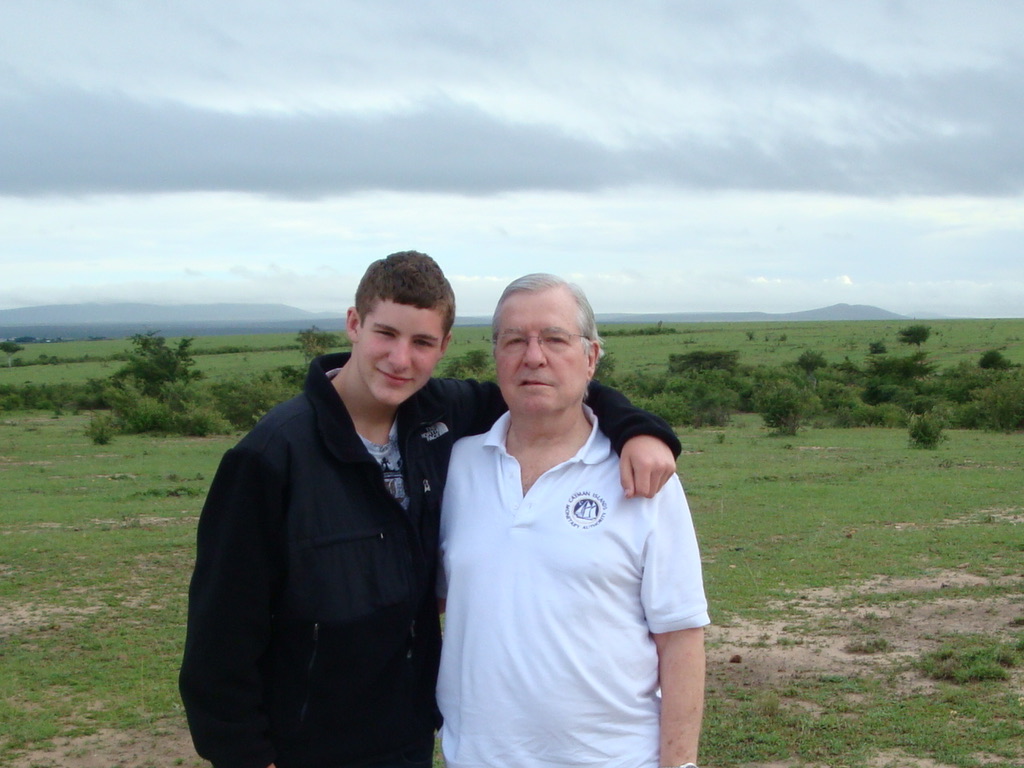
In April 2010 he traveled with me to London and Kenya. I am so grateful for that time we had together. While working in the Central Bank of Kenya in Nairobi during the day, I insisted that Bryce not leave our hotel. I had been told that the slang word for white people walking around town translated to “money” in English. We went out in the evenings for dinner and to visit friends. Before we left for our safari through the Masia Mara National Reserve Bryce knew and was friends with everyone working in the Hotel. When I returned from the Bank in the afternoon, anyone I asked, “where is Bryce” would tell me immediately. We traveled with a car and driver provided by the Central Bank and when we overnighted in the Reserve Bryce immediately joined the local tribe in its celebration of something or other. While our little safari let us see all the Big Five (lions, elephants, buffalos, leopards, and rhinos), Bryce’s favorite animal encounter was with a friendly Cheetah at the Nairobi Zoo. His smile and enthusiasm will be, and is, much missed.