
The General’s Son

In the book “The General’s Son: Journey of an Israeli in Palestine,” by Miko Peled, the General refers to Major General Mattityahu “Matti” Peled (1923–1995), an Israeli military commander who became a prominent peace activist, academic, and politician. A key architect of the Israeli Defense Forces’ (IDF) victory in the 1967 Six-Day War, he later transitioned into a radical advocate for Israeli-Palestinian dialogue and a two-state solution.

Like his father, Miko was also an avid Zionist who believed in peaceful relations with his Arab neighbors in two sovereign states. When Milo’s niece Smadar was killed by a Palestinian suicide bomber in 1997, Miko’s reaction to his grief tells us all we need to know to understand the heart of this book. Rather than expressing hatred toward the Palestinian murderer of his beloved niece, he felt shame and anger toward his fellow Israelis for driving a Palestinian boy to take his own life in this way. The book relays Miko’s journey upto and beyond this tragedy and sets out a more balanced history than you might have heard.

Having settled in San Diego to teach karate, Miko began to participate in mixed Jewish/Arab groups (San Diego Jewish-Palestinian Dialogue Group) discussing their experiences in and hopes for Israel and the West Bank and Gaza Strip (WBGS) and became hopeful for two sovereign states living peacefully next to each other. When Israeli Prime Minister Ehud Barak and Palestinian leader Yasser Arafat meet with President Bill Clinton at Camp David in Maryland, Miko was sure peace was at hand. When the talks fail to achieve agreement and Clinton seems to blame Arafat, Miko is shocked.

“Arafat had been consistent for years. For the sake of peace he was willing to give up the dream of all Palestinians to return to their homes and their land in Palestine. He was willing to recognize Israel, the state that destroyed Palestine, took his people’s land, and turned them into a nation of refugees. He was ready to establish an independent Palestinian state in the West Bank and Gaza—which make up only 22 percent of the Palestinian homeland—with Arab East Jerusalem as its capital.

“He was ready to do all this, but he was not going to settle for anything less. He had always been clear about what he saw as the terms for peace.

“In the end, it turned out that… what the Israelis had demanded at Camp David was tantamount to total Palestinian surrender…. Barak demanded that Arafat sign an agreement to end the conflict forever and in return, he would be permitted to establish a Palestinian state on an area of land that could not be defined clearly because it was broken into pockets with no geographic continuity. Instead of Arab East Jerusalem, he would receive a small suburb of East Jerusalem as his capital. To that Yasser Arafat refused to agree.” (p. 126)

Miko’s love of Israel and increasing exposure to Palestinians (both in San Diego and in the West Bank, which he visited often to teach Karate and promote mutual understanding) exposed him to the shocking mistreatment of Palestinians in their own land. His compassionate heart and wisdom led him to strongly advocate the two-state solution to the struggles between the Arabs and Jews occupying the area.

During a visit to Ramallah to meet Abu Ali Shahin, Fatah commander and leader of the Palestine political prisoners for more the two decades, Miko exclaimed that: “Immediately after the war, while still in uniform, my father said that Israel must recognize the rights of the Palestinian people. He said that if we don’t do this, the Israeli army would become an occupation army and would resort to brutal means to enforce the IsraeliOslo occupation on the Palestinian people. He said this while still in uniform and he never stopped saying it and advocating for Palestinian rights till he died.” (p. 229)

In my own work with the IMF helping to establish the Palestine Monetary Authority called for by the Oslo Accord, I was disheartened to observe Israel’s abusive treatment of the Palestinians. The Oslo Accord itself did not provide for a fully independent and sovereign state for the Palestinians (themselves semitic children of Abraham). It provided what was hoped would be the first trust-building steps toward such a true state. However, Israel carved up the West Bank with highways only usable by Israelis. Palestinians driving to their new capital of Ramallah had to wait hours to enter via the Israeli-controlled check point. With my UN passport I could sail in via the Israeli entrance with no wait. Israel isolated the Palestinian population of the WBGS in every way imaginable.

Though declared illegal by the UN, Israeli Jews increasingly stole Palestinian land to establish Jewish settlements, carving up and often destroying Palestinian farms in the process. The number of Jews living in illegal settlements in the West Bank grew from about 80,000 in 1990 to almost 530,000 in 2025. But this pales compared to the shocking mistreatment reported by Miko.

At the end of Miko’s meeting with the 72-year-old Fatah leader, Abu, Ali Shahin, stated:

“We all belong to this land and need to live together. No one is safe in one Jewish state. Judaism is a religion, and I am speaking of a secular state of all its citizens. That is the only way to live here. Being Jewish or Muslim or Christian or atheist, that is a personal choice, not for me to dictate and not to be dictated to me. I don’t want a priest or a rabbi or a sheikh to govern my life. We belong in this land, and we need to live here as equals.”

Miko then writes: “This was not the first time I had heard someone talk of the ‘one secular democratic state,’ as the right solution. It was the part of the Fatah manifesto to create a secular democracy in all of Palestine. In the past, I could not stomach it, but the more I met impressive, intelligent people like Abu Ali, people who were driven by principle, the more I thought that there was no point, indeed no future, in dividing the people and the land. Not to mention the fact that the settlements and the facts on the ground had succeeded in erasing the West Bank as a viable area in which a Palestinian state could be established.”

In my book on my travels in the area, “Palestine: The Oslo Accords Before and After”, I still strongly supported a two-state solution. But when I asked George Abed, my IMF colleague then Governor of the Palestine Monetary Authority I was there to help create, if he would write the Foreword to my book, he declined, saying the book was unfair to the Palestinians. I have now come to accept that he was right.

This book was published in 2012. From that year (January 2012) until October 6, 2023 Palestinians killed about 300 Israelis, who killed about 3,900 Palestinians. From the October 7, 2023, attack on Israel until now (June 2, 2026), Palestinians killed about 1,400 Israelis (of whom 1,200 were killed during Hamas’s Oct. 7 attack), who then killed about 75,000 Palestinians. The status quo is clearly not working for Israelis or for Palestinians.

The United States, home to about as many Jews as there are in Israel, is a secular state with large populations of Jews, Protestants, Catholics, Muslims and other religious groups. Our constitution forbids the government from adopting any one of them. They have each flourished. I have reluctantly concluded that Israel must annex the West Bank of Gaza and give full and equal citizenship and rights to all Arabs and Jews living there. “A one state solution”“A one state solution – 2”.

The wars and ethnic cleansing now underway by the Netanyahu government is not only destroying Israel, but also dragging the United States down with it and I haven’t even mentioned Iran.
My Travels to Jerusalem

Palestine: The Oslo Accords before and after, My travels to Jerusalem By Warren L Coats (2021) Kindle and paperback versions available at: Oslo Accords: Before and After

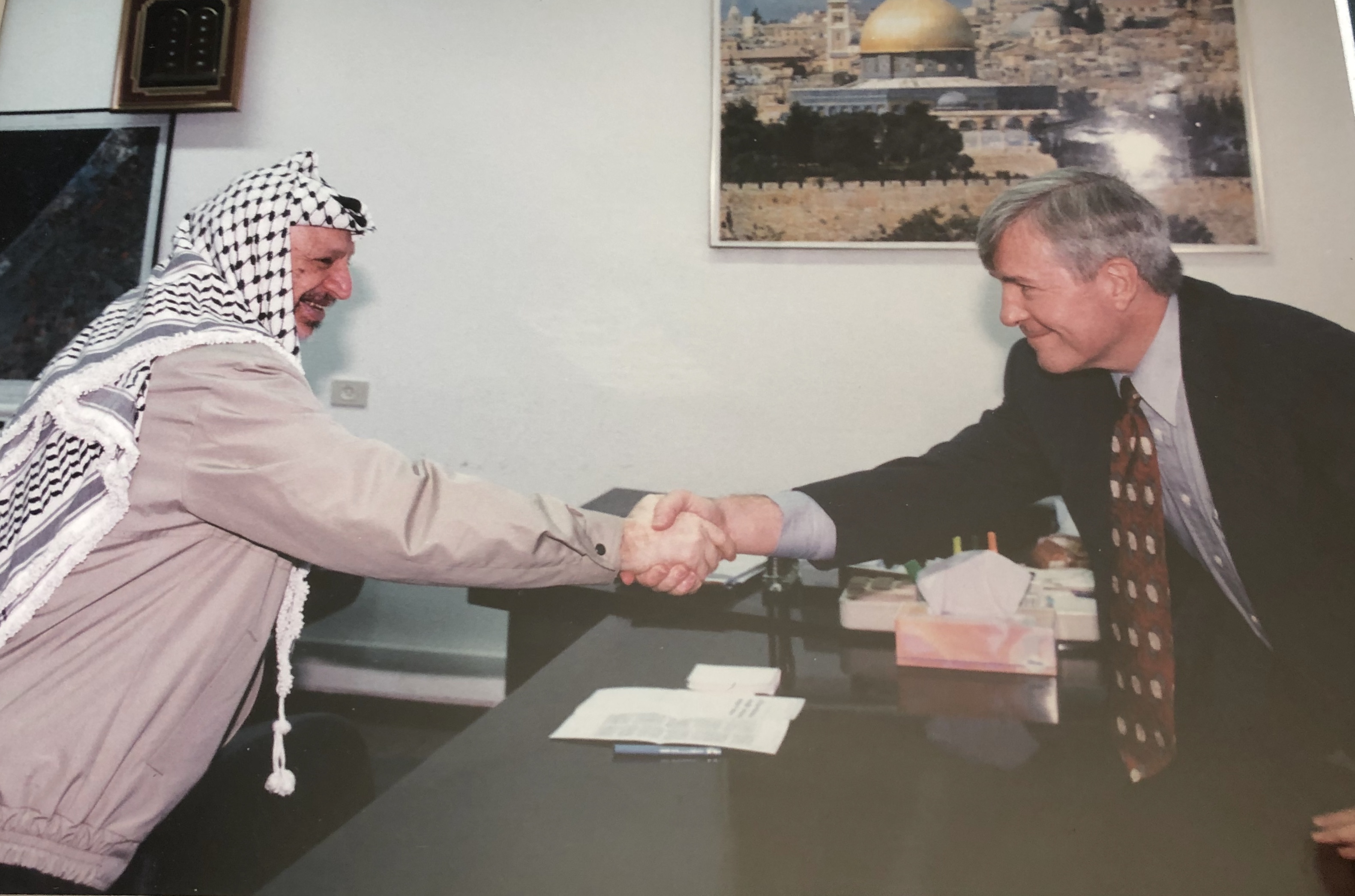
An intimate account of the establishment of the Palestine Monetary Authority and related adventures by one of the International Monetary Fund’s post-conflict, transition economy monetary experts. From being stranded in the desert without a cell phone, to hearing the sound at breakfast of a suicide bomber, to meeting with Yasser Arafat, and Stanley Fischer of the Bank of Israel, the author shares his adventures in the land of Canaan over a sixteen year period.

The establishment of the State of Israel in 1948 in Israel’s ancestral homeland required dealing with Palestine’s existing residents. In the Six-Day War in 1967, Israel’s occupation of the territories given to the Palestinians when the United Nations first recognized the State of Israel (the West Bank and Gaza Strip) increased pressure to resolve that issue. The Oslo Accords offered a path to its resolution, based on an agreement between Yasser Arafat, representing the Palestinian people, and the government of Israel, to swap land for peace (the return of Palestinian lands in exchange for Palestinian recognition of the State of Israel and its right to exist in peace).

One of the elements of the Oslo Accords was the establishment of a central bank in the Occupied Territories. Between 1995 and 2011 Warren Coats lead or participated in the missions of the International Monetary Fund to assist the Palestinian Authority in establishing and developing the capacities of the Palestine Monetary Authority. This book recounts the highlights of his visits, which included meetings with Arafat, as well as Bank of Israel officials.

Previous Books

One Currency for Bosnia: Creating the Central Bank of Bosnia and Herzegovina by Warren Coats (2007)   Hard cover: One Currency for Bosnia

FSU: Building Market Economy Monetary Systems–My Travels in the Former Soviet Union By Warren L Coats (2020)  Kindle and paperback versions available at: FSU-Building-Economy-Monetary-Systems

Afghanistan: Rebuilding the Central Bank after 9/11 — My Travels to Kabul By Warren Coats (2020)  Kindle and paperback versions available at:  “Afghanistan-Rebuilding the Central Bank after 9/11”

Iraq: An American Tragedy, My Travels to Baghdad By Warren Coats (2020) Kindle and paperback versions available at: Iraq-American-Tragedy-My-Travels-Baghdad

Zimbabwe: Challenges and Policy Options after Hyperinflation by Warren L. Coats (Author), Geneviève Verdier (Author)  Format: Kindle Edition Zimbabwe-Challenges and Policy Options after Hyperinflation-ebook

Money and Monetary Policy in Less Developed Countries: A Survey of Issues and Evidence by Warren L. Coats (Author, Editor), Deena R. Khatkhate (Author, Editor)  Format: Kindle Edition Money and Monetary Policy in LDCs-ebook

Oslo: the Play

IMG_2150Yessar Arafat and Warren Coats in the PLO office in Gaza in February 1996.

Last night I saw the Round House Theater’s magnificent production of Oslo, the story of the secret meetings in Norway that led to the establishment of the Palestinian Authority.  It was a moving (heart wrenching) and balanced recounting of how these meetings achieved agreement between Israel and the Palestinian Liberation Organization on “land for peace” as it was called at the time after many years of failed official negotiations. I urge you to see it.

We heard the PLO negotiators lay out the Israeli theft of their homes and killings of their people and we heard the Israeli negotiators lay out the Palestinian attacks on Israelis and on the efforts of Jews to establish and secure an Israeli homeland.  For perspective, since the second intifada (between September 29, 2000 and January 31, 2018) at least 9,560 Palestinians have been killed by Israelis and 1,248 Israelis have been killed by Palestinians.  “The View from the West Bank”

The play focused on the unusual approach of these negotiations, which built on the development of trust and respect between the opposing negotiators and the agreement on achievable steps one step at a time. Between their long negotiating sessions in an isolated room near Oslo, they dinned, drank and bonded together. Unfortunately, the play fails to provide us with an overview of the resulting agreement, which applied the same step by step confidence building approach to the incremental establishment of a Palestinian government (the Palestinian Authority) and withdrawal of Israeli troops from the West Bank and Gaza. The PA was given governance authority for a limited number of functions in order—step by step—to build both institutional capacity and trust.

One of those functions was the establishment of the monetary authority (central bank). I led the IMF team that helped establish the Palestinian Monetary Authority and have many stories to tell of my many visits to Israel and the West Bank and Gaza in 1995-6 plus a number of visits in later years (most recently in December, 2011).

The PMA has developed into a well-run organization of which Palestinians (and those Israelis who see a successful Palestine government as important and necessary for their own security) can be proud.  It helped a great deal that the Bank of Israel and PMA developed good relations. Stanley Fischer was the governor of the BoI from 2005-13 and George Abed was governor of the PMA from 2005-7. They had both previously been colleagues at the IMF. “Jerusalem in August 2006”

It is with a broken heart that I watch Israel’s Prime Minister, Benjamin Netanyahu, with help from American President Donald Trump, increasingly abandon the two state solution of the Oslo Agreement for an apartheid single state regime in which “democratic” Jewish control is preserved by denying what would become the majority Palestinian residents their right to vote. “The Future of Israel and Palestine”


American Exceptionalism—where has it gone?

Americans are among the most generous people in the world.  World Giving Index – published by the Charities Aid foundation – averages the percent of the population giving money to charities, the percent who have volunteered time for an organization in the past month, and the percent who have helped a stranger in the past month. Americans are sixth, tied with Switzerland with a score of 55%. Australia and New Zealand are first and second with 57% followed by Ireland and Canada with 56%. Germany is 19th with 44% and France is 93rd with a score of 27%.

I have always been proud that visitors to the United States have generally found Americans to be friendly, helpful, and good-hearted. I realize that this is a bit hard to imagine these days with the negativism thrown from the right and the left at each other, but we still manage the occasional smile in the grocery store as we wait at the checkout line. However, views of America abroad have been declining for some years and have plummeted this year. http://www.pewglobal.org/2017/06/26/u-s-image-suffers-as-publics-around-world-question-trumps-leadership/

The reasons for this decline that leap out to me reflect the propensity of our government to throw its weight around. We have been at war almost continuously since 9/11 (Afghanistan, Iraq, Somalia, Syria, Libya, Yemen, Nigeria, and who knows where else). The U.S. has 662 overseas bases in 38 foreign countries and military personnel in 130 countries. Most American soldiers are fine young men but no one likes foreign soldiers on their streets for very long, even went they are well behaved most of the time.

I was discussing with a Pakistani friend the “special” qualities of the American government and American people that make us exceptional https://works.bepress.com/warren_coats/35/. He suggested that a growing number of people around the world see the United States as exceptional in the sense that it doesn’t think it needs to follow the rules it sets out for everyone else. We are seen as bullies. Ouch.

The most recent and embarrassing example of this was President Trump’s announcement that the United States recognized Jerusalem as the capital of Israel and would move the U.S. Embassy there. As background, on May 14, 1948 the British agreed when Israel declared its independence from the British mandate that ruled Palestine. The State of Israel was immediately recognized by the United States. After several rejections by the UN Security Council, Israel’s UN membership application was accepted by the General Assembly on May 11, 1949 in Resolution 273, which, among other things, defined the new country’s boundaries. Between June 5 to 10, 1967 Israel attacked and captured surrounding territories in Egypt, Jordan and Syria in what became known as the Six-Day War. Except the Gaza Strip and the West Bank most of the captured territory was returned as part of a peace agreement. Israel ended its occupation of the Gaza Strip in August 2005.

The termination of Israel’s “temporary” occupation of the West Bank, including East Jerusalem remains the subject of the Israeli-Palestinian peace negotiations. “Under the 1947 UN Partition Plan to divide historical Palestine between Jewish and Arab states, Jerusalem was granted special status and was meant to be placed under international sovereignty and control. The special status was based on Jerusalem’s religious importance to the three Abrahamic religions.”  “Jerusalem-capital-Israel”

In general, the international community rejects the use of brute force to change borders. Russia’s annexation of Crimea into Russia (though it was previously part of Russia before Khrushchev gave it to Ukraine in 1954) violated this understanding.

President Trump’s announcement about the status of Jerusalem violates standing U.S. and international policy. It was almost universally condemned. The US vetoed a Security Council condemnation of Trump’s action but the General Assembly overwhelmingly (128 to 9, with 35 abstentions) passed a resolution declaring that, “any decisions and actions which purport to have altered the character, status or demographic composition of the Holy City of Jerusalem have no legal effect, are null and void and must be rescinded.” White-House-vows-to-stand-firm-on-trumps-recognition-of-jerusalem-as-israels-capital/2017/12/23/

The General Assembly vote used a rarely exorcised power as explained by Paul Pillar. “Among the principal takeaways from the General Assembly’s action is that an international sense of justice and fairness matters.  Many states reject the notion that might makes right, which is how the Israeli government has treated its relations with the Palestinians, and how the Trump administration approached its lobbying on this resolution.” “Uniting-against-trumps-policies-for-peace”

When the UN voted Thursday (Dec 22) to condemn this action “Only seven countries—Guatemala, Honduras, Togo, Nauru, Palau, Micronesia and the Marshall Islands—were willing to stand with Uncle Sam and Israel and vote against the resolution.” “Next-year-in-Jerusalem”

Aside from keeping the favor Israeli Prime Minister “Bibi” Netanyahu and some wealthy American Jewish donors, there is no upside to this step to be found. The peace talks, such as they were, have been damaged. Even the “Permanent Observer Mission of the Holy See to the United Nations called for maintaining of the status quo of Jerusalem.” In its letter to the President of the General Assembly it stated that: “The unique identity of Jerusalem, which is of universal interest, consists in its particular nature as a Holy City, most sacred to the three monotheistic religions and a symbol for millions of believers worldwide who consider it their “spiritual capital”. Its significance goes beyond the question of borders and this reality should be considered a priority in every negotiation for a political solution.” “Holy-See-supports-Jerusalem’s-historical-status-quo”

Israelis themselves are deeply divided on this issue. The continued and unresolved occupation of the West Bank by Israel has and continues to provoke terrible behavior by both sides. Uri Avnery, an Israeli freedom fighter in his youth, decries acts by his country against occupied Palestinians in passionate terms (email me if you are interested in his email) as does Phillip Weiss: Ending-crisis-Zionism/

But American bullying did not stop there. Nikki Haley, U.S. Ambassador to the UN, delivered a disgusting and threat-filled speech condemning the U.S. rebuke. “The crude tactics included Nikki Haley’s rhetoric about ‘taking names’ and Donald Trump’s bombast about cutting off U.S. aid.  Among the Arab states that supported the resolution were the two states—Egypt and Jordan—that receive more U.S. aid than anyone other than Israel.  The very crudeness of the tactics, and the offense taken to bullying, probably made the tactics counterproductive.” (see Pillar article above).

Good hearted and freedom loving Americans are increasingly represented by governments that push our views and interests on the rest of the world. The rest of the world’s resistance is building. This does not serve our economic or security interests. How did the “essential country”—the “exceptional country”—become a big bully? In recent weeks we have also been asking ourselves how prominent leaders in the media, industry, and Congress have become sexual bullies. It seems that power corrupts. Eternal vigilance is still needed.