
In the book “The General’s Son: Journey of an Israeli in Palestine,” by Miko Peled, the General refers to Major General Mattityahu “Matti” Peled (1923–1995), an Israeli military commander who became a prominent peace activist, academic, and politician. A key architect of the Israeli Defense Forces’ (IDF) victory in the 1967 Six-Day War, he later transitioned into a radical advocate for Israeli-Palestinian dialogue and a two-state solution.
Like his father, Miko was also an avid Zionist who believed in peaceful relations with his Arab neighbors in two sovereign states. When Milo’s niece Smadar was killed by a Palestinian suicide bomber in 1997, Miko’s reaction to his grief tells us all we need to know to understand the heart of this book. Rather than expressing hatred toward the Palestinian murderer of his beloved niece, he felt shame and anger toward his fellow Israelis for driving a Palestinian boy to take his own life in this way. The book relays Miko’s journey upto and beyond this tragedy and sets out a more balanced history than you might have heard.
Having settled in San Diego to teach karate, Miko began to participate in mixed Jewish/Arab groups (San Diego Jewish-Palestinian Dialogue Group) discussing their experiences in and hopes for Israel and the West Bank and Gaza Strip (WBGS) and became hopeful for two sovereign states living peacefully next to each other. When Israeli Prime Minister Ehud Barak and Palestinian leader Yasser Arafat meet with President Bill Clinton at Camp David in Maryland, Miko was sure peace was at hand. When the talks fail to achieve agreement and Clinton seems to blame Arafat, Miko is shocked.
“Arafat had been consistent for years. For the sake of peace he was willing to give up the dream of all Palestinians to return to their homes and their land in Palestine. He was willing to recognize Israel, the state that destroyed Palestine, took his people’s land, and turned them into a nation of refugees. He was ready to establish an independent Palestinian state in the West Bank and Gaza—which make up only 22 percent of the Palestinian homeland—with Arab East Jerusalem as its capital.
“He was ready to do all this, but he was not going to settle for anything less. He had always been clear about what he saw as the terms for peace.
“In the end, it turned out that… what the Israelis had demanded at Camp David was tantamount to total Palestinian surrender…. Barak demanded that Arafat sign an agreement to end the conflict forever and in return, he would be permitted to establish a Palestinian state on an area of land that could not be defined clearly because it was broken into pockets with no geographic continuity. Instead of Arab East Jerusalem, he would receive a small suburb of East Jerusalem as his capital. To that Yasser Arafat refused to agree.” (p. 126)
Miko’s love of Israel and increasing exposure to Palestinians (both in San Diego and in the West Bank, which he visited often to teach Karate and promote mutual understanding) exposed him to the shocking mistreatment of Palestinians in their own land. His compassionate heart and wisdom led him to strongly advocate the two-state solution to the struggles between the Arabs and Jews occupying the area.
During a visit to Ramallah to meet Abu Ali Shahin, Fatah commander and leader of the Palestine political prisoners for more the two decades, Miko exclaimed that: “Immediately after the war, while still in uniform, my father said that Israel must recognize the rights of the Palestinian people. He said that if we don’t do this, the Israeli army would become an occupation army and would resort to brutal means to enforce the IsraeliOslo occupation on the Palestinian people. He said this while still in uniform and he never stopped saying it and advocating for Palestinian rights till he died.” (p. 229)
In my own work with the IMF helping to establish the Palestine Monetary Authority called for by the Oslo Accord, I was disheartened to observe Israel’s abusive treatment of the Palestinians. The Oslo Accord itself did not provide for a fully independent and sovereign state for the Palestinians (themselves semitic children of Abraham). It provided what was hoped would be the first trust-building steps toward such a true state. However, Israel carved up the West Bank with highways only usable by Israelis. Palestinians driving to their new capital of Ramallah had to wait hours to enter via the Israeli-controlled check point. With my UN passport I could sail in via the Israeli entrance with no wait. Israel isolated the Palestinian population of the WBGS in every way imaginable.
Though declared illegal by the UN, Israeli Jews increasingly stole Palestinian land to establish Jewish settlements, carving up and often destroying Palestinian farms in the process. The number of Jews living in illegal settlements in the West Bank grew from about 80,000 in 1990 to almost 530,000 in 2025. But this pales compared to the shocking mistreatment reported by Miko.
At the end of Miko’s meeting with the 72-year-old Fatah leader, Abu, Ali Shahin, stated:
“We all belong to this land and need to live together. No one is safe in one Jewish state. Judaism is a religion, and I am speaking of a secular state of all its citizens. That is the only way to live here. Being Jewish or Muslim or Christian or atheist, that is a personal choice, not for me to dictate and not to be dictated to me. I don’t want a priest or a rabbi or a sheikh to govern my life. We belong in this land, and we need to live here as equals.”
Miko then writes: “This was not the first time I had heard someone talk of the ‘one secular democratic state,’ as the right solution. It was the part of the Fatah manifesto to create a secular democracy in all of Palestine. In the past, I could not stomach it, but the more I met impressive, intelligent people like Abu Ali, people who were driven by principle, the more I thought that there was no point, indeed no future, in dividing the people and the land. Not to mention the fact that the settlements and the facts on the ground had succeeded in erasing the West Bank as a viable area in which a Palestinian state could be established.”
In my book on my travels in the area, “Palestine: The Oslo Accords Before and After”, I still strongly supported a two-state solution. But when I asked George Abed, my IMF colleague then Governor of the Palestine Monetary Authority I was there to help create, if he would write the Foreword to my book, he declined, saying the book was unfair to the Palestinians. I have now come to accept that he was right.
This book was published in 2012. From that year (January 2012) until October 6, 2023 Palestinians killed about 300 Israelis, who killed about 3,900 Palestinians. From the October 7, 2023, attack on Israel until now (June 2, 2026), Palestinians killed about 1,400 Israelis (of whom 1,200 were killed during Hamas’s Oct. 7 attack), who then killed about 75,000 Palestinians. The status quo is clearly not working for Israelis or for Palestinians.
The United States, home to about as many Jews as there are in Israel, is a secular state with large populations of Jews, Protestants, Catholics, Muslims and other religious groups. Our constitution forbids the government from adopting any one of them. They have each flourished. I have reluctantly concluded that Israel must annex the West Bank of Gaza and give full and equal citizenship and rights to all Arabs and Jews living there. “A one state solution”, “A one state solution – 2”.
The wars and ethnic cleansing now underway by the Netanyahu government is not only destroying Israel, but also dragging the United States down with it and I haven’t even mentioned Iran.
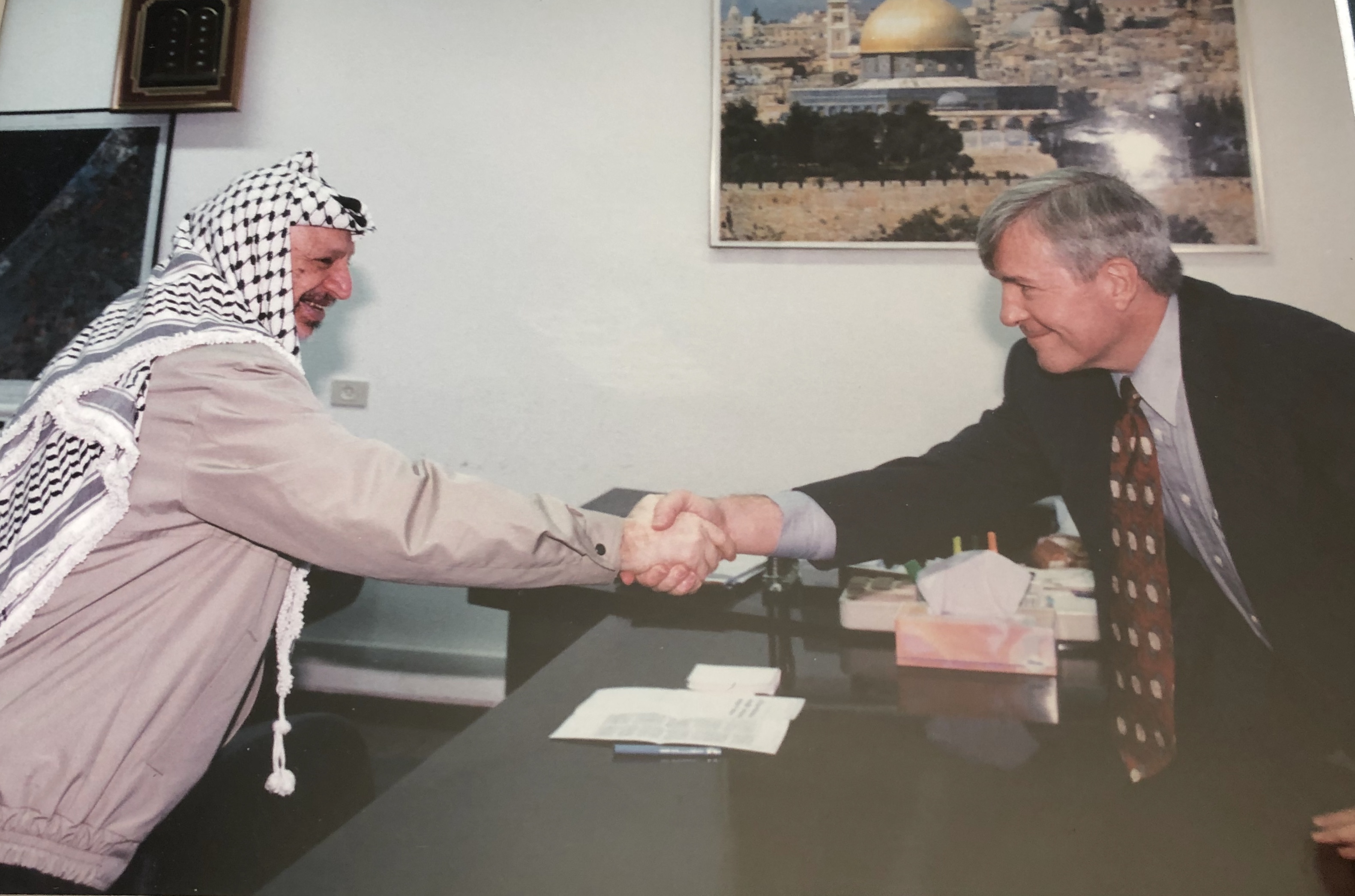 Yessar Arafat and Warren Coats in the PLO office in Gaza in February 1996.
