

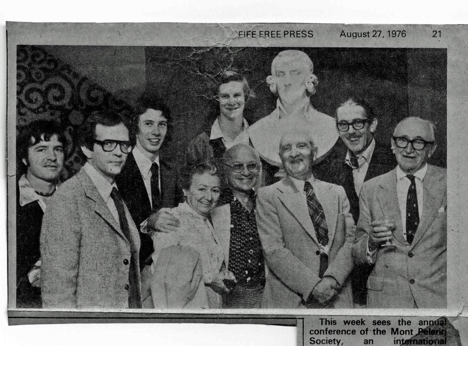

Author: Warren Coats
I specialize in advising central banks on monetary policy and the development of the capacity to formulate and implement monetary policy. I joined the International Monetary Fund in 1975 from which I retired in 2003 as Assistant Director of the Monetary and Financial Systems Department. While at the IMF I led or participated in missions to the central banks of over twenty countries (including Afghanistan, Bosnia, Croatia, Egypt, Iraq, Israel, Kazakhstan, Kenya, Kosovo, Kyrgystan, Moldova, Serbia, Turkey, West Bank and Gaza Strip, and Zimbabwe) and was seconded as a visiting economist to the Board of Governors of the Federal Reserve System (1979-80), and to the World Bank's World Development Report team in 1989. After retirement from the IMF I was a member of the Board of the Cayman Islands Monetary Authority from 2003-10 and of the editorial board of the Cayman Financial Review from 2010-2017. Prior to joining the IMF I was Assistant Prof of Economics at UVa from 1970-75. I am currently a fellow of Johns Hopkins Krieger School of Arts and Sciences, Institute for Applied Economics, Global Health, and the Study of Business Enterprise. In March 2019 Central Banking Journal awarded me for my “Outstanding Contribution for Capacity Building.” My recent books are One Currency for Bosnia: Creating the Central Bank of Bosnia and Herzegovina; My Travels in the Former Soviet Union; My Travels to Afghanistan; My Travels to Jerusalem; and My Travels to Baghdad. I have a BA in Economics from the UC Berkeley and a PhD in Economics from the University of Chicago. My dissertation committee was chaired by Milton Friedman and included Robert J. Gordon. I live in National Landing Va 22202 View all posts by Warren Coats


Dear Warren,
Greetings from Colombia!
I hope you are doing well. I had a great time looking at your picture—oh my goodness, you were, are, and always will be so delightfully gay! I absolutely love it. Your collar shirt and blink-blinks brought a big smile to my face.
About Milton: Milton was a brilliant fellow for his time. Looking back, however, many of his economic ideas have not aged as well as we once thought. That doesn’t mean you and I weren’t smart—it just means we were, much like your shirt, a bit impressionable.
After China’s rise, the 2008 financial crisis, COVID, the “silly” wars, and the damage these events have inflicted on our economy, politics, and the fading American Dream, I find it hard to believe there was ever a realistic path for pure libertarian economics.
Experience has a way of humbling even the brightest minds. We need to accept it before we extinguish…
Warm regards,
Sergio Pombo
Warren, I recognize some people in the picture but not others. Would you mind identifying everybody? You are over on the left in the groovy threads. (It was the 1970s. I also had the wide-collared shirt.) Rose and Milton Friedman are in the center. Is that Friedrich Hayek on the right?
In response to Sergio’s comment, I think that Friedman’s ideas in Capitalism and Freedom have generally aged well. Consider:
–The Federal Reserve: Inflation targeting and nominal GDP targeting are not too far of a stretch from the money supply targeting that Friedman advocated.
–Exchange rates: We have the floating exchange rates Friedman advocated (and, one might say, predicted).
–Fiscal policy: Friedman was on target with his criticisms of using fiscal policy as a tool for managing the economy (though there is a role for such countercyclical arrangements as unemployment insurance).
–Education: Vouchers have become widely though unevenly used.
–Discrimination: This is the area where I think what we have is nothing like Friedman advocated. Still, my experience has been that changing social mores, which Friedman preferred as the force of change, have contributed to a great reduction in racial and other discrimination alongside changes in laws.
–Occupational licensing: Even more prevalent than in Friedman’s time but there have been rollbacks of it in some states from time to time. Because Friedman made the argument, people are much more aware now that licensing is often not from benevolent motives. (Licensing for florists? Hairdressers? Teacher’s assistants?)
–Distribution of income: The flat tax has been adopted by some states and foreign countries, though not by the U.S. federal government.
–Social welfare: The Social Security system is headed to a crisis. Friedman’s criticism of it still holds.
–Alleviation of poverty: The negative income tax (or universal basic income) have not been implemented but have their advocates. (I am much less optimistic than Friedman was that the consequences would be much improvement over current arrangements.)