Homeland-part two

My apology for my lazy note on Homeland. It deserves much more so here goes.

The series, which ran for eight years from 2011-2020, centers on Carrie Matheson, a CIA officer with bipolar disorder and for its first two years (all we have watched so far) the Marine scout Nick Brody. Nick was captured in Iraq and held prisoner for eight years before returning to his wife and two kids. In the last few years of his captivity Nick was befriended by Abu Nazir a leader of al-Qaeda and charged with teaching Nazir’s son English. Nick adopts Islam and when an American drone attack kills Abu Nazir’s son, to whom Nick has become very attached, Nick agrees to work with Nazir against US interests. Nick returns home as a war hero, is elected to Congress and groomed to run as VP in the current VPs upcoming presidential campaign. Carrie correctly suspects that Nick has been turned by Nazir and sets out to expose him (or exploit his new position in the US government). Complicated enough?

Virtually every character, Carrie, Nick, Nick’s wife and son and daughter and his best friend (who fell in love with Nick’s wife during his absence and assumed death) as well as Carrie’s CIA colleagues, struggle with conflicting loyalties. Nick loves America and his family but hates what it has done (convincingly denounced as terrorism by Abu Nazir) and cooperates with Nazir in punishing it. The VP Nick expects to run with gave the orders for the drone attack that killed Nazir’s son. Each character is complex, which complex histories. Each side rightly sees the other as terrorists. The show is full of twists and turns and surprises. It is fantastic.

TV favorites

We watched and greatly enjoyed all ten seasons of Grantchester, built around the Clergymen of a British small town church and highly recommend it.

But we currently just finished watching the first of 8 seasons of Homeland and intend to watch the rest. It’s another CIA spy series build around a very talented but super intense bipolar female CIA analyst who drives everyone nuts but whose input they always want. It is a complex and fascinating story of an American marine who was captured and imprisoned for eight years in Bagdad and turned by his captures to work for our Islamic enemy but also loves the family he returned to after his eight years of imprisonment.

“The realism (Gansa consulted intel officers and diplomats) gave it serious weight. It racked up 6 Emmys and 7 Golden Globes, and even politicians like Obama openly praised it.

“If you’ve never watched it — or want to revisit peak paranoia TV — now’s the time. It’s smart, tense, messy, and still hits uncomfortably close to home.”

The series started in 2011 but often feels like it is depicting life today (war with Iran etc). Ito and I take a break after each episode during which I check email and the latest news on Trump/Bibi’s war in Iran and related events. It is truly weird. Going back and forth fifteen years as if they are the same. I highly recommend this.

Iran and the bomb

In the greatest public address any American President has ever given, Donald Trump claimed to have stopped Iran from developing atomic bombs (in the greatest lie every told).

Here are the facts. Ayatollah Ali Khamenei, the Supreme Leader of Iran at the time, supported the 2015 Joint Comprehensive Plan of Action (JCPOA) that provided international inspection of Iran’s enrichment of uranium used for its nuclear power plants to ensure that it did not enrich it to the level needed for atomic bombs. Khamenei repeatedly stated that the production, stockpiling, and use of nuclear weapons are forbidden under Islamic law. This religious position is formalized as a fatwa (a legal ruling under Sharia), which the Iranian government has cited for decades as proof of the peaceful nature of its nuclear program.

During his first term, President Trump withdrew the US from the JCPOA and international inspections stopped. A broad international consensus holds that the US/Israeli attacks on Iran this year will drive Iran to overcome its religious restraints on developing the bomb and proceed to do so out of its need to defend itself. Thus, rather than preventing Iran from developing atomic bombs Trump (and his friend Bibi) have probably forced Iran to do so. For good measure US/Israel killed Khamenei with an airstrike on February 28. Maybe Trump will find a way to blame NATO for all of this???

Winning the War in Iran

Most of you know that I am an optimist (though often disappointed). But I am quite optimistic that Trump will declare victory in his and Israel’s illegal war in Iran very soon. Moreover, he will offer Iran enough (lifting of sanctions, etc.) that they will end their attacks as well, including, of course, insuring safe passage through the Strait of Hormuz. Israel will also end its attacks on Iran (as well as on Lebanon, Syria, West Bank and Gaza) because Trump will tell them to (or is it the other way around).

But here is the really optimistic forecast. Trump will blame the mess in Iran on the worst, most damaging Secretary of Defense we have ever had and fire Pete Hegseth. How is that for good news!

America Alone

Donald Trump campaigned on a pledge to end “forever wars” and to put American interests first. In office, he has done the opposite.

In the first year of his second term Trump has bombed seven countries and 50 speed boats killing 159 people. His joint war with Israel on Iran is threatening global recession. None of these were authorized by the American Congress as required by our Constitution and violate international law as well. He has threated one an all even more freely (e.g. Canada, Greenland).

If this were not bad enough, Trump has insulted and alienated our friends and allies resulting in the refusal of most EU and Nato countries (Germany, France, UK, Spain, Italy) and Australia and Japan to agree to Trump’s plea for help in defending the Staits of Hormuz.

These measures have isolated and weakened the U.S.  Trump’s policies have not put America First–they have made a weakened America Alone.

Deploying his bully substitute for diplomacy, Trump, with help from JD Vance, Trump accused the EU of “extraterritorial censorship of Americans” through EU content‑moderation and hate‑speech rules. At the Munich Security Conference in February 2025, Vance warned that “across Europe, free speech…is in retreat,” This is from the same administration that repeatedly labeled critical media “fake news” and “the enemy of the people.” Currently he and senior officials have accused outlets critical of his Middle East war policy of undermining the country, with allies at the media regulator warning that broadcasters risked losing licenses if they spread “fake news.”

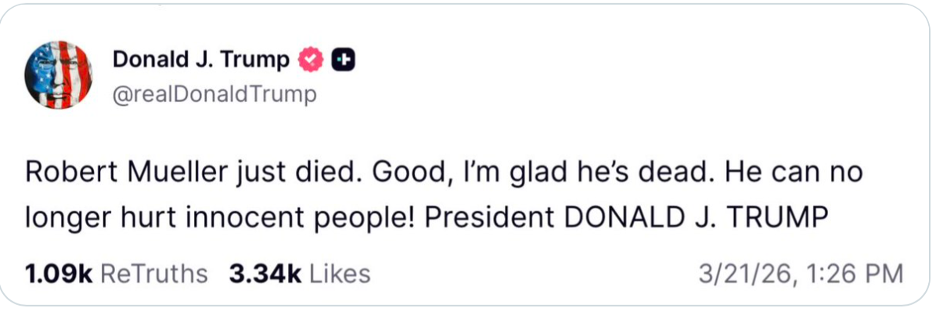
Condemning the opposition as enemies rather than challenging the policies of opponents is a sign of weakness and typical of tyrants. Trump attacks his domestic enemies as fiercely as foreign ones. Note the childish hate in Trump’s tweet today about the death of the man who investigated his misbehavior at the bottom of this blog:

The administration has backed or initiated high‑dollar defamation lawsuits against critical outlets (for example, a multibillion‑dollar suit against the Wall Street Journal). The Department of Justice has revived policies to subpoena reporters’ phone records to identify leakers, and Homeland Security officials have publicly boasted about catching sources for journalists—moves described by the Committee to Protect Journalists as “terrifying” and chilling to newsgathering.

The White House has at times revoked or restricted press credentials for reporters and outlets seen as adversarial, most famously CNN’s Jim Acosta. New, more restrictive rules for White House press passes have been criticized as targeting critical journalists and limiting independent coverage.

The unfunny clown who heads our Department of War has driving away most honest reporters by require department review of their prospective reports. A federal district court in Washington, D.C., just struck down key parts of the Pentagon’s new press-access and reporting restrictions. In a suit brought by The New York Times challenging the Defense Department’s 2025 press policy the judge ruled that the Pentagon’s policy limiting reporters’ access and conditioning accreditation on pledges not to gather or publish information without official approval violated the First Amendment and also raised due process concerns under the Fifth Amendment.

We have historically relied on the strength of our constitution and the separation of powers it establishes between the three major branches of government to contain abuses of government power. Generally, our institutions have served us well. But Trump has stretched executive power weakened its guardrails, for example by firing all Inspector Generals and failing to seek congressional support.

Trump and his repulsive advisor Stephen Miller’s immigration/deportation policies via the masked ICE agents who have killed two American citizens on public streets, have unleashed terror and abuse of power never seen in my life time. Last year 32 people died in ICE custody and in just the first weeks of 2026, at least 6 more people died in ICE detention.

The list goes on and on. From his reelection to his second term (2024) to early 2026, Trump’s estimated wealth has increased on the order of 2–4 billion dollars. Forbes reported his net worth at about 7.3 billion dollars by September 2025, calling it the most lucrative year of his career. In the realm of pure childish ego, he has added his name to the Kennedy Center now to be closed in two months, and the Institute of Peace, rebuilding the White House, and threatening to rename Dulles Airport. On top of that he wants his image on a gold coin. His administration proposing both a commemorative gold coin and a circulating $1 coin.

None of these are serving America’s interests.  Various indices of freedom/authoritarianism report a steep decline by the U.S.  Freedom House, which scores countries (0–100) on political rights and civil liberties and categorizes them as Free, Partly Free, or Not Free reports that the U.S. score is now at its lowest level since they adopted the 100‑point scale, while still rated “Free.”   The democracy watchdog, Martin Gelin reports that “Trump is aiming for dictatorship”. But we can still stop him if we wake up and yell STOP.

Kurdistan

Though large numbers of Jews were scattered around the world for two thousand years, Palestine has always retained a significant number of them. Of the almost 11.3 million Jews in 1900, most were in Europe (9 million), Russia (3.9 million) and the United States (1.5 million). At the beginning of the WWII the global population of Jews had grown to 15.4 million of which one third were in the US.

Even before the holocaust there were movements to reestablish a Jewish homeland in Palestine. The 1917 Belfour Declaration from British Foreign Secretary Arthur Balfour to Lord Walter Rothschild, pledged British support for a “national home for the Jewish people” in Palestine. The local Christian and Muslim community of Palestine, who constituted almost 90% of the population, strongly opposed the declaration.

What became known as Zionism (as formalized by Theodor Herzl, it aimed to secure a safe haven for Jews fleeing persecution and to revive Jewish culture and language) took many forms. For example, the question who is Jewish continues to be debated. Following World War I, Britian ruled the Lavant (Palestine). On September 3, 1947, the UN adopted the boundaries (green line) to divide the British mandate between a state of Israel and the rest. Israel was given 56% and Jerusalem (an important Christian, Jewish, and Muslim shrine) was made international. When Britten ended its Mandate, Israel declared its independence.

Most Zionists sought a democratic Jewish state. Upon its founding in 1947, Israel was roughly 60% Muslim, 40% Jewish and 10% Christian. That was an unacceptable problem for those wanting a democratic Jewish state. From the Nakba of 1948 (Jewish ethnic cleaning of over half of the Palestinians then living in Israel) Israel was about 90% Jewish in 1949. Currently the population of Israel is about 10 million, of which 73% are Jewish, and 20% are Muslims. Finding peace with the rest of Palestine has remained a challenge to this day. Are the prospects for a peaceful Kurdistan very different.

The Kurdish population worldwide is estimated to be between 40 and 45 million, making them one of the largest ethnic groups without a sovereign state. However, about 30 million of them live within what would be the sovereign state of Kurdistan should it be allowed to exist, made up of chunks of Turkey, Iraq, Iran and Syria.

Kurdish military forces have fought for territory but largely in pursuit of claims to rule what they considered home ground. It is extremely unlikely that the Kurds in this area would have any interest in expanding their territory. None the less Iraq, Iran, Syria and Turkey have generally been hostile to any effort of the Kurds to rule themselves. The formation of a Kurdistan raises the questions whether that would bring greater peace to the wider region and whether the “internal” politics would support domestic rule that would properly serve the Kurdish people (or all residents of the area). Intense opposing political views exist within Kurdistan, particularly in Iraq, where the Kurdistan Democratic Party (KDP) and the Patriotic Union of Kurdistan (PUK) compete for control, often leading to governance deadlocks, separate security forces, and split zones of control.

In addition, we must ask whether the Iraqi Kurds, Iranian Kurds, Turkish Kurds, and Syrian Kurds feel more loyal to the country they are located in or to their fellow Kurds in the surrounding countries. Does a nation function better toward the interests of its citizens when based on ethnic and/or religious commonality or when based on common principals of governance and rights?

Israel is an example of the first option—Jewishness. As a classical liberal (libertarian) I support the American approach of rights and laws applied equally without regard to ethnicity or personal religious beliefs. For Kurdistan, the question with whether the Kurds of Turkey, Iraq, Iran or Syria feel greater loyalty to other Kurds or to the country they live in.

I started this blog expecting to build the case for a Kurdistan. I have talked myself out of it.

How to be Safe

Much can be said about how and why almost everyone on earth has risen from poverty to affluence. Two of the most important are free markets that allow entrepreneurs to invent and build, and peace and security that allow our work to build consumer goods and services rather than weapons of war.

Taking the second of these, the safety of our persons and our property allows us to specialize and trade – an absolutely critical condition for flourishing. The more broadly we can trade the greater is the wealth producing potential of our efforts. So a key question and the focus of this blog is how we maximize our safety in order to maximize trade the production of consumer goods and services rather than weapons of war.

Since 9/11 almost one million people have been killed in wars and when including indirect deaths from wars the number rises to around 4.5 million. The U.S. alone has spent over $21 trillion dollars on defense since 9/11.  This is 5.25% of the U.S.’s cumulative GDP over that period of $400 trillion.

If we could trust every country in the world, we could get rid of our military complex and add that amount to our incomes. Obviously that would be unrealistic thus some defense spending will always be necessary. However, with the deployment of skillful diplomacy it can be greatly reduced and the losses from actual wars could potentially be eliminated.

We must live among other people. If we are good neighbors, we will be safer from attacks (verbal or worse) by those around us. Being a good neighbor requires being trustworthy (honest) and behaving in ways that take into account and respect the interests of our neighbors. What is true on the block and village is true globally as well. The adoption of mutually agreed rules/norms for our interactions with others is an important aspect of our safety and productivity.

Within each country, at least, agreement has been reached on which side of the road to drive, what frequency we can broadcast on, and what voltage our electricity will be. Across boarders we have agreed on setting dates and time (the calendar), airline overflight rules, and the orbits our satellites will occupy. After WWII, in addition to the UN and its many agencies, NATO, the World Bank, the IMF, and World Trade Organization, countries established the International Organization for Standardization (ISO), International Telecommunication Union (ITU), and the International Electrotechnical Commission (IEC). Moreover, the US and most every other country have established embassies in each other’s countries in order to serve the needs of their own citizens abroad and to maintain dialog and informed relations with each other’s governments.

An important part of soft power diplomacy are the supportive relationships with “allies” who contribute to mutual defense, thus lowering its cost. But good (cooperative) relationships in general are an important contributor to our safety and commercial interaction with other countries. To a large extent formal rules of war and treatment of others have promoted peace in the world.

Violating these rules (e.g. Russia’s invasion of Ukraine and U.S. invasion of Venezuela) raises the cost of our security. It makes us less safe and less wealthy. https://wcoats.blog/2026/01/03/war-2/

President Trump has angered our friends and allies with his tariff and other threats and a generally bullying approach to our relations with other countries. He has created enemies where we didn’t have them before. After bombing Venezuela and kidnaping its President, he is now threatening the same for Cuba, Panama, Columbia, Iran, and Greenland. Denmark’s government, which controls Greenland’s foreign affairs and defense, has told the White House to “stop the threats.”

Protests of US lawlessness is growing. As but one example:

JOINT DECLARATION BY THE GOVENMENTS OF

BRAZIL, CHILE, COLOMBIA, MEXICO, SPAIN, AND URUGUAY

“The governments of Brazil, Chile, Colombia, Mexico, Spain, and Uruguay, in light of the gravity of the events that have occurred in Venezuela and reaffirming their commitment to the principles enshrined in the United Nations Charter, make the following joint declaration:

“We are deeply concerned and reject the military actions unilaterally carried out on Venezuelan territory, which infringe fundamental principles of international law, in particular the prohibition of the use and threat of force, and respect for the sovereignty and territorial integrity of States, as enshrined in the United Nations Charter. These actions set an extremely dangerous precedent for peace and security in the region and endanger civilian populations.”

Trump has isolated the U.S. by breaking the rules and angering our friends and alias. We are much less secure than in the past.  WP: “Venezuela-Trump-Global Law and Order”

Playing by the rules

This morning’s NYTimes proclaimed that:“The Biden administration, responding to the death of Aleksei A. Navalny, unveiled its largest sanctions package to date as the war in Ukraine enters its third year.”

On November 30, 2023, Phillip Dean Hancock was executed in Oklahoma. As the death penalty has been eliminated in most countries and such killing is considered immoral by millions of people around the world, what sanctions would be appropriate for them to impose on the U.S.?

A quite different case arises from killing an enemy in someone else’s country (aside from in war, where anything seems to be “allowed.”)  On February 13 of this year, Maxim Kuzminov, a former Russian military pilot who defected to Ukraine, was found dead with multiple bullet wounds in Villajoyosa, a city on Spain’s Mediterranean coast. The murder is suspected to have been organized by Moscow. What measures should Spain take against Russia in response (hopefully the U.S. will keep its nose out of other people’s business—fat chance)?

On January 3, 2020, the U.S. assassinated Qasem Soleimani, an Iranian major general and the commander of the Iranian Quds Force, in Baghdad. More recently, on February 7, 2024, Abu Baqir al-Saadi, a senior commander in Kataib Hezbollah, an Iran-backed Iraqi militia, was killed in a U.S. drone strike in Baghdad. What measures should Iraq (and Iran) take against the U.S.?

The rule of law is a fundamental aspect of our freedoms and the prosperity it has made possible. The international rules based order is an extension of those principals internationally and has served, though imperfectly, the same purposes globally. The U.S. has become an Imperial power who doesn’t obey the rules it tries to impose on others. Thus, American influence in the world is declining rapidly. We will all suffer as a result.

Econ 101:  Oil Price Cap

Among U.S. (and E.U. and some other primarily Northern countries) objectives in reacting to Russia’s invasion of Ukraine, is to diminish its capacity to continue this war, in part by reducing its export (largely oil and gas) income with minimum damage to the U.S. and other embargo supporters and to pressure it to the bargaining table sooner rather than later (we are trying to do that aren’t we??). As you can see from the previous sentence, this is not a particularly simple issue.

One measure being promoted by U.S. Treasury Secretary Janet Yellen is to cap the price at which we are willing to buy Russian oil.  If we just stop buying Russian oil all together (effectively a price of zero), global oil supply would presumably fall, and oil prices would rise. We know, of course that Russia will redirect its sales to countries not participating in the embargo, such as China and India, to the extent it can and the oil these countries would have purchased from Saudi Arabia and other suppliers would then be available to us and global oil supply would not fall as much as we might have expected nor would prices increase as much as otherwise. Much could be written about this (the limited potential of embargoes if not everyone participates), but I won’t.

The idea of Secretary Yellen’s cap is that rather than buying no Russia oil we (and all embargo participants) would continue to buy it but at an agreed price that is below normal market prices in normal time (the price cap). Thus, hopefully, Russia would still sell its oil to the West but would earn less foreign exchange from it and the West would have more oil than with a total blockage and thus avoid sharp market price increases.

“There are several outstanding issues to settle on the price-cap idea. Those include figuring out exactly how to enforce it, convincing other nations to subscribe to it and deciding the sales price at which Western countries would permit the purchase of Russian oil. Looming over the proposal is also the presumption that Russia would continue to sell oil at a price mandated by the U.S. and its allies.”  “WSJ: Janet Yellen begins Asia trip to win support for cap on Russian oil price”

“Some economists and oil industry experts are skeptical that the plan will work, either as a way to reduce revenues for the Kremlin or to push down prices at the pump. They warn the plan could mostly enrich oil refiners and could be ripe for evasion by Russia and its allies. Moscow could refuse to sell at the capped price…. 

“Mr. Biden… moved swiftly to ban imports of Russian oil to the United States and coordinate similar bans among allies. In some ways, the price-cap proposal is an acknowledgment that those penalties have not worked as intended: Russia has continued to sell oil at elevated prices — even accounting for the discounts it is giving to buyers like India and China, which did not join in the oil sanctions — while Western drivers pay a premium….

“The cap plan seeks to keep the Russian oil moving to market, but only if it is steeply discounted. Russia could still ship its oil with Western backing if that oil is sold for no more than a price set by the cap.”  “NYT Biden gas price cap Russia”

John Bolton, whose view I don’t generally share, said about Yellen’s oil price cap: “The proposal, academic and untried, faces multiple practical obstacles and uncertainties. Widespread sanctions violations by Russian maritime cargoes already exist, with no reason to think the oil-price cap is more enforceable.” “WP: Biden oil price cap-Russia Sanctions”

Such efforts to “hurt” Russia cannot avoid also hurting us. What other approaches might the Biden administration consider?

“The White House… has held off for months on backing a gas tax holiday, amid divisions within the Democratic Party and skepticism a roughly 18.4 cent-per-gallon discount would be passed on to consumers….  In private meetings with senior Energy Department officials to discuss ideas for boosting supply and lowering prices, some industry representatives have instead used the sessions to push for longer-term priorities like building pipelines and easing environmental restrictions.”  “Politico: White House-Biden-gas prices”

“Rep. Kim Schrier, D-Wash.,… called it “infuriating” that spikes in gas prices were “happening at the same time that gas and oil companies are making record profits and taking advantage of international crises to make a profit. This must stop.″ “PBS: House approves bill to combat gasoline price gouging”

When the supply of a product falls short of its demand, the gap can be closed in one of two ways. Both involve rationing a scarce commodity as is required for anything in limited supply which is virtually everything. The first approach—the market approach of price rationing—allocates the product to those who want it the most, i.e. those who are willing to pay the most for it. The second approach—the administrative allocation approach—allocates the product to those the government agency responsible for choosing who gets it, determine are most worthy or in most need of it based on the criteria the agency sets (which in practice invariably includes friends and relatives). History has clearly documented which of these methods of allocation works best.  Some of you will remember the long lines at gas stations when President Richard Nixon capped gasoline prices (another form of rationing).

That leaves measures that encourage increased supply from everywhere except Russia or that facilitate reducing demand. “Biden officials are openly pleading with Big Oil to pump more, not less. ‘We want them to get their rig counts up. We want them to increase production so that people are not hurting,’ [Energy Secretary Jennifer] Granholm said.”  “CNN: Gas prices-Biden-inflation” A higher price at the pump provides the market a strong incentive to increase supply, but that generally takes years to achieve much of an increase. In the interim profits of the suppliers will be higher than usual.

Some months back policy sought to reduce the consumption of carbon omitting products as part of our effort to slow global warming. For that objective an increase in gasoline prices would be a good thing, whether from a gas tax or restrictions on finding and pumping more oil out of the ground.

For the moment, encouraging more production by Saudi Arabia and other (non Russian) members of OPEC would be helpful. Finally rejoining the JCPOA (Iran deal), Trump’s withdrawal from which Max Boot called the “single worst diplomatic blunder in U.S. history” “WP: Trump-Biden Iran nuclear deal dead with no alternative”, would, among other important things, increase an important source of oil supply, as would dropping sanctions on Venezuela. If we can make deals with Saudi Arabia, given all it has done, deals with Iran and Venezuela should be no brainers.

Ending the war in Ukraine promptly is the most important measure for addressing the shortage of oil (and food more generally). “End the war in Ukraine”

The Basis of American World Leadership

Since the end of World War II, the United States has played a disproportionately large role in guiding world affairs. It has unquestionably been the most powerful nation on earth. Its dominance reflects a number of factors including economic and military strength. But in addition to these, most countries have been happy, or at least willing, to accept American leadership because it was largely seen as guided by broad principles of fair play and the rule of law.  American leadership was the least of evils. The United States has benefited a great deal from this good will.

But as the old saying goes: power tends to corrupt, etc.  Being able often to bend other countries to our will (as long as others still saw us as driven by widely shared principles of fair play), the U.S. increasingly exploited this influence to encompass policies or actions others were not so happy to comply with.  To take a fairly recent example, the wisdom of President Trump’s withdrawal from the Joint Comprehensive Plan of Action (JCPOA or the Iran Deal) to stop Iran’s development of its nuclear capabilities for at least ten years was not shared by the other parties to the agreement (the P5+1–the permanent members of the UN Security Council: the United States, the United Kingdom, Russia, France, and China, plus Germany–and the European Union).  All signers of the agreement except the United States continued to abide by it. But the U.S. dollar is the primary currency used for international payments and the U.S. threatened to punish (cut off from the use of the dollar and trade with the U.S.) any country that did not observe its unilateral trade sanctions on Iran. The non-U.S. signers attempted to set up alternative ways for paying for trade with Iran that did not use the dollar but found the reach of American threats hard to avoid. On January 5, 2020 Iran announced that it would stop complying with the agreement and resume its nuclear development program. It is not clear why Trump considers this better for American security than the (at least) ten-year suspension in the Iran Deal he tore up.  See: Economic-Sanction

President Trump has also used up a lot of “good will capital” with his Trade wars. He began by withdrawing the U.S. from the 12-member Trans-Pacific Partnership or TPP (Australia, Brunei, Canada, Chile, Japan, Malaysia, Mexico, New Zealand, Peru, Singapore, Vietnam, and the United States). The TPP further reduced tariff and non-tariff restrictions on trade, while expanding and modernizing coverage for the digital world. As, or perhaps more, importantly, the TPP provided a model and positive encouragement to China to adopt Western trading rules as a condition of joining the TPP in the future.  The remaining signatories went forward with a Comprehensive and Progressive Agreement for Trans-Pacific Partnership, which went into effect a year ago with the U.S.

But Trump’s counterproductive trade strategies didn’t stop there by a long shot. In addition to economically harmful tariff protection of inefficient American industries (e.g. steel, washing machines, etc.), Trump has angered many of our friends in Europe, Japan and elsewhere by threatening tariffs in situations that do not seem to be justified by the World Trade Organization’s rules. In the process he is ignoring and weakening the WTO, which has played such an important role in the gradual trade liberalization that has dramatically lifted living standards around the world following WWII. He even tore up the North American Free Trade Agreement (NAFTA) and replaced with a new agreement that is not unambiguously better.  See: The-shriveling-of-US-influence

But once bullies taste their power, their appetites tend to grow. While elected with promises to end our forever wars and reduce our military commitments around the world, Trump has done neither.  This is not the occasion for exploring why (I don’t doubt Trump’s sincere desire to achieve both of those goals, but his ignorance of history seems to have made him vulnerable to flipflopping in the face of pressure from the neocons, such as Secretary of State Pompeo, he has surrounded himself with). Rather it is to review his rapid descent into a major bully, to the detriment of American influence and security.

On January 3, President Trump ordered the assassination of Maj. Gen. Qassem Soleimani, the leader of Iran’s paramilitary Quds Force in retaliation for an attack a week earlier on an Iraqi air base in Kirkuk that killed a U.S. civilian contractor and injured four U.S. soldiers and two Iraqis.

The drone that launched two missiles that killed Gen. Soleimani at the Baghdad International Airport also killed the Iraqi leader of the PMU, Abu Mahdi al-Muhandis, a close Soleimani associate, and eight other Iraqis.  According to the Pentagon, “General Soleimani was actively developing plans to attack American diplomats and service members in Iraq and throughout the region,”  According to Adil Abdul-Mahdi, Prime Minister of Iraq, Soleimani was on his way to see the PM in order to discuss moves being made to ease the confrontation between Shia Iran and Sunni Saudi Arabia.

The White House stressed that Soleimani’s planned attack was “imminent” thus justifying it without having to first inform Congress. Bruce Ackerman argues that Trump’s failure to obtain Congressional authorization for the attack justifies a third article of impeachment.  See: Trump-war-against-Iran-impeachable-offense  Iraqi PM Mahdi claimed that the attack on Iraqi soil was a violation of Iraqi sovereignty and a violation of the agreement between the U.S. and Iraq for stationing American forces in Iraq. Though Congress was not informed in advance, the Israeli government was told of the planned attack, according to some reports. In these circumstances, it is very difficult to know which reports are authentic and which are deliberate (or sometimes inadvertent) fake news.

In order to assess the likely impact of all this on our standing and support in the rest of the world, I like to evaluate American actions from how they might seem standing in someone else’s shoes. How would Americans react, for example, if our government had invited, say, French troops for training in the U.S., and the French Army blew up a Russian general on his way to meetings at the UN (or reverse the roles between the French and the Russians) without our permission?

But this note is not about whether this assassination was legal or good policy. For that see the following article from The Economist: Was-Americas-assassination-of-Qassem-Suleimani-justified?  It’s about the rise of American bullying in the world and its impact on our standing and ability to influence friends and enemies in ways that serve our national interest. What followed in the days after Soleimani’s assassination is mind boggling.

Keep in mind that following America’s invasion of Iraq that started on March 20, 2003, the U.S. and its coalition partners returned sovereignty to the Iraqi government at the end of June 2004. I was there as part of the Coalition Provisional Authority (I was the Senior Monetary Policy Advisor to the Central Bank of Iraq reporting to the U.S. Treasury). As we boarded helicopters to waiting planes at the Baghdad International Airport (of recent fame) many of us recalled images of the last American helicopter lifting off the roof of the American Embassy in Saigon when the U.S. ended its participation in the Vietnam War. Over the next seven years American and coalition troops remained in Iraq under terms agreed to in a Status of Forces agreement with the Iraqi government.  Following the ups and downs of troop surges and draw downs American forces were kicked out after Blackwater security contractors killed 17 Iraqis in Nisour Square in 2010.

With the rise of the Islamic State (ISIS) American troops were invited back under new, less formal terms. “Instead, the current military presence is based on an arrangement dating from 2014 that’s less formal and ultimately based on the consent of the Iraqi government, which asked the parliament on Sunday to pass urgent measures to usher out foreign troops…. ‘If the prime minister rescinds the invitation, the U.S. military must leave, unless it wants to maintain what would be an illegal occupation in a hostile environment,’” said Ramzy Mardini, an Iraq scholar at the U.S. Institute of Peace.  Getting-us-troops-out-of-iraq-might-not-be-that-hard-say-experts

And how did POTUS, the great negotiator, respond to the Iraqi Parliament’s vote: “President Donald Trump threatened to impose deep sanctions on Iraq if it moves to expel U.S. troops…. ‘We’ve spent a lot of money in Iraq,’ Trump told reporters aboard Air Force One as he returned to Washington after spending the holidays at his Florida resort, Mar-a-Lago. ‘We have a very extraordinarily expensive air base that’s there. It cost billions of dollars to build. … We’re not leaving unless they pay us back for it.’” Trump-threatens-iraq-sanctions-expel-us-troops

However, the Pentagon promptly announced that it was repositioning its troops in preparation for withdrawing them. Reuters released a copy of a letter on US Department of Defense letterhead addressed to the Iraqi Defense Ministry by US Marine Corps Brigadier General William H. Seely III, the commanding general of Task Force Iraq, which read in relevant part: “In deference to the sovereignty of the Republic of Iraq, and as requested by the Iraqi Parliament and the Prime Minister, CITF-OIR will be repositioning forces over the course of the coming days and weeks to prepare for onward movement…. We respect your sovereign decision to order our departure.”  reuters.com/article/

Within hours, the Pentagon stated that no decisions had been taken and that the letter had been sent by mistake. “U.S. Army General Mark Milley, chairman of the Joint Chiefs of Staff, said on Monday that a leaked letter from the U.S. military to Iraq that created impressions of an imminent U.S. withdrawal was a poorly worded draft document meant only to underscore an increased movement of forces.”  Iraq-security-pm  Or maybe they forgot to consult POTUS or maybe he changed his mind.  Are you confused yet? See: Amid-confusion-and-contradictions-Trump-white-house-stumbles-in-initial-public-response-to-Soleimanis-killing

In response to Iran’s threat to retaliate for killing General Soleimani “Trump tweeted on Saturday that the United States has targeted 52 sites for possible retaliation, including “some at a very high level & important to Iran & the Iranian culture.” The outcry over this clear war crime was immediate. “Secretary of Defense Mark Esper… put himself at odds with President Trump on Monday night by definitively telling reporters that the U.S. military will not target cultural sites inside Iran on his watch, even if hostilities continue to escalate in the wake of the U.S. drone strike that killed Maj. Gen. Qasem Soleimani at the Baghdad airport last week. ‘We will follow the laws of armed conflict….’” See: Esper’s-split-with-trump-over-targeting-iranian-cultural-sites-is-a-nod-to-the-laws-of-armed-conflict  Trump quickly backed down. Perhaps discussing these decisions with his staff before twitting them would be a good idea.

These are but a few examples of a bully on the loose. “Foreign Minister Mohammed Javad Zarif told NPR that he was scheduled to deliver an address when the U.N. Security Council meets Thursday [Jan 9] but that he was told the State Department had informed the U.N. that there was not enough time to process his request for a visa, which he said he first submitted 25 days ago.” Iran-foreign-minster-javad-zarif-denied-visa   Under the 1947 U.N. headquarters agreement, “the United States is generally required to allow access to the United Nations for foreign diplomats.”  Once again, we are violating our commitments. Iran is demanding that all future meetings of international bodies be held outside the US.  The IMF and World Bank are also headquartered in the U.S.

The American and coalition partners now in Iraq are there to support its fight against ISIS. This benefits us, our partners, and Iraq. The traditional tools of diplomacy (persuasion), rather than the threats of a bully, would ultimately be more effective.  The respectful consideration traditionally given to the views and positions of the United States in international bodies –such as global satellite spectrum allocation–global warming agreements–security agreements–or any other multilateral agreement in which we have an interest, is rapidly vanishing.  Assuming that the Trump administration can de-escalate the current tensions with Iran, something quite possible with sufficient diplomatic skill–see: The-soleimani-killing-could-draw-the-us-deeper-into-the-mideast-but-it-doesnt-have-to–our general loss of good will is the real cost of excessive bullying and it will hurt us considerably.