All Volunteer Military

In May 1967, The New Guard magazine published an article by Milton Friedman on “The Case for a Voluntary Army.”  It was a compelling case and was adopted when the U.S. suspended its military draft in January 1972. But was it correct? “45 years later Nixon-Gates commission”

In the 1960s, the drafting of 18 year old’s to fight in Vietnam was avoided by those able to go to college. This was rightly challenged as discriminatory against the poor and college deferments were replaced with a lottery system that started in 1970, which picked the birthdates at random that would then be first in line to be drafted each year. I was granted the last of the college deferments.  “Draft lottery (1969)”

While a student of Friedman’s at the University of Chicago from 1965-70, I joined with several other libertarian classmates to form the Council for a Volunteer Military to promote Friedman’s call for an end to the draft. The Directors of the Council were: James Powell, National Director; Henry Regnery, Treasurer; myself, Executive Secretary; Danny Boggs, national Filed Secretary; and David Levy, Publications Editor. Our sponsors were: Yale Brozen, Bruce K. Chapman, Richard C. Cornuelle, James Farmer, David Franke, Milton Friedman, Sanford Gottlieb, Eugene Groves, Karl Hess, and Norman Thomas: an impressively diverse group.

In 1969 President Richard Nixon establish the Gates Commission to advise him on established an all-volunteer military and appointed Friedman to the commission.  Based on the Commission’s recommendations, President Nixon signed a law in 1971 that ended the draft in January 1973.

A Rand Corporation report on the All-Volunteer Force (AVF) by Bernard D. Rostker stated that: “Although the country had conscripted its armed forces for only 35 of its 228 years — nearly all in the 20th century — the American people were generally willing to accept this practice when service was perceived as universal. However, in the 1960s, that acceptance began to erode. There were five major reasons:

  • Demographics. The size of the eligible population of young men reaching draft age each year was so large and the needs of the military so small in comparison that, in practice, the draft was no longer universal.
  • Cost. Obtaining enough volunteers was possible at acceptable budget levels.
  • Moral and economic rationale. Conservatives and libertarians argued that the state had no right to impose military service on young men without their consent. Liberals asserted that the draft placed unfair burdens on the underprivileged members of society, who were less likely to get deferments.
  • Opposition to the war in Vietnam. The growing unpopularity of the Vietnam war meant the country was ripe for a change to a volunteer force.
  • The U.S. Army’s desire for change. The Army had lost confidence in the draft as discipline problems among draftees mounted in Vietnam.”

At the time Crawford H. Greenewalt, another member of the Commission, wrote to Gates that “while there is a reasonable possibility that a peacetime armed force could be entirely voluntary, I am certain that an armed force involved in a major conflict could not be voluntary.”

“Rand research briefs”

The AVF matched or exceeding the high expectations for it. The professionalism of our Army improved. We fought 13 wars with our volunteer force: Lebanon (1982-4), Grenada (1983), Panama (1089-90), Gulf War (Iraq, Kuwait, Saudi Arabia and Israel 1990-91), Somalia (1992-5), Bosnian War (1992-95), Haiti (1994-5), Kosovo War (1998-99), Afghanistan War (2001-21), Iraq War (2003-11, 2014-2020), Somali Civil War (2007-21), Libya intervention (2011, 2015-20), and Syria (2014-present). Each was limited enough not to exhaust the supply of volunteers needed.

But a different criticism of our all-volunteer force was raised that gave me pause. Our costly and futile war in Vietnam from 1955-75 was finally ended (without admitting the defeat it surely was) in response to the growing protests in the U.S.  No such protests were raised for our imperial adventures since then. Some observers began to point their fingers at the absence of a draft and thus a military/industrial complex better sheltered from public criticism. When we campaigned for the end of the draft and an all-volunteer military, we assumed that we needed to maintain an Army for our defense. Instead, our military was deployed all over the planet (800 bases around the world) with sufficient restraint (generally) to avoid strong public push back.  “National defense”  If the average middle class family’s children were not being drafted to fight unnecessary wars in far off places, they were not as likely to complain about the billions of their taxpayer’s money being pumped into the military/industrial complex.  This was an unanticipated side effect of ending the draft that we had not anticipated.

Both former President Trump and President Biden expressed their intentions to end our forever wars and, at least in the case of Biden, to strengthen our capacity to deal with the world with diplomacy. We should wish him well. And we should urge Congress to reinstate the Weinberger Doctrine, which limited the use of U.S. forces to when vital U.S. interests were at stake, and only as a last resort. “A Biden doctrine starts to take shape”

You can read my experiences in Iraq in my book: “My travels to Baghdad” and my experiences in Afghanistan in my book: “My travels to Afghanistan”.

PS. Some how I forgot that I had written on this before with a somewhat different proposal: https://wcoats.blog/2015/01/23/the-all-volunteer-military-unintended-consequences-and-a-modest-proposal/

Israel and Palestine

Who started the feud between the Hatfields and the McCoys? Who is to blame? In the case of the new nation of Israel in the land of Canaan (Palestine) we might go back to Adam and Eve or more recently to the Balfour Declaration in 1917 (see the brief history in my book “Palestine-Oslo Accords-My Travels to Jerusalem”) to see where the feuding began.

Who started it?

But let’s start this current, tragic round of fighting with the Israeli police attacks on demonstrators “rallying against the forced expulsions of Palestinian families from the occupied East Jerusalem neighbourhood of Sheikh Jarrah…. At least 90 Palestinians were wounded on Saturday [May 8] during an Israeli police crackdown on protesters outside the Old City of Jerusalem, while another 200 Palestinians were injured on Friday when Israeli forces stormed the Al-Aqsa Mosque.” Al-Aqsa Mosque, known as the Dome on the Rock in English, is Islam’s third most sacred site. Muslims believe that Muhammad ascended to heaven from this site.

 “Jerusalem court delays Palestinian Sheikh Jarrah eviction hearing”

Israel’s Supreme Court “is reviewing a judgment to evict Palestinian families from the Sheikh Jarrah neighbourhood of East Jerusalem. Their homes sit on land that was owned by Jews before Jordan occupied the eastern part of Jerusalem in 1948. Israeli law allows the heirs of the original owners to reclaim property in East Jerusalem. Yet Palestinians cannot claim their former homes in West Jerusalem (or anywhere else in Israel). No wonder Palestinian residents of the city are always ready to protest.

“The injustices elsewhere are worse. Palestinians in the wider West Bank, like those in Jerusalem, have watched Israel confiscate land and build settlements on occupied territory, which is illegal under international law. They must also deal with Israeli checkpoints and an onerous permit regime. In Gaza more than 2m Palestinians have been cut off from the world by Israeli and Egyptian blockades since 2007, when Hamas grabbed control.” The Economist: Only negotiations can bring lasting peace to Israel and Palestine”

That is the immediate background to the dozens of rockets launched by Hamas from Gaza starting on Monday (May 10): “Palestinian militants launched dozens of rockets from Gaza and Israel unleashed new air strikes against them early Tuesday, in an escalation triggered by soaring tensions in Jerusalem and days of clashes at an iconic mosque in the holy city.” “Israeli police Palestinians clash Jerusalem holy site”

At least 30 Palestinians, including 10 children, and three Israelis were killed as tensions in Jerusalem spread west toward the seacoast Tuesday. Israeli airstrikes flattened a multistory apartment building in Gaza and rockets fired from the Gaza Strip reached Tel Aviv in an unusually far-reaching barrage that sent residents of Israel’s largest city scrambling into bomb shelters.  “Israeli clashes Palestinians turn deadly Jerusalem tensions spread”

More concerning than the exchange of rockets between Gaza and Israel, is the sharp rise of violence between Arab Israelis in Israel and between Palestinians and Israelis throughout the West Bank.  A major problem is that there are no good guys on either side. “Most Israelis are comfortable with the ‘anti-solutionism’ of Benjamin Netanyahu, the prime minister, who shows little interest in pursuing a permanent settlement with the Palestinians….  Fatah, has not done much better in the West Bank. The party’s leader, Mahmoud Abbas, is in the 17th year of a four-year term as Palestine’s president. He seems concerned mainly with preserving his own power.”  The Economist: Only negotiations can bring lasting peace to Israel and Palestine”

Critically, the United States has failed to promote Palestinian rights, giving one-sided support to whatever Israel does.

Sadly, the winners, if we can call them that, of today’s tragic fighting are the status quo leaders (Netanyahu, Abbas, and Hamas), who have failed to address the central issues of the coexistence of Israelis and Palestinians in the land of Canaan. War, or the threat of it, are historically tested instruments for strengthening public support of existing leaders.  In a recent report on the situation in Israel, the Human Rights Watch pronounced Israel an Apartheid state.  “Israel report apartheid” The Jewish diaspora are increasingly speaking up against the policies of Israel. The United States could make a major contribution by conditioning its very large financial aid to Israel on its respecting the rights of Palestinians.  “A New U.S. Approach to Israel-Palestine”  

I shudder to think what might be happening by the time you read this.

Hate Crimes

“The shooting deaths of eight people at Asian-run spas in Georgia this week triggered a vigorous national debate Thursday over whether the mass killing amounted to a hate crime.” “Georgia hate crime law-Atlanta shooting”  These deaths (and recent attacks on Asians more generally) raise several issues that I would like to explore. 1. What is the point of hate crime laws?  The poor ladies killed in this attack could care less what motivated Robert Aaron Long, the 21 year old shooter. 2. Whose fault is it? Let’s start with the shooter (and other attackers), please. 3. What should we do about it (beyond locking the shooter, and other attackers, up)?

What is the point of hate crime laws?

“Georgia State Rep. Chuck Efstration, a Republican who helped shepherd [Georgia’s Hate Crime] bill into law, said it was intended to allow for especially stiff penalties for crimes in which “the perpetrator’s prejudices and biases are attacks not only on the victims but on all of society.  Thank goodness law enforcement will have the ability to charge this as a hate crime if the facts support that,”   [op cit]

Georgia State University law professor Jessica Gabel Cino noted that: “The majority of the victims are women, and they are Asian. Those are two protected statuses.” And what if they hadn’t been?

Traditional laws do differentiate between first, second, and third degree murders, but if you plan to and succeed in killing someone, it didn’t traditionally matter whether you loved or hated the victim. I can understand why such information might be useful in exploring approaches to mitigating the risk of such future murders, but I don’t see its relevant to the guilt and punishment of the murderer. I do not support capital punishment, but Mr. Long should surely be put away for the rest of his pathetic life whatever motivated his killing spree.

According to Mr. Long, “he was on a mission… to stem his addiction to sex. The spas were ‘a temptation for him that he wanted to eliminate.’”  “What happened-Atlanta shooting”

In determining the length of a sentence, courts do pay some attention to the motive for a crime as well as the crime itself but a special category of “hate crimes” has always seemed troubling and unnecessary to me.

Whose fault is it?

In a free society of responsible citizens, we must never forget that in the first instance the fault for a crime rests with the criminal. But it is fair to ask what motivated the criminal. While Mr. Long’s horrible crimes do not appear to be motived by the hatred of Asian’s, there has definitely been an increase in verbal and physical attacks on Asians over the past year. Much of the press has been quite eager to point to the hate filled and divisive statements against China by former President Trump. While he is certainly guilty of poisoning public discourse on China, immigration, Muslims and related topics, it is an odd place to look first.

Animosity toward Asians, and Chinese in particular, arises in the first instance from the behavior of China (shorthand for the government of China — synonymous with the Communist Party of China). In fact, unfavorable attitudes toward China have skyrocketed around the globe over the last three to four years. “For our enemies we have shotguns explaining Chinas new assertiveness” Public attitudes toward China are lower in Australia and the U.K., for example, than in the U.S. and fell sharply well before the Covid-19 pandemic.  “China global reputation coronavirus”  Attitudes toward China began to deteriorate in the face of Chinese assertiveness in the South China Sea, violations of the one country, two systems agreement for Hong Kong, theft of intellectual property from the West, and treatment of the Uighurs in the Xinjiang region, to name a few. China’s suppression of information on the virus producing covid-19 pales in comparison to its bad behavior in other areas.

What should we do about it?

The world that objects to China’s behavior needs to stand together in pointing it out. Former President Trump’s stand-alone, bilateral approach was a failure. But it is very important when the U.S. and other governments criticize China to clearly differentiate the government of China from the Chinese people, whether citizens of China or the U.S. or elsewhere. It is the Chinese government–the Communist Party of China–that is misbehaving.

The distinction between a government and its people is important more generally. For example, those who criticize the misbehavior of the Israeli government toward the Palestinians in the West Bank and Gaza, are sometimes mistakenly accused of anti-Semitism–i.e., of being against the Jewish people. It is likely that many are reluctant to criticize the Israeli government for fear of being accused of anti-Semitism. As the Biden administration joins with other countries to criticize the misbehavior of the Chinese government, it must, and it is, clearly distinguishing the Chinese government from the Chinese people. And we, each one of us, must speak out at the sight of rude or inappropriate behavior toward Asians, or anyone else. ALL LIVES MATTER.

My Travels to Jerusalem

Palestine: The Oslo Accords before and after, My travels to Jerusalem By Warren L Coats (2021) Kindle and paperback versions available at: Oslo Accords: Before and After

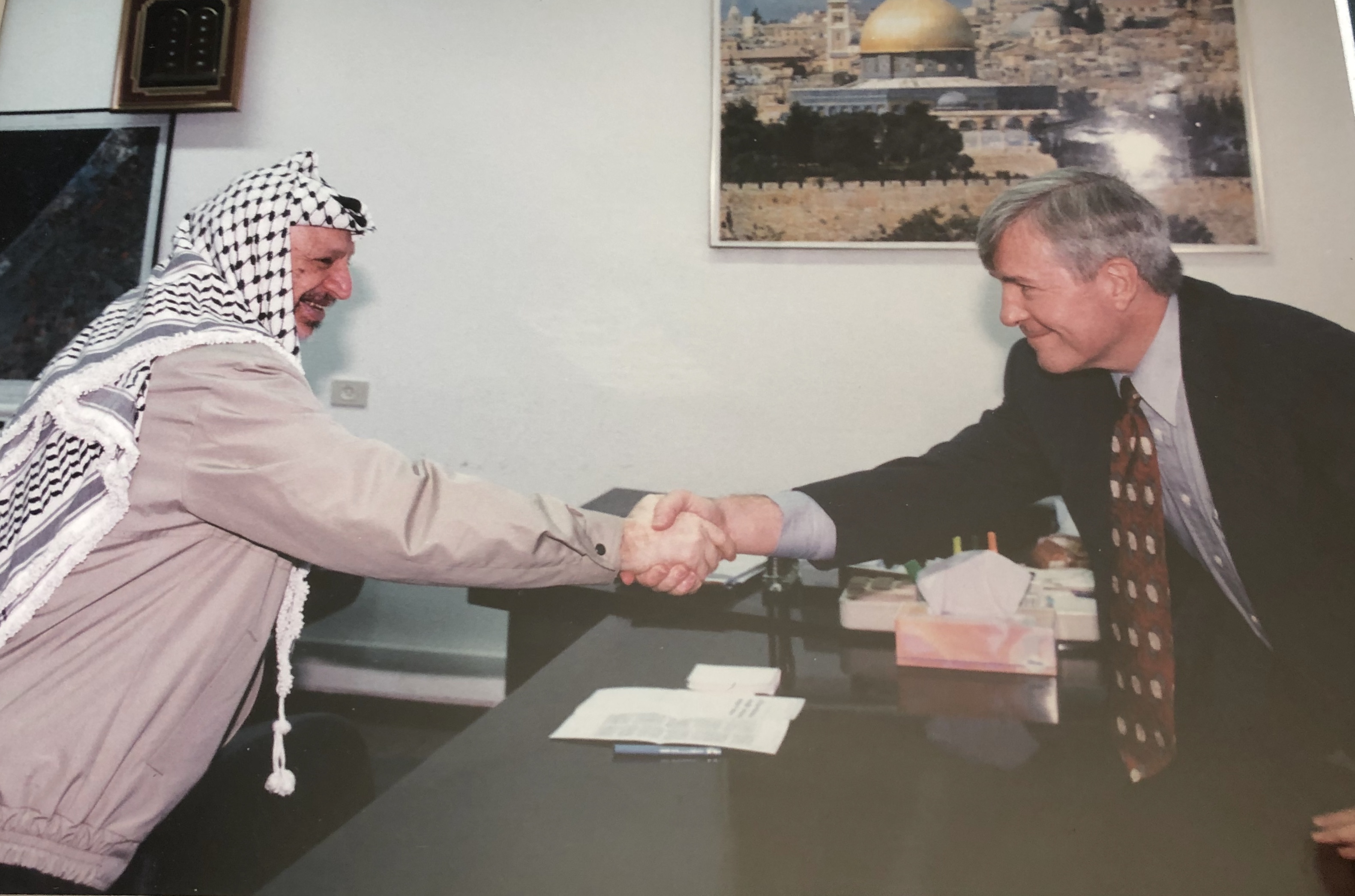
An intimate account of the establishment of the Palestine Monetary Authority and related adventures by one of the International Monetary Fund’s post-conflict, transition economy monetary experts. From being stranded in the desert without a cell phone, to hearing the sound at breakfast of a suicide bomber, to meeting with Yasser Arafat, and Stanley Fischer of the Bank of Israel, the author shares his adventures in the land of Canaan over a sixteen year period.

The establishment of the State of Israel in 1948 in Israel’s ancestral homeland required dealing with Palestine’s existing residents. In the Six-Day War in 1967, Israel’s occupation of the territories given to the Palestinians when the United Nations first recognized the State of Israel (the West Bank and Gaza Strip) increased pressure to resolve that issue. The Oslo Accords offered a path to its resolution, based on an agreement between Yasser Arafat, representing the Palestinian people, and the government of Israel, to swap land for peace (the return of Palestinian lands in exchange for Palestinian recognition of the State of Israel and its right to exist in peace).

One of the elements of the Oslo Accords was the establishment of a central bank in the Occupied Territories. Between 1995 and 2011 Warren Coats lead or participated in the missions of the International Monetary Fund to assist the Palestinian Authority in establishing and developing the capacities of the Palestine Monetary Authority. This book recounts the highlights of his visits, which included meetings with Arafat, as well as Bank of Israel officials.

Previous Books

One Currency for Bosnia: Creating the Central Bank of Bosnia and Herzegovina by Warren Coats (2007)   Hard cover: One Currency for Bosnia

FSU: Building Market Economy Monetary Systems–My Travels in the Former Soviet Union By Warren L Coats (2020)  Kindle and paperback versions available at: FSU-Building-Economy-Monetary-Systems

Afghanistan: Rebuilding the Central Bank after 9/11 — My Travels to Kabul By Warren Coats (2020)  Kindle and paperback versions available at:  “Afghanistan-Rebuilding the Central Bank after 9/11”

Iraq: An American Tragedy, My Travels to Baghdad By Warren Coats (2020) Kindle and paperback versions available at: Iraq-American-Tragedy-My-Travels-Baghdad

Zimbabwe: Challenges and Policy Options after Hyperinflation by Warren L. Coats (Author), Geneviève Verdier (Author)  Format: Kindle Edition Zimbabwe-Challenges and Policy Options after Hyperinflation-ebook

Money and Monetary Policy in Less Developed Countries: A Survey of Issues and Evidence by Warren L. Coats (Author, Editor), Deena R. Khatkhate (Author, Editor)  Format: Kindle Edition Money and Monetary Policy in LDCs-ebook

My Travels to Baghdad

Iraq: An American Tragedy, My Travels to Baghdad

Warren Coats (2020)

Kindle and paperback versions available at: Iraq-American-Tragedy-My-Travels-Baghdad

From the corkscrew landing at Saddam International Airport (now the Baghdad International Airport) to adventures in the Green Zone and beyond, this recounting of my experiences helping the Central Bank of Iraq develop modern market tools of monetary policy exposes the disfunction of the U.S. lead Coalition Provisional Authority (CPA) in its attempt to govern and rebuild post Saddam Iraq, following one of America’s more foolish and damaging military adventures. The existence of weapons of mass destruction was a lie. American skill at imperial rule–from disbanding the Iraqi Army to De-Ba’athification of the Iraqi bureaucracy– was a myth. 

Regime changes usually don’t involve changes in the monetary system. However, the toppling of Saddam Hussein’s government and the occupation of Iraq and the takeover of its government by the United States and a few allies in the name of the Coalition Provisional Authority (CPA) was accompanied by the replacement of the so-called Saddam dinar and modernization of Iraq’s monetary and financial system. The Iraq war was launched with “shock and awe” on March 20, 2003 and President George W Bush declared “mission accomplished” on May 1 a month and a half later. But when I retired from the International Monetary Fund and took up residence in Baghdad to advise the Central Bank of Iraq on developing Iraq’s financial markets and managing its new currency, the fighting was not over on many fronts. I lived in Baghdad the last two months of the CPA (May-June 2004) and made four two-week visits between then and December 2005

In this book, much of it written in diary form at the time, I share the challenges of advising the staff and management of the Central Bank of Iraq from my office in the central bank and of navigating the U.S. interagency rivalry from my office in Saddam’s Republican Palace in Baghdad’s Green Zone.  Security was always a challenge, producing many adventures. But the wisest advice I received was from a colleague in the CPA, who told me to “be careful who you talk to here (CPA headquarters in the Republican Palace), your worst enemies are in this building.” Over my 26 years in the International Monetary Fund and the technical assistance missions I lead to some 20 countries, many of them post conflict countries, I have never encountered the disfunction and resulting ineptitude of the U.S. led Coalition Provisional Authority in Iraq.

Previous Books

One Currency for Bosnia: Creating the Central Bank of Bosnia and Herzegovina

by Warren Coats (2007)    Hard cover: One Currency for Bosnia

FSU: Building Market Economy Monetary Systems–My Travels in the Former Soviet Union

By Warren L Coats (2020)  Kindle and paperback versions available at: FSU-Building-Economy-Monetary-Systems

Afghanistan: Rebuilding the Central Bank after 9/11 — My Travels to Kabul

By Warren Coats (2020)  Kindle Edition:  “Afghanistan-Rebuilding the Central Bank after 9/11”

Zimbabwe: Challenges and Policy Options after Hyperinflation

by Warren L. Coats (Author), Geneviève Verdier (Author)  Format: Kindle Edition

Zimbabwe-Challenges and Policy Options after Hyperinflation-ebook

Money and Monetary Policy in Less Developed Countries: A Survey of Issues and Evidence

by Warren L. Coats (Author, Editor), Deena R. Khatkhate (Author, Editor)  Format: Kindle Edition

Money and Monetary Policy in LDCs-ebook

My Travels in the Former Soviet Union

FSU: Building Market Economy Monetary Systems–My Travels in the Former Soviet Union

By Warren L Coats (2020)  Kindle and paperback versions available at: https://www.amazon.com/FSU-Building-Economy-Monetary-Systems-ebook/dp/B08K3WNQK2/ref=sr_1_2?dchild=1&keywords=warren+Coats&qid=1601491694&s=books&sr=1-2

By the end of 1991 the pressures for the Union of Soviet Socialist Republics (USSR) to break up into 15 separate countries climaxed. On December 25, Mikhail Gorbachev resigned as the President of the USSR and the next day the Supreme Soviet voted to end its existence. The demise of the Soviet Union was precipitated by the failure of its system of central planning to deliver an acceptable standard of living for its unfortunate citizens. Thus, Russian and the other now Formerly Soviet Republics wanted to transition into market economies as quickly as possible. They wanted to become what they called “normal” countries and to join the rest of the world.

Of direct relevance to me, my employer, the International Monetary Fund (IMF), suddenly faced the prospect of fifteen new members, each of which wished to convert its branch of Gosbank, the central bank for the USSR, into its own independent central bank overseeing the monetary and financial systems of market economies.

Four months after the USSR was formally dissolved, I was on a charter flight from Geneva, Switzerland, to Alma Ata, Kazakhstan, with eleven other economists to provide technical assistance to the National Bank of Kazakhstan. We knew almost nothing about the people we were to meet, the living conditions we would find, the social customs that we might be expected to understand, and the condition of the former branch of the Gosbank of the USSR that we were to help become a normal central bank. It was a challenging but very exciting undertaking.

In this book, I attempt to share some of the more interesting social, primarily non-economic, encounters of my work in Kazakhstan, Kyrgyzstan and Moldova from 1992 to 1995.

Previous Books

One Currency for Bosnia: Creating the Central Bank of Bosnia and Herzegovina by Warren Coats (2007)   Hard cover: One Currency for Bosnia

Afghanistan: Rebuilding the Central Bank after 9/11 — My Travels to Kabul By Warren Coats (2020)  Kindle and paperback versions available at:  “Afghanistan-Rebuilding the Central Bank after 9/11”

Zimbabwe: Challenges and Policy Options after Hyperinflation by Warren L. Coats (Author), Geneviève Verdier (Author)  Format: Kindle Edition Zimbabwe-Challenges and Policy Options after Hyperinflation-ebook

Money and Monetary Policy in Less Developed Countries: A Survey of Issues and Evidence by Warren L. Coats (Author, Editor), Deena R. Khatkhate (Author, Editor)  Format: Kindle Edition Money and Monetary Policy in LDCs-ebook

My travels to Afghanistan

Afghanistan: Rebuilding the Central Bank after 9/11 — My Travels to Kabul

By Warren Coats

Kindle and paperback versions available at:  “Afghanistan-Rebuilding the Central Bank after 9/11”

Watching the collapse of the twin Trade Towers in New York on September 11, 2001 on the TV in my hotel room in Bratislava, I never imagined that I would be in Kabul several months later and spend 212 days there spread over 19 trips from January 2002 to December 2013 to help modernize Afghanistan’s central bank–Da Afghanistan Bank (DAB). I learned more than I taught and share the highlights in this book. I became friends with many wonderful Afghan people, and bonded with my IMF team members. DAB was almost completely rebuilt. Watching its eager young staff mature into effective managers was a joy. Whether it will last in Afghanistan’s uncertain political and cultural environment is an open question.

I learned as much as I could about Islam and its internal struggle to denounce Islamism (radical Islamic fundamentalism). I share details of the collapse of Kabulbank, Afghanistan’s largest bank, and the corruption surrounding it and its resolution. The IMF’s presence and work in Afghanistan was not without tragedy. The IMF’s resident representative, in whose guest facilities we stayed, was killed in a terrorist attack. And I learned much about walls.

Previous Books

One Currency for Bosnia: Creating the Central Bank of Bosnia and Herzegovina

by Warren Coats (2007)   Hard cover: One Currency for Bosnia

Zimbabwe: Challenges and Policy Options after Hyperinflation

by Warren L. Coats (Author), Geneviève Verdier (Author)  Format: Kindle Edition

Zimbabwe-Challenges and Policy Options after Hyperinflation-ebook

Money and Monetary Policy in Less Developed Countries: A Survey of Issues and Evidence

by Warren L. Coats (Author, Editor), Deena R. Khatkhate (Author, Editor)  Format: Kindle Edition

Money and Monetary Policy in LDCs-ebook

Protecting yourself from Coronavirus

How can you best protect yourself from coronavirus? Unfortunately, the “government” is providing inconsistent and sometimes misleading advice, as are airlines and other businesses that want to keep you coming.  Disinfecting surfaces and extra cleaning of airplanes and other public transports may not be helpful and can communicate a false sense of safety. You would be safer to sit on an uncleaned toilet and then wash your hands, than to clean the toilet seat yourself with some disinfectant.

Two key facts are critical to understanding the transmission of viruses, such as Coronavirus. The first is that not all disinfectants are created equal.  Most are effective in killing bacteria but not viruses.  By and large only products with bleach (Clorox or sodium hypochlorite) will destroy viruses, but they can potentially also destroy the surfaces they are applied to, including your skin and thus it is not desirable to use them routinely. The second fact is that the coronavirus does not enter your body through your skin. It enters through your eyes, nose or mouth (or an open sore). This is why you should avoid touching your face.  Your best protection is to keep the virus off your hands, and then keep your hands off your face. The best way to keep the virus off your hands is to be more careful where you put them and to wash them with ordinary hand soap whenever you think your hands might have contacted the virus.

Wash your hands:  “If we sanitize, it will be fine.” No it won’t. Saying so can give a false sense of safety. Products to disinfect your hands without rinsing might kill bacteria but they will only rearrange viruses on your hands. Even ordinary soap will not “kill” viruses, but it is great at removing them from your skin so they can be rinsed away. Wash for 30 seconds (humming the “happy birthday to you” song twice) and rinse well. The following article provides an excellent and detailed discussion of the power of soap: “Deadly-viruses-are-no-match-for-plain-old-soap-heres-the-science-behind-it”

Don’t touch your face:  The most reliable measure of protection from acquiring covid-19 is to avoid touching your eyes, mouth or the inside of your nose. These are the access points for viruses into your body. This is easier said than done. See Ito’s suggestions below.

If you are young, don’t worry and have fun. That’s what the young do anyway. If you are my age, keep a distance from others and try not to touch anything (especially someone else’s hands). Stay home more. It will also allow time to develop better treatment protocols, increase isolation ward capacity, and a vaccine (which, however, will take another year or more to test for safety and effectiveness).

In the following, Dr. Victorino (Ito) Briones, MD, Ph.D., provides the most relevant tips on how to prevent getting infected with the Coronavirus

  1. The most significant source of infection will be your hands.

We always use our hands in order to go about our daily routine. We touch the doorknob to open the door, hold the grocery handle from a cart or a basket, shake hands, etc. Do not be afraid to get the virus on your hands. Our skin is one of the best defense barriers from this virus. It will not infect you even if you have touched an object or another person’s hand that has the coronavirus. The way the virus can get into your body is by entering through your mucous membranes, which in this case includes your eyes and your mouth as well as the inside of your nose.

Suggestions:

  • Do not touch your face. Again, don’t worry that you might have the virus in your hands. But don’t transfer the virus from your hands to your face where it can enter and infect you through your eyes, mouth and nose.
  • Wash your hands with soap and water. Do this most especially before eating.

NOTES: Most often public toilets will have a liquid soap dispenser. Be mindful that the top of the bottle may be contaminated with the virus by the previous person who used it. Be careful when you use bar soaps as the virus may survive in the soap bar as well. Also be mindful that the faucet knob or handle may be contaminated with the virus so do not close the faucet with the hand you just washed.

The CDC suggests about 30 seconds of washing. I personally like to wash once with soap first, then rinse and then wash again a second time. Please understand that soap and water do not kill the virus. Washing simply removes the virus from your hands.

  • Wrap a masking tape around the tips of both your forefingers.

It is extremely difficult to consciously prevent ourselves from touching our face.    Research says that we touch our face about 20 times an hour and we may not be aware we’re doing it. Wrap a masking tape (blue or orange) around the tips of your forefingers. The hope is that the masking tape at the tip of the forefinger will remind you not to scratch our face with your hands. Also, the sensation of the tape on the face should immediately tell you to stop.

  • What about Masks?

Masks are most helpful to those who already have cough and colds symptoms and this prevents them from spreading the virus in the air. Wearing masks, however, can be helpful in reminding you not to touch your face especially your mouth. But personally, I don’t find it essential.

  • Hand sanitizers?

A friend showed me a hand sanitizer he was using and the label said “antibacterial”. Antibacterial sanitizers do not kill viruses. Bacteria and viruses are very different organisms. CDC recommendations here: https://www.cdc.gov/handwashing/show-me-the-science-hand-sanitizer.html

Personally, I don’t like to recommend hand sanitizers because it may give the person a false belief that his hands are virus free. My recommendation is to think that your hands are always contaminated with the virus.

  • How to scratch your face/eyes?

It may be time to carry a pack of tissues with you. If you feel the urge to scratch your eyes, use a clean tissue from the pack. Make sure that your fingers don’t touch your eyes or face. Then discard the tissue into a trash can after using. Do not re-use the tissue. Be mindful that if your hand is contaminated, then the tissue is also now contaminated with the virus.

    2.  It might be time to change some personal habits.

  • No more shaking hands and embracing when greeting other people. At this time, people already understand and, I think, appreciate that this form of greeting is no longer appropriate.
  • Perhaps start the standard of using virtual fist bumps or elbow bumps to acknowledge personal greetings.

In general, always consider the possibility that everything you touch is potentially contaminated with the virus. But also understand that the virus cannot enter your body through the skin on your hand.  So don’t be afraid to go about your daily lives. However, be always mindful that the virus can enter your body through your face. Your hands are the most probable source of infection.


Nation Building in Afghanistan

Ambassador Crocker rightly calls the American role in “rebuilding” Afghanistan, “complicated.”  “I-served-in-Afghanistan-no-its-not-another-Vietnam”  I first met Ambassador Crocker in January 2002 when he was servicing as America’s chargé d’affaires to Afghanistan. We met in the American Embassy that had just been reopened after a decade or so of abandonment.  A decade’s worth of dust still covered the embassy floor several inches deep. Its newly returning employees were sleeping in cots along the hallways.

Following al-Qaeda’ 9/11 attacks in the U.S., I supported NATO’s UN sanctioned attack on Afghanistan’s Taliban regime as a necessary measure to deprive al-Qaeda of its sanctuary there. I wept when we abandoned that objective unfinished in order to pursue another war in Iraq, which I strongly opposed. The Washington Post just published Defense Department documents evaluating America’s 18-year war in Afghanistan and finding it a costly failure. https://www.washingtonpost.com/graphics/2019/investigations/afghanistan-papers/afghanistan-war-nation-building/

“Former defense secretary Jim Mattis defended American efforts to rebuild Afghanistan as part of the 18-year-old U.S. war there, saying Friday that ‘we had to try to do something in nation-building, as much as some people condemn it, and we probably weren’t that good at it.’  Speaking to journalists at The Washington Post, he cited an increase in the number of Afghan women who are educated, the development of Afghan diplomats and the inoculation of civilians against disease.

“Mattis, who oversaw the war as the four-star head of U.S. Central Command from 2010 to 2013, said violence in Afghanistan is ‘so heartbreaking that it can blind you to the progress,’ and he acknowledged that the United States made a strategic mistake by not paying enough attention to the country as the administration of George W. Bush launched the war in Iraq in 2003.  ‘That we didn’t do things right, I mean, I’m an example of it,’ Mattis said, recalling that as a one-star general, he was pulled out of Afghanistan in the spring of 2002, promoted and told to prepare for war in Iraq.

“’I was dumbfounded,’ he said. ‘But we took our eye off of there.’” “Mattis-Afghanistan-papers-we-probably-werent-that-good-nation-building”

But should we have remained as military occupiers and then as peace guarantors for another 18 years and counting?  I have spent a lot of time in Afghanistan over those 18 years, most intensively as a member of the IMF team addressing the Kabul Bank scandal from 2010-14 (22 visits after that first one in January, 2002).   “The Kabulbank Scandal–Part I” Cayman Financial Review, January 2015  “The Kabulbank Scandal–Part-II” Cayman Financial Review, April 2015  “The Kabulbank scandal–Part-III” Cayman Financial Review, July 2015

I have worked with many wonderful, mainly young, patriotic Afghans and have grown to care a great deal about their conditions and their future. We (the U.S., IMF, World Bank, EU) have a lot to teach them about the institutions of capitalism and they have been very eager to learn. However, the United States has rarely been very good at “building” modern nations that it conquered militarily.  Our Generals and Ambassadors, who rotate in and out every two to three years, rarely understand the cultures and histories they are trying to deal with.  With our military on the ground it is too easy to attempt to impose our institutions on societies unfamiliar with them without more patiently growing more modern institutions from what is in place that are thus better adapted to their traditions and thus more likely to function successfully.

Nation building at the point of a gun has not and is unlikely ever to work for us or for them. https://wcoats.blog/2009/11/16/afghan-national-army/https://wcoats.blog/2012/10/23/our-unsupportable-empire/.

My hope for the future of Afghanistan rests with its young, dedicated and increasingly well-educated young people. Our advice can be valuable, especially if filtered and adapted by Afghans themselves. After centuries of relative isolation, the modern world of the Internet, offers them the knowledge of the world. We need to get our troops and our billions of corrupting dollars out of their way.

Oslo: the Play

IMG_2150Yessar Arafat and Warren Coats in the PLO office in Gaza in February 1996.

Last night I saw the Round House Theater’s magnificent production of Oslo, the story of the secret meetings in Norway that led to the establishment of the Palestinian Authority.  It was a moving (heart wrenching) and balanced recounting of how these meetings achieved agreement between Israel and the Palestinian Liberation Organization on “land for peace” as it was called at the time after many years of failed official negotiations. I urge you to see it.

We heard the PLO negotiators lay out the Israeli theft of their homes and killings of their people and we heard the Israeli negotiators lay out the Palestinian attacks on Israelis and on the efforts of Jews to establish and secure an Israeli homeland.  For perspective, since the second intifada (between September 29, 2000 and January 31, 2018) at least 9,560 Palestinians have been killed by Israelis and 1,248 Israelis have been killed by Palestinians.  “The View from the West Bank”

The play focused on the unusual approach of these negotiations, which built on the development of trust and respect between the opposing negotiators and the agreement on achievable steps one step at a time. Between their long negotiating sessions in an isolated room near Oslo, they dinned, drank and bonded together. Unfortunately, the play fails to provide us with an overview of the resulting agreement, which applied the same step by step confidence building approach to the incremental establishment of a Palestinian government (the Palestinian Authority) and withdrawal of Israeli troops from the West Bank and Gaza. The PA was given governance authority for a limited number of functions in order—step by step—to build both institutional capacity and trust.

One of those functions was the establishment of the monetary authority (central bank). I led the IMF team that helped establish the Palestinian Monetary Authority and have many stories to tell of my many visits to Israel and the West Bank and Gaza in 1995-6 plus a number of visits in later years (most recently in December, 2011).

The PMA has developed into a well-run organization of which Palestinians (and those Israelis who see a successful Palestine government as important and necessary for their own security) can be proud.  It helped a great deal that the Bank of Israel and PMA developed good relations. Stanley Fischer was the governor of the BoI from 2005-13 and George Abed was governor of the PMA from 2005-7. They had both previously been colleagues at the IMF. “Jerusalem in August 2006”

It is with a broken heart that I watch Israel’s Prime Minister, Benjamin Netanyahu, with help from American President Donald Trump, increasingly abandon the two state solution of the Oslo Agreement for an apartheid single state regime in which “democratic” Jewish control is preserved by denying what would become the majority Palestinian residents their right to vote. “The Future of Israel and Palestine”