Juba, Southern Sudan

Sudan’s long history has been closely tied with Egypt’s on its Northern border. The British control of Sudan from 1899 – 1956 was motivated largely by its desire to safeguard its planned irrigation damn at Aswan by controlling the Nile, which flows North through Sudan and Egypt into the Mediterranean. For the Nile, down river is north, the opposite of all the big rivers I have known of.  The British effectively ruled the largely Arabic, Muslim North and the Black African Animist/Christian South separately. When Sudan became independent from Egypt and the UK on January 1, 1956, it was the largest country in Africa geographically but with a modest population of only 42 million.

A civil war between Northern and Southern Sudan broke out the year before independence and lasted for 17 years. The war resulted from Southern concerns over Northern domination and a variety of personal ambitions. Following a ten-year hiatus, war resumed when the North attempted to impose Islamic law on all of Sudan, contrary to the terms of the Addis Ababa Agreement of 1972 than ended the first civil war.  This second civil war raged until a Comprehensive Peace Agreement (CPA) was signed in January 2005. The Sudan People’s Liberation Army (SPLA), which now rules Southern Sudan, was formed at the beginning of this second civil war. Omar al-Bashir of the National Congress Party (NCP) is President of Sudan, ruling from the capital of Khartoum in the North. The International Criminal Court in The Hague indicted al-Bashir for war crimes on March 4, 2009.

The per capita income of Sudan is one of the lowest in the world at $2,380, which includes substantial oil revenue going to the government, and much lower for the South.  A census in 2008 counted 8.3 million people in the South, though some think the actual number is significantly larger. The two civil wars resulted in the deaths of 2.5 million Southern Sudanese, massive destruction, and infrastructure neglect in the South.

The Comprehensive Peace Agreement under which the country is now governed was designed to “Make Unity Work” by granting considerable autonomy to the “Government of Southern Sudan” (GOSS) in Juba, which oversees regional (state) governments and participates in the national government in Khartoum, sharing oil revenue with the South (where most of the oil fields are located), and other sharing arrangements. The CPA also established the Bank of Southern Sudan (BOSS) in Juba as a branch of the Central Bank of Sudan in Khartoum, though it operates somewhat independently. Very importantly the CPA provides for a referendum in the South in January 2011 of whether it wants to
become an independent country. The wide spread view in the South (I am told) is
that the North has not dealt and shared fairly with the South and that it will vote for independence.

I am working there to help the GOSS chose an appropriate monetary regime and to prepare it to issue and manage its own currency, if, as expected, Southern Sudan does become independent next year. In this capacity I am working for Deloitte Consulting under a USAID contract. My first two sets of meetings with the management of BOSS were in Nairobi last month and in 2007. My most recent meetings were in Juba a week and a half ago. While we have advised that the conditions for the successful launch of a new currency would be better after several years of dollarization, the Southern Sudanese want
their own currency as soon as possible. The management of the BOSS with whom I
work has agreed with us that such a currency should be issued under currency board rules (see my book about the currency board I helped establish in Bosnia, “One Currency for Bosnia”). I am now working with my Deloitte colleagues on drafting a new central bank law and an establishment plan for a new central bank, both to be discussed and finalized when I return to Juba in September.

I was not allowed to travel outside of Juba for security reasons. Juba, itself is a garrison city of refuge for hundreds of thousands of Southern Sudanese from years of war. Since the peace agreement in 2005 Juba’s population has exploded from 160,000 to over 1.1 million today. The capital city has few paved roads and I never imagined that the hills and valleys of rutted city roads could be so deep. Malaria is a problem. A scattering of huts surrounds
our relatively lovely camp on the banks of the White Nile. Our driver was proud to live in one such hut, which, he explained, has a real bed (off the ground with a mattress). Apparently that is all that it has. My colleague Adam, who has been in Juba for over a year, described a father and his four little sons who emerge every morning from their hut neatly dressed and with smiles on their faces. Adam asked the father, why they smile so brightly each morning. “Because we know we will have food today,” he replied.

These good and long suffering people deserve better. I don’t really know whether independence or Making Unity Work will be better for them. But I am happy to contribute what I can to at least improving the prospects of their having a stable currency if they issue one.

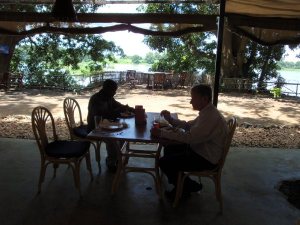
I am reluctant to photograph people in such poverty, so below you see two of my colleagues breakfasting at our lovely Camp by the White Nile.

Guns and things

Sorry to dwell on guns and traffic, but they are the two
most conspicuous features of Kabul along with the utter poverty and collapsed
structures everywhere. I just came back from a little walk up and down my
street and a few side streets. They are all enclosed at either end with
barricades and armed guards. My street, on which sits the IMF guesthouse, has
six barricades spaced out from one end to the other, two with zig zig concrete
approaches, a dozen armed pillboxes and about 50 or 60 armed guards. Behind the
sand bags and high concrete walls are houses like mine, the Canadian Embassy,
the British Embassy, the World Bank and a few others. You can’t see any of them
from the street. The side streets are even more cluttered with barriers. The
guards find my strolls amusing, I think, as they wave me on through their
respective checkpoints with a smile. The weather out today is wonderful. The
nearby Himalayan Mountains—the other most conspicuous feature of Kabul—were
shining beautifully in the sun.

Guns—AK 47s mainly—are everywhere, inside the central bank
and out. You just get used to it. Driving between the IMF guesthouse and the
central bank we always pass a number of pickup trucks with three or four guys
in the back with machine guns. Some are police. Some are dressed in black with
black masks covering their entire faces (not just their mouths cowboy style).
It can be kind of spooky. The masked ones are not as usual.

As usual, there are several Canadians staying in our
guesthouse. These guys are preparing for a major irrigation/farming project
near Kandahar that involves repairing a damn and levies, introducing more
efficient irrigation techniques and equipment, training maintenance people, working
with farmers to introduce new crops (poppies don’t need much water so this
opens up broader options), adjustments in processing plants, establishing markets
for the new crops and transportation to get them there, and political
negotiations with the surrounding village chiefs to obtain their buy in and
cooperation (some of the land along the waterway is owned by Taliban). My
Canadian friends commented how shockingly large a share of the project’s costs
went for security (one of their cars had already been hit by gun fire). I
replied that five years from now a congressional (Parliamentary) inquiry would
notice and refer to the large and wasteful payments to securities contractors
who made big profits (if they survived). Did someone think we could have a war cheaply? A private American security company has gotten into trouble here recently. I hope this does not give outsourcing a bad name because it is generally a very good and efficient thing to do.

Traffic has gone from bad to worse. The economy is
growing rapidly (around 10 percent per year for the last seven years) and
people keep buying more cars. But as security has deteriorated, more and more
roads are closed to regular traffic or more checkpoints erected, so more cars
are trying to travel fewer roads. Those still moving their commerce by donkey
cart and wheel borrow have an advantage. The IMF has three heavy armored cars
with three very skilled drivers. In my seven and a half years of coming here
never once have they hit or even grazed anything (or anyone). Thus I guess I
can still believe in miracles.

Edinburgh to Kabul


Following
the regional meeting of the Mont Pelerin Society in Stockholm from August 16 –
20 I waited out the go ahead to proceed to Kabul in Edinburgh. Afghanistan’s
elections took place on the 20th and our security people wanted to
see how conditions in Kabul developed in the week following before approving my
travel. Thus I spent a week enjoying the Edinburgh Festival in the midst of a
month long orgy of music, dance, and drama. Combining the International
Festival with the Fringe Festival, there are thirty to forty performances every
day to choose from.


Edinburgh
is a beautiful old European city located in the lushly green rolling hills of
central eastern Scotland. The heavens watered the countryside several times
every day I was there. I was the guest of a fellow Cayman Islands Monetary
Authority director and former dean of the University of Edinburgh Law School,
whose house is in the tree lined, stately neighborhood of The Grange and close
enough to the center to walk to all of the Festival events.


Like
all of the U.K., Scot’s drive on the left hand side of the road. Usually that
means that pedestrians also walk on the left side of walking paths, but I could
not detect such a habit in Edinburgh. In addition to thoroughly enjoying the
Festival and walking past the flowering yards of Gothic and Georgian homes
built centuries ago, I was confused and amused by the fact that the backs of
buses liked very much like their fronts, making it all the more difficult to
figure out which way they were going, adding to my confusion over driving on
the left. Another “amusement” was the fondness of taxi drivers, like their
London counterparts, for making as many turns as possible between any two
points.


Twenty-four
hours after leaving Edinburgh early Thursday morning I was in Kabul (which
included a seven hour stop over in Delhi) to continue my technical assistance
to the central bank in formulating and implementing monetary policy. Delhi was
an interesting bridge between the developed West and the utterly impoverished
Afghanistan. India has been growing rapidly for almost two decades but
continues to house hundreds of millions of extremely poor people. If it can
continue to grow, this will continue to change for the better. But India
remains the most overly bureaucratized country I have ever been in. Twenty-five
or so years ago, I counted 12 checkpoints from the entrance to the Delhi
airport to the plane. This involved rechecking and rechecking the same two or
three items. Today, post 9/11 where they have new things to check for (such as
the souvenir match book in my computer case—discovered at the last check while
boarding the plane) the number of check points has been greatly reduced (to
five or six—I lost track) but still employed several dozen people just to check
me and my carry on.


Kabul
is a different world all together. It seems a time two thousand years earlier
and after several decades of war totally devoid of any of the simple charm it
might have once had. Though Kabul has change a lot since my first visit in
January 2002—this is my 9th visit since then—it has not been rebuilt
as much as it should have been over the past seven and a half years. You can
see earlier pictures and earlier notes at www.facebook.com/wcoats. It does
finally have a new international air terminal and a few new buildings downtown,
but is characterized by dust, ruble, and trash.


My
security briefing this time was longer and more restrictive than earlier. The
Table of Contents of my Briefing Notes includes, for example, “Immediate
Actions on Rocket Explosions, heavy small arms fire” and “Earthquake emergency
procedures” which seems to cover a broad range of possibilities. It includes Security
Advisory No.3, which begins with: “You will see, below, that a security
advisory has been sent out by the CSA on behalf of the DO to the SMT members
and ASCs.” ????


Enhanced
security is event everywhere. The security around the central bank and the car
entrance has been dramatically strengthened. I am no longer allowed to got out
of my armored car outside the gates and walk in. To enter the Governor’s office
within the bank, my brief case is now thoroughly search and I must surrender my
Blackberry and two-way radio to armed guards for the duration of my visit with
him. On the other hand a new building on the central bank grounds has been
completed and occupied and the courtyard cleaned up. It actually looks quit
nice. The old water well pump is still there and still used but now looks more
out of place.


During
our first meeting of this visit, the Governor, who returned from exile in the
U.S. to again lead the central bank just one week ahead of my own first arrival
in January 2002, reminisced about those early “post” Taliban days. “Everything
was so hopeful then,” he said. “Your country made a tragic mistaken to leave
Afghanistan to fight Iraq. Now look where we are.” His central bank, on the
other hand, is becoming a stronger more professional institution with every passing
year.


Dinner
conversations on this visit have been dominated by discussions of the still
unknown outcome of the Presidential elections held here August 20th. The
results (whether President Karzai will win out right or be required to face
Abdullah Abdullah, a former Foreign Minister, in a run off) will not be known
until after I have left. At a dinner at the Canadian Embassy (the new Canadian
Ambassador is my old friend Bill Crosbie), Mina Sherzoy made the interesting
observation that despite many allegations of significant voting fraud and
irregularities, this election represents significant progress in the
development of democratic institutions in Afghanistan. She said that the
televised sight of the President having to defend himself in debates with other
candidates and open public discussions among the population would have been
unthinkable a few years ago. Mina was born in Kabul, fled to the U.S. during
Soviet occupation and returned in 2002. She is the founder of World
Organization for Mutual Afghan Network (WOMAN), founder of Afghan Women
Business Association (AWBA) in Afghanistan, the founder of Afghan Women
Business Federation (AWBF), and a beautiful woman. She allows some of us to
hope.

A note from Wolfie

After living in Europe for
many years, my friend
Ernest McCall
returned to the U.S. in May for a few months to test whether he wanted to relocate
back to North America. For the time being his answer is no. I asked him why and
here is his reply. His letters are always fun to read.


Hi from Amalfi…   we
took the hydrofoil here yesterday morning from Capri.


Im sitting in our
hotel’s lobby, the cloister of a convent founded in the 1200s by St. Francis,
using Anton’s MacBook (the one I gave him when I got back from DC).


To answer your
question, not very succinctly I fear: after 14 yrs. in Europe (3 in high
school, 1984-87, and then continuously since 1998), I feel as comfortable or
more comfortable here than in the US.  Better food, nicer architecture,
more educated people (not the elite, just the average guy on the street),
better public transport, longer history, a bit more realism or maybe cynicism
about human creation/accomplishment, blah blah blah.


I don’t want to rent two
places, e.g., here and in the US (DC or SF are my first choices, Portland or LA
or San Diego would be second choices), because everyone I know with two homes
spends most of their time in one or the other, as opposed to going to new
places.  I have a friend who has rented an apartment in St. Moritz for
about ten years, and needless to say, he never skis anywhere else.  My
brother has a house on a little island in the San Juans (Wash. State), he can
fly his family up there easily from Portland and their cabin backs onto the
landing strip, but again, they then end up hardly going anywhere else.  I
do not feel rich enough to maintain two homes (where rented or owned) and then
to spend another 3-4 months elsewhere.  And I don’t want (yet?) to spend
all my time in the same two places, no matter how different (another friend, a
painter, lives between an apartment on 56th St. just off Fifth Ave. and a tiny
Umbrian hill town).  So, if the choice is staying in Europe or coming back
to the US…   I dunno…   maybe it’s just inertia/laziness.
 Like most people, I *hate* moving, esp. internationally.  I can always
come back to the US whenever I want, right? It’s probably cheaper and much
easier to pay a lot more per month for a fully furnished apartment through an
agency like pied-a-terre, for three months here or four months there, than to
in fact move to DC and sign a long-term lease, sign up for utilities, etc.,
esp. if I don’t want to give up my apartment in Europe.


Then there’s always the
thought of moving somewhere else, e.g., Berlin or Paris or Rome or whatever.
 For a variety of reasons – subject of another drawn-out email, ha ha ha –
I’ve decided not to do that for now, I plan on renewing my lease in October of
this year.  I pay annually and in advance (my landlady loves me), so maybe
next summer, I’ll start whining about this matter again, where oh where in this
big wide world to live???  Basically, I get tired of certain things about Istanbul
at times, but when I’m gone, I miss it, esp. my panoramic view of the
Bosphorus, the wonderful seafood, my funny & entertaining group of friends,
the level of service / low cost of labor, etc.  And I am old enough to
know the grass is not greener, etc., I would get very sick of certain aspects
of Berlin or Paris or Rome, too.


I think the real problem is
that we die.  It sounds silly, but I’m being serious.  My dad totally
understands, i.e., not enough time for that spring in Seville and that summer
in Siberia and that autumn in Amsterdam and so forth.  He once asked me
about going somewhere or other, and I told him, "oh, you should go there
in October, the weather’s lovely then," to which he replied, "Ernest,
the weather’s lovely *everywhere* in October… in our mid-70s, your mother
& I need more Octobers in our lives, dammit!"


OK, off with Anton to the
saltwater pool + diving area, sort of built into the cliffs below the hotel.
 We just toured the oldest paper factory in Europe this morning. I didn’t
know that Amalfi was a center of papermaking since the 10th century.  It
was also – hard to believe for such a tiny place – a real rival to Venice and
Genoa and Pisa. These four cities still today hold an annual Regatta dei
Quattro Reppublichi (it changes location each year, i.e., each city gets it
every four years). Amalfi had ambassadors in Constantinople [Istanbul] and all
around the Arab world, it had 80,000 people at its peak, but most of them slid
into the sea in an earthquake in 1350 or so…   bummer.  Today the
town itself (without the surrounding villages) has about 3,000 people, so told
us the boy who sold Anton a belt this morning.


Renting a motorboat tomorrow
and going to Positano, some sort of local festa with fireworks, and then it
becomes a techno-rave-party on the beach, no doubt full of GORGEOUS tanned
Italian teenagers, our mouths hang open as we walk around these little towns.


OK, that’s enough for now.


Enjoy your time in Scotland
and London, good luck in Delhi and Kabul.


Wolfie


Las Vegas

For the second year in a row I participated in Mark Skousen’s FreedomFest here in Las Vegas. This year I spoke on “Inflation, Hyperinflation, and Will We Have One” and I debated “Fed up with the Fed: Should We Abolish it?” (John Fund and I vs Gene Epstein and Tom Woods) televised on C-SPAN.

Las Vegas itself deserves some comment. Its airport (the second busiest destination airport in the U.S.) has 16 baggage carousels (Dulles has 8) and can load 21 cabs at a time. The so called Strip (on the edge of town and seen in the picture) has 5 of the worlds 7 largest hotels. They are enormous. People still smoke inside here. Outside it gets to 110 plus degrees every day during the summer but the air is dry and you can see forever. We took a day trip to Hoover Dam about an hour away.

IMG00010-20090709-1539

The image of Vegas as a dessert oasis of bright lights and ever clanging slot machines is well deserved. You have to walk through the gigantic, cavernous, gaming rooms to go anywhere and the bells and whistles and whirling never stop. But Vegas is also THE CITY of SHOWS. It puts Broadway, with its cramped West End London like theaters, to absolute shame. The performance spaces are stunning and the productions spectacular. On this trip I took my daughter and two grand kids to see “LOVE,” the Cirque du Soleils’ tribute to the Beatles as only it could do it. It was just breath taking. Cirque du Soleil has at least five different shows permanently housed along the Strip. The Strip is lined with spectacular shows (not just the usual Jerry Seinfeld, Bette Midler, and magic shows that you would expect). Every Paris and Broadway shop of note is here as well (not that I would care). You can walk for blocks down the streets of Paris, Venice, the Village, etc without going outside (which is usually a good thing).

Now on to Bakersfield to help move my parents into an assisted living unit in their retirement complex (another painful downsizing).

Nairobi, Kenya

My latest two weeks in Nairobi are over. I am quite happy with the progress being made by the Central Bank of Kenya in developing its capacity to formulate and implement monetary policy. My advice in these areas has enjoyed the full and enthusiastic support of the Governor.

The sights and sounds of Africa included many memorable moments. Early on my first Sunday morning (about 6:00am), fifty or sixty singers passed on foot on the street below my window lead by a chanter. He would sing a phrase and the choir would respond. It was a lovely way to start the day.

My second Sunday, after two other members of the IMF team arrived, we drove to the home of Karen Blixen, authoress of Out of Africa. Much of the Meryl Streep and Robert Redford movie was filmed there. We also visited the orphan zoo on the edge of the Nairobi National Park. The zoo is unique and has a very different feel than any other zoo I have been to because all of its animals there have been rescued from certain death when they had been separated from their mothers (usually by her death) in the nearby jungles or bush. There I feed a giraffe from my hand and pet a cheetah. When I scratched the cheetah’s ears it purred loudly (reassuringly). You can see pictures on www.facebook.com/wcoats

Actually the highlights of my visit were the dinner discussions with fellow mission members Phil Bartholomew and Tom Lutton. Phil lead our IMF mission but earlier was Chief Economist of the Office of the Controller of the Currency ( the primary regulator of national banks) and staff economist of the former House Banking Committee (the Financial Services Committee now chaired by Barney Frank). Tom is now Principle Economist of Federal Housing Finance Agency, which regulates the bankrupt and now effectively nationalized Fannie Mae and Freddie Mac (the huge government sponsored mortgage financiers about which I have written much earlier). In 2003 Tom wrote a report on Fannie and Freddie for OFHEO as it was then called in which he concluded that they were not financially sound and should be broken up. He was asked to change the conclusion and refused. The report was not issued– an example of the corrupt relationship between industry, labor, and the government. Phil and Tom elaborated on why they consider the financial crisis of the last two years a major regulatory failure (not a failure to have enough regulations, but a failure to enforce existing ones) and why the government’s bailout response is a source of serious (moral hazard) problems for the future, and their disgust at the corrupting influence of Wall Street on American politics and government policy. I looked forward each day to another dinner discussion and wish I could share more of it with you but you have heard bits of it in my earlier notes on the crisis.

Our friend Denny Drabelle’s latest book is being published this month. He is also a traveler and has wonderful stories to tell. Information and reviews are attached.

There was sad news during my stay in Nairobi. Michael Jackson’s surprise death was announced. I received emails about it from all over the world. The next day the local newspaper delivered to my hotel room devoted its first full eight pages to Jackson.

The bodies of two of the Kroll PSDs (personal security details) assigned to my BearingPoint colleague Peter Moore, kidnapped in Baghdad two and half years ago, were turned over to the police. One of them, Jason Creswell, had an existing medical condition that may have caused his death, and we had been told a long time ago that the other Jason had committed suicide. Peter is the one that the kidnappers put on the Internet last year and may still be alive along with the other two Kroll PSDs kidnapped with him.

The two Jasons had actually been dead for some months. Their bodies were turned over to the police and then to the Ministry of Foreign Affairs. The bodies were released because one of the prisoners that were supposed to be exchanged for the hostages was released.  This was a "good faith" gesture on the part of the kidnappers. Such exchanges or payment of ransom keep kidnapping and piracy profitable, and guess what…

On the “lighter side” the joke (but all too true) of the week:

"Big Oil’s Answer to Carbon Law May be Fuel Imports"

By Joe Carroll and Edward Klump

June 26 (Bloomberg) — America’s biggest oil companies will probably cope with U.S. carbon legislation by closing fuel plants, cutting capital spending and increasing imports.

Hyperinflation in Zimbabwe

Hi from Harare, the capital of Zimbabwe,
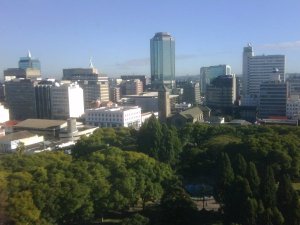
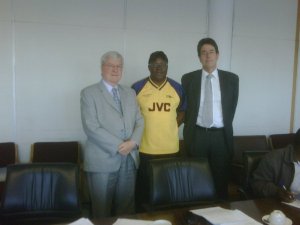
I am here as part of an IMF technical assistance team to the Finance Ministry and central bank specifically authorized by the IMF’s Executive Board to begin the IMF’s re engagement with Zimbabwe. Zimbabwe is a resource rich country and Harare is a beautiful city. (Top picture: Skyline with Reserve Bank of Zimbabwe prominently in the center. Second picture:  Me, Finance Minister Biti, and Ken Sullivan at a “casual Sunday” morning meeting)  I am impressed with the intelligence and skills of its professional class. What has happened in this country in recent years is a huge and shocking tragedy.

Our first day here The Harald’s front page headline in big letters read: “IMF technical team expected today.” Our second day the front page of the business section carried an article titled: “IMF team to assess payment system,” while the front page of the paper carried the headline “Man fights off crocodile in 6-hour battle.” On our third day the newspaper didn’t mention us at all, thank God. Our team of five (from the Netherlands, Denmark, Canada, New Zealand and myself) is here at the request of the Minister of Finance to advise the government on the governance of the central bank (the Reserve Bank of Zimbabwe), the efficiency of interbank and retail payment systems, the safety and soundness of the banking system following the collapse of Zimbabwe’s currency after the world’s second worst hyperinflation in history and to begin discussions of a future monetary regime. Most of our work was in the Reserve Bank, whose Governor (a close alley of President Mugabe) the Finance Minister would like to replace. We wished to be as inconspicuous as possible.

These missions, as the IMF calls them, draw upon and test every bit of knowledge and skills we have accumulated over our lifetimes. To appreciate the enormity and difficulty of our task, you need to understand a bit of Zimbabwe’s recent history. Please bear in mind in reading what follows that I hope to return to Harare and nothing is private anymore.

Zimbabwe, formerly known as Rhodesia, became independent of British rule in 1980, much later than most other African colonies. President Robert Mugabe has headed the government one way or another since then.[1] Mugabe became a national hero leading the guerrilla fighters in the Bush War (1964–1979) that overthrew the white-minority government ruling Rhodesia leading to its independence. He is/was revered throughout Africa.

Guided by the Lancaster House Agreement that provided for the transition from white to black rule of Zimbabwe, to which Mugabe was a signatory, Zimbabwe prospered. Over the past ten years, however, Mugabe became impatient with the pace of his people empowerment programs (“reallocating” property from white Zimbabweans to black ones). His “Fast Track Land Reform”, which abandoned the land reform agreement among Zimbabwean stakeholders at Lancaster House, confiscated farm land from white corporate farmers and redistributed it to “poor’ blacks. In reality the redistribution largely enriched Mugabe’s political supporters. Every employee of the Reserve Bank, for example, was given land taken from its owners. Agricultural output plummeted.[2] Mugabe’s “social” policies have bankrupted this beautiful and once prosperous country. The IMF reports “an estimated 14 percent fall in real GDP in 2008, on top of a 40 percent cumulative decline during the period of 2000–07.”[3]

The greed and corruption of Zimbabwe’s ruling classes diverted the government’s resources. The Reserve Bank was increasingly called upon to lend to various government projects (i.e. print money) to cover the difference. Inflation (annual percent change in the CPI) averaged around 20 percent in the 1990 and gradually rose to 239 percent in 2005, over 1,000 percent in 2006, and 10,000 percent in 2007. In 2008 it exploded and “is estimated to have peaked in September 2008 at about 500 billion percent. This incomprehensible rate of inflation means that in September prices were doubling every 11½ days. Are you surprised that a 100 percent increase in 11½ days if continued at that rate for one year will result in a 500 billion percent increase? This is the magic of compounding.

When the Zimbabwe Stock Exchange stopped trading the ZIM dollar in Nov 2008, the exchange rate of the ZIM dollar to the U.S. dollar was estimated by the UN to be 35 quadrillion (35 x 1015). This the rate generally used for 2008 year end financial statements. This is after 9 zeros had already been dropped from the currency last summer and three had been dropped earlier. The largest note issued before its collapse (and after the removal of the 12 zeros) was for 100 trillion ZIM dollars (100,000,000,000,000). The largest note I was able to get was for 20 trillion. The old notes are hard to find because Zimbabweans threw them away in disgust. As the currency collapsed, angry Zimbabweans came to the Reserve Bank to throw their notes at the building (this was the explanation given to me for why the sidewalk in front of the Bank was still roped off.

It is difficult to comprehend such rates and the impact on Zimbabwean economic life was devastating. The economy spontaneously dollarized, which was formally recognized by the new “inclusive” government in February.[4] Thus for the time being inflation is over (prices—now in U.S. dollars—have actually declined since the first of the year.)

Under the conditions of last year economic calculation becomes impossible. Over a year before the collapse of the currency many firms had already established financial accounts in U.S. dollars for internal management purposes. In real terms the banking sector today is little more than a quarter of its size in 2004. Banks are well capitalized today because they invested all they could in real estate and the stock market rather than lending in order to protect the real value of their assets. As a result, however, they now have very little lendable resources.

Two of my team members were here in December 2006. At that time, the shelves in the shops were empty and there were long lines for gasoline. The Reserve Bank couldn’t print new currency notes fast enough to keep up with the demand as people spent ZIM dollars faster and faster before prices went up even more. This is what happens in hyperinflations. The velocity of circulation of money accelerates reflecting raising expectations for further inflation with the result that the real value of the money supply shrinks. The total amount of ZIM dollars currency in circulation at the end of 2008 was 22,400,000,000,000,000. Its value in U.S. dollars is 64 cents, yes 64 cents. The Zimbabwean people and economy have been brutally raped. The governor of the Reserve Bank drives a Lamborghini.

Because the Reserve Bank could not keep up with the demand for currency, it imposed a limit on the amount of cash depositors could take out of their bank accounts at one time. At one point this amount was not enough to pay for a gas tank fill up, thus multiple trips to the bank were required. Zimbabwean’s can write checks on their bank accounts, but paying for gasoline with a check would entail a much higher price reflecting the inflation expected over the several days it would take the gas station to collect the money via check.

To help their customers pay for gasoline, wholesalers issued coupons denominated in litters of gasoline. These were purchased months before the holder intended to use them to pay for gasoline and locked in the real gasoline value of the later actual purchase of gasoline. Some firms bought large quantities and used these coupons to pay their employees. The coupons circulated as currency. The early sale of coupons for cash and its immediate use to pay for imported gasoline protected the wholesaler just as well as holding the inventory of gasoline for subsequent sale at a higher ZIM dollar price.

Restaurants put prices of menu items on a sheet at the back that could be replace every day with new prices and some stated prices in “units” where the ZIM dollar value of a unit was updated ever day. These few examples barely scratch the surface of the brutal attack on Zimbabweans by their government. I have not mentioned the murders and arrests of political opposition party members and many other forms of voter intimidation.

While the shops are full again and you can order almost everything on the menu, the practice of listing menu prices on a separate sheet perseveres still. With dollarization (the USD or the South African Rand), thus no more ZIM dollar, and stripping the powers of the Reserve Bank to the minimum needed to perform its remaining core functions of banking and payment system supervision (as we have proposed), hyperinflation is no longer possible.

This is made possible by ending government borrowing thus limiting its disbursements to cash on hands as tax revenues are received. However, for some time this means that many obligations cannot be honored. Government employees cannot be paid their salaries (all receive month stipends of $100 for the time being). The Reserve Bank cannot repay all depositors, etc. The economy can only earn USD by exporting and many of its industries are operating at one third capacity because they do not have the money to pay for electricity and other imported inputs needed to operate. Private banks cannot lend to them because significant amounts of their money is deposited with the Reserve Bank which cannot repay it at the moment. This policy is not sustainable without a recovery of the economy and the tax revenue that will accompany it and/or foreign assistance.

The private sector here is amazing and is rebuilding its positions quickly. But if the Reserve Bank is not bailed out by the government (which has no money with which to do so without international support), it will not be able to repay money owed to the private banks, which is owed ultimately to private firms and house holds. These failures could and very likely would bring down the new inclusive government. Aid in the past has helped keep corrupt governments in power (I will avoid names while I am still here in Harare). But at times it is critical. I met with the economic advisor in the U.S. Embassy here yesterday and she said that they are debating this dilemma and the right balance every day. The official U.S. position (but it is up to Congress) is that sanctions will not be lifted until at least the Governor goes. In the mean time Bob’s (Mugabe’s) friends have levied what are almost certainly trumped up charges against 4 of the MDC’s (Tsvangirai’s party) members of Parliament. Convictions would return control of Parliament to Mugabe’s friends (Bob is now largely a puppet under the control of his military leaders). This is but one instance of a very dirty game.Everyone has very tough choices.

Our parting gift was this mornings headline, “Cabinet gives nod to amend RBZ Act…,which will see the central bank revert to its core functions. Finance Minister Tendai Biti said…, This will ensure the central bank becomes a clean and legitimate institution.”  We will see.


[1] The early days of independence were marked by infighting between Maoist leaning Mugabe, whose support came largely from his Shona-speaking homeland in the north, and pro Soviet Joshua Nkomo, whose support came largely from the Ndebele-speaking south.

[2] Eddie Cross, “The Cost of Zimbabwe’s Continuing Farm Invasions”, Cato Foundation, Economic Development Bulletin no. 12, May 18, 2009

[3] Zimbabwe—Staff Report for the 2009 Article IV Consultation, International Monetary Fund, April 20, 2009.

[4] In general elections held March 29, 2008 Mugabe’s party, the ZANU-PF, lost its majority in the Parliament, and informal returns indicated that Mugabe had lost the Presidency to Morgan Tsvangirai of the MDC, whose party in coalition with a relatively small party (MDC-M) now has a majority of Parliament. Mugabe refused to concede and won an uncontested run off in the midst of considerable violence as Tsvangirai refused to participate in the run off to protect his party members from violence. A coalition government was finally formed in February 2009 with Mugabe as President and Tsvangirai as Prime Minister and the Ministries divided up.

Travel Notes for March 2009

Hi from Astana

Capitalism-service

When I first started coming to Kazakhstan in 1992 I was struck by the dramatic difference in the quality of customer service in the post communist country and the standards of the non-communist world. Under capitalism we make money serving others and you can make lots of money serving others better than anyone else. In the communist world, they explained to us, “they (the government) pretend to pay us and we pretend to work.” Service was begrudging and lousy. In fact, Hyatt and other international hotel chains refused to establish hotels in Almaty for a several years because they concluded that it would be too difficult (costly) to train local staff in the service levels expected at four star hotels around the world. Today, the Hyatt Regency I stay in when in Almaty and the Radisson I am staying in now in Astana provide excellent service, which is to say normal service. Impressive progress has been made toward the service orientation of capitalism. You can’t appreciate the transformational nature of this reorientation of incentives unless you have seen both.

Capitalism-standards

Even in the United States we have abdicated standard setting and enforcement in a growing number of areas to the government. I guess we are wealthy enough to afford it (i.e., to absorb the costs and inefficiencies of government rather than private provision of almost anything). But there are limits beyond which we will lose the wealth from which we afford such wastes. I was thinking of this while looking at the water purification facility hidden in the back of the Intercontinental Hotel I stayed in for three weeks in Nairobi a few weeks back. If Western travelers had to rely on third world government standards and enforcement of water purity, food quality, etc. (even electricity), we wouldn’t travel to the third world. What we rely on and trust in is the greedy self interest of international hotels to protect their reputation as clean and safe places to stay anywhere in the world.

International Cooperation

International cooperation is useful if not essential in almost every area of life. The need for different power plugs in different countries and driving on the left some places or on the right in others, stand out as examples of where cooperation on standards falls short. But modern technology overcomes some of these areas of limited standardization. We do manage to send emails and visit the WWW anywhere and from anywhere in the world seamlessly. Making payments anywhere is getting easier. Thus I was struck when leaving Nairobi two weeks ago with a “final” security check point (those at the gates after having passed one to get into the boarding area) at the entrance to the gate waiting room and another one on the other side of the room on the way to the plane. Guessing that the first one was Kenyan and the second one British Air, I ask the Brit at the second one why the guys at the first one didn’t trust him (my way of trying to be nasty). He shrugged and said that their two governments had not yet managed to negotiate an agreement on the matter so they were both required to have check points. More over, if I were arriving by in the U.S. in Atlanta, I would have to take my shoes off and go through it all again before being let back into the country. Fortunately this is not the case when arriving as I am at Dulles in Washington DC. There is more work to be done

Buy American—Dumb and Dangerous

The every thing but the kitchen sink stimulus package bill (I can’t remember its cute name) included Buy American restrictions on where the money could be spent (this particularly upset our Canadian friends whose economy is highly integrated with ours). This is dumb (it reflect ignorance of basis economics) because if we can’t buy cheaper better foreign goods and services, foreigners will not have the dollars with which to buy our relatively cheaper, better goods and services (ever hear of comparative advantage?). Increases in American exports were the one positive factor keeping our economy going last year. No jobs will be saved by “buying American”, they will just be shifted into less productive areas lowering our (and the rest of the world’s) standard of living. Every college student who has taken basic economics knows this. It is dangerous because it could lead to a rise in protectionism around the world (Buy Kazakh, Buy Russian, Buy German, etc) of the sort that was a major cause of the depth and duration of the Great Depression when retaliatory tariffs were raised all over the world in response to high tariffs in the U.S. Do we never learn anything?

The return of Marxism?

This is a dangerous time in many respects. One is the danger of a backlash against capitalism, despite the great wealth it has helped create and the huge increase in the standard of living of hundreds of millions of people around the world that it has made possible. We must address its weaknesses and vulnerabilities very carefully and thoughtfully. The economic Forum I participated in here in Astana, was full of anti-capitalist rhetoric. Ed Phelps, a Nobel Prize winner in economics (Bob Mundell, another Nobel Prize winner in Economics was also participating in the Forum), made the absolutely stupid proposal that the American banking system be restructured with government subsidies to focus on business lending. The chair of my panel, the last of the day, ended by quoting Marx (Karl not Groucho) favorably. Those of us who believe in the virtues and merits of capitalism (and this includes most of Obama’s team despite some very disappointing moves toward bigger government) have a big challenge to defend it in the coming years. This will require some adjustments in the government’s regulatory role and improvements in macro policies that contributed to the current crisis, in the never ending search for the best balance (partnership is the currently popular word) of the public and private sectors.

All the best,

Warren

Hi from Nairobi, Kenya

I am entering my third and last week of this visit to Nairobi. This time I am here for the IMF to provide assistance to the Central Bank of Kenya’s implementation of its monetary policy (it follows a monetary rule). This visit comes exactly two years after my first, which was for a regional meeting of the Mount Pelerin Society. So I looked back to see what I had said about that earlier visit. To my surprise, I had come last time from Kazakhstan with a pleasant stop over in Istanbul. This time I am traveling on to Kazakhstan, with a week in Amman, Jordan for meetings with the Central Bank of Iraq in between. And the President of Turkey is here in my hotel. I had breakfast with him this morning, sort of (from across the dinning room). Who would have imagined such a connection between Kazakhstan, Kenya, and Turkey.

Nairobi is a nice city of high and low rise buildings among many parks and a population of almost 4 million. It has too many cars and bad traffic. Its altitude of 5,450 ft above sea level is too high for malaria carrying mosquitoes. Its two rainy seasons produce a beautiful green country side with exotic and beautifully shaped trees the likes of which I have only seen in Africa. Kenya is near the equator and always temperate but February enjoys particularly good weather, which is generally clear and in the upper 70s during the day and the low 70s in the evenings.

I walk the five blocks between my hotel and the Central Bank each morning and afternoon. I took special note the other day that during my walk back to the Intercontinental I did not see one white face among the thousands I passed on the street. Inside my hotel is another matter. The Kenyans I have met are very friendly and helpful, often sensing correctly that I am lost (generally within the Central Bank). They are very open and easy to talk to, something highly valued in my profession of advisors. Everyone speaks English fluently.

A few days ago I meet with eight members of the Association of Financial Market Dealers to discuss the trading of government securities and a new inter bank repo (purchase/repurchase agreements for government securities). The issue was why this new instrument, which had been several years in preparation, had not yet traded. Like dealers every where in the world they were young and full of energy (or vinegar as my grandfather used to say). They were not shy about identifying this or that problem. At the end of our meeting the head of the Association, a witty, quick talking young man in his mid to late 20s, smiled and said: “Yes we can.”

On several occasions I was asked where I was from. Upon replying “America,” my questioners would smile and say something like, “You know that your new President is our brother.” It is nice not having to claim to be Canadian any more. No offense Bill.

The Richness of America

As I have not traveled outside of the area since the last Cayman Islands Monetary Authority’s board meeting November 5, my usual excuse for these notes, I would like to share with you a recent twenty minute car trip into town.

November 18

The orchestra for this evening’s concert rose as its young director Gustavo Dudamel walked to the podium. Then, still standing, they broke into The Star Spangled Banner. For a moment this cause some confusion among the Kennedy Center audience, as concerts, plays, movies and other public events in our country do not generally begin with the National Anthem as in many other countries. But we quickly rose to our feet and some even sang along with the orchestra. They played our National Anthem more beautifully than I had ever heard it before and tears actually formed in my eyes. As the music played I quietly reviewed some of America’s many strengths and virtues. I was proud of America again. It had been a while.

Before we could take our seats at the end of the Anthem, the orchestra took up the Hatikvah (the Hope). The haunting, melancholy strains of the Israeli National Anthem kept us standing for a few minutes more. We took our seats and the Israel Philharmonic Orchestra began Felix Mendelssonh’s Symphony No. 4, his “Italian” symphony. The young German composer traveled to Italy at the ago of 21 and wrote: “Italy at last. And what I have all my life considered as the greatest possible felicity is now begun, I am basking in it.” He began his Italian symphony during his nine month visit to Italy and premiered it three years later in London at the age of 24. And I was enjoying his symphony and even more Brahm’s (also German) much richer Symphony No 4 that followed it here in Washington DC performed by Israel’s premier orchestra.

The mix of nationalities reminded me of my first full Opera many years ago. Jean and Tom Dusenbery took me to the Berlin Concert Hall to watch Puccini’s Madam Butterfly. These beautify arias about an American in Japan where sung in Italian. I was watching it in West Berlin (my older friends will remember that there was a West Berlin for 28 years as well as a West Germany for about 45 years). For all its problems the world is a better place for most people.

December 24

Last months concert is one of the many experiences of rich cultural diversity that make life here so rich and exciting. It has been a trying and difficult year in many ways, but we do have so much to be thankful for as well and 2009 will be a new and I think exciting year. I wish you the very best for the coming year.