Travel notes from Juba, South Sudan


Amsterdam

Ito and I ended our Italian/French/Netherland vacation (see https://wcoats.wordpress.com/2011/07/23/travels-in-italy-and-france/) in Amsterdam visiting friends (Bill Wirt, Dolph Westerbos, and René van Hell). While there, we enjoyed the usual sights and the coldest July day in the Netherlands (July 24) since 1903! Then Ito took the plane home to Washington DC while I headed on to South Sudan.

While Amsterdam was having its coldest day, Washington was suffering one of its hottest days in history. The same weekend had the only two consecutive days with lows above 84 decrees ever recorded. The high temperature of 105° at 3:52 pm on July 22 at Washington Dulles was a new all-time record, beating the old record for July 22 of 98° in 1998 by 7°. By the 24th Dulles had “cooled” down to a high of 94° (97° at Reagan National).

The average global high may well have been perfectly normal (I couldn’t find such data if it exists), demonstrating that distribution does matter.
Juba, The Republic of South Sudan

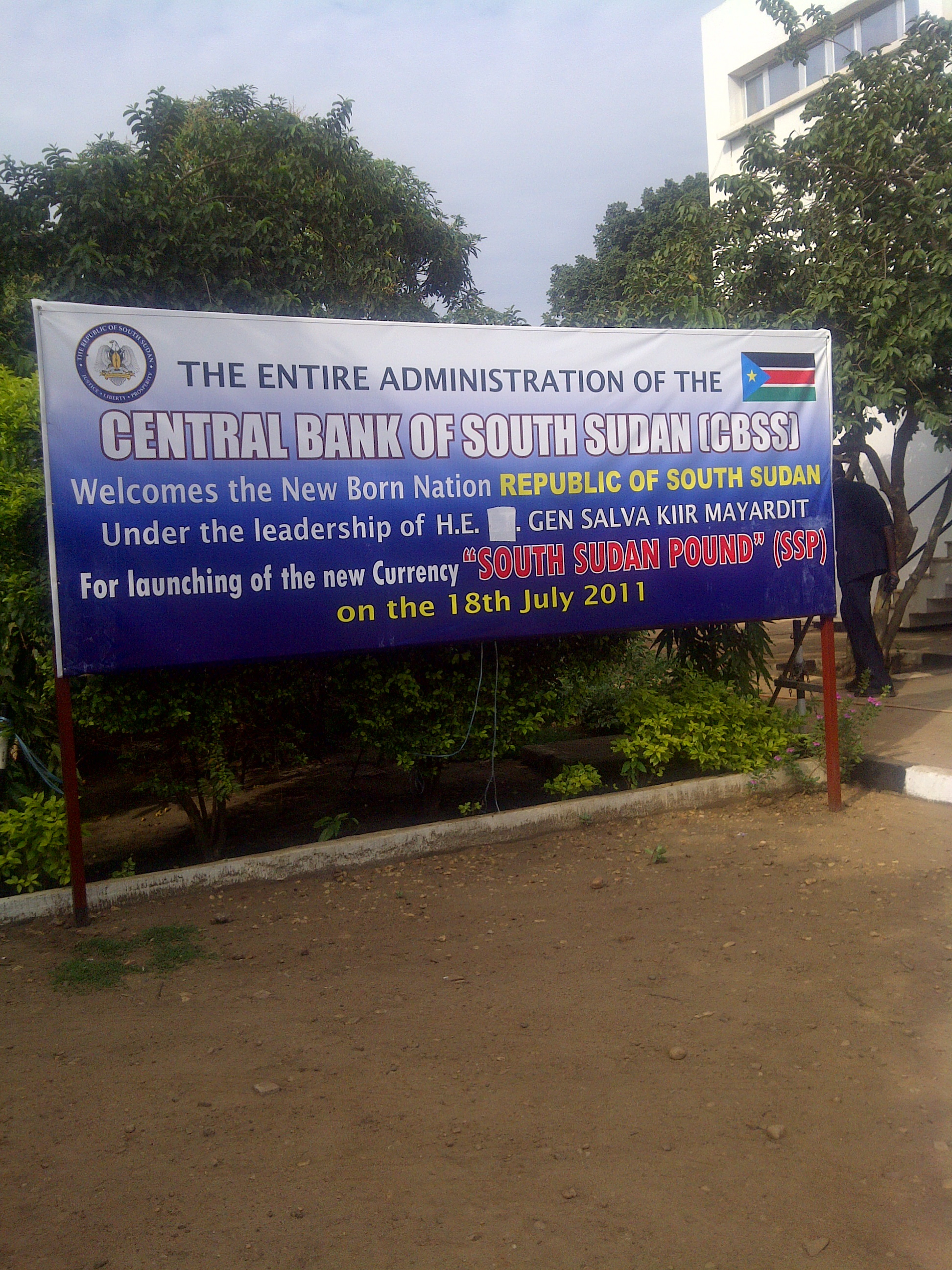
I left Southern Sudan on June 21 and returned on July 27th to the newly independent Republic of South Sudan (on July 9). The introduction of the new South Sudanese Pound (SSP), which our Deloitte team has been helping the local authorities prepare to issue for over a year, had started on July 18th.  The replacement of SDG (Sudanese Pounds) with the new SSP is targeted to be completed by the end of this month (August—a 45 day period).

The establishment of the new Central Bank of South Sudan, though inheriting most of the staff and buildings of the Bank of Southern Sudan (a branch of the Central Bank of Sudan headquartered in the North), is being seriously hampered by the failure so far of the President of the Republic to appoint its new Governor and Board.

The big success on this visit was the launch of foreign exchange auctions after the new central bank law wiped out all of the exchange controls imposed by North Sudan when Southern Sudan was part of it. The Central Bank of Sudan (the central bank for the whole country before the South spit off) was running out of foreign exchange reserves (foreign currency owned by the central bank that it could sell to the market to influence the exchange rate of its currency). It wanted to keep its exchange rate to the U.S. dollar and other foreign currency low so that those holding its currency could buy dollars more cheaply (a so-called “strong” currency). But to do that it had so sell dollars from its foreign currency reserves. When it was running out of dollars, it could no longer support the exchange rate it wanted. So it imposed restrictions on the purposes for which people could buy dollars with the Sudanese Pound (restricting demand) in order to support it’s artificially low (strong) exchange rate. As a result, a spread of up to 1½ percentage points opened up between the official rate and the street (black market) rate.

South Sudan has removed those restrictions and introduced twice weekly auctions of U.S. dollars to the highest bidders. There have been three auctions so far and they are working well as the market gets used to them. The spread between the official and street rate (no longer illegal) has already narrowed to about 25 basis points (a quarter of a percentage point). Today we hit a big bump in the process and the acting governor, responding to political pressure capped the exchange rate for the next auction below the rate of the last one. We expect the announcement of a permanent Governor very soon.

After independence, the Bank of Southern Sudan became the Central Bank of South Sudan (CBSS). The Bank has a fairly large courtyard in the middle where people gather to chat or smoke cigarettes and where the Governor holds large staff meetings. You can see it in the attached picture. I stepped out of my office on to the far edge of the courtyard the other day and was standing next to one of the Bank officials. He was on his cell phone and obviously expecting to meet someone: “Where are you? … You are standing under a tree? … What tree? We have a lot of them.” Every now and then a fairly large monkey drops out of one of them, which always gives me a start.

There seems to be more life around the Bank than before. After all, there is a lot going on (introducing a new currency and starting new foreign currency auctions). Yet the halls of the Bank are still cluttered with employees that are half asleep. I am not really sure what their duties are. Work habits are not very good here. Many of the African Sudanese in the South cling to the habits of the African lion, which lies around and sleeps most of the day, while his lionesses round-up the food and do the dishes so to speak. The entrepreneur spirit is in rather low supply. Many of the businessmen and shopkeepers are Kenyans or Ugandans.

The traditional pastoral and often nomadic lives of many Africans roaming the plains of Sub-Saharan African are not all bad, by any means. You can’t listen to them sing without hearing some happiness there. But it is too easy for those of us not living it day after day to overly romanticize it.

Life at the Afex Riverside Residence at the edge of the Nile remains the same. I continue to be impressed with the timeliness of Deloitte’s team for the morning and after lunch departures of its six cars. In the few minutes before 8:00 am every day except Sunday, thirty or so consultants converge on the car park from several paths and at 8:00 am sharp the cars start pulling out for the drive to the various Ministries (and in my case the Central Bank) at which they work. Often the departure, especially after the lunch break, is virtually simultaneous with all six cars departing from the camp one right behind the other in a caravan. It is an impressive sight.

On irregular trips, the drivers are required to provide a radio report to Base on who is with them and where they are going so that Base knows were every one is. It goes something like this: “Alpha to Base. Alpha to Base…  This is Base.  Leaving Charlie, Charlie, with Bravo D-4 (or whoever) and with, with, and with one “unassigned.”  I am the “unassigned” because I talked Base into not having to carry a bulky two-way radio around, because I almost always travel with colleagues who have one.

A few days back, while eating dinner in the Afex dinning hall—a very pleasant open air facility along the edge of the Nile—a strong gust came up that caused a heavy shower of little black things that covered the dinning room tables, floor, and my plate. I assumed that it was the carcasses of the hundreds of thousands of zapped insects that had given up their lives to the several electric bug killers overhead. I was greatly relieved when I learned that they were little mango seeds that had collected on the canvas roof and were dislodged by the brisk wind.

At dinner this evening our British security officer and another Englishman where telling war stories across the table from me. I was only half listening, but the other Brit’s story about their first-rate French interpreter (they must have been in a French-speaking African country as he is not old enough to be talking about WWII) ended with something like: “he eventually went native on us, drinking red wine and such.” I learn something new every day.

I have been away from home for over a month and need a haircut. My barber for the last 35 years gets very upset if anyone else cuts my hair. During my two month stay in Baghdad in 2004 I was forced to get several and Mike complained for the next two months that it was taking that long to get it back into proper shape. Tuffs of hair now tickle my ears occasionally leading me to fear that a malaria-carrying mosquito has landed there.

Our morning drive from Afex Camp to the Central Bank usually passes a lot of kids on their way to school. The girls and boys dressed in school uniforms is a lovely sight. There is little that is as encouraging and hopeful as seeing young kids smiling on their way to school, especially in a largely illiterate country. So there is hope. There is also little as heart breaking is the face of a child, usually a hungry child, with no hope. The expressionless, unfocused stare of such a child is more than I can bear.

I think that we take hope in American (especially) so for granted that it is hard to imagine a people who have little of it. A great deal of our existence, especially our younger years are filled with the hope that we can build decent enjoyable lives for our selves and our loved ones. What would our youth have been without it? There seems to be a lot of hope in South Sudan now. I hope that it is justified and that it can be sustained.

Travels in Italy and France

Between a delightful gathering at Robert Mundell’s home at Santa Columbo outside of Siena, Italy (July 7-11), and my return to Juba in newly independent South Sudan, Ito and I have been hanging out in Italy, France.

Mundell’s annual gathering of about 40 economists discussed the reform of the international monetary system. Participants included: Edmond Alphandéry, Domingo Cavallo, Jacob Frenkel, Steve Hanke, Nicolas Krul, Ronald McKinnon, Bill Middendorf II, Aleksei Mozhin, Robert Pringle, to name a few. Christine Lagarde was still on the participant list but didn’t attend having just taken up her duties as the new Managing Director of the IMF, but Rodrigo de Rato, former Managing Director of the IMF and former Vice President for Economic Affairs and Minister of Economy of Spain, was there, as was Min Zhu from China whose appointment as a Deputy Managing Director of the IMF was announced a few days later.

During the two days of discussion, I summarized the paper I had presented earlier at the G-20 High Level Seminar on the Reform of the International Monetary System in Nanjing, China; the Astana Forum, in Astana, Kazakhstan; and the Central Bank of Argentina in Buenos Aires, Argentine on a Real SDR World Currency Board: http://works.bepress.com/warren_coats/23/

From Siena we traveled by train to Milan for two days during which we saw Verdi’s Attila at the world-famous opera house, la Scala (see picture). The opera is not one of Verdi’s best but the la Scala production (co produced with the San Fransisco Opera Company) was outstanding. We had not been to la Scala since its renovation a few years ago: http://en.wikipedia.org/wiki/La_Scala

We traveled on by train to Lyon, France, via Geneva Switzerland to visit Scot Thompson and Louie Pangilinan. Scot has swapped his beautifully compound in Bali with a family with places near Lyon and Paris for the month of July. The house near Lyon is about ten miles north along the Saône River in Cailloux sur Fontaines. The French weather was too cool to use the swimming pool at that house, but Scot and Louie took us on several day trips to some wonderful spots.

The first was to the Château de Fléchères about 20 miles further north. The Château was built from 1606 to 1625. If you are interested you can learn more of its history and see pictures here: http://www.chateaudeflecheres.com/en

In a more easterly direction we visited the medieval village of Perouge, which developed in the 14th and 15th century: http://www.francethisway.com/places/perouges.php

On Monday (July 18) we took the train from Lyon to Avignon in Provence where we were met by Nicolas Krul. He drove us to his beautiful estate in Ménerbes about an hour’s drive southeast of Avignon. Nicolas and I continued the economics discussion we had started during Mundell’s gathering in Siena, and enjoyed two lovely bottles of Sauvignon blanc and a wonderful lunch prepared by his charming wife Meher.

On Tuesday (July 19) Scott and Louie drove us to the other house they had the use of in a southern suburb of Paris. On the way we visited the Basilique de Vézelay and amazing medieval village and cathedral built between the 9th and 13th centuries and from which the 2nd and 3rd Crusades were launched: http://www.burgundytoday.com/historic-places/abbeys-churches/basilique-ste-madeleine.htm

The next day was spent at the Palace and gardens of Versailles, for which no words are adequate: http://en.chateauversailles.fr/homepage. The next three days we explored the usual sights of Paris.

France has changed a lot since I visited it the first time in 1960, over fifty years ago. 1960 was only fifteen years after the end of WWII, which to me at the time seemed centuries earlier. In fact, fifteen years is less than the time from the collapse of the Soviet Union and now, which seems to me like yesterday. Among the pleasant surprises are English (as well as French, of course) announcements on trains and the number of French who can speak English. Even the information booths in rather out-of-the-way places were staffed with people who could speak English and they were very friendly and helpful. At the odd hour of 3:00 pm (between lunch and dinner) we wanted to eat before taking the train from Versailles and Paris. The Brasserie was no longer able to prepare pizza or make a sandwich (out of bread), but happily prepared us a salad with chicken, wanted to know if we were British or American and whether we enjoyed our lunch.

Even Parisians are often friendlier, but not always. Our train from the Eiffel Tower to Saint Michel ended at Invalides because of repairs and we were told that we would need to complete the trip by a bus waiting upstairs. We wandered around underground for a while trying to figure out how and where to go up to the street level. We asked at another Information booth. The lady insisted that we must go “up, UP!” All and all, however, it has been a very nice trip.

We travel to Amsterdam for three days today (Saturday) before Ito returns home and I return to work in Juba, South Sudan. Hopefully I can lose there some of the weight that I gained here.

The Astana Economic Forum

Hi from Astana, the capital of Kazakhstan.

I am here for the IV Astana Economic Forum at the invitation of Robert Mundell, the Reinventing Bretton Woods Committee, and the Eurasia Economic Club of Scientists. Formally I was invited by Nursultan Nazarbayev, President of the Republic of Kazakhstan, but I sure that he doesn’t know about it, though he will open the meetings. I will continue my year of talking about the IMF’s Special Drawing Right (SDR), which started in Paris in December and continued in Nanjing in March. I will explain my proposal for a global real SDR issued by an international currency board.

My fellow presenters include a number of Nobel Prize winners: Roger Kornberg (Chemistry), Sir James Mirrlees (Economics), John Nash (Economics and who looks nothing like Russell Crowe) and of course Bob Mundell. Other distinguished speakers include Jacob Frenkel, Chairman, JPMorgan Chase International (and my former IMF colleague), Hernando de Soto, economics author and former governor of Peru’s Central Reserve Bank, Richard Cooper, Professor of Economics, Harvard University, and Domingo Cavallo, Former Minister of Economy of Argentina. I am participating with the latter two in a Press Conference on Wednesday.

It is a long way to go for a two-day conference but it should be interesting.

Notes from Nanjing

French President Nicolas Sarkozy chairs the G-20 this year and has focused on the reform of the international monetary system. I was invited by the French Finance Minister and the central bank Governor to join the High Level G-20 Seminar in Nanjing March 31 on that subject as one of the lead speakers (of which there were quite a few). The G-20 is the group of industrial and emerging market countries that has replaced the G-7 industrial countries as the lead forum for global economic policy coordination. This meeting was attended by the Finance Ministers and Central Bank Governors of the G-20 countries or their deputies, heads of international financial organizations (like the IMF), and some academics like me.

The Nanjing meeting was opened by Vice Premier of the Peoples Republic of China (PRC), Wang Qishan, and French President Sarkozy. For this opening session I was seated next to a Germany delegate who was kind enough to explain to me who various people around us were and what was going on. The opening was delayed for an hour waiting for President Sarkozy to arrive. The President was grandstanding the Deputy Governor explained to me. “Don’t you find it strange,” he asked, “that the Vice Premier rather than the Premier is opening the meeting and doing so in front of the French and EU flags with no PRC flag?” “Well, yes, that is very strange.” I replied. “This is because,” he continued, “the Chinese government didn’t really want such a meeting in China. The issue of the exchange rate of the Chinese currency would have to come up. It was agreed, however, that the China Center for International Economic Exchanges (CCIEE) would host the seminar on behalf of the PRC. So no Chinese Premier and no Chinese flag.” I should always be lucky enough to sit next to a German.

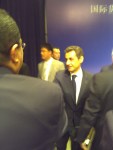
After the long wait, President Sarkozy delivered an excellent opening speech. He is an impressive performer. His several references to “my friend Tim,” while nodding to U.S. Treasury Secretary, Timothy Geithner, sitting in the front row, seemed perfectly natural and effective.

Nanjing is famous as the capital of the Ming and several other Dynasties and for its food. The food of each region of China is distinct. I can’t really explain the differences but the food here in Nanjing is very good. During the Seminar luncheon I sat next to the Finance Minister of Japan, who complimented me on my chopstick skills. I explained that I had been using them from childhood. On the rare occasions that my parents could afford to take us out for dinner, we went to a Chinese restaurant (they were cheaper). Thus Chinese restaurants were very special in my mind and like all kids I was eager to learn all that I could, including how to use chopsticks.

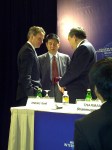
My own session was chaired by Christian Noyer, Governor of the Bank of France, and moderated by George Osborne, Minister of Finance of the U.K (Chancellor of the Exchequer as they call it in the U.K.). Following strict instructions from Ito and Ken Weisbrode, I informed Mr. Osborne that his wife’s novels were much enjoyed by some of my friends, though I had never read one myself. He was pleased and informed me that her next one would be out soon. During our session Minister Osborne replied to a procedural question with the remark that “As is often the case, the British are operating under the instructions of the French.” Delicious.

My presentation on the SDR, the International Monetary Fund’s reserve asset, was made sitting directly across the table from Dominique Strauss-Kahn, the Managing Director of the IMF and Robert Mundell, a friend and a Nobel prize winner in economics. I could not have wished for a better audience for my three-minute summary of my radical suggestions, which you can find here: http://global-currencies.org/smi/gb/home.php.

I was sitting next to Kevin Warsh, a Governor on the Board of Governors of the Federal Reserve System (the U.S. central bank), and while waiting for our session to get underway I could not resist telling him about a dinner I had with my friend Randy Kroszner, who was also a Governor on the Fed’s Board of Governors at the time.  I met Randy at a Belgian restaurant on MacArthur Boulevard in Washington that he wanted to try Tuesday evening September 16, 2008 after his meeting with the Federal Open Market Committee. Lehman Brothers had declared bankruptcy the day before and I was eager to talk to Randy about it. Around 9:00 pm I received a CNN news alert on my Blackberry that the Federal Reserve had saved AIG that day with a $85 billion injection that gave the Fed an 80% equity interest. My jaw dropped. “Randy,” I asked, “how could you sit there all evening and not say a word about this.” He looked uncomfortable and said, “I am afraid that I still can’t comment because I don’t know if CNN is reporting from a Fed Press Release or a leak.” If ever anyone was leak proof it is Randy.

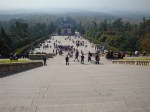
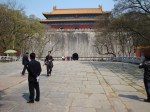
Despite the 12 hour time difference, I was wide awake until the afternoon session on surveillance (no offense Ted Truman, your presentation was very good). The next day, April 1, we were taken sightseeing. We climbed the 391 steps to the Mausoleum of Sun Yet-sen to see his tomb. Each step represented one million Chinese of the population as it was at the time of his death (obviously some time ago). I noticed that our police escort car was a Buick (probably made in China).

The food here in Nanjing is excellent as are our rooms and conference facilities outside the city in the Purple Palace Hotel at the foot of the Purple Mountains. The roads are equally modern and beautifully designed and built. From a distance I can see the modern skyscrapers of the city surrounded by a 600 hundred old 25 kilometer long stone wall. The city was founded 2,500 years ago. Most of the villages, which is where the majority of Chinese still live, remain very poor. But increasingly the hundreds of millions of Chinese in the major cities live in surprisingly modern and vibrant housing and surroundings. Most people visiting china are shocked.

China

I arrived today in Nanjing China for a “High-Level Seminar on the International Monetary System” organized by the G-20. The one-day seminar tomorrow will be opened by Vice Premier of the People’s Republic of China Wang Qishan and French President Nicolas Sarkozy. As one of the (relatively large number of) “lead speakers” I will discuss an enhanced role for the IMF’s SDR in the International Monetary System. The session I will speak in is:

Global liquidity management issues (including global financial safety nets and the role of the SDR):

Chair: Christian Noyer (Governor of the Bank of France)

Moderator: George Osborne (Minister of Finance of the United Kingdom)

Lead speakers: Alexei Kudrin (Minister of Finance of Russia), Yung Chul-Park (Seoul University), Olli Rehn (European Commissioner for Economic and Monetary Affairs), Hélène Rey (London Business School), Elena Salgado (Minister of Finance of Spain), Wang Jianye (Exim Bank chief economist), Kim Choong-Soo (Governor of the Bank of Korea), Jim O’Neill (Chairman of Goldman Sachs Asset Management), Obaid Al Tayer (Minister of State for Financial Affairs of UAE), Volker Wieland (Goethe University Frankfurt), Martin Crisanto EBE MBA (Minister of Finance of Equatorial Guinea), Warren Coats (Chicago economist and former IMF official).

Other speakers during the day include Dominique Strauss-Kahn, the Managing Director of the IMF, Timothy Geithner (US Secretary of the Treasury), Robert Mundell (Columbia University), Jean-Claude Trichet (President of the ECB—European Central Bank). I will try hard to sleep tonight in my new time zone and to stay awake tomorrow.

China is amazing. Nanjing is only the third Chinese city I have visited and I will not really see it until after the conference which is being held at a lake resort in the countryside outside of Nanjing (The Purple Palace). It was the capital of the Ming and several other Dynasties and with many interesting things to see. Driving through Nanjing this evening I could have been in LA on the freeway system or in Boston in the long tunnels under the city (though the quality of construction is better here in China). The skyline is beautiful with every effective use of lighting. They even apply capitalist pricing to the highways (toll roads), which are magnificent. Beijing, which I have seen more fully, is typical of a number of major cities in China, of which Shanghai is the most famous, in their impressive, modern buildings and infrastructure. I have described Beijing as what New York City might look like if it were modern (i.e., not old and run down). To be fair to NYC, its charm and attraction is not (any longer) its buildings but its vibrant and very diverse cultural life. I am not able top judge that aspect of life in China’s major cities.

Walking through Beijing Capital International airport for my connecting flight to Nanjing, it was like any other modern international airport (Terminal 5 of Heathrow, Dubai International, etc). Well organized, efficient, clean and full of familiar shops. Very unlike the old, deteriorating, and unattractive terminals at JFK.

Chinese people strike me as more like us than most any other people (including Europeans) I have met. And who do I mean by “us?” I don’t mean Anglo Saxons like myself. I mean the hard working, innovative, entrepreneur types who are creating most of the wealth in this country like Google founders, Larry Page (American born Jew) and Sergey Brin (Russian born Jew), or Steve Jobs, who was born in San Francisco to a Syrian father and German-American mother, and, of course, also includes many Anglo Saxons like myself.

China’s dramatic growth over the past 30 years resulted from the Chinese government gradually freeing the economy from the bottom up, starting with agriculture. The state got out of the way and let individuals make profits if they could. And the Chinese proved to be very entrepreneurial. They are willing to work very hard and innovatively to make money. China’s real output has grown more than 10 percent per year on average since these reforms began and it came almost totally from the rapid growth of the private sector, largely individuals and very small firms that grew larger in the space the government allowed. What the government has done is provide the infrastructure (road, power, etc) that has allowed private entrepreneurs to get their products to market efficiently. They excel in every society they live in.

The Chinese (English language) newspaper given to me on the plane earlier today had an amazing article about problems with illegal immigrants coming to China from Africa, the Middle East and elsewhere for better jobs and pay and more opportunity than then can get at home. I found that amazing. The good thing about people working hard to get ahead is that it is not a zero sum game. They add to overall wealth and everyone gains.

Travel notes from South Sudan and Kenya

As my Kenya Airways flight climbed out of Juba, the Nile cut through the brown countryside as far as I could see. In the last month of South Sudan’s dry season, little green can be seen. In a month and a half or so after the rainy season has started it will all be green.

An hour and a half later, as we descended into Nairobi, the vast plains of Kenya surrounding the city were lushly green and the relatively vast wealth of Kenya was easily discernible even from the sky. The drive from the airport to my hotel in the city center took me past row after row of modern office buildings and import export warehouses and assembly facilities. Kenya is a relatively modern and affluent African country. It is alive with activity. It’s rapidly growing wealth is unfortunately revealed in the infamous traffic jams along its main roads. Freeway construction has not kept pace.

Today, the front page of one of Nairobi’s daily newspapers was filled with news of the winners of the national school performance examination results, a testimony to the high value Kenyan’s place on education as an essential part if its development and continental and international competitiveness. The paper lamented the continued gap between the girls’ and the boys’ performance.

Kenya has made progress toward reducing the role of tribes in business and political life. If workers are promoted and otherwise rewarded on the basis of performance (merit), economies develop and grow much faster than those (so typical of much of Africa still) that function more narrowing long tribal lines. Then the Presidential elections in December 2007, which were expected to deepen democracy’s hold, erupted into violence along political/tribal lines when incumbent President Mwai Kibaki was declared the winner and shattered this progress. His opponent Raila Odinga was widely thought to have won. Over 800 people died and over 600,000 were displaced from the violence.

Most Kenyans were shocked by the violence of those weeks. Former UN General Secretary Kofi Annan brokered a power sharing agreement that restored peace but did not succeed in overcoming the resurgent tribalism and its poisonous effect on Kenya’s public and economic life. Ever since local newspaper headlines have been dominated by on again off again efforts to bring the perpetrators of the electoral violence to justice. The debate is between those who do not believe Kenyan institutions are strong enough to expose and punish those high government officials who are guilty and thus favor having the claims adjudicated in the Hague, and those who want Kenya to handle its own investigation. This later group includes coalition government, whose Finance Minister was accused by the International War Criminal Court in the Hague as one of the perpetrators. Like Zimbabwe, it is very painful to see such a wonderful and promising country slide backward.

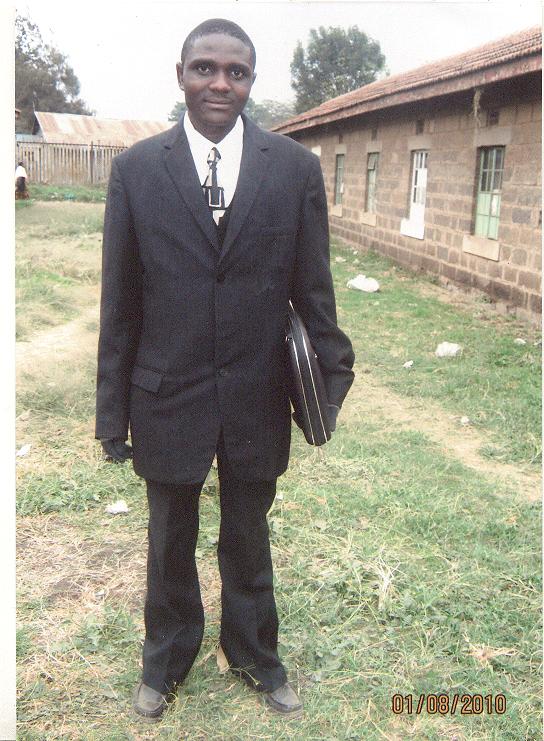
Then there is the story of Paul Oduor, pictured below. I had dinner with Paul several weeks ago in Nairobi on my way to Juba. I am still not quite sure how it came about. Several months ago I received a text message from a Kenyan phone number. I had never received an unsolicited text message from a stranger before (unlike all those messages from widows, Barristers, or bank officials in Nigeria or Benin—why Benin??—eager to deposit millions from their recently diseased husband, or client, in my bank account if I would just provided them with my account information).  He said something like, “I am a young African man, and would like to know you. Where are you?” not the usual “I am sure that you will be very surprised by this letter” favored by the fraudsters. My finger hovered over the delete button, but then I replied “I am in Washington DC. Who and where are you.” It turned out that he was in Nairobi and didn’t seem to want anything more that the adventure of connecting with someone somewhere else in the world. And, of course, I do pass through Nairobi fairly often, so we kept exchanging text messages and arranged to meet for dinner on February 18th.

Paul was a polite young man of 22 who ran a human rights organization with a partner that is affiliated with Humanists International. He was trying to educate the residence of the large squatter slum of several hundred thousand Kenyans in a square mile or so of Nairobi of their rights under the law. He gave me literature explaining the purpose of his organization. He had obviously had some training in sales, complimenting me on asking good questions. Finally I asked him how he got my phone number. He said that his mother worked in the kitchen of a hotel where we had held a workshop for some South Sudanese officials a year or two earlier and had picked up one of my papers that had the information. Maybe it was a participant list, as I don’t put my phone number on articles or other such papers. As best I can tell, Paul simply thought it would be fun to see if the far off person whose number he had acquired would respond. He never asked for money for his organization, which seemed to be a private voluntary undertaking on his part, but he did eat a hearty meal. As we parted, he said: “You are a Christian, aren’t you?” Then handed me a book called: “The Greatest Man Who Ever Lived.” Never a dull moment.

Southern Sudan votes for Independence

The independence referendum for Southern Sudan for which an estimated 2 million Sudanese have died over the last 30 years started today wherever Southern Sudanese live. I expect to return next month to continue providing technical assistance on setting up a new central bank and issuing a new currency. My Deloitte colleague Adam Wicik sent the following email this morning along with many happy pictures of which I am attaching three.

Hi,
Greeting from sunny, warm and still calm Juba. Again, there is no escaping some photos from here.
As you all know, a Referendum on the future of Southern Sudan started today and will go on for another 7 days.  Today was the first day.  As it is Sunday, with kind permission of Andy, Kate and I were able to go around and pretend to be press photographers.  We almost got arrested once for taking photos, but Deloitte ID card works like magic!
Photos fall into two groups – voting, i.e. long queues, people patiently waiting, casting their votes and immediately shouting in happiness, and having a fingers dipped in long lasting ink to stop them from voting twice.  Everything has been quiet and peaceful so far.
There was some singing, dancing, and drum beating as well.  Of course, what else could you expect on a happy day.
You will see some photos of those happy (and sleepy for some) moments too.
George Clooney is here again.  As always staying at AFEX.  Today we caught up with him at the local church.

This is all for now.  Keep your fingers crossed that the rest of this week, and the next six months, stay calm and happy.

All the best,
Adam

Happy New Year

Dear Friends,

I hope that your year is off to a good start. Like every other year that ever was, this one is full of challenges of each of us, for our country (which ever one it is) and for our world. I think that for most economies the prospects for recovery and growth are somewhat better than they were at this time last year. But for the United State and some other European countries serious public debt problems must be address sooner rather than later (actually, we are already now living in “later”).

My coming months will be largely taken up with the continuation of the work I was doing with the International Monetary Fund in Afghanistan and with Deloitte/USAID in Southern Sudan this past year. I expect to return to Kabul in a few weeks and, if all goes well with the independence referendum in Sudan starting this Sunday I will return there soon as well. For those of you interested, several articles in the Washington Post yesterday and today provide a good summary of what is going on in Sudan: “Sudan on the brink” “Sudan votes comes together after rocky Obama effort to prevent violence” Southern Sudan makes “final walk to freedom”

My role in Southern Sudan is to help them set up a new central bank and to issue a new currency and to keeps is value stable. It promises to be an active and interesting year.

My best wishes to you,

Warren

Annual Christmas Letter

Dear Friends,                                                                                                           December 8, 2010

Seasons Greetings. I hope that it has been a good year for you and those you love. It has been for me, but it remains a troubled time for western economies and for those parts of the world in which we have militarily involved ourselves and in a few in which we haven’t. Here are the highlights of my year. You can read my more extensive comments on my travels, the economy, and other things that have interested me at https://wcoats.wordpress.com/).

My first trip of the year, as usual, was to Grand Cayman Island for the quarterly board meeting of the Cayman Islands Monetary Authority (http://www.cimoney.com.ky/). My trip there for the May board meeting was my last. Although I was reappointed to the Board for a third, three-year term, I resigned during the summer effective the end of this year. I have good memories and some lasting friends from the experience (Richard Rahn, Tim Ridley, Jane Wareham, and Bill and Patricia Gilmore).

My second trip of the year was to Nairobi, Kenya for the IMF to continue my technical assistance to the Central Bank of Kenya (CBK) on how to improve its formulation and implementation of monetary policy. But this year was very special because I brought my 16-year-old grandson Bryce with me. It was Easter break for him and the CBK was closed from Good Friday through Monday, which gave us a perfect opportunity to drive to the Masia Mara game reserve near the Tanzania boarder for three days and two nights. This added some memorable pictures to my collection, which you can see on my Facebook pages.

The spring also included some fun domestic trips. My long time friend Jim Roumasset and I went to Boston at the end of April for Peter Diamond’s grand retirement party at MIT. Jim and I had had several courses from Diamond at UC Berkeley in the mid 60s. Subsequently Diamond shared this year’s Nobel Prize in Economics. Our Congress is still trying to figure out if he is qualified to be on the Board of Governors of the Federal Reserve. In mid May I flew out to my hometown of Bakersfield for my 50th high school reunion and to celebrate my shared birthday with my dad (what a birthday present he got when I was born).

In July Ito joined me for a trip to Robert Mundell’s annual gathering of economist at his home near Sienna, Italy. We stopped in London to visit Ito’s niece and in Florence to sightsee. We made friends with Bill Middendorf and his daughter Frances, who are both fascinating and enjoyable people.

In early September I was sitting in my gazebo reading about the collapse of Kabulbank, Afghanistan’s largest bank, when the IMF called to ask if I could join the mission leaving that evening for Kabul to help the authorities manage the Kabulbank crisis and to negotiate a new program with the IMF. It was an intense visit with a great IMF team providing little sleep. I traveled from Kabul on to Juba, Southern Sudan (via Dubai and Nairobi), which I did again after returning to Kabul a month later October – November). You can read about Kabulbank in the NYT or Washington Post. I continue to advise the Central Bank of Iraq from afar for the IMF.

I met with Southern Sudanese officials four times this year, once in Nairobi (June) and three times in Juba (July, September and November) after giving up my determination not to go there. As their independence referendum in January gets closer they are paying more and more attention to the issues we (Deloitte/USAID) are advising on (setting up a new post independence central bank and issuing and managing a new currency). On our last visit (November) we were finally meeting with the actual decision makers and we are hoping to convince them to adopt currency board rules for their new currency.

Between my September and November trips to Kabul/Juba, I also managed to attend my nephew Scott Naninga’s wedding in Santa Rosa California, and visit Daylin and Brandon and my grandkids in North Bend, WA and Vancouver, WA while on my way to the Mont Pelerin Society meetings in Sidney, Australia, all in October.

In mid November while I was in Juba my father tripped and fell and sprained his shoulder in Bakersfield and for a few days I feared that I would have to cancel another Thanksgiving dinner, but he is doing fine. My final trip of the year will be to Paris Dec 9-12 for a conference on “The International Monetary System: Old And New Debates,” to discuss the SDR as an international reserve asset.

Ito continues to draw/paint, play the piano and violin, and write while searching for the cure to cancer on the frontiers of molecular biology research at the National Cancer Institute in Fredrick Maryland, thus providing some stability and continuity to the family. So life at home is good when I am there.

Best wishes,

Warren

Return to Juba

Greetings from Juba, Southern Sudan

I am back in Juba for the third time since July continuing to discuss with various decision makers monetary policy regime options and negotiating positions with the North for dividing monetary assets and liabilities of the Central Bank of Sudan when the South becomes independent next year, and preparations for establishing a new central bank.

My residence in Afex Camp by the Nile continues to improve and is almost approaching what you could call, African adjusted, nice. The main paths from our bungalows to the open air dinning area by the Nile have been improved with relatively fine gravel, which lets the water drain when it rains and keeps the dust down when it doesn’t. Some quit attractive gardens have been planted on either side of some of these paths. The dinning pavilion, as before, has a high ceiling with ceiling fans that attempt to keep the insect kingdom from invading our food and faces. Its view of the Nile 10 meters away is as lovely as ever.

A unique feature of our dinning area is that everything is covered with saran wrap (plates, glasses, flat ware and of course the food) in order to keep the jungle creatures at bay. It seems to work well and dinners are quite pleasant. Next to our dinning pavilion is an open air (but also covered) bar that would be the envy of any such hang out. I have never had the time to sit there and enjoy it but it is nice to know that it is there.

My two room plus bathroom and toilet room bungalow is in fact quite nice as well, dramatically better, in fact, than my rooms in the IMF guesthouse in Kabul from which I have just come. On this visit I am staying in Zambia 2. On previous visits I stayed in Sudan 1 and Niger 1. My apartment is well air-conditioned and the mosquito net over my bed has no holes. It even has a TV with satellite station access (I am told as I have never tried to turn it on), and Internet access without which I really would feel deprived and isolated.

The evening of my arrival, the Deloitte project manager (my boss) called to say that the North South negotiators had just come to an agreement in Khartoum on the division of the assets and liabilities of the central bank (the currency and the assets that back it) between the North and South in preparations for the South’s independence next year (referendum is January 9 and independence day is scheduled to be July 9th).  This was one of the topics I came to advise on so this was quite a surprise. The project manager was trying to arrange for me to fly up to Khartoum the next day to review what was going on, but had to give up as my Sudanese visa had been stamped in Juba when I arrived and thus would be unacceptable in the North. Not only would they not permit me entry, he learned, but they would not let me return to the South (Juba) either. The next day while waiting for the new agreement to be faxed or emailed to us, we learned that none of it was true—just another one of the rumors that circulated from time to time. This was an adrenaline stimulating start to my visit.