The Future of Israel and Palestine

At an otherwise friendly dinner conversation at the home of Israeli friends, our host explained that Israel having taken over the West Bank and Gaza Strip (WBGS) in the 6 day war in 1967, i.e. having won the war fair and square, so to speak, the Palestinians and the rest of the world should accept that reality and move on. He was articulating the one state solution to the Israeli-Palestinian problem. The WBGS now belongs to and is part of Israel (though Israel did withdraw later from and gave up Gaza).

The Zionist movement’s goal of establishing a Jewish homeland, a Jewish nation, seemed fulfilled with the U.N.’s recognition of the new state of Israel in 1048. The commitment of its Jewish residents to building a democratic state required achieving and maintaining a Jewish majority in the population. Absorbing the West Bank into Israel presents some obvious challenges. If you are not familiar with the history of Israel, I urge you to read my summary of it: “View from the West Bank–A History of the Conflict”

One state for Israel and the West Bank would have a majority of Palestinians. The Jews around the world willing to move to Israel (the earlier strategy for obtaining a Jewish majority) have pretty much already done so and birth rates among the Palestinians are higher than among the Jews. Thus a consolidated, democratic, and Jewish state would require second-class citizenship for its Palestinian residence. A British journalist living in Nazareth, Israel explains this in more detail: “With-more-palestinians-than-jews-israel-waging-war-of-attrition”

Former President Jimmy Carter described this potential outcome in his 2006 book, “Palestine: Peace Not Apartheid,” where he wrote: “The bottom line is this: Peace will come to Israel and the Middle East only when the Israeli government is willing to comply with international law, with the Roadmap for Peace, with official American policy, with the wishes of a majority of its own citizens — and honor its own previous commitments — by accepting its legal borders.” This reality is recognized by many Israeli and even endorsed by some: “Israeli minister-endorses-apartheid.”

An apartheid regime for Israel would be an affront to liberal democratic values not easily swallowed by the Jewish diaspora. In fact, it would not be acceptable at all. That argues for continued effort to agree on a two state solution. In the following article Ronald Lauder, President of the World Jewish Congress, makes the case for the two state solution that the U.S. and U.N have worked for until now (or perhaps until last year) as the only morally and practically acceptable solution to this problem: “Israel’s Self-Inflicted Wounds”.

What we are seeing now, however, is something much uglier. The third option to two states, or one apartheid state, is one state that has ethnically cleansed the unwanted Palestinians in order to preserve Jewish control in a democratic state. The increasingly corrupt regime of Bibi Netanyahu seems to be moving in this direction and uncritical U.S. support of whatever his government does is putting the U.S. at odds with the rest of the world. For a similar review, see: “The-strange-catharsis-of-hopelessness-in-Israel”

U.S. tacit support of continued construction of illegal Israeli settlements on Palestinian land was resoundingly rejected by the U.N. When President Trump moved the U.S. Embassy to Jerusalem “The United Nations General Assembly voted… 128-9, with 35 abstentions, on a non-binding resolution condemning President Trump’s new policy recognizing Jerusalem as the capital of Israel…. U.S. Ambassador to the United Nations Nikki Haley told an emergency meeting of the General Assembly [that] ‘the United States will remember this day in which it was singled out for attack in the General Assembly for the very right of exercising our right as a sovereign nation.’” This is the language of a bully, not a world leader, and I was appalled and embarrassed for my country. “UN-votes-to-reject-US-decision-on-Jerusalem-despite-threats”

More worrying are increasing signs that Netanyahu’s government is indeed pursuing the ethnic cleansing option. In addition to stealing Palestinian land in the West Bank for Israeli expansion, Israel has increasingly isolated and stifled the Palestinian economy. “Israel-Jewish-nation-state-bill”

Israel has occupied the West Bank for fifty years. Some of its treatment of its wards would be seen as human rights violations if committed by any other country. “Alabama-Israel-apartheid.” Recent Israeli laws are escalating such abusive treatment, allowing “the minister of interior to revoke the residency rights of any Palestinian in Jerusalem on grounds of a “breach of loyalty” to Israel.” “Israel-passes-law-strip-residency-Jerusalem’s-Palestinians”

Last December you may have watched the video of 17 year old Ahed Tamimi attacking two Israeli soldiers who had just shot her 15-year-old cousin Mohammed Tamimi in the head at close range with a rubber-coated steel bullet. https://www.youtube.com/watch?v=8YFen2KdqbU. The Israeli soldiers get points for staying cool. Ahed is now servicing eight months in prison after agreeing to a plea bargain. More recently (March 30, 2018) Israeli soldiers shot and killed 16 Palestinians on the Gaza Israeli border and wounded hundreds. http://www.bbc.com/news/world-middle-east-43593594 “Both UN Secretary-General Antonio Guterres and EU diplomatic chief Federica Mogherini have called for an independent investigation. On Saturday, the United States blocked a draft UN Security Council statement urging restraint and calling for an investigation of the violence.” Such blind obedience to Netanyahu’s government does not service the U.S. or Israel well (not to mention the Palestinians). Israel rejected the call. “Israel-rejects-calls-independent-probe-Gaza-violence.”

To ours and Israel’s shame, ethnic cleansing seems to be winning out. During my many visits to Israel and the West Bank and Gaza I marveled at the open debate among Israelis of these issues and praised their free press. I wrote the following from Jerusalem 12 years ago and again praised the importance of a free journalism. “Jerusalem-in-august-2006″. I am now waiting for today’s tweet attacks from Mr. Fake News, and wondering if we are in danger of letting it slip away.

As a bonus, I recommend the following video discussion of these issues at the New America: “Ultimate-deal-or-ultimate-demise”


Uri Avnery on Israel

Uri Avnery is an amazing Israeli Jew. I have never met him but receive articles from him regularly and would like to share the last three of them with you. His history is remarkable. You can read part of it in the second article below (December 23) and more of it here: https://en.wikipedia.org/wiki/Uri_Avnery. Needless to say I share his views, as do many (but by no means all) of the Israelis I have met and worked with in Israel. You can keep up with his writing here: http://uriavnery.com/en/hatur.html

************************

Uri Avnery

November 18, 2017

  A History of Idiocy

I am furious. And I have good reason to be furious.

I was going to write an article about a subject I have been thinking about for a long time.

This week I opened the New York Times and lo, my yet unwritten article appeared on its opinion pages in full, argument after argument.

How come? I have only one explanation: the author – I have forgotten the name – has stolen the ideas from my head by some magical means, which surely must be branded as criminal. A person once tried to kill me for doing the same thing to him.

So I have decided to write this article in spite of everything.

THE SUBJECT is idiocy. Particularly, the role of idiocy in history.

The older I get, the more convinced I am that sheer stupidity plays a major role in the history of nations.

Great Thinkers, compared to whom I am a mere intellectual dwarf, have pursued other factors to explain what has turned history into a mess. Karl Marx blamed the economy. The economy has directed humankind from its earliest beginnings.

Others blame God. Religion has caused awful wars, and still does. Look at the Crusades, which for almost two hundred years raged in my country. Look at the 30-year War, which devastated Germany. No end in sight.

Some accuse Race. Whites against Red Indians. Aryans against Untermenschen. Nazis against Jews. Terrible.

Or geopolitics. The White Man’s Burden. The Drang-nach-Osten.

For many generations, Great Thinkers have been searching for some deep explanation for war. There must be such an explanation. After all, terrible historical events cannot just happen. There must be something profound, something sinister, which is causing all this untold misery. Something that has accompanied the human race from its very beginnings, and that still directs our destiny.

I HAVE adopted most of these theories in my time. Many of them impressed me very much. Great thinkers. Deep thoughts. I have read many thick volumes. But in the end, they left me unsatisfied.

In the end it hit me. There is indeed one factor common to all these historical events: foolishness.

I know that this sounds incredible. Foolishness? All these thousands of wars? All these hundreds of millions of casualties? All these emperors, kings, statesmen, strategists? All fools?

Recently I was asked for an example. “Show me how it works,” an incredulous listener demanded.

I mentioned the outbreak of World War I, an event that changed the face of Europe and the world forever, and which ended just five years before I was born, My earliest childhood was spent in the shadow of this cataclysm.

It happened like this:

An Austrian archduke was killed in the town of Sarajevo by a Serbian anarchist. It happened almost by accident: the planned attempt failed, but later the terrorist happened upon the duke and killed him.

So what? The duke was a quite unimportant person. Thousands of such acts have happened before and since. But this time the Austrian statesmen thought that this was a good opportunity to teach the Serbs a lesson. It took the form of an ultimatum.

No big deal. Such things happen all the time. But the powerful Russian empire was allied with Serbia, so the Czar issued a warning: he ordered the mobilization of his army, just to make his point.

In Germany, all the red lights went on. Germany is situated in the middle of Europe and has no impregnable natural borders, no oceans, no high mountains. It was trapped between two great military powers, Russia and France. For years the German generals had been pondering how to save the Fatherland if attacked from the two sides simultaneously.

A master-plan evolved. Russia was a huge country, and it would take several weeks to mobilize the Russian army. These weeks must be used to smash France, turn the army around and stop the Russians.

It was a brilliant plan, worked out to the finest detail by brilliant military minds. But the German army was stopped at the gates of Paris. The British intervened to help France. The result was a static war of four long years, where nothing really happened except that millions upon millions of human beings were slaughtered or maimed.

In the end a peace was made, a peace so stupid that it virtually made a Second World War inevitable. This broke out a mere 21 years later, with even larger numbers of casualties.

MANY BOOKS have been written about “July 1914”, the crucial month in which World War I became inevitable.

How many people were involved in decision-making in Europe? How many emperors, kings, ministers, parliamentarians, generals; not to mention academicians, journalists, poets and what not?

Were they all stupid? Were they all blind to what was happening in their countries and throughout their continent?

Impossible, one is tempted to cry out. Many of them were highly competent, intelligent people, people versed in history. They knew everything about the earlier wars that had ravaged Europe throughout the centuries.

Yet there you are. All these people played their part in causing the most terrible war (up to then) in the annals of history. An act of sheer idiocy.

The human mind cannot accept such a truth. There must be other reasons. Profound reasons. So they wrote innumerable books explaining why this was logical, why it had to happen, what were the “underlying” causes.

Most of these theories are certainly plausible. But compared to the effects, they are puny. Millions of human beings marched out to be slaughtered, singing and almost dancing, trusting their emperor, king, president, commander-in-chief. Never to return.

Could all these leaders be idiots? They certainly could. And were.

I DON’T need the examples of the thousands of foreign wars and conflicts, because I live in the middle of one right now.

Never mind how it came about, the present situation is that in the land that used to be called Palestine there live two peoples of different origin, culture, history, religion, language, standard of living and much more. They are now of more or less equal size.

Between these two peoples, a conflict has now been going on for more than a century.

In theory, there are only two reasonable solutions: either the two peoples shall live together as equal citizens in one state, or they shall live side by side in two states.

The third possibility is no solution – eternal conflict, eternal war.

This is so obvious, so simple, that denying it is sheer idiocy.

Living together in one state sounds logical, but is not. It is a recipe for constant conflict and internal war. So there remains only what is called “two states for two peoples”.

When I pointed this out, right after the 1948 war, the war in which Israel was founded, I was more or less alone. Now this is a world-wide consensus, everywhere except in Israel.

What is the alternative? There is none. Just going on with the present situation: a colonial state in which 7 million Israeli Jews oppress 7 million Palestinian Arabs. Logic says that this is a situation that cannot go on forever. Sooner or later it will break down.

So what do our leaders say? Nothing. They pretend to be oblivious to this truth.

At the top of the pyramid we have a leader who looks intelligent, who speaks well, who seems competent. In fact, Binyamin Netanyahu is a mediocre politician, without vision, without depth. He does not even pretend that he has another solution. Nor do his colleagues and possible heirs.

So what is this? I am sorry to have to say it, but there is no other definition than the rule of idiocy.

***************************************

Uri Avnery

December 23, 2017

  Cry, Beloved Country

ANYONE PROPOSING the death penalty is either a complete fool, an incorrigible cynic or mentally disturbed – or all of these.

There is no effective therapy for any of these defects. I wouldn’t even try.

A fool would not understand the overwhelming evidence for the conclusion. For a cynic, advocacy of the death penalty is a proven vote catcher. A mentally disturbed person derives pleasure from the very thought of an execution. I am not addressing any of these, but ordinary citizens of Israel.

LET ME start by repeating the story of my own personal experience.

In 1936, the Arab population of Palestine launched a violent uprising. The Nazi persecution in Germany drove many Jews to Palestine (including my own family), and the local Arabs saw their country slipping away from under their feet. They started to react violently. They called it the Great Rebellion, the British talked of “disturbances” and we called it “the events”.

Groups of young Arabs attacked Jewish and British vehicles on the roads. When caught, some of them were sent by the British courts to the gallows. When the Arab attacks did not stop, some right-wing Zionists started a campaign of “retaliation” and shot at Arab vehicles.

One of these was caught by the British. His name was Shlomo Ben-Yosef, a 25 year old illegal immigrant from Poland, a member of the right-wing youth organization Betar. He threw a grenade at an Arab bus, which failed to explode, and fired some shots that hit nobody. But the British saw an opportunity to prove their impartiality.

Ben-Yosef was sentenced to death. The Jewish population was shocked. Even those who were totally opposed to “retaliation” pleaded for clemency, rabbis prayed. Slowly the day of the execution drew near. Many expected a reprieve at the last moment. It did not come.

The hanging of Ben-Yosef on June 29, 1938 sent a powerful shockwave through the Jewish public. It caused a profound change in my own life. I decided to fill his place. I joined the Irgun, the most extreme armed underground organization. I was just 15 years old.

I repeat this story because the lesson is so important. An oppressive regime, especially a foreign one, always thinks that executing “terrorists” will frighten others away from joining the rebels.

This idea stems from the arrogance of the rulers, who think of their subjects as inferior human beings. The real result is always the opposite: the executed rebel becomes a national hero, for every rebel executed, dozens of others join the fight. The execution breeds hatred, the hatred leads to more violence. If the family is also punished, the flames of hatred rise even higher.

Simple logic. But logic is beyond the reach of the rulers.

Just a thought: some 2000 years ago, a simple carpenter was executed in Palestine by crucifixion. Look at the results.

IN EVERY army, there are a number of sadists posing as patriots.

In my army days, I once wrote that in every squad there is at least one sadist and one moral soldier. The others are neither. They are influenced by either of them, depends on which of the two has the stronger character.

Last week something horrible happened. Since the announcement of the American Clown-In-Chief about Jerusalem, there have been daily demonstrations in the West Bank and the Gaza Strip. The Palestinians in the Gaza Strip approach the separation fence and throw stones at the soldiers on the Israeli side. The soldiers are instructed to shoot. Every day Palestinians are wounded, every few days Palestinians are killed.

One of the demonstrators was Ibrahim Abu-Thuraya, a 29 year old legless Arab fisherman. Both of his legs were amputated nine years ago, after he was injured in an Israeli air-strike on Gaza.

He was pushed in his wheelchair over the rough terrain towards the fence when an army sharpshooter took aim and killed him. He was unarmed, just “inciting”.

The killer was not an ordinary soldier, who may have shot without aiming in the melee. He was a professional, a sharpshooter, used to identify his victim, take careful aim and hit the exact spot.

I try to think about what went on in the shooter’s brain before shooting. The victim was close. There was absolutely no way not to see the wheelchair. Ibrahim posed absolutely no threat to the shooter or to anyone else.

(A cruel Israeli joke was born immediately: the sharpshooters were ordered to hit the lower parts of the bodies of the demonstrators. Since Ibrahim had no lower parts, the soldier had no choice but shoot him in the head.)

This was a criminal act, pure and simple. An abhorrent war crime. So, did the army – yes, my army! – arrest him? Not at all. Every day, a new excuse was found, each more ridiculous than the other. The shooter’s name was kept secret.

My God, what is happening to this country? What is the occupation doing to us?

Ibrahim, of course, became overnight a Palestinian national hero. His death will spur other Palestinians to join the fight.

ARE THERE no rays of light? Yes there are. Though not many.

A few days after the murder of Ibrahim Abu-Thuraya, an almost comic scene was immortalized.

In the Palestinian village Nabi Saleh in the occupied West Bank, two fully armed Israeli soldiers are standing. One is an officer, the other a sergeant. A group of three or four Arab girls, about 15 or 16 years old, approach them. They shout at the soldiers and make abusive gestures. The soldiers pretend not to notice them.

One girl, Ahd Tamimi, approaches a soldier and hits him. The soldier, much taller than her, does not react.

The girl comes even closer and hits the face of the soldier. He defends his face with his arms. Another girl records the scene with her smartphone.

And then the incredible happens: both soldiers walk backwards and leave the scene. (Later it appears that the cousin of one of the girls was shot in the head a few days earlier.)

The army was shocked by the fact that the two soldiers did not shoot the girl. It promised an investigation. The girl and her mother were detained that night. The soldiers are in for a rebuke.

For me, the two soldiers are real heroes. Sadly, they are the exceptions.

Every human being has the right to be proud of his or her country. To my mind, it’s a basic human right as well as a basic human need.

But how can one be proud of a country that is trading in human bodies?

In Islam, it is very important to bury the dead as soon as possible. Knowing this, the Israeli government is withholding the bodies of dozens of “terrorists”, to be used as trading chips for the return of Jewish bodies held by the other side.

Logical? Sure. Abhorrent? Yes.

This is not the Israel I helped to found and fought for. My Israel would return the bodies to the fathers and mothers. Even if it means giving up some trading chips. Isn’t losing a son punishment enough?

What has become of our common human decency?

************************************

Uri Avnery

December 30, 2017

 The Man Who Jumped

NOBODY DESCRIBED the outbreak of the Palestinian-Israeli conflict better than the historian Isaac Deutscher.

A man lives in a house that catches fire. To save his life, he jumps out of the window. He lands on a passer-by in the street below and injures him grievously. Between the two a bitter enmity arises. Who is to blame?

Of course, no parable can reflect reality exactly. The man who jumped out of the burning house did not land on this particular passer-by by chance. The passer-by became an invalid for life. But on the whole, this parable is better than any other I know.

Deutscher did not provide an answer to the question of how to solve the conflict. Are the two condemned to fight each other forever? Is there a solution at all?

COMMON SENSE would say: of course there is. True, the injured person cannot be restored to his former condition. The man who caused the injury cannot return to his former home, which was destroyed by the fire. But…

But the man can – and must – apologize to his victim. That is the minimum. He can – and must – pay him compensation. That is what justice demands. But then the two can become friends. Perhaps even partners.

Instead, the man continues to harm the victim. He invades the victim’s home and throws him out. The victim’s sons try to evict the man. And so it goes on.

Deutscher himself, who fled the Nazis from Poland to England in time, did not see the continuation of the story. He died a few days after the Six-day War.

INSTEAD OF quarreling endlessly about who was right and who was wrong, how wonderful we are and how abhorrent the others are, we should think about the future.

What do we want? What kind of a state do we want to live in? How do we end the occupation, and what will come after?

Israel is divided between “Left” and “Right”. I don’t like these terms – they are obvious misnomers. They were created in the French National Assembly more than two hundred years ago by the accidental seating of the parties in the hall at the time, as seen by the speaker. But let’s use them for convenience sake.

The real division is between those who prefer the people to the land, and those who prefer the land to the people. Which is more sacred?

In the early days of the state there was a joke making the rounds. God summoned David Ben-Gurion and told him: you have done great things for my people, make a wish and I shall grant it.

Ben-Gurion answered: I wish that Israel will be a Jewish state, that it will encompass all the country between the Mediterranean Sea and the Jordan River and that it be a just state.

“That is too much even for me,” God said. “But I will grant you two of your three wishes.”

Since then we have the choice between a Jewish and just state in part of the country, or a Jewish state in all the country that will not be just, or a greater and just state, that will not be Jewish.

Ben-Gurion must be weeping in his grave.

SO WHAT are the solutions proposed by the two major forces in Israeli politics?

The “Left” has by now an orderly program. I am proud of having contributed to it. It says, more or less:

(a) A State of Palestine will come into being next to the State of Israel.

(b) Between the two states there will be peace, based on an agreement that will provide for open borders and close mutual relations.

(c) There will be joint institutions as necessary, by consent.

(d) The united city of Jerusalem will be the capital of both states, West Jerusalem the capital of Israel and East Jerusalem the capital of Palestine.

(e) There will be a limited, agreed, one-to-one exchange of territory.

(f) There will be a limited, symbolic return of refugees to Israel, all other refugees will receive generous compensation and “return” to the State of Palestine or remain where they are.

(g) Israel will remain a mainly Jewish state, with Hebrew as its first official language and open for Jewish immigration according to its laws.

(h) Both states will join regional institutions.

This is a clear picture of the future. Both ardent Zionists and non-Zionists can accept it wholeheartedly.

WHAT IS the program of the “Right”? How do its ideologues see the future?

The simple fact is that the Right has no picture of the future, no program, not even a dream. Only vague sentiments.

That may be its strength. Sentiments are a strong force in the life of nations.

What the Right would really like is the endless continuation of the present situation: the military occupation of the West Bank and East Jerusalem, and the indirect occupation of the Gaza Strip, enforced by blockade.

Cold logic says that this is an unnatural situation that cannot go on forever. Sooner or later it has to be institutionalized. How?

There are two possibilities, and only two: an apartheid state or a binational state.

That is so obvious, that even the most fanatical right-winger cannot deny it. No one even tries to.

There is a vague hope that the Arabs in Palestine will somehow pack up and just go away. That will not happen. The unique circumstances of 1948 will not and cannot repeat themselves.

A few well-to-do Palestinians may actually leave for London or Rio de Janeiro, but their demographic weight will remain negligible. The mass of people will remain where they are – and multiply.

Already now, there live between the sea and the river, in the Greater Israel of the dream, according to the last count (July 2016): 6,510,894 Arabs and 6,114,546 Jews. The Arab birthrate is bound to fall, but so will the Jewish one (except for the Orthodox).

What would life be like in the Israeli apartheid state? One thing is certain: it would not attract masses of Jews. The split between Jewish Israelis and Jews in the USA and other countries would widen slowly and inexorably.

Sooner or later, the disenfranchised majority would rise, world opinion would condemn and boycott Israel, and the apartheid system would break down. What would remain?

What would remain is the thing almost all Israelis dread: the binational State. One person – one vote. A country very different from Israel. A country from which many Israeli Jews would depart, either slowly or rapidly.

This is not propaganda, but simple fact. If there is a right-wing ideologue somewhere who has an answer to this – let them stand up now, before it is too late.

I CANNOT resist the temptation of telling again the old joke:

A drunken British lady stands on the deck of the Titanic, with a glass of whisky in her hand, and sees the approaching iceberg. “I did ask for some ice,” she exclaims, “but this is ridiculous!”

 

Improving Intercultural Understanding

My friend Yael Luttwak, a film maker, undertook a brilliant project in Palestine (now comprising Israel, the West Bank and the Gaza Strip) in 2007 to improve relations between Jewish Israeli and Palestinian women. In her own words she “filmed A Slim Peace, documenting what happened when women who were secular Israeli Jews, Jewish settlers, West Bank Muslims, and Bedouin came together in a health and nutrition group run by a Jewish and a Muslim woman. Most had never met the likes of their counterparts before, and most never would have. But in that setting, they connected and empathy and understanding grew.” These women met in Gush Etzion, outside Jerusalem, not for the ostensible purpose of improving Israeli Palestinian relations, but to explore how to improve their diets and lose weight. That is the brilliance of the project. Improved understanding of each other as people was a by-product rather than the main focus. It is worth reading Yael’s full account of the project: “About A Slim Peace”

With Yael’s project in mind, I read with some dismay the experience of white and black fraternity and sorority students at the University of Tennessee in Chattanooga with what seemed a similar project. In the 1990s well meaning white students joined receptive and welcoming black students in learning the African American “step” routines that back students had performed annually for many years. But in October 2016 “black fraternities and sororities at the University of Tennessee at Chattanooga had decided to [step] on their own. They took the show off campus, abandoning a glitzy annual homecoming event that had long included black and white students — and produced a program they felt was a more authentic reflection of stepping’s African American origins.” What was going on? “The-show-was-supposed-to-bring-black-and-white-students-together-it-almost-tore-them-apart”.

It is important to understand the profound difference between Yael’s Palestinian project and what happened at the University of Tennessee. The gatherings of Israeli and Palestinian women did not result in merging and blending, melting pot style, their respective cultures. Rather it resulted in improved understanding and cross-cultural bonding.

According one black student at the U of Tennessee: “The show no longer felt like a sharing of tradition but, rather, was one more element of black culture and identity that had been usurped…. This isn’t just entertainment for us,… When white students performed, it was just a performance. It had no greater meaning, or a sense of why. We don’t step without a ‘why.’ It connects us to something bigger.’”

“’Stepping isn’t yours,’ Hicks recalled responding. ‘This experience was so essential, and it’s so tied to the history of [black Greeks], and I think it just became something you have stolen and you are using it as your own’…. Kaitibi [a black student] told the audience that the black Greeks wanted to do something to ‘preserve our heritage and honor our traditions.’ It wouldn’t necessarily be bad if a white group wanted to do the same, ‘but we have to wonder: What traditions are you honoring?’”

“Black students [explained that] they were trying to find a balance between self-affirmation and racial reconciliation.”

In other words, the goal of racial and religious harmony and equal treatment under the law is not best served be attempting to obliterate or denying cultural/racial/religious differences. It is better served by developing and strengthening cross-cultural understanding and mutual respect.

American Exceptionalism—where has it gone?

Americans are among the most generous people in the world.  World Giving Index – published by the Charities Aid foundation – averages the percent of the population giving money to charities, the percent who have volunteered time for an organization in the past month, and the percent who have helped a stranger in the past month. Americans are sixth, tied with Switzerland with a score of 55%. Australia and New Zealand are first and second with 57% followed by Ireland and Canada with 56%. Germany is 19th with 44% and France is 93rd with a score of 27%.

I have always been proud that visitors to the United States have generally found Americans to be friendly, helpful, and good-hearted. I realize that this is a bit hard to imagine these days with the negativism thrown from the right and the left at each other, but we still manage the occasional smile in the grocery store as we wait at the checkout line. However, views of America abroad have been declining for some years and have plummeted this year. http://www.pewglobal.org/2017/06/26/u-s-image-suffers-as-publics-around-world-question-trumps-leadership/

The reasons for this decline that leap out to me reflect the propensity of our government to throw its weight around. We have been at war almost continuously since 9/11 (Afghanistan, Iraq, Somalia, Syria, Libya, Yemen, Nigeria, and who knows where else). The U.S. has 662 overseas bases in 38 foreign countries and military personnel in 130 countries. Most American soldiers are fine young men but no one likes foreign soldiers on their streets for very long, even went they are well behaved most of the time.

I was discussing with a Pakistani friend the “special” qualities of the American government and American people that make us exceptional https://works.bepress.com/warren_coats/35/. He suggested that a growing number of people around the world see the United States as exceptional in the sense that it doesn’t think it needs to follow the rules it sets out for everyone else. We are seen as bullies. Ouch.

The most recent and embarrassing example of this was President Trump’s announcement that the United States recognized Jerusalem as the capital of Israel and would move the U.S. Embassy there. As background, on May 14, 1948 the British agreed when Israel declared its independence from the British mandate that ruled Palestine. The State of Israel was immediately recognized by the United States. After several rejections by the UN Security Council, Israel’s UN membership application was accepted by the General Assembly on May 11, 1949 in Resolution 273, which, among other things, defined the new country’s boundaries. Between June 5 to 10, 1967 Israel attacked and captured surrounding territories in Egypt, Jordan and Syria in what became known as the Six-Day War. Except the Gaza Strip and the West Bank most of the captured territory was returned as part of a peace agreement. Israel ended its occupation of the Gaza Strip in August 2005.

The termination of Israel’s “temporary” occupation of the West Bank, including East Jerusalem remains the subject of the Israeli-Palestinian peace negotiations. “Under the 1947 UN Partition Plan to divide historical Palestine between Jewish and Arab states, Jerusalem was granted special status and was meant to be placed under international sovereignty and control. The special status was based on Jerusalem’s religious importance to the three Abrahamic religions.”  “Jerusalem-capital-Israel”

In general, the international community rejects the use of brute force to change borders. Russia’s annexation of Crimea into Russia (though it was previously part of Russia before Khrushchev gave it to Ukraine in 1954) violated this understanding.

President Trump’s announcement about the status of Jerusalem violates standing U.S. and international policy. It was almost universally condemned. The US vetoed a Security Council condemnation of Trump’s action but the General Assembly overwhelmingly (128 to 9, with 35 abstentions) passed a resolution declaring that, “any decisions and actions which purport to have altered the character, status or demographic composition of the Holy City of Jerusalem have no legal effect, are null and void and must be rescinded.” White-House-vows-to-stand-firm-on-trumps-recognition-of-jerusalem-as-israels-capital/2017/12/23/

The General Assembly vote used a rarely exorcised power as explained by Paul Pillar. “Among the principal takeaways from the General Assembly’s action is that an international sense of justice and fairness matters.  Many states reject the notion that might makes right, which is how the Israeli government has treated its relations with the Palestinians, and how the Trump administration approached its lobbying on this resolution.” “Uniting-against-trumps-policies-for-peace”

When the UN voted Thursday (Dec 22) to condemn this action “Only seven countries—Guatemala, Honduras, Togo, Nauru, Palau, Micronesia and the Marshall Islands—were willing to stand with Uncle Sam and Israel and vote against the resolution.” “Next-year-in-Jerusalem”

Aside from keeping the favor Israeli Prime Minister “Bibi” Netanyahu and some wealthy American Jewish donors, there is no upside to this step to be found. The peace talks, such as they were, have been damaged. Even the “Permanent Observer Mission of the Holy See to the United Nations called for maintaining of the status quo of Jerusalem.” In its letter to the President of the General Assembly it stated that: “The unique identity of Jerusalem, which is of universal interest, consists in its particular nature as a Holy City, most sacred to the three monotheistic religions and a symbol for millions of believers worldwide who consider it their “spiritual capital”. Its significance goes beyond the question of borders and this reality should be considered a priority in every negotiation for a political solution.” “Holy-See-supports-Jerusalem’s-historical-status-quo”

Israelis themselves are deeply divided on this issue. The continued and unresolved occupation of the West Bank by Israel has and continues to provoke terrible behavior by both sides. Uri Avnery, an Israeli freedom fighter in his youth, decries acts by his country against occupied Palestinians in passionate terms (email me if you are interested in his email) as does Phillip Weiss: Ending-crisis-Zionism/

But American bullying did not stop there. Nikki Haley, U.S. Ambassador to the UN, delivered a disgusting and threat-filled speech condemning the U.S. rebuke. “The crude tactics included Nikki Haley’s rhetoric about ‘taking names’ and Donald Trump’s bombast about cutting off U.S. aid.  Among the Arab states that supported the resolution were the two states—Egypt and Jordan—that receive more U.S. aid than anyone other than Israel.  The very crudeness of the tactics, and the offense taken to bullying, probably made the tactics counterproductive.” (see Pillar article above).

Good hearted and freedom loving Americans are increasingly represented by governments that push our views and interests on the rest of the world. The rest of the world’s resistance is building. This does not serve our economic or security interests. How did the “essential country”—the “exceptional country”—become a big bully? In recent weeks we have also been asking ourselves how prominent leaders in the media, industry, and Congress have become sexual bullies. It seems that power corrupts. Eternal vigilance is still needed.

General Michael Flynn

We all deserve to know whether Donald Trump colluded or cooperated with Putin and Russia in any way to illegally help his presidential campaign. I have full confidence that special counsel Robert Mueller’s investigation will provide us with the truth of that question one-way or the other.

I also strongly support former President Obama’s (Russian restart) and President Trump’s desires to build the closest and most cooperative relationship possible with Mr. Putin’s Russia that is consistent with American interests and values. This means that conversations—many conversations—between the Trump administration and Russian officials are not only proper, but also highly desirable.

The revelations that such conversations occurred tell us nothing about whether the Trump administration has been doing anything improper. Then enter General Michael Flynn.

Sunday’s Washington Post contains an article with the headline “Inside the day that set in motion Michael Flynn’s guilty plea”. The day in question was Dec 29, 2016, well after Trump’s election and four weeks before his inauguration. The day before President Obama had “imposed sanctions against Russia for its alleged interference in the election.” Flynn called Russian Ambassador Sergey Kislyak, “urging Moscow not to retaliate — and Russia later surprisingly agreed.”

On the face of it this is neither appropriate nor inappropriate. We would need additional information to come to such a conclusion. However, Flynn lied to the FBI about having such a conversation, which raises the suspicion that it was inappropriate. Unrelated to his work with the Trump administration, General Flynn failed to get clearance before doing work with foreign governments, nor did he register as their agent, as required by law. Generally Flynn seems to have a habit of lying. Later Flynn pleaded guilty to perjury as part of a deal to fully cooperate with Mueller’s investigation in exchange for not being charged with these other crimes.

So if Flynn was not making improper deals with Russia, why did he lie about it? Hopefully we will know in the course of time, but it could be because he belatedly learned that his “conversations with Kislyak violated the Logan Act, a 1799 law that prohibits private citizens from conducting U.S. foreign affairs without the permission of the government.”

No one has every been convicted of violating the Logan Act and a strong argument could be made that such acts by a President elect and his team are not covered.

I want to know the truth. Trump lies so regularly that he has no trust from anyone who really cares about the truth. But to be fair, Flynn’s conversations with Kislyak is not evidence of anything inappropriate. Let’s not jump to conclusions until we have enough information to do so with some confidence that they are correct.

What should we do with Confederate Heroes?

If you are a Yankee, the recent steps in New Orleans to remove public statues of Robert E. Lee and other Confederate heroes seem appropriate and obvious. The defeat of Lee and the Southern secessionists fighting the Northern states to preserve slavery represented an important victory for American values. But if we repudiate Lee and his confederate friends how should we approach the slave owning first President, George Washington, or the third President, Thomas Jefferson, who owned slaves as well, or the racist 28th President, Woodrow Wilson, who was quoted defending the KKK. It is a serious and important, but not simple, issue.

You could say that I was the equivalent of a Yankee when I was working in Kazakhstan and Kyrgyzstan in 1992-3. In fact, I was indeed a Yankee (“a person who lives in, or is from, the US”). I visited both newly independent, former Soviet Republics six times during those two years with my IMF team of central banking experts. The excited and somewhat bewildered people of these countries were debating what they should do with the many, and sometimes gigantic, statues of Joseph Stalin and Lenin (Vladimir Ilyich Ulyanov). They knew that they would have to live with the Socialist Realist statues and art of the USSR, not to mention the architecture of public buildings, for a longer time, just as we continue to endure the horrible architecture of the 1960s. But could they, should they, have to continue looking at Stalin, the second most deadly ruler in human history. Stalin was responsible for the deaths of 40 million people (mostly Russians), ahead of the 30 million deaths under Hitler’s leadership of Germany, but behind the 60 million (mostly Chinese) who died from torture or starvation under the rule of Mao Zedong.

Between my first visit to Kazakhstan and Kyrgyzstan (we visited them back to back and were flown in and out in private jets) in April 1992 and my second visit in July-August any remaining portraits of Stalin in public buildings had been removed, as were the smaller public statues. And plans were underway to remove the large ones. The removal of Stalin was a relatively easy call. Lenin was a more difficult issue, rather like George Washington if Washington had gone out of favor. Lenin was the founding leader of the Soviet Union (the Chairman of the Council of Ministers) and of the Russian Soviet Federative Socialist Republic that preceded it. He was the political theorist who transformed Marxism into the government structures and policies that we knew as the Union of Soviet Socialist Republics (USSR). Kazakhstan and Kyrgyzstan were two of those republics. Lenin continued to be respected if not revered in 1992. My personal interpreter, Steve Lang, photographed as many Lenin statues as he could, suspecting that they would not be around long. Virtually every village had at least one.

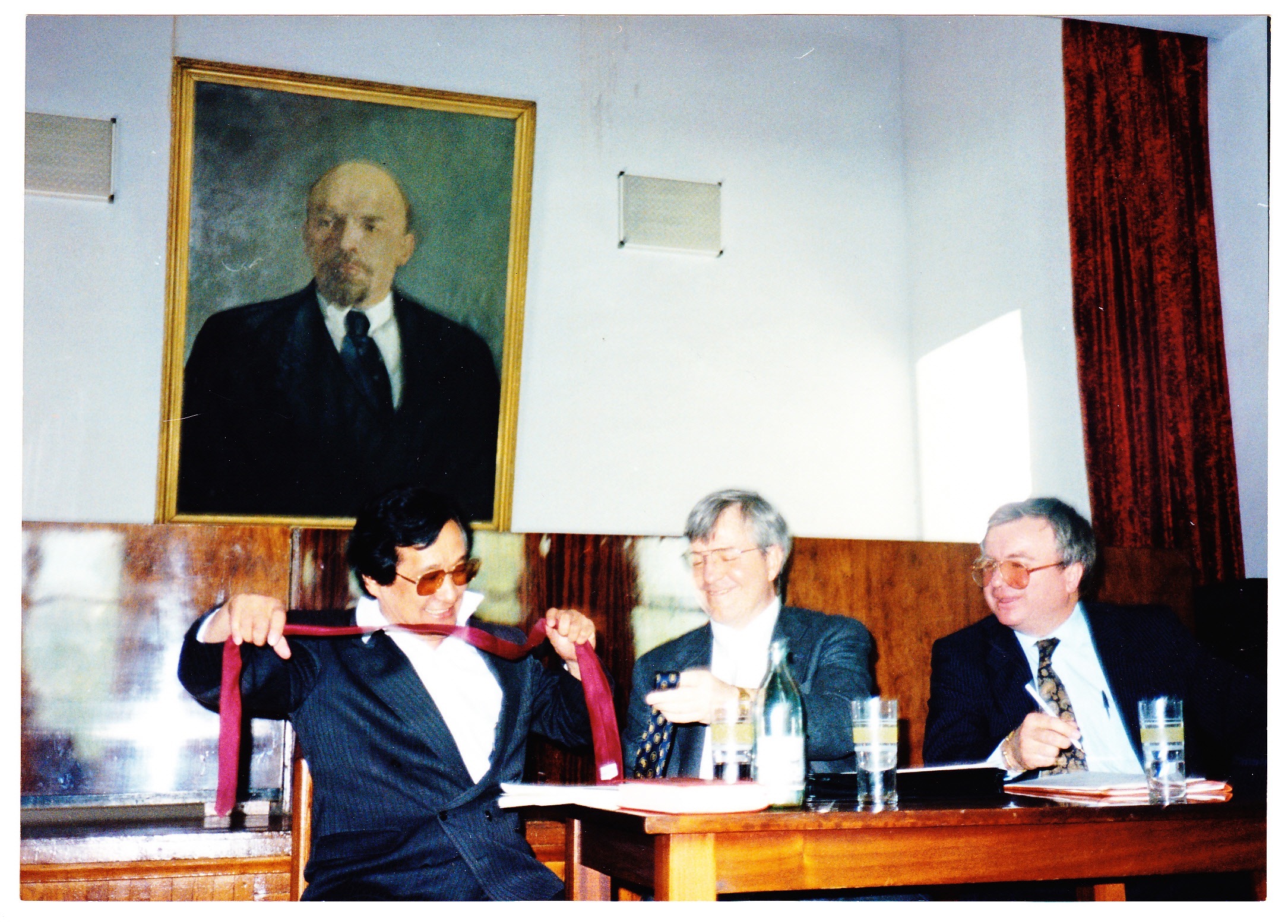
As you can see in the picture below a huge portrait of Lenin (about 20 feet tall) still hung in the background of the main auditorium in the National Bank of Kyrgyzstan during our first visit there in April 1992. In the picture we were meeting with the staff of the NBK to report on our recommendations and work plan. I am presenting the Governor of the NBK, Kemelbek Nanayev, with my Adam Smith tie (the image of Smith’s head appears throughout the tie) and Governor Nanayev was reciprocating by giving me his own tie. Our Russian interpreter from Moscow was looking on and so was Lenin. When we returned three and a half months later, the Lenin portrait had been removed.

TieExchange

But Lenin did not disappear as quickly in some other places. He remained on the wall of the Chief Accountant of the National Bank of Kazakhstan, Ms. Abdulina, for some time. Ms. Abdulina was, I would guess, in her early 60s and was very bright and forward looking. After explaining to her the new accounting needs as the NBK issued its own currency and undertook its own monetary policy, she moved quickly to set up a team of young accountants (they were all women) to receive her training in producing a daily balance sheet to reflect bank deposits with the NBK and more broadly what we call reserve money (the monetary liabilities of the central bank). She said that it would be a waste of time trying to retrain the older more senior ones. I liked and respected her very much, but she would not remove Lenin from her office wall. In fact, she never did. On my final visit with the IMF in March 1994 (I have been back many times since under other auspices), Ms. Abdulina had been moved into a new, larger office. Lenin was not displayed on her new office wall. She never had to deliberately remove him from her office wall but now her office was free of him—a very clever finesse.

Lenin was not as directly responsible for the death of millions as was Stalin, but is hardly a lovable character to those of us who grew up in the west. According to George Orwell, Charles Dickens’ “A Christmas Carol… was read to Lenin on his deathbed and according to his wife, he found its ‘bourgeois sentimentality’ completely intolerable.” Why Socialists Don’t Believe In Fun Dec. 1943. Nonetheless Soviet citizens had grown up seeing him as the great founder of their country and many could not let go of that easily.

The United States and especially, but not exclusively, its Southern States are now facing the same issue. Should earlier heroes, whose actions or values are now condemned, be removed from the public square?

New Orleans Mayor Mitch Landrieu defended his plan to remove Confederate monuments across the city in a speech earlier this month:

“These statues are not just stone and metal. They’re not just innocent remembrances of a benign history. These monuments celebrate a fictional, sanitized Confederacy — ignoring the death, ignoring the enslavement, ignoring the terror that it actually stood for….

“There is a difference between remembrance of history and reverence of it.  For America and New Orleans, it has been a long, winding road, marked by great tragedy and great triumph. But we cannot be afraid of our truth….

“Last year, President Barack Obama echoed these sentiments about the need to contextualize and remember all of our history…. Remember President Bush’s words, “A great nation does not hide its history. It faces its flaws and corrects them….”

We are removing these statues, “Because we are one nation, not two; indivisible with liberty and justice for all, not some.”

I was blown away by the Mayor’s wonderful speech and urge you to read all of it: New Orleans mayor Landrieu’s address on confederate monuments

Among the statues removed were those of Robert E. Lee and Jefferson Davis about which Mayor Landrieu said: “It is self-evident that these men did not fight for the United States of America, They fought against it. They may have been warriors, but in this cause they were not patriots.”

What should we and other countries do when past heroes cease to deserve or have our respect? They are, after all, part of our history. The first principle, as articulated by Obama, Bush W, and Mayor Landrieu, is that that history should be told and understood honestly. The second principle is that historical actors should be understood and judged in the context in which they acted.

George Washington and Thomas Jefferson were slave owners in a time in which that was accepted and common as horrible and unacceptable as we see it and know it today. They were otherwise men of great wisdom and courage who deserve our respect. Robert E. Lee inherited slaves but freed them before the Civil War was over. However, he led a war against his country and fought to preserve the institution of slavery. Many former Soviet Republics moved their statues of Lenin and Stalin to historical parks outside of the towns they had occupied where their history could be told honestly and in the context of their time. The statues of Robert E Lee, Jefferson Davis, and P.G.T. Beauregard will also be relocated away from the heart of New Orleans. I find this to be an appropriate resolution to the pain their presence brought to many of today’s residence of this fascinating city.


Cayman Financial Review, Q3 2015

Dear Friends,

The Third Quarter issue of the Cayman Financial Review is now available on the web: http://www.compasscayman.com/cfr/. I am on the Editorial Board and have two articles in this issue that might interest you. The first discusses the continued decline of U.S. world leadership exemplified in the case of the new Asian Infrastructure Investment Bank located in China: http://www.compasscayman.com/cfr/2015/08/19/US-leadership-and-the-Asian-Infrastructure-Investment-Bank/

The second is the final installment of my series on the Kabul Bank scandal. The failure of Kabul Bank in Afghanistan was probably the biggest bank failure and fraud in history on a per capital basis.  As this final article looks at some of the legal issues and developments in recovering stolen assets held abroad and Afghanistan’s uneven struggle to strengthen its criminal justice system, Gary Gegenheimer, a lawyer who also worked in Afghanistan, joined me to write this third installment: http://www.compasscayman.com/cfr/2015/08/19/The-Kabulbank-scandal–Part-III/

I hope that you enjoy them.

Best wishes,

Warren

Berlin: Then and Now

The first time I saw Berlin was in 1960, just 15 years after the end of World War II in Europe. I came for a week of exploring with the other participants in the International Christian Youth Exchange living in Germany for the school year of 1959 – 60, during which I lived with a German family in the small village of Rasdorf near the somewhat larger village of Hünfeld, near the small city of Fulda. Though Rasdorf was on the border between East and West Germany, we had to fly to Berlin, as it was an island of West Germany within the Deutsche Democratic Republic (DDR), commonly referred to as East Germany. While Berlin was technically divided into four zones (American, British, French and Russian), it was administratively divided into the Western Zone, which was part of the Federal Republic of Germany, and the Eastern Zone controlled by a puppet government installed by the Soviet Union. The wall that separated the two had not yet been built nor even thought of at the time.

By then I had lived for the better part of a year within walking distance of a ten meter wide strip of plowed earth that separated East and West Germany – the communist world from the free world – and our village from the next one to the east. The physical scars of the Great Patriotic War, as the Russians called it, were little in evidence in Germany’s villages such as Rasdorf. Berlin, however, was a very different matter.

According to Wikipedia: “Up to the end of March 1945 there had been a total of 314 air raids on Berlin, with 85 of those coming in the last twelve months. Half of all houses were damaged and around a third uninhabitable, as much as 16 km² of the city was simply rubble.” Estimates of the total number of dead in Berlin from air raids range from 20,000 to 30,000. To put it into perspective, the total U.S. causalities in Iraq from March 19, 2003 to May 26, 2015 were 4493.

By 1960 West Berlin had enjoyed considerable rebuilding. But vast areas remained flattened and uninhabitable, though generally cleared of rubble. The now thriving hot spot of Potsdamer Platz, just west of what was about to become the Berlin Wall, was a large vacant space. The Kurfürstendamm, on the other hand, was largely rebuilt and thriving with the steeple of the bombed out Kaiser Wilhelm memorial church still standing, as it is today, as a memorial to the horrors of war.

The 17 Juni strasse in the West becomes the Unter der Linden strasse as it passes through the Brandenburg Tor to the East. Its buildings also had been fully restored to their prewar appearance. But not more than one or two blocks on either side was nothing but gutted buildings and ruble. It was a shocking sight. Coming from America, I had never seen such massive devastation before in my life. Of course, today no evidence of the war exists anymore except in memorials and museums. And even the Berlin Wall, which existed from 1961 to 1989, is gone; a small portion of the Wall still remains as a historical reminder for visitors but mainly it has been broken up into inch-size fragments for sale to tourists or used as decorations in hotel lobbies, one of which sits on my office bookshelf.

The apartment building Ito and I are now staying in on Behrenstrasse is just one block south of Unter der Linden strasse and has replaced the gutted buildings I had seen 55 years earlier. As far as I can see in every direction now the area has been fully rebuilt, as very little was restorable. The exceptions are the grand buildings of Berlin’s original and once again city center (Humboldt University, several concert halls, Museums, the Berliner Dom and some other churches).

During our day trip to East Berlin during that first visit in 1960 our group went to the Opera House, which had survived the war, and saw a performance of a portion of opera. I remember the concert very well. They performed the Polovtsian Dances from Alexander Borodin’s Prince Igor. It was very familiar to me from the American musical Kismet. Being the naive and skeptical 18 year old that I was at the time, I complained to my companions that those damn Russian’s had stolen these songs. They will steal anything, I said. Learning that the reverse was true soon there after was eye opening.

I returned to Berlin, now divided by the Berlin Wall, in 1976 or so to visit my former wife’s sister Jean and her husband Tom, and then again for the Mont Pelerin Society meetings in 1982 with Milton Friedman and other economists in attendance. By then I was in my mid 30s. Reconstruction continued in the West but little had changed in the East. During the first of these two visits I saw, with Jean and Tom, my first ever full opera, this time in the Western Zone. The opera was Madam Butterfly, a nice introduction to the world of opera. I marveled at the music, of course, but also found it fascinating that I was watching an opera sung in Italian about a geisha who had fallen in love with an American Captain in Japan and I was watching it in Germany.

I returned to a reunited Berlin (and a reunited Germany) after the fall of the Berlin Wall in 1989 and the subsequent collapse of the USSR several times again for one reason or another. Once was to visit my German friend Moritz Schularick, with whom I will meet again here for dinner on Monday. The burst of construction and development in the newly freed Eastern Zone was amazing. The transformation with each of my subsequence visits was quite pronounced. Younger people no longer refer to the Eastern Zone. The hotel where we are now staying is in what was once part of the Eastern Zone, and is now called Mid Town (Mitte).

We are now vacationing in Berlin because Ito has been reading a lot about Winston Churchill and the Germans in the Nazi government such as Albert Speer, Joseph Goebbels, Rudolf Hess, and Hermann Göring, and WWII in general and he wanted to see the places he has read about. So here I am 55 years after my first visit in 1959 astonished at the city’s history of glory, infamy, courage and pain, destruction and eventual reconstruction and rebirth. Hitler’s famous bunker here where he ended his life together with his new wife Eva Braun and his dog Blondi has been filled in and covered over, but the Germans have gone out of their way not to cover up their treatment of the Jews in what came to be called the holocaust. Still, it feels a bid odd walking and riding around this historic city with its many Nazi ghosts. It is also the city in which brave Germans sought freedom in the West by jumping out of windows over the Wall, digging tunnels under it, and by risking their lives in order to escape the Eastern Zone to live in the West.

The story of Berlin, from then until now, is an example how a people can succumb to inhumane beliefs and behavior, recover their humanity and respect for freedom, and once again flourish. Germany’s long history includes both great and horrendous acts. Within my lifetime the Nazi’s rose to power and threatened the world in WWII, Berlin was completely and utterly destroyed by allied bombing near the end of that war, then occupied by the Red Army in 1945, the city butchered into four quadrants as part of the Allies’ Cold War with the USSR, the Berlin Wall was constructed in 1961 and torn down in 1989, and Germany was reunified in 1990, subsequently prospering as a free and democratic state. I am grateful to have been able to witness what seems to be a positive outcome to this complicated story.

The Cayman Financial Review

I have three articles in the latest issue of the quarterly Cayman Financial Review, on whose editorial board I serve. The first is the Letter from the Editorial Board, which explores my thoughts on restoring more market discipline of bank risk taking rather than piling on more government regulations: http://www.compasscayman.com/cfr/2015/04/22/Changing-direction-on-bank-regulation/ The second is the second installment of The Kabul Bank Scandal series, http://www.compasscayman.com/cfr/2015/04/22/The-Kabulbank-Scandal–Part-II/   And the third is my review of Martin Wolf’s new book, “Shifts and Shocks.”   http://www.compasscayman.com/cfr/2015/04/22/%E2%80%9CThe-Shifts-and-the-Shocks%E2%80%9D-by-Martin-Wolf/ If any of these topics interest you please click on its link.

Should the U.S. help finance Ukrainian weapons?

Ukraine is much more important to Russia than to the U.S. It borders Russia, was part of the Soviet Union, and much of what is now Ukraine, including Kiev, has been part of Russia from time to time for as long as the United States has existed. Ukraine’s importance to the U. S. is, however, more academic. It is reasonable to assume that as long as it is economically able Russia will counter any increase in Ukraine’s military capacity and activity in eastern Ukraine (the part bordering Russia) with equal or greater military force. If we increase our support and Ukraine elevates its military activities in the east, so will Russia. The Russian economy is suffering from years of exploitation by Putin and his friends as well as inadequate investment and is now suffering from the sharp fall in the prices of its primary exports– oil and gas. Russia will presumably only stop matching escalations from the West when it is no longer economically able to do so. Do we have a national security interest in escalating that far?

Our interest in Ukraine is humanitarian– not military out of a concern for our own security. We would like to see the people of every country enjoy the freedom and prosperity that we have. Moreover, most of us have long believed that healthy, prosperous, well-governed countries make better neighbors and a more peaceful and prosperous world. So it serves that interest and our humanitarian natures to encourage and financially support the new Ukrainian government’s efforts to reduce the corruption their country has long suffered from. Military aid is an entirely different matter.

Both we and Ukraine’s government in Kiev must accept and come to reasonable terms with Russia’s dominance in the area and its determination to remain in Eastern Ukraine as it has in South Ossetia and Abkhazia. The alternative, which would likely follow the injection of western arms into the conflict, would be a continued escalation of fighting with unknown consequences and an unknown end point. We don’t like to give in, and wouldn’t and shouldn’t whenever our national security is truly at stake, but this is not our war. What, after all, did our “victory” in Iraq (one of the most insane and ill-advised wars we have ever launched) gain us? ISIS!!

Let’s help Ukraine financially, which it desperately needs, as long as its government continues to seriously fight the corruption that has characterized it for so long (easier said than done). Ukrainian offensives in “rebel”/Russian dominated areas of the East are futile and we should not encourage them by providing the weapons that make them possible. Freeze the status quo until Russia comes to its senses (which we should encourage in every possible way) or collapses economically (which we should not hope for).