
Competing with China

China is now our main economic and political rival. Our proper and honorable response should be to strengthen our side—to be the best that we can be—in the way that one athletic team would fairly compete with another. Instead, we seem to be following the Michael Corleone—God Father—script of knee capping the enemy. Worse still, rather than pulling China into compliance with the international rules of commerce, we are moving toward their failing system of central guidance (industrial policy) of investment.

Deng Xiaoping, who served as the “paramount leader” of the People’s Republic of China (PRC) from December 1978 to November 1989, ended Mao’s repressive economic policies thus freeing up much of the economy under policies dubbed “socialism with Chinese characteristics.” Deng became known as the “Architect of Modern China.” “Since China began to open up and reform its economy in 1978, GDP growth has averaged almost 10 percent a year, and more than 800 million people have lifted themselves out of poverty.” When Xi Jinping took the throne in 2013, China’s annual GDP growth rate was 7.8%. As he increasingly reversed Deng’s economic liberalizations, China’s growth rate has steadily declined and is expected to average 2.8% in 2022. “World Bank – China”

The dramatic economic growth around the world since the start of the industrial revolution is founded in private property and trade. Trade enables individuals (and families) to specialize in what they have a comparative advantage in producing and trade it for what their neighbors are better at. Both are wealthier as a result. “Econ-101-Trade in very simple terms”    “Benefits of free trade”

Following President Richard Nixon’s page turning first visit to the Peoples Republic of China in 1972, when China’s total exports had drifted down from 4.3% of China’s GDP in 1960 ($2.6 billion) to 3.25% ($3.7 billion), until the U.S. formally established full diplomatic relations with the PRC under Deng in 1979, when its total exports were 5.16% of its GDP ($9.2 billion), exports remained a small part of China’s economic output. U.S. diplomatic recognition opened the door to increased trade with China.

At the time, a friend asked me what China could possibly produce that we would want to buy (I swear). While Chica’s exports changed little over those 19 years as a share of its GDP, it increased threefold in dollar value as a result of Chica’s overall economic growth.

Over the next 19 years (1979-1998) following Deng’s economic liberalization, China’s exports rose to 18.34% of its GDP and to $188.8 billion in absolute terms (over 20 times its exports in 1979). Income growth in developing countries normally reflect investment in capital, but in China’s case the larger share of its spectacular growth after its liberalization resulted from the improved efficiency of its resource allocations (increased labor and capital productivity). According to an IMF study “Analysis of the pre- and post-1978 periods indicates that the market-oriented reforms undertaken by China were critical in creating this productivity boom…. Prior to the 1978 reforms, nearly four in five Chinese worked in agriculture; by 1994, only one in two did. Reforms expanded property rights in the countryside and touched off a race to form small nonagricultural businesses in rural areas.” “Why Is China Growing So Fast”

But to maximize the win-win feature of trade, each person/firm must make its decisions about what to produce and trade without distorting outside interference (taxes, subsidies, buy American, etc.). Thus, communities develop rules and norms for “fair” trade. When trade extended beyond the community to the entire world, individuals and countries could maximize the mutual benefits of trade by extending such rules internationally. The U.S. had high protective tariffs on some Chinese goods under the Smoot–Hawley Tariff Act of 1930 (the Reciprocal Trade Agreements Act of 1934 allowed the US President to negotiate bilateral tariff reductions). China had many restrictions on foreign investments in China and a variety of government interventions in its export markets. These restrictive measures needed to be addressed as part of granting China membership in the World Trade Organization (WTO).

From joining the WTO at the end of 2001, China’s $272.1 billion in exports exploded to almost $3,550 billion over the next 19 years (2020), an increase of 13 times (essentially the same share of its GDP as the result of its extraordinary growth in total output). China’s imports followed a similar, but modestly lower, path, raising from 4.4% of GDP ($2.6 billion) to 17.42% of GDP ($3.090 billion) in 2020.  Prior to China’s admission into the WTO what had historically been generally balanced trade (imports and exports generally balanced) rose to a trade surplus of 4.45% in 1997. China sold more abroad than it bought from abroad and bought U.S. debt and property with the resulting surplus. It was hoped and expected that China’s pursuit of an export promotion policy based on an undervaluation of its exchange rate would be reined in by its adoption of WTO rules.

The Peoples Bank of China requested technical assistance from the IMF with complying with WTO requirements. In July 2002 the IMF sent me to discuss and organize the assistance for what was one of my most enjoyable missions (VIP tours of the Great Wall and the Forbidden City and some fabulous dinners). They wanted an American banking supervisor. One of my conditions was that he be given an office with an open door with the rest of the Chinese supervisors. The Deputy Governor approved our agreement, but the Governor vetoed it reflecting the existence of conflicting views on China’s way forward. The primary difference with the officials I talked to was how fast China should liberalize. They all agreed on the direction. The IMF report cited above stated that: “By welcoming foreign investment, China’s open-door policy has added power to the economic transformation. Cumulative foreign direct investment, negligible before 1978, reached nearly US$100 billion in 1994; annual inflows increased from less than 1 percent of total fixed investment in 1979 to 18 percent in 1994.” Direct foreign investment in 1994 was $34 billion and in 2020 it was $253 billion.

China’s gradual liberalization of its restrictions on capital outflows have resulted in larger outflows than inflows since early 2020. Between February and July of this year (2022), China suffered a record net outflow of US$81 billion via the Stock Connect and Bond Connect mechanisms, according to data from the Institute of International Finance (IIF). 

As developing countries catch up to the developed country leaders, their growth rates are expected to slow. But China’s continued heavy government direction of investment, while producing impressive high-speed trains and many thousands of high-rise apartments, and the resulting level of wasteful malinvestment is increasingly taking its toll. After speaking at a People’s Bank of China and Reinventing Bretton Woods conference in Hangzhou in 2014, I continued West to participate in the Astana Economic Forum, in Astana, Kazakhstan, stopping overnight in Urumqi, China, to celebrate my 72 birthday and change planes. Driving from the airport into a lovely Sheraton Hotel in downtown Urumqi, I passed row upon row of empty high-rise apartments (it was evening, and they were all dark) now the source of a major real estate crisis.

When Xi Jinping took over as China’s leader in 2013, the unfinished project of economic liberalization was stopped and put into reverse. The slowing of China’s growth rate accelerated. Clyde Prestowitz reported that: “The CCP [Chinese Communist Party] has long operated the economy on the basis of five year plans. In 2015, the new five year plan included the objective of: Made in China 2025. It listed a range of hi technology items with a target for making them in China by the year 2025. Semiconductors were high on the list, and as an advisor at the time to Intel, I can say that China exerted enormous pressure on that company and many others to move their production of semiconductor chips to China” “Tom Friedman has Biden and China Backward”

We are competing with China just as every firm competes with every other firm. It is mutually advantageous for both economies to grow. It is win win. But neither of us fully plays by the rules of fair trade. What should we do? While adopting policies to strengthen our own economy, we should encourage China to fulfil its WTO obligations. We are doing the opposite. We are taking the God Father mobster approach. As Edward Luce put it in the Financial Times: “Imagine that a superpower declared war on a great power and nobody noticed. Joe Biden this month launched a full-blown economic war on China — all but committing the US to stopping its rise — and for the most part, Americans did not react”  “Containing China is Biden’s Explicit Goal”

German Chancellor Olaf Scholz declared that “Globalisation has been a success story that enabled prosperity for many people. We must defend it…. Decoupling is the wrong answer…. 

We don’t have to decouple from some countries,… I say emphatically we must continue to do business with China.” “Decoupling China wrong answer says German leader”

“Mr. Xi and President Biden should focus their efforts on the future they seek, rather than the one they fear…. If a peaceful — if competitive — coexistence is the ultimate objective, Washington and Beijing do not need to knock each other out to win.” Jessica Chen Weiss in NY Times

We are restricting and reducing trade rather than encouraging its expansion. Not only has President Biden left former President Trump’s unjustified and damaging steel and aluminum tariffs in place (including on Canada) on national security grounds, but we have also directly knee-capped Chinese industries (Huawei, semiconductor chip supplies, etc.). “On 7 October, the Biden administration imposed a sweeping set of export controls that included measures to cut China off from certain semiconductor chips and chip-making equipment. Under these rules, US companies must cease supplying Chinese chipmakers with equipment that can produce relatively advanced chips unless they first obtain a licence.” “What do US curbs on selling microchips to China mean for the global economy”

Historically, such measures, as well as tariffs and bans on certain imports, have been motivated by protecting domestic firms or industries. “The Reign of Polite Protectionism”  The Jones Act of 1917, which forbids shipping goods between US ports in anything other than US built ships, is one of the most useless and embarrassing such laws (ask Puerto Rico). Banning the sale of some items to China can have a military justification but drawing the line between justifiable security concerns and the protection of uncompetitive domestic firms can be difficult. Trump’s 25% tariff on Canadian steel was (but cannot honestly be) justified on national security grounds. Whither justified or not, such restrictions make China and the U.S. (and the rest of the world) poorer. “Next salvo in Biden’s tech war on China expected to aim at quantum computing parts and artificial intelligence software.”  “US mulling bans to stunt China’s quantum computing”  Such restriction are examples of the knee-capping approach to competing with our rivals. “Trade protection and corruption”

But worse still we are now increasingly adopting China’s approach to economic management by the state—so called industrial policy. The recently adopted Inflation Reduction Act, for example, along with measures to reduce carbon omissions, subsidizes the domestic production of solar panels, wind turbines, batteries, and the processing of some critical minerals. A good economic case can be made for encouraging the use of low or non-carbon emitting sources of energy such as with the carbon taxes imposed in Europe. But there is no good case for incurring the higher cost of subsidizing the manufacture of low carbon emitting energy sources in the U.S. The same applies to subsidizing the domestic production of semiconductor chips as is established in this Act. The historical experience with government selection and support of particular products or technologies is not good to say the least. The Trump administration’s promise to buy successful Covid vaccines was a much better and very successful approach to encouraging the private sector.

“French President Emmanuel Macron slammed US trade and energy policies for creating “a double standard” with Europe…. He complained that ‘they allow state aid going to up to 80% on some sectors while it’s banned here — you get a double standard…. It comes down to the sincerity of transatlantic trade….’ The EU has been chafing over the US stimulus package known as the Inflation Reduction Act, which provides subsidies for electric cars made in North America.” “Macron accuses US of trade double standard amid energy crunch”

The financial incentive for corruption in obtaining government financial support is obvious. But even without it, government agents are at best just as good at determining and funding the best new and promising technologies for the future as are private entrepreneurs. The difference is that the private entrepreneurs are risking their own money and the government is risking yours and my money. The vast majority of such undertakings fail. When funded by the government, however, there is less financial pressure to fold and move on when outcompeted by better products. The government landscape is littered with white elephants.  “Questioning industrial policy”

Our China related policies have become damaging to the US and the West in almost every respect. “The China Initiative, launched in 2018 by the administration of former US president Donald Trump, aimed to fight suspected Chinese theft of technical secrets and intellectual property as competition between the two countries intensified…. At least 1,400 US-based ethnic Chinese scientists switched their affiliation last year from American to Chinese institutions,… The US had been ‘losing talent to China for a while and particularly after the China Initiative’,” “1400 US based ethnic Chinese scientists exited American institutions”  Not only do they return with Western technical knowledge but they also return with a fondness for Western values and freedom. Many Chinese retain that fondness and the desire to import more of it into China. We should not kill off those desires.

Doug Bandow offers sound advice: “There is still much for the West to do. The future is not set, and contra Xi’s boastful rhetoric, freedom still is the better bet for the world. Washington should start by addressing its own weaknesses. Free and allied states can constrain the PRC when necessary while cooperating with Beijing when possible, addressing Chinese abuses without adopting the PRC’s authoritarian and collectivist strategies. Americans should continue to engage the Chinese people, especially the young, showing respect for a great civilization while making the case for a free rather than totalitarian society. America can remember the crises she has overcome in the past, and confidently confront the China challenge today.” “Xi plays Mao without the madness”
The Ukraine War

Ukrainian President Zelensky says his country will file an expedited application to join NATO immediately. “’De facto, we have already proven interoperability with the Alliance’s standards, they are real for Ukraine — real on the battlefield and in all aspects of our interaction,’ Zelensky said. ‘Today, Ukraine is applying to make it de jure.”  “Zelensky says Ukraine filing expedited application to join NATO”  This reverses Zelensky’s statements he made in March of his willingness to stay out of NATO.

NATO members should just say no.  Hell no! After successfully serving to protect the West from the USSR, post-Soviet NATO has become a liability. After breaking our promise not to expand NATO further east in exchange for Russia’s agreement to the reunification of Germany, NATO has done nothing but cause problems.

In December 2021, Russia released an eight-point draft treaty to prevent its invasion of Ukraine. At the top of its list was no NATO membership for Ukraine. Soon after Russia’s invasion, President Zelensky offered to give up seeking NATO membership and agreed to much of what Russia demanded. The status of the largely Russian Donetsk and Lugansk was the largest sticking point. For reasons I totally fail to understand, the United States and its NATO allies refused to remove Ukraine’s NATO membership from the table while stating that membership was not a near term prospect. “Ukraine-Russia-NATO”

In March, following Russia’s stalled Feb 23 attack on Kyiv, representatives of Russia and Ukraine met at Belovezhskaya Pushcha, on the border of Poland and Belarus, for initial ceasefire talks.

Putin made six key demands:

  1. No NATO membership and a neutral position.
  2. Russian should be the second official language of Ukraine, with laws prohibiting it abolished.
  3. Recognize Crimea as Russian territory.
  4. Recognize the independence of Donetsk and Lugansk.
  5. Demilitarization of Ukraine and abandonment of weapons that could be a threat to the Kremlin.
  6. Banning of ultra-nationalist parties and organizations in Ukraine.

Of these, only #4 would be difficult for Ukraine to accept, but no agreement was reached, and the fighting continued with more and more Western support.  “Ukraine’s and Russia’s war”  The U.S. and NATO can bring Ukraine to the peace table anytime they want (by threatening to end their military and financial support).  No compromise agreement was reached in December, February, March or beyond. And NATO keeps expanding. Why? Why is the U.S. and NATO not pushing to make a peace agreement happen? If Russia still thinks it can come out ahead, China, India and others should convince it otherwise.

In a recent column in the Washington Post former chairman of the Joint Chiefs of Staff Mike Mullen, former U.S. senator Sam Nunn (D-Ga.) and former U.S. energy secretary Ernest J. Moniz, all of whom serve on the Nuclear Threat Initiative’s board of directors urged China to step forward:

“The most sensible policy choice for China is to wield its unique position of influence to encourage more “rational” decision-making by Putin. In particular, President Xi must make clear to Putin that nuclear use is a line he must not cross and that nuclear saber-rattling itself threatens the global nuclear order….  The United States and China can — and must — now work together with Europe and other nations to help end this war on the “just terms” called for by Biden in his speech to the United Nations.” “Xi Putin Ukraine nuclear arms”  

Every few months, I have urged us to stop this destructive war now. As winter approaches Europe with mounting energy shortages, I say it again. Stop it now.   “End the war in Ukraine”

Nancy Pelosi in Taiwan

Nancy Pelosi, the Speaker of the U.S. House of Representatives, just arrived in Taiwan. Why is this a big deal? Shouldn’t anyone be able to visit any country that has opened their doors to them? It depends on the context and purpose.

The civil war for control of China was won by the Chinese Communists lead by Mao Zedong in 1949. The opposition, led by General Chiang Kai-shek, fled to Taiwan and reestablished the Republic of China (POC) there. The civil war was fought on and off between 1927 and 1949 when the victorious Mao established the Peoples Republic of China (PRC) and designated Taiwan as its 23rd province. Both the PRC and POC claimed to be the legitimate governments of all of China.

Following President Richard Nixon’s historic visit to China in 1972, “the United States moved to recognize the People’s Republic of China (PRC) and de-recognize the Republic of China (ROC) in 1979, [and] the United States stated that the government of the People’s Republic of China was ‘the sole legal Government of China.’ Sole, meaning the PRC was and is the only China, with no consideration of the ROC as a separate sovereign entity.

“The United States did not, however, give in to Chinese demands that it recognize Chinese sovereignty over Taiwan (which is the name preferred by the United States since it opted to de-recognize the ROC). Instead, Washington acknowledged the Chinese position that Taiwan was part of China. To this day, the U.S. ‘one China’ position stands: the United States recognizes the PRC as the sole legal government of China but only acknowledges the Chinese position that Taiwan is part of China.

“Congress passed the Taiwan Relations Act in 1979 to protect the significant U.S. security and commercial interest in Taiwan. The TRA provided a framework for continued relations in the absence of official diplomatic ties….  The TRA sets forth the American Institute in Taiwan as the corporate entity dealing with U.S. relations with the island; makes clear that the U.S. decision to establish diplomatic relations with the People’s Republic of China rests upon the expectation that the future of Taiwan will be determined by peaceful means;… mandates that the United States make available defensive arms to Taiwan; and requires that the United States maintain the capacity to resist any resort to force or other forms of coercion that would jeopardize the security, or the social or economic system, of the people on Taiwan.”

“What is US one China policy and why does it matter?”

All American Presidents have affirmed this one China commitment while maintaining its “strategic ambiguity”. “U.S. Secretary of State Rex Tillerson said [that] the Trump administration is committed to the long-standing ‘One China’ policy as it reviews U.S. policy toward China, but also intends to keep all of its commitments to Taiwan.” June 13, 2017. “USA China-Tillerson committed to one China policy”

More recently: “Joe Biden made a potentially dangerous statement on Monday. In Tokyo, he gave a flat ‘yes’ to a reporter’s question of whether he was willing to ‘get involved militarily to defend Taiwan’. ‘That’s the commitment we made,’ the president claimed. In fact, the United States scrapped its formal commitment to defend Taiwan in 1979…. This is the third time in less than a year that Biden has publicly declared that the United States would use force to keep Beijing from seizing the island.  “Biden defend Taiwan-China invasion”

Pat Buchanan asks: “But if the U.S. went to war to defend Taiwan, what would it mean? We would be risking our own security and possible survival to prevent from being imposed on the island of Taiwan the same regime lately imposed on Hong Kong without any U.S. military resistance.”  “Is Taiwan’s independence worth war?”

What is Pelosi’s objective in going to Taiwan? What does she hope to accomplish with her poke in the Chinese eye? Our interest should be to promote the integration of Taiwan with the rest of China “by peaceful means.” Our diplomacy should be deployed to that end. President Biden’s repeated slips and Nancy Pelosi’s Taiwan visit do not provide the tone nor context for such diplomacy. I believe that her visit to Taiwan is a dangerous mistake. While we would be hard pressed from thousands of miles away to win a war with China, China would suffer enormously as well and probably has better sense than to start such a war. But what is the purpose of such a challenge?

Russia: How should we fight back?

Russia’s attack on Ukraine has rightly outraged most of us. Leaving aside the history that brought us to this present conflict, Russia’s attack is totally unjustified. Our natural instincts are to help Ukraine resist its aggressor. As we watch the destruction of lives and property, it is natural to want to send in our boys or planes to help. Surely, we can stop this by using the might of our military and advanced weapons. Wars tend to look like that in the beginning. Vietnam, Afghanistan, Iraq (I still can’t sort out what Bush/Cheney thought was America’s interest in attacking Iraq) looked like slam dunks going in. The realities were invariably very different by the end. How should we help Ukraine?

The U.S. and Ukraine’s NATO neighbors have been supplying Ukraine with weapons but left them to fight on their own. This was my assessment a month ago: “Ukraine-Russia-NATO”  As much as it strains against our impulse to help, President Biden is absolutely correct in ruling out our joining the war. For most of us, war, and the incredible pain it inflicts on those directly involved, is fought elsewhere by others. It is far too easy to say “sure, lets go to war.” “Ukraine-how should we help?”

But wars can be fought economically as well as militarily. Much of the West (the designation seems relevant again) has joined together to impose severe economic sanctions on Russia. But the objectives of these sanctions are not clear. They are too late to deter Russia from its invasion of Ukraine, though perhaps they provide an example of the potential cost to China if it decides to invade Taiwan. Are they meant to pressure Russia to come to the negotiating table? But it takes two to tango–Zelensky must be there as well. I have heard no statement of what Russia must do for the sanctions to be lifted.

The sanctions seem designed to cripple the Russian economy. Sadly, the pain will fall mainly on the Russia people rather than its government. Considerable pain will also fall on those imposing the sanctions. “The war in Ukraine and globalization”

Supply chains and financial channels will be disrupted for many years. But like military wars, the collateral damage an economic war is hard to predict. China and Russia and maybe India and much of Africa are being driven together to establish new trading relationships and non-dollar payment channels that don’t seem to serve American interests. If they are not explicitly linked to accelerating a negotiated peace, what are the sanctions for?  I don’t necessarily believe that our military industrial complex deliberately promotes the perpetuation of war, but as an economist I can’t ignore the fact that they have an economic incentive to do so.  

Missing from all of this seems to be the skillful deployment of diplomacy. The first priority, of course, is to end the fighting in Ukraine. But any peace agreement must look beyond the immediate war to the conditions that will promote peace and prosperity for Ukraine, Russia, Europe, and the world well into the future. As is often the case Chas Freeman says it best: https://www.youtube.com/watch?v=0vxufUeqnuc

American policy on Taiwan

Following President Richard Nixon’s famous visit to China in 1979 the so called One-China policy was first stated in the Shanghai Communiqué of 1972: “the United States acknowledges that Chinese on either side of the Taiwan Strait maintain there is but one China and that Taiwan is a part of China. The United States does not challenge that position.” “One China policy – U.S. policy”  However, in the Taiwan Relations Act (April 10, 1979), the U.S. stressed its opposition to any effort by the People’s Republic of China (PRC) to change conditions in Taiwan by force. Just how that opposition might be expressed has remained ambiguous ever since.

The United States has no treaty obligation to help defend the Republic of China (ROC–Taiwan) against a military attack by the PRC. It is doubtful that the U.S., located thousands of miles from Taiwan, could win an encounter with the PRC only 100 miles away. In recent simulated war games with China the U.S. has lost. “As the US and China continue to posture the key will be Taiwan” A military intervention by the U.S. would create a significant risk of escalation into nuclear war. 

China experts such as Chas Freeman have argued that since Washington long ago agreed that ‘there is only one China and that Taiwan is part of it,’ any mainland invasion would simply be a civil war in which America has no right to intervene.” Moreover, risking nuclear war to defend Taiwan would not be in America’s or anyone else’s interest.

Until quite recently, Taiwan’s efforts to build its capacity to defend itself from a mainland attack rested heavily on the presumption that its defense would come from the U.S. “Taiwan’s military has closely mirrored its U.S. counterpart in miniature for years…. The problem with copying the American approach to warfare is that the U.S. military’s doctrine is to project power over great distances and to maximize mobility and networks to take the fight to the enemy with overwhelming superiority. Taiwan, on the other hand, needs the opposite: short-range and defensive systems that can survive an initial bombardment from a larger adversary and that are suitable for deployment close to home in defense of the island should it come under blockade or attack.” “Winning the fight Taiwan cannot afford to lose”

Taiwan’s almost $17 billion-dollar annual defense expenditures keep American weapon’s companies happy but didn’t contribute seriously to Taiwan’s defense. “Taiwanese military analysts have criticized the island for spending too little on defense, and for spending money on eye-catching purchases such as F-16 fighter jets rather than less-flashy weapons systems that would better enable Taiwan to wage asymmetric warfare against the PLA’s superior strength.” “Concerns about Taiwan put focus on islands defensive weakness” This has begun to change in the last few years toward weapons more appropriate to defending Taiwan against a ground assault.

While it is in America’s interest for Taiwan, as well as every other country in the world, to be peaceful, democratic, and prosperous, that interest is not sufficient to risk going to war–not even close. We should hope that the relations between Taiwan and the Peoples Republic of China remain peaceful and consensual whatever form they ultimately take. But should China attempt to “change conditions in Taiwan by force,” how should the U.S. express its opposition.  It is a very sad commentary on the state of American international policy that so many American policy makers routinely conceive of expressing American opposition militarily. We have done so too often to the detriment of American interests.

On the other hand, a Chinese military attack on Taiwan would be a violation of its commitment not “to change conditions in Taiwan by force.” In such an event the U.S. should oppose such actions vigorously with coordinated diplomatic measures. A U.S. China war would certainly stop all trade with China. This would badly hurt both of us. But even without war, if a total trade embargo by the U.S. were joined by the EU, Australia, Japan, Korea, Canada, UK, and most other UN members it would be devastating to China. China could be expelled from all the international organizations it has so proudly joined in recent years. Its global ambitions would be destroyed. Such prospects would surely be as powerful a deterrent to China’s invasion of Taiwan as would the prospect of U.S. military intervention in defense of Taiwan.

American interests are better served by being the best that we can be, i.e., by strengthening our own economy and political system (which is in a dangerous mess at the moment). It would also be helpful if Ted Cruz would stop blocking President Biden’s State Department appointments so that we can strengthening our use of diplomacy and return our military from its foreign adventures to the defense of our homeland.

See Jon Schwarz’s interesting review:  WE’VE ALL PRETENDED ABOUT TAIWAN FOR 72 YEARS. IT MAY NOT WORK ANY LONGER   “Taiwan, China, nuclear weapons”

Chinese and U.S. Models

Many aspects of our respective societies and governments follow different rules and approaches to organizing our communities. We presumably prefer (most of) our choices over theirs and vice versa. In explaining why we prefer ours, we might freely criticize theirs. But we generally have no right to demand that they abandon their approach and adopt ours.

Consider China’s Social Credit System.  In the U.S. we are “well accustomed to credit checks: data brokers such as Experian trace the timely manner in which we pay our debts, giving us a score that’s used by lenders and mortgage providers. We also have social-style scores, and anyone who has shopped online with eBay has a rating on shipping times and communication, while Uber drivers and passengers both rate each other; if your score falls too far, you’re out of luck.

“China’s social credit system expands that idea to all aspects of life, judging citizens’ behaviour and trustworthiness. Caught jaywalking, don’t pay a court bill, play your music too loud on the train — you could lose certain rights, such as booking a flight or train ticket.”  “China social credit system explained”

A good Social Credit score will ease access to loans and other good things. Compared to our approach to collecting information on our likely credit worthiness, the more comprehensive and centrally organized rating is more efficient and comprehensive. But we are very aware of the Chinese Communist Party’s sensitivity to criticism and its potential (if not certainty) for abusing such extensive access to information on our personal behavior. So, we would never allow such a system.

But what about the U.S.’s strong support (and push) for AML/CFT (Anti-Money Laundering and Combating the Financing of Terrorism) laws and procedures?  How do we (how can we) justify that? The U.S. requires that all financial firms collect information about their customers (KYC–Know Your Customer) that facilitates the government’s tracing payments of potentially illegally gained money and it has forced this requirement on all countries using U.S. dollars. The cost of these requirements is enormous. But why follow allegedly illegally gained money when the government can’t prove that it was illegally gained in the first place? If it could, the government should attack the illegal activity at its source. Thus, it claims, but cannot prove, that the money was illegally earned. Not only are AML requirements very expensive but the benefits (identifying criminals) are negligible and morally indefensible. “Operation Choke Point”

The issue of whether to require a so-called vaccination passport to document that the bearer has been vaccinated in order to enter facilities that require such proof, provides another example of a clash between efficiency and convenience and privacy. The pros and cons of such documentation are currently being debated in the U.S.  “vaccine passports”

My point is that each country has its own models for organizing and sharing information and for enforcing its laws.  We have every right, and should, carefully evaluate our own practices. What China chooses to do, is China’s business. Fortunately, we live here.

China and the United States

“Biden describes the China challenge as a global, ideological struggle between democracies and autocracies…. Any event from the pandemic to the Olympics will occasion commentary, particularly in the United States, of who “won,” China or America, and what it means for the epic struggle for global supremacy.” “There is no unified front against China”

I am not sure what it is that we want to win. We don’t seem to mind selling planes and bombs to other autocracies (Saudi Arabia, Qatar, etc.). Anything to keep the defense industry’s profits flowing short of yet another war seems a (relatively) good deal. And why might “global supremacy” matter?

Winning things sounds to me like rooting for our own basketball team and cheering when it wins the championship. How do we go about striving to have the best basketball team? First, we recruit the best basketball players we can find and hire the best coach to train them. Everyone must play by the agreed rules, and we win by playing the best game. In short, our efforts go into being the best team possible, not into poisoning the drinking water of the other teams.

But sporting contests are zero sum. One side wins and the other losses. Global cooperation and trade is win–win. The goods we produce and sell (for example) to China, with which to pay for the goods we buy from China make us and China both richer. The citizens of both countries benefit from this exchange. Win–win. Sharing information on the source, nature, and potential cure of a virus (which knows no borders) benefits all of us. Win–win.

The world’s output is maximized when our productive assets (labor and capital) are allocated to their most productive uses globally. That requires that market prices reflect the true productivity and value of each activity. Thus, the world as a whole benefits from rules governing government interferences in market prices and allocations. The World Trade Organization is the forum for agreeing on these rules of fair trade and enforcing them. “Econ 101- Trade in very simple terms”

The airplanes built by Boeing and Airbus benefit from government support of one sort or another. For years they have fought one another over whether this support conformed to fair trade rules. A settlement has finally been reached. “Boeing – Airbus settlement”

Trade restriction in the name of national security, while potentially legitimate, can easily cross the line into wealth reducing protectionism. Does the use of Huawei 5G equipment really threaten U.S. national security or U.S. business interests (protectionism). Some of these cases are hard to call but we must look carefully at narrow business interests in protecting their markets to the detriment of the rest of us. “Huawei ban could crush US aid efforts”

Global supremacy suggests that we would set these rules. To be successful the rules of international trade must be very broadly followed. Thus, their formulation must be a collective undertaking. It is fine for the U.S. to exert influence in setting these rules, but unfortunately, we have a poor record of even following them. We have caused the demise of the WTO dispute resolution body. We have strangely and counterproductively withdrawn from the Trans-Pacific Partnership (TPP), which was then replaced by the Comprehensive and Progressive Agreement for Trans-Pacific Partnership (CPTPP). These set high standards for more open trade that China will hopefully have to meet to join. The self-image of supremacy has corrupted U.S. behavior. Former President Trump’s protectionist tariffs on trade with China, EU, Canada, etc., which President Biden has so far failed to remove, have further reduced U.S. and world income. “Trade protection and corruption”

So, what should our policy be toward China? China has no intention or interest in attacking the United States. They care about their own economies and their own neighborhoods. We should keep our nose and military home to look after our own neighborhood. We should work with China (and Russia and others) to formulate win-win rules for international interactions and behavior. We should apply the mechanisms of the WTO and other international bodies, and diplomacy more generally, to hold China (and others) to the agreed rules. But we must abide by them as well. The rule of law is not just for others.

We should fix the problems in our own economy. We should work to make our domestic rules of commerce fair and efficient so that our economy will be the best in the world. We should work with other countries, including China, to maximize the productivity of their resources because we and everyone else will benefit (win-win).

The United States was founded on principles that have served us well providing a model that the rest of the world would do well to follow. The idea that we should (or can) impose our principles on others rather than provide an example like “a shining city on a hill,” is a violation of those very principles. We have repeatedly failed to uphold those principles, but we keep trying. We must continue trying and must try harder.

Econ 101: Tony Judt on Trade

I just finished listening to the Audible version of Thinking the Twentieth Century, a discussion between Tony Judt and Timothy Snyder, recorded just before Judt died in 2010. Judt was a British-American historian, essayist and university professor who specialized in European history. Snyder is an American author and historian specializing in the history of  Central and Eastern Europe and the Holocaust.

I found Judt to be a very insightful in his area of political and social history expertise but generally off base on economic issues, which is not his field. I fear that his misunderstanding of trade is widely shared so I will set out some important basics as a contribution to better public understanding. “Science” doesn’t dictate policy, but a correct understanding of the economics of trade is essential if one’s value preferences are to lead to policies that produce your desired result.

Judt describes the increase in American wages for manufacturing workers along with their health and pension benefits over the past several decades leading manufacturing firms to outsource their production to the cheaper labor in (for example) China and thus hollowing out American manufacturing.  Almost everything about this description is wrong.

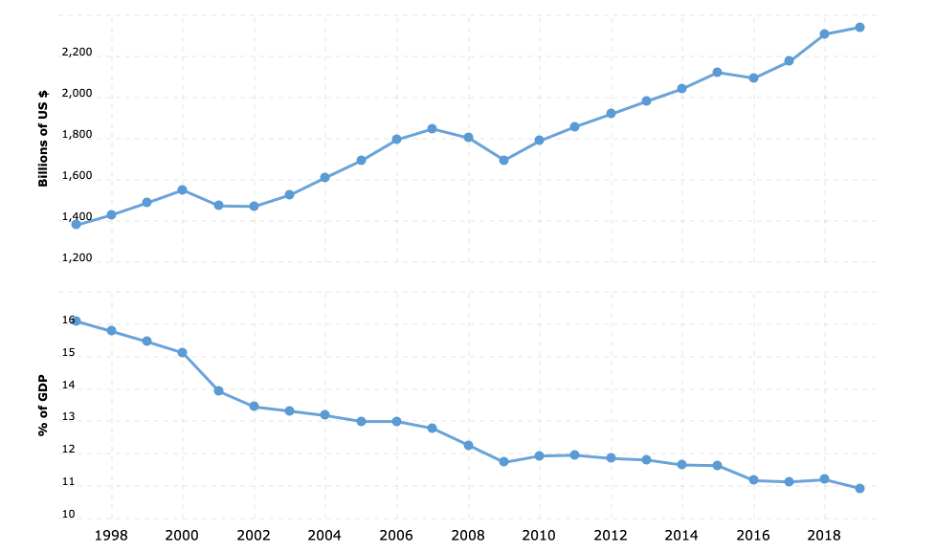
For starters manufacturing output in the U.S. is at an all-time high (prior to Covid shutdowns). Off shorting some of it has not hollowed out U.S. manufacturing.  Because manufacturing output has grown more slowly than the economy overall (the upper line below), its share of GDP has fallen (the lower line). Moreover, because of increased labor productivity in manufacturing, fewer workers are needed to produce this increased output (second chart) thus freeing labor to work in other areas and increasing our overall standard of living.

U.S. manufacturing output

Billions of US $ and Percent of GDP

Data Source: World Bank
MLA Citation: <a href=’https://www.macrotrends.net/countries/USA/united-states/manufacturing-output’>U.S. Manufacturing Output 1997-2021</a>. http://www.macrotrends.net. Retrieved 2021-08-16.

But let’s take a closer look at Judt’s statement. If the U.S. shifts some manufacturing offshore, it must pay for it. Instead of paying American workers it must pay Chinese workers, and firms and shipping companies. Fundamentally, a country’s imports must be paid for by its exports (or by capital inflows from the exporting country). Let’s look carefully at each possibility. To simplify, let’s initially assume that there are no capital flows (cross border investments from one country in another) so that trade in goods and services must balance (i.e., pay for each other).

For starters whether labor is cheaper in China than in the U.S. cannot be determined without considering the exchange rate of the dollar for the Chinese Yuan. If exchange rates (not mentioned by Judt) are flexible (determined freely in the market) the fact of an increase in U.S. imports from China (i.e., the offshoring of U.S. manufacturing to China) will depreciate the dollar/Yuan exchange rate. As U.S. manufacturers sell dollars to buy Yuan with which to pay for the goods they now want to buy from China, Yuan will become more expensive (a depreciation of the exchange value of the dollar). The dollar’s depreciation will have two effects. It increases the cost of Chinese labor to U.S. companies and thus will reduce the cost advantage of Chinese labor and reduce the demand for it by U.S. firms. And it will lower the cost of U.S. exports thus making them more attractive in China. While the adjustments will take time, the dollar depreciation will continue until American exports increase and its imports from China moderate until trade balances–our increased exports pay for our increased imports.

If the exchange rates are fixed, as they were in gold standard days, the adjustment in the real effective exchange rate needed to balance trade takes a different form.  The initial increase in the demand for Chinese products (outsourcing to Chinese workers) are paid for with dollars. But to preserve the fixed exchange rate, the PBRC (Chinese central bank) must buy these dollars with newly created Chinese currency. This increase in the Chinese money supply will lift prices in China making Chinese exports more expensive in the U.S. and U.S. goods cheaper in China. In short, the real exchange rate adjustment needed to balance imports and exports in this case results from a higher inflation rate in China than in the U.S. while in the first case of flexible exchange rates it results from adjustments in the nominal exchanges rates themselves.

A third possibility is for China to take the extra dollars being spent in China and invest them in the U.S. (or elsewhere) This is the capital flow case in which trade itself does not balance.  This was the policy followed by China in the 2000s through 2014. The PBRC would buy the dollars being spent for outsourced Chinese labor (U.S. manufacturers payments to Chinese workers rather than to American ones for the goods they needed) and would invest them in the U.S. If the increase in the Chinese money supply resulting from those dollar purchases was more than was consistent with stable prices in China, the excess money would be sterilized–so called sterilized foreign exchange intervention (the PBRC would create Yuan to buy dollars and would repurchase some of those Yuan back with domestic Chinese securities owned by the PBRC).

To some extent this foreign exchange market intervention by the PBRC was the result of its desire to build up its FX reserves (a kind of insurance policy for exchange rate shocks). However, much of it was to prevent an appreciation of the Yuan that would reduce its exports (it was following an export led development strategy). This policy was much criticized abroad as currency manipulation and ended in 2013-4.  Thus, China has financed a significant part of the U.S. governments fiscal debt. https://nationalinterest.org/feature/who-pays-uncle-sams-deficits-26417

Thus, when someone says that something is cheaper to make in China, remember that it must also be that from China’s perspective, something must be cheaper to make in the U.S. in order to pay for what China sends to us. Both sides benefit and the world grows richer.

National Defense

American military strength (an important aspect of our national security) depends on the size, training, and equipment (weapons) of our military, which is very much dependent on the size and efficiency of our economy, which pays for it.  Devoting more of our productive capacity to the military reduces our economic capacity. Getting the balance right between military and nonmilitary uses of our resources is very important.  Knowing what military capacity we need to insure our defense requires assessing the sources of threats to our national security and what motivates their deployment.

The cold war was a confrontation with international communism, most heavily concentrated in the Soviet Union. This was an ideological enemy of free market, capitalist countries, whose goal was to spread its ideology to the entire world. There is no such ideological enemy today. The Chinese government wants to be strong and prosperous and doesn’t care whether anyone else follows their model or not. They do want the rules for global trade and interactions to permit their own domestic model. We need to engage China fairly in establishing international rules that serve everone.

Historically wars were generally about territory and political control, usually about moving boarders a bit this way or that.  The Mogul, Roman, Persian, British, Ottoman and other empires existed largely to extract economic gain from the territories they ruled, something more peacefully enjoyed today via free (or freer) trade.  The mere threat of war and the creation and maintenance of potential enemies is also a useful device for rallying countries around their leaders and for keeping the money flowing to their “defense” industries–think of Mr. Putin, Xi Jinping and the U.S. military/industrial complex.

American defense today requires military strength sufficient to deter any country from successfully attacking the United States. It does not require the 800 military bases that we maintain around the world.  It did not require and was not enhanced by our many wars that followed the infamous and very damaging Viet Nam war (Lebanon 1982-4, Grenada 1983, Panama 1989-90, Gulf War 1990-91, Somali 1992-5, Bosnia 1992-5, Haiti 1994-5, Kosovo 1998-9, Afghanistan 2001-date, Iraq 2003-11, 2014-date, Somali 2007-21, Libya 2011, 2015-20, Syria 2014-date, War on Terror in various places). War with China would be quite a different matter. “The delusions of high tech warfare”

Fareed Zakaria unloaded on our war industry last month: “Defense Secretary Lloyd Austin outlined his key concern. ‘China is our pacing threat,’ he said. He explained that for the past 20 years, the United States had been focused on the Middle East while China had been modernizing its military. ‘We still maintain the edge,’ he noted, ‘and we’re going to increase the edge going forward.’ Welcome to the new age of bloated Pentagon budgets, all to be justified by the great Chinese threat.

“What Austin calls America’s ‘edge’ over China is more like a chasm. The United States has about 20 times the number of nuclear warheads as China. It has twice the tonnage of warships at sea, including 11 nuclear-powered aircraft carriers compared with China’s two carriers (which are much less advanced). Washington has more than 2,000 modern fighter jets compared with Beijing’s roughly 600, according to national security analyst Sebastien Roblin. And the United States deploys this power using a vast network of some 800 overseas bases. China has three. China spends around $250 billion on its military, a third as much as the United States.”  “The Pentagon is using China as an excuse for huge new budgets”  As noted above, over-investing in the military results in a smaller economy overall.

The latest debate is whether we should make our commitment to go to war with China to defend the independence of Taiwan explicit or leave it implied and ambiguous. In 1979 the U.S. recognized the People’s Republic of China as the sole legal Government of China and acknowledged that Taiwan was part of China (slightly fuzzy diplomatic language). So would American national security be enhanced by an explicit credible commitment to go to war with China, if necessary, to preserve the independence of Taiwan? China is a nuclear power. Going to war with China (World War III if we could get anyone else to join us) would inflect enormous damage on the U.S. whether it became nuclear or not, even if we won. In my opinion it would be simply insane to take such risks.

Would the U.S. deter China by being tough enough?  As Doug Bandow put it: “America’s antagonists saw something very different than weakness…. Stupidity and arrogance. Poor judgment. Refusal to admit mistakes. An almost demented willingness to sacrifice America’s future in a desperate attempt to redeem the nation’s tragic past. A better way not to show weakness would be to stop doing ‘stupid shit,’ as Obama suggested.

“China’s Xi Jinping and his colleagues in Zhongnanhai likely have a far more objective and practical take on U.S. policy: Endless wars by Washington are good for Beijing. The Chinese would love to see the US pour trillions more dollars and thousands more lives into new conflicts. Invade Iran? Please! Maybe occupy Syria too? Lebanon also needs fixing. Don’t forget the need to redeem Afghanistan. Then there is the problem of Russia in Ukraine, Syria, and elsewhere: go for it!”  https://original.antiwar.com/doug-bandow/2021/03/23/the-failure-of-huff-and-puff-foreign-policy/

But China (and Russia in Ukraine) has been behaving badly–claiming this little island in the China Sea and that one as its own, not to mention the ever-present risk of invading Taiwan. Even if the forced takeover of Taiwan by the PRC would not threaten our national defense, shouldn’t we care? Shouldn’t we care about the abhorrent genocide by the Chinese government against its Uighur Muslim minority in its western province of Xinjiang? Of course, we should, but we should reject the presumption of our neocon friends and the military/industrial complex we keep fat and rich that these and other interests can only be addressed militarily. See my experiences in Iraq and Afghanistan: “My Travels to Baghdad”

The creation of the United Nations and Bretton Woods institutions and other international cooperative agreements and institutions after World War II were meant to provide dispute resolution mechanisms other than wars. President Biden is committed to rebuilding these neglected institutions and strengthening and reenergizing our diplomatic institutions and initiatives. We can confront China more effectively and more realistically together with most of the rest of the world using the tools of diplomacy rather than of war. If the people of Taiwan chose to integrate their governance more fully with that of the PRC, that is their choice and their business. But if China invades Taiwan or otherwise forces such an integration, China should know the economic and political price they would pay. In my opinion, such a declaration would be far more effective in deterring such behavior by China than a fuzzy uncertain threat of war. It is encouraging that Congress seems on the verge of reclaiming its War Powers provided by the Constitution.

It is worth remembering the words of Dr. Martin Luther King, Jr. against our war in Vietnam delivered April 4, 1967. https://kingandbreakingsilence.org/