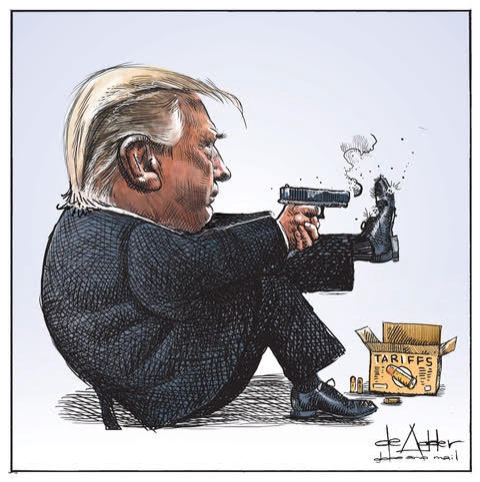
Econ 101: Our standard of living

In 1900, US income (GDP) was $4,096 per capita in 2023 dollars, while in 2023 it was $81,695. The US poverty rate fell from 56% to 11.1% over the same period. How was such a dramatic increase in our widely shared standard of living possible? The answer (without explaining how it came about) is increased labor productivity. Each worker has been able to produce more and more and hence earned a higher income.

Putting this differently, more and more people were automated out of their old jobs allowing them to find new ones and produce new things increasing overall output/incomes. Such dynamism does carry the temporary cost of finding new jobs and developing new skills. At any point over the last century that cost could have been prevented by freezing productivity improvements, but that would also have ended the growth in our incomes. Thank heavens such crazies did not win out. But it seems they never stop trying.

The International Longshoremen’s Association (ILA), the union that represents some 47,000 dockworkers, is threatening to strike if the United States Maritime Alliance (USMX), which oversees port operations, goes forward with plans to automate more of these port activities.

“’There has been a lot of discussion having to do with ‘automation’ on United States docks,’ Trump wrote in his post Thursday. ‘I’ve studied automation, and know just about everything there is to know about it. The amount of money saved is nowhere near the distress, hurt, and harm it causes for American Workers, in this case, our Longshoremen. Foreign companies have made a fortune in the U.S. by giving them access to our markets.’

“’For the great privilege of accessing our markets, these foreign companies should hire our incredible American Workers, instead of laying them off, and sending those profits back to foreign countries,” Trump wrote.” “WP: Trump – port-strike-automation”

Whether out of ignorance or deliberate obfuscation, Trump again misstates who gains and who pays. When foreign ships are unloaded in American ports it is the American consumers who benefit from any cost savings at the ports.  Trump also claims (though he surely knows better) that China would pay for his high tariffs on imports from China.

A tariff, of course, is a tax the US levies at our borders on goods we import from abroad. It’s paid in the first instance by the American importers. Like any other tax, it is added to the price of selling these imports to the American public. It’s very purpose is to reduce domestic demand for such imports in order to encourage (more expensive and less efficient) domestic production of such goods. Please, let’s not stop technical progress and the higher income it enables.

America’s Trump style Foreign Policy

The world benefits from rules of interaction that provide peace and cooperation. Rather than building more weapons of war, we could build more temples of beauty. Championing rules most countries respect and aspire to and being the largest (or perhaps second largest) economy in the world, the United States has naturally led such an international order. Retaining that role would be jeopardized if the U.S. did not diplomatically fashion such rules that were embraced and respected by most other countries and if the U.S. did not itself abide by the rules it had championed.

America’s leadership role is being jeopardized by our hypocrisy, such as condemning Russia’s invasion of Ukraine while given a blank check and American weapons for Israel’s invasion of Gaza and Lebanon and ignoring its abuse of its occupied territories in the West Bank of Palestine. America’s embrace of the International Criminal Court’s (ICC’s) arrest warrant for Vladimir Putin for Russia’s invasion of Ukraine and America’s condemnation of the ICC’s arrest warrant for Israel’s PM Benjamin Netanyahu’s and its former Defense Minister Yoav Gallant is the very definition of hypocrisy.  

President elect Donald Trump’s style of negotiating international agreements reflects more the behavior of a bully than a diplomat. Last Monday Trump threatened to levy a 25% percent tariff on all imports from Mexica and Canada, despite the large economic harm to the US as well as Mexica and Canada and despite the laws and agreements it would violate, if they did not stop the illegal drugs and aliens entering the US across their borders. WC: “tariffs”

“Trump’s threat spurred outrage across the northern and southern U.S. borders, prompting backlash and warnings of retaliatory tariffs from both Mexico and Canada.”  The Hill: “Takeaways from trumps new tariff threat”

“Donald Trump’s angry threat to impose 25 percent tariffs on all U.S. imports from Mexico… is widely being depicted as a bluff….

“But amid all this parsing of Trump’s intentions, a crucial fact about his new move is getting lost: At the center of it is a lie. This lie is hiding in plain sight: It’s the underlying suggestion that Mexico is not doing anything to stop migrants from coming and that Trump’s threat of tariffs is needed to change that….

“All this is laid bare by the sharp response to Trump’s threat that new Mexican President Claudia Sheinbaum issued Tuesday. Her statement is getting attention for its barbed claim that American guns trafficked to Mexico are fueling crime and violence there among gangs supplying U.S. markets with drugs. ‘Tragically, it is in our country that lives are lost to the violence resulting from meeting the drug demand in yours,’ Sheinbaum noted acidly, suggesting that the two countries’ interrelated national challenges underscore the need for cross-border cooperation rather than Trumpian confrontation.”

She further noted that: “You may not be aware that Mexico has developed a comprehensive policy to assist migrants from different parts of the world who cross our territory en route to the southern border of the United States. As a result, and according to data from your country’s Customs and Border Protection (CBP), encounters at the Mexico-United States border have decreased by 75% between December 2023 and November 2024….

“What this polite (and euphemistic) language says is that Mexico is already acting extensively to thwart migrants who travel through that country—originating south of Mexico—so they don’t reach our own southern border. As Sheinbaum notes, this is partly why border apprehensions in the United States have dropped sharply of late.” New Republic: “Mexico’s Sheinbaum responds to Trump tariffs”

So, what did our bully in chief do next?  “President-elect Donald Trump has said he had a “wonderful” conversation with Mexico’s President Claudia Sheinbaum, in an apparent easing of the tensions raised this week over trade tariffs….  After Wednesday’s phone call, both leaders described the conversation in positive terms. Trump said on Truth Social, his social media platform, that it was a ‘very productive conversation’ and thanked Mexico for its promised efforts.”

Perpetuating his original lie, “Trump indicated that Sheinbaum would stop migration through Mexico, ‘effectively closing the southern border’.

“Sheinbaum said she had explained her country’s efforts to deal with migrants and that her position would ‘not be to close borders but to build bridges’”.  https://on.ft.com/49czcol

Trump may or may not be a good negotiator (6 of his businesses have filled for bankruptcy) but his approach is that of a bully. Given America’s dominant status in the world, bullying rather than leading and negotiating in the search for mutually beneficial compromises will hasten American decline from leadership.

Tariffs

“Posting on his Truth Social platform, Trump said [Monday] that on the first day of his presidency he will charge Mexico and Canada a 25% tariff on all products coming into the U.S. He added in a separate social-media post that he would impose an additional 10% tariff on all products that come into the U.S. from China,… That would come on top of existing tariffs the U.S. has already imposed on Chinese goods.

“’This Tariff will remain in effect until such time as Drugs, in particular Fentanyl, and all Illegal Aliens stop this Invasion of our Country!’ Trump wrote.” WSJ: Trump pledges tariffs on Mexico Canada and China”

A tariff is a tax on an import. They are permitted by the World Trade Organization when leveed on goods receiving state subsidies in order to create a level playing field for trade. Such global trade has made an enormous contribution to the standard of living around the world.  “Ernie Tedeschi, former chief economist for President Joe Biden’s Council of Economic Advisers, said the North American tariffs would cost the typical American household almost $1,000 per year.” WP: “Trump tariffs-China Mexico Canada”

The normal expectation is that the tariff will reduce U.S. demand for the taxed import and encourage its domestic production. But the US labor force is fully employed and can only increase domestic production of the targeted goods by shifting workers from the production of goods the US has a comparative advantage in thus reducing our overall income. Though employment of manufacturing workers has declined in the US, manufacturing output has not because worker productivity has increased. In fact, our imports have not shipped American jobs overseas as increasing productivity has resulted in reduced manufacturing employment most everywhere in the world, including China, surely a good thing. WC: “Trade protection and corruption”

Immediately after Trump’s tariff announcement, the exchange rate of the dollar strengthened. A stronger dollar reduces the cost of imports (but increases the cost to foreigners of our exports), thus undoing to some extent the demand reducing impact of the tariff. But it hurts our exports because of their higher price to foreign purchaser and reduces our overall standard of living.

China and others hit with this tax are likely to retaliate with their own tariffs. “Under the United States-Mexico-Canada Agreement (USMCA), which took effect in 2020, goods moving among the three North American nations cross borders on a duty-free basis. ‘Obviously, unilaterally imposing a 25 percent tariff on all trade blows up the agreement,’ said John Veroneau, a partner at Covington & Burling in Washington.”  WP: “Trump tariffs-China Mexico Canada”

Should Trump actually impose these tariff’s he would (again) be violating the law, which only allows the President to impose tariffs without Congressional approval for national security reasons: WC: “Tariff abuse”

Trump’s threatened tariffs are not even leveed on the goods he wants to restrict (drugs and illegal aliens). Thus, unlike traditional tariffs they would be leveed to pressure Mexico and Canada to take other actions Trump wants. They are bargaining ploys. So at the cost of raising prices and lowering incomes in the US, weakening the global trading rules from which we have benefited so much, and weakening the checks and balances limiting an over extended executive branch, Trump may be playing his bargaining game again. But in my opinion the cost to us and the world trading system is too high.

Econ 101: Trade balance

Everyone understands that we are each wealthier if we buy most of what we consume from others and pay for it with what we specialize in producing ourselves. But at dinner last night one of our guests (Chatham House Rules prevent me from revealing his identity) asked how we can compete with China when their workers are so cheap? The teacher in me rises up to unpack this statement and the related issue of trade balance. It is both complicated and simple.

  1. Are Chinese goods cheaper? Chinese workers are paid in their currency (RMB) and American’s buy China’s output in our currency (USD). If an LED light bulb made in China is sold for 140 RMB is that cheap for American’s? If the exchange rate of RMB for USD is 4 RMB per USD it will cost us $35 per bulb (expensive), but if the exchange rate is 10 RMB per USD it will cost us $14 per bulb (cheap).
  2. So will we buy everything from China? What will the Chinese do with the dollars they receive from exporting to us? They might buy goods from the US (made by workers who used to make LED light bulbs). If the exchange rate is “right”, the Chinese will spend all of those export dollars on imported US products. Trade (imports and exports) will balance.  An exchange rate that makes dollars more expensive in China (RMB cheaper in the US) will decrease China’s imports from the US relative to its exports (a Chinese trade surplus). What will they do with the remaining dollars held in China?
  3. What happens with Chinese trade surplus holding of USD? The Chinese can invest them in the US (buy US Treasury securities, stocks, property, etc.). Or sell them for their own currency driving the exchange rate of RMB for USD down (or up depending on what you put in the denominator). The reduced cost in China of US goods will increase Chinese imports and the higher cost of Chinese good in the US will reduce US imports from China. The Chinese trade surplus (US trade deficit) will vanish (or adjust to the rate of capital flow desired by cross border investors). The incomes of Chinese and American workers will be higher because each will be producing the goods for which they each have a comparative advantage (the win-win of free trade).
  4. Exchange rate manipulation or production subsidies distort the outcome. EU tariffs on Chinese EVs are explicitly set at a level to compensate for Chinese government subsidies of EVs. This is allowed by WTO trade rules to put Chinese and German car manufacturers on a fair, competitive basis. The US’s much higher tariff on Chinese EVs makes no mention of complying with WTO rules (the US again does whatever it wants to the detriment of the global trading system).
  5. Trade balance between US and China is used as a simplification. What matters is the balance between each country and the rest of the world but distilling the world into two countries simplifies the discussion.
  6. Time for the dessert.

What to do about China?

“China’s much anticipated post-pandemic recovery appears to have flopped, with signs of a significant slowdown after decades of supercharged growth and data flashing warning signs.” Bloomberg “China’s failing recovery”

“Signs of deflation are becoming more prevalent across China, heaping extra pressure on Beijing to reignite growth or risk falling into an economic trap it could find hard to escape.”

What, if anything, should the U.S. response be? That depends on whether we see China as a competitor or an enemy. That should depend on our assessment of China’s objectives. Does China want to expand its territory one way or another, or to expand its influence in the global order? China’s behavior might support either assessment.

China claims sovereignty over almost the entire South China Sea, including the Paracel and Spratly islands, which are also claimed by Vietnam, the Philippines, Malaysia, Brunei, and Taiwan. In 1947 China asserted its claims with a map depicting a U-shaped line covering almost 70 percent of the South China Sea, known as the nine-dash line. In 2016, an Arbitration Tribunal rejected many of China’s maritime claims as lacking a basis in international law.

The UK returned Hong Kong to China July 1, 1997, with the understanding that it would be self-governed independently of the Peoples Republic of China for fifty years. China violated this agreement with its full takeover in 2020.

In 1972 President Richard Nixon confirmed that Taiwan was part of the People’s Republic of China but would continue to govern itself independently until it agreed to merge its government with the mainland’s. In the Taiwan Relations Act of 1979, the U.S. committed to providing defensive weapons to Taiwan to defend itself from invasion (as opposed to the volunteer absorption into the Peoples Republic envisioned in the One China Act). What we provided instead were heavy weapons irrelevant to Taiwan’s defense but prized by America’s defense industries. “Taiwan-China policy assurances military” The U.S. has more recently seemed to even question its commitment to the One China agreement.

These aggressive moves by China are better seen as solidifying its borders (much in the same way the US worries about its borders with Cuba) than military expansions. On the other hand, China joining the World Trade Organization, pressing for representation in the IMF and World Bank that is more reflective of its economic size, and its Belt and Road, Asian Infrastructure Bank and BRICS initiatives reflect China’s desire to gain status in the global system comparable to that of the U.S. In short, they reflect the behavior of a rising economic competitor.

We seem to be treating China as an enemy rather than the trade and economic competitor they see themselves as. Among sportsmen, competition takes the form of doing your best—of being the best you are capable of. Within our economy we rightly see competition as good and healthy. With fair competition, both sides benefit. The world is made wealthier. Kneecapping our competition is the approach of bad guys. I explored this more fully in my blog “Competing with China”

But China is not competing fairly either. We would be wiser to use the mechanisms of the global system of rules to push and pull them into compliance. We should end our own tariff—industrial policy violation of these rules as well. We might start by restoring the dispute resolution body of the WTO. While there will be genuine security justifications for trade restrictions, they should be very limited.  They should not include taxing steel purchased from Canada. Trade is win, win.

A recent G-7 statement clarified that: “We are not decoupling or turning inwards. At the same time, we recognize that economic resilience requires de-risking and diversifying.” US Treasury Secretary Janet Yellen stressed this message during her recent visit to China. We should facilitate and encourage China’s economic rise as it contributes to our own. The opposite direction—treating China as an enemy—ends in war.

America’s Unipolar period has corrupted us. We demand that others follow rules that we violate ourselves when we don’t find them convenient. We have become a bully. My hope is that we adjust to the fact that we are no longer the world’s sole superpower by strengthening the rules we helped develop and competing fairly under them: “Goodbye unipolar world and good riddance”

Reducing CHIP Supply Risks

When semiconductors where invented in the U.S. in the late 1950 and began to replace vacuum tubes in electronic circuits, the world of electronic circuitry changed dramatically forever (from the computer I am composing this note on, to the mobile phone on which I might discuss it with you or the electronics in the car I might drive to meet you while listening to the radio these chips made possible, not to mention of submarines, planes, and satellites they empower).

American companies continue to lead the world in the design of the most sophisticate chips and semiconductor circuits. However, they have increasingly found it more economical to outsource their manufacture to facilities in foreign countries. Almost all the most sophisticated chips (still designed in the US) are now produced in Taiwan by TSMC, which produces about 56% of world output of semiconductors.  Especially given the increasing suggestion, even by the President of the United States, that the U.S. might renounce its acceptance of China’s claim to Taiwan, such reliance on TSMC for our most advanced chips is an economic and security risk we should reduce.

What is the best way to reduce the risk of our heavy dependance on Taiwan’s supply of such Chips? The rest of this note briefly compares the market approach with the government (socialist/industrial planning) approach to reducing that risk.

American and other firms concentrated the manufacturing of the chips they designed and/or needed where it was cheapest to produce (and deliver) them. Where China violated the WTO rules of fair trade via state subsidies, importing countries are allowed by WTO rules to impose tariffs at levels designed to neutralize such artificial advantages. WTO rules also allow the use of tariffs to diminish the risk to national security of dependance on foreign supplies.

The opposite approach is for a government to subsidize the otherwise uneconomical manufacture of semiconductors (or whatever) in their own country.  In the U.S., the CHIPS and Science Act of 2022 appropriated $280 billion in part to subsidize factories to produce such chips in the U.S. Why was so much needed to get firms to produce chips in the U.S.? “’It’s much cheaper to build the chips and the factories in Taiwan than it is in the United States,’ former Google CEO Eric Schmidt told Semafor. ‘Similarly, the workforce quality is not as good as it is in Taiwan.’” “Chip war-US-Taiwan”

The Biden administration’s industrial policy approach suffers all the well-known disadvantages of industrial policy. First, like China’s subsidies, it violates WTO trading rules, which the U.S. seems all too willing to do when it is the violator rather than someone else. Second, it, rather than market factors, must decide who gets the subsidies (and tax breaks), either by establishing the rules for access or by outright picking winners. Governments’ records at picking winners, especially picking technologies, have historically been poor compared with the search for profit by entrepreneurs, most of whom fail and quietly fade away without further cost or waste. Third, when governments pick winners, they establish an economic incentive for corruption by those seeking to be “picked”. Governments, like everyone else, tend to bend to such temptations.

Rather than paying hundreds of billions of American taxpayer’s money for more costly Made in American products, imposing tariffs on imported chips sufficient to reflect the existing sole source risk would leave it to the market to find the best alternative and more diversified sources (India, Korea, Japan, Viet Nam, etc.). The full cost of lower living standards from industrial policies will only be felt in the longer run. “The slippery slope”

The same economic forces and arguments apply to slowing or preventing further global warming. A carbon tax reflecting the global warming externality of carbon producing activities leaves to the market the search for the best technologies for reducing carbon emissions without loss or with minimal loss of output.

China and the United States

“Biden describes the China challenge as a global, ideological struggle between democracies and autocracies…. Any event from the pandemic to the Olympics will occasion commentary, particularly in the United States, of who “won,” China or America, and what it means for the epic struggle for global supremacy.” “There is no unified front against China”

I am not sure what it is that we want to win. We don’t seem to mind selling planes and bombs to other autocracies (Saudi Arabia, Qatar, etc.). Anything to keep the defense industry’s profits flowing short of yet another war seems a (relatively) good deal. And why might “global supremacy” matter?

Winning things sounds to me like rooting for our own basketball team and cheering when it wins the championship. How do we go about striving to have the best basketball team? First, we recruit the best basketball players we can find and hire the best coach to train them. Everyone must play by the agreed rules, and we win by playing the best game. In short, our efforts go into being the best team possible, not into poisoning the drinking water of the other teams.

But sporting contests are zero sum. One side wins and the other losses. Global cooperation and trade is win–win. The goods we produce and sell (for example) to China, with which to pay for the goods we buy from China make us and China both richer. The citizens of both countries benefit from this exchange. Win–win. Sharing information on the source, nature, and potential cure of a virus (which knows no borders) benefits all of us. Win–win.

The world’s output is maximized when our productive assets (labor and capital) are allocated to their most productive uses globally. That requires that market prices reflect the true productivity and value of each activity. Thus, the world as a whole benefits from rules governing government interferences in market prices and allocations. The World Trade Organization is the forum for agreeing on these rules of fair trade and enforcing them. “Econ 101- Trade in very simple terms”

The airplanes built by Boeing and Airbus benefit from government support of one sort or another. For years they have fought one another over whether this support conformed to fair trade rules. A settlement has finally been reached. “Boeing – Airbus settlement”

Trade restriction in the name of national security, while potentially legitimate, can easily cross the line into wealth reducing protectionism. Does the use of Huawei 5G equipment really threaten U.S. national security or U.S. business interests (protectionism). Some of these cases are hard to call but we must look carefully at narrow business interests in protecting their markets to the detriment of the rest of us. “Huawei ban could crush US aid efforts”

Global supremacy suggests that we would set these rules. To be successful the rules of international trade must be very broadly followed. Thus, their formulation must be a collective undertaking. It is fine for the U.S. to exert influence in setting these rules, but unfortunately, we have a poor record of even following them. We have caused the demise of the WTO dispute resolution body. We have strangely and counterproductively withdrawn from the Trans-Pacific Partnership (TPP), which was then replaced by the Comprehensive and Progressive Agreement for Trans-Pacific Partnership (CPTPP). These set high standards for more open trade that China will hopefully have to meet to join. The self-image of supremacy has corrupted U.S. behavior. Former President Trump’s protectionist tariffs on trade with China, EU, Canada, etc., which President Biden has so far failed to remove, have further reduced U.S. and world income. “Trade protection and corruption”

So, what should our policy be toward China? China has no intention or interest in attacking the United States. They care about their own economies and their own neighborhoods. We should keep our nose and military home to look after our own neighborhood. We should work with China (and Russia and others) to formulate win-win rules for international interactions and behavior. We should apply the mechanisms of the WTO and other international bodies, and diplomacy more generally, to hold China (and others) to the agreed rules. But we must abide by them as well. The rule of law is not just for others.

We should fix the problems in our own economy. We should work to make our domestic rules of commerce fair and efficient so that our economy will be the best in the world. We should work with other countries, including China, to maximize the productivity of their resources because we and everyone else will benefit (win-win).

The United States was founded on principles that have served us well providing a model that the rest of the world would do well to follow. The idea that we should (or can) impose our principles on others rather than provide an example like “a shining city on a hill,” is a violation of those very principles. We have repeatedly failed to uphold those principles, but we keep trying. We must continue trying and must try harder.

Is Huawei a Security Risk?

This question is quite beyond my technical competence to answer.  Even the experts disagree amongst themselves.  President Trump thinks it is too risky to use Huawei equipment and insists that Britain and our other allies not use Huawei equipment for building out their 5G telephone infrastructures. British Prime Minister Boris Johnson thinks its OK (plus it is available and cheaper than its potential future competitors) for many but not all uses.  President Trump, who likes to think he is protecting American jobs even though our economy is fully employed, was so angry at Johnson’s unwillingness to bow to his demands that he hung up on Johnson in their most recent phone conversation.  Johnson promptly cancelled his planned trip to the White House. Ukraine President, Volodymyr Zelensky, must be shaking his head in disbelief.

Trump has reason to be suspicious of foreign produced equipment following the recent disclosure that a CIA owned Swiss company, Crypto AG, sold encryption devises to 120 countries that enabled the U.S. and Germany to “easily break the codes that countries used to send encrypted messages.”  This went on for over 40 years allowing us to spy on our friends and foes alike. “National-security/cia-crypto-encryption-machines-espionage”

But these days security is much more sophisticated and wouldn’t allow such hardware to slip through undetected. On the other hand, the spying technology is more sophisticated too. Britain and other European countries are avoiding Huawei equipment for sensitive applications and using it for the rest. My point is not to join the debate over whether and where to use Huawei equipment but rather to argue that the more promising approach to convincing our friends of potential dangers (the more Adult approach, if I may) is to present our evidence and endeavor to convince them of our views. Trump’s approach, as in so many other areas, is to threaten and bully. “The-basis-of-American-world-leadership”

It is not easy to determine when trade restrictions reflect genuine security concerns and when they are just another manifestation of Trump’s protectionist, central planning direction of our resources.  He has imposed and threatened to impose tariffs with abandon, inflicting harm on our own economy as well as the tariffs’ targets. “Trumps-recent-trade-moves-show-adversarial-approach-has-only-just-begun”  “The United States has also threatened duties of up to 100% on French goods, from champagne to handbags, because of a digital services tax that Washington says harms U.S. tech companies.”  “Trump-threatens-big-tariffs-on-car-imports-from-EU”  This use of tariffs has nothing to do with trade and violates WTO rules, which Trump seems to pay little attention to in any event.

While this type of bully approach might work sometimes, it is unsustainable in the long run.  Needless to say, world confidence in the U.S. to do the right thing has plummeted. While for now other countries bow to and follow orders from the U.S., not out of respect but out of fear of retaliation, they follow a strategic waiting game. They know that Trump will not always be in power. And after he is gone, the U.S. will no longer have allies but adversaries ready to bare their claws for revenge.  https://www”9-charts-on-how-the-world-sees-Trump”


The Sources of Prosperity

I am an economist so I can’t help writing about the virtues of trade in the (futile?) hope that what is obvious to economists might be better understood and appreciated by the general public. https://wcoats.blog/2016/12/22/save-trade/,  https://wcoats.blog/2017/01/06/the-liberal-international-order/,   https://wcoats.blog/2018/03/03/econ-101-trade-in-very-simple-terms/, https://wcoats.blog/2017/01/06/the-liberal-international-order/, https://wcoats.blog/2019/02/09/tariff-abuse/

So please bear with me one more time. If you join with ten, or a hundred, or a thousand others to cooperatively produce things, you can jointly produce much more than ten times, or one hundred or one thousand times as much as you could all produce individually as one person factories. But that huge increase in productivity and output is not possible unless you can sell your joint output to others for the many other things you need and want to consume that they produce. In short, none of this is possible without trade. The wider the area over which we can trade the greater are the possible gains in productivity from the specialization of labor and capital that a larger market makes possible. The American constitution recognized this when it prohibited restraints on trade between the states (across state lines).  The ultimate limit in the size of the market is given by the world itself.

But markets—the “places” or the arrangements through which trade deals (purchase and sales agreements) occur—require trust that deals will be honored.  The rule of law, which protects private property and the enforcement of contracts, provides the certainty needed for a manufacturer or other service provider to invest in the productive capacity and facilities needed to generate the promised supply of products that is the foundation of our relative affluence. When trade extends beyond national boundaries the rule of law takes the form of international agreements to rules of the game.  Bilateral, multilateral and global trade agreements establish the rule of law within their domains.  The World Trade Organization (WTO) was created to oversee this process. The astonishing skyrocketing of the standard of living of the average (even the poorest) earthling rest on, i.e. would not have been possible without, trade.

The uneven but persistent history of trade has seen the protection of less efficient and uncompetitive firms and industries reduced over time via trade agreements that reciprocally reduced the taxation of imports (i.e. tariffs).  Starting with President Trump’s misguided withdrawal from the Trans Pacific Partnership (TPP) trade liberalization has been thrown into reverse. Trump vs Adam Smith  TPP modernized and further liberalized existing trade agreements between the U.S. and a number of Pacific countries.  The agreement was to be between 12 Asian Pacific countries until the U.S. withdrew.  It would have provided a strong magnet to further draw China into the global system of rules for increasingly free trade. It was ultimately signed by 11 countries without the U.S. and renamed the Comprehensive and Progressive Agreement for Trans-Pacific Partnership (CPTPP). The US withdrawal from the agreement was a serious mistake.

The United States as well as much of the rest of the world is beginning to pay the costs of Trump’s trade wars. In January of this year Deutsche Bank estimated that Trump’s trade wars have cost the U.S. stock market $5 trillion in forgone returns so far. Costs of trade war  “Bloomberg economists Dan Hanson and Tom Orlik have… concluded: If tariffs expand to cover all U.S.-China trade, and markets slump in response, global GDP will take a $600 billion hit in 2021, the year of peak impact.” US China trade war-economic fallout  “The import tariffs proposed by President Trump could wipe out the income gains provided by the Republican tax cuts for low- and middle-income earners, Jim Tankersley of The New York Times reported Monday.”  ”Trump-Tariffs-Could-Wipe-Out-Tax-Cuts-Most-Americans”

Are Trump’s import taxes old fashioned protectionism (protecting relatively inefficient domestic industries from foreign competition), a legitimate response to national security concerns, or a reflection of Trump’s “famed” negotiating style?

Protectionism

For starters Trump’s steel and aluminum tariffs of 25% and 10% respectively (following his earlier imposition of tariffs on solar panels of 30% and washing machines of 50%) are clearly protectionist and reflect an alarming over reach of executive authority. Using the “authority” given the President under Section 232 of the Trade Expansion Act of 1962, U.S. Department of Commerce found that imports of steel and aluminum “threaten to impair the national security” of the United States.  Canadian Prime Minister Justin Trudeau called the claim that reliance on Canadian steel could be considered a national security risk “absurd”.  Trump removed these tariffs on Canada and Mexico last month, but they remain in effect on our other friends (e.g., EU) and enemies. On several occasions Trump has threatened to raise tariffs on car’s imported from Europe on the same phony national security grounds.

The patters of trade that minimize costs of production and maximize labor productivity can be complex. While protecting a few inefficient American steel producers and their related jobs might be good for those few firms, it is bad for American consumers and the economy at large. Workers in less productive protected industries are thus not available to work in more productive activities. Moreover, more jobs were lost than saved as the result of high prices and lost sales by steel importing manufactures.  One study estimated that these tariffs could result in the loss of 146,000 jobs.[1]

A Peterson Institute for International Economics study estimated that American businesses and consumers paid more than $900,000 a year for each job that was created or saved as a result of the Trump administration’s tariffs on steel and aluminum. The cost for each job saved as a result of the administration’s tariffs on washing machines was $815,000.[2]

National Security

The distinction between legitimate security concerns and protectionism is not always obvious. Trump’s approach is often more protectionist and bargaining chips than concerns for security.  An early indication of this was the U.S.’s treatment of ZTE Corp, China’s second largest telecoms gear maker.  In April 2018 the U.S. band U.S. companies from selling their products to ZTE in connection with its violation on U.S. restrictions on trade with Iran, Sudan, North Korea, Syria and Cuba.  “That means no Qualcomm chips or Android software for its phones, and no American chips or other components for its cellular gear.” NYT The company was effectively shut down and heading for bankruptcy when in early June of 2018 Trump ordered these restrictions lifted to save Chinese jobs!!  According to the NYT: “The Trump administration is pressuring China to make trade concessions. It may also need Beijing’s help to strike a deal with North Korea as Washington and Pyongyang plan a high-profile meeting on June 12 in Singapore.  Mr. Trump appears to be using ZTE’s punishment as a bargaining chip in negotiations with China, rather than a matter of law enforcement.” What is ZTE–A Chinese Geopolitical Pawn

Trump’s more recent banishment of Huawei, a Chinese tech company leading the world in 5G development, from the American market and efforts to convinces our once British and EU friends to do the same provides another example. In some applications security concerns when dealing with a Chinese company may be justified, but these areas are limited and Huawei has gone to great lengths to allay those concerns. “Google has been arguing that by stopping it from dealing with Huawei, the US risks creating two kinds of Android operating system: the genuine version and a hybrid one. The hybrid one is likely to have more bugs in it than the Google one, and so could put Huawei phones more at risk of being hacked, not least by China.”  “Google warns of US national security risk of Huawei ban” FT June 6, 2019

The Trump administration has expressed its anger with the refusal of many other countries to follow its lead thus incurring a diplomatic cost as well as the economic one of restricting access to the best and/or most cost-effective products. The dangers and potential damage of using trade threats for other objections are clearly express by seven former US Ambassadors to Mexico in a joint letter published June 5: Ex US Mexico Ambassadors-Tariffs would destroy partnership we built

Moreover, the US’s exploitation of the importance of the dollar as a reserve and payment currency in forcing its political agenda on the rest of the world has incentivized the EU, Russian, China and others to look for alternatives. As another example of the growing risks of relying on American markets, Alibaba, China’s national champion internet giant whose share are currently only listed on the New York Stock Exchange, will raise its next round of capital on the Hong Kong exchange.

Bargaining

But some of Trump’s threats of tariffs no doubt reflect his approach to a trade negotiation. While it is not the usual approach to a trade negotiation, in which the parties should be looking for win-win reductions in tariffs and other impediments to freer trade, it could occasionally work to achieve greater concessions from the other side than otherwise. There is really little evidence that it has, however. The renegotiated NAFTA, given the new name United States-Mexico-Canada Agreement or USMCA, is no better than a normal review and updating of the existing NAFTA would have been expected to produce. It incorporates most of the updated provisions of the TPP, as was expected. But Trump started the NAFT review and update, by tearing up the old agreement and threatening to revert to the bad old days. Trump’s threated 5% tariff on imports from Mexico if it doesn’t do more to reduce or deal with the flow of refugees across the US Mexican border seems to be a counter example of a threat that worked.

___________________________________________________________________________

Donald J. Trump‏Verified account @realDonaldTrump

FollowFollow @realDonaldTrump

On June 10th, the United States will impose a 5% Tariff on all goods coming into our Country from Mexico, until such time as illegal migrants coming through Mexico, and into our Country, STOP. The Tariff will gradually increase until the Illegal Immigration problem is remedied,..

4:30 PM – 30 May 2019

______________________________________________________________________________

What if Trump doesn’t back down as China matches each of Trump’s escalations with new tariff increases of their own? Such a true trade war was not a necessary approach to the negotiations and could be terribly detrimental to both economies as well as those of our trading partners. Some of China’s behavior should be challenged. Its theft of intellectual property, state aid to some of its companies, and restrictions on foreign companies operating in China violate the spirit of the competitive deployment of resources to their most productive uses. But these criticisms are shared by most other countries (UK, EU, Japan, Korea, India, etc.). The US should negotiate with China together with these allies. It should use and strengthen the mechanisms of the World Trade Organization rather than ignoring and weakening it.

Even if Trump does backdown, as he generally has in the past, considerable damage has already been done that could take years to undo. The development of the cost saving, productivity enhancing global supply chains took time and were built with confidence in the rules that would apply—the rule of law. These very much included the maximum taxes (tariffs) and other regulations that would apply. The trust in that framework of rules has now been badly damaged.

Supply chains are already being restructured to reduce the risks of US policy shifts. While new arrangements may avoid or reduce these risks, they do so at the cost of efficiency.  Refusing to buy Russian booster rockets or Chinese semiconductors because of concerns that the Chinese or Russian government might exploit their companies’ products militarily or to steal our trade secrets, forces us into more expensive and/or inferior products and thus keeps us and the world poorer than otherwise. We had better be sure that the costs are necessary.

[1]  Timmons, Heather (March 5, 2018). “Five US jobs will be lost for every new one created by Trump’s steel tariffs”. Quartz (publication).

[2] Long, Heather (2019). “Trump’s steel tariffs cost U.S. consumers $900,000 for every job created, experts say”. The Washington Post.

Tariff Abuse

The U.S. constitution gives Congress the authority to enact and control tariffs (taxes on American consumers of imported goods and services).  Over the years Congress has increasingly delegated that authority to the executive branch (the President) under certain specified circumstances. Section 232 of the Trade Expansion Act of 1962 gives the President the authority to restrict (impose tariffs on) imports that threaten national security without the need for congressional approval.

Last year President Trump imposed a 25 percent tariff on steel imports and a 10 percent tariff on aluminum on the grounds, confirmed upon the President’s prompting by the Commerce Department, that relying on steel from Canada and the EU (fellow NATO members) was a threat to our national security.  If this were a skit on “Saturday Night Live” we would have a good laugh, but unfortunately it is for real.  It is the launching of a very ill-advised trade war by a President who had promised when campaigning for office to reign in executive overreach.  Sen. Ben Sasse, Republican from Nebraska, called Trump’s decision “dumb.”

Trump’s stated motive was to restore American jobs to an industry in which we are relatively inefficient. The few additional workers in steel and aluminum resulting from these tariffs were outweighed by the loss of jobs in industries dependent on these now more expensive metals as inputs. Bestowing financial favors on a selected group to the detriment of the rest of us can rightly be called corruption. https://wcoats.blog/2018/09/28/trade-protection-and-corruption/  Such policies do not reflect America First. They reflect My Friends First.

Trump has apparently asked the Commerce Department to “evaluate” whether importing cars is a national security threat that would allow him to impose tariffs on them without Congressional consent. So much for rolling back executive overreach and any consideration of the national interest.

Both Republicans and Democrats may have had enough of this.  “While the Trump Administration ponders whether to claim that imported Volkswagens threaten national security, some on Capitol Hill are trying again to rein in the President’s tariff powers.”  WSJ: “Two-bills-to-defend-free-trade”

Two bills have been introduced in the House that would shift the responsibility of determining if an import is a national security risk from the Commerce Department, which naturally leans toward protecting American commerce, to the Defense Department, which should better understand real security risks. “The stronger bill was introduced last week by Senator Pat Toomey, the Pennsylvania Republican….  Mr. Toomey’s bill would require Congress’s blessing. Once a tariff is proposed, lawmakers have 60 days to pass a privileged resolution—no Senate filibuster to block consideration—authorizing it. No approval, no tariff.” WSJ 2/9/2019  A somewhat weaker bill has been introduced by Senator Rob Portman, Republican from Ohio, on the grounds that it has a better chance of passing over a Presidential veto.

Please write your congressional representatives to support one of these bills (preferably the Toomey bill) before this President fights another war that we all lose.