Kill

On Friday President Trump announced that: “Any document signed by Sleepy Joe Biden with the Autopen, which was approximately 92% of them, is hereby terminated, and of no further force or effect….” https://truthsocial.com/@realDonaldTrump/posts/115629010097815862

Rather than evaluating each Presidential order and rescinding those that are inconsistent with Trump’s policy objectives (whatever those might be), Trump rescinds them all if not signed personally by former President Biden.

This reflects Trumps use of his position to attack anyone who disagrees with him—his enemies. Rather than explaining why a policy is bad, Trump simply condemns the work of his “enemies.”

When six democratic congressmen posted a video reminding solders of their legal obligation to refuse to execute illegal orders, Trump exploded.  “The president said lawmakers who appeared in a video committed “seditious behavior” and should be arrested and put on trial for treason.” https://www.washingtonpost.com/politics/2025/11/20/trump-democrats-seditious-behavior/

A prime example of such an illegal order was Secretary Hegseth’s order to bomb boats in the Caribbean he thought were bringing illegal drugs to the US and to kill all aboard. “Hegseth order on first Caribbean boat strike, officials say: Kill them all” https://www.washingtonpost.com/national-security/2025/11/28/hegseth-kill-them-all-survivors-boat-strike/

Hegseth’s order was illegal under both US and international law. SEAL Team 6, which committed these murders, executed an illegal order, thus violating their pledge to uphold the constitution.

President Trump also violated the law by directing the Justice Department to pursue those who criticize him—his enemies. From universities and law firms to former FBI head James Comey, and former national security advisor John Bolton, Trump has threatened to withhold Federal funds from universities that do not bow to his demands or try his enemies for one thing or other. Bolton’s crime is the same as Donald Trump’s – the improper handling of secret government documents. And of course, anything Biden did is condemned as the cause of anything wrong.

Trump’s masked ICE teams arresting and deported supposedly illegal immigrants has been a lawless disaster—occasionally arresting legal American citizen and embarrassing the whole effort to strengthen the enforcement of immigration rules.

Trump’s haphazard announcements of Tariffs, (hopefully) soon to be declared illegal by the Supreme Court, followed none of the rules of the World Trade Organization, which are designed to promote economic efficiency and thus maximize world incomes. They were deployed to bully individual countries to agree to whatever was in Trump’s interest, an interest rarely compatible with American interests.

I am all for downsizing the government, but on the basis of careful reviews of what functions are needed and desirable and the required staff to carry them out efficiently. Elon Musk’s led Department of Government Efficiency (DOGE) took a chainsaw approach that led Trump appointed department heads to object.

This, of course, is not how a mature adult would govern in a constitutional republic. Trump and many of his appointees are not such people. Living together peacefully and productively requires civil discussion of issues and cooperation and compromise—not bullying.

Those breaking the law or issuing illegal orders should be removed from their positions and tried for the crimes they have committed.

Trade

Without trade each household/family would have to be self-sufficient, i.e., would only have to consume what they themselves could make, grow or do. No one would doubt the dire poverty the world would endure. Even trade limited to your neighborhood, with each household specializing in a few things to trade with other families specializing in other needs or wants would significantly increase everyone’s income. The wider the range of trade the greater the degree of specialization and increased income possible.

Expanding the potential for trade requires the ability to transport goods and serves over longer distances. The benefits of such connectedness extend well beyond higher incomes. Quoting from George Will’s wonderful book The Conservative Sensibility: Referring to the:

“Erie Canal. [Dewitt] Clinton [the sixth governor of New York] saw this project as a means of preventing states in the West from detaching themselves from the Union. The canal would “bind the union together by indissoluble ties” because the people would be “habituated to frequent intercourse and beneficial inter-communication,” and all Americans would be “bound together by the golden ties of commerce and the adamantine chains of interest.” The canal also, and inadvertently, helped to bring down the old order in Europe. By bringing cheap wheat from America’s Great Plains, the canal struck at the roots of Europe’s landed aristocracy.”

Implicit in the above is private ownership of one’s production. People work hard for their own benefit but to benefit from trade they must take account of the needs and wants of others. Trade must be win-win or it will not take place. I benefit from selling my production and you benefit from buying it. Communism—communal production—lacks the personal (selfish) incentive to work hard and has broadly failed as a system. Also from George Will: “In China, once collective farms were disbanded in 1978 under the leadership of the reformer Deng Xiaoping, agriculture output doubled in the space of just four years.”

The topic of trade keeps returning and I have written about it often. Rather than repeat myself, yet again, I will share some of those earlier blogs:

U.S. – Japanese trade agreement

Free trade of goods and services produced without government subsidies or restrictions would maximize the incomes of all involved. To promote this result, the World Trade Organization has led the effort to reduce or eliminate tariff and other trade restrictions and has authorized the use of tariffs carefully targeted to nullify the distorting effect of government subsidies or other interferences in the competitive market production of goods and services.

This is not how President Trump has used or threatened in his usual bully style to use tariffs. For Trump, tariffs are not established to improve a level playing field for world trade, and not even always to protect inefficient American manufacturers such as the 50% tariff on imported Steel. An outrageous example was his threat to impose a 50% tariff on all Brazilian imports, effective August 1, 2025, if Brazil went forward with the prosecution of his ally, former President Jair Bolsonaro, who is charged with attempting to stage a coup d’état to overturn the results of the 2022 presidential election in Brazil. Incidentally, the U.S. currently has a trade surplus with Brazil. Go figure.

On July 23, “President Donald J. Trump announced a landmark economic agreement with Japan…. [In exchange for a reduction of US tariffs on all Japanese imports from 25% to 15%, it] will invest $550 billion directed by the United States to rebuild and expand core American industries…. The United States will retain 90% of the profits from this investment…. In addition to raising billions in revenue, this new tariff framework, combined with expanded U.S. exports and investment-driven production, will help narrow the trade deficit with Japan and restore greater balance to the overall U.S. trade position.” “Whitehouse fact-sheets/2025/07/”  

As an aside, Trump has also threated to punish any country that stops using U.S. dollars as its reserve and trade vehicle currency. Somehow, he fails to understand that for a country to acquire these dollars (and for Japan to acquire the $550 billion it is to invest in the US) they must have a trade surplus (US trade deficit). Oh well.

“Japanese officials said there was no written agreement with Washington — and no legally binding one would be drawn up — after Trump administration officials claimed Tokyo would back investments in the US from which American taxpayers would reap nine-tenths of the profits.”  https://www.ft.com/content/c1183b13-9135-41f6-9206-7b52af66f0a5

In addition to the fact that Japanese officials are disputing that they have agreed to such a deal, I hope that you are surprised that the American government is proposing to create new state owned companies. The world’s experience with state own companies has not been good. Our private enterprise dominated economy has served us (our standard of living) very well.

If this all seems rather confusing, welcome to Trump land.

Taxation norms

Taxes are levied to raise money but also to influence behavior. What is taxed and how much influences how much of it is demanded. To take an example of a tariff (tax) on steel imports, the resulting higher price of imported steel increases the relative attractiveness of domestically produced steel. Under the rules of the World Trade Organization, such a tariff would be justified if it offsets an artificial (and thus economic efficiency undermining) subsidy of the foreign produced steel.

President Trump has introduced a totally different way of using tariffs/taxes. He uses them as threats to pressure a country to take action totally unrelated to the item to be taxed. This follows his general bully approach to negotiations. To pressure a country or firm to agree to his requests, he threatens harm if they refuse. If a university or newsman behaves in ways he doesn’t like, he attacks them or threatens them with harm.

In the most recent example Trump is threatening a 50% tariff on all imports from Brazil primarily due to Brazil’s legal proceedings against former President Jair Bolsonaro, which Trump characterizes as a “witch hunt,” and to address what he claims is an “unfair” trade relationship between the two countries.

“Trump demands that the trial against former president Bolsanero, who had tried to instigate a military coup after he had lost the last election, should be immediately end.”  “First casualties from Trump’s increasing tariff craze”

 It’s not clear what Trump means by “unfair” trade relationship. His positions on trade, which he clearly does not understand at all, are contradictory. He has threatened to raise tariffs on imports from countries that avoid using US dollars in their FX reserves and foreign trade payments. For countries to use US dollars they must have a trade surplus with the US (a US trade deficit with such countries) in order to acquire them. “Why Does the World Need a Reserve Asset with a Hard Anchor?”  But Trump doesn’t seem to like or want such deficits. The US actually has a trade surplus with Brazil.

It may sound like this is all from the Onion, but sadly it is not. I don’t expect it to end well.

Looking for win-win

The essence of trade is that both the seller and buyer benefit (win-win). Without that feature the trade would not take place. The expansion of trade locally and then globally increased the output and thus incomes of the average person dramatically.

In 1820, about 80% of the world’s population lived in extreme poverty (defined as living on less than $2.15 per day in today’s terms). By 2019, this figure had fallen to roughly 10%. This decline is especially notable given that the global population increased more than sevenfold during this period.


The pace of poverty reduction accelerated in recent decades. From 1990 to 2019, the global extreme poverty rate dropped from 43% to below 10%, with the fastest declines occurring since the 1990s. This progress was driven largely by rapid economic growth in Asia, particularly in China and India.

The increase in win-win gains in income from trade have been promoted by broad agreement on rules and norms for “fair trade” to maximize the increase in incomes that results. These have been developed over time through what is now called the World Trade Organization (WTO). Tragically, rather than further improving its rules, the U.S. has undermined the WTO by refusing to appoint new members to its dispute resolution body.

The benefits of such collaborative cooperation have been sought and gained in other areas as well. To take one, the climate benefits of nuclear energy also carries the risks of destruction from nuclear bombs. Agreements among the countries with such capacity to contain and minimize the associated risks are reflected in the Treaty on the Non-Proliferation of Nuclear Weapons (NPT) of 1968 (extended in 1995). The Comprehensive Test Ban Treaty (CTBT, 1996), several bilateral agreements with the USSR/Russia and others have further reduced the risks.

The dramatic development of Artificial Intelligence (AI) programs promises incredible increases in our incomes but also carries risks. As with nuclear energy, all would benefit from agreements that limit these risks. Cooperating in developing such guard rails is in everyone interest. The US is making a big mistake in attempting to stifle  China’s AI development rather than a win-win cooperation with them to maximize its promise while minimizing its risk.

The case for such cooperation with China is powerfully made by Alvin Graylin in a recent presentation to the Committee for the Republic (on whose board I serve) the other day. https://www.youtube.com/watch?v=Jg6brPvFJGw.

Econ 101: Our standard of living

In 1900, US income (GDP) was $4,096 per capita in 2023 dollars, while in 2023 it was $81,695. The US poverty rate fell from 56% to 11.1% over the same period. How was such a dramatic increase in our widely shared standard of living possible? The answer (without explaining how it came about) is increased labor productivity. Each worker has been able to produce more and more and hence earned a higher income.

Putting this differently, more and more people were automated out of their old jobs allowing them to find new ones and produce new things increasing overall output/incomes. Such dynamism does carry the temporary cost of finding new jobs and developing new skills. At any point over the last century that cost could have been prevented by freezing productivity improvements, but that would also have ended the growth in our incomes. Thank heavens such crazies did not win out. But it seems they never stop trying.

The International Longshoremen’s Association (ILA), the union that represents some 47,000 dockworkers, is threatening to strike if the United States Maritime Alliance (USMX), which oversees port operations, goes forward with plans to automate more of these port activities.

“’There has been a lot of discussion having to do with ‘automation’ on United States docks,’ Trump wrote in his post Thursday. ‘I’ve studied automation, and know just about everything there is to know about it. The amount of money saved is nowhere near the distress, hurt, and harm it causes for American Workers, in this case, our Longshoremen. Foreign companies have made a fortune in the U.S. by giving them access to our markets.’

“’For the great privilege of accessing our markets, these foreign companies should hire our incredible American Workers, instead of laying them off, and sending those profits back to foreign countries,” Trump wrote.” “WP: Trump – port-strike-automation”

Whether out of ignorance or deliberate obfuscation, Trump again misstates who gains and who pays. When foreign ships are unloaded in American ports it is the American consumers who benefit from any cost savings at the ports.  Trump also claims (though he surely knows better) that China would pay for his high tariffs on imports from China.

A tariff, of course, is a tax the US levies at our borders on goods we import from abroad. It’s paid in the first instance by the American importers. Like any other tax, it is added to the price of selling these imports to the American public. It’s very purpose is to reduce domestic demand for such imports in order to encourage (more expensive and less efficient) domestic production of such goods. Please, let’s not stop technical progress and the higher income it enables.

America’s Trump style Foreign Policy

The world benefits from rules of interaction that provide peace and cooperation. Rather than building more weapons of war, we could build more temples of beauty. Championing rules most countries respect and aspire to and being the largest (or perhaps second largest) economy in the world, the United States has naturally led such an international order. Retaining that role would be jeopardized if the U.S. did not diplomatically fashion such rules that were embraced and respected by most other countries and if the U.S. did not itself abide by the rules it had championed.

America’s leadership role is being jeopardized by our hypocrisy, such as condemning Russia’s invasion of Ukraine while given a blank check and American weapons for Israel’s invasion of Gaza and Lebanon and ignoring its abuse of its occupied territories in the West Bank of Palestine. America’s embrace of the International Criminal Court’s (ICC’s) arrest warrant for Vladimir Putin for Russia’s invasion of Ukraine and America’s condemnation of the ICC’s arrest warrant for Israel’s PM Benjamin Netanyahu’s and its former Defense Minister Yoav Gallant is the very definition of hypocrisy.  

President elect Donald Trump’s style of negotiating international agreements reflects more the behavior of a bully than a diplomat. Last Monday Trump threatened to levy a 25% percent tariff on all imports from Mexica and Canada, despite the large economic harm to the US as well as Mexica and Canada and despite the laws and agreements it would violate, if they did not stop the illegal drugs and aliens entering the US across their borders. WC: “tariffs”

“Trump’s threat spurred outrage across the northern and southern U.S. borders, prompting backlash and warnings of retaliatory tariffs from both Mexico and Canada.”  The Hill: “Takeaways from trumps new tariff threat”

“Donald Trump’s angry threat to impose 25 percent tariffs on all U.S. imports from Mexico… is widely being depicted as a bluff….

“But amid all this parsing of Trump’s intentions, a crucial fact about his new move is getting lost: At the center of it is a lie. This lie is hiding in plain sight: It’s the underlying suggestion that Mexico is not doing anything to stop migrants from coming and that Trump’s threat of tariffs is needed to change that….

“All this is laid bare by the sharp response to Trump’s threat that new Mexican President Claudia Sheinbaum issued Tuesday. Her statement is getting attention for its barbed claim that American guns trafficked to Mexico are fueling crime and violence there among gangs supplying U.S. markets with drugs. ‘Tragically, it is in our country that lives are lost to the violence resulting from meeting the drug demand in yours,’ Sheinbaum noted acidly, suggesting that the two countries’ interrelated national challenges underscore the need for cross-border cooperation rather than Trumpian confrontation.”

She further noted that: “You may not be aware that Mexico has developed a comprehensive policy to assist migrants from different parts of the world who cross our territory en route to the southern border of the United States. As a result, and according to data from your country’s Customs and Border Protection (CBP), encounters at the Mexico-United States border have decreased by 75% between December 2023 and November 2024….

“What this polite (and euphemistic) language says is that Mexico is already acting extensively to thwart migrants who travel through that country—originating south of Mexico—so they don’t reach our own southern border. As Sheinbaum notes, this is partly why border apprehensions in the United States have dropped sharply of late.” New Republic: “Mexico’s Sheinbaum responds to Trump tariffs”

So, what did our bully in chief do next?  “President-elect Donald Trump has said he had a “wonderful” conversation with Mexico’s President Claudia Sheinbaum, in an apparent easing of the tensions raised this week over trade tariffs….  After Wednesday’s phone call, both leaders described the conversation in positive terms. Trump said on Truth Social, his social media platform, that it was a ‘very productive conversation’ and thanked Mexico for its promised efforts.”

Perpetuating his original lie, “Trump indicated that Sheinbaum would stop migration through Mexico, ‘effectively closing the southern border’.

“Sheinbaum said she had explained her country’s efforts to deal with migrants and that her position would ‘not be to close borders but to build bridges’”.  https://on.ft.com/49czcol

Trump may or may not be a good negotiator (6 of his businesses have filled for bankruptcy) but his approach is that of a bully. Given America’s dominant status in the world, bullying rather than leading and negotiating in the search for mutually beneficial compromises will hasten American decline from leadership.

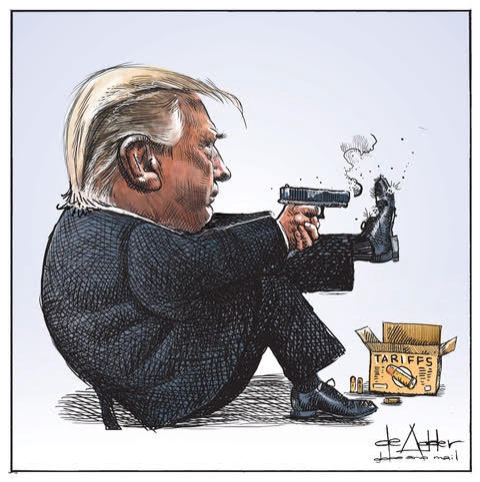
Tariffs

“Posting on his Truth Social platform, Trump said [Monday] that on the first day of his presidency he will charge Mexico and Canada a 25% tariff on all products coming into the U.S. He added in a separate social-media post that he would impose an additional 10% tariff on all products that come into the U.S. from China,… That would come on top of existing tariffs the U.S. has already imposed on Chinese goods.

“’This Tariff will remain in effect until such time as Drugs, in particular Fentanyl, and all Illegal Aliens stop this Invasion of our Country!’ Trump wrote.” WSJ: Trump pledges tariffs on Mexico Canada and China”

A tariff is a tax on an import. They are permitted by the World Trade Organization when leveed on goods receiving state subsidies in order to create a level playing field for trade. Such global trade has made an enormous contribution to the standard of living around the world.  “Ernie Tedeschi, former chief economist for President Joe Biden’s Council of Economic Advisers, said the North American tariffs would cost the typical American household almost $1,000 per year.” WP: “Trump tariffs-China Mexico Canada”

The normal expectation is that the tariff will reduce U.S. demand for the taxed import and encourage its domestic production. But the US labor force is fully employed and can only increase domestic production of the targeted goods by shifting workers from the production of goods the US has a comparative advantage in thus reducing our overall income. Though employment of manufacturing workers has declined in the US, manufacturing output has not because worker productivity has increased. In fact, our imports have not shipped American jobs overseas as increasing productivity has resulted in reduced manufacturing employment most everywhere in the world, including China, surely a good thing. WC: “Trade protection and corruption”

Immediately after Trump’s tariff announcement, the exchange rate of the dollar strengthened. A stronger dollar reduces the cost of imports (but increases the cost to foreigners of our exports), thus undoing to some extent the demand reducing impact of the tariff. But it hurts our exports because of their higher price to foreign purchaser and reduces our overall standard of living.

China and others hit with this tax are likely to retaliate with their own tariffs. “Under the United States-Mexico-Canada Agreement (USMCA), which took effect in 2020, goods moving among the three North American nations cross borders on a duty-free basis. ‘Obviously, unilaterally imposing a 25 percent tariff on all trade blows up the agreement,’ said John Veroneau, a partner at Covington & Burling in Washington.”  WP: “Trump tariffs-China Mexico Canada”

Should Trump actually impose these tariff’s he would (again) be violating the law, which only allows the President to impose tariffs without Congressional approval for national security reasons: WC: “Tariff abuse”

Trump’s threatened tariffs are not even leveed on the goods he wants to restrict (drugs and illegal aliens). Thus, unlike traditional tariffs they would be leveed to pressure Mexico and Canada to take other actions Trump wants. They are bargaining ploys. So at the cost of raising prices and lowering incomes in the US, weakening the global trading rules from which we have benefited so much, and weakening the checks and balances limiting an over extended executive branch, Trump may be playing his bargaining game again. But in my opinion the cost to us and the world trading system is too high.

Econ 101: Trade balance

Everyone understands that we are each wealthier if we buy most of what we consume from others and pay for it with what we specialize in producing ourselves. But at dinner last night one of our guests (Chatham House Rules prevent me from revealing his identity) asked how we can compete with China when their workers are so cheap? The teacher in me rises up to unpack this statement and the related issue of trade balance. It is both complicated and simple.

  1. Are Chinese goods cheaper? Chinese workers are paid in their currency (RMB) and American’s buy China’s output in our currency (USD). If an LED light bulb made in China is sold for 140 RMB is that cheap for American’s? If the exchange rate of RMB for USD is 4 RMB per USD it will cost us $35 per bulb (expensive), but if the exchange rate is 10 RMB per USD it will cost us $14 per bulb (cheap).
  2. So will we buy everything from China? What will the Chinese do with the dollars they receive from exporting to us? They might buy goods from the US (made by workers who used to make LED light bulbs). If the exchange rate is “right”, the Chinese will spend all of those export dollars on imported US products. Trade (imports and exports) will balance.  An exchange rate that makes dollars more expensive in China (RMB cheaper in the US) will decrease China’s imports from the US relative to its exports (a Chinese trade surplus). What will they do with the remaining dollars held in China?
  3. What happens with Chinese trade surplus holding of USD? The Chinese can invest them in the US (buy US Treasury securities, stocks, property, etc.). Or sell them for their own currency driving the exchange rate of RMB for USD down (or up depending on what you put in the denominator). The reduced cost in China of US goods will increase Chinese imports and the higher cost of Chinese good in the US will reduce US imports from China. The Chinese trade surplus (US trade deficit) will vanish (or adjust to the rate of capital flow desired by cross border investors). The incomes of Chinese and American workers will be higher because each will be producing the goods for which they each have a comparative advantage (the win-win of free trade).
  4. Exchange rate manipulation or production subsidies distort the outcome. EU tariffs on Chinese EVs are explicitly set at a level to compensate for Chinese government subsidies of EVs. This is allowed by WTO trade rules to put Chinese and German car manufacturers on a fair, competitive basis. The US’s much higher tariff on Chinese EVs makes no mention of complying with WTO rules (the US again does whatever it wants to the detriment of the global trading system).
  5. Trade balance between US and China is used as a simplification. What matters is the balance between each country and the rest of the world but distilling the world into two countries simplifies the discussion.
  6. Time for the dessert.

What to do about China?

China’s much anticipated post-pandemic recovery appears to have flopped, with signs of a significant slowdown after decades of supercharged growth and data flashing warning signs.” Bloomberg “China’s failing recovery”

“Signs of deflation are becoming more prevalent across China, heaping extra pressure on Beijing to reignite growth or risk falling into an economic trap it could find hard to escape.”

What, if anything, should the U.S. response be? That depends on whether we see China as a competitor or an enemy. That should depend on our assessment of China’s objectives. Does China want to expand its territory one way or another, or to expand its influence in the global order? China’s behavior might support either assessment.

China claims sovereignty over almost the entire South China Sea, including the Paracel and Spratly islands, which are also claimed by Vietnam, the Philippines, Malaysia, Brunei, and Taiwan. In 1947 China asserted its claims with a map depicting a U-shaped line covering almost 70 percent of the South China Sea, known as the nine-dash line. In 2016, an Arbitration Tribunal rejected many of China’s maritime claims as lacking a basis in international law.

The UK returned Hong Kong to China July 1, 1997, with the understanding that it would be self-governed independently of the Peoples Republic of China for fifty years. China violated this agreement with its full takeover in 2020.

In 1972 President Richard Nixon confirmed that Taiwan was part of the People’s Republic of China but would continue to govern itself independently until it agreed to merge its government with the mainland’s. In the Taiwan Relations Act of 1979, the U.S. committed to providing defensive weapons to Taiwan to defend itself from invasion (as opposed to the volunteer absorption into the Peoples Republic envisioned in the One China Act). What we provided instead were heavy weapons irrelevant to Taiwan’s defense but prized by America’s defense industries. “Taiwan-China policy assurances military” The U.S. has more recently seemed to even question its commitment to the One China agreement.

These aggressive moves by China are better seen as solidifying its borders (much in the same way the US worries about its borders with Cuba) than military expansions. On the other hand, China joining the World Trade Organization, pressing for representation in the IMF and World Bank that is more reflective of its economic size, and its Belt and Road, Asian Infrastructure Bank and BRICS initiatives reflect China’s desire to gain status in the global system comparable to that of the U.S. In short, they reflect the behavior of a rising economic competitor.

We seem to be treating China as an enemy rather than the trade and economic competitor they see themselves as. Among sportsmen, competition takes the form of doing your best—of being the best you are capable of. Within our economy we rightly see competition as good and healthy. With fair competition, both sides benefit. The world is made wealthier. Kneecapping our competition is the approach of bad guys. I explored this more fully in my blog “Competing with China”

But China is not competing fairly either. We would be wiser to use the mechanisms of the global system of rules to push and pull them into compliance. We should end our own tariff—industrial policy violation of these rules as well. We might start by restoring the dispute resolution body of the WTO. While there will be genuine security justifications for trade restrictions, they should be very limited.  They should not include taxing steel purchased from Canada. Trade is win, win.

A recent G-7 statement clarified that: “We are not decoupling or turning inwards. At the same time, we recognize that economic resilience requires de-risking and diversifying.” US Treasury Secretary Janet Yellen stressed this message during her recent visit to China. We should facilitate and encourage China’s economic rise as it contributes to our own. The opposite direction—treating China as an enemy—ends in war.

America’s Unipolar period has corrupted us. We demand that others follow rules that we violate ourselves when we don’t find them convenient. We have become a bully. My hope is that we adjust to the fact that we are no longer the world’s sole superpower by strengthening the rules we helped develop and competing fairly under them: “Goodbye unipolar world and good riddance”