Who is to blame?

Did you know that the first Covid-19 vaccine shot reduces your body’s ability to produce white blood cells by 50% and the second shot reduces it by an additional 25%? For good measure these shots contain poisonous ingredients as well.  Did you know that “former” President Trump actually won the 2020 election? Or that former President Donald Trump’s grandfather was, “a pimp and tax evader,” and that his father was a member of the KKK. Or that Rep. Alexandria Ocasio-Cortez proposed a ban on motorcycles, and that House speaker Nancy Pelosi was diverting Social Security funding for the Trump impeachment inquiry. None of these claims are true but they were viewed and often believed by millions of Americans, often on Facebook.

Granted that it is often hard to know who or what to believe, many of these claims don’t pass the laugh test (though they are rarely funny). A debate is now underway in the U.S. over whether social media should do more to weed out such lies. (“What to do with social media”) While the best answer to this dilemma probably requires balancing several approaches, I want to focus on our own responsibility vs the government’s to sort out the “truth”. To what extent should we rely on protection by government (forgive me for referring to it as “Big Brother”) or on our own efforts to identify reliable (trusted) sources of information (“Trust”) and to develop the capacity to spot obvious or likely lies.  Where do we want the dividing line between what we do for ourselves and what we want the government to do for us?

Over the years I have defended free speech as the best way to challenge bad ideas. “Do we really need free speech”  So naturally I resist giving the government much of a roll in protecting us from offensive, or “wrong” speech. Controversies over vaccines, facemasks, climate change, oil pipelines, etc. often involve serious claims on each side that are best tested in open debate.  In my view, Facebook and other social media platforms should be free to set their own rules and standards for posts. According to The Economist “Nick Clegg, Facebook’s vice-president of policy and global affairs,… pointed out that last year the company removed 30m posts that violated its policies on terrorism and 19m posts that crossed company lines for inciting hatred.” “Facebook flounders in the court of public opinion” Their users can decide whether they agree or disagree with these rules and either stay or opt out of the social platform.

But we have an interest in and responsibility to evaluate the many claims that come our way. We can do a better job of providing our children with the tools for spotting fake or potentially fake information. Along with civics and home economics (how to cook etc.) that are (or should be) taught in high school, students should be taught how to spot and challenge highly improbably statements.

For example, it does not require any medical knowledge at all to spot the vaccine video referred to above as a fake. The medical “expert” who presents her shocking claims is anonymous, as are her credentials and medical affiliations. The vaccine she reports on and claims will kill 20 to 30% of those who take it is unnamed. All the animals it was tested on died, she said. While many of us have lost confidence in the veracity of the information provided by the Food and Drug Administration and the Center for Disease Control (drugs might be approved too slowly or too quickly, etc.) none of us would (or at least should) believe that they would approve a vaccine with the properties alleged in the video.

I have seen much better produced videos the were totally fabricated stories for reasons I find hard to understand (we shouldn’t blame Russia for everything). One very well done and potentially convincing video claimed that no plane actually crashed into the Pentagon on 9/11. Any sensible person should have doubts about claims that are so directly contradicted by pictures and reports to the contrary. But I must admit that my rejection of its big lie was fortified by the fact that at that time I lived next to the Pentagon and saw the damage to the building, and I witnessed the wreckage of the plane laid out for months in the Pentagon parking lot. I also knew a woman who died in that plane.

More could be done by social media platforms to flag potential misinformation, but it should not be censored by the government. We should strengthen our personal capacity to evaluate propaganda but most importantly we need to carefully establish news sources that we trust. Knowing that the Facebooks of the world feed us what they think we like, thus creating an information bubble, we should make the effort to check other sources for their views. We have not flourished as a nation because we turned over our care to the government even if it must provide a critical foundation for our security and interactions. 

Never Again

On this 20th anniversary of the 9/11 attack on America, many of us are saying “NEVER AGAIN”. What those saying it mean will determine the future of our country.

If “never again” means to you that we will never allow attacks on our homeland again, you are saying that out of your fear you chose safety over liberty. You support the authoritarian, repressive measures of the so-called Patriot Act and the related government intrusions in our privacy and liberties in the name of greater security. This is not the spirit of those Americans who continue to get into their cars to drive to work or wherever despite automobile accidents killing ten times more Americans every year as American soldiers who have died in Afghanistan in the past 20 years.

For me and thankfully for many other Americans, it means that we will never again surrender to the fear that blinded us to the tragic mistakes of American aggression in Afghanistan, Iraq, Libya, Somalia, Syria, and Uganda. Lawrence Wilkerson explains our self-destructive behavior in the following interview. COL Wilkerson was a senior official in the Bush administration when it launched the Iraq invasion. Now he calls it a mistake born of rage and fear. https://www.cnn.com/videos/tv/2021/09/10/amanpour-wilkerson-9-11.cnn

We have the most powerful military in the world. No military force could protect us at home (to the extent that our safety depends on military force) better. When it comes to its effectiveness in offensive attacks on other countries, its effectiveness is less clear and its effectiveness in efforts to rebuild the countries it has occupied…… well this fantastic three hour discussion reveals it as worse than zero https://www.youtube.com/watch?v=GkjsjBknWfo

We once revered and defended our liberty above all else and we were respected and envied around the world. We prospered. Over the last twenty years we have gradually, year by year, squandered our cherished traditions and our standing and respect in the world has declined as a result. Former President Trump signed an agreement with the Taliban promising to remove all American troops from Afghanistan by May 1 of this year. It was a bad agreement, but our departure was many years overdue. President Biden extended our stay for a few more months but has now honored Trump’s commitment. Why our military was unable to prepare properly for our withdrawal from Afghanistan with this two-year notice is a mystery we need to investigate.  

Never again should mean that we never again act out of fear. https://wcoats.blog/2021/09/05/nation-building-in-afghanistan-2/

Nation Building in Afghanistan

The lesson of Afghanistan is not that the US is washed up as a great power. The lesson is that the US is such a great power, militarily and economically, that it is continually tempted to try hopeless things that nobody else on earth – including China – would ever attempt.  David Frum

On July 8, 2021, President Biden said that: “the United States did what we went to do in Afghanistan: to get the terrorists who attacked us on 9/11 and to deliver justice to Osama Bin Laden, and to degrade the terrorist threat to keep Afghanistan from becoming a base from which attacks could be continued against the United States.  We achieved those objectives.  That’s why we went.
We did not go to Afghanistan to nation-build.” “Remarks by President Biden on the drawdown of U.S. forces in Afghanistan”

In fact, except for killing Osama Bin Laden, we had achieved those objectives before I arrived with an IMF team in January 2002 to contribute to building a more effective government. Finding and killing Bin Laden was delayed until May 2, 2011, because of the redirection of American efforts to the ill-advised and illegal war in Iraq. So why were American troops still occupying Afghanistan until August 30, 2021?

In an August 18, 2021, interview with George Stephanopoulos, President Biden explained what happened asking: “Then what happened? Began to morph into the notion that, instead of having a counterterrorism capability to have small forces there in — or in the region to be able to take on al-Qaeda if it tried to reconstitute, we decided to engage in nation-building. In nation-building. That never made any sense to me.”  “Biden’s claim that nation building Afghanistan never made any sense”

George W Bush opposed nation building in his 2000 presidential campaign. In his memoir, Decision Points, he states that “After 9/11, I changed my mind.” Already by April 2002, he stated that “We know that true peace will only be achieved when we give the Afghan people the means to achieve their own aspirations. Peace will be achieved by helping Afghanistan develop its own stable government.” He was right. However, as he noted: “Our government was not prepared for nation building.” He was right about that as well.  “Bush on nation building and Afghanistan”

The U.S. officials responsible for “nation building” in Afghanistan knew little about its history and culture. They foolishly imposed an alien Western style government dropped on a diverse people as if from a drone. The US military is an excellent machinery of war. The best in the world. However, it does not have the skills required for “nation building.” Our military couldn’t even recruit the right solders or provide the training they needed to fight on their own, much less build a proper military organization. “Afghanistan combat interpreter Baktash Ahadi: U.S. cultural illiteracy”  And attempting nation building at the point of a gun is bound to fail.

And why did the Afghan soldiers that Americans trained for decades not fight to defend the existing government? “Afghan forces were demoralized by neglect, corruption and ethnic bias among their superiors. Often they went without pay and ammunition, and sometimes without rations….  ‘The why is corruption, the why is poor leadership,’ John Sopko, told The Washington Post in 2017, ‘If leadership is poor, the people below don’t care, and they wonder why they have to die.’” “Afghanistan U.S. troop withdrawal”

On Sunday August 15, 2021, Taliban forces walked into Kabul and took over the government without a shot.  “The Band of Brothers and Afghanistan”   But what did they take over or replace? And did 20 years of so-called nation building make any difference.  “Nation building” is often given a bad name because it has too often been associated with the imposition of a “government” by an occupying military force as with imperialism.  Afghanistan is a very different place than it was 20 years ago. Both the nation and its government and its institutions have changed considerably. We can hope that the Taliban has changed as well.

Governments consist of ruler/decision makers, and the institutions that administer whatever it is that the government does. A nation extends beyond its government to include civil society, and social and cultural norms. The Taliban have displaced Afghanistan’s President Ashraf Ghani, who fled to Uzbekistan then to the UAE rather than step aside for a transition period as had been agreed. Afghanistan’s Chief Executive Officer, Abdullah Abdullah, remained and with former President Karzai is discussing the composition of a new government with Taliban leaders.

“Taliban co-founder Mullah Abdul Ghani Baradar will lead a new Afghan government….  Haibatullah Akhundzada, the Taliban’s supreme religious leader, will focus on religious matters and governance within the framework of Islam.

“While the Taliban have spoken of their desire to form a consensus government, a source close to the Islamist militant movement said the interim government now being formed would consist solely of Taliban members. It would comprise 25 ministries, with a consultative council, or shura, of 12 Muslim scholars, the source added.

“Also being planned within six to eight months is a loya jirga, or grand assembly, bringing together elders and representatives across Afghan society to discuss a constitution and the structure of the future government, the source said.”  “Taliban co-founder Baradar will lead new Afghanistan govt”

Prior to the fall of Kabul, the government of Afghanistan consisted of the cabinet of ministers, provincial governors and the national assembly, with a democratically elected president serving as the head of state, head of government and commander-in-chief of the Afghan Armed Forces. It appears that the new government will retain the same administrative units. In addition to the central bank (DAB), which I advised, these would include functions such as Foreign Affairs, Internal Affairs, Finance, Economy, Agriculture, Energy and Water, Justice, Information and Culture, Education, Industry and Commerce, Transportation, Women’s Affairs, Public Health, Mines, and of course, National Defense. Though the U.S. did a poor job developing Afghanistan’s National Defense institutions, more experienced international agencies made considerable progress in developing more efficient and effective agencies in many other areas. Of at least equal importance, a generation of Afghan men and women have grown up expecting their place in the world to reflect their skills and accomplishments (merit) rather than who they knew.

I have written earlier about the dramatic progress in modernizing the central bank’s operations. It was achieved in the proper, traditional way of “nation” and institution building. We explained best practice for central banks derived from the experiences of established central bank and the approaches we thought would fit best with Afghanistan’s existing central bank and economy. But DAB’s management and staff made the decisions of what to embrace and how to move forward and we offered guidance on designing and implementing those decisions. “BearingPoint Afghans”

But one institution can’t develop independently of what is happening in the rest of the country. In particular, developing the rule of law is critical and difficult. An example was provided by DAB’s (the banking supervisor) confrontation with a corrupt President and Attorney General over the resolution of the insolvent and criminal Kabulbank in 2010-12. The founders and owners of Kabulbank (President Karzai’s brother Mahmood was the third largest shareholder) had rapidly grown this newly licensed local bank into the country’s largest depository and had lent almost all of its deposits to themselves. During the global financial crisis of 2008, many of Kabulbank’s owners’ investments failed and they were unable to repay their depositors. DAB’s banking supervisors were blamed for weak supervision and even arrested and jailed in disregard of the provisions of the central bank law. The scandal revealed considerable corruption, but the supervisory resolution of the bank somewhat strengthened (modestly) the rule of law in the process.  “Afghan President Ghani’s attack on corruption”    “The Kabul Bank Scandal”

Another huge set back to the impressive development of DAB resulted from President Ghani appointing an unqualified friend, Ajmal Ahmady, as Acting Governor of the central bank. He fired many of the best of the BearingPoint Afghans and brought in his own small group of cronies. Mr. Ahmady’s appointment was rejected by the Parliament, but he illegally remained in his post.  The Taliban (???) have now appointed Haji Mohammad Idris as the Acting Governor of the central bank. “Mr. Idris was head of the Tabliban‘s finance section, but he has no formal financial training or higher education.”  “Haji Mohammad Idris”

These examples are meant to illustrate the distinction between a government’s leaders and its administrators. Time will tell whether our “nation building” efforts with DAB survive the attacks on it from Afghanistan’s leaders (current and past). But as a result of the nation building efforts of many international bodies, Afghanistan is a very different and better place, and its young population has very different expectations, than twenty years ago. I hope that the Taliban leaders that have taken over the government are also very different than their repressive and brutal forebearers of twenty years ago.

While the new government will no doubt leave many of the institutional structures in place that have been developed over the last two decades, from which they and the country have benefitted, the big question is what policies and rules they will establish under the name of Sharia law, especially with regard to the rights of women. The Taliban have their own internal factions that need to be sorted out and their earlier version of Sharia was an extremely harsh interpretation not shared by most Muslims. The Taliban has pledged to treat women and others fairly, within the dictates of Sharia Law. Other Muslims will need to convince the Taliban to moderate their earlier interpretations of what that means. The United States, the EU  “EU sets five conditions for future operational engagement with Taliban”, China, Russia, and the international organizations, have enormous financial and diplomatic leverage with which to encourage the Taliban government’s better behavior. They should be used vigorously to help build a better Afghanistan. Early signs are not encouraging, but these are early days. One Afghan friend changes locations every night in the hopes of not being found. Other friends are afraid to leave their homes at all.

The idea that we should refuse to cooperate with the new government and should oppose it at every turn from the outset is bone headed. Just ponder the alternatives for a second. Do not think that it is easy for me to sit here in my comfortable Bethesda home and urge us to give the Taliban a try. My days begin with heart wrenching pleas for help from Afghan friends and strangers. I challenge you to read the following account of dashed hopes without weeping: “After a university falls in Afghanistan a DC organization scrambles to keep students safe and still learning”   

Efforts to achieve a better Taliban government this time around may be a long shot, but the alternatives of a return to civil war and worse yet the return of American and NATO troops are not pretty either. The U.S. intention to cooperate with the new government in countering ISIS-K is encouraging, but, like anything else in life, not without risks.  “US may coordinate with Taliban to take on ISIS-K”  Nation building by everyone but the U.S. government over the last 20 years has not been a waste of time. Now is not the time to give it up.

Nation building is unlikely to be successful when coerced, i.e., when it is part of a military intervention. It does not follow that nation building–sharing best practice in the design and operation of institutions public and private–is an unworthy objective and undertaking.

BearingPoint Afghans

Sometime around 2004 or 2005, the US Agency for International Development (USAID) contracted BearingPoint (now part of Deloitte Consulting) to recruit and mentor approximately 80 young Afghan college graduates into Afghanistan’s central bank (DAB) and Finance Ministry. These young Afghans worked in DAB and the Finance Ministry for two years while being trained and mentored by BearingPoint experts. Following these two years they were offered regular jobs in these two institutions. While some moved on to higher paying jobs elsewhere most of them stayed with DAB and the MOF. Over the years that followed they rose within these institutions, and in DAB headed many of the departments including the position of Second Deputy Governor. Working with and watching the progress of these young Afghans was one of the most enjoyable and gratifying assignments in my career with the International Monetary Fund. They were smart, honest, and dedicated to improving life in their country (including their own). They were, and I hope still are, the hope for a better future for Afghanistan.

The elected Afghan government under which these BearingPoint Afghans worked has now been toppled by the Taliban, a group that harshly ruled Afghanistan from 1996 until displaced by an American-British invasion in November 2001.  Back in 1996: “Gaining control over most of the country, the Taliban impose their rule, forbidding most women from working, banning girls from education, and carrying out punishments including beatings, amputations and public executions. Only three countries officially recognize the Taliban regime: Pakistan, Saudi Arabia and the United Arab Emirates.”  “Afghanistan conflict timeline”

The Taliban in 1996 claimed to impose Sharia Law on Afghanistan. “Sharia” translates to ‘the way’ in Arabic and refers to a wide-ranging body of moral and ethical principles drawn from the Quran and from the sayings and practices of the Prophet Muhammad. The principles vary according to the interpretation of various scholars who established schools of thought followed by Muslims who use them to guide their day-to-day lives. Many Muslim-majority countries base their laws on their interpretation of the principles of Islamic law but, despite this, no two have identical laws.”  “Taliban and Sharia Law in Afghanistan”

The Taliban imposed a very severe version of Sharia that has not been embraced by very many Muslims. It was particularly restrictive on the activities and rights of women. Twenty years later Afghanistan is a different place, and the Taliban sounds like a different organization.

“KABUL, Afghanistan (AP) — The Taliban vowed Tuesday to respect women’s rights, forgive those who fought them and ensure Afghanistan does not become a haven for terrorists as part of a publicity blitz aimed at reassuring world powers and a fearful population.

“Following a lightning offensive across Afghanistan that saw many cities fall to the insurgents without a fight, the Taliban have sought to portray themselves as more moderate than when they imposed a strict form of Islamic rule in the late 1990s. But many Afghans remain skeptical — and thousands have raced to the airport, desperate to flee the country.

“Older generations remember the Taliban’s previous rule, when they largely confined women to their homes, banned television and music, and held public executions. A U.S.-led invasion drove them from power months after the 9/11 attacks, which al-Qaida had orchestrated from Afghanistan while being sheltered by the Taliban.”  “Afghanistan Taliban Kabul”

So, what should American policy be toward the forthcoming Taliban or Taliban lead government? What does the Taliban pledge to “respect women’s rights consistent with their version of Sharia Law actually mean? We should deploy every diplomatic tool possible to encourage/pressure the new government to live up to its promises. Former President Karzai, current CEO Abdullah Abdullah and others are currently in discussions with the Taliban leadership over terms for an inclusive government.

The alternative of nonrecognition, once there is a government to recognize, is to encourage and even support civil war. Or, God forbid, to send our troops back (there is not much chance that our NATO allies would be conned a second time into join us there again). And how did that work out for us last time? Our over used weapon of economic sanctions harms the public we should be trying to help. Our inhuman sanctions on Cuba and Venezuela are imposing horrible pain on the their citizens with little impact on their governments. “Evidence-costs and benefits of economic sanctions”

In a recent Washington Post oped Nikki Haley argued that we should not recognize the Taliban government no matter what. “Nikki Haley-America must not recognize Taliban” I respected Ms. Haley when she was Governor of South Carolina but I eventually got over her when she embarrassed us while Ambassador to the UN. “The future of Israel and Palestine” Her unqualified attack on the Taliban firmly ties her to those who were responsible for our Afghan disaster in the first place. The new Afghan government may turn out to be as bad as the previous Taliban government, but we should do everything possible to prevent that.

The U.S. has suspended currency shipments purchased by Afghanistan’s central bank. Afghan assets (foreign exchange reserves, etc.) deposited abroad have been frozen including “its” access to reserves at the IMF. These may appear to be rejections of a new government, but they are not. There is no new government yet and those holding Afghan assets must keep them safe until their new owners are clearly and properly identified. The situation is much like the bank in which you have deposited money, freezing your deposits when you die until the new lawful owner is determined. There is an unavoidable, awkward period of uncertainty. It is not too late to reverse our mistake in closing our Embassy and running out while at the same time accusing the Afghan Army of behaving the same way.

It is also not true that nothing was accomplished these past 20 years. Our military leaders may have failed in their task of building a reliable Afghan Army, but many others, myself included, did not waste our time by helping Afghans build better institutions (see the story of the BearingPoint Afghans I started this article with above). See the discussion of this issue by Jonathan Rauch: “The  Afghanistan war was a partial success”

No one knows what the Afghan government will look like or which way it will go, but we all (except for the war mongers) have an interest in promoting its success, especially the hopeful, new generation of Afghans. “Can US work with Taliban”    “What do Taliban’s really want?”

And we must resist the siren calls of those who think that we can and should impose our vision and institutions on the rest of the world. We must keep our Army home to defend our homeland rather than messing with other people’s business. Our defense industries have profited enough.

The Band of Brothers and Afghanistan

Sunday night Ito and I finished the tenth and final episode of the WWII story of Easy Company of the 101 airborne division of the U.S. Army–The Band of Brothers. It is a moving and masterful depiction of the horrors of war, and its impact on those (often) brave men who fight them.  How, I asked myself, can good people do such terrible things to each other?  And why?  Who benefits (that is too obvious to answer explicitly)?

I woke up that morning to the fact that the government in Afghanistan that I had been working with for the past 20 years had been replaced by the Taliban who intends to form a new government. Fingers are being pointed all over the place in the search for fault. I am afraid that this American question is of little interest to my Afghan friends. Those who have not already left the country are holed up in their homes afraid to go to work. Their question is what the new Taliban regime will look like.

Our objective now should be to join with all other nations to exert diplomatic pressure on the new government (which potentially will have the cooperation of at least former President Hamid Karzai, CEO Abdullah Abdullah, and Islamic Party leader Gulbuddin Hekmatyar) to adhere to UN standards of humanitarian treatment of its citizens and to help them administer an efficient and honest government. America’s leadership in this regard will be critical for Afghanistan’s future.

But who should we blame for, and what lessons should we learn from, Afghans fleeing the country by climbing onto the outside of planes leaving the Kabul Airport (something I have done many times but more comfortably seated)? Working backward, President Trump gave our military leaders a May 1 deadline for leaving. It rather looks like they ignored him (tempting but not appropriate).

The speed with which the Taliban took over the country with barely a shot fired surprised most of us. We had dinner at the home of Edward and Dalya Luttwak Saturday. During the conversation I passed on the statement by an Afghan friend emailed to me that afternoon that the Taliban could take Kabul by the next day or week.  We all thought that would be impossible, thinking it might be as fast as a few months. In fact, they peaceably took over the city the next day (Sunday Aug 15).  In fact, our Embassy and Military leaders should not have been surprised. My work in Afghanistan with its central bank did not require that I be thoroughly versed on Afghan history and customs, but that is not true for our foreign policy establishment working in and on Afghanistan.

Rather than arm, train, and support Afghan fighters in regions they cared about, we pulled together a national Army with the incentive of money. In addition, the broader Afghan public did not strongly support its corrupt government and could fairly easily change sides. “Afghanistan military collapse-Taliban”  Moreover, waring tribes and political groups such as the Taliban have a long tradition of negotiating peaceful surrenders when the outcome seems clear.  “Afghanistan history-Taliban collapse”

The initial blame for our failure to “build” a strong government in Afghanistan falls on George W Bush who gave in to the Cheney/Rumsfeld fantasies of American Imperialism, and abandoned the original and sensible approach of American support of the Northern Alliance war against the Taliban. “Its plan was for small teams of CIA officers, along with Green Berets and U.S. air power, to assist the indigenous Afghan resistance—the Northern Alliance.” “Afghanistan withdrawal-CIA-bin Laden-al Qaeda-Bush-Biden-Northern Alliance” Instead we took over and occupied the country.

Rather than work with and build from Afghanistan’s traditional tribal structures, we imposed an alien, centralized government that was not understood and was generally resented outside of Kabul. Rather than elevating village chiefs to govern provinces, for example, Kabul sent strangers to oversee areas they knew nothing about. Our ignorance and arrogance were mind boggling, but sadly typical. And our military—the best in the world for waging wars— is incompetent at nation building, which should be the job of others. We couldn’t even build an Afghan Army in 20 years. “How America failed Afghanistan”  

Those who are most loudly criticizing Biden’s troop withdrawal are those most responsible for creating this mess to begin with.   “Afghanistan disaster started with withdrawals most ardent critics”  See my account of my work with the central bank in Kabul:  “My travels to Afghanistan”

Trust

Trust is a critically important feature of successful relationships and of flourishing societies. Enduring trust builds on honestly and truth.  I have just finished reading Jonathan Rauch’s exposition of these truths in The Constitution of Knowledge: A Defense of Truth and his enlightening exploration of how to find and defend truth in today’s challenging environment. 

How can we determine what is true and what is not? Rauch’s book explores this question. In sorting out fact from fiction we must recognize the personal and social biases through which we evaluate claims and the factors that motivate them. The task is made even more difficult by the fact that there are some who deliberately propagate falsehoods for their own purposes. Whatever else might motivate them, political and other leaders act to gain or retain their power. They often have an incentive to misrepresent facts, i.e., to lie. Former President Trump and his Big Lie (and his many, many other lies) is by no means the only President to have lied to the American public. Many other Presidents have also lied.

Ken Burn’s documentary, The Vietnam War, is a brilliant expose of such lies and yesterday I watched for the first time the 2010 Goldsmith and Ehrlich directed documentary The Most Dangerous Man in American: Daniel Ellsberg and the Pentagon Papers. Lyndon Johnson and Richard Nixon almost give Trump a run for his money as liars, though I think that they thought they were lying for the benefit of our country along with their reelection (which by no means excuses it).

Our constitution provides limited, enumerated powers to our government and checks and balances of the powers between its branches and its citizens. But the power of free speech and a free press to expose lies is an indispensable check on the lies of public officials. Our republic has been defended from foreign attacks by many brave solders. But we should also be grateful for the self-sacrifices of a few brave whistleblowers for exposing government lies and thus defending our republic and the individual liberty in which we have flourished.

Wednesday, I watched Daniel Ellsberg receive the Committee for the Republic’s Defender of Liberty award. We are still meeting virtually, but the event was a fascinating discussion of the Vietnam war decision making. The discussion included the Pentagon Papers movie directors, Goldsmith and Ehrlich; the official head of the Pentagon project that wrote the Pentagon Papers history of the war, Morton Halperin; the New York Times reporter who wrote the first article on the Papers given to him by Ellsberg; and Ellsberg himself who went on at great length. It was a riveting two-hour discussion. You can watch it here: https://youtu.be/l7L3DOhakNU

I hope that we can present this award to Edward Snowden in the future.  

Holding our government officials accountable for speaking the truth and for abiding by the law are critically important in preserving (or restoring) trust and in determining “the truth.” Each one of us contribute to (or detract from) those goals. But I am in awe at the personal sacrifices of Ellsberg and Snowden in the service of truth, which so badly needs defending. If there is hope of saving our fractured and disbelieving Republic, it will be because of the bravery of such people and the embrace by the rest of us of the wisdom expressed by writers like Rauch. It requires our individual commitment to truth and the institutions and norms that facilitate and incentivize finding it (filtering falsehood from truth). It requires an effective Constitution of Knowledge.

Do what we say and not what we do

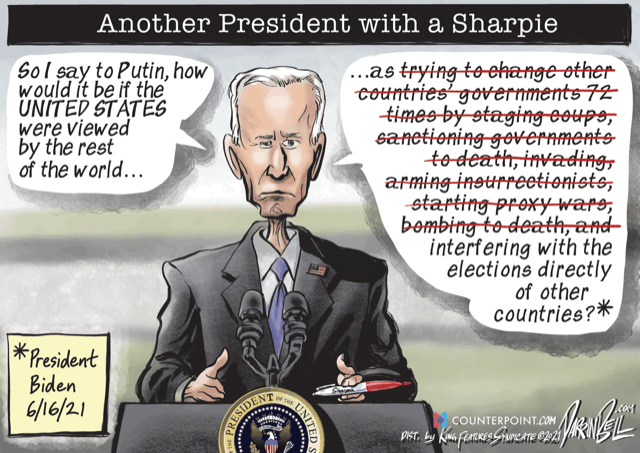
In his meeting with President Putin, President Biden is thought to have proposed red lines against the use of cyber weapons such as ransomware. The idea of shutting down something like Colonial Pipeline with a computer hack is surely repugnant. I seem to remember that many of us cheered when the U.S. (and Israel?) damaged the Iranian uranium enrichment facility at Natanz with a malicious computer worm called Stuxnet. Nor were many of us much bothered when U.S. financed coups topped unfriendly governments, or when we attacked Afghanistan, Iraq, Libya, Haiti, Nigeria, Syria, to name but a few.

“The supreme international crime according to 2017 U.S. media reporting is interfering nonviolently in a democratic election — at least if Russia does it. William Blum, in his book Rogue State, lists over 30 times that the United States has done that. Another study, however, says 81 elections in 47 countries.”  https://davidswanson.org/warlist/

While this is hard to swallow, our bad behavior differs from that of Russia’s or of other autocrats. I will not go to jail for writing this. Most Americans (I like to believe) condemn such behavior contrary to our founding principles when they learn of it. Our press is happy to expose such breaches when they discover them. In short, while our government often violates our principles of individual rights and the rule of law and lies regularly about it, public scrutiny and outrage tend to check bad behavior and move us back toward conformity with our principles. We never get there but it is very important that we keep trying.  

All Volunteer Military

In May 1967, The New Guard magazine published an article by Milton Friedman on “The Case for a Voluntary Army.”  It was a compelling case and was adopted when the U.S. suspended its military draft in January 1972. But was it correct? “45 years later Nixon-Gates commission”

In the 1960s, the drafting of 18 year old’s to fight in Vietnam was avoided by those able to go to college. This was rightly challenged as discriminatory against the poor and college deferments were replaced with a lottery system that started in 1970, which picked the birthdates at random that would then be first in line to be drafted each year. I was granted the last of the college deferments.  “Draft lottery (1969)”

While a student of Friedman’s at the University of Chicago from 1965-70, I joined with several other libertarian classmates to form the Council for a Volunteer Military to promote Friedman’s call for an end to the draft. The Directors of the Council were: James Powell, National Director; Henry Regnery, Treasurer; myself, Executive Secretary; Danny Boggs, national Filed Secretary; and David Levy, Publications Editor. Our sponsors were: Yale Brozen, Bruce K. Chapman, Richard C. Cornuelle, James Farmer, David Franke, Milton Friedman, Sanford Gottlieb, Eugene Groves, Karl Hess, and Norman Thomas: an impressively diverse group.

In 1969 President Richard Nixon establish the Gates Commission to advise him on established an all-volunteer military and appointed Friedman to the commission.  Based on the Commission’s recommendations, President Nixon signed a law in 1971 that ended the draft in January 1973.

A Rand Corporation report on the All-Volunteer Force (AVF) by Bernard D. Rostker stated that: “Although the country had conscripted its armed forces for only 35 of its 228 years — nearly all in the 20th century — the American people were generally willing to accept this practice when service was perceived as universal. However, in the 1960s, that acceptance began to erode. There were five major reasons:

  • Demographics. The size of the eligible population of young men reaching draft age each year was so large and the needs of the military so small in comparison that, in practice, the draft was no longer universal.
  • Cost. Obtaining enough volunteers was possible at acceptable budget levels.
  • Moral and economic rationale. Conservatives and libertarians argued that the state had no right to impose military service on young men without their consent. Liberals asserted that the draft placed unfair burdens on the underprivileged members of society, who were less likely to get deferments.
  • Opposition to the war in Vietnam. The growing unpopularity of the Vietnam war meant the country was ripe for a change to a volunteer force.
  • The U.S. Army’s desire for change. The Army had lost confidence in the draft as discipline problems among draftees mounted in Vietnam.”

At the time Crawford H. Greenewalt, another member of the Commission, wrote to Gates that “while there is a reasonable possibility that a peacetime armed force could be entirely voluntary, I am certain that an armed force involved in a major conflict could not be voluntary.”

“Rand research briefs”

The AVF matched or exceeding the high expectations for it. The professionalism of our Army improved. We fought 13 wars with our volunteer force: Lebanon (1982-4), Grenada (1983), Panama (1089-90), Gulf War (Iraq, Kuwait, Saudi Arabia and Israel 1990-91), Somalia (1992-5), Bosnian War (1992-95), Haiti (1994-5), Kosovo War (1998-99), Afghanistan War (2001-21), Iraq War (2003-11, 2014-2020), Somali Civil War (2007-21), Libya intervention (2011, 2015-20), and Syria (2014-present). Each was limited enough not to exhaust the supply of volunteers needed.

But a different criticism of our all-volunteer force was raised that gave me pause. Our costly and futile war in Vietnam from 1955-75 was finally ended (without admitting the defeat it surely was) in response to the growing protests in the U.S.  No such protests were raised for our imperial adventures since then. Some observers began to point their fingers at the absence of a draft and thus a military/industrial complex better sheltered from public criticism. When we campaigned for the end of the draft and an all-volunteer military, we assumed that we needed to maintain an Army for our defense. Instead, our military was deployed all over the planet (800 bases around the world) with sufficient restraint (generally) to avoid strong public push back.  “National defense”  If the average middle class family’s children were not being drafted to fight unnecessary wars in far off places, they were not as likely to complain about the billions of their taxpayer’s money being pumped into the military/industrial complex.  This was an unanticipated side effect of ending the draft that we had not anticipated.

Both former President Trump and President Biden expressed their intentions to end our forever wars and, at least in the case of Biden, to strengthen our capacity to deal with the world with diplomacy. We should wish him well. And we should urge Congress to reinstate the Weinberger Doctrine, which limited the use of U.S. forces to when vital U.S. interests were at stake, and only as a last resort. “A Biden doctrine starts to take shape”

You can read my experiences in Iraq in my book: “My travels to Baghdad” and my experiences in Afghanistan in my book: “My travels to Afghanistan”.

PS. Some how I forgot that I had written on this before with a somewhat different proposal: https://wcoats.blog/2015/01/23/the-all-volunteer-military-unintended-consequences-and-a-modest-proposal/

Why some still believe the Big Lie

Last Monday (May 3) Trump proclaimed that the 2020 election “will be, from this day forth, known as THE BIG LIE!” In reply Congresswoman Liz Cheney tweeted: “The 2020 presidential election was not stolen. Anyone who claims it was is spreading THE BIG LIE, turning their back on the rule of law, and poisoning our democratic system. 10:27 AM · May 3, 2021·       “More on Trump acquittal”

The voter frauds loudly proclaimed by Trump spokesmen in public were generally not repeated in court where those making such claims had to speak under oath. Where specific charges of vote tampering were made against voting machine companies such as Dominion Voting Systems, the objects of such attacks were protected by libel laws, which required proof, which was totally lacking. Libel suits brought by Dominion and others led to retractions and apologies by Fox news and many others for their fabrications.

“The latest legal target to tuck its tail is the conservative cable news channel Newsmax, which released a statement Friday night apologizing to Eric Coomer, a top official at Dominion Voting Systems, who filed a suit against Newsmax in December.” “Slow painful death-trump allies voting machine conspiracy theories”

My favorite “apology” for falsely claiming voter fraud was from Sidney Powell, one of Trump’s shameless lawyers until even he had to distance himself from her.  “A key member of the legal team that sought to steal the 2020 election for Donald Trump is defending herself against a billion-dollar defamation lawsuit by arguing that “no reasonable person” could have mistaken her wild claims about election fraud last November as statements of fact.” “Sidney Powell-Trump election fraud claims”

I have struggled to understand how presumably decent people could continue to believe such obvious nonsense. The conservative Christian writer David French provides a partial explanation. “Prophecy is very important in Pentecostal Christianity…. Many millions of Americans spent the Trump era deeply loyal to Trump not because of policy arguments or political debate, but in large part because “prophets” told them he was specifically and specially anointed by God for this moment. These Americans were resistant to the election outcome because they were told—again and again—by voices they trusted that God promised Trump would win.”  “Making prophecy great again”  French is an interesting and thoughtful writer, and correctly notes that this belief is a problem for the Pentecostal church. 

But many more than these Pentecostals continue to repeat the big lie. According to Michael Gerson: “To be a loyal Republican, one must be either a sucker or a liar. And because this defining falsehood is so obviously and laughably false, we can safely assume that most Republican leaders who embrace it fall into the second category.” “Trump republicans big lie”

We have many serious policy issues to discuss. We seriously need to get beyond The Big Lie.

What to do with Social Media?

Social media is changing how we get news and debate public issues. How should its contents be regulated and by whom? The answer should reflect the fundamental importance of free and open speech for forming broadly supported public policies and social attitudes.

The quality of public discussion in the United States today has deteriorated. There are even some who wish to end debate on some issues altogether (the cancel culture). Take two recent examples:

In reaction to Georgia’s new Voting Rights Act President Biden said: “Parts of our country are backsliding into the days of Jim Crow, passing laws that harken back to the era of poll taxes — when Black people were made to guess how many beans, how many jelly beans, in a jar or count the number of bubbles in a bar of soap before they could cast their ballot.” “Biden US backsliding-Jim Crow”

Representative Maxine Waters traveled to Brooklyn Center, Minnesota, to join crowds protesting the police shooting of Duante Wright. On that occasion, “A reporter then asked, if Chauvin isn’t convicted on all charges, “What should protesters do?”

“Well, we gotta stay on the street,” Waters said. “And we’ve got to get more active. We’ve got to get more confrontational. We’ve got to make sure that they know that we mean business.”

For her complete comments see: “In her own words-Maxine Waters”

In response to Water’s words Representative Marjorie Taylor Greene tweeted:

_________________________________  

@RepMaxineWaters you don’t live in Minnesota.

You crossed state lines and incited riots, violence against police, shootings at the MN NG, and threatened a jury as a sitting US Congresswoman.@SpeakerPelosi surely you will expel this criminal from Congress and uphold the law! pic.twitter.com/twH52VwFTP

— Marjorie Taylor Greene 🇺🇸 (@mtgreenee) April 19, 2021

_________________________________ 

“Marjorie Taylor Greene says Maxine Waters incited riots calls for her expulsion from congress”

‘Maxine Waters-Kevin McCarthy Minnesota police”

President Biden’s and Representative Greene’s comments both earn four Pinocchios. Senator Ted Cruz’s comments about Waters’ statement were just as bad. But then we are used to politicians lying to us, especially in the heat of campaigns. However, they do not contribute to the constructive dialog needed over these and other pressing public issues.  

With regard to Georgia’s new Voting Law, assessments are mixed. For example: “Rather than allowing voters to request ballots six months from Election Day, the new law says voters can start requesting ballots 78 days out; counties can begin sending ballots to voters just 29 days before Election Day, rather than the previous 49 days.” “Georgia voting law explained”

This hardly strikes me as voter suppression. I grew up in Bakersfield California and our voting precinct voted in our garage. As a kid I was fascinated by it all (though not thrilled with having to clean the garage for the occasion). There was no such thing as early voting except for absentee ballets by military service men and women. No drop boxes or any of that stuff. You came to our garage on election day or you didn’t vote. But there is surely a place for serious pros and cons of each provision of the law. As the press has been overwhelmingly (almost hysterically) negative (despite Georgia’s Governor and Secretary of State’s refusal to yield to Trump’s pressure to overturn his election defeat in Georgia) here is a more measured defense of the new law: “Exclusive 21 black leaders defend Georgia voting law as proper honest reform”

The real question is why were changes in Georgia’s voting law needed in the first place? What weaknesses were being addressed? Even with this new law, Georgia’s law is more permissive than those of Biden’s Delaware. In a negative, but more balanced assessment, Derek Thompson stated that:  “Georgia’s voting rights have long been more accommodating than those of deep-blue states including not only Delaware, but also Connecticut, Massachusetts, New Hampshire, and New York.” “Georgia voting rights fiasco”

Maxine Waters didn’t, and often doesn’t, use the best judgement in where, when and what she said, but she didn’t say anything that she should not be allowed to say whether you agree with her or not.  Referring to Reps. Waters and Rashida Tlaib, D-Mich, Newt Gingrich wrote that:

“House Democrats have produced two radical demagogues whose policies would endanger the lives of innocent Americans, lead to the breakdown of society, and undermine the U.S. Constitution.”  “Repudiate Tlaib and Waters promote mob rule Newt Gingrich” This is precisely the sort of name calling that impedes the serious dialogue over concrete issues and proposals that we so badly need. Demonizing opponents–turning opponents into enemies–is a tactic of the weak (think Vladimir Putin).

Rep Waters’ charge that protesters should get more confrontational did not strike me as an incitement to violence anymore (and rather less) than former President Trump’s call for his assembled supporters on January 6 to march to the Capital and “fight like hell. And if you don’t fight like hell, you’re not going to have a country anymore.” The brief submitted by Trump’s lawyers for his impeachment trail stated the “his call for the crowd to ‘fight like hell,’ was not meant to be taken literally.” OK, then perhaps he should keep it to himself. This reminds me of my favorite “apology” for lying about voter fraud that kept Trump from remaining in the White House. In response to a liable suit by the voting software company Dominion Voting Systems,  Sidney Powell stated in court that “’no reasonable person would conclude’ that her accusations of Dominion being part of an election-rigging scheme with ties to Venezuela ‘were truly statements of fact.’” “Sidney Powell-Dominion-No reasonable person”  Sadly I know some very fine people who did (or do) believe her nonsense.

But what if Biden’s, Trump’s, Waters’ and Greene’s comments were suppressed–erased–rather than challenged? These were opinions, however off the mark, rather than statements of fact. What if someone (named Trump) claims that Barack Obama was not born in the U.S. and thus not eligible to run for President (despite irrefutable evidence to the contrary)? I will spare you the very long list of such lies. And, to finally get to my real topic, what should social media do about it?  

Unlike newspapers and magazines, which are responsible for the accuracy of their content, Facebook and Twitter and Tiktok (I am too old to be current with all of the other newer platforms) “merely” provide the vehicle by which its users (you and me) distribute our content. The government does have laws that limit speech.  “Categories of speech that are given lesser or no protection by the First Amendment (and therefore may be restricted) include obscenity, fraud, child pornography, speech integral to illegal conduct, speech that incites imminent lawless action, speech that violates intellectual property law, true threats….and defamation that causes harm to reputation….”  “United States free speech exceptions”. What is not legally allowed generally, should not be allowed on social media. But in my opinion, those are the only restrictions that should be allowed in the law.  The last thing we want is Nancy Pelosi or Ten Cruz deciding what is allowed and not allowed on Twitter.

In short, beyond speech that is already restricted by law, the government should leave social media free to set their own policies for what they permit on their platforms.  But what should those policies be? In my opinion, all opinions should be allowed, even those, and especially those, that the platform operators consider wrong or repugnant. Bad policy prescriptions should best be countered by counter arguments not by censorship. It is not possible to over emphasize the benefit to America of free and open debate. Bad ideas are best countered and refuted by good ideas.  You are not likely to find a better statement of these views and a better defense of free speech than in Jonathan Rauch’s Kindly Inquisitors: The New Attacks on Free Thought.

But what about clearly fake news? Unfortunately, the distinction between fact and opinion is not always 100 percent clear. Tweeter should not have removed Donald Trump’s pages, though full of lies. Facebook should not have removed QAnon’s totally ridiculous conspiracy claims to take another extreme example. Many far less controversial posts have been removed as well for very unclear reasons. Facebook and other social media are working diligently to strike the right balance but are not there yet in my opinion. When Facebook or other social media platforms have good reason to doubt facts posted on their platforms, rather than remove (censure) them it would be better for Facebook to attach its warning and perhaps a link to more reliable information.

If Facebook (or any other platform) chooses to forbid hate speech, it would be better to rely on user complaints than its AI algorithm to determine what is hate speech. In an amusing, but not so amusing, example of the pitfalls of reliance on programmatic detection of disallowed speech, Facebook removed a post of a section of the Declaration of Independence because of its “nasty” reference to American Indians.  “Facebook censored a post for hate speech-it was the Declaration of Independence”

It is often argued that given the realities of network externalities (everyone wants to be where everyone else is), Facebook and Twitter are virtual monopolies and that this justifies more intrusive government regulation.  But the competition has expanded to include at the top of the list: YouTube, Instagram, Snapchat, Tumblr, Twitter, and Pinterest. Even Trump plans to launch his own platform. Facebook and the other popular platforms must ultimately please their users or they will be replaced even if network externalities are hard to overcome. It has happened before and can happen again. Government intervention to regulate platform content beyond the restrictions already in the law would be contrary to our traditional freedom of speech and potentially dangerous.

There are measures that the government might take to make competition easier. When phone companies were required to give ownership of phone numbers to the subscriber, making them easily portable from one phone company to another, competition received an important boost. Something similar might be done with social media data of users (e.g., username, friends, pictures and posts).

A much more challenging area concerns social media algorithms for directing users to others with similar interests (or beliefs) in order to better target the advertising that pays for it all. If users only see or hear the views of the likeminded, unhealthy ego chambers can be created and promulgated. Agreeing on constructive approaches to dealing with this danger will require more public discussion.

Summary: Demonizing political opponents is bad for democracy. Opponents are not enemies. There needs to be enough common ground for most of us to stand on if we are to remain a viable country. Free speech has been a very important feature of America and its flourishing. It is best to protect free speech and counter misinformation and bad ideas with rebuttal and better ideas. No opinion should be censured. Social media should flag questionable information rather than remove.

A liberal dad complained about the one-sided liberal (in the American rather than classical sense) education his children had received in college because, he said, “they are completely unable to defend what they believe.”