
Bitcoin Excitement

Interest in bitcoin is growing. Its promotors are generally good guys wanting to provide the world a better payment system. Its users are often bad guys happy to move their ill gotten money pseudo anonymously (though the Feds tracked down and recovered some of the ransomware paid in bitcoin by Colonial Pipeline). 

Ezra Fieser reports in Bloomberg on a fascinating effort in the El Salvadorian village of El Zonte to expand the use of Bitcoin for making payments.  [“World’s biggest bitcoin experiment is a surf town in El Salvador”]  On June 9th, El Salvador approved President Nayib Bukele’s proposal to add Bitcoin to the U.S. dollar as legal tender in the country (El Salvador does not have its own currency).  El Zonte has no bank, thus storing money and making payments of it from a smart phone wallet would be very attractive.

Michael Peterson is the acknowledged father of efforts to establish bitcoin in El Zonte. The requirements for its use are apps for acquiring, storing, and paying bitcoin on smart phones and the proliferation of people and merchants with such apps willing and able to deal in bitcoin. Peterson “used Wallet of Satoshi, one of the many existing smartphone apps created for small transactions using Bitcoin, which is notoriously impractical—expensive and slow—for everyday purchases.  As more stores began asking how they could accept Bitcoin, Peterson decided El Zonte needed its own app. The Bitcoin Beach Wallet, which launched in September, similarly uses technology that allows for small transactions.” [Bloomberg, ibid]

Bitcoin ownership and transactions are recorded on blockchains that are replicated thousands of times around the world and publicly accessible. Blockchain is a slow and expensive approach to record keeping, but avoids the so called “trusted third party” of, say, a bank account ledger. Thus, work arounds have been developed for small payments that can be spent without the slow and cumbersome mining that prevents double spending for digital currencies on distributed ledgers (e.g., blockchain).  Despite the touted attraction of avoiding a “trusted third party”, most bitcoin users hold them with exchanges such as CoinDesk. These exchanges also facilitate finding sellers for those wishing to buy bitcoin and buyers for those wishing to sell them. Bitcoin traders no longer gather in park meetings that brought buyers and sellers together. [“The future of bitcoin exchanges”]

But the value of bitcoin has been highly unstable. On April 15 Bitcoin traded at $64,829.14, rising unevenly from virtually nothing starting in July 2010. On May 23, it traded for $31,248.42 and as I write this it is trading at $34,616.24, not exactly a stable value.

Thus, bitcoin has not been used to fulfill one of the key functions of money, i.e., to set prices. Though a growing (but still relatively small) number of establishments in El Zonte will accept bitcoin, they all price their goods and services in U.S. dollars. Thus, before bitcoin can be used for payment, an exchange rate (bitcoin equivalent of the required dollar amount) must be agreed. 

To succeed and be widely accepted and used as a currency, the value of bitcoin will need to become much more stable. In fact, to be competitive with the dollar or other sovereign currencies, bitcoin will need to become more stable than its competitors. Improving payment technology can be used for the dollar or any other currency, so the issue is the currency itself rather than the technology for paying it.  See the very successful example of M-Pesa in Kenya. That technology is very unlikely to rely on the clunky blockchain. Even Facebook’s Libra (now called Diem) only pretended to use blockchain, stating that it intended to switch to blockchain in the future. [“Bitcoin, cybercurrencies, and blockchain”]

As explained in my first article on bitcoin written over seven years ago [“Cryptocurrencies-the bitcoin phenomena”] the value of bitcoin or any other currency results from the matching of its supply with its demand at a particular value. Achieving that equilibrium requires either an adjustment in its supply or in its value. Widespread use of bitcoin for payments (rather than just speculative investments) will create demand to hold it for future payments. Bitcoin’s supply is totally predictable. It is growing gradually to a maximum of 21 million units by the year 2040. The supply is currently 18.74 million. Thus, its value depends on what happens to its demand for payments.

While the demand for money (dollars or whatever) tends to be relatively stable in relation to income over moderate periods of time, it is subject to seasonal and other temporary short-term fluctuations.  In the search for a rule based monetary policy, Milton Friedman proposed that the money supply should grow at a constant rate (e.g., 3 to 5%) over time to match the increase in the demand for money as income grows.  But short-term (even day to day) fluctuations in money demand would have resulted in very volatile interest rates in order to keep money demand in line with the steadily increasing supply. Central banks around the world have generally targeted interest rates instead to allow short run adjustments in supply to short-run changes in demand. But setting and adjusting the policy interest rate can be tricky as well.

The ideal monetary regime is to fix the value of currency to something (such as gold, or a basket of currency as in the case of the IMF’s SDRs, or a small basket of widely traded commodities) and then allow the public to adjust the supply to match its changing demand for that fixed value. Such a system follows currency board rules. The central bank passively supplies or redeems its currency in response to the public’s demand at the fixed price. Such a system has been adopted by several countries as is described in detail in my book on the creation of the Central Bank of Bosnia and Herzegovina.  [“One Currency for Bosnia-Creating the Central Bank of Bosnia and Herzegovina”]

Even under the most favorable conditions of widespread use for payments, bitcoin would suffer the weakness of the Friedman rule. With no elasticity to its supply, a holder of bitcoin wanting to sell some would have to offer a price that another holder would be willing to accept and visa versa. Its value would remain volatile (though less so). It is hard to imagine bitcoin ever succeeding as a widely used currency. https://www.economist.com/finance-and-economics/2021/06/10/cryptocoins-are-proliferating-wildly-what-are-they-all-for?frsc=dg%7Ce
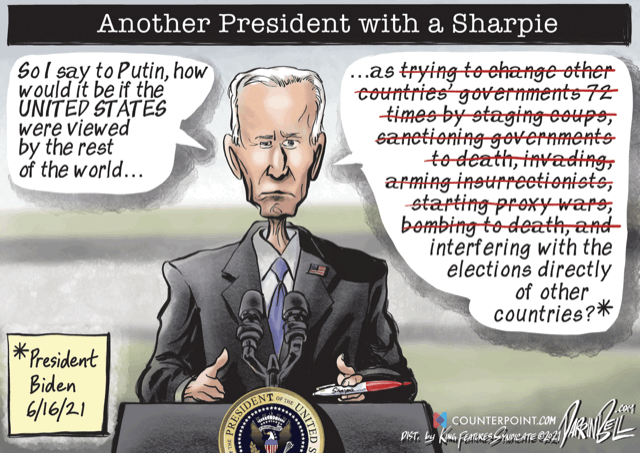
Do what we say and not what we do

In his meeting with President Putin, President Biden is thought to have proposed red lines against the use of cyber weapons such as ransomware. The idea of shutting down something like Colonial Pipeline with a computer hack is surely repugnant. I seem to remember that many of us cheered when the U.S. (and Israel?) damaged the Iranian uranium enrichment facility at Natanz with a malicious computer worm called Stuxnet. Nor were many of us much bothered when U.S. financed coups topped unfriendly governments, or when we attacked Afghanistan, Iraq, Libya, Haiti, Nigeria, Syria, to name but a few.

“The supreme international crime according to 2017 U.S. media reporting is interfering nonviolently in a democratic election — at least if Russia does it. William Blum, in his book Rogue State, lists over 30 times that the United States has done that. Another study, however, says 81 elections in 47 countries.”  https://davidswanson.org/warlist/

While this is hard to swallow, our bad behavior differs from that of Russia’s or of other autocrats. I will not go to jail for writing this. Most Americans (I like to believe) condemn such behavior contrary to our founding principles when they learn of it. Our press is happy to expose such breaches when they discover them. In short, while our government often violates our principles of individual rights and the rule of law and lies regularly about it, public scrutiny and outrage tend to check bad behavior and move us back toward conformity with our principles. We never get there but it is very important that we keep trying.  

A One State “Solution”

I have long been an admirer and supporter of the Oslo Accords, which set out a step-by-step roadmap for establishing peaceful relations between Israel and the West Bank and Gaza–a so called “Two State Solution.” The new HBO film, “Oslo” premiers today. Continuing the work started by my IMF colleague, Arne Petersen, I spent two years leading IMF technical assistance missions to Israel/WBGS to develop the Palestine Monetary Authority. “My travels to Jerusalem”  A growing consensus has concluded that the two-state solution is dead, and sadly I reluctantly agree. It has failed because of poor Palestinian leadership, Israeli governments (especially Benjamin Netanyahu’s) that were happy with the stalled status quo, and American governments that allowed the Israeli government to get away with it.

Israel has behaved like most other colonial powers of the last century and in many ways worse. It has populated its Occupied Territories with illegal Jewish settlements and has carved up the West Bank with walled off, exclusively Jewish highways that make normal life for the Palestinians impossible.  It is small wonder that Palestinian youth are fed up and revolting. It is either ignorance or dishonesty to blame the tensions on Hamas, the bad guys in Gaza–the Israeli prison of Palestinians between Egypt, the Mediterranean and Israel proper, and cut off from the rest of the West Bank. “How Israel lost the culture war”

But of course, Palestinians outnumber Jews in the land of Canaan despite seven decades of effort by Zionists to attract Jews from around the world to the new Israel. This threatens the Zionist dream of a democratic Jewish homeland. The starting point for a one-state or any other solution should be the insistence that Israel honor the human rights of all inhabitances of the land it controls, i.e., from the Mediterranean to the Jordan River. A recent report of the Human Rights Watch concludes that Israel is an Apartheid state. Large numbers of Jews around the world are offended by Israel’s treatment of the Palestinians as second-class citizens. The United States has embarrassed itself and undermined its moral standing by supporting the Israeli government’s behavior.  Fareed’s Global Briefing”

One state with a constitution that protects all of its residents equally should protect Jews as well as Palestinians to live and worship as they see fit. Such rights should not depend on having Jewish governments.  More Jews live in the United States than in Israel and such an arrangement works well for them here.

I remember well being driven from Gaza to Jerusalem in 1995 by an Arab Israeli cab driver. As we chatted about the situation in the area, he volunteered that “you know, the Palestinians and Jews are cousins.” I replied that “maybe they are even brothers.” He paused and replied: “No, brothers would not treat each other this way.”  “The Economist: Two States or One?

Compromise

We are a country of citizens with a range of views on how our community should guide and regulate our interactions. But we are all anchored in our commitment to our Constitution and its Bill of Rights. What is the nature of the compromises that enable us to live, work and flourish together?

Views on the proper role of government in supporting and improving our lives are dangerously widening. To simplify the discussion with stereotypes and not always appropriate labels I will characterize Republicans as more interested in individual freedom and Democrats as more interested in helping the poor. The two parties want both but there are clear differences in emphasis and approaches. “The great divide-who decides?”

Everyone wants to help families. But consider the difference in the approach of the Democrats with Bidens American Families Plan and the Republicans with Mitt Romney’s Family Security Act. Among many other benefits, Biden’s “plan will provide a government-paid family leave program for employees who need extended paid time off for family issues… will help working families by providing government-subsidized child care… [and] will provide free universal government-run preschool, which it claims will help children academically far into the future.” These would be run by the government or pursuant to detailed government regulations. “The American Families Plan will do more harm than good”

“Romney’s Family Security Act would replace the Child Tax Credit with a $3,000 yearly benefit per child — $4,200 for kids under the age of 5 — spread out in monthly installments that begin four months before a child’s due date,…” “Romney child care benefit democrats”

The overriding difference between Biden’s and Romney’s family plans is who makes the decisions about how the assistance is used. The same overriding difference can be seen in Democrat and Republican approaches to financing education. Charter schools and, even more so, tuition vouchers favored by Republicans leave the power of choice with parents rather than public school districts (government).  Democrats distrust the judgement of individual families to decide how best to use government assistance and want to impose conditions that insure (in their minds) that it is well spent.

How can these two conflicting approaches be reconciled? Each side will need to give up something to gain what is most important to them. Democrats want to help the poor. Republicans want to protect their freedom of choice. If Democrats are willing to give up their regulation and control of how their financial assistance is used (i.e., set aside their distrust of the poor’s ability to make wise decisions for themselves) and if Republicans are willing to give up their commitment to self-sufficiency that keeps the social safety net as small as possible, Democrats can gain a more generous safety net and Republicans can gain greater freedom of choice by coming together to enact a Universal Basic Income (UBI) in place of the large number of specific government controls assistance programs.  “Our social safety net”

In addition to allowing individual recipients to determine how best to use this assistance, two broad differences between a UBI and the existing approach stand out. The first is the difference in the financial incentive to work. Unemployment insurance, for example, ends when a recipient takes a job. Most welfare programs, such as food stamps, end when the recipient’s income increases beyond some minimal level. The incomes of many now helped by Covid-19 support programs will fall if and when they return to work. A UBI is paid to everyone whether they are working or not, so any extra income earned in any way adds fully to their income. There is no financial disincentive to work.

The second major difference is the lower administrative cost and greater simplicity of a UBI compared to those of the multitude of assistance programs with their qualification criteria that it would replace. Consider the administrative challenges faced when sending checks to those qualifying under the CARES Act as part of the Covid-19 assistance. Some intended recipients were missed. Some who were not meant to receive payments received them. It took time to set up the system of payments. But with UBI monthly payments are made to everyone without further question or investigation once they are enrolled in the system (most likely administered through the Social Security System).

My proposal would also replace all income taxes (personal and corporate) with a uniform consumption tax. This combination of UBI and consumption taxation would result in the financing of government that is progressive relative to income and would resolve the dilemma of how to tax companies operating globally. For more details see my earlier blog:  “Replacing Social Security with a universal basic income”

Democrats would gain more efficient and extensive help to the poor but would have to give up oversight and control over how that help is used. Republicans would increase their control over how they live, but would have to relax their insistence on self-sufficiency. This is a compromise whose time has come.

All Volunteer Military

In May 1967, The New Guard magazine published an article by Milton Friedman on “The Case for a Voluntary Army.”  It was a compelling case and was adopted when the U.S. suspended its military draft in January 1972. But was it correct? “45 years later Nixon-Gates commission”

In the 1960s, the drafting of 18 year old’s to fight in Vietnam was avoided by those able to go to college. This was rightly challenged as discriminatory against the poor and college deferments were replaced with a lottery system that started in 1970, which picked the birthdates at random that would then be first in line to be drafted each year. I was granted the last of the college deferments.  “Draft lottery (1969)”

While a student of Friedman’s at the University of Chicago from 1965-70, I joined with several other libertarian classmates to form the Council for a Volunteer Military to promote Friedman’s call for an end to the draft. The Directors of the Council were: James Powell, National Director; Henry Regnery, Treasurer; myself, Executive Secretary; Danny Boggs, national Filed Secretary; and David Levy, Publications Editor. Our sponsors were: Yale Brozen, Bruce K. Chapman, Richard C. Cornuelle, James Farmer, David Franke, Milton Friedman, Sanford Gottlieb, Eugene Groves, Karl Hess, and Norman Thomas: an impressively diverse group.

In 1969 President Richard Nixon establish the Gates Commission to advise him on established an all-volunteer military and appointed Friedman to the commission.  Based on the Commission’s recommendations, President Nixon signed a law in 1971 that ended the draft in January 1973.

A Rand Corporation report on the All-Volunteer Force (AVF) by Bernard D. Rostker stated that: “Although the country had conscripted its armed forces for only 35 of its 228 years — nearly all in the 20th century — the American people were generally willing to accept this practice when service was perceived as universal. However, in the 1960s, that acceptance began to erode. There were five major reasons:

  • Demographics. The size of the eligible population of young men reaching draft age each year was so large and the needs of the military so small in comparison that, in practice, the draft was no longer universal.
  • Cost. Obtaining enough volunteers was possible at acceptable budget levels.
  • Moral and economic rationale. Conservatives and libertarians argued that the state had no right to impose military service on young men without their consent. Liberals asserted that the draft placed unfair burdens on the underprivileged members of society, who were less likely to get deferments.
  • Opposition to the war in Vietnam. The growing unpopularity of the Vietnam war meant the country was ripe for a change to a volunteer force.
  • The U.S. Army’s desire for change. The Army had lost confidence in the draft as discipline problems among draftees mounted in Vietnam.”

At the time Crawford H. Greenewalt, another member of the Commission, wrote to Gates that “while there is a reasonable possibility that a peacetime armed force could be entirely voluntary, I am certain that an armed force involved in a major conflict could not be voluntary.”

“Rand research briefs”

The AVF matched or exceeding the high expectations for it. The professionalism of our Army improved. We fought 13 wars with our volunteer force: Lebanon (1982-4), Grenada (1983), Panama (1089-90), Gulf War (Iraq, Kuwait, Saudi Arabia and Israel 1990-91), Somalia (1992-5), Bosnian War (1992-95), Haiti (1994-5), Kosovo War (1998-99), Afghanistan War (2001-21), Iraq War (2003-11, 2014-2020), Somali Civil War (2007-21), Libya intervention (2011, 2015-20), and Syria (2014-present). Each was limited enough not to exhaust the supply of volunteers needed.

But a different criticism of our all-volunteer force was raised that gave me pause. Our costly and futile war in Vietnam from 1955-75 was finally ended (without admitting the defeat it surely was) in response to the growing protests in the U.S.  No such protests were raised for our imperial adventures since then. Some observers began to point their fingers at the absence of a draft and thus a military/industrial complex better sheltered from public criticism. When we campaigned for the end of the draft and an all-volunteer military, we assumed that we needed to maintain an Army for our defense. Instead, our military was deployed all over the planet (800 bases around the world) with sufficient restraint (generally) to avoid strong public push back.  “National defense”  If the average middle class family’s children were not being drafted to fight unnecessary wars in far off places, they were not as likely to complain about the billions of their taxpayer’s money being pumped into the military/industrial complex.  This was an unanticipated side effect of ending the draft that we had not anticipated.

Both former President Trump and President Biden expressed their intentions to end our forever wars and, at least in the case of Biden, to strengthen our capacity to deal with the world with diplomacy. We should wish him well. And we should urge Congress to reinstate the Weinberger Doctrine, which limited the use of U.S. forces to when vital U.S. interests were at stake, and only as a last resort. “A Biden doctrine starts to take shape”

You can read my experiences in Iraq in my book: “My travels to Baghdad” and my experiences in Afghanistan in my book: “My travels to Afghanistan”.

PS. Some how I forgot that I had written on this before with a somewhat different proposal: https://wcoats.blog/2015/01/23/the-all-volunteer-military-unintended-consequences-and-a-modest-proposal/

Israel and Palestine

Who started the feud between the Hatfields and the McCoys? Who is to blame? In the case of the new nation of Israel in the land of Canaan (Palestine) we might go back to Adam and Eve or more recently to the Balfour Declaration in 1917 (see the brief history in my book “Palestine-Oslo Accords-My Travels to Jerusalem”) to see where the feuding began.

Who started it?

But let’s start this current, tragic round of fighting with the Israeli police attacks on demonstrators “rallying against the forced expulsions of Palestinian families from the occupied East Jerusalem neighbourhood of Sheikh Jarrah…. At least 90 Palestinians were wounded on Saturday [May 8] during an Israeli police crackdown on protesters outside the Old City of Jerusalem, while another 200 Palestinians were injured on Friday when Israeli forces stormed the Al-Aqsa Mosque.” Al-Aqsa Mosque, known as the Dome on the Rock in English, is Islam’s third most sacred site. Muslims believe that Muhammad ascended to heaven from this site.

 “Jerusalem court delays Palestinian Sheikh Jarrah eviction hearing”

Israel’s Supreme Court “is reviewing a judgment to evict Palestinian families from the Sheikh Jarrah neighbourhood of East Jerusalem. Their homes sit on land that was owned by Jews before Jordan occupied the eastern part of Jerusalem in 1948. Israeli law allows the heirs of the original owners to reclaim property in East Jerusalem. Yet Palestinians cannot claim their former homes in West Jerusalem (or anywhere else in Israel). No wonder Palestinian residents of the city are always ready to protest.

“The injustices elsewhere are worse. Palestinians in the wider West Bank, like those in Jerusalem, have watched Israel confiscate land and build settlements on occupied territory, which is illegal under international law. They must also deal with Israeli checkpoints and an onerous permit regime. In Gaza more than 2m Palestinians have been cut off from the world by Israeli and Egyptian blockades since 2007, when Hamas grabbed control.” The Economist: Only negotiations can bring lasting peace to Israel and Palestine”

That is the immediate background to the dozens of rockets launched by Hamas from Gaza starting on Monday (May 10): “Palestinian militants launched dozens of rockets from Gaza and Israel unleashed new air strikes against them early Tuesday, in an escalation triggered by soaring tensions in Jerusalem and days of clashes at an iconic mosque in the holy city.” “Israeli police Palestinians clash Jerusalem holy site”

At least 30 Palestinians, including 10 children, and three Israelis were killed as tensions in Jerusalem spread west toward the seacoast Tuesday. Israeli airstrikes flattened a multistory apartment building in Gaza and rockets fired from the Gaza Strip reached Tel Aviv in an unusually far-reaching barrage that sent residents of Israel’s largest city scrambling into bomb shelters.  “Israeli clashes Palestinians turn deadly Jerusalem tensions spread”

More concerning than the exchange of rockets between Gaza and Israel, is the sharp rise of violence between Arab Israelis in Israel and between Palestinians and Israelis throughout the West Bank.  A major problem is that there are no good guys on either side. “Most Israelis are comfortable with the ‘anti-solutionism’ of Benjamin Netanyahu, the prime minister, who shows little interest in pursuing a permanent settlement with the Palestinians….  Fatah, has not done much better in the West Bank. The party’s leader, Mahmoud Abbas, is in the 17th year of a four-year term as Palestine’s president. He seems concerned mainly with preserving his own power.”  The Economist: Only negotiations can bring lasting peace to Israel and Palestine”

Critically, the United States has failed to promote Palestinian rights, giving one-sided support to whatever Israel does.

Sadly, the winners, if we can call them that, of today’s tragic fighting are the status quo leaders (Netanyahu, Abbas, and Hamas), who have failed to address the central issues of the coexistence of Israelis and Palestinians in the land of Canaan. War, or the threat of it, are historically tested instruments for strengthening public support of existing leaders.  In a recent report on the situation in Israel, the Human Rights Watch pronounced Israel an Apartheid state.  “Israel report apartheid” The Jewish diaspora are increasingly speaking up against the policies of Israel. The United States could make a major contribution by conditioning its very large financial aid to Israel on its respecting the rights of Palestinians.  “A New U.S. Approach to Israel-Palestine”  

I shudder to think what might be happening by the time you read this.

The Great Divide–Who Decides?

The American Constitution establishes a government of limited and enumerated powers to protect the property and safety of its sovereign citizens. There is a lot in that sentence so let me unpack it. Sovereignty in the United States resides in its individual citizens. We are responsible for our own lives and how to live them. But to ensure our ability to exercise our freedom in a broader community we gave up limited powers to our government, which are checked and balanced among the three branches of government (legislative, executive, and judicial). America has flourished under this arrangement of exceptional individual freedom.  “American Exceptionalism”

Our government is meant to provide the foundation and general rules for interacting with each other. It establishes the standard units of weights and measures, voltage, assignments of radio spectrum, rules of the road, etc. It defends us from aggression both foreign and domestic and administers the enforcement of contracts (courts). In short, it establishes the agreed framework in which we each take our own decisions about where to work, what to eat, and how to spend our free time within society. If we only surrender decisions (rules) that set and enforce the standards for our interactions with others, with minimal restrictions on our own behavior, our individual freedom will be maximized to our’s and our community’s benefit. America has flourished from our extensive individual freedom.

But where exactly is the optimal boundary between our individual and community choices? Views vary about the answer and the resulting policies between those of us who want small government and those who want somewhat larger government. What are the pros and cons of each? The answer, of course, will depend on the specific issue, but I want to review the question more generally.

The benefit of being free to take our own decisions about something is that it better reflects our knowledge of our particular situation and our own tastes. We don’t make such decisions in a void, of course. We draw on our own knowledge and values (taught by our parents, schools, clubs, churches, friends, etc.). Thus, our inherited and learned culture plays a critical role in the quality of our choices. Our government can help as well by promulgating information (the state of knowledge) and/or setting standards for communicating relevant information (e.g., product labeling standards). It can also add to our knowledge by financing basic research that private firms have little or no financial incentive to undertake (as opposed to applying the knowledge gained from such research to the development of marketable applications).

We also expect government (in addition to family and community organizations) to provide help when we are financially unable to because of sickness or unemployment (the social safety net). Because America is a rich country, we expect our social safety net to be relatively generous. Here is an area were views start to diverge. If we continue to have confidence in the ability of individuals to make sensible decisions, the government should help financially but not override the recipient’s freedom to choose how to use it. This is the philosophy of a Universal Basic Income.  “Replacing Social Security with a universal basic income”

At the other end of this spectrum are those who think that in many instances government employees can make wiser and better informed decisions for us than we can ourselves. Thus, instead of money we are given food stamps. Instead of school vouchers we are provided with take it or leave it neighborhood schools. Instead of health information on food products to help our individual choice, some food and other products are banned all together, etc.

The benefit of the government taking decisions for us is that individual officials (sometimes referred to as bureaucrats) can devote more time to investigating the costs and benefits of choices and thus potentially take and impose better decisions than we can ourselves. Though that might be true “in principle,” government officials are less likely to know our particular situation and tastes. In addition, the laws and regulations adopted in Congress and by government agencies are influenced more by the interests of the subjects of their regulations (e.g., Facebook) than of their customers (us). In other words, the discipline on the behavior of private firms from market competition is weaker or totally absent on regulators.

The case of the military/industrial complex is well known. Only the government can effectively defend us from potential foreign aggressors, so we are forced to live with the inefficiencies (corruption if you like) of the near monopoly that defense firms enjoy that ensures that the DOD keeps buying their products. The B-2 stealth bomber cost $2,100 million per plane. The scandalous F-35, the plane no one wants, cost US tax payers $115.5 million per plane. But the real cost to us of the military/industrial complex is the cost in lives, equipment, and reputation of our forever wars that ensure that BAE Systems, Bell Helicopter, Boeing, Lockheed Martin, Northrop Grumman, Pratt and Whitney and a few others, keep receiving billions of tax dollars every year.

Another example of government vs individual decision making is provided by the Centers for Disease Control and Prevention (CDC) and the US Food and Drug Administration (FDA). We look to the CDC for the best scientific guidance on protecting ourselves from disease, such as Covid-19 and to the FDA to approve what drugs and vaccines we are allowed to have. During the past year the “scientific” information provided by the CDC was polluted by ill-informed political messages. Public confidence in government information plummeted and advice became sadly political. “Covid-19-why aren’t we prepared”

The FDA initially mangled the approval of Covid-19 test kits, delaying their availability, thus undermining the detect and trace strategy. “Covid-19-what should Uncle Sam do?”  Fortunately, it then relaxed its risk averse restrictions on drug approvals to grant emergency approval of several Covid-19 vaccines. As of May 7, 111 million American’s have been fully vaccinated with these vaccines, which have proved safe and effective. Many lives have been saved as a result.

Last month the FDA reverted to its more independent, scientific form when it temporarily suspended the use of Johnson and Johnson’s Covid-19 vaccine because of very rare blood clots. On April 13, the CDC and FDA issued a joint statement reporting that “As of April 12, more than 6.8 million doses of the Johnson & Johnson (Janssen) vaccine have been administered in the U.S. CDC and FDA are reviewing data involving six reported U.S. cases of a rare and severe type of blood clot in individuals after receiving the J&J vaccine.”   “Joint CDC and FDA statement on Johnson-Johnson covid-19 vaccine”  There were more than that number of such blood clots among those who had not taken the vaccine. This measure reflects government’s usual excessive risk aversion. If they do their job right (approving drugs that are safe and effective), few people notice, but if they make a mistake (thalidomide babies), they are in big trouble. So, the incentive is to be overly cautious. During the several weeks hiatus in administering the Johnson and Johnson vaccine more people died from Covid who might have been saved if they had received the vaccination, than from the rare blood clot.  The political issue, once again, is who should decide–government officials or individuals on the basis of information provided by the government (and others). “Beating covid-19-compulsion or persuasion and guidance”

A very different example of government making decisions for us comes from our trade policy. Government imposed trade restrictions, often in the form of taxes on imports (so called tariffs), restrict our individual right to chose what we buy (or sell). While there may well be national security or other national interests that justify such interference, more often they simply reflect corruption (the financial favoring of one group or industry in exchange for votes). “Trade protection and corruption”  Former President Trump’s abuse of the national security excuse to tax Canadian steel imports provides a recent example.  “Tariff abuse”  Strangely, but no doubt for the same reasons, President Biden has not yet removed these damaging tariffs.  “Trump disastrous steel tariffs”

As a final example of our choice between government and individual decision making, consider President Biden’s American Families Plan, which provides $225 million in childcare subsidies. But rather than vouchers that can be used by families as they see fit, it finances government run childcare services. “Biden’s plan for government run childcare is exactly what most moms don’t want”  Sometimes government-run and controlled services are better than those we choose ourselves in the private sector (perhaps with government financial and/or information assistance). Not that many in my opinion. But, please let’s have a serious and informative discussion of the pros and cons of each.

Why some still believe the Big Lie

Last Monday (May 3) Trump proclaimed that the 2020 election “will be, from this day forth, known as THE BIG LIE!” In reply Congresswoman Liz Cheney tweeted: “The 2020 presidential election was not stolen. Anyone who claims it was is spreading THE BIG LIE, turning their back on the rule of law, and poisoning our democratic system. 10:27 AM · May 3, 2021·       “More on Trump acquittal”

The voter frauds loudly proclaimed by Trump spokesmen in public were generally not repeated in court where those making such claims had to speak under oath. Where specific charges of vote tampering were made against voting machine companies such as Dominion Voting Systems, the objects of such attacks were protected by libel laws, which required proof, which was totally lacking. Libel suits brought by Dominion and others led to retractions and apologies by Fox news and many others for their fabrications.

“The latest legal target to tuck its tail is the conservative cable news channel Newsmax, which released a statement Friday night apologizing to Eric Coomer, a top official at Dominion Voting Systems, who filed a suit against Newsmax in December.” “Slow painful death-trump allies voting machine conspiracy theories”

My favorite “apology” for falsely claiming voter fraud was from Sidney Powell, one of Trump’s shameless lawyers until even he had to distance himself from her.  “A key member of the legal team that sought to steal the 2020 election for Donald Trump is defending herself against a billion-dollar defamation lawsuit by arguing that “no reasonable person” could have mistaken her wild claims about election fraud last November as statements of fact.” “Sidney Powell-Trump election fraud claims”

I have struggled to understand how presumably decent people could continue to believe such obvious nonsense. The conservative Christian writer David French provides a partial explanation. “Prophecy is very important in Pentecostal Christianity…. Many millions of Americans spent the Trump era deeply loyal to Trump not because of policy arguments or political debate, but in large part because “prophets” told them he was specifically and specially anointed by God for this moment. These Americans were resistant to the election outcome because they were told—again and again—by voices they trusted that God promised Trump would win.”  “Making prophecy great again”  French is an interesting and thoughtful writer, and correctly notes that this belief is a problem for the Pentecostal church. 

But many more than these Pentecostals continue to repeat the big lie. According to Michael Gerson: “To be a loyal Republican, one must be either a sucker or a liar. And because this defining falsehood is so obviously and laughably false, we can safely assume that most Republican leaders who embrace it fall into the second category.” “Trump republicans big lie”

We have many serious policy issues to discuss. We seriously need to get beyond The Big Lie.

What to do with Social Media?

Social media is changing how we get news and debate public issues. How should its contents be regulated and by whom? The answer should reflect the fundamental importance of free and open speech for forming broadly supported public policies and social attitudes.

The quality of public discussion in the United States today has deteriorated. There are even some who wish to end debate on some issues altogether (the cancel culture). Take two recent examples:

In reaction to Georgia’s new Voting Rights Act President Biden said: “Parts of our country are backsliding into the days of Jim Crow, passing laws that harken back to the era of poll taxes — when Black people were made to guess how many beans, how many jelly beans, in a jar or count the number of bubbles in a bar of soap before they could cast their ballot.” “Biden US backsliding-Jim Crow”

Representative Maxine Waters traveled to Brooklyn Center, Minnesota, to join crowds protesting the police shooting of Duante Wright. On that occasion, “A reporter then asked, if Chauvin isn’t convicted on all charges, “What should protesters do?”

“Well, we gotta stay on the street,” Waters said. “And we’ve got to get more active. We’ve got to get more confrontational. We’ve got to make sure that they know that we mean business.”

For her complete comments see: “In her own words-Maxine Waters”

In response to Water’s words Representative Marjorie Taylor Greene tweeted:

_________________________________  

@RepMaxineWaters you don’t live in Minnesota.

You crossed state lines and incited riots, violence against police, shootings at the MN NG, and threatened a jury as a sitting US Congresswoman.@SpeakerPelosi surely you will expel this criminal from Congress and uphold the law! pic.twitter.com/twH52VwFTP

— Marjorie Taylor Greene 🇺🇸 (@mtgreenee) April 19, 2021

_________________________________ 

“Marjorie Taylor Greene says Maxine Waters incited riots calls for her expulsion from congress”

‘Maxine Waters-Kevin McCarthy Minnesota police”

President Biden’s and Representative Greene’s comments both earn four Pinocchios. Senator Ted Cruz’s comments about Waters’ statement were just as bad. But then we are used to politicians lying to us, especially in the heat of campaigns. However, they do not contribute to the constructive dialog needed over these and other pressing public issues.  

With regard to Georgia’s new Voting Law, assessments are mixed. For example: “Rather than allowing voters to request ballots six months from Election Day, the new law says voters can start requesting ballots 78 days out; counties can begin sending ballots to voters just 29 days before Election Day, rather than the previous 49 days.” “Georgia voting law explained”

This hardly strikes me as voter suppression. I grew up in Bakersfield California and our voting precinct voted in our garage. As a kid I was fascinated by it all (though not thrilled with having to clean the garage for the occasion). There was no such thing as early voting except for absentee ballets by military service men and women. No drop boxes or any of that stuff. You came to our garage on election day or you didn’t vote. But there is surely a place for serious pros and cons of each provision of the law. As the press has been overwhelmingly (almost hysterically) negative (despite Georgia’s Governor and Secretary of State’s refusal to yield to Trump’s pressure to overturn his election defeat in Georgia) here is a more measured defense of the new law: “Exclusive 21 black leaders defend Georgia voting law as proper honest reform”

The real question is why were changes in Georgia’s voting law needed in the first place? What weaknesses were being addressed? Even with this new law, Georgia’s law is more permissive than those of Biden’s Delaware. In a negative, but more balanced assessment, Derek Thompson stated that:  “Georgia’s voting rights have long been more accommodating than those of deep-blue states including not only Delaware, but also Connecticut, Massachusetts, New Hampshire, and New York.” “Georgia voting rights fiasco”

Maxine Waters didn’t, and often doesn’t, use the best judgement in where, when and what she said, but she didn’t say anything that she should not be allowed to say whether you agree with her or not.  Referring to Reps. Waters and Rashida Tlaib, D-Mich, Newt Gingrich wrote that:

“House Democrats have produced two radical demagogues whose policies would endanger the lives of innocent Americans, lead to the breakdown of society, and undermine the U.S. Constitution.”  “Repudiate Tlaib and Waters promote mob rule Newt Gingrich” This is precisely the sort of name calling that impedes the serious dialogue over concrete issues and proposals that we so badly need. Demonizing opponents–turning opponents into enemies–is a tactic of the weak (think Vladimir Putin).

Rep Waters’ charge that protesters should get more confrontational did not strike me as an incitement to violence anymore (and rather less) than former President Trump’s call for his assembled supporters on January 6 to march to the Capital and “fight like hell. And if you don’t fight like hell, you’re not going to have a country anymore.” The brief submitted by Trump’s lawyers for his impeachment trail stated the “his call for the crowd to ‘fight like hell,’ was not meant to be taken literally.” OK, then perhaps he should keep it to himself. This reminds me of my favorite “apology” for lying about voter fraud that kept Trump from remaining in the White House. In response to a liable suit by the voting software company Dominion Voting Systems,  Sidney Powell stated in court that “’no reasonable person would conclude’ that her accusations of Dominion being part of an election-rigging scheme with ties to Venezuela ‘were truly statements of fact.’” “Sidney Powell-Dominion-No reasonable person”  Sadly I know some very fine people who did (or do) believe her nonsense.

But what if Biden’s, Trump’s, Waters’ and Greene’s comments were suppressed–erased–rather than challenged? These were opinions, however off the mark, rather than statements of fact. What if someone (named Trump) claims that Barack Obama was not born in the U.S. and thus not eligible to run for President (despite irrefutable evidence to the contrary)? I will spare you the very long list of such lies. And, to finally get to my real topic, what should social media do about it?  

Unlike newspapers and magazines, which are responsible for the accuracy of their content, Facebook and Twitter and Tiktok (I am too old to be current with all of the other newer platforms) “merely” provide the vehicle by which its users (you and me) distribute our content. The government does have laws that limit speech.  “Categories of speech that are given lesser or no protection by the First Amendment (and therefore may be restricted) include obscenity, fraud, child pornography, speech integral to illegal conduct, speech that incites imminent lawless action, speech that violates intellectual property law, true threats….and defamation that causes harm to reputation….”  “United States free speech exceptions”. What is not legally allowed generally, should not be allowed on social media. But in my opinion, those are the only restrictions that should be allowed in the law.  The last thing we want is Nancy Pelosi or Ten Cruz deciding what is allowed and not allowed on Twitter.

In short, beyond speech that is already restricted by law, the government should leave social media free to set their own policies for what they permit on their platforms.  But what should those policies be? In my opinion, all opinions should be allowed, even those, and especially those, that the platform operators consider wrong or repugnant. Bad policy prescriptions should best be countered by counter arguments not by censorship. It is not possible to over emphasize the benefit to America of free and open debate. Bad ideas are best countered and refuted by good ideas.  You are not likely to find a better statement of these views and a better defense of free speech than in Jonathan Rauch’s Kindly Inquisitors: The New Attacks on Free Thought.

But what about clearly fake news? Unfortunately, the distinction between fact and opinion is not always 100 percent clear. Tweeter should not have removed Donald Trump’s pages, though full of lies. Facebook should not have removed QAnon’s totally ridiculous conspiracy claims to take another extreme example. Many far less controversial posts have been removed as well for very unclear reasons. Facebook and other social media are working diligently to strike the right balance but are not there yet in my opinion. When Facebook or other social media platforms have good reason to doubt facts posted on their platforms, rather than remove (censure) them it would be better for Facebook to attach its warning and perhaps a link to more reliable information.

If Facebook (or any other platform) chooses to forbid hate speech, it would be better to rely on user complaints than its AI algorithm to determine what is hate speech. In an amusing, but not so amusing, example of the pitfalls of reliance on programmatic detection of disallowed speech, Facebook removed a post of a section of the Declaration of Independence because of its “nasty” reference to American Indians.  “Facebook censored a post for hate speech-it was the Declaration of Independence”

It is often argued that given the realities of network externalities (everyone wants to be where everyone else is), Facebook and Twitter are virtual monopolies and that this justifies more intrusive government regulation.  But the competition has expanded to include at the top of the list: YouTube, Instagram, Snapchat, Tumblr, Twitter, and Pinterest. Even Trump plans to launch his own platform. Facebook and the other popular platforms must ultimately please their users or they will be replaced even if network externalities are hard to overcome. It has happened before and can happen again. Government intervention to regulate platform content beyond the restrictions already in the law would be contrary to our traditional freedom of speech and potentially dangerous.

There are measures that the government might take to make competition easier. When phone companies were required to give ownership of phone numbers to the subscriber, making them easily portable from one phone company to another, competition received an important boost. Something similar might be done with social media data of users (e.g., username, friends, pictures and posts).

A much more challenging area concerns social media algorithms for directing users to others with similar interests (or beliefs) in order to better target the advertising that pays for it all. If users only see or hear the views of the likeminded, unhealthy ego chambers can be created and promulgated. Agreeing on constructive approaches to dealing with this danger will require more public discussion.

Summary: Demonizing political opponents is bad for democracy. Opponents are not enemies. There needs to be enough common ground for most of us to stand on if we are to remain a viable country. Free speech has been a very important feature of America and its flourishing. It is best to protect free speech and counter misinformation and bad ideas with rebuttal and better ideas. No opinion should be censured. Social media should flag questionable information rather than remove.

A liberal dad complained about the one-sided liberal (in the American rather than classical sense) education his children had received in college because, he said, “they are completely unable to defend what they believe.”

National Defense

American military strength (an important aspect of our national security) depends on the size, training, and equipment (weapons) of our military, which is very much dependent on the size and efficiency of our economy, which pays for it.  Devoting more of our productive capacity to the military reduces our economic capacity. Getting the balance right between military and nonmilitary uses of our resources is very important.  Knowing what military capacity we need to insure our defense requires assessing the sources of threats to our national security and what motivates their deployment.

The cold war was a confrontation with international communism, most heavily concentrated in the Soviet Union. This was an ideological enemy of free market, capitalist countries, whose goal was to spread its ideology to the entire world. There is no such ideological enemy today. The Chinese government wants to be strong and prosperous and doesn’t care whether anyone else follows their model or not. They do want the rules for global trade and interactions to permit their own domestic model. We need to engage China fairly in establishing international rules that serve everone.

Historically wars were generally about territory and political control, usually about moving boarders a bit this way or that.  The Mogul, Roman, Persian, British, Ottoman and other empires existed largely to extract economic gain from the territories they ruled, something more peacefully enjoyed today via free (or freer) trade.  The mere threat of war and the creation and maintenance of potential enemies is also a useful device for rallying countries around their leaders and for keeping the money flowing to their “defense” industries–think of Mr. Putin, Xi Jinping and the U.S. military/industrial complex.

American defense today requires military strength sufficient to deter any country from successfully attacking the United States. It does not require the 800 military bases that we maintain around the world.  It did not require and was not enhanced by our many wars that followed the infamous and very damaging Viet Nam war (Lebanon 1982-4, Grenada 1983, Panama 1989-90, Gulf War 1990-91, Somali 1992-5, Bosnia 1992-5, Haiti 1994-5, Kosovo 1998-9, Afghanistan 2001-date, Iraq 2003-11, 2014-date, Somali 2007-21, Libya 2011, 2015-20, Syria 2014-date, War on Terror in various places). War with China would be quite a different matter. “The delusions of high tech warfare”

Fareed Zakaria unloaded on our war industry last month: “Defense Secretary Lloyd Austin outlined his key concern. ‘China is our pacing threat,’ he said. He explained that for the past 20 years, the United States had been focused on the Middle East while China had been modernizing its military. ‘We still maintain the edge,’ he noted, ‘and we’re going to increase the edge going forward.’ Welcome to the new age of bloated Pentagon budgets, all to be justified by the great Chinese threat.

“What Austin calls America’s ‘edge’ over China is more like a chasm. The United States has about 20 times the number of nuclear warheads as China. It has twice the tonnage of warships at sea, including 11 nuclear-powered aircraft carriers compared with China’s two carriers (which are much less advanced). Washington has more than 2,000 modern fighter jets compared with Beijing’s roughly 600, according to national security analyst Sebastien Roblin. And the United States deploys this power using a vast network of some 800 overseas bases. China has three. China spends around $250 billion on its military, a third as much as the United States.”  “The Pentagon is using China as an excuse for huge new budgets”  As noted above, over-investing in the military results in a smaller economy overall.

The latest debate is whether we should make our commitment to go to war with China to defend the independence of Taiwan explicit or leave it implied and ambiguous. In 1979 the U.S. recognized the People’s Republic of China as the sole legal Government of China and acknowledged that Taiwan was part of China (slightly fuzzy diplomatic language). So would American national security be enhanced by an explicit credible commitment to go to war with China, if necessary, to preserve the independence of Taiwan? China is a nuclear power. Going to war with China (World War III if we could get anyone else to join us) would inflect enormous damage on the U.S. whether it became nuclear or not, even if we won. In my opinion it would be simply insane to take such risks.

Would the U.S. deter China by being tough enough?  As Doug Bandow put it: “America’s antagonists saw something very different than weakness…. Stupidity and arrogance. Poor judgment. Refusal to admit mistakes. An almost demented willingness to sacrifice America’s future in a desperate attempt to redeem the nation’s tragic past. A better way not to show weakness would be to stop doing ‘stupid shit,’ as Obama suggested.

“China’s Xi Jinping and his colleagues in Zhongnanhai likely have a far more objective and practical take on U.S. policy: Endless wars by Washington are good for Beijing. The Chinese would love to see the US pour trillions more dollars and thousands more lives into new conflicts. Invade Iran? Please! Maybe occupy Syria too? Lebanon also needs fixing. Don’t forget the need to redeem Afghanistan. Then there is the problem of Russia in Ukraine, Syria, and elsewhere: go for it!”  https://original.antiwar.com/doug-bandow/2021/03/23/the-failure-of-huff-and-puff-foreign-policy/

But China (and Russia in Ukraine) has been behaving badly–claiming this little island in the China Sea and that one as its own, not to mention the ever-present risk of invading Taiwan. Even if the forced takeover of Taiwan by the PRC would not threaten our national defense, shouldn’t we care? Shouldn’t we care about the abhorrent genocide by the Chinese government against its Uighur Muslim minority in its western province of Xinjiang? Of course, we should, but we should reject the presumption of our neocon friends and the military/industrial complex we keep fat and rich that these and other interests can only be addressed militarily. See my experiences in Iraq and Afghanistan: “My Travels to Baghdad”

The creation of the United Nations and Bretton Woods institutions and other international cooperative agreements and institutions after World War II were meant to provide dispute resolution mechanisms other than wars. President Biden is committed to rebuilding these neglected institutions and strengthening and reenergizing our diplomatic institutions and initiatives. We can confront China more effectively and more realistically together with most of the rest of the world using the tools of diplomacy rather than of war. If the people of Taiwan chose to integrate their governance more fully with that of the PRC, that is their choice and their business. But if China invades Taiwan or otherwise forces such an integration, China should know the economic and political price they would pay. In my opinion, such a declaration would be far more effective in deterring such behavior by China than a fuzzy uncertain threat of war. It is encouraging that Congress seems on the verge of reclaiming its War Powers provided by the Constitution.

It is worth remembering the words of Dr. Martin Luther King, Jr. against our war in Vietnam delivered April 4, 1967. https://kingandbreakingsilence.org/