Why some still believe the Big Lie

Last Monday (May 3) Trump proclaimed that the 2020 election “will be, from this day forth, known as THE BIG LIE!” In reply Congresswoman Liz Cheney tweeted: “The 2020 presidential election was not stolen. Anyone who claims it was is spreading THE BIG LIE, turning their back on the rule of law, and poisoning our democratic system. 10:27 AM · May 3, 2021·       “More on Trump acquittal”

The voter frauds loudly proclaimed by Trump spokesmen in public were generally not repeated in court where those making such claims had to speak under oath. Where specific charges of vote tampering were made against voting machine companies such as Dominion Voting Systems, the objects of such attacks were protected by libel laws, which required proof, which was totally lacking. Libel suits brought by Dominion and others led to retractions and apologies by Fox news and many others for their fabrications.

“The latest legal target to tuck its tail is the conservative cable news channel Newsmax, which released a statement Friday night apologizing to Eric Coomer, a top official at Dominion Voting Systems, who filed a suit against Newsmax in December.” “Slow painful death-trump allies voting machine conspiracy theories”

My favorite “apology” for falsely claiming voter fraud was from Sidney Powell, one of Trump’s shameless lawyers until even he had to distance himself from her.  “A key member of the legal team that sought to steal the 2020 election for Donald Trump is defending herself against a billion-dollar defamation lawsuit by arguing that “no reasonable person” could have mistaken her wild claims about election fraud last November as statements of fact.” “Sidney Powell-Trump election fraud claims”

I have struggled to understand how presumably decent people could continue to believe such obvious nonsense. The conservative Christian writer David French provides a partial explanation. “Prophecy is very important in Pentecostal Christianity…. Many millions of Americans spent the Trump era deeply loyal to Trump not because of policy arguments or political debate, but in large part because “prophets” told them he was specifically and specially anointed by God for this moment. These Americans were resistant to the election outcome because they were told—again and again—by voices they trusted that God promised Trump would win.”  “Making prophecy great again”  French is an interesting and thoughtful writer, and correctly notes that this belief is a problem for the Pentecostal church. 

But many more than these Pentecostals continue to repeat the big lie. According to Michael Gerson: “To be a loyal Republican, one must be either a sucker or a liar. And because this defining falsehood is so obviously and laughably false, we can safely assume that most Republican leaders who embrace it fall into the second category.” “Trump republicans big lie”

We have many serious policy issues to discuss. We seriously need to get beyond The Big Lie.

What to do with Social Media?

Social media is changing how we get news and debate public issues. How should its contents be regulated and by whom? The answer should reflect the fundamental importance of free and open speech for forming broadly supported public policies and social attitudes.

The quality of public discussion in the United States today has deteriorated. There are even some who wish to end debate on some issues altogether (the cancel culture). Take two recent examples:

In reaction to Georgia’s new Voting Rights Act President Biden said: “Parts of our country are backsliding into the days of Jim Crow, passing laws that harken back to the era of poll taxes — when Black people were made to guess how many beans, how many jelly beans, in a jar or count the number of bubbles in a bar of soap before they could cast their ballot.” “Biden US backsliding-Jim Crow”

Representative Maxine Waters traveled to Brooklyn Center, Minnesota, to join crowds protesting the police shooting of Duante Wright. On that occasion, “A reporter then asked, if Chauvin isn’t convicted on all charges, “What should protesters do?”

“Well, we gotta stay on the street,” Waters said. “And we’ve got to get more active. We’ve got to get more confrontational. We’ve got to make sure that they know that we mean business.”

For her complete comments see: “In her own words-Maxine Waters”

In response to Water’s words Representative Marjorie Taylor Greene tweeted:

_________________________________  

@RepMaxineWaters you don’t live in Minnesota.

You crossed state lines and incited riots, violence against police, shootings at the MN NG, and threatened a jury as a sitting US Congresswoman.@SpeakerPelosi surely you will expel this criminal from Congress and uphold the law! pic.twitter.com/twH52VwFTP

— Marjorie Taylor Greene 🇺🇸 (@mtgreenee) April 19, 2021

_________________________________ 

“Marjorie Taylor Greene says Maxine Waters incited riots calls for her expulsion from congress”

‘Maxine Waters-Kevin McCarthy Minnesota police”

President Biden’s and Representative Greene’s comments both earn four Pinocchios. Senator Ted Cruz’s comments about Waters’ statement were just as bad. But then we are used to politicians lying to us, especially in the heat of campaigns. However, they do not contribute to the constructive dialog needed over these and other pressing public issues.  

With regard to Georgia’s new Voting Law, assessments are mixed. For example: “Rather than allowing voters to request ballots six months from Election Day, the new law says voters can start requesting ballots 78 days out; counties can begin sending ballots to voters just 29 days before Election Day, rather than the previous 49 days.” “Georgia voting law explained”

This hardly strikes me as voter suppression. I grew up in Bakersfield California and our voting precinct voted in our garage. As a kid I was fascinated by it all (though not thrilled with having to clean the garage for the occasion). There was no such thing as early voting except for absentee ballets by military service men and women. No drop boxes or any of that stuff. You came to our garage on election day or you didn’t vote. But there is surely a place for serious pros and cons of each provision of the law. As the press has been overwhelmingly (almost hysterically) negative (despite Georgia’s Governor and Secretary of State’s refusal to yield to Trump’s pressure to overturn his election defeat in Georgia) here is a more measured defense of the new law: “Exclusive 21 black leaders defend Georgia voting law as proper honest reform”

The real question is why were changes in Georgia’s voting law needed in the first place? What weaknesses were being addressed? Even with this new law, Georgia’s law is more permissive than those of Biden’s Delaware. In a negative, but more balanced assessment, Derek Thompson stated that:  “Georgia’s voting rights have long been more accommodating than those of deep-blue states including not only Delaware, but also Connecticut, Massachusetts, New Hampshire, and New York.” “Georgia voting rights fiasco”

Maxine Waters didn’t, and often doesn’t, use the best judgement in where, when and what she said, but she didn’t say anything that she should not be allowed to say whether you agree with her or not.  Referring to Reps. Waters and Rashida Tlaib, D-Mich, Newt Gingrich wrote that:

“House Democrats have produced two radical demagogues whose policies would endanger the lives of innocent Americans, lead to the breakdown of society, and undermine the U.S. Constitution.”  “Repudiate Tlaib and Waters promote mob rule Newt Gingrich” This is precisely the sort of name calling that impedes the serious dialogue over concrete issues and proposals that we so badly need. Demonizing opponents–turning opponents into enemies–is a tactic of the weak (think Vladimir Putin).

Rep Waters’ charge that protesters should get more confrontational did not strike me as an incitement to violence anymore (and rather less) than former President Trump’s call for his assembled supporters on January 6 to march to the Capital and “fight like hell. And if you don’t fight like hell, you’re not going to have a country anymore.” The brief submitted by Trump’s lawyers for his impeachment trail stated the “his call for the crowd to ‘fight like hell,’ was not meant to be taken literally.” OK, then perhaps he should keep it to himself. This reminds me of my favorite “apology” for lying about voter fraud that kept Trump from remaining in the White House. In response to a liable suit by the voting software company Dominion Voting Systems,  Sidney Powell stated in court that “’no reasonable person would conclude’ that her accusations of Dominion being part of an election-rigging scheme with ties to Venezuela ‘were truly statements of fact.’” “Sidney Powell-Dominion-No reasonable person”  Sadly I know some very fine people who did (or do) believe her nonsense.

But what if Biden’s, Trump’s, Waters’ and Greene’s comments were suppressed–erased–rather than challenged? These were opinions, however off the mark, rather than statements of fact. What if someone (named Trump) claims that Barack Obama was not born in the U.S. and thus not eligible to run for President (despite irrefutable evidence to the contrary)? I will spare you the very long list of such lies. And, to finally get to my real topic, what should social media do about it?  

Unlike newspapers and magazines, which are responsible for the accuracy of their content, Facebook and Twitter and Tiktok (I am too old to be current with all of the other newer platforms) “merely” provide the vehicle by which its users (you and me) distribute our content. The government does have laws that limit speech.  “Categories of speech that are given lesser or no protection by the First Amendment (and therefore may be restricted) include obscenity, fraud, child pornography, speech integral to illegal conduct, speech that incites imminent lawless action, speech that violates intellectual property law, true threats….and defamation that causes harm to reputation….”  “United States free speech exceptions”. What is not legally allowed generally, should not be allowed on social media. But in my opinion, those are the only restrictions that should be allowed in the law.  The last thing we want is Nancy Pelosi or Ten Cruz deciding what is allowed and not allowed on Twitter.

In short, beyond speech that is already restricted by law, the government should leave social media free to set their own policies for what they permit on their platforms.  But what should those policies be? In my opinion, all opinions should be allowed, even those, and especially those, that the platform operators consider wrong or repugnant. Bad policy prescriptions should best be countered by counter arguments not by censorship. It is not possible to over emphasize the benefit to America of free and open debate. Bad ideas are best countered and refuted by good ideas.  You are not likely to find a better statement of these views and a better defense of free speech than in Jonathan Rauch’s Kindly Inquisitors: The New Attacks on Free Thought.

But what about clearly fake news? Unfortunately, the distinction between fact and opinion is not always 100 percent clear. Tweeter should not have removed Donald Trump’s pages, though full of lies. Facebook should not have removed QAnon’s totally ridiculous conspiracy claims to take another extreme example. Many far less controversial posts have been removed as well for very unclear reasons. Facebook and other social media are working diligently to strike the right balance but are not there yet in my opinion. When Facebook or other social media platforms have good reason to doubt facts posted on their platforms, rather than remove (censure) them it would be better for Facebook to attach its warning and perhaps a link to more reliable information.

If Facebook (or any other platform) chooses to forbid hate speech, it would be better to rely on user complaints than its AI algorithm to determine what is hate speech. In an amusing, but not so amusing, example of the pitfalls of reliance on programmatic detection of disallowed speech, Facebook removed a post of a section of the Declaration of Independence because of its “nasty” reference to American Indians.  “Facebook censored a post for hate speech-it was the Declaration of Independence”

It is often argued that given the realities of network externalities (everyone wants to be where everyone else is), Facebook and Twitter are virtual monopolies and that this justifies more intrusive government regulation.  But the competition has expanded to include at the top of the list: YouTube, Instagram, Snapchat, Tumblr, Twitter, and Pinterest. Even Trump plans to launch his own platform. Facebook and the other popular platforms must ultimately please their users or they will be replaced even if network externalities are hard to overcome. It has happened before and can happen again. Government intervention to regulate platform content beyond the restrictions already in the law would be contrary to our traditional freedom of speech and potentially dangerous.

There are measures that the government might take to make competition easier. When phone companies were required to give ownership of phone numbers to the subscriber, making them easily portable from one phone company to another, competition received an important boost. Something similar might be done with social media data of users (e.g., username, friends, pictures and posts).

A much more challenging area concerns social media algorithms for directing users to others with similar interests (or beliefs) in order to better target the advertising that pays for it all. If users only see or hear the views of the likeminded, unhealthy ego chambers can be created and promulgated. Agreeing on constructive approaches to dealing with this danger will require more public discussion.

Summary: Demonizing political opponents is bad for democracy. Opponents are not enemies. There needs to be enough common ground for most of us to stand on if we are to remain a viable country. Free speech has been a very important feature of America and its flourishing. It is best to protect free speech and counter misinformation and bad ideas with rebuttal and better ideas. No opinion should be censured. Social media should flag questionable information rather than remove.

A liberal dad complained about the one-sided liberal (in the American rather than classical sense) education his children had received in college because, he said, “they are completely unable to defend what they believe.”

National Defense

American military strength (an important aspect of our national security) depends on the size, training, and equipment (weapons) of our military, which is very much dependent on the size and efficiency of our economy, which pays for it.  Devoting more of our productive capacity to the military reduces our economic capacity. Getting the balance right between military and nonmilitary uses of our resources is very important.  Knowing what military capacity we need to insure our defense requires assessing the sources of threats to our national security and what motivates their deployment.

The cold war was a confrontation with international communism, most heavily concentrated in the Soviet Union. This was an ideological enemy of free market, capitalist countries, whose goal was to spread its ideology to the entire world. There is no such ideological enemy today. The Chinese government wants to be strong and prosperous and doesn’t care whether anyone else follows their model or not. They do want the rules for global trade and interactions to permit their own domestic model. We need to engage China fairly in establishing international rules that serve everone.

Historically wars were generally about territory and political control, usually about moving boarders a bit this way or that.  The Mogul, Roman, Persian, British, Ottoman and other empires existed largely to extract economic gain from the territories they ruled, something more peacefully enjoyed today via free (or freer) trade.  The mere threat of war and the creation and maintenance of potential enemies is also a useful device for rallying countries around their leaders and for keeping the money flowing to their “defense” industries–think of Mr. Putin, Xi Jinping and the U.S. military/industrial complex.

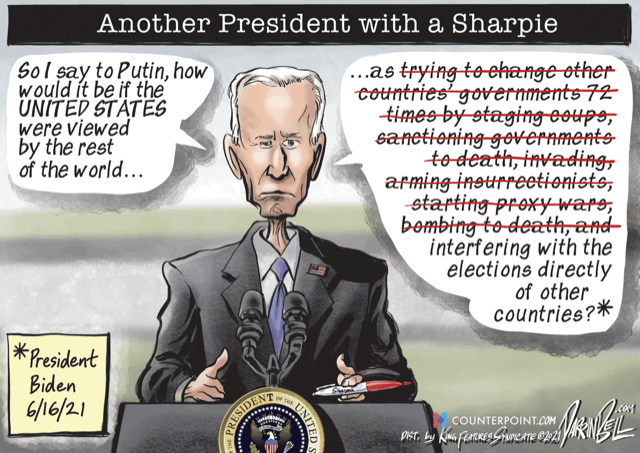
American defense today requires military strength sufficient to deter any country from successfully attacking the United States. It does not require the 800 military bases that we maintain around the world.  It did not require and was not enhanced by our many wars that followed the infamous and very damaging Viet Nam war (Lebanon 1982-4, Grenada 1983, Panama 1989-90, Gulf War 1990-91, Somali 1992-5, Bosnia 1992-5, Haiti 1994-5, Kosovo 1998-9, Afghanistan 2001-date, Iraq 2003-11, 2014-date, Somali 2007-21, Libya 2011, 2015-20, Syria 2014-date, War on Terror in various places). War with China would be quite a different matter. “The delusions of high tech warfare”

Fareed Zakaria unloaded on our war industry last month: “Defense Secretary Lloyd Austin outlined his key concern. ‘China is our pacing threat,’ he said. He explained that for the past 20 years, the United States had been focused on the Middle East while China had been modernizing its military. ‘We still maintain the edge,’ he noted, ‘and we’re going to increase the edge going forward.’ Welcome to the new age of bloated Pentagon budgets, all to be justified by the great Chinese threat.

“What Austin calls America’s ‘edge’ over China is more like a chasm. The United States has about 20 times the number of nuclear warheads as China. It has twice the tonnage of warships at sea, including 11 nuclear-powered aircraft carriers compared with China’s two carriers (which are much less advanced). Washington has more than 2,000 modern fighter jets compared with Beijing’s roughly 600, according to national security analyst Sebastien Roblin. And the United States deploys this power using a vast network of some 800 overseas bases. China has three. China spends around $250 billion on its military, a third as much as the United States.”  “The Pentagon is using China as an excuse for huge new budgets”  As noted above, over-investing in the military results in a smaller economy overall.

The latest debate is whether we should make our commitment to go to war with China to defend the independence of Taiwan explicit or leave it implied and ambiguous. In 1979 the U.S. recognized the People’s Republic of China as the sole legal Government of China and acknowledged that Taiwan was part of China (slightly fuzzy diplomatic language). So would American national security be enhanced by an explicit credible commitment to go to war with China, if necessary, to preserve the independence of Taiwan? China is a nuclear power. Going to war with China (World War III if we could get anyone else to join us) would inflect enormous damage on the U.S. whether it became nuclear or not, even if we won. In my opinion it would be simply insane to take such risks.

Would the U.S. deter China by being tough enough?  As Doug Bandow put it: “America’s antagonists saw something very different than weakness…. Stupidity and arrogance. Poor judgment. Refusal to admit mistakes. An almost demented willingness to sacrifice America’s future in a desperate attempt to redeem the nation’s tragic past. A better way not to show weakness would be to stop doing ‘stupid shit,’ as Obama suggested.

“China’s Xi Jinping and his colleagues in Zhongnanhai likely have a far more objective and practical take on U.S. policy: Endless wars by Washington are good for Beijing. The Chinese would love to see the US pour trillions more dollars and thousands more lives into new conflicts. Invade Iran? Please! Maybe occupy Syria too? Lebanon also needs fixing. Don’t forget the need to redeem Afghanistan. Then there is the problem of Russia in Ukraine, Syria, and elsewhere: go for it!”  https://original.antiwar.com/doug-bandow/2021/03/23/the-failure-of-huff-and-puff-foreign-policy/

But China (and Russia in Ukraine) has been behaving badly–claiming this little island in the China Sea and that one as its own, not to mention the ever-present risk of invading Taiwan. Even if the forced takeover of Taiwan by the PRC would not threaten our national defense, shouldn’t we care? Shouldn’t we care about the abhorrent genocide by the Chinese government against its Uighur Muslim minority in its western province of Xinjiang? Of course, we should, but we should reject the presumption of our neocon friends and the military/industrial complex we keep fat and rich that these and other interests can only be addressed militarily. See my experiences in Iraq and Afghanistan: “My Travels to Baghdad”

The creation of the United Nations and Bretton Woods institutions and other international cooperative agreements and institutions after World War II were meant to provide dispute resolution mechanisms other than wars. President Biden is committed to rebuilding these neglected institutions and strengthening and reenergizing our diplomatic institutions and initiatives. We can confront China more effectively and more realistically together with most of the rest of the world using the tools of diplomacy rather than of war. If the people of Taiwan chose to integrate their governance more fully with that of the PRC, that is their choice and their business. But if China invades Taiwan or otherwise forces such an integration, China should know the economic and political price they would pay. In my opinion, such a declaration would be far more effective in deterring such behavior by China than a fuzzy uncertain threat of war. It is encouraging that Congress seems on the verge of reclaiming its War Powers provided by the Constitution.

It is worth remembering the words of Dr. Martin Luther King, Jr. against our war in Vietnam delivered April 4, 1967. https://kingandbreakingsilence.org/

Hate Crimes

“The shooting deaths of eight people at Asian-run spas in Georgia this week triggered a vigorous national debate Thursday over whether the mass killing amounted to a hate crime.” “Georgia hate crime law-Atlanta shooting”  These deaths (and recent attacks on Asians more generally) raise several issues that I would like to explore. 1. What is the point of hate crime laws?  The poor ladies killed in this attack could care less what motivated Robert Aaron Long, the 21 year old shooter. 2. Whose fault is it? Let’s start with the shooter (and other attackers), please. 3. What should we do about it (beyond locking the shooter, and other attackers, up)?

What is the point of hate crime laws?

“Georgia State Rep. Chuck Efstration, a Republican who helped shepherd [Georgia’s Hate Crime] bill into law, said it was intended to allow for especially stiff penalties for crimes in which “the perpetrator’s prejudices and biases are attacks not only on the victims but on all of society.  Thank goodness law enforcement will have the ability to charge this as a hate crime if the facts support that,”   [op cit]

Georgia State University law professor Jessica Gabel Cino noted that: “The majority of the victims are women, and they are Asian. Those are two protected statuses.” And what if they hadn’t been?

Traditional laws do differentiate between first, second, and third degree murders, but if you plan to and succeed in killing someone, it didn’t traditionally matter whether you loved or hated the victim. I can understand why such information might be useful in exploring approaches to mitigating the risk of such future murders, but I don’t see its relevant to the guilt and punishment of the murderer. I do not support capital punishment, but Mr. Long should surely be put away for the rest of his pathetic life whatever motivated his killing spree.

According to Mr. Long, “he was on a mission… to stem his addiction to sex. The spas were ‘a temptation for him that he wanted to eliminate.’”  “What happened-Atlanta shooting”

In determining the length of a sentence, courts do pay some attention to the motive for a crime as well as the crime itself but a special category of “hate crimes” has always seemed troubling and unnecessary to me.

Whose fault is it?

In a free society of responsible citizens, we must never forget that in the first instance the fault for a crime rests with the criminal. But it is fair to ask what motivated the criminal. While Mr. Long’s horrible crimes do not appear to be motived by the hatred of Asian’s, there has definitely been an increase in verbal and physical attacks on Asians over the past year. Much of the press has been quite eager to point to the hate filled and divisive statements against China by former President Trump. While he is certainly guilty of poisoning public discourse on China, immigration, Muslims and related topics, it is an odd place to look first.

Animosity toward Asians, and Chinese in particular, arises in the first instance from the behavior of China (shorthand for the government of China — synonymous with the Communist Party of China). In fact, unfavorable attitudes toward China have skyrocketed around the globe over the last three to four years. “For our enemies we have shotguns explaining Chinas new assertiveness” Public attitudes toward China are lower in Australia and the U.K., for example, than in the U.S. and fell sharply well before the Covid-19 pandemic.  “China global reputation coronavirus”  Attitudes toward China began to deteriorate in the face of Chinese assertiveness in the South China Sea, violations of the one country, two systems agreement for Hong Kong, theft of intellectual property from the West, and treatment of the Uighurs in the Xinjiang region, to name a few. China’s suppression of information on the virus producing covid-19 pales in comparison to its bad behavior in other areas.

What should we do about it?

The world that objects to China’s behavior needs to stand together in pointing it out. Former President Trump’s stand-alone, bilateral approach was a failure. But it is very important when the U.S. and other governments criticize China to clearly differentiate the government of China from the Chinese people, whether citizens of China or the U.S. or elsewhere. It is the Chinese government–the Communist Party of China–that is misbehaving.

The distinction between a government and its people is important more generally. For example, those who criticize the misbehavior of the Israeli government toward the Palestinians in the West Bank and Gaza, are sometimes mistakenly accused of anti-Semitism–i.e., of being against the Jewish people. It is likely that many are reluctant to criticize the Israeli government for fear of being accused of anti-Semitism. As the Biden administration joins with other countries to criticize the misbehavior of the Chinese government, it must, and it is, clearly distinguishing the Chinese government from the Chinese people. And we, each one of us, must speak out at the sight of rude or inappropriate behavior toward Asians, or anyone else. ALL LIVES MATTER.

Shifting Gears: The Way Forward

The Trump administration accomplished many good things and many bad things (especially in the trade and foreign policy areas). Trump himself belongs in jail in my opinion. Hopefully, with the new Biden administration we can turn our attention to policy issues and stop calling our policy opponents nasty names. We must state the positive case for why our policy views are more appropriate–why they are better for our country. These are the sorts of public debates that we have been missing for a while and to which we should return.

One of our most fundamental principles is America’s commitment to equal treatment under the law for everyone regardless of race, religion, sexual orientation, or preferred hair style. Equal treatment is extended to everyone whether they or their ancestors came from Asia, Europe, Africa or Ireland (yes, even Ireland). We have never fully measured up to this principle, but it remains, and should remain, the objective to which we continually strive. It means that our accomplishments and “place” in society largely reflect our own talents and efforts. We are a nation of individual liberty. We are free (to a large extent) to make our own decisions. Our policy disputes often concern where to draw the line between what we decide for ourselves and what the government decides for us. My blog last week on our response to Covid-19 provides an example: https://wcoats.blog/2021/03/06/the-unnecessary-fight-over-covid-19/

Equity (equal outcomes) was the fundamental principle of the Soviet Union, though its outcomes fell far short of the principle. Between these extremes of equity (communism/socialism) and equality (equal treatment under the law) is our actual world of governments with more intrusive or less intrusive rules and dictates on our behalf, with broader or narrower social safety nets, etc.  America continues to debate where and how to set these boundary’s, but one of our great strengths, and a source of our broadly shared affluence, is undertaking the debate from the side of (and with the presumption of) self-reliance (with family and friends) and equality under the law.

The distinction between equity and equality is sharply contrasted in the following WSJ oped.

THE  WALL  STREET  JOURNAL.

Friday,  March  5,  2021.

Section A, Page 17, Column 1

‘Equity’ Is a Mandate to Discriminate

The new buzzword tries to hide the aim of throwing out the American principle of equality under the law.

By Charles Lipson


On his first day as president, Joe Biden issued an “Executive Order on Advancing Racial Equity and Support for Underserved Communities.” Mr. Biden’s cabinet nominees must now explain whether this commitment to “equity” means they intend to abolish “equal treatment under law.” Their answers are a confused mess.

Arkansas Sen. Tom Cotton raised the question explicitly in confirmation hearings. Attorney General-designate Merrick Garland responded: “I think discrimination is morally wrong. Absolutely.” Marcia Fudge, slated to run Housing and Urban Development, gave a much different answer. “Just to be clear,” Mr. Cotton asked, “it sounds like racial equity means treating people differently based on their race. Is that correct?”

Ms. Fudge’s responded: “Not based on race, but it could be based on economics, it could be based on the history of discrimination that has existed for a long time.” Ms. Fudge’s candid response tracks that of Kamala Harris’s tweet and video, posted before the election and viewed 6.4 million times: “There’s a big difference between equality and equity.”

Ms. Harris and Ms. Fudge are right. There is a big difference. It’s the difference between equal treatment and equal outcomes. Equality means equal treatment, unbiased competition and impartially judged outcomes. Equity means equal outcomes, achieved if necessary by unequal treatment, biased competition and preferential judging.

Those who push for equity have hidden these crucial differences for a reason. They aren’t merely unpopular; they challenge America’s bedrock principle that people should be treated equally and judged as individuals, not as members of groups.

The demand for equal outcomes contradicts a millennium of Anglo-Saxon law and political evolution. It undermines the Enlightenment principle of equal treatment for individuals of different social rank and religion. America’s Founders drew on those roots when they declared independence, saying it was “self-evident” that “all men are created equal.”

That heritage, along with the lack of a hereditary aristocracy, is why claims for equal treatment are so deeply rooted in U.S. history. It is why radical claims for unequal treatment must be carefully buried in word salads praising equity and social justice.

Hidden, too, are the extensive measures that would be needed to achieve equal outcomes. Only a powerful central government could impose the intensive—and expensive—programs of social intervention, ideological re-education and economic redistribution. Only an intrusive bureaucracy could specify the rules for every business, public institution and civic organization. Those unhappy implications are why advocates of equity are so determined to hide what the term really means.

Americans have demanded that all levels of government stop giving special treatment to the rich and powerful. That is simply a demand for equality. Likewise, they recognize that equal treatment should begin early, such as with adequate funding for K-12 students.

Since the New Deal, most Americans have supported some form of social safety net for the poor and disadvantaged. But this safety net doesn’t demand that out-of-work coal miners receive the same income as those who are working. The debate has always been about how extensive the safety net should be and how long it should last for each recipient. There is broad agreement that no worker should be laid off because of his race, gender or religion. Again, that is a demand for equal treatment.

What we are seeing now is different. It is the claim that the unfair treatment of previous generations or perhaps a disadvantaged childhood entitles one to special consideration today as an adult or young adult. Most Americans, who are both generous and pragmatic, have been willing to extend some of these benefits, at the margins and for limited periods. They don’t want to turn these concessions into large, permanent entitlement programs, giving substantially different treatment to different groups, even if those groups have suffered historical wrongs.

One measure of how unpopular these unequal programs are is how often their proponents need to rename them. “Quotas” were restyled as “affirmative action.” The goal was still to give special benefits to some groups to achieve desired outcomes. Now “affirmative action” has also become toxic, rejected most recently by voters in deep-blue California. Hence, the new name, “equity.”

Instead of making their case openly and honestly, advocates of equity twist and turn to avoid revealing their radical goal of re-engineering society through coercion. If the results fall short, as they inevitably would, the remedy is obvious: more money, more rules and more indoctrination. Why not tell us who will receive these special benefits and for how long? At whose expense? Who will administer these programs? Who will judge whether the outcomes are fair enough? When will it all end?

Since the ultimate goal is achieving equal outcomes, these evasions raise the hardest question of all. Isn’t equity just a new brand name for the oldest program of achieving equal outcomes? Its name is socialism.

Mr. Lipson is a professor emeritus of political science at the University of Chicago, where he founded the Program on International Politics, Economics, and Security.

Australia and Facebook

As reported in Bloomberg: “Australia’s parliament passed a world-first law to force digital giants such as Facebook Inc. and Google pay local publishers for news content…. The legislation was passed Thursday and will ensure “news media businesses are fairly remunerated for the content they generate,…  ‘We look forward to agreeing to new deals with publishers and enabling Australians to share news links once again,’ [Nick Clegg, Facebook’s vice president of global affairs] wrote in a blog post dated Feb. 24.”  Got that???  Does this apply to content that Facebook generates or collects and shares or does it apply to news links Australians share? Perhaps both. Actually, I think that newspapers and other news sources pay Facebook to post their links. It’s called advertising.

But what about the links I post on Facebook and Twitter to articles in the Washington Post, WSJ, and Bloomberg (all of which I subscribe to)?  Facebook is the platform on which I post them. Is Facebook being asked to pay the Post and WSJ for my posts? What I do with what I buy from these news services should be between me and these services and should have nothing to do with Facebook. Should Word Press have to pay the sources I link in my blogs? Should AOL have to pay sources I send or link in my email? OK, OK, I am an older gentlemen and got my AOL email address over thirty years ago and I don’t want to change. !!!  Should the U.S. Postal service have to peak into my regular mail and pay for any source content that I might be sending someone? This is ridiculous and it should be opposed.   

Facebook and Immigration

December 3rs’s WSJ started an article on immigration as follows:

“The Trump administration has sued Facebook Inc., accusing the social-media company of illegally reserving high-paying jobs for immigrant workers it was sponsoring for permanent residence, rather than searching adequately for available U.S. workers who could fill the positions.

The lawsuit reflects a continuing Trump administration push to crack down on alleged displacement of American workers.”  “Trump administration claims Facebook improperly reserved jobs for H1-b workers”

Immigration policy is a complex issue with many aspects. The economic aspects, however, should be straight forward and simple. https://wcoats.blog/2018/03/03/econ-101-trade-in-very-simple-terms/  https://wcoats.blog/2018/03/24/econ-101-trade-deficits-another-bite/  https://wcoats.blog/2018/09/28/trade-protection-and-corruption/ A free market in goods and labor increases productivity and output making the world wealthier. The cost for this extraordinary benefit is that some firms may go out of business and some workers may lose their existing jobs when someone else does better what the firm or worker were doing. They will need to move on to other activities or jobs.  It is wise and appropriate social policy to help those displaced by competition find alternative uses of their resources and skills.

It might seem rather harmless to protect existing firms and jobs from competition (aside from its afront to our individual freedom) but overtime the cost in reduced income growth will become greater and greater. What if such policies had been imposed a hundred years ago? Where would we be now?

If there are American workers who can perform the same job for the same wage Facebook needs, it has every financial incentive to hire them over sponsoring foreign workers. They don’t need laws to push them to do so. The good old profit incentive works just fine. It is fortunate that the exercise of our individual freedom to invent, invest, and work where we please also produces the most efficient (i.e. productive, thus profitable) use of our talents and resources. Talk about win-win. Those displaced when I come up with a better idea (i.e., something the rest of you like better) should be discouraged from stopping such progress with an effective economic safety net. “Replacing Social Security with a Universal Basic Income”

The Thanksgiving Revolt

Sadly, Thanksgiving and healthcare more generally has been politicized (or “weaponized” as I said in a report to the UNDP with regard to the monetary system in Yemen–my advice was that nothing as important as the monetary system should be weaponized). Why are normally sensible (I am being generous on this day of giving thanks) people behaving like rebellious teenagers? Among other reasons, I think, it is in part because they are being treated like children. We can demand that our children do this or that (at least when we don’t have the time or patience to explain why they should do this or that as part of preparing them to become adults).

Mature, independent minded adults (i.e., typical Americans) bristle when told that they must stay home, or cancel Thanksgiving dinner and other social activities, even when they suspect that it is the prudent thing to do. Our government should not be dictating our behavior in a free society. There are exceptions, of course, for the protection of the rest of us. We are (or should be) free to do what we like as long as we do not infringe on the right and ability of others to do the same. For example, we don’t permit people infected with communicable diseases to wander around in public endangering the rest of us–quarantining those with active cases of Covid-19 is properly required.

We each have our own assessment of the risks of infection and our own willingness to take risks.  We should be free to make our own decisions about what to do (as long as we are not endangering others–yes you should wear a face mask if you go out).

What should the government’s role be? The government should provide the best information available on what those risks are and how best to mitigate them. Not everyone agrees on what the data says.  Where that is the case, the government (CDC basically) should be honest about the disagreement and the basis of the government’s consensus judgement. This is a constructive, helpful role and a proper way of dealing with adults. Somehow too many political types have acquired the tone of voice with which one might speak to children. And if that weren’t bad enough the government provides conflicting information. Fortunately, our stable genius is no longer listened to and his quack remedies will fade from our memories.

We need an honest and less intrusive government that advises rather than dictates. We need fellow citizens who civilly share their views with us while respecting, even if not necessarily agreeing with, ours. We have a long way to go but let’s rally and raise above the muck we are in.  Oh yes, and happy Thanksgiving.

Thanksgiving Proclamation, 3 October 1789

Thanksgiving Proclamation

[New York, 3 October 1789]

By the President of the United States of America. a Proclamation.

Whereas it is the duty of all Nations to acknowledge the providence of Almighty God, to obey his will, to be grateful for his benefits, and humbly to implore his protection and favor—and whereas both Houses of Congress have by their joint Committee requested me “to recommend to the People of the United States a day of public thanksgiving and prayer to be observed by acknowledging with grateful hearts the many signal favors of Almighty God especially by affording them an opportunity peaceably to establish a form of government for their safety and happiness.”

Now therefore I do recommend and assign Thursday the 26th day of November next to be devoted by the People of these States to the service of that great and glorious Being, who is the beneficent Author of all the good that was, that is, or that will be—That we may then all unite in rendering unto him our sincere and humble thanks—for his kind care and protection of the People of this Country previous to their becoming a Nation—for the signal and manifold mercies, and the favorable interpositions of his Providence which we experienced in the course and conclusion of the late war—for the great degree of tranquillity, union, and plenty, which we have since enjoyed—for the peaceable and rational manner, in which we have been enabled to establish constitutions of government for our safety and happiness, and particularly the national One now lately instituted—for the civil and religious liberty with which we are blessed; and the means we have of acquiring and diffusing useful knowledge; and in general for all the great and various favors which he hath been pleased to confer upon us.

and also that we may then unite in most humbly offering our prayers and supplications to the great Lord and Ruler of Nations and beseech him to pardon our national and other transgressions—to enable us all, whether in public or private stations, to perform our several and relative duties properly and punctually—to render our national government a blessing to all the people, by constantly being a Government of wise, just, and constitutional laws, discreetly and faithfully executed and obeyed—to protect and guide all Sovereigns and Nations (especially such as have shewn kindness unto us) and to bless them with good government, peace, and concord—To promote the knowledge and practice of true religion and virtue, and the encrease of science among them and us—and generally to grant unto all Mankind such a degree of temporal prosperity as he alone knows to be best.

Given under my hand at the City of New-York the third day of October in the year of our Lord 1789.

Go: Washington

Saving the American Dream

The American Dream is under attack.

“The American Dream is the belief that anyone, regardless of where they were born or what class they were born into, can attain their own version of success in a society where upward mobility is possible for everyone. The American Dream is achieved through sacrifice, risk-taking, and hard work….” “The American Dream is to succeed by work, rather than by birth”. The Dream has attracted the world’s best and brightest to our shores making America the world’s leading economic powerhouse and enabling us to live freely as we each determine what we are willing to work for, for ourselves and our families.

Historically, individuals have been limited in what they could achieve by where they were born in society, by their parent’s position in life, and by who they knew. Companies of individuals were limited by the restrictions placed on them by their governments, often by the protections from competition government granted their friends (crony capitalism). Such traditional societies limited the freedom and ambitions of its citizens and limited the productivity of its human and physical resources. In short, traditional societies were keep poorer than they would have been if their citizens had been freer to innovate and compete.

The American Dream is now under attack by Donald Trump’s trade protectionism, crony capitalist government favoritism, immigration walls, and weakening of the international rule of law that has extended the benefits of specialization and trade globally. It is also being attacked by Alexandria Ocasio-Cortez’s (LOC’s) vision of state leadership and control of production and a new generation of idealistic, but uninformed, voters who mean well but have missed the lessons of socialism’s failures. If we are to save the conditions in the United States in which the American Dream still lives, we must better understand what has led so many Americans to vote against it.

I am sure that the answers to that question are many and complex, but broadly speaking two stand out in my mind, both of which point to the measures needed to restore support for the dream.

The first is to better educate the public, especially its younger members, about the conditions that allow and encourage a productive, innovative economy. This includes understanding the proper role of government in protecting private property, enforcing contracts, maintaining public safety (the rule of law) and in providing the public infrastructure that facilitates private activities and commerce (the commons of public goods). It includes the lessons of why all socialist economies have failed as a result of the corrupting incentives of state direction of economic activity rather than the competitive search by profit seeking private enterprises for better ways to serve the public.

The second answer concerns the adequacy and efficiency of our social safety net. The American Dream concerns individuals who take responsibility for their own well-being. While on average this has opened the way for most to prosper to the extent of their talents and energy, some will, often through no fault of their own, fail and fall off the tightrope. Society has an interest (even beyond the obvious humanitarian one) in softening the fall. It has an interest in an effective social safety net. 

Some–those who have not understood the lessons of socialism’s failures–have looked to trade and immigration restriction to prevent them from losing their jobs. They object to the economic benefits of free trade when it means that they must look for a new job (however, most manufacturing job losses in the U.S. have resulted from technical progress and the resulting increase in productivity rather than from cross border trade). “Econ-101-trade-in-very-simple-terms”  “Trade-protection-and-corruption” Those with such views have supported Trump’s anti free market policies. They have been attracted by Trump’s “I win you lose, us vs them” rhetoric.

AOC and her friends point to the widening income inequality–the dramatic increase in the incomes of the wealthiest and the stagnation of the incomes of the middle class in recent years–and demand income redistribution. But she fails to understand that it has been the growth of government’s role in the economy and the incentives in big government toward corruption and crony capitalism (protectionism for the wealthy) that have reduced competition and protected the position and markets of the biggest companies with friends in government. Socialism would make those incentives even stronger.

America’s dynamism and success reflects the creative destruction of risk-taking entrepreneurs and their hard-working employees.  https://economics.mit.edu/files/1785  However, the workers whose jobs are displaced by new products and new technologies may need help in finding and retraining for new jobs. They may need financial assistance in between (unemployment insurance). If nothing else, this may be the cost of their support for such a dynamic system.  Our social safety net sometimes provides poor incentives and sometimes has holes. It is time to seriously consider replacing it with a less intrusive and more comprehensive Universal Basic Income.  “Our-social-safety-net”  “Replacing-Social-Security-with-a-Universal-Basic-Income”

The American Dream–the foundation of our freedom and affluence–is under attack from the left and the right. We should fight to preserve (or restore) it.

My Travels to Baghdad

Iraq: An American Tragedy, My Travels to Baghdad

Warren Coats (2020)

Kindle and paperback versions available at: Iraq-American-Tragedy-My-Travels-Baghdad

From the corkscrew landing at Saddam International Airport (now the Baghdad International Airport) to adventures in the Green Zone and beyond, this recounting of my experiences helping the Central Bank of Iraq develop modern market tools of monetary policy exposes the disfunction of the U.S. lead Coalition Provisional Authority (CPA) in its attempt to govern and rebuild post Saddam Iraq, following one of America’s more foolish and damaging military adventures. The existence of weapons of mass destruction was a lie. American skill at imperial rule–from disbanding the Iraqi Army to De-Ba’athification of the Iraqi bureaucracy– was a myth. 

Regime changes usually don’t involve changes in the monetary system. However, the toppling of Saddam Hussein’s government and the occupation of Iraq and the takeover of its government by the United States and a few allies in the name of the Coalition Provisional Authority (CPA) was accompanied by the replacement of the so-called Saddam dinar and modernization of Iraq’s monetary and financial system. The Iraq war was launched with “shock and awe” on March 20, 2003 and President George W Bush declared “mission accomplished” on May 1 a month and a half later. But when I retired from the International Monetary Fund and took up residence in Baghdad to advise the Central Bank of Iraq on developing Iraq’s financial markets and managing its new currency, the fighting was not over on many fronts. I lived in Baghdad the last two months of the CPA (May-June 2004) and made four two-week visits between then and December 2005

In this book, much of it written in diary form at the time, I share the challenges of advising the staff and management of the Central Bank of Iraq from my office in the central bank and of navigating the U.S. interagency rivalry from my office in Saddam’s Republican Palace in Baghdad’s Green Zone.  Security was always a challenge, producing many adventures. But the wisest advice I received was from a colleague in the CPA, who told me to “be careful who you talk to here (CPA headquarters in the Republican Palace), your worst enemies are in this building.” Over my 26 years in the International Monetary Fund and the technical assistance missions I lead to some 20 countries, many of them post conflict countries, I have never encountered the disfunction and resulting ineptitude of the U.S. led Coalition Provisional Authority in Iraq.

Previous Books

One Currency for Bosnia: Creating the Central Bank of Bosnia and Herzegovina

by Warren Coats (2007)    Hard cover: One Currency for Bosnia

FSU: Building Market Economy Monetary Systems–My Travels in the Former Soviet Union

By Warren L Coats (2020)  Kindle and paperback versions available at: FSU-Building-Economy-Monetary-Systems

Afghanistan: Rebuilding the Central Bank after 9/11 — My Travels to Kabul

By Warren Coats (2020)  Kindle Edition:  “Afghanistan-Rebuilding the Central Bank after 9/11”

Zimbabwe: Challenges and Policy Options after Hyperinflation

by Warren L. Coats (Author), Geneviève Verdier (Author)  Format: Kindle Edition

Zimbabwe-Challenges and Policy Options after Hyperinflation-ebook

Money and Monetary Policy in Less Developed Countries: A Survey of Issues and Evidence

by Warren L. Coats (Author, Editor), Deena R. Khatkhate (Author, Editor)  Format: Kindle Edition

Money and Monetary Policy in LDCs-ebook