The Bitcoin Act

“With the introduction of the BITCOIN Act this summer, Senator Cynthia Lummis (R-Wyo.) called for the creation of a strategic Bitcoin reserve with the goal of reducing the government’s near-$36 trillion national debt. But can this kind of reserve actually solve our debt crisis?”  FREOPP: “Can a bitcoin reserve save the US?”

Wow. This is one of the dumbest ideas I have seen in a long time.

For starters, sovereign reserve funds consist of investments of foreign currencies earn from a country’s exports (usually oil) that it did not chose to spend on imports, i.e. the result of a trade surplus. The U.S. has a trade deficient (we buy more from abroad than we sell) not a surplus and thus have no extra foreign currency to invest. The US would need to borrow the money to invest in bitcoin when the US government is all ready $36 trillion in debt. But if it were a relatively sure way of earning more than the cost of borrowing it, it could help reduce the national debt.

Is bitcoin such an investment? As I write this, bitcoin is selling at $96,479, a 146% increase from one year ago. Not bad to say the least. If instead the bitcoin fund had purchased bitcoin in 2013 (at about $450) and sold it at the end of 2016 ($434) it would have earned a bit less than nothing. But if it purchased it at the beginning of 2018 at $13,657 it would have lost its shirt by the end of the year at $3,709. In short bitcoin prices have been all over the map. They are not redeemable for anything, cannot be used to pay for anything with rare exceptions, and are thus a purely speculative form of gambling. WC: “Bitcoin”   WC: “Bitcoin2”

Creating a bitcoin reserve would be beyond stupid.

But in the currency area there is competition for destructive stupidity.  The US dollar is by far the most used currency for international transactions for good economic reasons. The US recently has been making the dollar less attractive by freezing Russian and Afghan dollar accounts: WC: “The dollar again” But rather than focusing on measures that would preserve or restore the dollar’s attractiveness (Make the Dollar Great Again), president elect Trump has threatened any country that does not use it with 100% tariffs. Such bullying is enough to embarrass even the worst bullies. WP: “Trudeau Trump tariffs”

America’s Trump style Foreign Policy

The world benefits from rules of interaction that provide peace and cooperation. Rather than building more weapons of war, we could build more temples of beauty. Championing rules most countries respect and aspire to and being the largest (or perhaps second largest) economy in the world, the United States has naturally led such an international order. Retaining that role would be jeopardized if the U.S. did not diplomatically fashion such rules that were embraced and respected by most other countries and if the U.S. did not itself abide by the rules it had championed.

America’s leadership role is being jeopardized by our hypocrisy, such as condemning Russia’s invasion of Ukraine while given a blank check and American weapons for Israel’s invasion of Gaza and Lebanon and ignoring its abuse of its occupied territories in the West Bank of Palestine. America’s embrace of the International Criminal Court’s (ICC’s) arrest warrant for Vladimir Putin for Russia’s invasion of Ukraine and America’s condemnation of the ICC’s arrest warrant for Israel’s PM Benjamin Netanyahu’s and its former Defense Minister Yoav Gallant is the very definition of hypocrisy.  

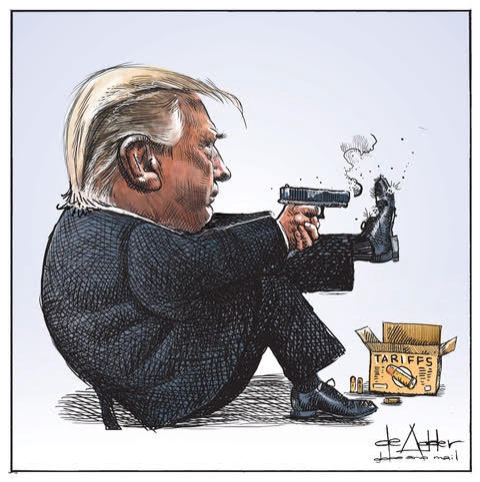
President elect Donald Trump’s style of negotiating international agreements reflects more the behavior of a bully than a diplomat. Last Monday Trump threatened to levy a 25% percent tariff on all imports from Mexica and Canada, despite the large economic harm to the US as well as Mexica and Canada and despite the laws and agreements it would violate, if they did not stop the illegal drugs and aliens entering the US across their borders. WC: “tariffs”

“Trump’s threat spurred outrage across the northern and southern U.S. borders, prompting backlash and warnings of retaliatory tariffs from both Mexico and Canada.”  The Hill: “Takeaways from trumps new tariff threat”

“Donald Trump’s angry threat to impose 25 percent tariffs on all U.S. imports from Mexico… is widely being depicted as a bluff….

“But amid all this parsing of Trump’s intentions, a crucial fact about his new move is getting lost: At the center of it is a lie. This lie is hiding in plain sight: It’s the underlying suggestion that Mexico is not doing anything to stop migrants from coming and that Trump’s threat of tariffs is needed to change that….

“All this is laid bare by the sharp response to Trump’s threat that new Mexican President Claudia Sheinbaum issued Tuesday. Her statement is getting attention for its barbed claim that American guns trafficked to Mexico are fueling crime and violence there among gangs supplying U.S. markets with drugs. ‘Tragically, it is in our country that lives are lost to the violence resulting from meeting the drug demand in yours,’ Sheinbaum noted acidly, suggesting that the two countries’ interrelated national challenges underscore the need for cross-border cooperation rather than Trumpian confrontation.”

She further noted that: “You may not be aware that Mexico has developed a comprehensive policy to assist migrants from different parts of the world who cross our territory en route to the southern border of the United States. As a result, and according to data from your country’s Customs and Border Protection (CBP), encounters at the Mexico-United States border have decreased by 75% between December 2023 and November 2024….

“What this polite (and euphemistic) language says is that Mexico is already acting extensively to thwart migrants who travel through that country—originating south of Mexico—so they don’t reach our own southern border. As Sheinbaum notes, this is partly why border apprehensions in the United States have dropped sharply of late.” New Republic: “Mexico’s Sheinbaum responds to Trump tariffs”

So, what did our bully in chief do next?  “President-elect Donald Trump has said he had a “wonderful” conversation with Mexico’s President Claudia Sheinbaum, in an apparent easing of the tensions raised this week over trade tariffs….  After Wednesday’s phone call, both leaders described the conversation in positive terms. Trump said on Truth Social, his social media platform, that it was a ‘very productive conversation’ and thanked Mexico for its promised efforts.”

Perpetuating his original lie, “Trump indicated that Sheinbaum would stop migration through Mexico, ‘effectively closing the southern border’.

“Sheinbaum said she had explained her country’s efforts to deal with migrants and that her position would ‘not be to close borders but to build bridges’”.  https://on.ft.com/49czcol

Trump may or may not be a good negotiator (6 of his businesses have filled for bankruptcy) but his approach is that of a bully. Given America’s dominant status in the world, bullying rather than leading and negotiating in the search for mutually beneficial compromises will hasten American decline from leadership.

Tariffs

“Posting on his Truth Social platform, Trump said [Monday] that on the first day of his presidency he will charge Mexico and Canada a 25% tariff on all products coming into the U.S. He added in a separate social-media post that he would impose an additional 10% tariff on all products that come into the U.S. from China,… That would come on top of existing tariffs the U.S. has already imposed on Chinese goods.

“’This Tariff will remain in effect until such time as Drugs, in particular Fentanyl, and all Illegal Aliens stop this Invasion of our Country!’ Trump wrote.” WSJ: Trump pledges tariffs on Mexico Canada and China”

A tariff is a tax on an import. They are permitted by the World Trade Organization when leveed on goods receiving state subsidies in order to create a level playing field for trade. Such global trade has made an enormous contribution to the standard of living around the world.  “Ernie Tedeschi, former chief economist for President Joe Biden’s Council of Economic Advisers, said the North American tariffs would cost the typical American household almost $1,000 per year.” WP: “Trump tariffs-China Mexico Canada”

The normal expectation is that the tariff will reduce U.S. demand for the taxed import and encourage its domestic production. But the US labor force is fully employed and can only increase domestic production of the targeted goods by shifting workers from the production of goods the US has a comparative advantage in thus reducing our overall income. Though employment of manufacturing workers has declined in the US, manufacturing output has not because worker productivity has increased. In fact, our imports have not shipped American jobs overseas as increasing productivity has resulted in reduced manufacturing employment most everywhere in the world, including China, surely a good thing. WC: “Trade protection and corruption”

Immediately after Trump’s tariff announcement, the exchange rate of the dollar strengthened. A stronger dollar reduces the cost of imports (but increases the cost to foreigners of our exports), thus undoing to some extent the demand reducing impact of the tariff. But it hurts our exports because of their higher price to foreign purchaser and reduces our overall standard of living.

China and others hit with this tax are likely to retaliate with their own tariffs. “Under the United States-Mexico-Canada Agreement (USMCA), which took effect in 2020, goods moving among the three North American nations cross borders on a duty-free basis. ‘Obviously, unilaterally imposing a 25 percent tariff on all trade blows up the agreement,’ said John Veroneau, a partner at Covington & Burling in Washington.”  WP: “Trump tariffs-China Mexico Canada”

Should Trump actually impose these tariff’s he would (again) be violating the law, which only allows the President to impose tariffs without Congressional approval for national security reasons: WC: “Tariff abuse”

Trump’s threatened tariffs are not even leveed on the goods he wants to restrict (drugs and illegal aliens). Thus, unlike traditional tariffs they would be leveed to pressure Mexico and Canada to take other actions Trump wants. They are bargaining ploys. So at the cost of raising prices and lowering incomes in the US, weakening the global trading rules from which we have benefited so much, and weakening the checks and balances limiting an over extended executive branch, Trump may be playing his bargaining game again. But in my opinion the cost to us and the world trading system is too high.

Econ 101:  Money

My Ph.D. in economics from the University of Chicago dealt with a monetary policy issue. My five years as an Assistant Professor of Economics at the University of Virginia allowed me to lecture extensively about monetary policy and my 26 years at the International Monetary Fund were largely devoted to providing technical assistance to member (primarily post conflict) county central banks (including Afghanistan, Bosnia, Croatia, Egypt, Iraq Israel, Kazakhstan, Kenya, Kosovo, Kyrgyzstan, Moldova, Serbia, South Sudan, Turkey, West Bank and Gaza, and Zimbabwe). In case you didn’t know, central banks issue the currency (money) of their respective countries. So, I know a lot about “money” and like talking about it.

And it’s not that I haven’t already written a lot about the subject. For a few examples see: “Econ 101-the Value of Money”   “Money”  “A Libertarian Money”

A lot of interesting things are happening these days in the monetary area, but they pertain to payments (transferring money from one person to another via PayPal, Venmo, Zelle, Visa, etc.) rather than money itself. I want to talk to you about “money” (not payments) as I might with my granddaughter. Money is what is transferred in payment.

Money exists because none of us are self-sufficient and must trade what we produce with others who produce the other things we want. I will skip the presumably well-known story of barter trade and its challenge of the double coincidence of wants (you have what I want, and I have what you want so we trade). Giving you a commonly accepted asset, that you can hold until you want to buy something from someone else and can “pay” for it by passing that asset on to the next seller is the essence of money. In addition, it becomes the unit of account (the unit for stating prices). Thus, money is a unit of account, means of payment and store of value.

But now dear granddaughter, lets dig deeper to discuss where this money comes from and its key features in today’s modern electronic (digital) world. First of all, I can’t pay you with any old asset equal in value to your sale price (the barter problem). I must pay you with “money,” an asset universally accepted within the country. To cut to the bottom line, money is the asset issued by our central bank (any of our twelve Federal Reserve Banks) or creditable claims on the Fed’s monetary liability—the U.S. dollar. Until 1933 these dollars could be redeemed for gold at $20.67 per once. Now the U.S. government accepts them in payment of our taxes denominated in dollars, which insures their ultimate value.

Federal Reserve notes (dollar bills) are the most direct manifestation of our money. But almost 90% of our money (the asset with which we can pay for things) is in the form of deposits at American banks, and credit unions. These figures can be a bit misleading because over 60% of our currency is held abroad.

When you pay someone with cash, they receive a direct claim on the Federal Reserve. When you pay with your bank deposit, your bank’s deposit with (claim on) a Federal Reserve bank is transferred to the payee’s bank, which credits the payee’s bank account with the designated amount. The asset paid and received is still ultimately a claim on the Fed.

But our demand deposits with our banks amount to 15.9 trillion dollars, while the reserves that our banks keep with the Federal Reserve Banks amount to only $3.3 trillion reflecting our “fractional reserve” system. What is going on here? How did banks create more of our money (ultimate claims on the central bank) than it backs with its reserves at the Fed?

When teaching money and bank at the U. of Virginia I loved walking the class through the money/banking multiplier that resulted from our fractional reserve backing system. It has become fashionable for some to claim that banks create deposits (money) by making loans. When you received a mortgage loan from your bank, they say it creates the deposits placed in our deposit account. This is sort of true and sort of not true. Your bank actually pays your mortgage loan to the account of the person selling their home and their account is almost surely in another bank. That means that your bank must have sufficient reserve balances at the Fed to transfer to the seller’s bank.

I will leave the details of the bank money multiplier to the Money and Banking class you will hopefully take when you go to college, but the fact that your deposits are only partially backed with reserves at the Fed (the rest of the backing being the bank’s loans and other financial assets, is what lies behind the occasional bank runs we saw in the movies before deposit insurance was introduced to assure depositors that they could get the money back even if their bank failed. If enough bank borrowers default on their loans, the bank could become insolvent. Only the first to withdraw their deposits will be able to get their money back. The potential risk of such runs on a bank only partial backing your deposits with reserves at the central bank motivated the Chicago Plan of 100% reserve banking. “Protecting Bank Deposits”

If bank deposits of US dollars are money, what about cybercurrencies? What are they ultimately claims on? Bitcoin, as you hopefully know, is not a claim on anytime. They can’t be redeemed for anything. It is not unit of account or means of payment for hardly anything—it is not money. It is a speculative “asset” for those who like to speculate (gamble). “Cryptocurrencies-the bitcoin phenomena”  “The future of bitcoin exchanges”  “Bitcoin-Cybercurrencies and Blockchain”  “The difference between bitcoin and FTX”

But there is a class of cryptocurrencies that claim to be redeemable for money, such as US dollars—so called stable coins. The validity of this claim, as with your bank re your deposits there, depend on the details of its contract and the faithfulness of its adherence to that contract. Tether and USD Coin are the most popular US dollar stable coins.

But to use a stable coin for making payments, the person or firm you are paying must have the software or card reader needed to use the cryptocurrency you want to use. You might remember (probably not you, dear granddaughter) when not so many stores could accept visa, or MasterCard (or the Shell Oil, or Texico gas cards). Payment technology has continued to evolve and improve, but if it is not transferring money (US dollars in our case)—i.e. an asset ultimately redeemable for the Federal Reserve’s liability, it will not get you very far.

Other than handing someone cash, paying with your bank account requires a messaging and authorization system. Do you still write checks occasionally—so sorry. A check both indicates the amount to be paid and authorizes its transfer. Almost all payment instructions and authorizations are made electronically these days. Many central banks are considering introducing digital cash in place of or along side their currency notes (Central Bank Digital Currency). When offered through a bank, a CBDC would have the advantage of 100% reserve backing (it would be a direct claim on the Fed). On the other hand, modern electronic means of payment leave little room for further improvement as might be offered by CBDCs. “Econ 101-Retail Central Bank Digital Currency-CBDCs”

To make payments, or send money, abroad, your money must be exchanged for the money of the recipient. I regularly send dollars to Afghanistan, which are received as Afghani. A massive foreign exchange market in which the exchange rate of one currency for another is determined exists for that purpose. Such payments can be made more quickly and cheaply if both parties are willing to use the same currency. Thus, the US dollar is rather widely accepted for cross border payments. “The Dollar Again”  The Special Drawing Right (SDR) of the International Monetary Fund serves this purpose for governments but is not widely used. “What are SDRs?” Stable coins redeemable for gold provide another promising potential unit given golds historical importances. The best existing example is e-gold by Global Standard (to which I am an advisor).

But not all monies behave the same. The behavior of the value of each (its inflation rate) depends on how its issuing central bank manages its supply. Some central bank’s supply whatever their government needs, generally resulting in high inflation rates. Some, such as our Federal Reserve, regulate its money’s supply in an attempt to maintain an inflation target (in the US the target is 2%). Others follow currency board rules that leave to the market the determination of a supply that keeps the currency’s value consistent with that of another currency (The Euro in the case of the Bosnian dinar or the Bulgaria lev). So dear granddaughter there are many interesting things to study about money.

Why don’t you pop over and let’s discuss it more over lunch? Oh, I forgot that you are in the West Coast Washington (state) while I am near the East Coast Washington (DC). Well at least we can meet on FaceTime or Zoom (or even the old fashion telephone). But I would love to meet one way or the other.

P.S. In 2002 as Patrick Honohan and I were finishing up the Bank-Fund Financial Stability Assessment of Egypt (Patrick led the World Bank team and I led the IMF team) I said in an email “Patrick, why don’t you just come across the street and discuss this over tea?” Patrick replied: “Warren, I am in Dublin. I moved here several months ago.” He later became the Governor of the Central Bank of Ireland.

Econ 101: Trade balance

Everyone understands that we are each wealthier if we buy most of what we consume from others and pay for it with what we specialize in producing ourselves. But at dinner last night one of our guests (Chatham House Rules prevent me from revealing his identity) asked how we can compete with China when their workers are so cheap? The teacher in me rises up to unpack this statement and the related issue of trade balance. It is both complicated and simple.

  1. Are Chinese goods cheaper? Chinese workers are paid in their currency (RMB) and American’s buy China’s output in our currency (USD). If an LED light bulb made in China is sold for 140 RMB is that cheap for American’s? If the exchange rate of RMB for USD is 4 RMB per USD it will cost us $35 per bulb (expensive), but if the exchange rate is 10 RMB per USD it will cost us $14 per bulb (cheap).
  2. So will we buy everything from China? What will the Chinese do with the dollars they receive from exporting to us? They might buy goods from the US (made by workers who used to make LED light bulbs). If the exchange rate is “right”, the Chinese will spend all of those export dollars on imported US products. Trade (imports and exports) will balance.  An exchange rate that makes dollars more expensive in China (RMB cheaper in the US) will decrease China’s imports from the US relative to its exports (a Chinese trade surplus). What will they do with the remaining dollars held in China?
  3. What happens with Chinese trade surplus holding of USD? The Chinese can invest them in the US (buy US Treasury securities, stocks, property, etc.). Or sell them for their own currency driving the exchange rate of RMB for USD down (or up depending on what you put in the denominator). The reduced cost in China of US goods will increase Chinese imports and the higher cost of Chinese good in the US will reduce US imports from China. The Chinese trade surplus (US trade deficit) will vanish (or adjust to the rate of capital flow desired by cross border investors). The incomes of Chinese and American workers will be higher because each will be producing the goods for which they each have a comparative advantage (the win-win of free trade).
  4. Exchange rate manipulation or production subsidies distort the outcome. EU tariffs on Chinese EVs are explicitly set at a level to compensate for Chinese government subsidies of EVs. This is allowed by WTO trade rules to put Chinese and German car manufacturers on a fair, competitive basis. The US’s much higher tariff on Chinese EVs makes no mention of complying with WTO rules (the US again does whatever it wants to the detriment of the global trading system).
  5. Trade balance between US and China is used as a simplification. What matters is the balance between each country and the rest of the world but distilling the world into two countries simplifies the discussion.
  6. Time for the dessert.

Preserving the Global Order

As the number of BRICS member countries grows, the international organizations through which countries cooperate are at risk of fragmenting.  To keep the IMF, World Bank, WTO, WHO, ITU and other international bodies together to perform their financial, standard setting, and coordination functions that have contributed so much to global prosperity, each member must believe that they are fairly represented in such bodies.

Unlike the UN’s one country one vote, members of the International Monetary Fund and World Bank, have votes (quotas) that reflect their economic importance. The fundamental criteria for the financial contribution and voting share of each member country in the IMF and WB are the economic size of its economy and its share of world trade and reserves.

When they were established after WWII in 1944, the total size of the IMF was 8.8 billion dollars of which $2.9 billion was pledged by the U.S. giving it a quota (and vote) of 33% of the total. Any major policy decisions or amendments to the IMF’s Article of Agreement require an 85% support. This gave, and continues to give, the U.S. a veto over any important measure it doesn’t like. At that time the U.K. quota of $1.3 billion was 15% of the total and that of France was $0.65 billion or 7.4% of the total.

The Republic of China was an original member of the IMF in 1944, whose seat was transferred to the Peoples Republic of China in 1980 with a quota of 1.2 billion SDR which was 3.1% of the total of SDR 39.0 billion. “What are SDRs?” This was promptly increased to 1.8 billion SDRs (4.6%). The quotas and voting strength of the IMF’s six largest members in 1980 and 2022 were:

                        1980               2022

U.S.           19.83%               16.08%

U.K.             6.94%               4.03%

Germany    5.13%               5.31%

China           4.62%              6.08%

France.        4.57%              4.03%

Japan.          3.96%              6.14%

Over the last 4 decades, China and many other lower income countries have grown significantly. U.S. GDP in 1980 was $9.7 trillion in 2022 dollars while China’s was $1.03 trillion in 2022 dollars.  But by 2022 the US economy had double while Chinas increased almost 14 times. The adjustments in member quotas failed miserably to reflect these changes. The US quota dropped from 19.8% to 16.5% while China’s increased from 4.62% to 6.08%

In 2022 GDPs of the top five were:

  1. United States: $20.89 trillion
  2. China: $14.72 trillion
  3. Japan: $5.06 trillion
  4. Germany: $3.85 trillion
  5. United Kingdom: $2.67 trillion
  6. India: $2.66 trillion

To quote from Wikipedia: “To further rebalance power in the IMF, China appealed for changes that would transfer voting power to developing economies. In 2010, the Chinese executive director of the Fund, Zhou Xiaochuan, addressed the board and asserted that giving more power to the emerging economies was critical for the group’s legitimacy, accountability and long-term health.”

In the IMF/WB annual meetings that just concluded in Morocco have called for an increase in IMF resources but distributed equiproportionately, i.e., with no change in members’ relative voting weight (quotas). This moves member quotas even further away from the basic formula for determining them. Why and what might be the consequence?

The U.S. has dominated the IMFs policies from its inception largely in furtherance of developing and preserving a liberal trading order that has benefited the world. But it is apparently unwilling to give up its veto power (a quota of more than 15%). Such dominance risks corruption over time: “Monopolies”   “The Dollar Again”

But if the governance of the IMF is not seen as fair by its members, they have an incentive to look elsewhere. China understandably wants the status and influence of its increased size. So, Brazil, Russia, India, China, and South Africa (BRICS) have started to go their own way with China’s Belt and Road Initiative, Asia Infrastructure Investment Bank, and other China lead initiatives. More countries are joining the BRICS. The fragmenting of international norms and rules for cross countries relations threatens to harm global prosperity. As an early example, sovereign debt restructuring agreements are now being held up because of China’s reluctance to play ball with the term agreed by the other sovereign lenders.

U.S. and IMF—wake up. “Goodbye unipolar world and good riddance”

Monopolies

A company that produces a really attractive product or service and does so efficiently and thus at lower cost than can potential competitors, will grow and potentially dominate and even monopolize that market. It is tempting for such very successful companies to seek laws and regulations that protect their dominance by making it harder for potential competitors to enter those markets with lower costs. But as a company enjoys its increasingly protected monopoly, it tends to lose the edge that put it on top in the first place. Its drive to innovate is reduced. It tends to become lazy and even corrupt in the defense of its monopoly position. While economist differ on what policies are best when dealing with a monopolist, there is generally consensus that monopolies are bad in the long run.

The same is true of countries that grow to international dominance. With the collapse of the Soviet Union and the resulting unipolar dominance of the United States, the U.S. increasingly behaves like a bully and disregards the rules of international commerce and diplomacy that it helped establish and demands that others follow.

The United States was founded on an extremely well-conceived set of principles designed to protect its individual citizens to lead their own lives and pursue their own flourishing as they each saw fit. The American constitution limited what the government may do to enumerated powers and provided checks and balances on the actions of each branch of government. For the most part these restrictions have held, and our government has provided the defense, protection, and framework needed for our individual flourishing.

But as we gained strength and dominance and especial during our brief period of unipolarity, we increasingly violated the rules we demanded that others follow. For example, we joined others to sponsor the World Trade Organization to establish the rules of fair trade in order to maximize the benefits of higher incomes for everyone made possible by trade.  We properly challenged China for dumping its excess steel on the market as a violation of WTO rules. But President Trump’s tariffs on Canadian, European, as well as Chinese steel in the name of national defense violated WTO rules as well as common sense. And how do President Biden’s multibillion dollar subsidies for domestic semiconductor chip production differ from “China’s state-led, non-market approach to the economy and trade” we object to?

Though the U.S. won most of the cases it brought to the WTO Appellate Body, the WTO’s dispute resolution body, that Body has not been able to function since December 2019 because the US has blocked the appoint of new judges.

But it gets worse. We have rightly condemned Russia for violating the sovereignty of Ukraine by invading it, while overlooking our equally illegal violations or attempted violations of the sovereignty of Cuba, Iraq, and Libya among others.  

But it gets worse still. In reaction to Canadian Prime Minister Justin Trudeau’s accusation that the government of India was responsible for the assassination of Canadian Sikh activist Hardeep Singh Nijjar on Canadian soil, Adrienne Watson, the White House National Security Council spokesperson, said “targeting dissidents in other countries is absolutely unacceptable and we will keep taking steps to push back on this practice.” Had she forgotten the dozens of such assassinations carried out by the U.S. on foreign soil? Of the more recent was the drone attack in Yemen that killed Anwar al-Awlaki and his young grandson on September 30, 2011. Al-Awlaki was an Islamic scholar and lecturing living here in Arlington Va.  Our assassination of Qasem Soleimani in Baghdad on January 3, 2020, again with a drone attack, raised considerable international criticism. Soleimani was the Commander of the Quds Force of the Islamic Revolutionary Guard Corps. We were not at war with either Iran or (at that time) Iraq.

With our near monopoly of political power in the world, the ability of our defense industry to protect and promote its profitable supply of weapons is strong. We can be thankful of their capacity to produce the weapons that defend us. But our military industrial complex that President Eisenhower warned us of profits however and by whom ever its products are used. Its profits are strengthened and sustained by our forever wars and those we supply. Ike knew of what he spoke.

Of the 2023 FY budget (ending next week) of $1.7 trillion in discretionary spending (yes trillions if you can swallow that), $860 billion (or 50.6%) was for defense. Half of that was paid to the defense industry. Most of that is for weapons. But they provide other services as well. When I was living in Baghdad as part of the Coalition Provisional Authority in 2004, Halliburton (the company Dick Chaney had been Chairman and CEO of) provided our meals in the Embassy mess hall (Saddam Hussein’s Presidential Palace). Lockheed alone gets more of its annual revenue from the federal government than the annual GDP of all but the top 81 countries (about half) in the world.

While our constitution’s checks and balances go a long way to protect our government from capture by the defense and other industries, the honestly of our elected representatives (devotion to the interests of their constituents and our country rather than to the size of their corporate contributions) still matters. It is hard to understand otherwise why we send our sons and daughters off to fight and die in foreign lands or encourage Ukraine to fight to the last Ukrainian.

Our government and foreign policy have been corrupted by our unipolar dominance. But our very arrogance—abide by our rules while we do what we want—has and will increasingly weaken our global influence. There are faint signs that we are being to recognize this new reality and tempering our behavior. The demise of our monopoly behavior and our return to fair and proper competition should be encouraged.

It makes sense to restrict trade of important military products. National Security Advisor Jake Sullivan was right to claim that we should aim for a “small yard with a high fence” to protect military supplies while otherwise maximizing beneficial trade. But the profit motive of our defense industries to expand the size of that yard as much as possible is strong and has been and will be hard to resist.

More on constructive competition

In contrasting our treatment of others as competitors or enemies in my blog on “What to do About China”  I am reminded of the 120 days I spent in Baghdad as an advisor to the Central Bank of Iraq paid for by the USAID and supervised by the US Treasury. Our occupation of Iraq included staff from the US Treasury, USAID, Commerce Dept, State Department, and, of course, the Dept. of Defense. Competition by each of them to do a better job than the others would clearly be win-win making our overall occupation more successful. But too often one agency treated the others as enemies diminishing and undermining their efforts rather than supporting them. My biggest fear with my dual association with USAID and Treasury was that each would see me as on the other side, which would have undermined my effectiveness. Luckily the each saw me as on their own side.  “Iraq-An American Tragedy-My Travels to Baghdad”

What to do about China?

China’s much anticipated post-pandemic recovery appears to have flopped, with signs of a significant slowdown after decades of supercharged growth and data flashing warning signs.” Bloomberg “China’s failing recovery”

“Signs of deflation are becoming more prevalent across China, heaping extra pressure on Beijing to reignite growth or risk falling into an economic trap it could find hard to escape.”

What, if anything, should the U.S. response be? That depends on whether we see China as a competitor or an enemy. That should depend on our assessment of China’s objectives. Does China want to expand its territory one way or another, or to expand its influence in the global order? China’s behavior might support either assessment.

China claims sovereignty over almost the entire South China Sea, including the Paracel and Spratly islands, which are also claimed by Vietnam, the Philippines, Malaysia, Brunei, and Taiwan. In 1947 China asserted its claims with a map depicting a U-shaped line covering almost 70 percent of the South China Sea, known as the nine-dash line. In 2016, an Arbitration Tribunal rejected many of China’s maritime claims as lacking a basis in international law.

The UK returned Hong Kong to China July 1, 1997, with the understanding that it would be self-governed independently of the Peoples Republic of China for fifty years. China violated this agreement with its full takeover in 2020.

In 1972 President Richard Nixon confirmed that Taiwan was part of the People’s Republic of China but would continue to govern itself independently until it agreed to merge its government with the mainland’s. In the Taiwan Relations Act of 1979, the U.S. committed to providing defensive weapons to Taiwan to defend itself from invasion (as opposed to the volunteer absorption into the Peoples Republic envisioned in the One China Act). What we provided instead were heavy weapons irrelevant to Taiwan’s defense but prized by America’s defense industries. “Taiwan-China policy assurances military” The U.S. has more recently seemed to even question its commitment to the One China agreement.

These aggressive moves by China are better seen as solidifying its borders (much in the same way the US worries about its borders with Cuba) than military expansions. On the other hand, China joining the World Trade Organization, pressing for representation in the IMF and World Bank that is more reflective of its economic size, and its Belt and Road, Asian Infrastructure Bank and BRICS initiatives reflect China’s desire to gain status in the global system comparable to that of the U.S. In short, they reflect the behavior of a rising economic competitor.

We seem to be treating China as an enemy rather than the trade and economic competitor they see themselves as. Among sportsmen, competition takes the form of doing your best—of being the best you are capable of. Within our economy we rightly see competition as good and healthy. With fair competition, both sides benefit. The world is made wealthier. Kneecapping our competition is the approach of bad guys. I explored this more fully in my blog “Competing with China”

But China is not competing fairly either. We would be wiser to use the mechanisms of the global system of rules to push and pull them into compliance. We should end our own tariff—industrial policy violation of these rules as well. We might start by restoring the dispute resolution body of the WTO. While there will be genuine security justifications for trade restrictions, they should be very limited.  They should not include taxing steel purchased from Canada. Trade is win, win.

A recent G-7 statement clarified that: “We are not decoupling or turning inwards. At the same time, we recognize that economic resilience requires de-risking and diversifying.” US Treasury Secretary Janet Yellen stressed this message during her recent visit to China. We should facilitate and encourage China’s economic rise as it contributes to our own. The opposite direction—treating China as an enemy—ends in war.

America’s Unipolar period has corrupted us. We demand that others follow rules that we violate ourselves when we don’t find them convenient. We have become a bully. My hope is that we adjust to the fact that we are no longer the world’s sole superpower by strengthening the rules we helped develop and competing fairly under them: “Goodbye unipolar world and good riddance”

Goodbye Unipolar World, and Good Riddance

“Power tends to corrupt and absolute power corrupts absolutely.” Lord Acton. The United States has accomplished a lot—a lot of it good—as the world’s indispensable nation.  But as Lord Acton said, power tends to corrupt and as the time of American dominance has gone on its diplomatic skills have eroded. It behaves more and more like a bully that expects to get its way. It is in our interest to recognize and adjust to our diminished relative power and to rebuild our diplomatic, soft power skills of persuasion. It will help us better adhere to the values and rules we preach to others but increasingly ignore ourselves.

In the July, 2023 issue of Foreign Affairs, Justin Winokur offers an excellent review of the adjustments we need to make in The Cold War Trap How the Memory of America’s Era of Dominance Stunts U.S. Foreign Policy “Cold war trap-America foreign policy”

These days our most important international challenge is our relationship with China. While each sovereign nation is entitled to its own approach to its internal governance, its interactions with the rest of the world require mutual understandings and/or agreements. Following World War II, the rules for such cross border interactions have generally been developed by international organizations to which all or most countries are members, such as the UN and its many agencies, the World Bank and regional development banks, and the IMF. To take but one example, the skies full of telecommunications satellites would not be able to serve anyone properly without the rules and spectrum allocations via the International Telecommunications Union.

It is in America’s interest, as well as the interest of most countries, to draw China more fully into the international organizations established after World War II—the Bretton Woods and UN Institutions. “Chinese competition-Asia stability-institutional balancing”  But China is increasingly going its own way and creating its own international organizations. BRICS, China’s Belt and Road Initiative, Asian Development Bank, The Shanghai Cooperation Organization, Asian Infrastructure Investment Bank. Why?

Why have we failed to convince China that its interests are also serviced by joining and cooperating with the liberal international order? When China was admitted to the World Trade Organization on December 11, 2001, and requested help from the IMF with how best to satisfy the WTO’s rules, the IMF sent me. The officials I met with in China told me over and over that there was no differences of opinion in China over where it wanted to go (in joining the liberal international order). The debate was only over how fast to get there. In recent years this has changed. It has changed, in my view, in part because the U.S. has abused its dominance in the world and failed to yield (balance) appropriate power to China.

As I have spent most of my professional life with the International Monetary Fund, let me illustrate these points with the determination of IMF quota’s which is meant to reflect its members voting strength and financial contribution to world trade. A member country’s quota reflects its size and position in the world economy. The basic formula, which provided the base line for quota decisions is:  Quota = (0.50*GDP + 0.30*Openness+ 0.15*Variability  +0.05*Reserves)^K.

But when the IMF was created, the US wanted to ensure that it would dominate it. It insured that some important decisions could only be taken with super majorities. A few even required an 85% majority, such as to adjust quotas, or amend the IMF’s Article of Agreement.  The U.S. was initially given a quota well above that 15% that gave it veto power over these limited policies. As the rest of the world has grown, the size of the US economy relative to the whole world’s output has fallen from 40% in 1960 to 24% in 2019. “US share of global economy over time”  China’s GDP relative to world GDP, on the other hand, rose from 4.5% in 1960 to 16.3% in 2020. Thus, a strict adherence to the IMF’s quota formula should have significantly increased China’s quota and reduced the US quota.

Quoting from Wikipedia: “China has been trying to expand its political and decision-making power within the IMF. The IMF’s voting system weights each country’s vote based on the amount of that country’s monetary contribution to the Fund. China has been trying to raise its quota. In May 1980, the Chinese government appealed to adjust its IMF quota. With approval from the IMF board, the quota of China was increased from 1.2 billion SDRs to 1.8 billion SDRs. China also obtained a single-country seat on the IMF executive board, which expanded the number of IMF directors to 22 members. As of 2017 the quota of China in the IMF was 30.5 billion SDRs, giving it 6.09% of the total vote.

“To further rebalance power in the IMF, China appealed for changes that would transfer voting power to developing economies.[5] In 2010, the Chinese executive director of the Fund, Zhou Xiaochuan, addressed the board and asserted that giving more power to the emerging economies was critical for the group’s legitimacy, accountability and long-term health.” China and the International Monetary Fund – Wikipedia

Currently the IMF quota for the US is 17.43%, remaining well above the critical 15% needed to retain its veto power, while those of other larger economies are China 6.40%, Canada 2.31%, Germany 5.59%, Japan 6.47%, and UK 4.23%. This is not in keeping with the IMF’s base line quota formula.

This exploitation of American dominance is driving China away and dividing global cooperation to the detriment of the whole world, including the U.S. The current U.S. approach to “competing” with China is not consistent with our values nor our long run interest. “Competing with China”

Our economic and political success—the beacon on the hill that has attracted the best and the brightest to our shores—is the result of our individual freedom and rule of law, not our coercive power and its bullyish use. I hope that we wake up before it is too late. “Why do we promote growth in other countries?”