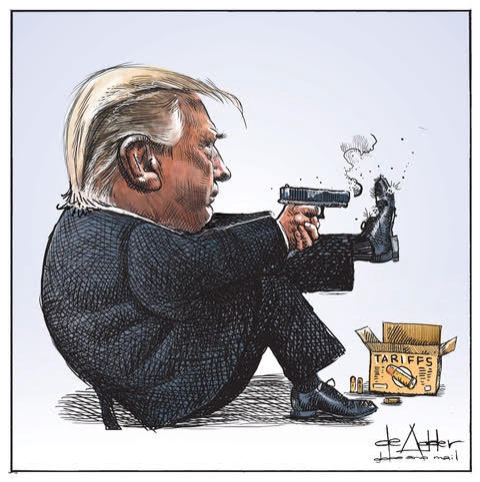
Tariffs

“Posting on his Truth Social platform, Trump said [Monday] that on the first day of his presidency he will charge Mexico and Canada a 25% tariff on all products coming into the U.S. He added in a separate social-media post that he would impose an additional 10% tariff on all products that come into the U.S. from China,… That would come on top of existing tariffs the U.S. has already imposed on Chinese goods.

“’This Tariff will remain in effect until such time as Drugs, in particular Fentanyl, and all Illegal Aliens stop this Invasion of our Country!’ Trump wrote.” WSJ: Trump pledges tariffs on Mexico Canada and China”

A tariff is a tax on an import. They are permitted by the World Trade Organization when leveed on goods receiving state subsidies in order to create a level playing field for trade. Such global trade has made an enormous contribution to the standard of living around the world.  “Ernie Tedeschi, former chief economist for President Joe Biden’s Council of Economic Advisers, said the North American tariffs would cost the typical American household almost $1,000 per year.” WP: “Trump tariffs-China Mexico Canada”

The normal expectation is that the tariff will reduce U.S. demand for the taxed import and encourage its domestic production. But the US labor force is fully employed and can only increase domestic production of the targeted goods by shifting workers from the production of goods the US has a comparative advantage in thus reducing our overall income. Though employment of manufacturing workers has declined in the US, manufacturing output has not because worker productivity has increased. In fact, our imports have not shipped American jobs overseas as increasing productivity has resulted in reduced manufacturing employment most everywhere in the world, including China, surely a good thing. WC: “Trade protection and corruption”

Immediately after Trump’s tariff announcement, the exchange rate of the dollar strengthened. A stronger dollar reduces the cost of imports (but increases the cost to foreigners of our exports), thus undoing to some extent the demand reducing impact of the tariff. But it hurts our exports because of their higher price to foreign purchaser and reduces our overall standard of living.

China and others hit with this tax are likely to retaliate with their own tariffs. “Under the United States-Mexico-Canada Agreement (USMCA), which took effect in 2020, goods moving among the three North American nations cross borders on a duty-free basis. ‘Obviously, unilaterally imposing a 25 percent tariff on all trade blows up the agreement,’ said John Veroneau, a partner at Covington & Burling in Washington.”  WP: “Trump tariffs-China Mexico Canada”

Should Trump actually impose these tariff’s he would (again) be violating the law, which only allows the President to impose tariffs without Congressional approval for national security reasons: WC: “Tariff abuse”

Trump’s threatened tariffs are not even leveed on the goods he wants to restrict (drugs and illegal aliens). Thus, unlike traditional tariffs they would be leveed to pressure Mexico and Canada to take other actions Trump wants. They are bargaining ploys. So at the cost of raising prices and lowering incomes in the US, weakening the global trading rules from which we have benefited so much, and weakening the checks and balances limiting an over extended executive branch, Trump may be playing his bargaining game again. But in my opinion the cost to us and the world trading system is too high.

Econ 101:  Money

My Ph.D. in economics from the University of Chicago dealt with a monetary policy issue. My five years as an Assistant Professor of Economics at the University of Virginia allowed me to lecture extensively about monetary policy and my 26 years at the International Monetary Fund were largely devoted to providing technical assistance to member (primarily post conflict) county central banks (including Afghanistan, Bosnia, Croatia, Egypt, Iraq Israel, Kazakhstan, Kenya, Kosovo, Kyrgyzstan, Moldova, Serbia, South Sudan, Turkey, West Bank and Gaza, and Zimbabwe). In case you didn’t know, central banks issue the currency (money) of their respective countries. So, I know a lot about “money” and like talking about it.

And it’s not that I haven’t already written a lot about the subject. For a few examples see: “Econ 101-the Value of Money”   “Money”  “A Libertarian Money”

A lot of interesting things are happening these days in the monetary area, but they pertain to payments (transferring money from one person to another via PayPal, Venmo, Zelle, Visa, etc.) rather than money itself. I want to talk to you about “money” (not payments) as I might with my granddaughter. Money is what is transferred in payment.

Money exists because none of us are self-sufficient and must trade what we produce with others who produce the other things we want. I will skip the presumably well-known story of barter trade and its challenge of the double coincidence of wants (you have what I want, and I have what you want so we trade). Giving you a commonly accepted asset, that you can hold until you want to buy something from someone else and can “pay” for it by passing that asset on to the next seller is the essence of money. In addition, it becomes the unit of account (the unit for stating prices). Thus, money is a unit of account, means of payment and store of value.

But now dear granddaughter, lets dig deeper to discuss where this money comes from and its key features in today’s modern electronic (digital) world. First of all, I can’t pay you with any old asset equal in value to your sale price (the barter problem). I must pay you with “money,” an asset universally accepted within the country. To cut to the bottom line, money is the asset issued by our central bank (any of our twelve Federal Reserve Banks) or creditable claims on the Fed’s monetary liability—the U.S. dollar. Until 1933 these dollars could be redeemed for gold at $20.67 per once. Now the U.S. government accepts them in payment of our taxes denominated in dollars, which insures their ultimate value.

Federal Reserve notes (dollar bills) are the most direct manifestation of our money. But almost 90% of our money (the asset with which we can pay for things) is in the form of deposits at American banks, and credit unions. These figures can be a bit misleading because over 60% of our currency is held abroad.

When you pay someone with cash, they receive a direct claim on the Federal Reserve. When you pay with your bank deposit, your bank’s deposit with (claim on) a Federal Reserve bank is transferred to the payee’s bank, which credits the payee’s bank account with the designated amount. The asset paid and received is still ultimately a claim on the Fed.

But our demand deposits with our banks amount to 15.9 trillion dollars, while the reserves that our banks keep with the Federal Reserve Banks amount to only $3.3 trillion reflecting our “fractional reserve” system. What is going on here? How did banks create more of our money (ultimate claims on the central bank) than it backs with its reserves at the Fed?

When teaching money and bank at the U. of Virginia I loved walking the class through the money/banking multiplier that resulted from our fractional reserve backing system. It has become fashionable for some to claim that banks create deposits (money) by making loans. When you received a mortgage loan from your bank, they say it creates the deposits placed in our deposit account. This is sort of true and sort of not true. Your bank actually pays your mortgage loan to the account of the person selling their home and their account is almost surely in another bank. That means that your bank must have sufficient reserve balances at the Fed to transfer to the seller’s bank.

I will leave the details of the bank money multiplier to the Money and Banking class you will hopefully take when you go to college, but the fact that your deposits are only partially backed with reserves at the Fed (the rest of the backing being the bank’s loans and other financial assets, is what lies behind the occasional bank runs we saw in the movies before deposit insurance was introduced to assure depositors that they could get the money back even if their bank failed. If enough bank borrowers default on their loans, the bank could become insolvent. Only the first to withdraw their deposits will be able to get their money back. The potential risk of such runs on a bank only partial backing your deposits with reserves at the central bank motivated the Chicago Plan of 100% reserve banking. “Protecting Bank Deposits”

If bank deposits of US dollars are money, what about cybercurrencies? What are they ultimately claims on? Bitcoin, as you hopefully know, is not a claim on anytime. They can’t be redeemed for anything. It is not unit of account or means of payment for hardly anything—it is not money. It is a speculative “asset” for those who like to speculate (gamble). “Cryptocurrencies-the bitcoin phenomena”  “The future of bitcoin exchanges”  “Bitcoin-Cybercurrencies and Blockchain”  “The difference between bitcoin and FTX”

But there is a class of cryptocurrencies that claim to be redeemable for money, such as US dollars—so called stable coins. The validity of this claim, as with your bank re your deposits there, depend on the details of its contract and the faithfulness of its adherence to that contract. Tether and USD Coin are the most popular US dollar stable coins.

But to use a stable coin for making payments, the person or firm you are paying must have the software or card reader needed to use the cryptocurrency you want to use. You might remember (probably not you, dear granddaughter) when not so many stores could accept visa, or MasterCard (or the Shell Oil, or Texico gas cards). Payment technology has continued to evolve and improve, but if it is not transferring money (US dollars in our case)—i.e. an asset ultimately redeemable for the Federal Reserve’s liability, it will not get you very far.

Other than handing someone cash, paying with your bank account requires a messaging and authorization system. Do you still write checks occasionally—so sorry. A check both indicates the amount to be paid and authorizes its transfer. Almost all payment instructions and authorizations are made electronically these days. Many central banks are considering introducing digital cash in place of or along side their currency notes (Central Bank Digital Currency). When offered through a bank, a CBDC would have the advantage of 100% reserve backing (it would be a direct claim on the Fed). On the other hand, modern electronic means of payment leave little room for further improvement as might be offered by CBDCs. “Econ 101-Retail Central Bank Digital Currency-CBDCs”

To make payments, or send money, abroad, your money must be exchanged for the money of the recipient. I regularly send dollars to Afghanistan, which are received as Afghani. A massive foreign exchange market in which the exchange rate of one currency for another is determined exists for that purpose. Such payments can be made more quickly and cheaply if both parties are willing to use the same currency. Thus, the US dollar is rather widely accepted for cross border payments. “The Dollar Again”  The Special Drawing Right (SDR) of the International Monetary Fund serves this purpose for governments but is not widely used. “What are SDRs?” Stable coins redeemable for gold provide another promising potential unit given golds historical importances. The best existing example is e-gold by Global Standard (to which I am an advisor).

But not all monies behave the same. The behavior of the value of each (its inflation rate) depends on how its issuing central bank manages its supply. Some central bank’s supply whatever their government needs, generally resulting in high inflation rates. Some, such as our Federal Reserve, regulate its money’s supply in an attempt to maintain an inflation target (in the US the target is 2%). Others follow currency board rules that leave to the market the determination of a supply that keeps the currency’s value consistent with that of another currency (The Euro in the case of the Bosnian dinar or the Bulgaria lev). So dear granddaughter there are many interesting things to study about money.

Why don’t you pop over and let’s discuss it more over lunch? Oh, I forgot that you are in the West Coast Washington (state) while I am near the East Coast Washington (DC). Well at least we can meet on FaceTime or Zoom (or even the old fashion telephone). But I would love to meet one way or the other.

P.S. In 2002 as Patrick Honohan and I were finishing up the Bank-Fund Financial Stability Assessment of Egypt (Patrick led the World Bank team and I led the IMF team) I said in an email “Patrick, why don’t you just come across the street and discuss this over tea?” Patrick replied: “Warren, I am in Dublin. I moved here several months ago.” He later became the Governor of the Central Bank of Ireland.

Econ 101 – Price gouging

The good news is that the Presidential campaign has moved on to the presentation of policy positions—at least on Kamila Harris’s part–Trump’s response at a Pennsylvania campaign stop over the weekend was thatshe’s gone “full communist.”

The bad news is that in addition to continuing some of Trump’s bad economic policies (tariffs, buy American protectionism, etc.) some of Harris’s economic policies are bad. Here I will take a closer look at her promise to ban “price gouging” by grocery stores.

In March of 2020 US. Broad Money (M2) growth jumped from its usual 5 to 6% per annum growth to over 25% a year later. As a result, U.S. Inflation (CPI) began to increase rapidly above its 2% target at the beginning of 2021. The Federal Reserve did not begin to tighten monetary policy until a year later when inflation had already reached 8% per annum. In addition, federal government deficit spending exploded over the same period. To fight this inflation the Fed’s policy interest rate was increased from almost zero from March 2022 to 5.3% by mid 2023 where it remains, thus ending M2 growth.

Since its disastrous late start in monetary tightening, the Fed’s management of the return of inflation to its 2% target has been as good as I could hope. Inflation has fallen below 3% without (yet) causing an economic slowdown. My guess is that the Fed is slightly behind the curve and should have started reducing it policy rate earlier this month.

So what is Harris’s ban on price gouging all about? “Perhaps Harris’s most surprising policy announcement was her plan to ban “price gouging” in grocery and food prices. While details were sparse, the measure would include authorizing the Federal Trade Commission to impose large fines on grocery stores that impose “excessive” price hikes on customers, her campaign said. Grocery prices remain a top concern for voters: Even though the rate of increase leveled off this year, grocery prices have jumped 26 percent since 2019, according to Elizabeth Pancotti, director of special initiatives at the Roosevelt Institute.” https://www.washingtonpost.com/business/2024/08/16/kamala-harris-2024-policy-child-tax-credit/

In an excellent editorial last Friday (I urge you to read it) the Washington Post asked: “‘Price gouging’ is not causing inflation. So why is the vice president promising to stamp it out?”   https://www.washingtonpost.com/opinions/2024/08/16/harris-economy-plan-gimmicks/

Stores only offer goods for sale when they can be sold for more than their cost to the story by enough to pay for their own employees, cost of their store and its maintenance and “normal” profit (return on the investment made by the store’s owners). The erratic economic events of the last few years create disruptions in these normal relationships that can produce temporary losses and/or usually large profits.

The supply and demand for a good can be matched by its price or by some other form of rationing. If a pandemic suddenly spikes the demand for facemasks, it will take a while for manufacturers to increase the supply. Until that happens demand will exceed supply.  Dr. Fauci and the government can ban sales to us common people in order to reserve the existing supply for doctors and nurses, or the market will increase the price such that only those with the most pressing need (or desire) will pay the higher price of the available supply. Rationing by prices has two big advantages. The first is that each individual (rather than government bureaucrats) determines whether their need is strong enough to pay the higher price. This makes it MUCH more likely that face masks will go to those with the highest need. Second it maximizes the market incentive to increase production and supply faster.

It the supply (relative to demand) shortage is not rationed by price, some other rationing mechanism and criteria must take its place. One is first come first served until the shelves are empty. During the wage and price freeze imposed by President Richard Nixon starting on Aug 15, 1971, gasoline was rationed by long lines of cars waiting for their turn at gas stations. It is not surprising that freely determined market prices have served us so well.

Labor Unions

To maximize a company’s market value, it must maximize its expected profits over time (its current market price reflects the discounted present value of expected future profits). To do so it must offer products or services that the public wants at prices they are prepared to pay that exceed the cost of supplying them. These products must be produced with the quality desired and as cheaply as possible. But that requires hiring workers of appropriate skills and providing them with appropriate tools (investments in equipment and other inputs) while paying them no more than is required to attract and retain them. “Appropriate” in these contexts means cost effective (best output at lowest cost).

Unions can help a firm’s management find, train, keep and manage the most appropriate workers. The general work environment is part of what attracts workers in addition to wages and related benefits. The optimal mix of the “right” capital and the “right” labor to produce market demanded products, produces the biggest pie to split between labor and shareholders (i.e., maximizes profits). So, both labor and owners share an interest in getting it right (maximizing). When unions deal with management in this positive sum, win-win frame of mind both they and shareholders benefit. But unions that see the process as zero sum and simply seek to maximize their share of the pie, reduce the size of the pie (loss-loss). American unions too often fall into this trap.

My personal experiences with American unions have not been good. I will share the experiences of my parents and myself that have influenced my views.

During the summers of my undergraduate studies at the U of California at Berkeley, I worked in the oil fields of Kern County for Shell Oil. Children of Shell employees like my dad were given preference for such jobs (typical profit maximizing behavior). A typical summer day in Kern County was dry, with temperatures ranging from 105 degrees to an occasional 112. This was more comfortable than a typical humid day of 95 degrees here in the Washington DC area. The first summer I worked in the fields north of Bakersfield, and the second summer at the ten-section refinery fields where my dad had worked in the refinery west of Bakersfield.

The full-time Shell employees I worked with, along with two other summer hires, were all pleasant and talked about their families and such things during our lunches together in the “doghouse,” as they called it. I had no idea whether they were union members or not. Digging up leaky pipes as a roustabout in such heat was a challenge.

My second year I was promoted to working on a well pulling rig. The traditional rocker-arm wells that you have surely seen in pictures are fairly shallow and push the oil up a pipe as the rocker moves up and down. The pump is attached to the bottom of this pipe and opens to let the oil in, and then closes as it pushes it up the pipe with each rock. We pulled the pipes, with their pump on the bottom end, out of existing wells for repair.

Every now and then the pump at the bottom failed to open to allow the oil to flow out as our rig pulled it up. Those were called wet wells as rather than draining out, the oil spouted out the top and rained down on the rig platform. The first time I encountered a wet well, the guys recommended that I put on a wet suit to keep the oil off me. As I recall it was 110 degrees that day and I turned down the wetsuit. However, as I become covered in oil my sweat stopped evaporating and I almost passed out. I had to sit out the rest of the day in great embarrassment.

My third summer I was paired with the full-time employee in the supply yard behind Shell’s Kern County headquarters that provided all the parts needed out in the fields. We rode around in a forklift to load needed supplies onto trucks that delivered them to the fields. My “partner” was a union member, All he could talk about was how Shell was exploiting us. I hated it and hated him and his antagonistic rather than cooperative attitude. This added to my dislike of American unions.

Many years earlier when Shell workers went on strike, my dad had to strike as well, as he had to belong to the union to work in the refinery. After a month or two, when it was clear that the strike was about to end, several union guys came to our house and threatened my pregnant mother (with my seven-year younger brother), that it would be unhealthy for her if my dad went back to work already.

Many years later, when my mother had become an elementary school teacher, she disliked the teacher’s union as having little real interest in the kids, but spent their time protecting the jobs of mediocre teachers.

It seems to me that unions are helpful or detrimental (good or bad) depending on whether they see their negotiations with their companies in positive sum or zero-sum terms. Mandatory union membership is more likely to result in the latter, detrimental relationship.

The latest on Social Security Benefits

If no changes are made to the Social Security law: “Starting in 2034… Social Security will only have enough money to pay 79% of its promised benefits.” “Day of reckoning for Social Security draws closer”  The system promises a given pension upon retirement (a defined benefit) that is financed by a given payroll tax. It is not a pool of saving that is drown down at retirement. It is pay as you go. “Saving Social Security”.

This financial problem results from the fact that Americans are living longer and thus receive their SS pension for more years if there is no change in the retirement age. Moreover, the growth in the population has slowed so that the ratio of workers (i.e. those paying the tax financing the pensions of the retired) to retirees has fallen from approximately 3.3 in 1970 to 2.9 in 2020. It is projected to fall further to 2.0 by 2030.

The system must and will change, the only question is how. Legal immigration could be increased to increase the number of workers. The wage tax could be increased. Retirement age could be increased (20% voluntarily work after retirement already). As people live longer many choose to work longer for more than just the extra income. Pension benefits could be indexed to inflation rather than to wage growth (which has been greater than inflation). But more recently I have proposed replacing Social Security and other safety net programs with a Universal Basic Income for every man, woman and child without exception. Such a remake of our social safety net would have several very good features. “Replacing Social Security with a Universal Basic Income”

Econ 101: Trade balance

Everyone understands that we are each wealthier if we buy most of what we consume from others and pay for it with what we specialize in producing ourselves. But at dinner last night one of our guests (Chatham House Rules prevent me from revealing his identity) asked how we can compete with China when their workers are so cheap? The teacher in me rises up to unpack this statement and the related issue of trade balance. It is both complicated and simple.

  1. Are Chinese goods cheaper? Chinese workers are paid in their currency (RMB) and American’s buy China’s output in our currency (USD). If an LED light bulb made in China is sold for 140 RMB is that cheap for American’s? If the exchange rate of RMB for USD is 4 RMB per USD it will cost us $35 per bulb (expensive), but if the exchange rate is 10 RMB per USD it will cost us $14 per bulb (cheap).
  2. So will we buy everything from China? What will the Chinese do with the dollars they receive from exporting to us? They might buy goods from the US (made by workers who used to make LED light bulbs). If the exchange rate is “right”, the Chinese will spend all of those export dollars on imported US products. Trade (imports and exports) will balance.  An exchange rate that makes dollars more expensive in China (RMB cheaper in the US) will decrease China’s imports from the US relative to its exports (a Chinese trade surplus). What will they do with the remaining dollars held in China?
  3. What happens with Chinese trade surplus holding of USD? The Chinese can invest them in the US (buy US Treasury securities, stocks, property, etc.). Or sell them for their own currency driving the exchange rate of RMB for USD down (or up depending on what you put in the denominator). The reduced cost in China of US goods will increase Chinese imports and the higher cost of Chinese good in the US will reduce US imports from China. The Chinese trade surplus (US trade deficit) will vanish (or adjust to the rate of capital flow desired by cross border investors). The incomes of Chinese and American workers will be higher because each will be producing the goods for which they each have a comparative advantage (the win-win of free trade).
  4. Exchange rate manipulation or production subsidies distort the outcome. EU tariffs on Chinese EVs are explicitly set at a level to compensate for Chinese government subsidies of EVs. This is allowed by WTO trade rules to put Chinese and German car manufacturers on a fair, competitive basis. The US’s much higher tariff on Chinese EVs makes no mention of complying with WTO rules (the US again does whatever it wants to the detriment of the global trading system).
  5. Trade balance between US and China is used as a simplification. What matters is the balance between each country and the rest of the world but distilling the world into two countries simplifies the discussion.
  6. Time for the dessert.

The Right to Choose

I have always supported a woman’s right to choose whether to complete a pregnancy up to the point at which another person (her fetus) acquires existence and thus the protection of the law. In my view a fetus becomes a person when viable, i.e. when they are able to live outside the womb. In my opinion, laws that permit abortions that comply with that standard, should not force those who disagree to pay for such abortions. Thus I do not support allowing the Armed services to pay for its member’s wanting an abortion for the travel and related expenses of the abortion. Tax payers should not be forced to pay for such individual choices.

A similar argument has been made about taxpayer funding of elementary education. A Jewish taxpayer should not have to pay for a catholic child’s education in a catholic school or visa versa. But I also favor school choice. How do I defend this use of taxpayer’s money? An abortion up to the allowed age of the fetus is an individual choice. But elementary education is required for all children in the public interest. Thus, it is appropriate that the government (taxpayers) pay for it. But, providing public (i.e. taxpayer’s) money for each child’s education can and should leave the choice of school to each parent. It is appropriate that schools eligible to receive public funds meet minimum standards of curriculum to be covered. School choice not only maximizes the freedom of choice among parents with different religious beliefs and views on the most effect approach to education, but the competition among schools improves the over quality of education. https://wcoats.blog/2021/05/09/the-great-divide-who-decides/

What to do about Social Security

Sixteen years ago I wrote about problems with the U.S. Social Security System. The system promises a given pension upon retirement (a defined benefit) that is financed by a given payroll tax. It is not a pool of saving that is drown down at retirement. It is pay as you go. https://wcoats.blog/2008/08/28/saving-social-security/

When Franklin Roosevelt established it, average life time after retirement was only about two years. Today life expectancy in the US is 79 years, or 14 years of retirement pension payments for those retiring at age 65. This fact, plus the declining population growth rate, means that the workers being taxed to pay for the currently retired are shrinking relative to those already retired and receiving benefits. The worker to beneficiary ratio of 3.3 in 2005 is projected to fall to 2.1 in 2040. At that point wage taxes will not be enough to cover the current benefits promised at that time.

Various proposals have been made to address this problem. The wage tax could be increased. Retirement age could be increased (20% voluntarily work after retirement already). As people live longer many choose to work longer for more than just the extra income. Pension benefits could be indexed to inflation rather than to wage growth (which has been greater than inflation). But more recently I have proposed replacing Social Security and other safety net programs with a Universal Basic Income for every man, woman and child without exception. Such a remake of our social safety net would have a number of very good features. https://wcoats.blog/2020/08/20/replacing-social-security-with-a-universal-basic-income/

Abortion

Views on abortion have always been difficult to reconcile. Under our constitution, anyone born here is a citizen and has all of the rights of all other citizens. But when does a human fetus or embryo become a person with such rights? The question can be most challenging when the rights of two people—the mother and the fetus—conflict. My own view is that a fetus obtains the status of person with the right to protection, when it is viable, i.e., capable of living when removed from the womb.

The recent ruling by the Alabama Supreme Court that an embryo is a person that must enjoy the protections of the law, moves the goal post to a whole new level. Dr. Ito Briones (MD, Ph.D) argues that, if that is true and applied into practical terms, then women will be subject to a whole new level of restrictions on their behavior in the interest of the unborn person. His interesting observations follow:

The recent ruling by the Alabama supreme court to equate the embryo as a person started when embryos frozen in tubes were accidentally destroyed in a fertility clinic. The parents sued the clinic based on Alabama’s  law of “wrongful death of a minor’s act”. The lower courts said that this law does not apply but the Alabama Supreme Court overturned that decision. And so here we are.

As a practical consequence of this ruling, IVF clinics in Alabama have expectedly suspended treatments. There are already numerous outlets online and in the news that discuss this topic and so I will not discuss this here anymore. Unfortunately, there are also other unintended consequences from this decision that might turn the mundane day to day life of a woman into a dystopian mess.

Here are other issues that may need to be considered because of this ruling. 

  1. Is a restaurant owner liable for serving alcohol to a pregnant woman even if she didn’t know she was pregnant and does not inform the establishment? Presently, restaurants and stores can be held legally liable if they serve or sell alcohol to minors. The liability is valid even if they were not aware of the age status of the patron. To solve this issue, restaurants ask for an ID to confirm age. Does this mean women should also be required to show a negative pregnancy test before being served any alcohol? 
  • Coffee has been scientifically proven to be harmful to the embryo. Do women also have to show a negative pregnancy test before being served coffee? Caffeine is the main culprit in harming embryos and caffeine is also present in tea, chocolate, soft drinks and other foodstuff. Should the government limit the sale of these items to women?
  • How about pregnant women who have breast cancer or any cancer? Can they get treatment even if it will most probably harm if not kill the embryo? 

Before this ruling, a medical case of a pregnant woman with cancer will involve an intimate discussion with the woman, her husband and family, and the doctor. Because of this ruling, the government and law enforcement will have to join the already hypersensitive and impossible dilemma that she will face.

Additionally, any medical treatment on a pregnant woman will have to be reviewed by lawyers to make sure that the embryo’s rights are taken into consideration.

Medical studies have shown that stress on pregnant women may harm the embryo. Stress can induce sleepless nights, hypertension, loss of appetite or a tendency to overeat, headaches, etc. 

Can pregnant women (at any trimester including the first) work as nurses (exposing the embryo/child to harm) or police officers? Should women in these jobs show a monthly negative pregnancy test while at work?

Driving can be very stressful for the woman. Can pregnant women drive? 

Do women have to show a negative pregnancy test while enrolled in college?

By the way, is every miscarriage going to be handled as a possible homicide?

If I have any recommendation about this ruling it is that one should invest in pregnancy test kits soon. The stock value of these tests in the market will surely skyrocket. 

Should the State mandate or advise?

It depends of course. But in America, which was established to empower each individual to make their own decisions, the state should only regulate those individual activities that might harm others such as violating property rights. This attitude presumes that each of us cares more about our wellbeing than does anyone else and know better how to achieve it taking account of our differences in tastes, interests, and risk preferences. It has resulted in a society of more prosperous and happier members.

This can be contrasted with the view that the average person is not intelligent enough or self-motivated enough to maximize their potential and needs to be guided by smarter, wiser people.

A society in which each individual enjoys the maximum freedom of choice hardly means that the government has little or no role in our wellbeing. In addition to providing public safety, shared institutional and physical infrastructure development, and the adjudication and enforcement of contracts (the rule of law), government can contribute to the provision of the knowledge to help inform the individual choices we each make. I want to review two very different areas of government involvement that have reflected the above conflicting attitudes of the government’s best role—monetary policy and public health policy.

Section 8 of the US Constitution gives the federal government the power “To coin Money, regulate the Value thereof,…” Our twelve Federal Reserve Banks and the Board of Governors of the Federal Reserve System carry out that mandate via a system of market determined prices of goods and services and an inflation target of 2%. While I would prefer a monetary policy in which currency was issued or redeemed at a fix price for a hard anchor (traditionally gold) in response to market demand (currency board rules), the Fed has behaved very well within its inflation targeting regime over the past two years (after keeping its policy interest rate too low until two years ago).

A successful inflation targeting policy requires keeping inflation expectations anchored to the target (2% in the US) so that economic wage and price decisions are made in light of that expectation. But todays’ policy actions are only fully felt over the next year or two (what Milton Friedman called “long and variable lags” in the effects of policy). Federal Reserve policy is implemented largely by setting the rate at which it supplies the money it creates to the market. If it sets that rate below the so called neutral rate, it must supply money to keep the rate low. If it sets the Fed Funds (and related) rate above the neutral rate, it must absorb money from the market to keep the rate high. Setting its policy interest rate is the lever by which it controls the rate at which the money supply grows. Each Federal Reserve President and Governor must evaluate all available information about economic activity most likely over the next one to two years and determine in like of that what monetary growth is most likely to result in 2 percent inflation over that period. If market participants believe that the Fed’s choice is most likely to result in achieving the stated target in the future, their wage and price decisions will anticipate that inflation and thus bring it about.

It should be obvious that if Fed officials are honest it attempting to achieve their target and explain as fully as they themselves understand the prospects to the public and the public has confidence in the Fed’s commitment, this is the best that can be done. In fact, the Fed deserves high marks for such transparency in our uncertain and evolving world. Each person and firm make their own forward looking decisions in light of their best guesses of future conditions. The Fed’s guidance is the best and most the Fed can do to bring or keep inflation on target.  

When governments don’t trust “the people” to make their own decisions (they are not smart enough or are two lazy or whatever), they must mandate the “proper” behavior. Consider our approach to the public’s health during the Covid pandemic. Whether government should offer advice and provide information on what is known about a disease such as Covid-19 is complicated by the fact that we should not be free to expose others to communicable diseases. In the case of Covid the government’s understanding of its nature and best protection grew and evolved over time. But the US public heath agencies lost credibility from the beginning by telling well intentioned lies.

“In early March 2020, Dr. Fauci said ‘there’s no reason to be walking around with a mask.’ In the same interview he said people could wear masks if they liked, but they wouldn’t get perfect protection, and it would further pinch what at the time was a short supply of masks for doctors and nurses.” PolitiFact | Marco Rubio says Anthony Fauci lied about masks. Fauci didn’t.

But more to my point, CDC officials thought that their shut down and isolation mandates would be more effective than allowing individuals to determine how best to protect themselves and others. The subsequent evidence suggested that they were wrong. Any benefits were outweighed by very substantial costs. Read the following articles and studies for examples.

Scott Atlas on Lies

“I explore the association between the severity of lockdown policies in the first half of 2020 and mortality rates. Using two indices from the Blavatnik Centre’s COVID-19 policy measures and comparing weekly mortality rates from 24 European countries in the first halves of 2017–2020, addressing policy endogeneity in two different ways, and taking timing into account, I find no clear association between lockdown policies and mortality development.” https://academic.oup.com/cesifo/article/67/3/318/6199605?login=false  

“The most restrictive nonpharmaceutical interventions (NPIs) for controlling the spread of COVID-19 are mandatory stay-at-home and business closures. The most restrictive nonpharmaceutical interventions (NPIs) for controlling the spread of COVID-19 are mandatory stay-at-home and business closures. Given the consequences of these policies, it is important to assess their effects. We evaluate the effects on epidemic case growth of more restrictive NPIs (mrNPIs), above and beyond those of less-restrictive NPIs (lrNPIs)….

“After subtracting the epidemic and lrNPI effects, we find no clear, significant beneficial effect of mrNPIs on case growth in any country…. While small benefits cannot be excluded, we do not find significant benefits on case growth of more restrictive NPIs. Similar reductions in case growth may be achievable with less-restrictive interventions.”  January 2021 study