My letter from the Editorial Board of the Cayman Financial Review addresses the above and other American Government over reaches in the use of U.S. dollars abroad: Financial Review, April, 2016
I hope that you enjoy it.
Warren

My letter from the Editorial Board of the Cayman Financial Review addresses the above and other American Government over reaches in the use of U.S. dollars abroad: Financial Review, April, 2016
I hope that you enjoy it.
Warren
Dear Friends,
Are you attending FreedomFest this year? It claims to be the world’s largest gathering of free minds. At this year’s gathering from July 13 – 16 at Planet Hollywood in Las Vegas I will be debating John Tamny, editor of Real Clear Politics and author of the new book, “Who Needs the Fed?” on Friday morning, July 15. In addition, I will be on a panel discussing the new documentary, “The Moneychangers” on Saturday afternoon July 16.
You can use code SALEM (all upper case) to get $100 off the registration fee. Go to “register now” at www.freedomfest.com, or call toll-free 1-855-850-3733, ext 202.
Here are some highlights:
Gary Johnson to Address FreedomFest
Now FreedomFest is pleased to announce that Gary Johnson, the former governor of New Mexico and the new presidential candidate for the Libertarian Party, will address FreedomFest at 4 pm Pacific Time, July 15, 2016, in the Celebrity Ballroom at Planet Hollywood, Las Vegas.
Johnson recently polled 10% support in two national polls. Many pundits consider him a legitimate third party candidate since Ross Perot ran for president in 1992. As David French wrote for National Review: “Good news, disgruntled Americans: As you ponder whether to vote for one of the two most-disliked, dishonest, and morally corrupt politicians ever to run for president — Donald Trump and Hillary Clinton — you just might have a third option. His name is Gary Johnson.”
Why FreedomFest?
Steve Forbes, chairman of Forbes Inc., said it best: “FreedomFest is where the best ideas and policies are flushed out. I attend all 3 days and wouldn’t miss it for the world.”
What’s FreedomFest all about? Everything! Philosophy, history, science & technology, healthy living, politics and your money, and much much more. It’s a Renaissance gathering in the entertainment capital of the world.
It’s organized by Mark and Jo Ann Skousen. Mark Skousen is a financial economist, author, and university professor who has taught at Columbia Business School and now Chapman University. Jo Ann Skousen teaches English literature at Chapman University and Mercy College, and is the director of the Anthem Film Festival.
Once a year in July all the freedom lovers of the world gather in Las Vegas for FreedomFest, what the Washington Post calls “the greatest libertarian show on earth.” Steve Forbes and John Mackey, CEO of Whole Foods Market, are co-ambassadors and attend all 3 days. Last July over 2,500 people showed up to learn, network and celebrate liberty–including Donald Trump, Senator Marco Rubio, Steve Wynn, Peter Thiel, and Glenn Beck. Steve Moore even debated Paul Krugman, the Nobel Prize economist and columnist at the New York Times. Want a summary? Watch the 5-minute video at www.freedomfest.com/videos).
Who’s coming this year? This year’s keynote speakers include Senators Rand Paul and Ben Sasse (who will debate Trump as the Republican candidate), radio hosts Larry Elder and Michael Medved, Judge Andrew Napolitano, TV host Kennedy from Fox Business, Charles Koch’s right-hand man Richard Fink, authors George Gilder and Steve Moore, and the former heavy weight champion of the world, George Foreman, and boxing promoter extraordinaire Don King.
In fact, they are holding a special reception with George Foreman, where attendees will get a chance to meet him, get an photograph taken with him, and have him sign a copy of his book, “Knockout Entrepreneur.” (He sold his grill business for $138 million.)
This year’s big debate will be “Capitalism vs. Socialism: Free to Choose or Free to Lose?” between John Mackey, co-founder and co-CEO of Whole Foods Market, and John Roemer, Yale professor at the top Marxist/socialist in the country (supporter of Senator Bernie Sanders). The debate is set for Thursday morning, July 14, in the Celebrity Ballroom, Planet Hollywood.
Other features: Watch the mock trial as we put “Global Warming on Trial” (C-SPAN coverage)…. Grover Norquist (CNN considers him “the most powerful man in Washington”) will hold his famous “Wednesday Meeting” at FreedomFest….a special session by the “Women of Liberty”….a debate on voting with actor/activist Ed Asner and political commentator John Fund….a 3-day investment conference with Peter Schiff, Alex Green, Mark Skousen, and Keith Fitz-Gerald….a debate between Dinesh D’Souza and Michael Shermer (Scientific American) on the Bible….and win $25,000 in prizes in the Pitch Tank organized by Shark Tank’s Kevin Harrington. Join all the freedom organizations and think tanks – Cato, Heritage, Reason, Students for Liberty, Americans for Prosperity, etc. They are all there in a gigantic exhibit hall, the “Trade Show for Liberty.”
Plus the ever-popular Anthem film festival, run by Jo Ann Skousen. This year one of the films will be shown by the producer of “Schindler’s List.”
Oscar Goodman, former mayor of Las Vegas, calls it an “intellectual feast” in Las Vegas – one of a kind!
FreedomFest will take place July 13-16, at Planet Hollywood, Las Vegas. For more details, go to www.freedomfest.com.
They clean up the mess beside the road that has been left there to rot. It is not a pleasant sight but who can really object to the service these birds perform. Actually, the vultures I want to defend are not the feathered ones but the even uglier, so called, bottom- feeders, who take advantage of asset fire sales.
I am trying to find words to explain the stupidity of the attack on people who swoop in to buy things when their prices are depressed, that will not be insulting to the intelligence of non economist. I think that every one understands that if the demand for something increases its price will go up (or not fall as far). A so-called fire sale is when someone, often a company facing bankruptcy, is forced to liquidate some or all of its assets in order to pay its bills. The forced sale often pushes the price of the asset below its true long run value (to the extent anyone knows what that is). Bottom feeders step in and buy when they think the price has fallen to or below that long run value. If they are right, they will make money in the long run when the price of the asset recovers. Are they doing a bad thing? If we some how could keep them out of the market, what would happen to the price of the asset being sold under duress? It would fall further, of course! If you think that these vultures are exploiting distressed sellers, you are free to offer a higher price.
The attack on Payday lenders, so called because borrowers use an upcoming paycheck as collateral, is a bit more subtle. Interest fees on these emergency loans are very high, as these risky borrowers don’t qualify for normal bank loans. According to the Washington Post “Each loan comes with steep fees. The CFPB found that payday borrowers pay a median $15 in fees for every $100 they borrow, amounting to an annual percentage rate of 391 percent on a median loan of $350.” The new Consumer Financial Protection Bureau (CFPB) has just proposed “sweeping new rules” that will limit their use. As with restrictions on vulture investors (which fortunately have not been proposed by the administration), restricting access to payday loans would force such borrowers to seek out loans with still worse terms or suffer the consequences of no loan. If you think that payday lenders are exploiting their customers, you are free to lend to them at better terms.
However, restrictions on payday loans have a big brother, paternalistic purpose. The argument is that these emergency borrowers can’t be trusted to use the money responsibly. “The agency found that about 80 percent of payday loans are rolled over into a repeat loan, causing fees to pile up for borrowers. Roughly 45 percent of payday customers take out at least four loans in a row.” http://wapo.st/1sPFODl It is appropriate to take away the freedom of choice from people judged mentally or emotionally incapable of exorcising that judgment in their own best interest. The power to do this is potentially dangerous and should only be used sparingly and with careful judicial guidelines and oversight. Dangerously our government has pushed this boundary far beyond what can be justified in a free society. Big brother has grown fat.
A further step in the direction of ever more intrusive government are the new rules issued by the Obama administration that would require investment advisors to put the interests of their clients above their own. “Trade groups representing businesses, Wall Street firms and other financial professionals joined forces to file a legal challenge against a new rule from the Obama administration that would restrict the advice brokers and advisers can offer to retirement savers…. The groups are attempting to block a rule announced by the Labor Department in April that created a higher standard for the investment advice offered to retirement savers. The new regulations require brokers selling investments for retirement accounts to put their clients’ interest ahead of their own.” http://wapo.st/1TM6gVj
Putting the interests of investors above those of their advisors is a perfectly good standard. It is what I, and most people, expect from their financial advisors. The questionable self-interest of the trade groups opposing it is obvious. It doesn’t follow that every good practice should be made a legal requirement enforced by the government, which is the direction we have been going in recent decades resulting in thousands and thousands of pages of regulations in almost every area of economic activity. Markets tend to adopt good practice on their own.
Investment advisors who give the best advice from their clients point of view (rather than investments that might pay the advisors the highest commissions) are certainly more desirable to investors. The marketing issue is how to know and insure that that is the standard followed by a particular advisor. If such a standard is written into your contract with your investment advisor—something she would surely proudly advertise—you would have the legal basis to sue if that standard were violated.
Private markets don’t have the best solutions to all problems of product quality but they do have the best solutions in an ever-changing technical world for most of them when given the chance.
Most people, and I mean almost everyone, would rather work than receive welfare. Earning your own living is an essential element of happiness and self esteem. These are the well-documented conclusions of Phil Harvey and Lisa Conyers in their new book The Human Cost of Welfare. You can watch their discussion of their book at Cato last month here: http://www.cato.org/events/human-cost-welfare-how-system-hurts-people-its-supposed-help.
Dozens of welfare programs attempt to help the poor and disadvantaged with mixed results. We would do well to replace most of these programs with a guaranteed minimum income (from which the government should deduct funds dedicated to health insurance and old age pensions of the recipients choice) as I proposed several years ago as part of a major tax reform: http://www.compasscayman.com/cfr/2009/07/07/US-federal-tax-policy/
Some of these programs discourage work by imposing financial costs for working as the result of reduced income from lost benefits. These welfare design flaws should be fixed (as the proposed guaranteed minimum income would), but governments have also thrown up many other barriers to getting jobs in the form of regulatory requirements and restrictions. Unnecessary or overly burdensome licensing requirements for many jobs protect incumbents and discourage job seekers.
According to the Washington Post: “Last year, a White House report documented the startling fact that 1 in 4 U.S. workers need a license to do their jobs, a fivefold increase since the 1950s.”
One of thousands of examples is the “license to blow” in Maryland. The state of Maryland has just bravely reduced the amount of training required for a license to wash and dry hair from 1,200 hours to 350 hours. “The new Maryland bill creates a “limited” cosmetology license for workers in blowout salons; it can be obtained after 350 hours of training. Previously, you had to be licensed as a stylist or cosmetologist, which require 1,200 and 1,500 hours of training, respectively” Washington Post May 18, 2016 https://www.washingtonpost.com/opinions/maryland-blows-away-a-hurdle-for-workers/2016/05/17/fc61cb36-1c50-11e6-9c81-4be1c14fb8c8_story.html
Most people want to work and we should make it easier for them to do so.
It is in our natures to serve our personal interests first and those of others second. The interests of others include not only those around us in need but also our children and future generations in general, which are served by far sighted policies that might entail short-run and immediate sacrifices. Communities and societies that have instilled in each generation the values that promote and serve such longer-run interests will flourish relative to those with more narrowly “selfish” values.
Adam Smith famously explained in The Wealth of Nations how an individual’s pursuit of his personal gain benefits society at large. In the marketplace the fruits of our labors enjoy the greatest profit the better they meet the desires and needs of our customers at the lowest possible cost. While we might like to cut corners and raise our prices if we could get away with it, competition in the market prevents us from doing so.
Free trade and the international agreements that promote it is an example of the trade off between personal and community or national interests that I am raising. The Trans-Pacific Partnership (TPP) and the Transatlantic Trade and Investment Partnership (TTIP) will further extend the freedom to trade among the countries signing up to them while raising the standards for working conditions, intellectual property protection, and conflict resolution.
I began an article on free trade written a year and a half ago with: “World per capita income didn’t change much from the time of Christ to the founding of the United States ($444 to $650 in 1990 dollars), a period of 1,790 years. But in the following 320 years it jumped to $8,080. And about half of that jump came over the last 50 years. What explains this fairly recent explosion of well being? Many things, of course, but central to this explosion of wealth was trade.” free-markets-uber-alles As the most disheartening and distressing U.S. presidential campaign in my lifetime has made clear, the huge gains from freer trade as with the huge gains from technical advances have not been evenly shared thus highlighting the trade off between personal and community interests I am exploring.
We have long accepted that economic progress should not be stopped because it would make a particular set of skills or tools less valuable. When someone developed cheaper and better ways of providing us with music than the old 78 inch vinyl record—itself an amazing technological feat in its time—those producing the old records were forced to learn new skills. We should debate whether society (family, church, community governments, etc.) should help those adversely affected by technological progress and how best to do it, but few would want to prevent such progress from which almost everyone in the world has eventually benefited enormously.
Government, which represents an exercise of our collective will, is meant in part to give primacy to our concerns for the interests of others and/or the long run over our individual, immediate personal well being. The American constitution was all about trying to do that without the government becoming captive of the self-interest of those running it. Our natures, whether we operate as private individuals constrained by the market place or as public officials constrained by the law and a broadly agreed public purpose, remain a mix of self-interest and public interest. The fundamental difference between our behavior as private citizens or public servants is in the external constraints that impact our behavior. Our natures otherwise remain the same.
The power of government can be exploited to thwart the discipline of competitive markets on the dominance of self-interest over the common interest. Preventing government from being captured by the self-interest of those running it or those who seek special privileges from it is no easy task. To that end our constitution strictly limited what government could do (the enumerated powers) and encumbered it with checks and balances. The dangers of such capture posed by the military industrial complex of which President Eisenhower warned, is well known and real (e.g. $400 billion F-35 Joint Strike Fighter that few believe we need), but the same is true of most other intrusions of government into private affairs, such as all of our many wars (on drugs, terror, poverty, etc.) as well.
Sadly our government has expanded well beyond its necessary functions into every nook and cranny of our personal lives with increasingly pernicious and alarming results. The abuses of its ever-expanding powers for personal and partisan benefits are exemplified by the scandal of asset forfeiture,the-abuse-of-civil-forfeiture/, which alarmingly continues, the long and bipartisan history of political abuse of the IRS, irs-tea-party-political, and most recently the legal attack on companies questioning the climate change forecasts of the Intergovernmental Panel on Climate Change (IPCC) by the AGs United for Clean Power using the Racketeer Influenced and Corrupt Organizations (RICO) Act in an effort to silence criticisms of UN climate studies. prosecuting-climate-chaos-skeptics-with-rico. Such a blatant government attack on free speech is truly shocking. These are but a few examples of growing government tyranny and corruption.
The most effective defenses against such corruption are to limit the scope of government as much as possible (i.e. subject individual actions to the discipline of the market as much as possible) and to strengthen public insistence on adherence to the rule of generally applicable law. As trade has moved beyond the village and nation, so must the rule of law.
Following World War II the United States led the establishment of international arrangements and laws governing trade (WTO) and financial (IMF and WB) and diplomatic (UN, NATO) relations among nations. The U.S. was the natural leader of this globalized world not only because it had the largest economy and the largest military, but because it was generally respected for its commitment to the rule of law. More than any other country the U.S. was seen as committed to the longer run prosperity of the world above short run tactical benefits for itself.
In an April 12, 2016 interview by Steve Clemons in The Atlantic, U.S. Treasury Secretary Jacob Lew observed that “In the 21st century, the world needs the United States to be a North Star. The world wants us to be the North Star. I really do believe that. I am amazed at how other countries want to hear our advice and what we think makes sense. Sometimes we may have the habit of lecturing too much. We have to be careful not to do that.”
In recent years American leadership has been slipping. Rather than draw China more tightly into the global rule based trading system, we have pushed them away. After the United States convinced the IMF’s European members to accept a reduction in their share of votes in the IMF in order to bring the voting shares of China, India, and some other emerging economies more in line with their economic size, it took the U.S. Congress more than five years before it approved the amendments to the IMF Articles of Agreement needed to implement this agreement. In the mean time China set up its own international lending organization. US-leadership-and-the-Asian-Infrastructure-Investment-Bank
Rather than strengthen cooperative, diplomacy based relationships the U.S. has launched a series of generally failed wars to promote “democracy,” (Gulf War 1990-91, Somalia 1992-5, Haiti 1994-5, Bosnia 1994-5, Kosovo 1998-99, Afghanistan 2001 – to date, Iraq 2003-11, Libya 2011). These have weakened respect for American leadership.
On the economic front the United States has imposed hugely costly anti-money laundering (AML) and global tax reporting (FACTA) requirements on the rest of the world without regard for their cost and despite the lack of any evidence of benefits. Operation Choke Point These are serious abuses of American leadership that will produce a growing backlash. But it is not just misguided arrogance that is undermining our role in the world, it is the growing perception that our leadership is increasingly motivated by the selfish personal interests of crony capitalists rather than the high principles that have serviced us and world so well in the past.
Consider the example of the FATCA (Foreign Account Tax Compliance Act). Badly designed corporate and income tax laws in the United States have pushed an increasing number of companies and wealthy people out of the U.S. Rather than clean up its tax laws, the U.S. attempts to tax the income of Americans where ever they earn it and where ever they might live. The only escape is to renounce U.S. citizenship. The Obama administration is now proposing an exit wealth tax for American’s giving up their citizenship. It reminds me of the measures the Soviet Union took to prevent its citizens from leaving. Have we really fallen so low?
The use of off shore, tax minimizing structures by American companies and individuals (i.e. legal tax planning measures) as well as illegal efforts to hide income have been met by increasingly intrusive efforts by the U.S. to find and tax such income. Quoting from the introduction of the Wikipedia article on FATCA: “The Foreign Account Tax Compliance Act (FATCA) is a 2010 United States federal law to enforce the requirement for United States persons including those living outside the U.S. to file yearly reports on their non-U.S. financial accounts to the Financial Crimes Enforcement Network (FINCEN). It requires all non-U.S. (foreign) financial institutions (FFI’s) to search their records for indicia indicating U.S. person-status and to report the assets and identities of such persons to the U.S. Department of the Treasury.”
As the world attempts to comply with American extra territorial demands, the United States itself is not. Such reporting requires knowledge of the beneficial owners of companies. Most companies established in the United States, such as those incorporated in Delaware, are not required to provide the identities of beneficial owners. The U.S. seems to have no intention of requiring its companies to comply with what it demands from other countries.
The decline and fall of the “American Empire” seems to be underway. It doesn’t need to be.
A recent dinner companion inquired whether an economy that was not growing was necessarily a problem. What she had in mind was whether people choosing more leisure to enjoy their incomes rather than continuing to work the same or longer hours created an economic problem. The short answer is no. I will explore that issue further and then make a point about the propriety of governments making work/leisure choices for us rather than leaving the choice to us.
Our incomes grow when we work longer hours, acquire improved skills, work with more tools, or work with better tools. The economy as a whole grows without individual incomes necessarily increasing when more people work (i.e., when the population grows). Unless you are very pessimistic about the prospects for continued innovation and technical improvements in each worker’s productivity, our incomes will continue to increase even if we don’t work longer hours.
Over the last 65 years the average annual hours worked by employed Americans dropped from 1,910 to 1,710 while real disposable personal income per capita (in 2009 dollars) increased from $10,000 to over $38,000. Over the longer period of a century or two the drop in hours worked and the increase in per capital income have been much more dramatic. This dramatic increase in income reflects better skills, more capital (tools) and better capital. But it is less than in would have been if people had not chosen to enjoy that income by working less and playing more. The over all economy can adjust to any of these – growing, stagnate, or shrinking income.
While Bernie Sanders may think that the best way to increase the standard of living for the poor is to redistribute to them some of the high income of the wealthy, most everyone else would agree that only economic growth has and can continue to lift large numbers of the poor out of poverty. Global poverty (per capita income below $1.25 per day) dropped from 50% in 1980 to 20% in 2011, an astonishing achievement totally beyond what any amount of redistribution could have accomplished. Most of us think that the proper purpose of redistributing income is for the better off to finance a safety net floor for those unable to work. This dramatic increase in income was the result of improvements in worker productivity (i.e., better skills and more and better capital) not working longer hours.
But what about the choices workers have made and are making about the hours they work vs. the hours they play with the proceeds of that work once they are well above poverty? Over time as most people’s incomes have grown they have generally reduced the long hours worked six or more days a week. Employers and workers strike deals that maximize the profits of the firm and the happiness and well-being of employees. Why then do many governments feel that they need to legislate the matter? Why, for example, did French Socialists feel compelled to legislate a 35-hour workweek a few years ago?
In limited cases, a public safety argument might make sense to over ride the preferences of workers and their employers, for example, if truck drivers felt included to push themselves more hours than they could safely stay awake at the wheel. Mr. Hollande’s French government is now proposing to remove the 35-hour limit and relax other labor market restrictions. I hope they succeed, as leaving more of such decisions with the people themselves will result in happier workers and a more productive economy.
This issue came up a few years ago in connection with the Greek financial crisis. Here are two of my blogs written three years apart on the situation in Greece: https://wcoats.wordpress.com/2012/02/26/saving-greece-austerity-andor-growth/, https://wcoats.wordpress.com/2015/02/08/greece-debt-and-parenting/ To over generalize, it is often the case that people living in temperate climates (such as Greece and the Southern cone of the EU) work less and have lower incomes. If they are freely choosing to enjoy more leisure in the lovely climate in which they live, they are no doubt happier and better off because of it. Greece’s problem was not that its many Zorba’s had a great zest for life and played more than they worked. Its problem was that after getting away with playing on other peoples’ work/money, they thought they should be entitled to continue doing so. The balancing of work and leisure that is optimal is a person-by-person decision. The economy will be fine and will adjust to whatever these preferences are. People at different income levels and/or different preferences within the same economy will likely make different choices. There is no justification for the government to impose its notion of what is optimal uniformly on everyone. This is just another example of government over stepping its proper role.
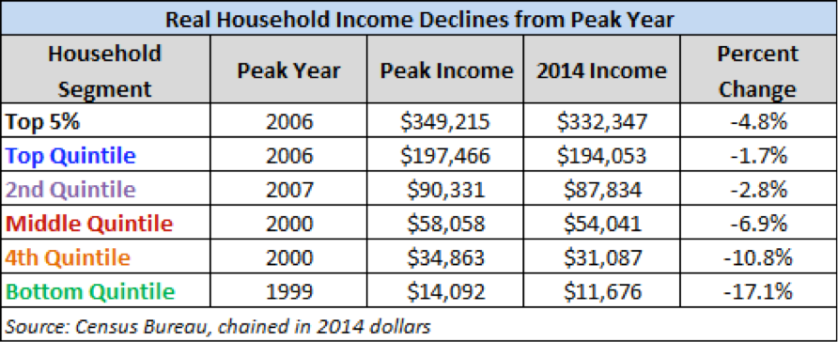
After many decades of impressive and relatively steady increases in the standard of living (increases in real per capital income) of all quintiles of the American income distribution, since 2000 all quintiles have lost ground. In the run up to 2000 incomes in the top quintile increased more rapidly than those in the lower quintiles resulting in a less equal distribution income.
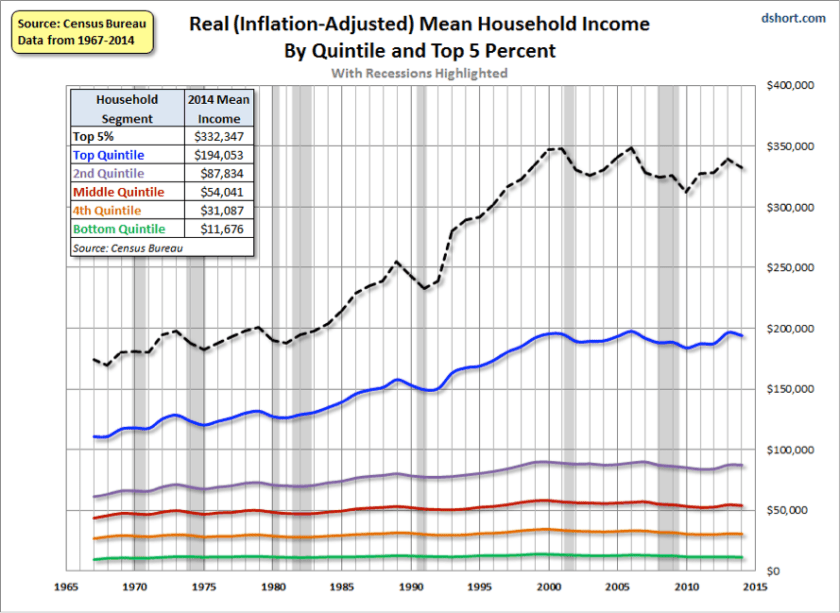
The mean real incomes of each quintile are lower now (2014) than they were in 2000. However, the percentage decline has been larger for the middle and lower income quintiles (see table below) leaving the more unequal income distribution in place. Some of the relative gains of the top quintile are attributed to the growing premium for higher education, but as claimed by the Occupy Wall Street demonstrators, some have not been earned by providing higher valued products.
Most of us do not resent and in fact are grateful for those whose wealth resulted from inventing and giving us products we greatly enjoy. However, we are rightly angry at both political parties for increasingly supporting crony capitalists—those who benefit from their connection with and influence on the government—who benefit at the expense of the rest of us. They are capturing economic rents at the expense of the rest of us rather than enjoying the fruits of greater productivity.
The broad political consensus in the United States that we are each entitled to the wealth we each create, but must fairly share in the cost of providing our national defense, public goods and a satisfactory safety net for the poor, seems to be falling apart. In the economic sphere, the left increasingly favors one group, the working class represented by labor unions, against the professional and entrepreneurial classes. Classical liberals (i.e., economic conservatives) champion fairness – a level playing field – and the freedom to get rich if you work harder, or create a better product, or a more efficient way of producing what people want. They champion measures that facilitate entrepreneurship and economic growth without much regard for its impact on income distribution. Trade – globalization – is an essential part of promoting economic efficiency and thus growth, allowing, if not forcing, firms to shift resources into goods for export in which they are relatively more efficient in order to pay for the cheaper imports enjoyed by the average middle class consumer.
The Republican Party more so than the Democratic Party, though not by much, has increasingly been failing to preserve a level playing field in various areas (Wall Street, defense industry etc.). But the embrace of protectionism offered by Donald Trump reflects either class warfare or ignorance of globalization’s enormous contribution to our standard of living. The big trade and industrial unions of old—think of the United Auto Workers in Detroit—followed a different drummer. They were not interested in fairness but rather fought to bring economic rents (monopoly returns) to themselves at the expense of other workers via a deal with their employers to create, defend, and share monopoly returns. This worked with the auto industry, where auto workers earned at least double the prevailing wages for nonunion workers with comparable skills as long as GM, Ford and Chrysler could hold off competition from German and Japanese (plus a growing list) auto producers via a combination of tariffs and safety standards. Globalization gradually destroyed this monopoly arrangement and almost killed the American automobile industry until U.S. automakers relocated to southern, non-union states.
While good working conditions are win win for workers and employers, pushing up wages above their competitive level either drives firms to other locations (non union states or abroad) or kills them all together. Voters supporting protectionist policies either don’t understand that they lower the standard of living for most people (here and abroad) by lowering the overall productivity of workers or they seek to exploit monopoly rents for themselves at the expense of other workers.
Such thinking was dramatically illustrated by the recent strike of workers at Tesla Motor’s giga battery factory project in Nevada. As reported in the Washington Post on March 2: “On Monday, hundreds of workers walked off their jobs at the giant battery factory that Tesla Motors is building in the desert outside Reno, Nevada. It wasn’t your typical picket: They weren’t protesting bad working conditions, or making a show of force around contract negotiations. Rather, they were protesting other workers — specifically, the fact that they were from somewhere else.” Their complaint was that workers from out side Nevada were willing to work for less than the $35 per hour that members of the local union were making. These were not “foreign” workers from South of the border. These were workers from Arizona and New Mexico. The out of state workers obviously found their “low” wages with Tesla in Nevada better than the wages they would receive staying at home so they were better off coming to Reno.
The Post further reported: “That dispute explains an important debate underway right now in all sorts of skilled trades: Builders say there’s a labor supply problem, which needs to be fixed by bringing more people into the field from across the country and across the border. Worker groups say there isn’t a supply problem — it’s just that builders aren’t paying enough to make the jobs worth someone’s while.”
Trump’s pledge to protect America workers from cheap Chinese and other imports so they can produce them in the U.S. at a higher cost, is bad economics and bad policy. He is pledging to benefit one group of workers at the expense of other workers and at the expense of the standard of living more generally. This is not what the Republican Party has stood for in the past and not what it should stand for now. It should stand for fairness and equal opportunity for workers and entrepreneurs to benefit from doing things better and thereby raising their incomes and the income of the nation. The principle of fairness is widely held in the United States but has always had to battle for dominance against the temptation of the zero sum claims of special interests for government to serve their interests at the expense of others and at the expense of fairness. Donald Trump and Bernie Sanders are appealing to special rather than general interests at the expense of fairness.
It is possible to fix the bankrupt Social Security System and the Federal Reserve’s failure to achieve its inflation target painlessly. Yes, really.
The Fed has failed to raise inflation to its 2% target because over regulated banks can’t find over regulated firms wanting to borrow and invest. As a result, the increases in the Fed’s base money from its Quantitative Easing and other efforts to stimulate the economy has piled up as bank excess reserve deposits at the Federal Reserve Banks.[1] If the Fed pushes too hard (e.g., by lowering the interest it pays on these bank reserves, potentially even to negative levels) it feeds asset price bubbles (stock and housing prices), which do great damage when they burst.[2] If the Fed just printed more money and sprinkled it around to the general public—what Milton Friedman called helicopter money—there is no doubt that the public would spend more and drive up prices.
Leaving aside whether it is really a good idea to create a steady 2% rate of inflation, there is an easy way of doing it that would also facilitate badly needed reform of the government’s retirement system. Contrary to the myth that our Social Security pensions reflect what we paid in (saved) to the system, Social Security pension payments are now fully pay as you go. This means that the revenue from payroll taxes approximately matches the outflow for current pensions, i.e. nothing is being saved for the future. As our population continues to age and the number of retired pensioners increases relative to the shrinking number of workers paying into the system, the modest amounts that have been accumulated in the Social Security “Trust Fund” will be drawn down to zero in about 15 years at which time the government will not be able to meet existing promises.[3]
The following proposal combines helicopter money sufficient to bring the inflation rate to its target with badly needed reform of our government pension system. Under this proposal all individuals will receive a minimum government guaranteed pension for life whether they paid in anything or not. This might be implemented as part of a Friedman like negative income tax and other badly needed tax reforms,[4] or stand alone. Before retirement, individuals who are working but with incomes below the poverty level (to be politically established) will not pay a wage tax as they do now. The subsequent pensions of such people will be paid with helicopter money (the Federal Reserve will print the money to buy government bonds sufficient to finance these expenditures). All workers with incomes above the poverty level will be required (as they are now) to set aside the amount of income needed to finance their minimum guaranteed pension on a fully funded basis. They are free to save more if they would like a higher pension. The funds set aside must be invested in government licensed and approved private pension funds chosen by each worker rather than in the almost fictitious Social Security Trust Fund.
This would establish the three pillars of good pension policy proposed by the World Bank in 1998: a means tested minimum pension financed by the government’s general revenue, a mandatory minimum pension paid for and privately invested by all working individuals, and additional, optional, supplemental retirement saving privately invested. Such a model was first adopted in Chile over 35 years ago with great success. Central and Eastern European countries have adopted similar models as part of their transition from centrally planned to market based economies. Financing income subsidies to the poor from general revenues (via printing money), and a user fee approach to mandatory saving (mandatory saving matched to the actuarial value of the pension received), conforms more closely to the principles of good tax policy.[5] The alternative sometimes proposed of raising the income cap on the payroll tax is closer to general revenue financing (if the government guaranteed minimum is only paid to the poor), but leaves out non-wage income and thus fails the good tax criteria.
As new workers would be truly saving for retirement, their savings would not be available to finance those currently retired, as is now the case with our pay as you go system. Thus transitional arrangements will be needed (for several decades) to deal with existing unfunded promises. If the promises remain unchanged, the money to pay for them will have to come from somewhere (higher taxes or reduced defense or other expenditures). Usually, in such cases the government spreads the burden around (burden sharing). Two simple and sensible changes to the current promises would absorb the greater part of the shortfall. The first is to adjust the pensionable retirement age to the fact that the average person lives much longer than when the current retirement ages were fixed. People are living longer and can (and most would like to and do) work longer. The other is to change the index to people’s pensions from a wage index (which generally increases pensions in real terms over time) to the cost of living (CPI), which would preserve their real value against any inflation over time.
For today, this means that the wage tax on the poor would be abolished and paid for with new Fed money that would thus be put in the hands of those who would spend it, increasing employment (though we are really at full employment now) and/or wages and prices. It would both raise inflation a bit and launch a genuine, long over due pension reform.
[1] “US Monetary Policy–QE3” Cayman Financial Review, January 2013
[2] “The D E Fs of the Financial Markets Crisis” CATO Institute, September 26, 2008.
[3] https://wcoats.wordpress.com/2008/08/28/saving-social-security/
[4] http://www.compasscayman.com/cfr/2009/07/07/US-federal-tax-policy/
[5] http://www.compasscayman.com/cfr/2013/07/12/The-principles-of-tax-reform/
By Warren Coats and Dongsheng Di
Jin Liqun, President of the new Asian Infrastructure Investment Bank (AIIB) announced on January 17, 2016 that all of its loans would be in U.S. dollars, “signaling that Beijing will not use the development bank as a platform to promote renminbi internationalization.”[1] In this note we argue that the AIIB should make all of its loans in SDRs. Doing so would make a major contribution to promoting the replacement/supplementation of the U.S. dollar for international payments that was called for by People’s Bank of China’s Governor, Zhou Xiaochuan in 2009.[2] As the SDR valuation basket will include the Chinese renminbi after October 1, 2016[3] it will also contribute, but more modestly, to the international use of the renmimbi.[4]
As the AIIB is a Chinese initiative and is headquartered in China, it was initially thought by some that its operations would be denominated in RMB. However, denominating its loans in RMB and actually disbursing RMB would suffer several disadvantages for the AIIB and for its loan recipients. There was concern by some that the use of the RMB might further strain the already complicated US-China bilateral relationship. In might also force the pace of China’s financial and capital account liberalization faster than other conditions warrant. Moreover, with greater exchange rate volatility of late, loan recipients would be exposed to greater exchange rate risk. The AIIB’s choice of the U.S. dollar avoids these risks but continues to subject its borrows to exchange risks associate with the dollar, which has varied considerably over the years. For these reasons the IMF, for example, denominates its loans and other financial operations in its Special Drawing Right (SDR), whose value is based on the market value of specific amounts of the five freely useable currencies in its valuation basket.[5] Thus for most countries, the international value of the SDR is more stabile than is the value of the dollar or another of the other currencies in its valuation basket. This logic applies fully to the operations of the AIIB and other development banks. The case for creating “private” SDRs to disburse to AIIB loan recipients rests on the contribution it would make toward developing the SDR issued by the IMF into a global reserve asset to supplement or replace the U.S. dollar, Euro and other national currencies in countries foreign exchange reserves.
The development and use of private SDRs, SDR denominated bank liabilities, is described in detail in an article one of us wrote over thirty four years ago in the IMF Staff Papers.[6] The AIIB would establish SDR denominated deposits with its bank (e.g., the BIS) and instruct its loan recipients to establish SDR accounts with their banks. AIIB loans would be disbursed by transferring the appropriate amounts of its SDR balances at the BIS to the recipients’ account at its banks. The dollar value of these SDRs would be determined in the same way as is the IMF’s official SDR. Following the procedures used by the IMF when disbursing its SDR denominated loans, recipients could request to receive their loans in the equivalent value of a freely usable currency of their choice (or in any or all of the five currencies in the valuation basket). In the first instance, AIIB loan recipients are likely to be governments with accounts in their central banks. Thus these central banks would need, in addition to their SDR accounts with the IMF, to establish (private) SDR accounts for their governments and commercial banks. If the loan recipient is able to spend these SDRs (pay its contractors and suppliers) directly it would do so, but most often it would need to exchange them for the currency wanted the ultimate recipients. This exchange would most likely be executed by its bank providing the SDR deposit.
Cross border private SDRs payments would be cleared and settled in the same general way as are U.S. dollar payments. Net outflows of SDRs from the banks of one country via their central bank to another country via its central bank, would be settled by the transfer of official SDRs on the books of the SDR Department of the IMF. Alternative clearinghouse arrangements are also possible has suggested by Peter Kennan in his comments on the 1982 IMF Staff Papers article. When such loans are repaid, if the repaying government (or other loan recipient) doesn’t have sufficient balances in its private SDR account with its central bank to transfer to the AIIB’s account with the BIS it would use other currencies to buy additional private SDRs. It might also use its official IMF allocated SDRs to either buy private ones or to transfer directly to the AIIB (assuming that like most other development banks and the BIS it has become an “other holder” of official SDRs). Private and official SDRs would have essentially the same relationship with each other as do base money and bank money in national currencies.
China and the AIIB are in a strong position, working through the IMF or bilateral discussions, to urge central banks to open private SDR accounts for their governments and their commercial banks toward the fulfillment of their obligation under the IMF’s Articles of Agreement to make the SDR “the principal reserve asset in the international monetary system” (IMF Article XXII). Through their representatives at the World Bank, Asian Development Bank, and their New BRICS Development Bank they could press these institutions to disburse in SDRs (private and/or official) as well. As an important purchaser of oil and other globally traded commodities they could encourage their pricing in SDRs. In the first instance, many loan recipients would choose to convert their SDRs into one or more of its basket currencies. But as private SDRs and supporting clearing and settlement arrangements proliferated, holding and using SDRs for international transactions would become more convenient and would potentially grow rapidly. This is an opportunity that should not be missed.
References
Coats, Warren, 1982 “The SDR as a Means of Payment,” IMF Staff Papers, Vol. 29, No. 3 (September 1982) (reprinted in Spanish in Centro de Estudios Monetarios Latinoamericanos Boletin, Vol. XXIX, Numero 4, Julio–Agosto de 1983).
1983, “The SDR as a Means of Payment, Response to Colin, van den Boogaerde, and Kennen,” IMF Staff Papers, Vol. 30, No. 3 (September 1983).
2009, “Time for a New Global Currency?” New Global Studies: Vol. 3: Issue.1, Article 5. (2009).
2011, “Real SDR Currency Board”, Central Banking Journal XXII.2 (2011), also available at http://works.bepress.com/warren_coats/25
2014, “Implementing a Real SDR Currency Board”
_____. Dongsheng Di, and Yuxaun Zhao, 2016, Why the World needs a Reserve Asset with a Hard Anchor, http://works.bepress.com/warren_coats/34/
Footnotes
Dr. Warren Coats retired from the International Monetary Fund in 2003 where he led technical assistance missions to more than twenty countries (including Afghanistan, Bosnia, Egypt, Iraq, Kenya, Serbia, Turkey, and Zimbabwe). He was Chief of the SDR Division of the Finance Department from 1982-88. His PhD from the University of Chicago was supervised by Milton Friedman. He was part of the IMF’s program team for Afghanistan from 2010-2013 and is a U.S. citizen. Wcoats@aol.com
Dr. Dongsheng DI is an associate professor of International Political Economy with School of International Studies, Renmin University of China and also a Research fellow with International Monetary Institute of RUC. In 2015 he is a visiting researcher at Edmund A. Walsh School of Foreign Service of Georgetown University. His research interests include the political economy of global monetary affairs, RMB internationalization, and Chinese Domestic Reforms. He is also a policy advisor to NDRC and China Development Bank and is a citizen of the People’s Republic of China. didongsheng@vip.sina.com
[1] China’s New Asia Development Bank will lend in US dollars, Financial Times Jan 17, 2016 http://www.ft.com/intl/cms/s/0/762ce968-bcee-11e5-a8c6-deeeb63d6d4b.html#axzz3xWiTvQZD
[2] Zhou Xiaochuan, “Reform the International Monetary System”, Website of the People’s Bank of China, March 23, 2009;
[3] The amount of the China currency in the SDR valuation basket will be determined on September 30, 2016 such that its weight in the basket on that day is 10.92% of the total value of one SDR.
[4] Banks offering SDR denominated deposits will generally balance them with SDR denominated assets or assets in the five currencies in the SDR’s valuation basket similarly weighted.
[5] The RMB will be added to the existing basket of four currencies—USD, Euro, GBP, JPY—from October 1, 2016.
[6] Warren Coats, “The SDR as a Means of Payment,” IMF Staff Papers, Vol. 29, No. 3 (September 1982); “The SDR as a Means of Payment, Response to Colin, van den Boogaerde, and Kennen,” IMF Staff Papers, Vol. 30, No. 3 (September 1983).
By his own admission President Obama’s rejection of the Keystone XL pipeline project is political rather than scientific.
Two environmental concerns have been raised. The first is that the emissions of greenhouse gases are about 17% higher for oil from oil sands compared to conventional sources. However, the rejection of the pipeline proposal will not materially change the production and consumption of Canada’s oil shale crude, which will now be transported to market by more expensive means. “Rail transport has expanded to carry oil sands to the United States, soaring from just 16,000 barrels in 2010 to 51.2 million barrels in 2014 before dropping somewhat this year. But rail transport is more expensive than pipeline transport…. Royal Dutch Shell’s chief executive, Ben van Beurden, said last year that the company had bid for space on another pipeline to move its oil-sands crude to Canada’s east coast and from there to world markets, including Gulf Coast refiners. ‘We’re covered. I’m good,’ he said in an interview. He said that ‘the argument that Keystone is a bad idea because it will somehow enable development of resources in Canada is to some extent flawed,’ adding that other alternatives would emerge.” (This and other quotes are from today’s Washington Post in the article linked below)
The second environmental concern arises from the possibility of oil spills from breaks in the pipeline. This possibility needs to be compared with the possibility of spills from rail accidents or breaks in alternative pipelines.
Because the pipeline would cross international boundaries it must be approved by the State Department. As the application was being reviewed, then Secretary of State Hillary Clinton stated on October 15, 2010 that the department was “inclined” to approve project. “We’re either going to be dependent on dirty oil from the Gulf or dirty oil from Canada,” she said. On August 26, 2011 the State Department issued its final environmental impact statement determining “there would be no significant impacts to most resources along the proposed project corridor.” And again on March 1, 2013 the State Department issued another environmental review that raised no major objections to the Keystone XL oil pipeline saying that other options to get the oil from Canada to Gulf Coast refineries were worse for climate change.
Canada’s new liberal Prime Minister, Justin Trudeau, supported the project. “TransCanada’s president and chief executive, Russ Girling, issued a statement saying his company was ‘disappointed. Today, misplaced symbolism was chosen over merit and science — rhetoric won out over reason,’ Girling said…. Terry O’Sullivan, general president of the Laborers’ International Union of North America, said Friday that ‘Obama has also solidified a legacy as a pompous, pandering job killer.’” (same Post article).
“As Obama rode from the White House to the campus [Georgetown on June 25, 2013, he], said he would approve Keystone XL only ‘if it does not significantly exacerbate the climate problem.’” But his own State Department found that it does not. So what is going on?
“By late 2013, Obama and Kerry had concluded that the pipeline failed their climate test — not because blocking it would guarantee that Canada’s fossil fuels would remain in the ground, but because denying the permit would strengthen America’s position in international climate negotiations…. ‘The reality is that this decision could not be made solely on the numbers — jobs that would be created, dirty fuel that would be transported here, or carbon pollution that would ultimately be unleashed,’ Kerry said in a statement. ‘The United States cannot ask other nations to make tough choices to address climate change if we are unwilling to make them ourselves.’”
In short the President lied (not an uncommon practice among politicians, but we might hope for a higher standard from American Presidents). But apparently not. The Obama administration has authorized the selling of coal owned by the U.S. government that would not meet our C02 emission standards to third world countries, which helps our emission record but not the world’s. https://www.washingtonpost.com/world/us-exports-its-greenhouse-gas-emissions–as-coal-profitable-coal/2015/10/08/05711c92-65fc-11e5-bdb6-6861f4521205_story.html
“The Washington Post’s editorial on the pipeline today began: “President Obama rejected the Keystone XL oil pipeline on Friday, ending an unseemly political dispute marked by activist hysteria, GOP hyperbole, presidential weakness and a general incapability of various sides to see the policy question for what it was: a mundane infrastructure approval that didn’t pose a high threat to the environment but also didn’t promise much economic development. The politicization of this regulatory decision, and the consequent warping of the issue to the point that it was described in existential terms, was a national embarrassment, reflecting poorly on the United States’ capability to treat parties equitably under law and regulation.”

