Taxing the Wealthy

The administration has “backed a tax plan that analysts say would greatly benefit the wealthy.” I want to unpack that and take a closer look at what it might mean.

“The Trump tax plan drops the top bracket from 39.6 to 35 percent, and allows for the possibility of a 25 percent top rate through a pass-through entity.” The Washington Post Fact Checker

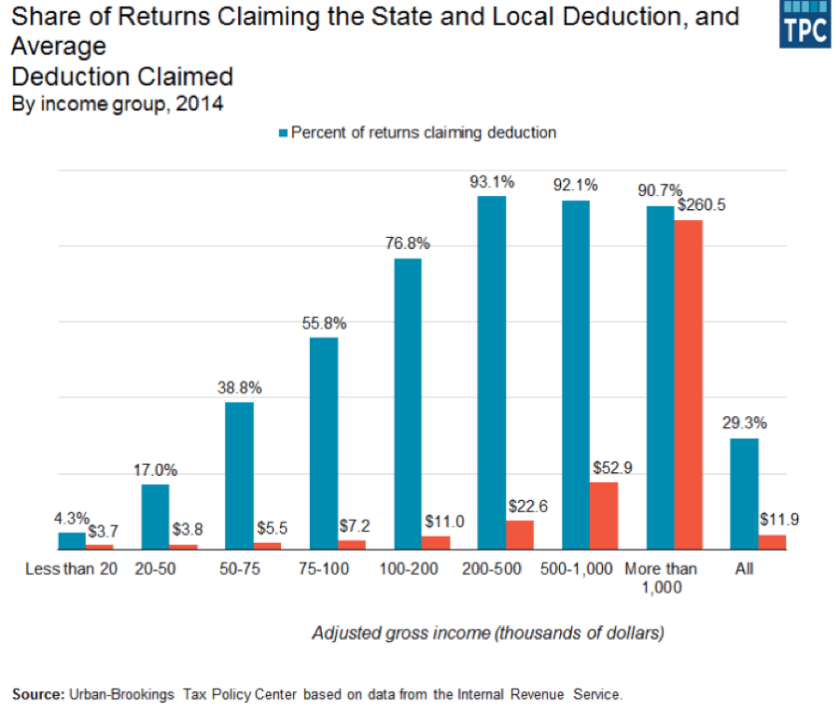
I want to explore two questions. Would the proposed income tax changes reduce the taxes paid by the average wealthy tax payer (say the top ten percent, who in 2016 paid 80% of all income taxes)? Would that be a good thing or a bad thing and in what ways should we judge that question?

To evaluate the impact on taxes paid by dropping the marginal tax rate from 39.5 to 35 percent we must also take into account the increase in taxable income resulting from broadening the tax base (eliminating some of the existing deductions from taxable income such as State and Local Taxes and interest paid on other than mortgage debt, etc). The conventional wisdom of tax reform is to lower the rates and broaden the base. This can be done in amounts that leave tax revenue unchanged (revenue neutral). Whether the wealthy pay more or less from the proposed modest drop in the tax rate will depend on how successful congress is in fighting off the special interest groups that will try to preserve their special interest deductions.

There are two other important considerations when evaluating the revenue impact of a rate cut. To the extent that lower marginal tax rates encourage greater investment, the economy will grow more than otherwise. This is an additional way in which the tax base is increased and with it the tax revenue generated from whatever the tax rate might be. While there is no case in which the economy grew fast enough to recover all of the revenue lost from cutting the rate, faster growth generally recovered some of it. But a bigger revenue boost can also come from the wealthy repatriating more of their income held abroad to be taxed in the U.S.

But let’s assume, all things considered, that lowering the marginal tax rate for the wealthy reduces the taxes they pay. Is that a good or a bad thing? Leaving aside the point above about increasing economic activity in the U.S., what should the standard of judgment be of what is fair? Obviously people with more income should pay more taxes but how much more? If current tax rates (and deductions) are unfairly high for the wealthy, then lowering them is a good thing. If they are unfairly low, they should be raised. In short, it is not necessarily appropriate to say that something that lowers the taxes paid by the wealthy is a bad thing. The core question is thus: what is our standard of fairness?

Tax burdens are generally discussed in relation to the share of ones income paid in taxes. Rather than comparing the fairness of a millionaire with an income of $5,000,000 paying $1,000,000 in taxes with the average American family income of $50,000 paying $10,000, we look at the tax burden in relation to the share of ones income paid in taxes. In the preceding example, both the millionaire and the average family are paying 20% of their incomes in taxes. In fact, the average share of income paid in taxes of the top 10% of income earners was almost 20% in 2012 while the bottom 50% (most of whom paid no federal income taxes) was 3.3%. A flat tax rate (same marginal rate for everyone), which means that a person with twice the income pays twice the tax, is my standard of fairness. Many others believe that it is fair for the rates to be progressive (higher marginal rate for higher incomes).

My point is that it is wrong to conclude that any reduction in the taxes paid by the wealthy is good or bad unless we have first agreed on the standard of fairness and whether existing tax payments exceed or fall below that standard.

It is important to note also that there are many other taxes that people pay. While most America families pay no federal income taxes, they do generally pay wage (social security) taxes, sales taxes, property taxes and other taxes. “The Principles of Tax Reform”


A Basic Human Right

Hunter-gatherers freely traded what they produced (gathered) for what they needed but did not produce. The story is well known (except by Peter Navarro, an energy and environmental policy analyst masquerading as Trump’s trade expert). By specializing in what they did best (hunting) and trading their bounty with those better at producing the other things hunters needed, total output was greater and every one was better off. The right to sell what we produce for what we need/want but don’t produce is, or should be, a pretty fundamental right. It is called free trade.

Historically governments have interfered with this right to protect the markets of special groups otherwise unable to compete. These trade restrictions and tariffs reduced total output making everyone (except those protected) worse off. Recognizing the general harm done by trade restrictions, most countries have negotiated mutual reductions in these restrictions. These have taken the form of bilateral and regional and global multilateral trade agreements.

The Trans-Pacific Partnership (TPP) was one of the most recent efforts to expand trade and its income rising benefits. It was negotiated over an eight year period among 13 Pacific Rim countries and in addition to expanding trade would have deepened U.S. leadership in setting trade standards in the region. Steve Bannon rejoiced when President Trump withdrew the United States from the agreement, claiming that all future agreements would be bilateral. President Trump thereby potentially gave standard setting leadership in the area to China. Not very smart.

Candidate Trump had also promised to scrap the North American Free Trade Agreement (NAFTA) with Canada and Mexico, calling it the worst trade deal of all times (a rather crowded category). President Trump wisely decided to renegotiate it instead. It has been updated several times since it was originally signed and another round can potentially make it better still. In fact, many of the good features of the now discarded TPP are being incorporated.

If we remove existing restrictions on purchasing Canadian lumber and millwork products, for example, fewer trees will be cut down in Washington and Oregon. In exchange Canada will reduce its tariffs and other restrictions on American cars, equipment, and food product sales to Canada. Production will be more efficient and incomes will rise both here and there.

As competitive advantages shift with freer trade and product and manufacturing innovations, some workers will need to shift to new areas of work and may need new skills. Public policy should facilitate and ease the adjustment burdens of these shifts, but it is important to recognize that these shifts arise mainly from improving productivity and not from increases in cross border trade. Most of us export our labor to a domestic company (our employer) and import everything we need (paid for by our labor export). But most of those imports are from domestic companies and service providers not from so called foreign trade. The era of the self sufficient farm families ended long, long ago. https://wcoats.wordpress.com/2017/07/23/the-balance-of-trade/

President Trump may well oversee the negotiation of a better NAFTA (better for all three countries involved). Unfortunately his style of leadership in this area—baseless claims of great harm to American workers from existing trade agreements—provides a very misleading message to the American worker and public in general. He creates a negative atmosphere around the right of each of us to sell what we make to whom ever we choose and to buy what we need from whomever we choose. The world has benefited enormously from freer trade and the increases in worker productivity it has made posible. This is a huge understatement. President Trump does us all a great disservice by characterizing trade in negative terms.

Finally (?): Healthcare Reform

What are the problems with our universal healthcare system (no one is denied the care they need “Health-care-plan-B”) that Congress is trying to fix? At the broadest level America’s health care costs much more than it should for the results it delivers and the distribution of its financing is neither efficient nor equitable. Six years ago Democrats made the mistake of sneaking through the Affordable Care Act without significant debate. This year Republicans committed the same error but failed to pass a law. This provides congress (thank you Senator McCain) with the opportunity to fashion a healthcare reform law the proper way (open committee hearings, etc.).

A new attempt to reform the system would no longer be restrained by the limitations of a budget law that limited what earlier attempts were able to do. In particular a new law should address the factors that drive up the cost of medical care in the U.S. These include relaxing legal limitations on who can provide what services and how they may be performed, requiring that the cost of services be transparent and requiring stronger incentives for customers (patients) to care about cost when choosing medical treatments. “Heath-care-reform-fatigue

How medical services are paid for influences the incentives of both suppliers of these services as well as the users to seek and provide the most cost effective options. Medical services are paid for by patients (because they are uninsured, or pay deductibles or copays), insurance premiums, or taxpayers. Each provides its own set of incentives for choosing what is delivered. When patients pay for the services they have a financial incentive to choose the option with the highest benefit-cost ratio. When third parties pay for medical services, (insurance companies or government) they must impose choices that patients, in consultation with their doctors, would otherwise make.

Some commentators have complained that third party payers, whether a single payer (government) system or many insurance companies, introduce rationing. However, all scarce goods and services are necessarily rationed. The relevant issue is how they are rationed, whether on the basis of the preferences of patients or the judgment of the third party payer of what is reasonable.

To the extent that medical costs are paid for by taxpayers, the incidence of such financing depends on and is determined by the structure of the government systems of taxation. In the U.S. these are currently unfair and inefficient and in bad need of reform quite independently of the issues of healthcare delivery. Medical insurance financing is complicated by the ill advised post World War II tax incentive for employers to provide and help pay for medical insurance. This practice establishes insurance pools (the firms employees) that generally mix the number of healthy and sick policyholders in a representative way. The very purpose of insurance is for the healthy to share the costs of the sick and thus reduce the financial burden of medical surprises. Most Americans with health insurance buy it through their employers’ plans.

The most serious problem with the existing American health insurance system is for those not receiving insurance from an employer (or those changing employers and needing to establish new insurance policies). These people must use the so-called private market for which the Affordable Care Act established the insurance exchanges. The cost of insurance purchased in this private market depends on the mix of healthy and sick people that sign up. Employer provided plans are essentially mandatory for a firm’s employees (and enjoy a tax subsidy) and thus result in a well mixed (sick and healthy) risk pool. Private market plans were made mandatory by the ACA but with a penalty for remaining uninsured that was so low that large numbers of young healthy people choose not to join. Thus private market plans were increasingly populated by the sick (and those expecting that they were likely to become sick). This undermines the cost sharing the insurance exists to provide and thus drives up the premium cost. The simple cure for this problem is to make healthcare insurance mandatory as originally proposed by the Heritage Foundation.

Mandatory healthcare insurance should cover every health service for which society believes financial assistance should be given. It undermines the purpose of insurance to allow policy holders to pick and choose which services will be covered. Premiums might very with age, lifestyle choices that effect health (such as smoking or obesity) and the choice of the level of deductions and copays but policy holders should not be able to opt out of services society intends to provide and finance one way or another even if they never expect to need them. The issue of preexisting conditions would not arise when insurance is mandatory and policies are not linked to individual employers. “Health-care-in-America”

The individual policyholders’ choices of the level of deductions and copays (but not the scope of services covered) would determine the division of financing between patients and third party payers. In addition, government (the voting public) would choose the extent to which the cost of medical services would be taken over by taxpayers as a result of government financial assistance to the poor. A further policy option is whether the cost of catastrophic health care needs would be lifted from insurance premiums and paid for by taxpayers via a reinsurance plan. But the cost of medical services that must be paid over all (by patients, insurance premiums, or tax payers) can be greatly reduced by taking those measures that will lower the cost of these services in the first place.

Hopefully this time around congress will entertain open public discussion of all of these issues so that the public will understand the purposes and tradeoffs of the policies ultimately adopted.

The Balance of Trade

President Trump has regularly called for bilateral trade balances with our trading partners. Though he prudently gave up his campaign promise to declare China a currency manipulator on his first day in office because of China’s large trade surpluses with the U.S., he more recently criticized Germany’s even larger surplus. The Trump administration’s objectives in renegotiating the North American Free Trade Agreement (NAFTA) published July 17th also call for reducing U.S. bilateral trade deficits with Mexico and Canada. Economists recognize these objectives as nonsensical, but it might be worthwhile to spell out to the broader public (if not to Trump’s protectionist White House wing) why that is so.

Let’s start with the U.S. trade balance with the rest of the world. As we pay for what we import with what we export, we would generally expect a balance between imports and exports over time, just as we expect a rough balance between our income and expenditures over time. But uniquely in the case of the U.S., we need to have a deficit (imports exceeding exports) paid for with U.S. dollars, because the rest of the world holds and uses our dollars to finance many international transactions. The dollar is the world’s primary international reserve currency and our trade deficit is the primary means by which we supply them to the rest of the world.

This is an over simplification, however, because dollars are also supplied to the rest of the world via our capital account, i.e. Americans investing abroad. At the end of 2016 Americans had invested about $24 trillion USD equivalent. However, the rest of the world had invested over $32 trillion USD in the U.S. Roughly $5 trillion of this net investment in the U.S. of $8 trillion represented official foreign exchange reserves held by foreign governments in U.S. dollars out of total foreign exchange reserves of about $8 trillion.

Something also needs to be said about the relationship between foreign holdings of dollars and changes in those holdings. Any increase in the demand for foreign exchange reserves by foreign governments, something that tends to happen naturally as economies grow, must be met by the balance of payments deficits of the countries supplying those reserves. Thus the U.S. trade deficit last year (2016) of about $500 billion USD more or less reflects the addition to the dollar reserves of foreign governments.

So the use of the U.S. dollar in foreign exchange reserves implies that the U.S. will have, and need to have, a balance of trade deficit of a similar amount. But let’s simplify and assume that U.S. trade with the rest of the world is balanced (zero trade balance as well as zero current and capital account balances), perhaps because the U.S. dollar is replaced in international reserves by the SDR as I have long recommended. See my: Real SDR Currency Board What about the trade balance with Mexico and Canada? Should we want and expect each bilateral trade relationship to be balanced?

The error of such thinking can be easily illustrated with a simple, hypothetical example. Assume that within NAFTA the U.S.’s comparative advantage is in manufacturing all the pieces that make up an automobile and growing wheat, Mexico’s comparative advantage is using its “cheap” labor to assemble those pieces into cars, and Canada’s is growing and milling lumber. Assume that that is all they do that crosses their borders. The U.S. sells its car parts to Mexico, which puts them together and sells the cars to the U.S. and Canada. The value of the parts sold to Mexico is less than the value of the cars (which incorporates the parts from the U.S.) Mexico sells to the U.S. so that on net the U.S. has a trade deficit with Mexico. The U.S. sells wheat to Canadians buying a lesser value of lumber in return and Canada sells its lumber to the U.S. and to Mexico buying a few cars but of less value. Looking at bilateral trade balances, Mexico has a surplus vs. the U.S. and a deficit vs. Canada. Canada has a surplus vs. Mexico just sufficient to cover its deficit vs. the U.S. These bilateral deficits and surpluses are not a problem because the U.S. has a trade balance vs. Mexico and Canada combined and indeed with all of the rest of the world. The same is true for Mexico and Canada. What really matters is whether the value of a country’s exports to the rest of the world match and thus pay for the value of its imports from the rest of the world. As someone noted, no one worries that you have a large trade deficit with the grocery store as long as your total spending everywhere is covered by your income (the sale of your labor to your employer).

Being the eternal optimist, I trust that there are enough people in the Trump administration that understand that seeking bilateral trade balances with each and every country would be a terrible mistake to keep him from trying to do so.

Heath Care Reform Fatigue

On average, Americans spend about twice as much on medical care as do Europeans and with poorer results. About half of that cost is paid for by government. If we could get the cost of medical care down to European levels either the government (i.e., tax payers) could stop paying for any of it with no change in the cost to patients, or patients could stop paying anything with no change in the cost to government. Of course it wouldn’t work like that and is much more complicated but it does focus the mind about the issues concerned.

Both the Affordable Care Act of Obama and the current drafts of its replacement by the Republicans are limited to what can be considered budget authorizations so that they can be passed with simple majorities. In June 2015, when the Supreme Court rejected challenges to the constitutionality of parts of the ACA (the insurance mandate), Chief Justice Roberts complained that: “Congress wrote key parts of the Act behind closed doors. . . . Congress passed much of the Act using a complicated budgetary procedure known as ‘reconciliation,’ which limited opportunities for debate and amendment, and bypassed the Senate’s normal 60-vote filibuster requirement. . . . As a result, the Act does not reflect the type of care and deliberation that one might expect of such significant legislation.” Now the Republicans are doing the same thing. Once again George Will is right on target: Why-repeal-and-replace-will-become-tweak-and-move-on/2017/06/27/

This means that the most important elements of health care reform in America—reducing supply side costs—must await other legislation. However, limited market forces are already eating away slowly at the American Medical Association’s (the doctors’ union) self protective strangle hold on the delivery of medical services. The information technology now exists to dramatically improve the quality of service while lowering its cost. Nurse practitioners have already taken over some routine functions previously preserved for MDs. With a growing shortage of doctors, more restrictive practices are likely to be relaxed such as phone consultations, etc.

The focus of the ACA and the current Republic efforts to “repeal and replace” it, has been how best to finance these costs for those financially unable to pay them. The two overriding challenges for this effort should be to adequately target those who need such assistance and in the process to avoid undermining to the extent possible the incentives for both doctors and their patients to provide and to seek the most cost effective care.

There are many small and large details in ACA and proposed Republican replacements that could be changed to improve targeting of financial assistance and the incentives for seeking and delivery cost effective care. See my earlier discussion: A-mistitled-tax-proposal. The largest issues are how best to remove the unfair tax treatment of employer provided health insurance vs. the “private” market and how to insure that the risk pools in the private insurance market include both healthy and sick premium payers.

The point of insurance is to pool the cost of the risk of bad things happening, like breaking a leg or getting sick. Thus the lucky (healthy) share the costs of the unlucky (sick or injured). The group as a whole must pay the total medical costs of all members of the group. It follows that health insurance should be mandatory for every one in a properly defined group. The risk pool of employer provided health insurance consists of the company’s employees, and premiums are set on the basis of the average medical costs of that group. There is no such predefined risk pool for those who buy insurance in the “private” market. The logic of insurance suggests that everyone within each age group should be required to buy insurance at a cost to each that reflects the total medical costs of the full group. The-individual-health-insurance-mandate.

The simplest, cleanest, and most comprehensive way to insure that those unable to pay for whatever medical care they need can do so is to require that all people in their group buy insurance so that those who later don’t need it finance those who do. I have earlier advocated that this approach be integrated as part of a guaranteed minimum income (GMI). A GMI would provide the basis for eliminating most government welfare programs from Social Security and food stamps, to disability and unemployment insurance. But first a brief word about minimum wage laws.

Charles Lane has proposed a sensible approach to balancing the political attraction for legal minimum wages with the economic case against them. He proposes that the issue be removed from the political arena by legislating an automatically adjusting formula for a legal minimum wage that closely matches actual historical wage experience so as to minimize the harm to low skilled and inexperienced (teenagers) workers that would be hurt by higher minimum wages. Forget the $15 minimum wage–here’s what a sensible compromise would look like/2017/06/28

A legal minimum wage does not help the unemployed. A Guaranteed Minimum Income would. It should be paid to every man, woman, and child but the amount might vary with age (but not with income). It could be administered by the Social Security Administration, which it would replace. Saving-social-security. Fixed shares of the GMI would be placed in an individual health insurance account, a pension account, and an education account (school tuition or college fund). The amount deposited to the health savings account would be required to be used to purchase general health insurance and would be sufficient to do so.

The GMI would be paid for from general tax revenue. Clearly our existing, hole riddled income tax laws (both personal and business) are a mess and need to be cleaned up. As I have argued earlier the fairest, least distorting and easiest to administer tax is a consumption tax. I should replace all income taxes, wage taxes and existing sales taxes with one uniform Value Added Tax (VAT). My-political-platform-for-the-nation-2017.

Let’s try for better health care that costs less for both patients and tax payers.

A mistitled tax proposal

The Wall Street Journal used the following headline to an article exploring a healthcare reform issue: “GOP Senators Weigh Taxing Employer-Health Plans”. The article itself is a well-balanced presentation of the issue but the article headline gives a very different impression.  WSJ article

The issue is that employment benefits that are part of a worker’s remuneration, such as health insurance, are excluded from a worker’s taxable income while a self-employed worker who buys their own health insurance (the private market) cannot deduct it’s cost from their taxable income. Both Democrats and Republicans recognize that this is unfair to those who do not receive employer provided health insurance. They differ over how to eliminate this unfair treatment—whether to include the value of health insurance in taxable income for both or to exclude it, as is done with employer provided coverage, for both. No one is proposing taxing health insurance as the article’s title suggests. The following headlines would give a rather different impression for the same proposal: “GOP Senators weigh equal treatment of health plans between employer and self-employed provided plans” or even, “GOP Senators weigh including value of health insurance in taxable income for everyone.”

As I have noted before we must find ways to reduce the cost of health care in America (it costs twice as much as care in Europe with poorer results) while insuring that everyone has reasonable access to it. But how we allocate its cost and structure the payments of those costs determine the incentives faced by the medical care industry that have played a major role in inflating those costs. https://wcoats.wordpress.com/2017/03/15/health-care-in-america/

Net Neutrality

The issue of net neutrality is almost as complicated as the Internet (the network of networks) itself. As with so many topics, the debate over how best to maximize the development of and benefits from the Internet (email, World Wide Web, and all of the rest) broadly divides between those who support prescriptive rules to guide and govern its operations and those who support a more permissive role for the government stepping in only to correct actual problems. To overstate it a bit, it divides the statists from the free marketers.

The history of what we now call the Internet is quite amazing. History of the Internet. Though governments provided the seed money that got it going (in the U.S. it was the Department of Defense’s ARPANET and later the National Science Foundation’s CSNET and in the U.K. it was the National Physical Laboratory), the U.S. gradually stepped back and allowed the unregulated development of commercial and private uses of the connectivity that was developing and allowed private Internet Service Providers (ISPs) to develop the gateways (access) for almost all users (both content providers and consumers) to the Internet. This policy was imbedded in the Telecommunications Act of 1996 signed by President Clinton. That legislation, affirmed that the policy of the United States was: “to preserve the vibrant and competitive free market that presently exists for the Internet . . . unfettered by Federal or State regulation.”

From the beginning of its break away from its narrow military and scientific uses, all involved in the Internet’s development were committed to it being free and open. The Federal Communications Commission (FCC) promulgated guidelines to preserve this principle in November 2011. “The FCC’s rules focus on four primary issues:

  • Transparency. Fixed and mobile broadband providers must disclose the network management practices, performance characteristics, and terms and conditions of their broadband services;
  • No blocking. Fixed broadband providers may not block lawful content, applications, services, or non-harmful devices; mobile broadband providers may not block lawful Web sites, or block applications that compete with their voice or video telephony services; and
  • No unreasonable discrimination. Fixed broadband providers may not unreasonably discriminate in transmitting lawful network traffic.
  • Reasonable network management. ISPs may engage in reasonable network management to maintain a high quality of service for broadband Internet access.” FCC Openness Principles

In this permissive environment the Internet flourished, developing in directions and ways no one could have imagined only a few decades earlier. “But two years ago, the federal government’s approach suddenly changed. The FCC, on a party- line vote, decided to impose a set of heavy-handed regulations upon the Internet. It decided to slap an old regulatory framework called “Title II”—originally designed in the 1930s for the Ma Bell telephone monopoly—upon thousands of Internet service providers, big and small. It decided to put the federal government at the center of the Internet.” Ajit Pai’s Newseum Internet Freedom Speech

What happened? Were the principles of an open Internet with fair access to all suddenly being violated or under threat in 2015? Is the proposed return to the status quo before 2015 really a threat to the principles of net neutrality?

Like all other economic activities, every aspect of the Internet costs money that someone has to pay. Those who built and maintain the Internet Backbone (NTT, Cogent, GTT, etc.), the facilities and networks of the ISPs (Verizon, AT&T, Comcast, etc.), and the content providers (Netflix, Facebook, Snapchat, HBO, etc.) did so to make money (or at the very least to cover their costs). We all know about content and service providers who thought first about how to attract users and only later how to get them to pay (e.g., Facebook and Amazon). They gradually developed their business models over time and some worked and others didn’t. What worked best (most cost efficient use of Internet resources, etc.) was not and could not have been foreseen in the beginning of the Internet’s development. Had the regulations imposed in 2015 been imposed two decades earlier, it is very unlikely we would be enjoying the Web we have today. Freezing or constraining the business models of the key players with very prescriptive regulations is neither necessary nor wise. As Mike Montgomery put it in The Hill: “The digital world moves at the speed of light. To slow that growth to the speed of bureaucracy would have serious negative effects on the burgeoning tech industry which is creating jobs faster than almost any other industry out there.” (see the link below)

Markets function best when profits are maximized by providing the best service at the lowest cost. In such cases, which is the general case, incentives are aligned, i.e. what best serves the supplier/producer also best serves the general public/consumers. Two forces operate to insure that the Internet is open to all. The first was a broad public consensus that the Internet should be open to all on fair terms (no discrimination against—filtering out or blocking—any one or any idea or point of view). The second is that discriminating in any way blocks some customers and thus reduced profits. The incentives for ISPs to provide fair access to all aligned with the public’s expectations of and desires to have fair access.

Ideology enters the discussion when people disagree over the meaning of fairness. Some people think that some classes of users (the poor, IT startups, etc.) should have the cost of their use of the Internet paid by someone else (tax payers, cross subsidies from larger, established users/suppliers, etc.). ISPs, the gateways to the Internet, have no profit incentive to provide such subsidies. Fairness for most economists is when each user pays the marginal cost of their use (plus a small profit margin).

The primary legitimate concern with respect to the net neutrality I want to see is that industry consolidation has reduced the number of ISPs to the point that over half of the country has only one (i.e. no) choice. The only competition in some areas comes from your cell phone plan. Thus there is a legitimate concern with the possibility that an ISP might charge different prices for fundamentally the same service and that those ISPs that are beginning to produce their own content might favor it over competitors’ content with faster lanes or worse.

There were indeed a few problems during the long era of light touch regulation prior to 2015. Verizon’s dispute with Netflix over download speeds and AT&T’s blocking Facetime video but not Skype on iPhones (not even an Internet issue), for example. This occurred before and were resolved before the 2015 FCC regulations on the basis of existing legislation. Excessive concentration and abuses of market power can be and have been dealt with via existing anti trust laws and state and individual civil suits.

The United States has generally allowed markets to develop fairly freely, only applying regulations to deal with real problems when they occur. I represented the IMF as an observer at a G10 Deputies Working Group on E-money meeting at the BIS in Basel Switzerland in December of 1996. The G10 Deputies are the Finance Ministers and Central Bank Governors of the ten largest economies in the world. The meeting was chaired by a young Tim Geithner, then the Deputy Assistant Secretary for International Monetary and Fiscal Policy in the U.S. Treasury Department. The meeting was to determine the regulatory approach to the prospective emergence of Electronic Money, now referred to as Cyber money. We considered reports on developments to date and took the wise decision to stand back and watch how things developed before formulating regulatory advice.

More recently the Federal Reserve’s Faster Payments Task Force project and the Federal Reserve’s cautious approach to bitcoin and other digital currencies reflects a similar attitude. That attitude, to repeat, is that no one knows for sure the direction that the development of new technologies will take in the search for maximizing their benefits thus profits. Government can at best play a supportive role of providing a flexible legal and regulatory framework within which new products and services can be explored. If problems arise, the government can review with consumers and producers how best to deal with them. The approach to regulating bitcoin and other digital currencies is still evolving.

A counter example to the above enlightened approach is the U.S. approach to Anti Money Laundering and Combating the Financing of Terrorism (AML/CFT), which has imposed enormous regulatory costs on payments of all sorts with no discernable benefits.

Those who believe that private sector behavior and the development and use of technology can be carefully and successfully regulated by government suffer what I have called hubris in other contexts. See, for example: https://works.bepress.com/warren_coats/38/. Nonetheless, in the case of so called net neutrality greater certainty about the legal and regulatory environment in which the Internet must operate would help further its development and evolution, especially if the light touch regulation under which it has developed is restored. Congress should write net neutrality into law.

An excellent discussion of these issues can be heard in this podcast on the Future of Internet regulation with FCC chairman Ajit Pai

The Individual Health Insurance Mandate

Legislation to replace and/or reform Obamacare (the Patient Protection and Affordable Care Act—ACA) was passed by the U.S. House of Representatives last week. Despite President Trump’s premature celebration the process of fashioning a new health care law is just getting underway as the Senate begins the rewriting of the House bill. One of the important issues dividing Democrats from most Republicans, and Republicans from each other, concerns whether everyone should be required to buy health insurance and if so what that insurance must minimally cover. “Health Care Plan B”

The fundamental purpose of insurance is to provide the broadest possible sharing of unpredictable costs. Thus it was not surprising that the Heritage Foundation published a report by Stuart M Butler recommending mandatory health care insurance on October 1, 1989: “Assuring Affordable Health Care for All Americans”. Dr. Butler elaborated his health care insurance mandate in a March 5, 1992 Heritage Foundation report: “Policy Maker’s Guide to the Health Care Crisis”

Robert E. Moffitt elaborated the public policy case for the insurance mandate as follows: “Absent a specific mandate for at least catastrophic health insurance coverage, some persons, even with the availability of tax credits to offset their costs, will deliberately take advantage of their fellow citizens by not protecting themselves or their families, with the full knowledge that if they do incur a catastrophic illness that financially devastates them, we will, after all is said and done, take care of them and pay all of the bills. They will be correct in this assessment…

“An individual mandate for insurance, then, is not simply to assure other people protection from the ravages of a serious illness, however socially desirable that may be; it is also to protect ourselves. Such self protection is justified within the context of individual freedom; the precedent for this view can be traced to none other than John Stuart Mill.” Health Affairs, January 1994.

Two bills offered in the U.S. Senate in 1994, the Consumer Choice Health Security Act sponsored by 25 Republican Senators and the bipartisan Health Equity and Access Reform Today Act sponsored by 19 Republican and 2 Democratic Senators included health insurance mandates.

When Mitt Romney was the governor of Massachusetts signed that state’s “An Act Providing Access to Affordable, Quality, Accountable Health Care,” adopted in 2006 with broad bipartisan support. It required all Massachusetts residents to buy health insurance. Surprisingly in 2008 presidential candidate Barack Obama opposed an individual mandate (but apparently supported the existing employer health insurance mandate for their employees). But only two years later in 2010 then President Obama signed into law the ACA, which included a weak individual insurance mandate.

Conservatives turned against the individual mandate, I assume, because it seemed to exceed the constitutional authority of the federal government under the enumerated powers of the U.S. constitution (remember them). In a very controversial 5-4 Supreme Court decision written by Chief Justice Roberts, the court ruled on June 28, 2012 in National Federation of Independent Business v. Sebelius that although the individual mandate was not constitutional under the commerce clause (already stretched beyond recognition), it could be construed as a tax and was therefore valid under the constitutional authority for congress to “lay and collect taxes.” While I favor a health insurance mandate, I also favor preserving the constitutional limitations on the powers of the federal government, which leave the establishment of such mandates to the individual states.

States have generally been more successful at addressing the financing of its citizens’ health care needs. They also have the advantage of learning from each others experiences. Consider the issues of catastrophic health care costs and those of preexisting conditions. Preexisting conditions are not appropriate for insurance coverage (insurance is meant to share the cost of “future and unexpected losses”), but they must, nonetheless, be paid for by someone. In the past, the financing of these known and/or unusually large expenses have been provided through risk pools. “Before Obamacare, 35 states had risk pools – available to people in the individual market who had been turned down for private insurance because of a health condition…. These arrangements were not perfect,” but worked better than the approach taken in Obamacare and should be restored and improved. “High risk pools worked just fine before obamacare”

So where are we? Republicans and Democrats want generally the same outcome–cheaper but better healthcare for all.  Democrats want that administered by the government and Republicans want to rely more on the private sector. I favor the latter.  Hopefully as the Senate writes their own health care reform bill they will provide the federal government’s financial support (tax subsidies) for those unable to afford their medical care costs (whether directly or via insurance) in such a way that states are incentivized to require individual mandates for adequate health insurance and that health care providers are not rewarded for unnecessary procedures. This is one important and complex piece of the overall adjustments needed to lower the cost of providing good care to everyone while allocating its cost fairly (a whole other debate).


Buy American, Hire American

President Trump continues to repeat his populist slogan “Buy American, hire American,” reflecting the way he and Steve Bannon appear to understand what is needed to make America Great Again. Thus, with apologies, I endeavor again to explain why this catchphrase is fundamentally wrong and would actually make America weak. “Trade and Globalization” “Save trade”

If buying an American made product or service (100% American, 90%, 51%?) or hiring an American worker is my best option, I would not need to be compelled to do so by the government. If it is not my best option, being compelled to do so forces me to accept an inferior option. It would make me worse off. The Trump family understands this as their hotels import and purchase foreign made products (from China, Philippines and India, to name a few) and Ivanka sells clothing made in China.

It is obvious that being forced to buy and hire American would make many of us worse off (not to mention diminish our freedom of choice), but are there compensating benefits or gains for others in the American economy that would justify making us worse off? “Teeing up Trump tariffs”

Buy American

If I must buy an American made Corvette rather than a German Porsche, does the American economy benefit? To simplify, leave aside the fact that a substantial part of the components making up a Corvette are imported from various countries. The fact that I had to be forced to buy the American car rather than the German one, i.e. that it was an inferior deal, means that the American workers who make it were reallocated from the production of export products at which the United States had a comparative advantage. Trading less as a result of buying American mean allocating American workers to producing things (Corvette) that they are not as productive at making. They would be moved from producing Boeing aircraft to sell to Germany (to pay for our imports of Porsches) to producing Corvettes. So in addition to my being made worse off as a result of having to buy American, the American economy as a whole would be worse off as a result of a less productive work force and thus lower overall income (lower GDP). This is Econ 101.

In addition, as noted by the Financial Times, “Attempts to restrict procurement to domestic companies tend to backfire. They induce retaliation from trading partners, harming US businesses trying to sell abroad. They raise input costs, ensuring less infrastructure is built and fewer construction workers are hired for each dollar of public spending.” “The Pitfalls of having to buy and hire American”

Hire American

The meaning and impact of a requirement to hire Americans is a bit more complex. If the terms to American companies of employing the workers needed, whether they are citizens, permanent residents, or temporary or permanent immigrants from abroad, are not competitive with importing the product or service, American companies will in effect hire foreigners abroad (i.e. they will import the goods and services produced abroad). Thus it is a bit unclear what “hire American” means. “The long, rough ride ahead for ‘Made in America'”

Presumably, “hire American” refers to our immigration policies. Indeed our immigration laws need fixing. This includes providing a solution to the status of the 10 or 11 million people living here illegally, and adjusting immigration quotas to better match the needs of American firms for workers without undercutting the status of existing American workers. “Illegal-aliens”

The decline in American manufacturing jobs is largely the result of automation, not foreign trade. Manufacturing employment has fallen almost everywhere in the world as manufacturing output has increased. Automation enables the work force to produce more and thus enjoy a higher living standard. It need not cause unemployment.

The wonderful film “Hidden Figures” tells the true story of the large number of human “computers” employed by NASA (the National Air and Space Administration) who cranked out the numbers needed to put Americans in space and bring them home again. The stars of the film are three black women whose mathematical skills were indispensible to NASA. At the end of the day and in time for the first American to orbit the earth in 1961, new IBM’s mainframe computers proved essential to crunch the critical data fast enough. Overnight the human computers were no longer needed. But rather than becoming unemployed, most of them retrained to program and run the IBM computers with an unbelievable boost in productivity. While other things also affected NASA’s workload, the employment data are interesting. In 1960 NASA had 13,500 in house employees, which increased to 41,100 by 1965 and gradually drifted down to 18,618 in 2010. The numbers for contract workers on the same dates were 33,200 in 1960, 369,900 in 1965 and zero in 2010.

The President’s appeal to Buy American and Hire American, in addition to restricting our freedom of choice, flies in the face of what made America Great in the first place. As proclaimed by the Financial Times: “The principle should remain to keep the US economy as open as possible to the inflow of good products and good workers from abroad. Slamming down the drawbridge is only likely to impoverish the residents of the citadel.”


Health Care: Plan B

“Our goal is to give every American access to quality, affordable health care,” Paul Ryan “Health care Obamacare replacement-Paul Ryan”

The above statement by Paul Ryan is the goal of both Republicans and Democrats, so surely there is enough common ground that with a few compromises on each side congress can adopt reforms with broad support. Such fundamental, broad based legislation should always have broad bipartisan support. Failure to fulfill that requirement was one of Obamacare’s flaws.

America’s universal health care costs twice as much as does health care in Europe. Healthcare costs per capital in the United State in 2014 where $9,024, while in Canada they were $4,506 and in Italy $3,207. Our system provides universal care through company group insurance plans, individual insurance plans, government plans (Veterans Administration, Medicaid or Medicare), out of pocket payments for the uninsured who can afford it or charitable clinics and services, or free emergency room medical treatment for those who can’t afford it. “Health-care expenditures rose as a percentage of GDP from 5 percent in 1960 to 17.8 percent in 2015.” “A radical idea for health care reform-listen to the doctors.” While Canadians, Italians and others from around the world who can afford it come to the U.S. for top of the line care, the average result in terms of general health under America’s system is worse than in Europe. Clearly the American system is seriously flawed.

President Trump has promised that everyone would have health insurance and pay less for it. On January 15 he said: ““We’re going to have insurance for everybody. There was a philosophy in some circles that if you can’t pay for it, you don’t get it. That’s not going to happen with us.” “Trump-vows-insurance-for-everybody-in-obamacare-replacement-plan”. It is possible to achieve this ambitious promise.

This note reviews the options for reducing the cost of health care and insuring that everyone gets the care they need whether they can afford it or not.

Costs can be reduced by better aligning incentives of providers and patients for choosing the most cost effective care, by removing government and professional (i.e. union) restrictions on how care is delivered, by increasing competition to reduce the huge price range for the same service in the same market (e.g., stronger incentives for customers to seek out the best deal and the price/quality information needed for them to do so), and by Tort reform that reduces doctor’s risks of being sued that has resulted in wasteful, defensive prescriptions of unnecessary lab tests, etc.

Two broad measures supported by Republicans to reduce the cost of medical services are to free up the regulatory restrictions on how medical service are delivered (computerized diagnoses, telephone consultations, greater use of nurse practitioners, etc.) and stronger incentives for patients to shop for lower prices for the same service. Modern technology is on the threshold of dramatically improving the quality of health services while lowering its cost, if given the chance. Many Democrats would accept these reforms as well in exchange for better protection of the poor.

Health care services are paid for by various mixes of out of pocket payments, insurance, and government assistance. The design of this mix influences the incentives of service providers and patients to make better choices, and the fairness and efficiency of service financing.

Insurance by its nature is a plan for sharing health care costs so that those who are unlucky and have large health costs are helped by those who are lucky and don’t. The cost of insurance is lowest when the insurance pool is largest, mixing the healthy with the sick. Prior to the Affordable Care Act of 2010 (Obamacare), the private medical insurance market suffered from two serious problems. Most people acquire health insurance through their employer. Employers, especially companies with many employees, can negotiate better terms with insurance companies because insurers can be confident that the insured pool of workers has a normal mix of healthy and sick people over which to average the cost of insurance claims. However, they have another, unfair advantage over individually purchased insurance because that part of insurance premiums paid by employers (usually half) are not taxed as they would have been if paid out directly as wages then spent by the employee on health insurance. Furthermore, when an employee leaves the company for whatever reason, she losses the company provided policy and must pay the higher unsubsidized cost of insurance in the private market, plus a still higher premium if she has an existing medical condition and risks being uninsurable all together.

Republicans and Democrats both agree that people should be able to keep their insurance policy if they change employers, retire, or become unemployed and that the private and the company markets should enjoy the same tax treatment (both should have the same tax exemption or both should have no tax exemption for insurance premiums). Both also endorse some form or other of supporting the cost to insurance companies of patients with chronic or catastrophic medical costs. Different states have adopted and are experimenting with different approaches to financing such costs and should be encouraged to continue doing so by converting Federal financial assistance into block grants to the states. Agreement in both parties on the approach to these situations should not be that difficult to reach if the effort is made.

For given health service costs, the lowest possible insurance premiums for insurance policies that cover them would be achieved when everyone is required to pay them. Thus everyone should be required to have health insurance. Many issues arise about the coverage of such insurance (any uncovered health care services would have to be paid for out of the patient’s pocket, by charities, or by tax payers). One issue is whether there should be one insurance pool sharing the costs (healthier young paying for the sicker elderly, men paying for women’s child birth and women paying for uniquely male afflictions, etc.) or several. For example, should premiums reflect age differences as they do now (the more costly elderly pay higher premiums than the less costly young but not enough higher to cover their higher costs)? If insurance pools should be segregated by age, should the segregation be total (no health care financing transferred on average from young to old) or should the higher health costs of the elderly be financed to some extent by the young, and if so to what extent? Keep in mind that the very purpose of insurance is to share costs. As anyone could opt out of the insurance mandate under Obamacare with only a modest penalty, fewer younger people acquired insurance than was expected, leaving an older, sicker, and thus more costly pool to share the costs. This has been one of the factors increasing insurance premiums under Obamacare.

If the government makes purchasing health insurance mandatory, as it should, it will have to set the minimum standards of coverage required to satisfy that mandate. It is really contrary to the whole purpose and philosophy of insurance that each person would choose to insure only those health needs they think they might need (car accident, heart attack, diabetes, broken arm, etc). However, the coverage of all such possibilities can come with a higher or lower deductible and copay or a wider or narrower network of participating medical practitioners etc. Republicans and Democrats can surely come to an agreement over these minimum features. The required features should be carefully designed to maximize the incentives for providers and recipients to make efficient choices. Anyone wishing to and willing to pay for broader services (a doctor outside the network, recovery in the Swiss Alps, etc.) would be, as always, free to do so. The United States already has a government run insurance policy for the elderly called Medicare. Medicare can be purchased in addition to other health insurance policies or in place of them and thus is not a so-called “single payer” system.

With such a minimum coverage policy established by the government, each of us would be free to sign up for an employer offered policy of our choice or buy one from the private market with no difference in price with the policy offered by the employer (incorporating the above recommended elimination of tax discrimination between company and private market policies and allowing policy portability). The bigger challenge is how to cover the cost of insurance for those who cannot afford it. Democrats generally prefer to achieve universal insurance coverage via the government as the single payer and health service provider (our VA system or the British public health service) leaving the better off free to pay more for services outside that system if they wish to. Republicans generally prefer to maximize the choices of the public and to encourage competition among insurance providers.

Health insurance for the poor must be paid for by the government one way or another. Our existing system—Medicaid—is administered by states, which determine eligibility, but is financially supported by the Federal Government if its considerable regulations are adopted by the state. Only American citizens and legal permanent residents are eligible for Medicaid. Obamacare subsidizes up to 90% of state costs for Medicaid. One criticism of Medicaid financing is that when its recipients start working they can loose coverage. This is the so-called financial cliff and can be a deterrent to accepting a job or increasing the number of hours worked. Obamacare has addressed this problem by phasing out the withdrawal of Medicaid financing, ending it at incomes well above the poverty line

Republicans have proposed a refundable tax credit, in effect a guaranteed minimum income, for the poor that must be applied to the purchase of health insurance. This opens the door to competition among multiple insurance providers and would make it easier for low-income families to purchase more expensive policies, if they wanted to, by adding a small amount of their own money to the government’s tax credit. This is close to the minimum guaranteed income proposals I support. “US federal tax policy”. A gradual phasing out of the tax credit as one’s income increased above the poverty level would also reduce the work disincentive of the financial cliff.

The state run insurance exchanges are a useful aid to those looking for an insurance policy and should be retained. Either the Republican tax credit or the Democrat direct subsidy would be applied via the exchanges.

There are many important details to sort out that I have only hinted at. But as Republicans and Democrats both want the more efficient delivery of health care, which would reduce its costs, and humane and effective provision of the financing of such services to everyone, including the poor, it should be possible with only modest give and take to agree on a package that would enjoy broad bipartisan support.