Taxation norms

Taxes are levied to raise money but also to influence behavior. What is taxed and how much influences how much of it is demanded. To take an example of a tariff (tax) on steel imports, the resulting higher price of imported steel increases the relative attractiveness of domestically produced steel. Under the rules of the World Trade Organization, such a tariff would be justified if it offsets an artificial (and thus economic efficiency undermining) subsidy of the foreign produced steel.

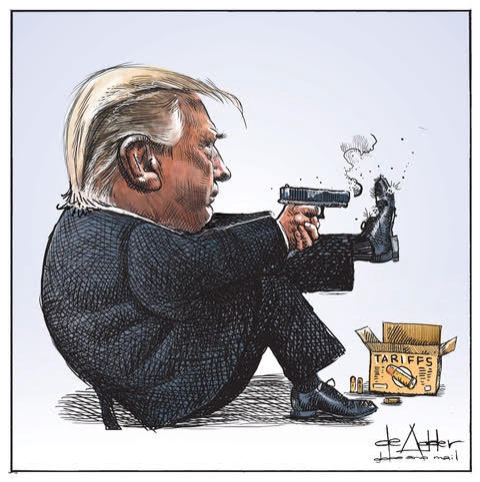
President Trump has introduced a totally different way of using tariffs/taxes. He uses them as threats to pressure a country to take action totally unrelated to the item to be taxed. This follows his general bully approach to negotiations. To pressure a country or firm to agree to his requests, he threatens harm if they refuse. If a university or newsman behaves in ways he doesn’t like, he attacks them or threatens them with harm.

In the most recent example Trump is threatening a 50% tariff on all imports from Brazil primarily due to Brazil’s legal proceedings against former President Jair Bolsonaro, which Trump characterizes as a “witch hunt,” and to address what he claims is an “unfair” trade relationship between the two countries.

“Trump demands that the trial against former president Bolsanero, who had tried to instigate a military coup after he had lost the last election, should be immediately end.”  “First casualties from Trump’s increasing tariff craze”

 It’s not clear what Trump means by “unfair” trade relationship. His positions on trade, which he clearly does not understand at all, are contradictory. He has threatened to raise tariffs on imports from countries that avoid using US dollars in their FX reserves and foreign trade payments. For countries to use US dollars they must have a trade surplus with the US (a US trade deficit with such countries) in order to acquire them. “Why Does the World Need a Reserve Asset with a Hard Anchor?”  But Trump doesn’t seem to like or want such deficits. The US actually has a trade surplus with Brazil.

It may sound like this is all from the Onion, but sadly it is not. I don’t expect it to end well.

A perfect world (economically)

The goal of policy should be to maximize world income (output) and its distribution that reflects the contribution of each player. That occurs when resources (capital and labor) are allocate to their most productive uses. But how is that achieved? First by ensuring that the government does not interfere. If the government subsidizes an activity, it will draw resources from its most productive use to the subsidized one thus reducing income.

The government’s role is important for defining and protecting property rights and the rule of law and the basic infrastructure on which firms operate. For example, in the U.S. the government funded basic research because there is no market incentive to undertake it. Much of it provides knowledge that is never used or exploited, but some is exploited by private firms for purposes the government could not guess in advance.

In the real world, consumers’ tastes change and the products and services being offered evolve and the optimal allocation of resources (capital and labor) must evolve as well. Those that are not the most productive tend to go out of business, freeing those resources for better uses. When governments intervene via subsidies or differential taxes they invariably reduce the efficiency of resource allocation and thus lower incomes. Bilateral trade deals introduce large distortions in resource allocation and thus lower global income.

The global maximum thus requires common rules for fair trade globally. The World Trade Organization is the institution through which such rules are developed and enforced (or at lease it should be). Bilateral deals undermine the level playing field optimal resource allocation requires and thus lower world income. With the weakening of the WTO and other international rules and norms, the world is increasingly falling below the income it is capable of.

Tariffs

“Posting on his Truth Social platform, Trump said [Monday] that on the first day of his presidency he will charge Mexico and Canada a 25% tariff on all products coming into the U.S. He added in a separate social-media post that he would impose an additional 10% tariff on all products that come into the U.S. from China,… That would come on top of existing tariffs the U.S. has already imposed on Chinese goods.

“’This Tariff will remain in effect until such time as Drugs, in particular Fentanyl, and all Illegal Aliens stop this Invasion of our Country!’ Trump wrote.” WSJ: Trump pledges tariffs on Mexico Canada and China”

A tariff is a tax on an import. They are permitted by the World Trade Organization when leveed on goods receiving state subsidies in order to create a level playing field for trade. Such global trade has made an enormous contribution to the standard of living around the world.  “Ernie Tedeschi, former chief economist for President Joe Biden’s Council of Economic Advisers, said the North American tariffs would cost the typical American household almost $1,000 per year.” WP: “Trump tariffs-China Mexico Canada”

The normal expectation is that the tariff will reduce U.S. demand for the taxed import and encourage its domestic production. But the US labor force is fully employed and can only increase domestic production of the targeted goods by shifting workers from the production of goods the US has a comparative advantage in thus reducing our overall income. Though employment of manufacturing workers has declined in the US, manufacturing output has not because worker productivity has increased. In fact, our imports have not shipped American jobs overseas as increasing productivity has resulted in reduced manufacturing employment most everywhere in the world, including China, surely a good thing. WC: “Trade protection and corruption”

Immediately after Trump’s tariff announcement, the exchange rate of the dollar strengthened. A stronger dollar reduces the cost of imports (but increases the cost to foreigners of our exports), thus undoing to some extent the demand reducing impact of the tariff. But it hurts our exports because of their higher price to foreign purchaser and reduces our overall standard of living.

China and others hit with this tax are likely to retaliate with their own tariffs. “Under the United States-Mexico-Canada Agreement (USMCA), which took effect in 2020, goods moving among the three North American nations cross borders on a duty-free basis. ‘Obviously, unilaterally imposing a 25 percent tariff on all trade blows up the agreement,’ said John Veroneau, a partner at Covington & Burling in Washington.”  WP: “Trump tariffs-China Mexico Canada”

Should Trump actually impose these tariff’s he would (again) be violating the law, which only allows the President to impose tariffs without Congressional approval for national security reasons: WC: “Tariff abuse”

Trump’s threatened tariffs are not even leveed on the goods he wants to restrict (drugs and illegal aliens). Thus, unlike traditional tariffs they would be leveed to pressure Mexico and Canada to take other actions Trump wants. They are bargaining ploys. So at the cost of raising prices and lowering incomes in the US, weakening the global trading rules from which we have benefited so much, and weakening the checks and balances limiting an over extended executive branch, Trump may be playing his bargaining game again. But in my opinion the cost to us and the world trading system is too high.

Econ 101: Trade balance

Everyone understands that we are each wealthier if we buy most of what we consume from others and pay for it with what we specialize in producing ourselves. But at dinner last night one of our guests (Chatham House Rules prevent me from revealing his identity) asked how we can compete with China when their workers are so cheap? The teacher in me rises up to unpack this statement and the related issue of trade balance. It is both complicated and simple.

  1. Are Chinese goods cheaper? Chinese workers are paid in their currency (RMB) and American’s buy China’s output in our currency (USD). If an LED light bulb made in China is sold for 140 RMB is that cheap for American’s? If the exchange rate of RMB for USD is 4 RMB per USD it will cost us $35 per bulb (expensive), but if the exchange rate is 10 RMB per USD it will cost us $14 per bulb (cheap).
  2. So will we buy everything from China? What will the Chinese do with the dollars they receive from exporting to us? They might buy goods from the US (made by workers who used to make LED light bulbs). If the exchange rate is “right”, the Chinese will spend all of those export dollars on imported US products. Trade (imports and exports) will balance.  An exchange rate that makes dollars more expensive in China (RMB cheaper in the US) will decrease China’s imports from the US relative to its exports (a Chinese trade surplus). What will they do with the remaining dollars held in China?
  3. What happens with Chinese trade surplus holding of USD? The Chinese can invest them in the US (buy US Treasury securities, stocks, property, etc.). Or sell them for their own currency driving the exchange rate of RMB for USD down (or up depending on what you put in the denominator). The reduced cost in China of US goods will increase Chinese imports and the higher cost of Chinese good in the US will reduce US imports from China. The Chinese trade surplus (US trade deficit) will vanish (or adjust to the rate of capital flow desired by cross border investors). The incomes of Chinese and American workers will be higher because each will be producing the goods for which they each have a comparative advantage (the win-win of free trade).
  4. Exchange rate manipulation or production subsidies distort the outcome. EU tariffs on Chinese EVs are explicitly set at a level to compensate for Chinese government subsidies of EVs. This is allowed by WTO trade rules to put Chinese and German car manufacturers on a fair, competitive basis. The US’s much higher tariff on Chinese EVs makes no mention of complying with WTO rules (the US again does whatever it wants to the detriment of the global trading system).
  5. Trade balance between US and China is used as a simplification. What matters is the balance between each country and the rest of the world but distilling the world into two countries simplifies the discussion.
  6. Time for the dessert.

Monopolies

A company that produces a really attractive product or service and does so efficiently and thus at lower cost than can potential competitors, will grow and potentially dominate and even monopolize that market. It is tempting for such very successful companies to seek laws and regulations that protect their dominance by making it harder for potential competitors to enter those markets with lower costs. But as a company enjoys its increasingly protected monopoly, it tends to lose the edge that put it on top in the first place. Its drive to innovate is reduced. It tends to become lazy and even corrupt in the defense of its monopoly position. While economist differ on what policies are best when dealing with a monopolist, there is generally consensus that monopolies are bad in the long run.

The same is true of countries that grow to international dominance. With the collapse of the Soviet Union and the resulting unipolar dominance of the United States, the U.S. increasingly behaves like a bully and disregards the rules of international commerce and diplomacy that it helped establish and demands that others follow.

The United States was founded on an extremely well-conceived set of principles designed to protect its individual citizens to lead their own lives and pursue their own flourishing as they each saw fit. The American constitution limited what the government may do to enumerated powers and provided checks and balances on the actions of each branch of government. For the most part these restrictions have held, and our government has provided the defense, protection, and framework needed for our individual flourishing.

But as we gained strength and dominance and especial during our brief period of unipolarity, we increasingly violated the rules we demanded that others follow. For example, we joined others to sponsor the World Trade Organization to establish the rules of fair trade in order to maximize the benefits of higher incomes for everyone made possible by trade.  We properly challenged China for dumping its excess steel on the market as a violation of WTO rules. But President Trump’s tariffs on Canadian, European, as well as Chinese steel in the name of national defense violated WTO rules as well as common sense. And how do President Biden’s multibillion dollar subsidies for domestic semiconductor chip production differ from “China’s state-led, non-market approach to the economy and trade” we object to?

Though the U.S. won most of the cases it brought to the WTO Appellate Body, the WTO’s dispute resolution body, that Body has not been able to function since December 2019 because the US has blocked the appoint of new judges.

But it gets worse. We have rightly condemned Russia for violating the sovereignty of Ukraine by invading it, while overlooking our equally illegal violations or attempted violations of the sovereignty of Cuba, Iraq, and Libya among others.  

But it gets worse still. In reaction to Canadian Prime Minister Justin Trudeau’s accusation that the government of India was responsible for the assassination of Canadian Sikh activist Hardeep Singh Nijjar on Canadian soil, Adrienne Watson, the White House National Security Council spokesperson, said “targeting dissidents in other countries is absolutely unacceptable and we will keep taking steps to push back on this practice.” Had she forgotten the dozens of such assassinations carried out by the U.S. on foreign soil? Of the more recent was the drone attack in Yemen that killed Anwar al-Awlaki and his young grandson on September 30, 2011. Al-Awlaki was an Islamic scholar and lecturing living here in Arlington Va.  Our assassination of Qasem Soleimani in Baghdad on January 3, 2020, again with a drone attack, raised considerable international criticism. Soleimani was the Commander of the Quds Force of the Islamic Revolutionary Guard Corps. We were not at war with either Iran or (at that time) Iraq.

With our near monopoly of political power in the world, the ability of our defense industry to protect and promote its profitable supply of weapons is strong. We can be thankful of their capacity to produce the weapons that defend us. But our military industrial complex that President Eisenhower warned us of profits however and by whom ever its products are used. Its profits are strengthened and sustained by our forever wars and those we supply. Ike knew of what he spoke.

Of the 2023 FY budget (ending next week) of $1.7 trillion in discretionary spending (yes trillions if you can swallow that), $860 billion (or 50.6%) was for defense. Half of that was paid to the defense industry. Most of that is for weapons. But they provide other services as well. When I was living in Baghdad as part of the Coalition Provisional Authority in 2004, Halliburton (the company Dick Chaney had been Chairman and CEO of) provided our meals in the Embassy mess hall (Saddam Hussein’s Presidential Palace). Lockheed alone gets more of its annual revenue from the federal government than the annual GDP of all but the top 81 countries (about half) in the world.

While our constitution’s checks and balances go a long way to protect our government from capture by the defense and other industries, the honestly of our elected representatives (devotion to the interests of their constituents and our country rather than to the size of their corporate contributions) still matters. It is hard to understand otherwise why we send our sons and daughters off to fight and die in foreign lands or encourage Ukraine to fight to the last Ukrainian.

Our government and foreign policy have been corrupted by our unipolar dominance. But our very arrogance—abide by our rules while we do what we want—has and will increasingly weaken our global influence. There are faint signs that we are being to recognize this new reality and tempering our behavior. The demise of our monopoly behavior and our return to fair and proper competition should be encouraged.

It makes sense to restrict trade of important military products. National Security Advisor Jake Sullivan was right to claim that we should aim for a “small yard with a high fence” to protect military supplies while otherwise maximizing beneficial trade. But the profit motive of our defense industries to expand the size of that yard as much as possible is strong and has been and will be hard to resist.

Goodbye Unipolar World, and Good Riddance

“Power tends to corrupt and absolute power corrupts absolutely.” Lord Acton. The United States has accomplished a lot—a lot of it good—as the world’s indispensable nation.  But as Lord Acton said, power tends to corrupt and as the time of American dominance has gone on its diplomatic skills have eroded. It behaves more and more like a bully that expects to get its way. It is in our interest to recognize and adjust to our diminished relative power and to rebuild our diplomatic, soft power skills of persuasion. It will help us better adhere to the values and rules we preach to others but increasingly ignore ourselves.

In the July, 2023 issue of Foreign Affairs, Justin Winokur offers an excellent review of the adjustments we need to make in The Cold War Trap How the Memory of America’s Era of Dominance Stunts U.S. Foreign Policy “Cold war trap-America foreign policy”

These days our most important international challenge is our relationship with China. While each sovereign nation is entitled to its own approach to its internal governance, its interactions with the rest of the world require mutual understandings and/or agreements. Following World War II, the rules for such cross border interactions have generally been developed by international organizations to which all or most countries are members, such as the UN and its many agencies, the World Bank and regional development banks, and the IMF. To take but one example, the skies full of telecommunications satellites would not be able to serve anyone properly without the rules and spectrum allocations via the International Telecommunications Union.

It is in America’s interest, as well as the interest of most countries, to draw China more fully into the international organizations established after World War II—the Bretton Woods and UN Institutions. “Chinese competition-Asia stability-institutional balancing”  But China is increasingly going its own way and creating its own international organizations. BRICS, China’s Belt and Road Initiative, Asian Development Bank, The Shanghai Cooperation Organization, Asian Infrastructure Investment Bank. Why?

Why have we failed to convince China that its interests are also serviced by joining and cooperating with the liberal international order? When China was admitted to the World Trade Organization on December 11, 2001, and requested help from the IMF with how best to satisfy the WTO’s rules, the IMF sent me. The officials I met with in China told me over and over that there was no differences of opinion in China over where it wanted to go (in joining the liberal international order). The debate was only over how fast to get there. In recent years this has changed. It has changed, in my view, in part because the U.S. has abused its dominance in the world and failed to yield (balance) appropriate power to China.

As I have spent most of my professional life with the International Monetary Fund, let me illustrate these points with the determination of IMF quota’s which is meant to reflect its members voting strength and financial contribution to world trade. A member country’s quota reflects its size and position in the world economy. The basic formula, which provided the base line for quota decisions is:  Quota = (0.50*GDP + 0.30*Openness+ 0.15*Variability  +0.05*Reserves)^K.

But when the IMF was created, the US wanted to ensure that it would dominate it. It insured that some important decisions could only be taken with super majorities. A few even required an 85% majority, such as to adjust quotas, or amend the IMF’s Article of Agreement.  The U.S. was initially given a quota well above that 15% that gave it veto power over these limited policies. As the rest of the world has grown, the size of the US economy relative to the whole world’s output has fallen from 40% in 1960 to 24% in 2019. “US share of global economy over time”  China’s GDP relative to world GDP, on the other hand, rose from 4.5% in 1960 to 16.3% in 2020. Thus, a strict adherence to the IMF’s quota formula should have significantly increased China’s quota and reduced the US quota.

Quoting from Wikipedia: “China has been trying to expand its political and decision-making power within the IMF. The IMF’s voting system weights each country’s vote based on the amount of that country’s monetary contribution to the Fund. China has been trying to raise its quota. In May 1980, the Chinese government appealed to adjust its IMF quota. With approval from the IMF board, the quota of China was increased from 1.2 billion SDRs to 1.8 billion SDRs. China also obtained a single-country seat on the IMF executive board, which expanded the number of IMF directors to 22 members. As of 2017 the quota of China in the IMF was 30.5 billion SDRs, giving it 6.09% of the total vote.

“To further rebalance power in the IMF, China appealed for changes that would transfer voting power to developing economies.[5] In 2010, the Chinese executive director of the Fund, Zhou Xiaochuan, addressed the board and asserted that giving more power to the emerging economies was critical for the group’s legitimacy, accountability and long-term health.” China and the International Monetary Fund – Wikipedia

Currently the IMF quota for the US is 17.43%, remaining well above the critical 15% needed to retain its veto power, while those of other larger economies are China 6.40%, Canada 2.31%, Germany 5.59%, Japan 6.47%, and UK 4.23%. This is not in keeping with the IMF’s base line quota formula.

This exploitation of American dominance is driving China away and dividing global cooperation to the detriment of the whole world, including the U.S. The current U.S. approach to “competing” with China is not consistent with our values nor our long run interest. “Competing with China”

Our economic and political success—the beacon on the hill that has attracted the best and the brightest to our shores—is the result of our individual freedom and rule of law, not our coercive power and its bullyish use. I hope that we wake up before it is too late. “Why do we promote growth in other countries?”

The politics of Trade

The post WWII history of international trade and the World Trade Organization has been one of gradual liberalization, i.e., a gradual roll back of tariffs and other trade restrictions. Each side offering freer imports in exchange for freer exports. But the game can work in revers as well. The U.S. has restricted –actually banned—the export to China of high end semiconductors that it fears might have military uses in China. China has responded by banning the export to the U.S. of rare materials needed to produce these chips. It sounds a bit like a joke—a bad joke.

Poor Janet Yellen, who is now visiting China. The Secretary is as sharp as they come but is in the middle of this impossible game.

“U.S. Treasury Secretary Janet Yellen criticized China during a visit to Beijing for imposing export controls on critical metals, expanding subsidies for state-owned firms, and imposing punitive measures on foreign businesses. Her harsh remarks spotlight the gulf between the U.S. and China, and the difficulty of translating calls for improved ties into actual improved ties. A top Chinese official told China Daily that the curbs on metals exports were “just the beginning” of efforts to combat U.S. restrictions on China’s semiconductor sector, and warned that Beijing could yet “escalate” if Washington were to toughen its rules further, a move it is reportedly considering” Semafor Flagship July 7, 2023

But as reported by Bloomberg she had more positive things to say as well:

“Yellen Says US-China Rivalry Not ‘Winner-Take-All’ Situation (Bloomberg)

U.S. Treasury Secretary Janet Yellen said competition between the world’s biggest economies is not a “winner-take-all” situation, and called for both sides to manage their rivalry with a fair set of rules. Yellen’s comments were delivered today during a meeting with Chinese Premier Li Qiang as she made a long-anticipated trip to Beijing, aimed at finding some common ground between the two superpowers. “We seek healthy economic competition that is not winner-take-all but that, with a fair set of rules, can benefit both countries over time,” the Treasury chief told China’s No. 2 official, adding that U.S. actions to protect national security should be “targeted.” Li also struck a note of optimism, telling Yellen he believed bilateral ties would eventually see a “rainbow,” after going through a period of “wind and rain.” He also urged Chinese entrepreneurs to brace themselves for “hardships” and “look further to the horizon.” From IMF News Report, July 7, 2023

Yes, these are from the same trip. How it turns out is anyone’s guess. But a return to freer trade is in everyone’s best interest—win win as we say. National security can be a legitimate (sensible) reason for restricting trade. But it must be very carefully applied if it is not to degenerate into counterproductive protectionism.

Why do we promote growth in other countries?

The world’s twenty largest economies give around $100 billion in aid to poorer countries each year, about 40% of which is to promote economic development. Promoting economic development and growth in other countries is not just charity or to buy peace. More prosperous countries, those that produce more, contribute to our own prosperity more directly as well. 

It is easiest to understand this fact if we think of growth within our own country or state or town. https://wcoats.blog/2023/01/22/trade-once-again/  When you sell something you made and/or own, you benefit from the sale or you wouldn’t have undertaken it. Similarly, the buyer benefits or it wouldn’t have made the purchase. As you have heard or read me and other economists state over and over again, trade is win-win.

But the benefits go beyond the win-win benefits of the transaction itself. Being able to buy some of what I need from others rather than having to make it myself frees up my time to specialize in producing for sale to others what I am best at. In short, and forgive me for repeating this for the umpteen time, world out increases from the specialization that trade enables. As the result of trade world GDP skyrocketed in just 50 years from $1.3 trillion in 1971 to $96.5 trillion in 2021. https://wcoats.blog/2018/03/03/econ-101-trade-in-very-simple-terms/

We benefit from the inventions of entrepreneurs anywhere in the world and should encourage such developments. Pfizer’s Covid vaccine was developing in Germany by BioNTech, with whom Pfizer partners to produce to large quantities demanded. China’s incredible growth over the last thirty years has contributed to our own growth as well. In 1991 the US exported to China $5.2 billion worth of goods, which had grown to $151.i billion in 2021. In 1991 the US imported $12.7 billion worth of goods, which had grown to $506.4 billion in 2021. Following Nixon’s famous trip to and recognition of China in 1972, I remember well a friend who asked “what would we possibly want to buy from China?” We should cheer the fact that China’s economy has grown dramatically to the benefit of us all.

In general, we should welcome and encourage the economic growth of all countries around the world. The exceptions might be for countries that threaten war on their neighbors or us. We might well block the export of our products and related technologies with clear military applications to countries that might pose a military threat. And we might be cautious not to rely on such products from such countries. While these would be sensible policies, they are also easily abused by domestic industries wanting to be protected from competition.

When I was in China in the summer of 2002 to help its compliance with the requirements of the World Trade Organization, those I met were excited about growing into the world trading system. China was a rising power, most certainly not an enemy. How did they become an enemy, if indeed they are. In a word, Taiwan. But I can see nothing China has done to violate their agree with the US about Taiwan as part of One China. If China has become an enemy—a threat to the US—we are largely responsible in my opinion by raising doubts about our commitment to the One China policy.

This is not to say that China has always behaved according to the rule. I and many others were there to help them move in the right direction. Now we have pushed them backward for no good reason. Hopefully the Biden administration is beginning to recognize this and we will return to promoting China’s growth rather than repressing it.   https://wcoats.blog/2022/10/23/competing-with-china/

Reducing CHIP Supply Risks

When semiconductors where invented in the U.S. in the late 1950 and began to replace vacuum tubes in electronic circuits, the world of electronic circuitry changed dramatically forever (from the computer I am composing this note on, to the mobile phone on which I might discuss it with you or the electronics in the car I might drive to meet you while listening to the radio these chips made possible, not to mention of submarines, planes, and satellites they empower).

American companies continue to lead the world in the design of the most sophisticate chips and semiconductor circuits. However, they have increasingly found it more economical to outsource their manufacture to facilities in foreign countries. Almost all the most sophisticated chips (still designed in the US) are now produced in Taiwan by TSMC, which produces about 56% of world output of semiconductors.  Especially given the increasing suggestion, even by the President of the United States, that the U.S. might renounce its acceptance of China’s claim to Taiwan, such reliance on TSMC for our most advanced chips is an economic and security risk we should reduce.

What is the best way to reduce the risk of our heavy dependance on Taiwan’s supply of such Chips? The rest of this note briefly compares the market approach with the government (socialist/industrial planning) approach to reducing that risk.

American and other firms concentrated the manufacturing of the chips they designed and/or needed where it was cheapest to produce (and deliver) them. Where China violated the WTO rules of fair trade via state subsidies, importing countries are allowed by WTO rules to impose tariffs at levels designed to neutralize such artificial advantages. WTO rules also allow the use of tariffs to diminish the risk to national security of dependance on foreign supplies.

The opposite approach is for a government to subsidize the otherwise uneconomical manufacture of semiconductors (or whatever) in their own country.  In the U.S., the CHIPS and Science Act of 2022 appropriated $280 billion in part to subsidize factories to produce such chips in the U.S. Why was so much needed to get firms to produce chips in the U.S.? “’It’s much cheaper to build the chips and the factories in Taiwan than it is in the United States,’ former Google CEO Eric Schmidt told Semafor. ‘Similarly, the workforce quality is not as good as it is in Taiwan.’” “Chip war-US-Taiwan”

The Biden administration’s industrial policy approach suffers all the well-known disadvantages of industrial policy. First, like China’s subsidies, it violates WTO trading rules, which the U.S. seems all too willing to do when it is the violator rather than someone else. Second, it, rather than market factors, must decide who gets the subsidies (and tax breaks), either by establishing the rules for access or by outright picking winners. Governments’ records at picking winners, especially picking technologies, have historically been poor compared with the search for profit by entrepreneurs, most of whom fail and quietly fade away without further cost or waste. Third, when governments pick winners, they establish an economic incentive for corruption by those seeking to be “picked”. Governments, like everyone else, tend to bend to such temptations.

Rather than paying hundreds of billions of American taxpayer’s money for more costly Made in American products, imposing tariffs on imported chips sufficient to reflect the existing sole source risk would leave it to the market to find the best alternative and more diversified sources (India, Korea, Japan, Viet Nam, etc.). The full cost of lower living standards from industrial policies will only be felt in the longer run. “The slippery slope”

The same economic forces and arguments apply to slowing or preventing further global warming. A carbon tax reflecting the global warming externality of carbon producing activities leaves to the market the search for the best technologies for reducing carbon emissions without loss or with minimal loss of output.

Buy American

In recent years the U.S. government has become more protectionist (protecting its domestic firms from foreign competition). Last year it even provided billions of dollars to subsidize chip production and other designated products in the U.S., an example of industrial policy (state directed development). The CHIPS Act passed last year will shell out over $200 billion over the next five years to subsidize domestic chip production.

To add insult to injury, the so called “Inflation Reduction Act” may violate World Trade Organization rules: “We have concerns about a number of discriminatory elements in this Inflation Reduction Act which puts requirement for local content, for local production,” Dombrovskis, who also is a European Commission vice president, told Bloomberg in Prague.” EU Is Assessing If US Inflation Act in Breach of WTO Rules – Bloomberg Did we really think that we could cheat and Europe and the rest of the world would just roll over and play dead.

President Biden has proclaimed that these expensive policies are needed to create jobs in American. This is bazar given that we are currently suffering from a labor shortage.  Manufacturing output in the U.S. is at an all-time high. U.S. employment in manufacturing has gradually declined in recent decades because our workers have become more productive. But that is surely a good thing, resulting in an increase in our standard of living. President Biden has taken steps to lower our standard of living in order to create American job. Take a deep breath. If we don’t significantly increase legal immigration, you can count on the continuation of long waits on the phone to talk to a real service person.

Where does the “Buy American” impulse come from? It seems that some people see American nationalism as keeping everything at home whatever the cost, while I see it as enjoying the fruits of our largely free society to work and innovate and flourish as we each see fit for the benefit of all.

Several years ago, Ito and I celebrated the 4th of July at the American Embassy in Roma at the invitation of our friend David Zimov, at that time Counselor for Economic Affairs at the U.S. Embassy in Rome. It was really a fun event overflowing with hot dogs and hamburgers. While listening to the Marine Band and waving the little American flags we were all given, I noticed that the flag had been Made in China (clearly tagged). I am guessing that the American nationalists I referred to above were appalled. I, on the other hand, was grateful that my tax dollars were being spent as carefully and wisely as possible—on this occasion at least.  https://wcoats.blog/2023/01/22/trade-once-again/