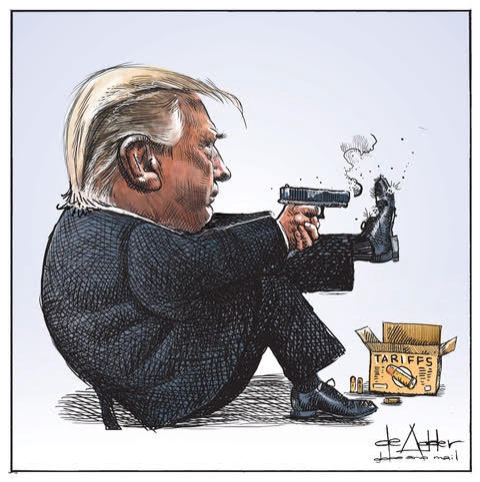
Tariffs

“Posting on his Truth Social platform, Trump said [Monday] that on the first day of his presidency he will charge Mexico and Canada a 25% tariff on all products coming into the U.S. He added in a separate social-media post that he would impose an additional 10% tariff on all products that come into the U.S. from China,… That would come on top of existing tariffs the U.S. has already imposed on Chinese goods.

“’This Tariff will remain in effect until such time as Drugs, in particular Fentanyl, and all Illegal Aliens stop this Invasion of our Country!’ Trump wrote.” WSJ: Trump pledges tariffs on Mexico Canada and China”

A tariff is a tax on an import. They are permitted by the World Trade Organization when leveed on goods receiving state subsidies in order to create a level playing field for trade. Such global trade has made an enormous contribution to the standard of living around the world.  “Ernie Tedeschi, former chief economist for President Joe Biden’s Council of Economic Advisers, said the North American tariffs would cost the typical American household almost $1,000 per year.” WP: “Trump tariffs-China Mexico Canada”

The normal expectation is that the tariff will reduce U.S. demand for the taxed import and encourage its domestic production. But the US labor force is fully employed and can only increase domestic production of the targeted goods by shifting workers from the production of goods the US has a comparative advantage in thus reducing our overall income. Though employment of manufacturing workers has declined in the US, manufacturing output has not because worker productivity has increased. In fact, our imports have not shipped American jobs overseas as increasing productivity has resulted in reduced manufacturing employment most everywhere in the world, including China, surely a good thing. WC: “Trade protection and corruption”

Immediately after Trump’s tariff announcement, the exchange rate of the dollar strengthened. A stronger dollar reduces the cost of imports (but increases the cost to foreigners of our exports), thus undoing to some extent the demand reducing impact of the tariff. But it hurts our exports because of their higher price to foreign purchaser and reduces our overall standard of living.

China and others hit with this tax are likely to retaliate with their own tariffs. “Under the United States-Mexico-Canada Agreement (USMCA), which took effect in 2020, goods moving among the three North American nations cross borders on a duty-free basis. ‘Obviously, unilaterally imposing a 25 percent tariff on all trade blows up the agreement,’ said John Veroneau, a partner at Covington & Burling in Washington.”  WP: “Trump tariffs-China Mexico Canada”

Should Trump actually impose these tariff’s he would (again) be violating the law, which only allows the President to impose tariffs without Congressional approval for national security reasons: WC: “Tariff abuse”

Trump’s threatened tariffs are not even leveed on the goods he wants to restrict (drugs and illegal aliens). Thus, unlike traditional tariffs they would be leveed to pressure Mexico and Canada to take other actions Trump wants. They are bargaining ploys. So at the cost of raising prices and lowering incomes in the US, weakening the global trading rules from which we have benefited so much, and weakening the checks and balances limiting an over extended executive branch, Trump may be playing his bargaining game again. But in my opinion the cost to us and the world trading system is too high.

War

My many visits to Sarajevo, Mostar, and Banja Luka in 1996-7 exposed me to the devastation of war, as did my multiple visits to Pristina in 1999-2000, and my 23 visits to Kabul between 2002-13.  My two months in Bagdad as part of the Coalition Provisional Authority in 2004 and five, two week follow up visits added live fire to my “post” war experiences that left me jumpy for many months after returning home.  None of these came close to the front-line experiences of reporter Robert Fisk, whose accounts are reproduced in his thick book “The Great War for Civilization: The Conquest of the Middle East,” though he reported from the same countries I had worked in.

Fisk’s reports on his interviews with actual people and his viewing of their butchered bodies and mass graves in the dessert confronts his readers with the real victims of war. To characterize his accounts as heart wrenching doesn’t come close to the true tragedies he reports. The deceptions and lies of all sides, add to the immense tragedies of our post WW wars, which have accomplished nothing but death and destruction.

The current Middle East wars (Israel’s slaughter of men, women and child in Gaza, West Bank, and Lebanon), following decades of Israel’s abusive rule over Palestinian territories, is beyond belief and too many Americans remain silent.  But no side has been “pure.” Our illegal and lie filled invasion of Iraq in 2003 followed years of American and British bombing of Iraq following the Gulf War in 1991 (Desert Storm). Our sanctions of Iraq over that period staved to death 1.5 million Iraqi’s, mainly children (despite the Food for Oil program), and the U.S. military’s use of depleted uranium munitions in that war dramatically increased Iraqi cancer cases and birth defects in the years that followed. Fisk reports on these and US and UK efforts to keep it all quiet.

Some of Iraq’s health problems were also aggravated by Iraq’s use of chemical warfare agents such as mustard gas and sarin during the Iran-Iraq war of 1980-88. The United States, being on Iraq’s side at that time, ignored its use of these chemicals, which remain in the soil today.  American leadership, which is desired by much of the world, is undermined by such double standards. Our government lies to its own citizens about its illegal behavior as well. Edward Snowden is paying a very high price for exposing some of it. We owe him a lot.

American interference in other countries’ affairs (other than by being the beacon on the hill) has rarely served our national interest. While we have blindly assumed that we would be welcomed as liberators in Panama (1989-90), Iraq (1991, and 2003), Somalia (1993, 2007, and 2010), Haiti (1994), Bosnia (1994), Afghanistan (1998, and 2001), Serbia (1999), Libya (1986, and 2011) and Syria (2014)–(need I mention Vietnam?), we failed to understand that peoples of most every country hate invaders no mater who they are. Moreover, our ignorance and arrogance made us very inept occupiers.

In Ukraine and Israel our interference stops short of sending our solders (almost). But Russia’s invasion of Ukraine could have easily and sensibly been avoided if the U.S. had encouraged the negotiations Russia sought in December 2021 “Ukraine’s and  dead and  war”.  Following Russia’s invasion, we tragically threw cold water on the agreement almost reached between Ukraine and Russia in the March 2022 negotiations in Turkey. ‘Peace negotiations in the Russian invasion of Ukraine”  So onward to the last Ukrainian. The final outcome is very likely to be identical to the March 2022, Istanbul Communiqué but with 120,000 dead and 600,000 wounded Russians and 70,000 dead soldiers and 10,000 dead civilians and 140,000 wounded Ukrainians and 500 billions of dollars’ worth of property destruction. In other words, Russia and Ukraine paid a huge price (with our help) for nothing.

Fisk gives human faces to the real people who pay the price for our aggressions. This horrible cost in lives and property has contributed nothing to our national security. America has much to offer the world and has contributed much to the quality of life around the world. But it has done so with its example, trade, and diplomacy, not its army. The principles and institutions on which American was founded and has flourished have served us well when we have remained faithful to them.

President elect Trump has nominated Tulsi Gabbard to become his Director of National Intelligence. When she left the Democratic party two years ago and endorsed Trump for President this August she praised Trump for “having the courage to meet with adversaries, dictators, allies and partners alike in the pursuit of peace, seeing war as a last resort” and condemned the Biden administration for the U.S. “facing multiple wars on multiple fronts in regions around the world and closer to the brink of nuclear war than we ever have been before.”

“In 2022, she also faulted the Biden administration for failing to address Russian concerns as it invaded Ukraine.

“’This war and suffering could have easily been avoided if Biden Admin/NATO had simply acknowledged Russia’s legitimate security concerns regarding Ukraine’s becoming a member of NATO, which would mean US/NATO forces right on Russia’s border,’

Following a 2017 trip to visit Syrian leader Bashar al-Assad, Gabbard defended meeting with an American enemy by saying:

“I think we should be ready to meet with anyone if there’s a chance it can help bring about an end to this war, which is causing the Syrian people so much suffering,”  “The Hill–Tulsi Gabbard-Trump Nomination — 11/14/24”

 I hope that she still thinks this way.

Palestine

Starting in July 1995, I led IMF technical assistance teams to Israel and the West Bank and Gaza to help implement the provisions in the Oslo Accords to establish a monetary authority (Central Bank). These visits were at the invitation of the Israeli government and began and ended with briefing meetings with officials at the Bank of Israel in Jerusalem. I later led the IMF’s Financial Stability Assessment of Israel. The last of my eleven visits was in December 2013.

Following Israel’s occupation of the West Bank and Gaza Stripe (WBGS) in 1967, it allowed Palestinian skilled workers to fill labor needs in Israel. In the mid 1980s 40% of the Palestine workforces was employed in Israel. But prior to my first visit Israel closed that door and began importing workers from North Africa to fill the resulting shortage.

Looking back, in light of Israels on going attacks on Gaza, West Bank, Lebanon, Syria and Iran, (what a Financial Times article headlined as “Israel’s Spiraling Offensive” https://www.ft.com/content/cbe18019-752f-4770-be40-fe4b2dc5abd7?d )  I am surprised at what we close our eyes to officially and unofficially.

We knew that Jewish settlements in the West Bank (and earlier in Gaza) on land stolen from Palestinians were in violation of the Fourth Geneva Convention, which prohibits the transfer of an occupying power’s civilian population into occupied territory. But in our Financial Stability Assessment of Israel, we ignored the financial implications for Israeli bank loans to setters on the grounds that the Israeli government would bail them out for any loses incurred. Looking back, I don’t really know where this judgement came from, but we understood that we were to ignore the Settlements.

During one of my missions we saw a new Jewish settlement being born before our eyes. A few dozen Jewish families had parked their trailers on Palestinian land. When Palestinians protested the theft of their land, the Settlers call on the Israeli Army for protection. Subsequently they would build permanent houses on this property.

On most of my missions to the WBGS we stayed in the famous American Colony Hotel in East Jerusalem (Laurence of Arabia had stayed there as had Peter O’Toole while later filming the movie). From there we had to drive each day to Ramallah, the headquarters of the Palestine Authority and future home of the Palestine Monetary Authority we were helping create.  Two features of our daily drive confronted us with how Israel was treating the Palestinians in the territories it occupied.

Israel was building separate Jewish only highways through the West Bank and to Gaza. Most Palestinians working in Ramallah commuted each day on their own roads.  There were separate entry check points for Palestinians and for Jews (and the international community such as us). We sailed through the Jewish entry, where our UN passports were quickly reviewed, while it took an hour or two for most Palestinians lined up at their check point to enter every day. I was amazed that Palestinian anger at such treatment was so subdued and seldom expressed.

Our several trips to Gaza and my meeting with Yasser Arafat and near abandonment in the desert are a fascinating story in their own right that you can read in my book:  “Palestine-Oslo Accords – My Travels to Jerusalem” Hearing the explosion of a terrorist attack on a Jerusalem bus while eating breakfast in the American Colony Hotel and subsequently fleeing to Jordan across the tiny Allenby Bridge over the Jordan River are also discussed in the same book.

Goodbye 2019 (and good riddance)

As 2019 and the decade of the 20 teens comes to a close, the impeachment of Donald Trump, only the third President impeached in the history of the United States, dominates the headlines.  My hope (I am a crazy optimist) and wish for my country’s sake is for Trump’s trial in the US Senate to adopt rules that most everyone will see as fair. That means giving Trump every opportunity to state and defend his case and the opposition every opportunity to state theirs. Some Republicans have denied the evidence presented in the House investigation that Trump offered favors (White House visit and military aid) to Ukraine President Zelensky if he would investigate the activities of Trump’s political opponent’s son in Ukraine. Other Republicans, such as Congressman Will Hurd, accepted the evidence but argued that the offence was not sufficiently serious to justify impeachment. Congressman Hurd’s judgement reflects the fact, I suppose, that political standards have sunk so low that we now accept that every President lies to us and abuses his authority (see the Washington Post’s Afghanistan Papers https://www.washingtonpost.com/graphics/2019/investigations/afghanistan-papers/documents-database/).  I think it would be a mistake to accept and normalize such behavior.

Here are some of the key issues of this year (at least those I wrote about) and a few of my blogs/articles about them:

Health care insurance

Given medical costs must be paid by someone (the recipient of the care, the tax payers, insurance premiums, etc.). Insurance shares the cost (the lucky who are well help pay for the unlucky who are sick). But how services are paid for (what and how much is covered by insurance, etc.) will also influence the services provided and their cost.

https://wcoats.blog/2019/08/01/health-care-in-america-2/

Trade war and protectionism

President Trump has torn up the rule book for negotiating freer and freer trade. The result so far has left us worse off.  Fed economists Aaron Flaaen and Justin Pierce found “that tariff increases enacted in 2018 are associated with relative reductions in manufacturing employment and relative increases in producer prices.” https://www.federalreserve.gov/econres/feds/files/2019086pap.pdf

Trump pulled out of the progressive Trans Pacific Partnership (TPP), negotiated a “new” North American Free Trade Agreement (whatever he calls it) that is worse than the existing NAFTA except for the new parts taken from the TPP, worsened trade with China (so far–see Federal Reserve report above), alienated potential partners who would have happily joined us in negotiating with China, and angered the EU with whom he wants a new trade agreement. His potentially illegal uses of tariffs have introduced government protection of favored industries increasing crony capitalism. He continues to weaken the World Trade Organization (WTO), which has provided the bases of increasingly free rule-based trade since WWII. The growth in trade over the last 70 years has helped lift most peoples of the world out of dire poverty.  The number of people living in extreme poverty fell from 2.2 million in 1970 to 0.7 million in 2015.

https://wcoats.blog/2019/11/18/protecting-jobs/

https://wcoats.blog/2019/08/05/econ-101-currency-manipulation/

https://wcoats.blog/2019/06/07/the-sources-of-prosperity/

Foreign wars and policy

President Trump rightly condemned our forever wars and promised retrenchment. I agree with his assessment of our excessive military aggressions and deployments abroad, but for one reason or another he has failed to deliver. The New York Times reports that: “Under President Trump, there are now more troops in the Middle East than when he took office.” https://www.nytimes.com/2019/10/21/world/middleeast/us-troops-deployments.html

Trump seems to act on impulse without serious consultation with his National Security Council, State Department or Pentagon, decimating our diplomacy. His periodic insults to our foreign allies haven’t helped either.  Nor have his love affairs with Putin, Kim Jon-un, and Xi Jinping (do you see a pattern here?).  Diplomacy is the alternative to military adventures for serving our national interests abroad. Trump has failed to fill important State Department positions and seems to pay little attention to his NSC and State Department briefings. Having removed two ambassadors to Ukraine in one year (this year) because his personal lawyer, Rudy Giuliani, thought they were insufficiently loyal to Trump, the U.S. currently has no ambassador in Ukraine.  Trump’s stewardship of our international relations has been a disaster.

Then there was Trump’s intervention in Military justice: From the Military Times: “President Donald Trump’s decision to grant clemency in the cases of three military members tangled in war crimes cases raises questions about whether troops are being given a green light to disobey the rules of law…

Army 1st Lt. Clint Lorance, convicted of second degree murder in the death of three Afghans, was given a full pardon from president for the crimes. Army Maj. Mathew Golsteyn, who faced murder charges next year for a similar crime, was also given a full pardon for those alleged offenses.  Special Warfare Operator Chief Edward Gallagher, who earlier this fall was acquitted of a string of alleged war crimes while being convicted of posing with a dead Taliban member, had his rank restored to Chief Petty Officer by the president.”  “We-shouldnt-forget-what-whistleblower-seals-told-us-about-eddie-gallagher”  What is Trump thinking? What does he have in mind?

https://wcoats.blog/2019/12/14/nation-building-in-afghanistan/

https://wcoats.blog/2019/05/03/oslo-the-play/

https://wcoats.blog/2019/03/11/is-rep-ilhan-omar-anti-semitic/

Monetary policy and the international monetary system

While monetary policy has been relatively good for a floating exchange rate system, asset price bubbles and international currency flow imbalances persist and, in my view, are unavoidable. We need to adopt a hard anchor for the value of the dollar.  The shockingly large fiscal deficits (over one trillion dollars per annum in 2019) with a fully employed economy, when we should be running a budget surplus to provide room for deficits during the next downturn, are building serious risks for the not so distant future. Trump’s attacks on the Federal Reserve’s monetary policy will make managing those risks more difficult.

https://wcoats.blog/2019/01/25/central-banking-aware/

https://wcoats.blog/2019/03/24/central-banking-award/

https://wcoats.blog/2018/05/01/free-banking-in-the-digital-age/

https://wcoats.blog/2019/07/24/whither-libra/

https://wcoats.blog/2019/04/16/returning-to-currencies-with-hard-anchors/

Information and the Internet

The Internet has had a profound impact on how we live and do business. It is hard to imagine a day without our mobile phones. But like all new tools and technology it opens the door to new ways of doing harm as well. This is currently most conspicuous with the spreading of fake news and learning anew what news sources to trust and not trust.

https://wcoats.blog/2019/12/01/new-tools-require-new-rules/

Domestic politics and Trump

In my discussions of the Trump administration I have tried to focus on policies, some of which I like and some I don’t, rather than on Donald Trump himself, about whom I like nothing. The following focuses on Trump.

https://wcoats.blog/2019/12/27/a-letter-to-the-republican-party/

https://wcoats.blog/2019/11/20/to-whom-or-what-am-i-loyal/

My friend Jonathan Rauch explains the limitations of my efforts to focus on policies in an article well worth reading. “Believing is belonging,” https://www.nationalaffairs.com/publications/detail/rethinking-polarization

Modern Society and its challenges

If we move away from personalities and dig deeper into our human motivations that inform policy design and choices, we can’t escape the role of incentives at the center of much of the analysis of my profession–economics. I have and will continue to explore my thoughts on human nature and the role of incentives, institutions, and customs in our search for how best to live free with others seeking their own goals in our society.

https://wcoats.blog/2019/08/10/where-does-the-desire-to-explore-come-from/

https://wcoats.blog/2016/11/22/globalization-and-nationalism-good-andor-bad/

https://wcoats.blog/2016/12/31/my-political-platform-for-the-nation-2017/

Happy New Year


A Letter to the Republican Party

As a no doubt futile outlet for my frustration with the Republican Party, I have been enclosing the following letter in the return envelops they keep sending me with the request for financial support.

Dear Members of the Republican National Committee,

The Trump administration has had some positive achievements domestically (tax reform, regulatory reforms and court appointments). However, its continued increase in government spending (annual deficits of one trillion or more when the economy is at a cyclical peak) is wrong and unthinkable for Republicans. President Trump’s weakening of America’s support for and role in international organizations, abandonment of the Iran Deal and anti-nuclear proliferation treatises, and war on trade, are bad for America and the world we live in.  President Trump’s divisive language is unbecoming of the leader of a great nation, a nation of immigrants. The Republican Party has failed to stand up for these principles and to criticize the President for these offenses.

Even more concerning is your acquiescence to President Trump’s lying, immorality, and corruption. His clearly documented attempted bribery of the President of Ukraine for personal gain is damaging American security interests. His obstruction of Congress’s execution of its constitutional duties is very concerning. These and other acts cross the sadly low bar of acceptable behavior.

For the sake of our deeply divided country, the Senate owes us all an impeachment trial that any honest person will consider fair. President Trump must have every opportunity to explain and defend his behavior and those challenging it must have every opportunity to make their case. President Trump obstructed the House’s efforts to obtain firsthand evidence of the President’s attempt to use his executive authority for personal gain. It is essential that the Senate permit the testimony of those blocked in the House by the President (Bolton, Mulvaney, Mike Duffey).

With your silence you have abandoned me and my continued commitment to limited and sound government.  I cannot continue to support the party until you stand up and again defend our principles.

Sincerely,

Warren Coats

Buy American, Hire American

President Trump continues to repeat his populist slogan “Buy American, hire American,” reflecting the way he and Steve Bannon appear to understand what is needed to make America Great Again. Thus, with apologies, I endeavor again to explain why this catchphrase is fundamentally wrong and would actually make America weak. “Trade and Globalization” “Save trade”

If buying an American made product or service (100% American, 90%, 51%?) or hiring an American worker is my best option, I would not need to be compelled to do so by the government. If it is not my best option, being compelled to do so forces me to accept an inferior option. It would make me worse off. The Trump family understands this as their hotels import and purchase foreign made products (from China, Philippines and India, to name a few) and Ivanka sells clothing made in China.

It is obvious that being forced to buy and hire American would make many of us worse off (not to mention diminish our freedom of choice), but are there compensating benefits or gains for others in the American economy that would justify making us worse off? “Teeing up Trump tariffs”

Buy American

If I must buy an American made Corvette rather than a German Porsche, does the American economy benefit? To simplify, leave aside the fact that a substantial part of the components making up a Corvette are imported from various countries. The fact that I had to be forced to buy the American car rather than the German one, i.e. that it was an inferior deal, means that the American workers who make it were reallocated from the production of export products at which the United States had a comparative advantage. Trading less as a result of buying American mean allocating American workers to producing things (Corvette) that they are not as productive at making. They would be moved from producing Boeing aircraft to sell to Germany (to pay for our imports of Porsches) to producing Corvettes. So in addition to my being made worse off as a result of having to buy American, the American economy as a whole would be worse off as a result of a less productive work force and thus lower overall income (lower GDP). This is Econ 101.

In addition, as noted by the Financial Times, “Attempts to restrict procurement to domestic companies tend to backfire. They induce retaliation from trading partners, harming US businesses trying to sell abroad. They raise input costs, ensuring less infrastructure is built and fewer construction workers are hired for each dollar of public spending.” “The Pitfalls of having to buy and hire American”

Hire American

The meaning and impact of a requirement to hire Americans is a bit more complex. If the terms to American companies of employing the workers needed, whether they are citizens, permanent residents, or temporary or permanent immigrants from abroad, are not competitive with importing the product or service, American companies will in effect hire foreigners abroad (i.e. they will import the goods and services produced abroad). Thus it is a bit unclear what “hire American” means. “The long, rough ride ahead for ‘Made in America'”

Presumably, “hire American” refers to our immigration policies. Indeed our immigration laws need fixing. This includes providing a solution to the status of the 10 or 11 million people living here illegally, and adjusting immigration quotas to better match the needs of American firms for workers without undercutting the status of existing American workers. “Illegal-aliens”

The decline in American manufacturing jobs is largely the result of automation, not foreign trade. Manufacturing employment has fallen almost everywhere in the world as manufacturing output has increased. Automation enables the work force to produce more and thus enjoy a higher living standard. It need not cause unemployment.

The wonderful film “Hidden Figures” tells the true story of the large number of human “computers” employed by NASA (the National Air and Space Administration) who cranked out the numbers needed to put Americans in space and bring them home again. The stars of the film are three black women whose mathematical skills were indispensible to NASA. At the end of the day and in time for the first American to orbit the earth in 1961, new IBM’s mainframe computers proved essential to crunch the critical data fast enough. Overnight the human computers were no longer needed. But rather than becoming unemployed, most of them retrained to program and run the IBM computers with an unbelievable boost in productivity. While other things also affected NASA’s workload, the employment data are interesting. In 1960 NASA had 13,500 in house employees, which increased to 41,100 by 1965 and gradually drifted down to 18,618 in 2010. The numbers for contract workers on the same dates were 33,200 in 1960, 369,900 in 1965 and zero in 2010.

The President’s appeal to Buy American and Hire American, in addition to restricting our freedom of choice, flies in the face of what made America Great in the first place. As proclaimed by the Financial Times: “The principle should remain to keep the US economy as open as possible to the inflow of good products and good workers from abroad. Slamming down the drawbridge is only likely to impoverish the residents of the citadel.”


Globalization and Nationalism: Good and/or Bad?

Globalization is under attack and nationalism is on the rise. The evidence includes the election of Donald Trump. But what is this globalization these people are so opposed to?

After 1945—after the Great Depression and two world wars—Western nations established an international system of rules that honored national sovereignty, facilitated the flourishing of global commerce, and encouraged respect for human rights and liberties. This liberal international order resulted in the longest period of peace among the world’s major powers the world had ever seen, broad-based economic growth that created large middle classes in the West, the revival of Europe, growth in poor countries that lifted hundreds of millions of people out of poverty, and the spread of freedom across the globe. Fareed Zakaria, Washington Post/2016/11/17/. This is the liberal international order that I largely support.

What exactly is under attack and what is on the rise? In a very insightful article in the National Review, Michael Lind characterizes the globalist view as follows: “In the 1970s and 1980s, libertarians made all of the major arguments heard from globalists since the 1990s: Favoring citizens over foreign nationals is the equivalent of racism; national borders impeding the free flow of labor and goods are both immoral and inefficient; the goal of trade and immigration policy should not be the relative security or relative wealth of particular countries, but the absolute economic well-being of all human beings.” Michael Lind, National Review, Sept 15, 2016

What about the rise of nationalism in relation to globalism? I believe strongly in the economic benefits of the freest possible global trade, but it would be a mistake to overlook or ignore the concerns of those who oppose it. In this note I attempt to restate the case for freer trade in terms that should appeal to economic nationalists who wish American trade (and other) policies to reflect the interests of Americans first (before taking into account the benefits to the rest of the world). I also reflect on the international rules of trade from the perspective of the sovereignty concerns of nationalists, or what economist Larry Summers calls “responsible nationalism.” Voters deserve responsible nationalism not reflex globalism

I was forced to think more carefully about the case for freer trade by the opposition to globalization expressed by many of Trump’s supporters. But I quickly discovered that my friend Michael Lind has been there before (see above) as has the brilliant social psychologist Jonathan Haidt who noted that: “those who dismiss anti-immigrant sentiment as mere racism have missed several important aspects of moral psychology related to the general human need to live in a stable and coherent moral order.” Jonathan Haidt: “When and why Nationalism Beats Globalism”, The American Interest, July 2016

Haidt’s closing words succinctly summarize our challenge: “The great question for Western nations after 2016 may be this: How do we reap the gains of global cooperation in trade, culture, education, human rights, and environmental protection while respecting—rather than diluting or crushing—the world’s many local, national, and other “parochial” identities, each with its own traditions and moral order? In what kind of world can globalists and nationalists live together in peace?”

Immigration and trade are intimately linked – if Mexicans can make it in Mexico and export it to the U.S. they will be less interested in moving to the U.S. in order to build it there (in fact, net Mexican migration to the U.S. has been negative for the last few years)—and thus I will look at both.

The most promising starting point in my view is with the sovereignty of each American citizen. Unlike the Magna Carta, which wrested more autonomy for the people from the King, the free men and women of revolutionary America gave up a limited amount of their autonomy to a new state in order to better protect their property and individual rights. The direction of delegation was the exact opposite of what the world had ever seen before. It is not without profound significance that our Constitution begins with “We the people.”

Thus it is quite appropriate to judge governmental authority and policies by the standard of how well they serve our individual sovereign interests. In evaluating those interests, it is appropriate to do so from the perspective of John Rawls’ veil of ignorance, i.e. principals of fairness—rules of the game—that we accept as fair without knowing which positions in society we will occupy. This is the perspective of free market, competitive capitalists and is opposite to the perspective of crony capitalists who exploit the power of government for their personal benefit.

We have surrendered limited (enumerated) powers to our governments (local, state, federal, etc.) in order to enjoy greater security and protection of our property but also to support and protect our freedom to trade and to enjoy its benefits. No one really needs to be convinced that being able to specialize in what we make best and trade it for other things we need has enormously increased our wealth over being self-sufficient (no trade). No one needs to be convinced that by investing in tools and better technologies we have been able to produce more for trade and thus become wealthier. But investing and trading require common understandings with those with whom we trade—the rules of trade. We have long ago understood that we all benefit from giving up some of our sovereignty to our government to negotiate and enforce the agreed rules of trade, protect our property, and mediate disputes over whether the rules were followed.

The simple act of entering into a contract with someone involves giving up the freedom to act as we want each moment in exchange for a similar commitment by our counterparty for the mutual benefit of both of us. Where the mutual benefits of such rules are greater than the cost of the forgone freedom of action, the agreement is a positive sum arrangement—win-win. Conforming to international product standards, e.g. adhering to standards of weights, measures, voltage, labeling, etc., facilitates trade. The key policy issues in this area are the nature and details of the rules of trade that best serve our personal interests (in the Rawlsian sense) and thus our community and national interests, and the extent of the market in which we are able to trade (village, province, nation, world). “Free Markets Uber Alles,” Dec 2014

The more widely we can trade, the greater is our opportunity to specialize in what we produce and to develop and apply more productive technologies.

“Trade and Globalization,” Aug 3, 2016. Our founding fathers were rightly concerned about the power of the new American government to limit the right of its citizens to trade. In fact, the U.S. Constitution prohibited the States from interfering with trade across State borders (interstate commerce). Article I, Section 8, Clause of the Constitution states that the United States Congress shall have the power “To regulate commerce with foreign nations, and among the several States, and with the Indian Tribes.” While Congress has occasionally used this power to impose restrictions on trade across national borders, the majority of Americans still believe that cross border (international) trade has been mostly good for the U.S. (65% in 2015). The wrong-headed effort to save American jobs during the Great Depression with high tariffs imposed by the Smoot Hawley Tariff Act of 1930, precipitated retaliatory tariffs around the world and a disastrous collapse of global trade and employment. U.S. imports and exports fell by more than half and the whole world was made poorer by it.

As noted above, the resulting increase in the world’s wealth from technical progress and trade has been enormous. But the incentive created by trade in a large market to innovate new products and more efficient ways to produce them has also meant that some of the existing products and/or technologies lose out and must give way to the improved ones. Those producing the old products and services are forced to find new ones and if necessary new productive skills.

The United States has generally grown economically faster than most other countries, in part, because its citizens have not been willing to allow those who lose out in such competition to block progress by the “winners” by protecting their products and jobs. The ultimate willingness of Americans to accept and protect the dynamic economics of competitive national and global markets rests, I think, on the three pillars: maximum wealth creation, maximum opportunity for everyone (the chance to win at a fair game), and help for those who lose out.

Americans should only be willing to give up some of their personal sovereignty to their government when they gain more in exchange in the Rawlsian sense of a positive sum, fair game. We should impose the same conditions on the extension of the rules of trade beyond national boundaries. This is the standard by which bilateral, regional and global trade agreements should be judged. They have the largest potential for win-win expansions of mutual trade and the greater income and wealth that expanded trade can produce. The Bretton Woods institutions created after World War II (the IMF, World Bank and World Trade Organization) established the institutional arrangements for such international cooperation. It is important to insure that such agreements do not increase the protection of “privileged” industries or sectors of the economy. In fact, they should diminish such protections where they already exist, which is why many European industries and interests oppose the Transatlantic Trade and Investment Partnership (TTIP). Much of the Trans Pacific Partnership (TPP) has this positive character. American leadership in creating the international institutions through which we interact with others abroad, i.e., through which the rule of law is established and enforced internationally, has ensured that the international order has remained true to the values on which America was founded.

The evolution of man established the family as the unit of first and primary concern. The well being of one’s family stands above the interests of all others. However, the process of civilization has been one in which mechanisms of trust and mutual assistance have convinced individuals to yield some of their sovereignty to larger units (village, state, etc.) under conditions that strengthened the security and well being of family units. Globalization is the logical conclusion of such a process. It is the development of laws of cooperation and the mechanisms of their enforcement (i.e. the rule of law) that potentially raise the welfare of everyone. But the details of the expanding circles of cooperation are important and must not violate genuine national and family interests.

In listening to the views of many Trump supporters I concluded that their anger and demand for big change derives from feelings that their government—especially the federal government—is not serving their legitimate interests and in fact is interfering with their lives without commensurate benefits. “The reason Mr. Trump won, [Mr. Bannon] says, ‘is not all that complicated. The data was overwhelming: This is a change election. People weren’t happy with the direction of the country. So all you had to do was to give people permission to vote for Donald Trump as an agent of change, and make sure he articulated that message.’” steve-bannon-on-politics-as-war-WSJ

So what are the Trump supporters mad about? What do they want to change? To the extent that they are concerned about the same things I am, it is that too much of our individual sovereignty has been taken by an overweening government, which has become a big brother who attempts to make our decisions for us for our own welfare. Our personal choices have increasingly been taken away from us and with them our opportunities. The “elites” have arranged the rules for there own benefit. It is no longer a fair game.

The weaknesses of current arrangements at the national level that seem to anger Trump supporters largely concern: a) regulatory capture of an over extended regulatory state, b) inadequate provision of a level playing field and c) an inefficient and poorly designed safety net for the losers in the competitive game. Very briefly:

  1. a) The crony capitalism reflected in President Eisenhower’s famous concerns with the risks of a military industrial complex, have metastasized into a much broader capture by legacy industries of a much more extensive government intrusion into the economy. Wherever government regulates (and some are actually helpful), the most affected, established firms are best placed to insure that such regulations benefit rather than hurt them, usually by protecting themselves from the competition of new comers. Wall Street comes to mind. Changing direction on bank regulation, Cayman Financial Review April 2015
  1. b) A level playing field. Good quality education (especially K-12) is one of the most important ways for the poor and initially disadvantaged to get into the productive economy and to rise as far as their talents and energy will take them. But the education provided to this group is often of poor quality. The iron grip of teachers’ unions has often served the interests of teachers at the expense of their students. School choice (tuition vouchers) would introduce badly needed competition in the provision of education to all – the poor as well as the rich (who all ready enjoy considerable choice).
  1. c) An efficient safety net. When jobs disappear to technological advancements (e.g., increased automation) the affected workers and capital need to be reallocated to more productive uses. But this is economist speak. The workers involved often lose their human capital (i.e. their existing skills lose value in the market place) and need to retrain for new tasks. Older works might never rebuild new skills sufficient to restore their previous incomes. Government policy should give more attention to vocational training (and retraining). But the ultimate safety net should be strengthened and redesigned by replacing existing welfare programs and social security with a guaranteed minimum income for each and every citizen (in the spirit of Milton Friedman’s negative income tax). US federal tax policy, Cayman Financial Review July 2009

Responsible Nationalism and Globablization

As Michael Lind observed earlier, America has been dividing into liberal internationalists like myself who live in the big urban centers and civic nationalists, who live in the rest of the country. The civic, economic, responsible and just plain old nationalists seem to be reacting against their sense of a loss of control over their own lives. Big brother seems to be regulating more and more what we can do, say, produce, or buy. Their opportunities are being thwarted by an unfair game—crony capitalism for the well-placed elites. This sense of a loss of control is compounded by concerns over the lack of control of our borders against undesirable immigrants and potential terrorists. While the assimilation of different cultures into the framework of basic American values of personal freedom and responsibility can be touchy and challenging at times, the finger pointing and pressure from the American left for full cultural integration feeds the fears of many of a loss of cultural, ethnic, and religious identity.

When some groups receive preferential treatment some other groups are necessarily discriminated against. While I have tried hard to accept the logic of “Black Lives Matter,” it always rubbed my sense of fair play the wrong way. All lives matter. Thus while I am saddened that it seems necessary to some white males (I am guessing they are males because that is what the press always says) to carry signs saying “White Lives Matter,” I can understand. If we need to say the one, we need to say the other if we still have any sense of fairness.

So there are plenty of things for Trump supporters to be angry about and to want to change. But now that we have him, what changes should we push for? I am particularly interested in changes that will reassure Trump’s angry voters to support American participation in the liberal global order. In evaluating what is in our national interest, we need to consider the long term rather than immediate benefits of a rule based, freely competitive world order.

We should push for a thorough reform of our tax system (see my article above), strengthen our safety net for those displaced by technology (by far the major source of job losses in the U.S.) and trade, and shift more of the regulation of commerce to the market (to consumers and owners) thus significantly reducing government regulation. We must also fashion an immigration policy that meets the needs of our economy without overwhelming the capacity of our society to absorb new members. Existing long term, undocumented residence need to be offered a realistic path to legal status. But most of all, in fashioning these and other changes we need to listen carefully and constructively to each other’s concerns and take them into account.

Making sense of Trump

With the latest scandals and polls dropping, Trump’s defeat becomes ever more certain. But rather than broadening his appeal to the undecided Trump has instead doubled down with his hard-core base and declared the election “rigged.” What is he thinking? What is his strategy? The generous interpretation was given by veteran GOP strategist Mike Murphy: “’I think Trump is right: The shackles have been released, but they were the shackles of reality. Trump has now shifted to a mode of complete egomaniacal self-indulgence.’” http://wapo.st/2ef3vmQ This interpretation states that Trump is only making excuses for his defeat to save his damaged ego.

Maybe. But few observers claim that Trump is dumb. This implies that he knows what he is doing. His repeated claims that the establishment (press, elites, corporate America) has rigged the elections is so treasonous that Republic House leader Paul Ryan spoke out against them Saturday: “’Our democracy relies on confidence in election results, and the speaker is fully confident the states will carry out this election with integrity,’ Ryan’s press secretary, AshLee Strong, said in a statement sent to several media outlets.” http://www.theblaze.com/stories/2016/10/15/paul-ryan-pushes-back-against-trumps-claims-that-the-election-is-rigged/

“The people who speak for Donald Trump’s presidential campaign on Sunday tried to walk back his incendiary comments about a ‘rigged’ election, with vice presidential candidate Mike Pence saying that Trump was only referring to media bias and vowing that ‘we will absolutely accept the result of the election.’… And literally hours after those media appearances, Trump was back on Twitter ― making clear that, yes, he thought voter fraud was a real threat to the election’s legitimacy.” http://www.huffingtonpost.com/entry/trump-rigged-election_us_5803876de4b0162c043c7d1f

Poor Mike Pence who seemed a generally decent guy. He is in an even worse position than Paul Ryan being dragged along through Trump’s seditious muck. What does Trump want or expect his hard-core supporters to do when he losses in a rigged election? He doesn’t seem to be pumping them up to just hang their heads and go home. Trump seems not to care who or what he destroys as befits his disgusting model of zero sum capitalism in which he profits (wins) by gaining better terms in deals with counterparties and/or stiffing business partners with his bankruptcies. No win win for Trump.

The real concern, as expressed strongly by Fareed Zzkaria Friday, is that along with destroying the Republican Party, Trump will destroy America as well. http://wapo.st/2dWNmQe

Trump has gone from evil to seriously dangerous, not because he has changed any—he hasn’t—but because there are so many people who have been willing to support his ugly, incoherent, ranting candidacy. I understand their anger at an ever larger, more intrusive government that has in the nature of things been captured for the benefit of crony (rather than real, competitive) capitalists. But Trump only promises to expand government further and to manipulate it more skillfully, for the benefit of….??? I will vote for Gary Johnson and William Weld.


Republicans and the Fiscal Cliff: What are they thinking?

Our government, whether headed by a Republican or a Democrat, governs for all of us. The Republicans lost this time around, though they still control the House of Representatives. They are in the minority. The Democrats, who control the Senate and the Executive branch, rightly expect to introduce and oversee policies that are more aligned with their view of what is best for the country than the views of the party that lost. But if they are wise and have the best interests of the country at heart they will take into account the views of the rest of the country as well. Compromise is part of the art of governing a diverse people successfully. Limiting the scope of government is another. See my comments on this theme over four years ago: “The Death of the Right?”

Many Republicans, however, are behaving as if they think they should force their views on the majority.  Not only is this unwillingness to compromise unacceptable in our democracy, it is producing worse outcomes for those of us who would like to keep government smaller. These republicans rejected a deal last year tentatively agreed between House Speaker John A. Boehner (R-Ohio) and President Obama that would have increased tax revenue by $800 billion over the next ten years in exchange for spending cuts three times that.  Without some sort of agreement by the end of this week, falling over the “fiscal cliff” will increase tax revenue by around $5,000 billion over the same period. That won’t happen, of course, as both parties want to restore the existing income tax rates for all but the wealthy. The Democrat controlled Senate has already passed such a bill, which would increase tax revenue by $700 billion over the next ten years. That would become the base line from which Obama would bargain for more tax revenue in exchange for budget cuts.

I assume that some minimalist agreement will be reached in the next week that will eliminate the worst tax effects from going over the cliff, but that will only perpetuate and prolong uncertainty over how our currently unsustainable future spending commitments will be rained in and/or financed. This uncertainty is a major factor contributing to the slow recovery of investment and the economy in general. The current impasse will continue to do great damage to the county.

According to Ezra Klein: “If Boehner had taken the White House’s deal in 2011, he could’ve stopped the tax increase at $800 billion. If he took their most recent deal, he could stop it at $1.2 trillion. But if he insists on adding another round to the negotiations — one that will likely come after the White House pockets $700 billion in tax increases — then any deal in which he gets the entitlement cuts he wants is going to mean a deal in which he accepts even more tax increases than the White House is currently demanding.

“Today, Boehner wishes he’d taken the deal the president offered him in 2011. A year from now, he might wish he’d taken the deal the president offered him in 2012.”[1] See also: “The GOPs worst cliff myth”[2]

For the sake of the country and for the sake of the principles in which many Republicans believe, they must recover (with the cooperation of Democrats) the art of governing.


[1] Ezra Klein, “Obamas small deal could lead to bigger tax increases” The Washington Post, Dec 22, 2012

[2] Ezra Klein, The Washington Post, Dec 24, 2012.

Romney on Culture

Mitt Romney is clearly an intelligent guy with an impressive business track record. This makes it all the more disturbing that while visiting Israel Romney felt called upon to blame the difference in living standards between Israel and the occupied West Bank and Gaza (WBG) on cultural differences. I will unpack the ignorance of this claim further on, but first, why did he do it?

We know that Romney is weak on foreign policy issues and regrettably influenced in this area by neocon advisors who tend to favor the one Israeli state solution to the Israeli/Palestinian problem favored by the Israeli right wing over American interests and policies. Since George W Bush American policy has explicitly supported a two state solution. Those unfamiliar with the history of these issues are urged to read my earlier blogs on the topic: “The View from the West Bank – a history of the conflict”, “Jerusalem in august 2006″, “Leaving Israel August 11 2006″. “The Invented Palestinians”.

The United States has a strong commitment to the military defense of Israel and it was appropriate for Romney to restate that commitment while visiting Israel. But it is neither in our national interest nor Israel’s to support or endorse every measure the current Israeli government might think up or take in relation to its neighbors. Israel’s well being depends on making a just peace with its neighbors and returning the West Bank and Gaza to the Palestinians that live there. This is well known and accepted by most Israeli’s but not, apparently, by Romney’s neocon advisors. Given Romney’s lack of understanding in these issue, wisdom would have called for him to remain silent on the issue. So why did he say it, then deny it and than say it again?

First, what did he actually say? According to the Associated Press (“Romney outrages Palestinians by saying Jewish culture helps make Israel more successful”) on July 30 Romney told a breakfast meeting with wealthy donors at the King David Hotel in Jerusalem:  “As you come here and you see the GDP per capita, for instance, in Israel which is about $21,000 dollars, and compare that with the GDP per capita just across the areas managed by the Palestinian Authority, which is more like $10,000 per capita, you notice such a dramatically stark difference in economic vitality…. And as I come here and I look out over this city and consider the accomplishments of the people of this nation, I recognize the power of at least culture and a few other things.”

Saeb Erekat, a top Palestinian official told the AP: “What is this man doing here? Yesterday, he destroyed negotiations by saying Jerusalem is the capital of Israel, and today he is saying Israeli culture is more advanced than Palestinian culture. Isn’t this racism?”

The next day in an interview with Fox News’ Carl Cameran in Poland, Romney denied that he has spoken of the role of culture in the differences in income between Israel and Palestine. (Cameron interview of Romney) It did not take long for Romney to correct this misstatement in a National Review article under his name, “Culture does matter-Mitt Romney”: “During my recent trip to Israel, I had suggested that the choices a society makes about its culture play a role in creating prosperity, and that the significant disparity between Israeli and Palestinian living standards was powerfully influenced by it. In some quarters, that comment became the subject of controversy.”

So why did he say it?  Sadly Tom Friedman probably has it right in his July 31 column in the New York Times: “Why not in Vegas”  “Since the whole trip was not about learning anything but about how to satisfy the political whims of the right-wing, super pro-Bibi Netanyahu, American Jewish casino magnate Sheldon Adelson, why didn’t they just do the whole thing in Las Vegas? I mean, it was all about money anyway — how much Romney would abase himself by saying whatever the Israeli right wanted to hear and how big a jackpot of donations Adelson would shower on the Romney campaign in return.”

So statesmanship, diplomacy, American national interest had nothing to do with it. So maybe Romney actually understood how stupid his comments were. But let me walk us through the facts.

First, Palestinians and non Arab Israelis are first cousins racially. So this can’t be what Romney had in mind. Religiously, Judaism, Christianity, and Islam, the three great monotheistic religions, with Islam the most recent in that evolutionary chain, all share cultures of individual responsibility and work ethic. So it is hard to see Romney’s point in this area. My point is not that culture is unimportant, though calling in “everything” is clearly wrong. My point is that anyone who knows anything about Israel and the WBG, knows that it does not apply there. A very informative and well worth reading criticism of Romney’s statement is in Fareed Zakaria’s Aug 2, Washington Post op-ed, “Capitalism not culture drives economies”.

If Romney had driven the short, but time consuming, distance from Jerusalem to the temporary Palestinian capital in Ramallah, he would have seen some of the physical evidence of how Israel is choking the economies of the occupied, land locked West Bank and the blockaded Gaza Strip (high concrete walls cutting through Palestinian farms, check points blocking the movement of people and commerce, illegal Israeli settlement on Palestinian lands, etc.). I would have thought that a man of Romney’s intelligence would chose to remain silent on these deeply explosive issues until he could consult a more balanced group of foreign policy experts. Sadly he seems to have put politics above national interest.