
Hamas had good reasons for its Oct 7 attack on Israel. However, its vicious attack was not justified. Israel has good reasons for its attack on Gaza. However, its vicious attack is not justified. What follows? Who will occupy and rule Gaza when Israel ends its assault and withdraws?
One State Solution
The answer to that question should reflect what will best serve Israel’s security and prosperity. “I am the only one who will prevent a Palestinian state in Gaza and [the West Bank] after the war,” Netanyahu told Likud lawmakers, according to Israel’s Kan public broadcaster. However, the aim of the right wing of Netanyahu’s government to kill or otherwise remove Palestinians from Gaza and the West Bank in order to allow a single, democratic, Jewish state over the whole region is not acceptable to most Jews both in Israel and elsewhere. Such a genocide or pogrom would not be acceptable to most people.
The 700,000 Palestinians driven from their homes in 1947 in the war that established the state of Israel now occupy Gaza, the West Bank, Jordan, Syria, and Lebanon. Along with increasing illegal Israeli settlements in the West Bank and the Israel army’s occupation of the WBGS since the Six Day War in 1967, frictions have increase between these regions. For more details see my book: Palestine: The Oslo Accords Before and After-My Travels to Jerusalem”
One of many abuses under Israel occupation has been the arrest and detention of Palestinians, many of them children, for protesting or attacking their occupiers. Over 800,000 have been jailed, about a third with no charges or trail. “The power to incarcerate people who have not been convicted or even charged with anything for lengthy periods of time, based on secret ‘evidence’ that they cannot challenge, is an extreme power,” noted Israeli human rights group B’Tselem. “Israel uses it continuously and extensively, routinely holding hundreds of Palestinians at any given moment.” “Israel Palestine detention”
A recent example was the arrest of 22 year old Ahed Tamimi on Nov 6. “After holding Ms. Tamimi for nearly three weeks without access to a lawyer or her family, Israel moved to incarcerate her under administrative detention…. The Israeli military has said Ms. Tamimi was arrested on suspicion of inciting violence and calling for terrorist activity, but has declined to provide further information. Her mother said the arrest was based on a post to an Instagram account in her name that referenced Hitler and vowed to “slaughter” settlers in the West Bank.” NYtimes – Ahed Tamimi detained”
While Hamas has fired thousands of rockets into Israel, they have resulted in few casualties. Between December 9th 1987 and April 30th 2021, conflict casualties for Palestinians and Israelis claimed 13,969 lives. Fully 87% of the dead were Palestinian. If Israel is not prepared to give full and equal rights to Palestinians within one integrated state, it will need to make peace with and end its occupation of the WBGS. “A one state solution”
Two State Solution
“President Biden recently declared his desire to see a ‘revitalized’ Palestinian government that could bring together Gaza and the West Bank under ‘a single governance structure.’ That is a worthy aim.” A two state solution requires a Palestinian agreement with Israel over borders, right of return (if any), the status of Jerusalem and an efficient, properly functioning Palestinian government for WBGS. Palestinians will need to give up their claims to lost homes now in Israel and formally recognize the State of Israel. But neither side will be safe and secure without a proper, and effective Palestinian government. ‘Biden Calls for Recognition of Palestinian State”
Effective governance of Gaza must be part of the new Palestine (following a transition period of UN or other international control). To get there an interim administration by Hamas and Palestinian Authority officials will be necessary while preparing for internationally supervised election in the WBGS. How does that square with Israel’s determination to obliterate Hamas?
Israel’s goal should be to end the capacity of Hamas fighter to threaten Israel. That does not and must not mean to destroy the capacity of Gaza’s administrative bodies to oversee the essential services any society requires. Seen in terms of the United States, it would mean incapacitation of the U.S. military, not the other departments of the U.S. government.
If you think this is obvious, consider the amazing steps by the U.S. lead Coalition Provisional Authority in Iraq of which I was sadly a part in its final months in 2004. In what must rank as two of the most destructive acts of any occupying force, the first two Orders by the CPA kneecapped the Iraqi government and turned its army out onto the street “unemployed.”
“Section 1 Disestablishment of the Baath Party
“1) On April 16, 2003 the Coalition Provisional Authority disestablished the Baath Party of Iraq. This order implements that declaration by eliminating the party’s structures and removing its leadership from positions of authority and responsibility in Iraqi society. By this means, the Coalition Provisional Authority will ensure that representative government in Iraq is not threatened by Baathist elements returning to power and that those in positions of authority in the future are acceptable ot the people of Iraq.
“2) Ful members of the Baath Party holding the ranks of ‘Udw Qutriyya (Regional Command Member), U’ dw Far* (Branch Member), ‘Udw Shu’ bah (Section Member), and ‘Udw Firqah (Group Member) (together, “Senior Party Members”) are hereby removed from their positions and banned from future employment in the public sector.”
The Baath Party was the equivalent of Hamas in Gaza. Rather than removing the government’s leaders, this order removed most of those with the knowledge and ability to administer the Iraqi government.
“Coalition Provisional Authority Order Number 2: Dissolution of Entities signed by Coalition Provisional Authority on 23 May 2003, disbanded the Iraqi military, security, and intelligence infrastructure of President Saddam Hussein.[1] It has since become an object of controversy, cited by some critics as the biggest American mistake made in the immediate aftermath of the fall of Saddam Hussein[2] and as one of the main causes of the rise of the Islamic State of Iraq and the Levant (ISIL/ISIS).” “Coalition Provisional Authority Order 2”.
You can find more details on the Iraq experience in my book “Iraq: An American Tragedy-My Travels tp Baghdad”
Conclusion
Israel’s security would be best served by agreement with its Palestinian neighbors on recognition of a Palestine State. This will require the end of illegal settlements in the WBGS, end of Israel’s occupation of the WBGS, and observance of other UN degrees. To apply maximum pressure on Israel to meet these conditions, the U.S. should join the vast majority of UN members in supporting these measures and recognize the State of Palestine. Palestine must recognize the State of Israel, respect its borders and laws, and renounce violence. And the U.S., Gulf States, and UN should support and facilitate the establishment and development of a unified Palestinian Authority.
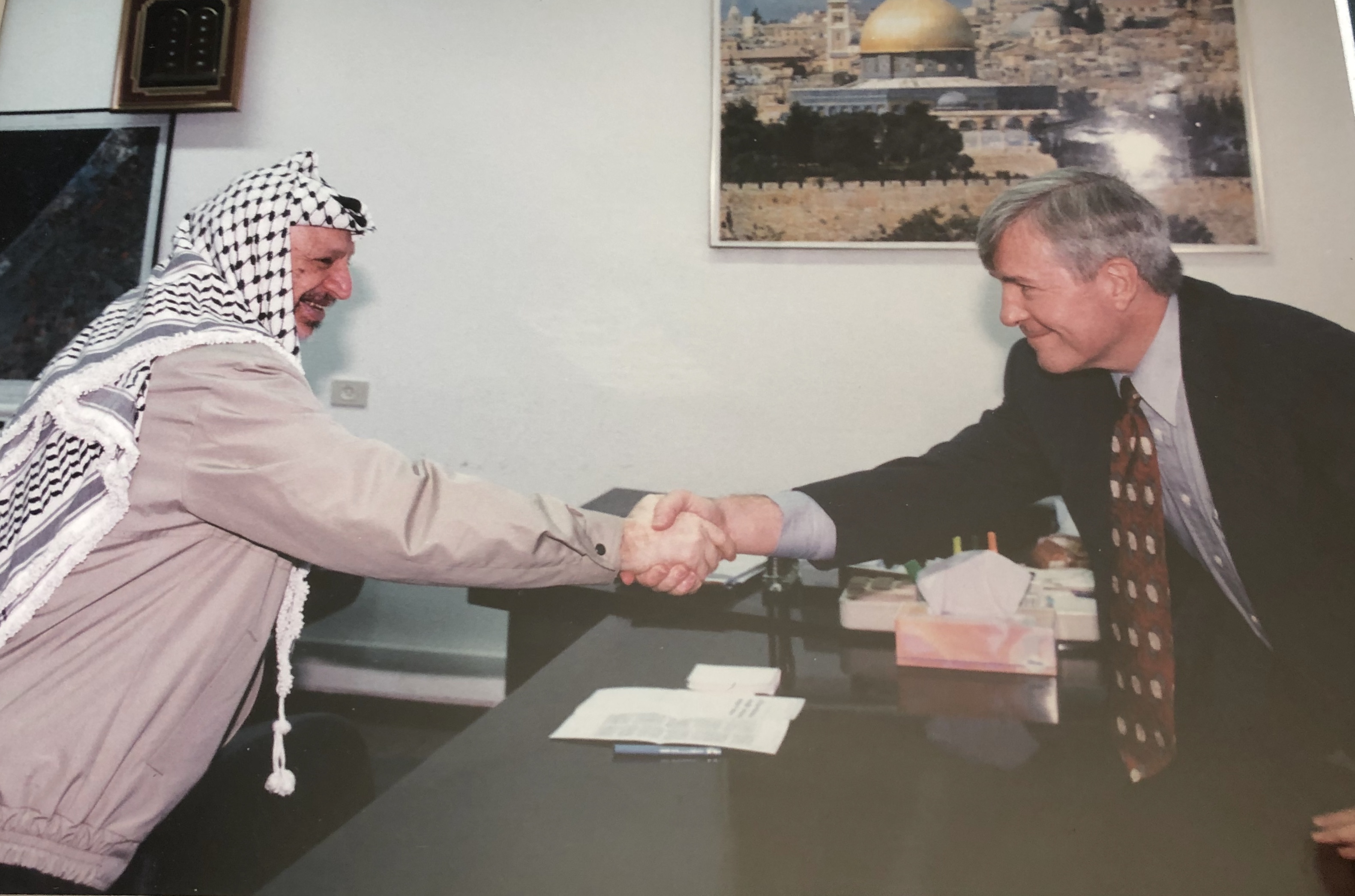 Yessar Arafat and Warren Coats in the PLO office in Gaza in February 1996.
 Warren's space