Modern Monetary Theory—A Critique

So called Modern Monetary Theory (MMT) has become popular with Green New Dealers because it claims to remove or at least loosen traditional constraints on government spending.  MMT offers unconventional ideas about the origins of money, how money is created today, and the role of fiscal policy in the creation of money. It argues that government can spend more freely by borrowing or printing money than is claimed by conventional monetary theory. “The most provocative claim of the theory is that government deficits don’t matter in themselves for countries—such as the U.S.—that borrow in their own currencies….  The core tenets of MMT, and the closest it gets to a theory, are that the economy and inflation should be managed through fiscal policy, not monetary policy, and that government should put the unemployed to work.” James Mackintosh,  “What  Modern Monetary Theory Gets Right and Wrong’  WSJ April 2, 2019.

In fact, despite its efforts to change how we conceive and view monetary and fiscal policies, MMT abandons market based countercyclical monetary and fiscal policies for targeted central control over the allocation of resources. It would rely on specific interventions to address “road blocks” upon the foundation of a government guaranteed employment program.

MMT is an unsuccessful attempt to convince us that we can finance the Green New Deal and a federal job guarantee painlessly by printing money. But it remains true that shifting our limited resources from the private to the public sector should be judged by whether society is made better off by such shifts.  Printing money does not produce free lunches.

Where does money come from?

It has been almost 50 years since the U.S. dollar (or any other currency for that matter) has been redeemable for gold or any other commodity whose market value thus determined the value of money. It remains true, however, that money’s value depends on its supply given its demand. The supply of money these days reflects the decisions of the Federal Reserve and other central banks.

The traditional story for the fractional reserve banking world we live in is that a central bank issues base or high-powered money (its currency and reserve deposits of banks with the central bank) that is generally given the status of “legal tender.”  You must pay your taxes with this money.  We deposit some of that currency in a bank, which provides the bank with money it can lend. When the bank lends it, it deposits the loan in the borrower’s deposit account with her bank, thus creating more money for the bank to lend.  This famous money multiplier has resulted in a money supply much larger than the base money issued by the central bank. In July 2008, base money (M0) in the United States was $847 billion dollars while the currency component of that plus the public’s demand deposits in banks (M1) was almost twice that — $1,442 billion dollars. Including the public’s time and savings deposits and checkable money market mutual funds (M2) the amount was $7,730 billion.  [I am reporting data from just before the financial crisis in 2008 because after that the Federal Reserve began to pay interest on bank reserve deposits at the Fed in order to encourage them to keep the funds at the Fed rather than lending them and thus multiplying deposits. This greatly increased and distorted the ratio of base money to total money, i.e. reduced the multiplier. In October 2015 at the peak of base money M0 = $4,060 billion, of which only $1,322 billion was currency in circulation.]

The neo Chartalists, now known as MMTists, want us to look at this process differently.  In their view banks create deposits by lending rather than having to receive deposits before they can lend.  While a bank loan (an asset of the bank) is extended by crediting the borrower’s deposit account with the bank (a liability of the bank), the newly created deposit will almost immediately be withdrawn to pay for whatever it was borrowed for.  Thus, the willingness of banks to lend must depend on their expectations of being able to finance their loans from existing or new deposits, by borrowing in the interbank or money markets, or by the repayment of previous loans at an interest rate less than the rate on its loans.

The money multiplier version of this story assumes a reserve constraint, i.e., it assumes that the central bank fixes the supply of base money and bank lending and deposit creation adjust to that.  The MMT version reflects the fact that monetary policy these days targets interest rates leaving base money to be determined by the market.  Traditionally the Fed set a target for the over-night interbank lending rate—the so-called Fed Funds rate.  In order to maintain its target interest rate, the central bank lends or otherwise supplies to the market whatever amount of base money is needed to cover private bank funding needs at that rate.  The market determination of the money supply at a given central bank interest rate is, in fact, similar to the way in which the market determines the money supply under currency board rules under which the central bank passively supplies whatever amount of money the market wants at the fixed official price (exchange rate) of the currency.  With the Federal Reserve’s introduction of interest on bank reserve deposits at Federal Reserve Banks, including excess reserves (the so-called Interest On Excess Reserves – IOER), banks’ management of their funding needs for a given policy rate now involve drawing down or increasing their excess reserves.

According to MMT proponents, loans create deposits and repayment of loans destroys deposits.  This is a different description of the same process described by the money multiplier story, which focuses on the central bank’s control of reserves and base money rather than interest rates. It is wrong to insist that deposits are only created by bank lending and equally wrong to insist that banks can only lend after they receive deposits.

How is Base Money Produced?

MMT applies the same approach to the creation of base or high-powered money (HPM) by the government as it does to the creation of bank deposits by the private sector:

“It also has to be true that the State must spend or lend its HPM into existence before banks, firms, or households can get hold of coins, paper notes, or bank reserves…. The issuer of the currency must supply it first before the users of the currency (banks for clearing, households and firms for purchases and tax payments) have it. That makes it clear that government cannot sit and wait for tax receipts before it can spend—no more than the issuers of bank deposits (banks) can sit and wait for deposits before they lend.”[1]

This unnecessarily provocative way of presenting the fact that government spending injects its money into the economy and tax payments and t-bond sales withdraws it does not offer the free lunch for government spending that MMT wants us to believe is there. Central banks can finance government spending by purchasing government debt, but this does not give the Treasury carte blanche to spend without concern about taxes and deficit finance.  This is the core of MMT that we must examine carefully.

MMT claims that:

“(i) the government is not constrained in its spending by its ability to acquire HPM since the spending creates HPM….  Spending does not require previous tax revenues and indeed it is previous spending or loans to the private sector that provide the funds to pay taxes or purchase bonds….

“(iii) the government deficit did not crowd out the private sector’s financial resources but instead raised its net financial wealth.

“Regarding (iii), the private sector’s net financial wealth has been increased by the amount of the deficit. That is, the different sequencing of the Treasury’s debt operations does not change the fact that deficits add net financial assets rather than “crowding out” private sector financial resources.”[2]

MMT is correct that federal government spending does creates money. But what if the resulting increase in money exceeds the public’s demand (thus reducing interest rates), or the destruction of money resulting from tax payments or public purchases of government debt reduces money below the public’s demand (thus increasing interest rates)?  MMT claims to be aware of the risk of inflation and committed to stable prices (an inflation target) but ignore it most of the time.

If the central bank sets its policy interest rate below the market equilibrium rate, it will supply base money at a rate that stimulates aggregate demand. If it persists in holding short term interest rates below the equilibrium rate it will eventually fuel inflation, which will put upward pressure on nominal interest rates requiring ever increasing injections of base money until the value of money collapses (hyperinflation). If instead the central bank money’s price is fixed to a quantity of something (as it was under the gold standard, or better still a basket of commodities) and is issued according to currency board rules (the central bank will issue or redeem any amount demanded by the market at the fix price), arbitrage will adjust the supply so as to keep the market price and the official price approximately the same (for a detailed explanation see my: “Real SDR Currency Board”).  Unlike an interest rate target, a quantity price target is stable.

Does the Story Matter?

But does the MMT story of how money is created open the door for government to spend more freely and without taxation, either by borrowing in the market or directly from the central bank?  According to MMT, “One of the main contributions of Modern Money Theory (MMT) has been to explain why monetarily sovereign governments have a very flexible policy space that is unencumbered by hard financial constraints.  Not only can they issue their own currency to meet commitments denominated in their own unit of account, but also any self-imposed constraint on their budgetary operations can be by-passed by changing rules.”[3]

MMT maintains that: “Politicians need to reject the urge to ask ‘How are we going to pay for it?’…   We must give up our obsession with trying to ‘pay for’ everything with new revenue or spending cuts….  Once we understand that money is a legal and social tool, no longer beholden to the false scarcity of the gold standard, we can focus on what matters most: the best use of natural and human resources to meet current social needs and to sustainably increase our productive capacity to improve living standards for future generations.”[4]

MMT proclaims that a government that can borrow in its own currency “has an unlimited capacity to pay for the things it wishes to purchase and to fulfill promised future payments, and has an unlimited ability to provide funds to the other sectors. Thus, insolvency and bankruptcy of this government is not possible. It can always pay….  All these institutional and theoretical elements are summarized by saying that monetarily sovereign governments are always solvent, and can afford to buy anything for sale in their domestic unit of account even though they may face inflationary and political constraints.”[5] But inflating away the real value of obligations (government debt) is economically a default.  Moreover, debt cannot grow without limit without debt service costs absorbing the government’s entire budget and even the inflation tax has its hyperinflation limit (abandonment of a worthless currency).

MMT advocates do acknowledge that at some point idle resources will be used up and that this process would then become inflationary, but this caveat is generally ignored.  But if MMT is serious about an inflation constraint, we must wonder about their criticism of asking how government spending will be paid for.  In this regard MMT is a throwback to the old Keynesianism, which implicitly assumed a world of perpetual unemployment.

Is There a Free Lunch?

MMT states that when the government spends more than its income (and thus must borrow or print money) private sector wealth is increased “because spending to the private sector is greater than taxes drawn from the private sector, the private sector’s net financial wealth has increased.”  As explained below this deficit spending increases the private sector’s holdings of government securities, but not necessarily its net financial wealth.

Whether we take account of the future tax liabilities created by this debt in the public’s assessment of its net wealth (Ricardian equivalence) or not, we must ask where the public found the resources with which it bought the debt. Did it substitute T-bonds for corporate bonds, i.e. did the government’s debt (or monetary) financing of government spending crowd out private investment thus leaving private sector wealth unchanged, or did it come from reduced private consumption, i.e. increased private saving. Any impact on private consumption will depend on what government spent its money on.  MMT claims that “the government deficit did not crowd out the private sector’s financial resources but instead raised its net financial wealth,” is simply asserted and is unsupported.  Whether the shift in resources from the private sector to the public sector is beneficial depends on whether the value of the government’s resulting output is greater than is the reduced private sector output that financed it.

One way or another, government spending means that the government is commanding resources that were previously commanded by or could be commanded by the private sector.  If the government takes resources by spending newly created money that the central bank does not take back, prices will rise to lower its real value back to what the public wants to hold. This is the economic equivalent of the government defaulting on its debt, contrary to MMT’s claim that default is impossible.  This inflation tax is generally considered the worst of all taxes because it falls disproportionately on the poor.  In fact, MMT proponents rarely mention or acknowledge the distinction between real and nominal values that are, or should be, central to discussions of monetary policy. The exception to the inflationary impact of monetary finance is if the resources taken by the government were idle, i.e. unemployed, which, obviously, is the world MMT thinks it is in.

MMT claims to have exposed greater fiscal space than is suggested by conventional analysis. They claim that government can more freely spend to fight global warming or to fund guaranteed jobs or other such projects by printing (electronic) money. However, the market mechanism they offer for preventing such money from being inflationary (market response to an interest rate target that replaces unwanted money with government debt), implies that such spending must be paid for with tax revenue or borrowing from the public.  Both, in fact all three financing options (taxation, borrowing, and printing money), shift real resources from the private sector to the public sector and only make society better off if the value of the resulting output is greater than that of the reduced private sector output. There is nothing new here.

Fiscal Policy as Monetary Policy

Government spending increases M and the payment of taxes reduces it.  MMT wants to use taxation to manage the money supply rather than for government financing purposes.  MMT wants to shift the management of monetary policy from the central bank to the finance ministry (Treasury).  The relevant question is whether this way of thinking about and characterizing monetary and fiscal policy produces a more insightful and useful approach to formulating fiscal policy.  Does it justify shifting the responsibly for monetary policy from the central bank to the Finance Ministry?  Should taxes be levied so as to regulate the money supply rather than finance the government (though it would do that as well)?

In advocating this change, MMT ignores the traditional arguments that have favored the use of central bank monetary policy over fiscal policy (beyond automatic stabilizers) for stabilization purposes.  None of the challenges of the use of fiscal policy as a countercyclical tool (timing, what the money is spent for, etc.) established with traditional analysis have been neutralized by the MMT vision and claim of extra fiscal space.  In fact, as we will see below, despite their advocacy of fiscal over monetary policy for maintaining price stability, MMT supporters have little interest in and no clear approach to doing so as they prefer to centrally manage wages and prices in conjunction with a guaranteed employment program.

But the arguments against MMT are stronger than that. The existing arrangements around the globe (central banks that independently execute price stability mandates and governments that determine the nature and level of government spending and its financing) are designed to protect monetary stability from the inflation bias of politicians with shorter policy horizons (the time inconsistence problem). The universal separation of responsibilities for monetary policy and for fiscal policy to a central bank and a finance ministry are meant to align decision making with the authority responsible for the results of its decisions (price stability for monetary policy and welfare enhancing levels and distribution of government spending and its financing).  It is the sad historical experience of excessive reliance on monetary finance and the costly undermining of the value of currencies that resulted that have led to the world-wide movement to central bank independence.  MMT is silent on this history and its lessons.  As pointed out by Larry Summers in an oped highly critical of MMT, the world’s experience with monetary finance has not been good. Modern Monetary Theory-a-foolish-pursuit-for-democrats

The establishment of central bank operational independence in recent decades is rightly considered a major accomplishment.  MMT advocates bring great enthusiasm for more government spending—especially on their guaranteed employment and green projects, which will need to be justified on their own merits.  MMT’s way of viewing money and monetary policy adds nothing to the arguments for or against these policies.

The Bottom Line

To a large extent, most of the above arguments by MMT are a waste of our time as MMT advocates actually reject the macro fine tuning of traditional Keynesian analysis. “This approach of government intervention aims at avoiding direct intervention to achieve the goal (e.g. hiring to achieve full employment, or price controls to achieve low inflation), but rather using indirect “tools” while letting market participants push the economy toward desired goals by tweaking their incentives.  MMT does not agree with this approach. The government should be directly involved continuously over the cycle, by putting in place structural macroeconomic programs that directly manage the labor force, pricing mechanisms, and investment projects, and constantly monitoring financial developments….  But MMT goes beyond full employment policy as it also promotes capital controls for open economies, credit controls, and socialization of investment. Wage rates and interest rate management are also important.”[6]  No wonder Congresswomen Alexandria Ocasio-Cortez is excited by MMT.

MMT attempts, unsuccessfully in my opinion, to repackage and resurrect the empirically and theoretically discredited Keynesian policies of the 1960s and 70s.  A 2019 survey of leading economists showed a unanimous rejection of modern monetary theory’s assertions that “Countries that borrow in their own currency should not worry about government deficits because they can always create money to finance their debt” and “Countries that borrow in their own currency can finance as much real government spending as they want by creating money.” http://www.igmchicago.org/surveys/modern-monetary-theory  Both the excitement and motivation for MMT seem to reflect the desire to promote a political agenda, without the hard analysis of its pros and cons—its costs and benefits.

****************************

[1] Fullwiler, Scott, Stephanie Kelton & L. Randall Wray (2012), ‘Modern Money Theory: A Response to Critics’, in Modern Monetary Theory: A Debate,  Modern Monetary Theory: A Debate, http://www.peri.umass.edu/fileadmin/pdf/working_papers/working_papers_251-300/WP279.pdf,  2012, page 19

[2] Ibid. page 22-23.

[3] Tymoigne and Wray, 2013 http://www.levyinstitute.org/publications/modern-money-theory-101

[4] Stephanie Kelton, Andres Bernal, and Greg Carlock, “We Can Pay For A Green New Deal” https://www.huffpost.com/entry/opinion-green-new-deal cost_n_5c0042b2e4b027f1097bda5b  11/30/2018

[5] Tymoigne and Wray, op cit. p. 2 and 5

[6] Ibid. pp. 44-45.

Their Turkey and Ours

“Recep Tayyip Erdogan believes high interest rates are the cause of inflation, not the remedy for it”  The Economist May 19, 2018 “How-turkey-fell-from-investment-darling-to-junk-rated-emerging-market”

During the 1990s the inflation rate in Turkey averaged around 80% per annum varying between 60% and 105%.  Over that period interest rates on its 3-month treasury bills averaged about 30% above the inflation rate reaching almost 150% in 1996.  The economy grew rapidly in real terms with real GDP growth averaging 8% per annum between 1995-7.  But growth depended heavily on borrowing abroad in foreign currencies.  Banks were poorly regulated, and heavily exposed to foreign exchange risk and to government debt.  Obviously, Turkey’s nominal exchange rate depreciated at about the same rate as its inflation rate in order to preserve a stable real exchange rate.

In the wake of the Asian and Russian debt crises in 1997 and 1998 foreign investors became more risk averse and capital inflows into Turkey were reduced sharply slowing down economic growth from 7.5% in 1997 to 2.5% in 1998.  A serious earthquake in Turkey’s industrial heartland in August 1999 further deteriorated Turkey’s economic performance.  The combined impact of the two pushed the economy into a deep recession, shrinking GDP by 3.6% in 1999.

With support from the International Monetary Fund (IMF) in 1999-2003 the Turkish government reigned in its spending and monetary growth and reduced its inflation rate to 10% by 2004. I was a member of the IMF’s Turkey team at that time and remember the long sleepless nights very well. Turkey’s interest rates followed inflation down and, in fact, its real interest rates (nominal interest rate minus its inflation rate) fell from 30% to negative rates as the economy stabilized. During this transition, a number of state owned enterprises were privatized, 18 insolvent banks were intervened, and debt and the financial sector were restructured and strengthened.  Within a few (rough) years the economy was growing rapidly with low inflation and low interest rates.  In 2017 real GDP grew 7.0% though inflation had crept back up to 11.1%.

Following Turkey’s and the rest of the world’s recession in 2009 the country reverted back to its bad old ways.  “Recep Tayyip Erdogan signed a decree easing access to foreign-exchange loans for Turkish companies.  The new rules lifted restrictions that barred companies without revenue in hard currencies from doing such borrowing—as long as the loans exceeded $5 million.”  How Erdogan’s push for endless growth brought Turkey to the Brink

Erdogan observed the low interest rates, low inflation, and high growth and apparently concluded that low interest rates caused low inflation rather than the other way around. Every economist knows that interest rates incorporate the market’s expectation of inflation over the period of a loan in order to establish a market clearing real rate of interest.  In 1996 when a borrower was willing to pay 130% interest and a lender was not willing to accept less it was because they expected 80% to 90% inflation per annum over the life of the loan.  The very high real rate (130% – 80% = 50%) reflects the risk premium of getting it wrong.

Central banks can, if inflation expectations adjust slowly, push real rates down temporarily by lowering nominal market rates below their equilibrium rate.  Doing so, however, increases the rate at which the money supply grows eventually increasing inflation and forcing nominal interest rates higher than they would otherwise have been.

Under political pressure from Erdogan, the central bank of Turkey has kept interest rates lower (and thus money supply growth greater) than are consistent with its inflation target of 5%.  In the last few years inflation has drifted up reaching 11.1% in 2017.  Markets have grown uneasy about the economic situation in Turkey and when the Central Bank failed to increase its policy interest rate last month from 17.75% investors began selling off Turkish bonds and withdrawing funds from the country.  Its exchange rate plummeted.  From January of this year the Turkish lira depreciated from 11.7 per dollar to 16 lira/USD at the beginning of July and to 21 lira/USD on the 22ndof August. Erdogan’s wrong-headed misunderstanding of the role of interest rates is pushing Turkey over the precipice of bankruptcy.

Meanwhile here in the United States, President Trump apparently attended the same school as Erdogan. After breaking a several decades old protocol against commenting on or interfering with the Federal Reserve’s monetary policy when he stated last month that he didn’t want to see the Fed increase its policy interest rate, he did it again a few days ago. “Trump-escalates-attacks-federal-reserve”  Trump’s advice is wrong. The Federal Reserve needs to continue raising its policy rate back toward normal levels (3% to 4%) before inflation momentum becomes any stronger. Real interest rates are still negative (less than the inflation rate).  The Fed should have started increasing rates several years earlier.

A proposal for the Fed’s balance sheet

By Warren Coats[1]

To save financial institutions from the collapse that threatened them after the bankruptcy of Lehman Brothers in September 2008, the Federal Reserve purchased government securities and Mortgage Backed Securities (MBS) sufficient to increase the size of its asset holdings from $0.9 trillion to $4.5 trillion by the end of 2014.  These large open market purchases were not meant to increase the money supply, the traditional purpose of such operations, which after a sharp drop followed by a sharp increase in the growth rate of broad money (M2) has grown at its historical average rate of around 6% per year. Rather they were to support the market prices of government debt and hard to price MBS in the face of market panic (at least initially).

The Fed accomplished this trick (large increase in the Fed’s asset holding with only modest increases in the money supply) by paying banks to keep the proceeds of their sales of securities to the Fed in deposits with the Fed, so called “reserves,” in excess of what is required, so called “excess reserves.”  Beginning in October 2008, the Fed began to pay interest on bank required and excess reserves deposited with Federal Reserve banks.  This kept broad money from growing in response to the huge increases in base money (the counterpart of the securities purchased by the Fed) and became the primary tool of monetary policy.

The Fed is now pondering what to do about its abnormally large balance sheet.  A year ago it announced its intention to gradually reduce the size of its asset portfolio in order to return to its traditional policy tools—regulating the growth in bank money and credit by targeting the overnight interbank lending rate (the Fed funds rate) via open market operations.  After having suspended the open market purchases that had inflated its balance sheet in recent years (QEs 1, 2, and 3), in October 2017 the Fed stopped replacing the maturing securities it held to the extend of about $20 billion per month.  As a result its asset holdings dropped about $150 billion in the nine months since then and by the end of June 2018 stood at $4,315 billion.  Its current intention is to reduce its asset holdings to $3 trillion by the end of 2022.

The reduction in the Fed’s holdings of these securities (Treasuries and MBSs) is an increase in the market’s holdings of them, other things equal.  But other things are not expected to be equal.  Our profligate government is expected to run a one trillion dollar deficit in 2019, adding that amount of government debt to the market on top of the Fed’s additions.  The Congressional Budget Office projects a worsening federal deficit every year over the next ten of its official forecast, worsening even as a percent of GDP. This will put pressure on the Fed to rain in or suspend its program to return its asset holdings to more traditional levels.

There is a better way to handle this difficult situation.  Bank reserves with the Fed are currently about $2 trillion (the rest of the Fed’s monetary liabilities is Currency in Circulation of $1.7 trillion) and banks’ checkable deposits are about the same amount (of which demand deposits are $1.5 trillion).  Requiring 100% reserve backing of checkable deposits was recommended in the 1930s by a group of University of Chicago economists as a way to protect our payment system from the loan default problems being experienced by many banks at the time.  This so called Chicago Plan would remove any risks to checkable deposits, a key part of our payment system, and thus eliminate the need for deposit insurance for such deposits.  Required reserves would continue to earn interest as they do now, but excess reserves would not.  But in addition to strengthening our payment system, adopting the Chicago Plan today would convert existing excess reserves into required reserves and end the debate over whether to further shrink the Fed’s balance sheet.

Adopting the Chicago Plan would prevent banks from on lending our checkable deposits.  At the moment they are not doing that anyway. This raises the question of where banks would get the funds (our savings) to on lend in their financial intermediary role?  In an extreme version of the Chicago Plan (100% required reserves against all deposits and deposit like bank liabilities) all bank lending would be finance by equity rather than debt.  Savers would hold claims on the value of a portfolio of loans as they now do with mutual fund investments and as in some Islamic banking instruments.  Equity rather than debt financed bank intermediation is a more stable structure as a result of shifting the risk of loses (loan defaults) from banks to the ultimate public investors.  The Federal Deposit Insurance Company would stop insuring 100% reserved deposits and its bank resolution functions would be moved to the Office of the Comptroller of the Currency (OCC) in the U.S. Department of the Treasury.

For purposes of requiring a 100% reserve and dropping deposit insurance, a more pragmatic boundary between all deposit liabilities and checkable deposits might include savings deposits (which can generally be shifted into checkable deposits almost automatically) and time deposits with a maturity of less than six months (or maybe three months).  This would add almost $10 trillion dollars to required reserves and would need to be phased in gradually.  The Fed would need to buy an equivalent amount of government securities in order to finance the increase in required reserves without contracting the money supply or bank credit.

It is very desirable to separate our payment system (checkable deposits of one definition or another) from the necessarily risky lending by banks and other financial institutions and make our money (currency and deposits) risk free.  Doing so would allow banks to take whatever risks with investor funds those investors are willing to finance.  This would enable a significant reduction in the government’s regulations of these activities.  “Changing Direction on Bank Regulation” Cayman Financial Review April 2015

[1]Dr. Coats retired from the International Monetary Fund in 2003 and is a fellow of Johns Hopkins Krieger School of Arts and Sciences, Institute for Applied Economics, Global Health, and the Study of Business Enterprise.

SALT—More press nonsense on tax reform

The elimination of State and Local Tax (SALT) deductions from the proposed tax reforms working their way through Congress has become a hot topic. Fine, but please keep the discussion honest. Sadly my local newspaper, The Washington Post, is not setting a good example: “In-towns-and-cities-nationwide-fears-of-trickle-down-effects-of-federal-tax-legislation”

First a word about tax reform vs tax reduction. We are now in the 9th year of economic recovery, one of the longest on record. It won’t go on forever. Ideally the Federal government’s budget should balance its expenditures and revenue over the business cycle. That allows for aggregate demand stimulating deficits during business downturns. These deficits result from so called automatic stabilizers—the fall in tax revenue from the fall in taxable income plus increased transfer payments to the unemployed. But a cyclically balanced budget also requires budget surpluses during the business expansion phase. The U.S. economy is now fully employed (in fact, unfilled vacancies exceed those looking for work). The Federal Reserve has finally increased inflation to its target rate of 2%. We should now have budget surpluses to make room for the deficits that will follow during the upcoming downturn.

But our fiscal situation is much worse than that. The large increase in “entitlement” expenditures for my greedy generation as we retire (greatly increasing unfunded social security and health benefits) will push our fiscal debt held by the public, now at 77% of our Gross Domestic Product (GDP), to over 150% of GDP within 30 years if current laws remain unchanged. See the figure below.

Taxes will either need to be increased (not reduced) or entitlement expenditures reduced (which means increased less than current law provides). My point is that reducing tax revenue at this time is irresponsible without at least matching expenditure cuts. The proposed tax reforms now in congress would increase the debt by $1,500 billion dollars over the next ten years on a static forecast basis, meaning without taking into account the increased growth and thus tax revenue that might result from the tax reforms, which no one expects to wipe out all of the static forecast of $1,500 billion.

Fed debt      Congressional Budget Office forecasts

While it is irresponsible to cut tax revenue at this time, it is highly desirable to reform how that revenue is raised. The existing taxes distort the economy and thus reduce our incomes in a number of ways. They grant favors to many special interest groups via allowing them to deduct specific expenditures from their taxable incomes (i.e. from the tax base). These so called tax subsidies encourage activities over what the private economy would otherwise under take. One very damaging example is the deduction of interest payments by businesses and individuals, which has encouraged excessive borrowing and indebtedness. The most popular of these is the mortgage interest deduction by homeowners. This tax subsidy benefits homeowners relative to renters, i.e. it benefits the wealthier at the expense of the poor. How well meaning middle and upper income American’s can justify this with a straight face is beyond me.

But what about the SALT deductions? By eliminating such deductions, i.e. by broadening the tax base, the same revenue can be raised with a lower tax rate. Other things equal (such as revenue), lower tax rates are good because they influence taxpayer decisions less. For example, companies are more likely to invest in the U.S. rather than abroad if the corporate tax rate is reduced from its current 35%, virtually the highest in the world, to 20%, which is closer to the rate in most developed countries.

Reducing tax subsidies to state and local governments is also good because it reduces an artificial encouragement for larger state and local government expenditures. If Californians are willing to pay more state taxes for larger state expenditures they are welcome to do so. But there can be no justification for transferring federal tax revenue from states with lower expenditures and matching taxes to California and other high spending states. To a large extent the existing SALT deductions transfer income from poorer states to wealthier ones. Who can support that with a straight face?

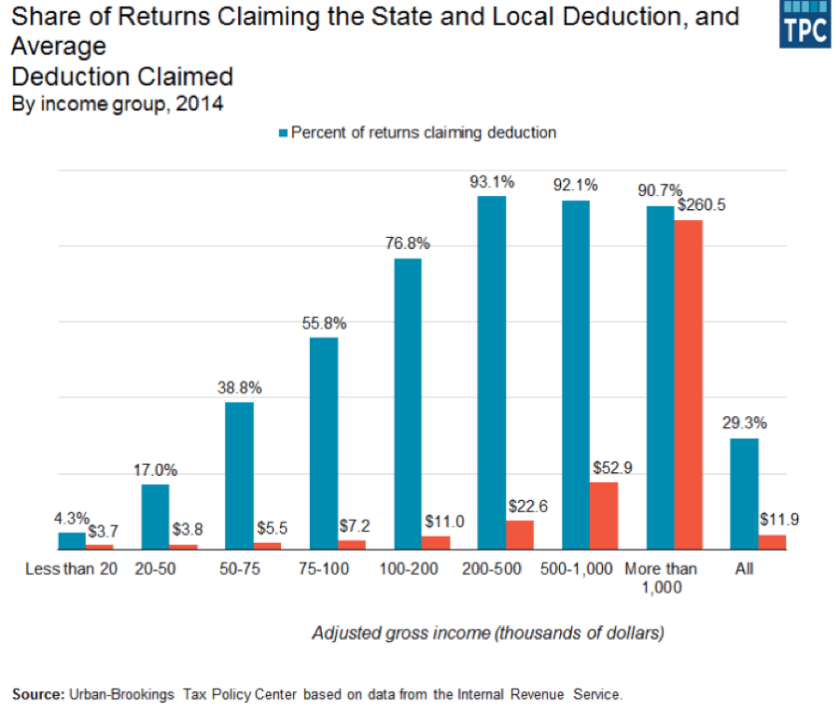
How information is presented can have a significant effect on how it is understood or viewed. How did Renae Merle and Peter Jamison of The Washington Post (see link above) report the proposed elimination of the SALT deduction? They reported that, “In San Diego County, the elimination of what is commonly called the “SALT” deduction could affect about a third of households, said Greg Cox, a member of the board of supervisors. The average middle-income resident would lose a $16,000 deduction.” They failed to note that the third of households affected are the wealthiest third. According to CNBC: “More than half of taxpayers who are earning $75,000 and above claim SALT deductions on their federal income tax returns as do more than 90 percent of taxpayers who make $200,000 or more.”

share of SALT

Furthermore, the figure $16,000 is misleading in two respects. The loss of a $16,000 deduction would increase taxes for a single person earning $200,000 annually by $5,280 at the current tax rate of 33%. However, broadening the tax base by eliminating the SALT and other deductions allows raising the same revenue with a lower tax rate. To measure the actual tax impact both effects must be combined. Current congressional proposals are to reduce the rate for the above person to 25%, which would result in an increased tax of $4,000. None of this would affect the poor directly. I assume that Renae Merle and Peter Jamison were just careless rather than letting their biases get the best of them, but you can make your own judgment.

The SALT deduction cannot be justified on either economic or fairness grounds, but there is sadly a good chance congress will cave in to the pressure from the wealthier states to keep it or at least some of it.


Discussion of John Tamny’s: Who Needs the Fed?

John concludes that we do not need the Fed because the Fed has become irrelevant. He argues that the interest rate “set” by the Fed is not relevant for the rest of the economy and that the Fed’s influence on bank credit is unimportant because not much credit comes from banks anymore, and that in any event the Fed can’t really control money and credit. While I think that John and I agree on many of the basic propositions that he sets out in his book, I disagree with many of his specific statements and with all of the propositions in my opening two sentences above.  To be blunt, John reveals a shocking lack of understanding of how the Fed and monetary policy more broadly work. The book has three Parts: Credit; Banking; and The Fed. I will set out my agreement with John on some important broad principles and then quote only a few of the many statements I disagree with.

For starters, John, Dan [Dan Mitchel, the moderator of this debate between John Tamny and myself at FreedomFest] and I all agree that it is what government spends that determines the resources it has taken from us and thus limiting that spending to the essentials is more important than cutting taxes. Of course how the government takes our incomes to finance its activities is also important. Some taxes are worse than others. On the other hand, it is surely not true that anything the government spends reduces the economy’s output. Government provided public safety, national security, and contract enforcement increase private economic output.

We agree that bailing out banks is bad for the health and efficiency of the banking sector.

We agree that failure of private sector firms that can’t make a profit and the market’s reallocation of those resources to better uses is good for economic efficiency and growth and rarely happens in government.

We agree that the market should determine the supply of money whose value is fixed to something tangible. But many of John’s statements suggest that he does not understand what the Feds does and what it is mandated to do. I will have a lot to say about this shortly.

Credit

The first of the books three parts is about Credit. When I get past some unusual usage of the word Credit to what I think is John’s fundamental point, I agree with him that those borrowing to invest in the real economy can only acquire and invest real resources. They cannot build factories, buy equipment, hire and organize workers with money created by the Fed, though a sound currency and efficient payment system lowers to the cost of connecting savers and investors. At the end of the day, real investment requires the saving and provision of real resources. This is what economists call the “neutrality of money, the idea that in the long run a change in the stock of money affects only nominal variables in the economy such as prices, wages, and exchange rates, with no effect on real variables, like employment, real GDP, and real consumption.” [Wikipedia] Unfortunately, throughout his book John fails to distinguish between real and nominal magnitudes.

John states this in several ways: “The Fed can’t create credit” [p. 4] However, it is not helpful when John defines credit as real resources when he means wealth or capital. Quoting him again: “Never forget that credit is the resources created in the actual economy.” [p. 26] And again: “Credit is just the name for real economic resources.” [p. 87] But near the end of his book he reverts to a more traditional definition of credit as a loan: “Credit is access to real economic resources.” [p. 178] There is a big difference between saying that credit “is real resources” and saying that it is “access to real resources.”

John talks a lot about what it takes for firms to attract funding of their activities. He provides many interesting examples of shifting credit risks in the economy and the credit market’s response in shifting resources away from higher risks to more promising uses, but these examples have nothing to do with monetary policy or the Fed. The Fed is not a credit institution. It does not allocate credit in the economy. The Fed is a monetary institution, whose job is to provide our currency and regulate its market value. John does not seem to understand the difference.

Banking

“It will never be a lack of money that fells Amazon [or any other company]. Only a lousy strategy will take it down.” [page 98] I sort of agree, but John then mistakenly applies this thinking to banks, which have a legal and business obligation to back all of their deposit and other liabilities with assets of equal or greater value, i.e. they must have positive capital. They must be solvent. John is mistaken to say that: “Because banks never simply run out of money, lack of investor patience is what causes them to file for bankruptcy.” [page 98] While banks can borrow when they are short of funds (credit in the usual sense of the word) as long as lenders and depositor think they are solvent, deposit and interbank funding runs can occur when depositors think the bank is not solvent. Solvency means having positive capital. Bank capital is difficult to assess because many of its assets are loans and it is not possible to know for sure how may of these loans will be repaid in the future. The real world, practical challenge with banks is to determine when they become insolvent as promptly as possible to prevent their continued borrowing and deposit taking as their capital hole grows so that most depositors and other creditors can be repaid when the bank is liquidated. A bank that continues to operate when insolvent is a ponzi scheme.

John correctly attack’s Murray Rothbard’s claim that fractional reserve banking is fraudulent. When banks lend out some or most of what we deposit with them—so called fractional reserve banking—they are doing exactly what they say they will. There is nothing fraudulent about it. It does make banks vulnerable to runs, however, which is why central banks are empowered to be lenders of last resort. John focuses his discussion on whether banks hold enough reserves (liquid deposits with the central bank and cash in their vaults) for unexpected deposit withdrawals and notes that any credit worthy bank can borrow what ever it need for this purpose from other banks. He says little about bank capital, however, which is the basis of whether a bank is credit worthy in the first place. If the market suspects that the bank has little or no capital, it will not lend to the bank.

John’s rejection of the broadly accepted proposition that banks multiple the money created by the central bank into a much larger quantity of bank deposits is completely wrong, as is his implicit rejection of the Chicago Plan of 100% reserve requirements by saying that “Banks can’t pay to stare at or warehouse dollars—they would quickly go out of business or be acquired—so logically they lend them.” [page 87]. Of course they can. If they are providing a valuable safekeeping and payment function, they can charge for it. Who remembers to old days when banks levied a service charge on demand deposits? Rather than focus exclusively on reserve requirements John should focus on the role of capital requirements for protecting depositor money. Positive capital means that the value of a bank’s assets exceeds its deposit and other liabilities.

John’s attempt to disprove the money multiplier fails to reflect or understand the intermediary nature of banks. They sit between the savers and the investors; between depositors and borrowers. He illustrates his claim with four friends at a table, one with a $100 who lends 90 to the next friend who lends ten percent of that to the next one and so on mimicking the standard text book explanation of the creation of money by banks. The correct game would have the friend with the $100 depositing it with the imaginary banker in the center of the table. The banker then lends $90 to the next friend by recording a deposit liability to the second friend of $90. The two friends between them now have $190 in deposits with the bank, which now lends $81 to the third friend by creating a $81 deposit for the third friend, etc. The example reflects a 10% reserve requirement. For some reason John doesn’t get this very real world phenomenon. The creation of deposit money by banks is only inflationary if their growth exceeds the growth of the public’s demand for them. It is forgivable if Joe six pack doesn’t understand the money multiplier by banks, but it is shocking for someone writing about the subject to failure so completely to understand it.

Banks are one of many financial intermediaries lending other peoples’ money, but they are the foundation of the payment system. Capital protects depositors’ money from the occasional non-performing loan made with those deposits. Historically virtually every country in the world bailed out insolvent banks rather than let depositors lose money. This created terrible moral hazard as John notes. Deposit insurance has improved the picture and the US has closed thousand of banks without serious disruption, but not the biggest ones viewed as too big to fail.

My recommendation is to separate the payment from the lending functions of banks, requiring 100 % reserves on demand and savings deposits, and requiring equity (capital) to finance bank lending and its other investments. Thus deposits and the payment system would be risk free and require very little further regulation.[1] The intermediated lending would be all equity financed, like a mutual fund investment, and require very little further regulation as well, as its investors would have total skin in the game and could take whatever amount of risk they wanted as they would reap the rewards or suffer the losses. Losses of loans and investments would no longer threaten bank deposits and the payment system. There would no longer be a need for the Lender of Last Resort function of the Fed or other central banks. This is the Chicago Plan put forth during the great depression by such notable economists as Irving Fisher, Frank H. Knight, Lloyd W. Mints, Henry Schultz, Henry C. Simons, Garfield V. Cox, Aaron Director, Paul H. Douglas, and Albert G. Hart.

The Fed

Most central banks these days have the legal mandate to regulate the supply of their currencies so as to keep its value stable— the so-called price stability mandate. The Fed has a problematic “dual mandate” of maximizing employment and stabilizing prices, which I will not discuss further here. There are several basic approaches to fulfilling this price stability mandate, ranging from fixing the price of the dollar to gold at one end of the spectrum to targeting inflation with market determined, i.e. freely floating, exchange rates at the other end. The policy debate is or should be about which of the rules for managing the money supply would be best for the U.S.

John says that “Friedman was the modern father of monetarism, a theory of money that says the central bank should closely regulate its supply.” [p 136] Friedman said no such thing.

Monetarism says that, like every other good, the value of money is determined by its supply and demand. The demand for money comes from the public and has been empirically related to their incomes. The supply is determined by the central bank in accordance with the policy rule it adopts. The gold standard was one such rule. A fixed monetary growth rate rule, once advocated by Friedman, is another. Inflation targeting, now in vogue, is yet another.

John makes a number of statements that suggest that he understands none of this. He says that: “Production is the source of money.” [p 136] We can make sense out of this strange statement if we change it to say that production is the source of the demand for money. Given that demand, monetarism says that the price or value of money (its purchasing power) will be determined by its supply and its supply will depend on the policy rule the central bank follows. If the Fed creates more money than the public wants to hold, people will spend the extra money. But as John and I agree, spending such money doesn’t create the goods people want to buy. Thus a money supply that exceeds its demand will drive up the prices of goods and services. That is the monetarist story of inflation.

John goes on to say that: “Friedman viewed inflation solely as a money-supply phenomenon. Inflation was a function of too much money, as opposed to a decline in the value of money.” [p 136] I can’t make sense of this strange statement. The statement that “inflation was a function of too much money” is a statement about the cause of inflation. The final clause of John’s statement says that: “inflation was a function of…a decline in the value of money.” But inflation is a decline in the value of money by definition. So what does John mean? His effort to explain why these are difference seems to concern the allocation of money around the country. He says: “money migrates to where production is.” Yes it goes to where it is demanded. John confuses the markets role in allocating credit around the country with the Fed’s role in controlling the aggregate supply of money. It is shocking that someone who writes regularly on this subject fails completely to understand its basics. I cannot find any evidence that John understands the basics of monetary theory of the supply and demand for money and its price, i.e., its value.

Another indicator of John’s confusion comes from the first Part of the book when he compares the Fed’s lowering the fed funds rate to Nixon fixing gasoline prices below the market price. Fixing the price of gas lower than the market price reduces its supply and increases its demand and produced long lines at gas stations in the hope of tanking up before the station runs out. But the Fed does not fix the fed funds rate; it sets a target for it. The difference is profound. The Federal funds rate is determined in the market by banks. When the Fed reduces its target for the Fed funds rate it increases its supply of liquidity to banks so that supply and demand force the interbank rate down. John repeats this fundamental misunderstanding throughout the book. In order to emphasize the importance of the distinction between fixing the Fed funds rate and targeting it, let me in Donald Trump fashion, repeat the point. The Fed does not fix the Fed funds rate. It enters the market as a buyer or seller of t-bills in order to increase or reduce the supply of bank reserves in order to stimulate the market to move the rate to the Fed’s target value.

John repeatedly describes the folly of the Fed trying to increase the money supply in Baltimore or Cincinnati to stimulate growth there, as markets will attract it away to healthier areas that demand it. He repeatedly discusses money as if it is credit. The Fed does almost no lending and then only to banks temporarily short of liquidity. When the Fed wants to lower the Fed funds rate in the market, it buys U.S. treasury bills from the market. The transactions (so called open market transactions) take place in New York but the sellers of these t-bills to the Fed are scattered all over the country and the newly created money is deposited in the sellers banks all around the country. John failures to reflect a basic understanding of how monetary policy works.

John’s misunderstanding of how the Fed operations is further illustrated in his following statements: “The Federal Reserve… proceeded to borrow reserves from the banking system so that it could buy trillions worth of U.S. Treasuries and mortgage back securities…. The Fed has credit to allocate only insofar as it extracts it from the real economy.” [p 149] This is completely wrong. The Fed supplied reserves to the banking system by buying Treasuries with money it created. Understanding this is absolutely fundamental to understanding what central banks do. John documents over and over again that he does not understand these basics.

John and I are both skeptical of the Fed’s ability to managing its monetary policy (the fed funds rate and/or the money supply) so as to smooth out business fluctuations while maintaining a stable value of the dollar. We both think that keeping short-term rates near zero for so long has been a mistake. In the long run, monetary policy determines the price level and its rate of inflation, not full employment and real income. John and I agree that the health of the economy, or its lack of it, is much more the result of stifling regulations, not monetary policy.

These suggest that the Fed would do better to adopt a different policy strategy or rule. John suggests that we can do away with banks and the Fed altogether, but says almost nothing about their replacements. I favor a supply of money determined by market demand whose value is fixed to a basket of goods. The Fed would supply currency under currency board rules whenever people wanted it and paid its official price and could redeem it at its official price, i.e. the market value of its valuation basket, if they had too much of it. In the case of the gold standard the only good in the valuation basket was gold, whose price is not as stable as would be a basket of goods. This proposal is discussed in my Real SDR Currency Board and other articles. Unfortunately you will not find John’s proposal for determining the money supply in his book.

John’s arguments that we do not need the Fed because it has no (or only negligible) affect on market interest rates and credit and because the Fed and banks cannot create money, are wrong. While interbank interest rates (the Fed funds rate) are a tiny fraction of all interest rates, market arbitrage insures that all interest rates are related to each other given the unique risks and characteristics of individual borrowers and classes of borrowers and of the appetites for risk of lenders. The Fed can and does “print money” expanding the currency held by the public and bank reserve deposits with the Fed (so called base money) and banks can and do multiply this base money into a much larger supply of money (currency and bank deposits) by lending it. While in the long run these activities of the Fed and banks only affect the value of money (inflation) with no affect on the real economy, they can and do have important real economy affects for good or ill in the short run. The question we need to answer is what monetary policy rules should the Fed adopt and follow in order to best fulfill its price stability and full employment mandate.

[1] “Changing direction on bank regulation” Cayman Financial Review, April 2015

Postscript

A few Booboos

“Housing is not investment…. Housing is consumption” [p 113]   Buying a house is an investment (it is a capital good). Living in or renting it is consumption.

“The Fed can’t create the credit that is economic resources” [p. 159] No but it can create money.

The Fed believes “that economic growth is the cause of inflation” [p. 159] Throughout John fails to distinguish real and nominal magnitudes (real exchange rate vs. nominal exchange rate; real interest rate vs. nominal interest rate; real income vs. Nominal income; real quantity of money vs. nominal quantity of money, etc.). Real economic growth with a constant money supply will cause deflation. Nominal economic growth when real income is constant is all inflation, etc.

“For those who still believe we need the Fed to keep a lid on the ‘money supply,’ what can’t be stressed enough is that our central bank cannot control that supply.” [p. 161] Not true.

References

Coats, Warren, 1982   “The SDR as a Means of Payment,” IMF Staff Papers, Vol. 29, No. 3 (September 1982) (reprinted in Spanish in Centro de Estudios Monetarios Latinoamericanos Boletin, Vol. XXIX, Numero 4, Julio–Agosto de 1983).

1983, “The SDR as a Means of Payment, Response to Colin, van den Boogaerde, and Kennen,” IMF Staff Papers, Vol. 30, No. 3 (September 1983).

2009, “Time for a New Global Currency?” New Global Studies: Vol. 3: Issue.1, Article 5. (2009).

2011, “Real SDR Currency Board”, Central Banking Journal XXII.2 (2011), also available at http://works.bepress.com/warren_coats/25

2014, “Implementing a Real SDR Currency Board”

_____. Dongsheng Di, and Yuxaun Zhao, 2016, Why the World needs a Reserve Asset with a Hard Anchor, http://works.bepress.com/warren_coats/34/


FreedomFest in Las Vegas

Dear Friends,

Are you attending FreedomFest this year? It claims to be the world’s largest gathering of free minds. At this year’s gathering from July 13 – 16 at Planet Hollywood in Las Vegas I will be debating John Tamny, editor of Real Clear Politics and author of the new book, “Who Needs the Fed?” on Friday morning, July 15. In addition, I will be on a panel discussing the new documentary, “The Moneychangers” on Saturday afternoon July 16.

You can use code SALEM (all upper case) to get $100 off the registration fee.  Go to “register now” at www.freedomfest.com, or call toll-free 1-855-850-3733, ext 202.

Here are some highlights:

Gary Johnson to Address FreedomFest

Now FreedomFest is pleased to announce that Gary Johnson, the former governor of New Mexico and the new presidential candidate for the Libertarian Party, will address FreedomFest at 4 pm Pacific Time, July 15, 2016, in the Celebrity Ballroom at Planet Hollywood, Las Vegas.

Johnson recently polled 10% support in two national polls.  Many pundits consider him a legitimate third party candidate since Ross Perot ran for president in 1992.  As David French wrote for National Review:  “Good news, disgruntled Americans: As you ponder whether to vote for one of the two most-disliked, dishonest, and morally corrupt politicians ever to run for president — Donald Trump and Hillary Clinton — you just might have a third option. His name is Gary Johnson.”

Why FreedomFest?

Steve Forbes, chairman of Forbes Inc., said it best:  “FreedomFest is where the best ideas and policies are flushed out.  I attend all 3 days and wouldn’t miss it for the world.”

What’s FreedomFest all about?  Everything!  Philosophy, history, science & technology, healthy living, politics and your money, and much much more.  It’s a Renaissance gathering in the entertainment capital of the world.

It’s organized by Mark and Jo Ann Skousen.  Mark Skousen is a financial economist, author, and university professor who has taught at Columbia Business School and now Chapman University.  Jo Ann Skousen teaches English literature at Chapman University and Mercy College, and is the director of the Anthem Film Festival.

Once a year in July all the freedom lovers of the world gather in Las Vegas for FreedomFest, what the Washington Post calls “the greatest libertarian show on earth.”   Steve Forbes and John Mackey, CEO of Whole Foods Market, are co-ambassadors and attend all 3 days.   Last July over 2,500 people showed up to learn, network and celebrate liberty–including Donald Trump, Senator Marco Rubio, Steve Wynn, Peter Thiel, and Glenn BeckSteve Moore even debated Paul Krugman, the Nobel Prize economist and columnist at the New York Times.  Want a summary?  Watch the 5-minute video at www.freedomfest.com/videos).

Who’s coming this year?  This year’s keynote speakers include Senators Rand Paul and Ben Sasse (who will debate Trump as the Republican candidate), radio hosts Larry Elder and Michael Medved, Judge Andrew Napolitano, TV host Kennedy from Fox Business, Charles Koch’s right-hand man Richard Fink, authors George Gilder and Steve Moore, and the former heavy weight champion of the world, George Foreman, and boxing promoter extraordinaire Don King.

In fact, they are holding a special reception with George Foreman, where attendees will get a chance to meet him, get an photograph taken with him, and have him sign a copy of his book, “Knockout Entrepreneur.”  (He sold his grill business for $138 million.)

This year’s big debate will be “Capitalism vs. Socialism:  Free to Choose or Free to Lose?” between John Mackey, co-founder and co-CEO of Whole Foods Market, and John Roemer, Yale professor at the top Marxist/socialist in the country (supporter of Senator Bernie Sanders).  The debate is set for Thursday morning, July 14, in the Celebrity Ballroom, Planet Hollywood.

Other features:  Watch the mock trial as we put “Global Warming on Trial” (C-SPAN coverage)…. Grover Norquist (CNN considers him “the most powerful man in Washington”) will hold his famous “Wednesday Meeting” at FreedomFest….a special session by the “Women of Liberty”….a debate on voting with actor/activist Ed Asner and political commentator John Fund….a 3-day investment conference with Peter Schiff, Alex Green, Mark Skousen, and Keith Fitz-Gerald….a debate between Dinesh D’Souza and Michael Shermer (Scientific American) on the Bible….and win $25,000 in prizes in the Pitch Tank organized by Shark Tank’s Kevin Harrington.  Join all the freedom organizations and think tanks – Cato, Heritage, Reason, Students for Liberty, Americans for Prosperity, etc.  They are all there in a gigantic exhibit hall, the “Trade Show for Liberty.”

Plus the ever-popular Anthem film festival, run by Jo Ann Skousen.  This year one of the films will be shown by the producer of “Schindler’s List.”

Oscar Goodman, former mayor of Las Vegas, calls it an “intellectual feast” in Las Vegas – one of a kind!

FreedomFest will take place July 13-16, at Planet Hollywood, Las Vegas.  For more details, go to www.freedomfest.com.

A Hard Anchor for the Dollar

For the last three years with zero interest rates and “quantitative easing” the Federal Reserve has been pushing on a string. It has been trying to stimulate an economy that suffers from problems that are not basically monetary. In the process it is distorting the limping economic recovery and potentially reflating housing and other asset bubbles. The Federal Reserve has jeopardized its revered independence by undertaking quasi-fiscal operations (buying long-term government debt and MBS to push down longer term interest rates in those markets while paying banks interest on their deposits at the Fed to keep them from lending the proceeds). The result has been an explosion of the Fed’s balance sheet (base money—the Fed’s monetary liabilities—jumped from around $800 billion in mid 2008 to over $3,200 billion in July 2013) while the money supply only grew modestly (over the same period M2 increased from about $8,000 billion to about $10,700 billion- about the same increase as over the five year earlier period from mid 2003 to mid 2008).

There is growing sentiment that our fiat currency system should be replaced with a hard anchor, such as the gold or silver standards in place in much of the world over the two centuries preceding gold’s abandonment by the United States in 1971. In order to avoid the weaknesses of the earlier gold standard, which contributed to its ultimate abandonment, three key elements of its operation should be modified. These are: a) the conditions under which currency fixed to a hard anchor is issued and redeemed; b) what the currency is sold or redeemed for; and c) what the anchor is.

Monetary Policy

During the earlier gold standard, the value of one U.S. dollar was fixed at $19.39 per ounce of fine gold from 1792 to 1934 and $35.00 per ounce from 1934 to 1971 when Nixon ended the U.S. commitment to buy and sell gold at its official price because the U.S. no longer had enough gold to honor its commitment.  None-the-less, the official price was raised to $38.00 per ounce in 1971 and to $42.22 in 1972 before President Ford abolished controls on and freed the price of gold in 1974.

Under a strict gold standard, operated under currency board rules, the central bank would issue its currency whenever anyone bought it for gold at the official price of gold and would redeem it at the same price. In fact, however, the Fed engaged in active monetary policy, buying and selling (or lending) its currency for U.S. treasury bills and other assets when it thought appropriate. Thus rather than being fully backed by gold, the Fed’s monetary liabilities (base money) were partially backed by other assets. Moreover the fractional reserve banking system allowed banks to create deposit money, which was also not backed by gold. The market’s ability to redeem dollars for gold kept the market value of gold and hence the dollar close to the official value. Because the Fed could offset the monetary contraction resulting from redeeming dollars, this link was broken and in 1971 President Nixon closed the “gold window” altogether for lack of gold.

A reformed monetary system should be required to adhere strictly to currency board rules. The Federal Reserve should oversee the interbank payment and settlement systems and provide the amount of dollars demanded by the market by passively buying and selling them at the dollar’s officially fixed price for its anchor (gold, in a gold standard system) in response to market demand. Banks should be denied their current privilege to create deposit money by replacing the fractional reserve system with a 100% reserve requirement (a subject for another time).

Indirect redeemability

Historically, gold and silver standards required that the monetary authority buy and sell its currency for actual gold or silver. These precious metals had to be stored and guarded at considerable cost. More importantly, taking large amounts of gold and/or silver off the market distorted their price by creating an artificial demand for them. Under a restored gold standard the relative price of gold would rise over time due to its limited supply, and the increasing cost of discovery and extraction. The fix dollar price of gold would mean that the dollar prices of everything else would have to fall (perpetual deflation). While the predictability of the value of money is one of its most important qualities, stability of its value (approximately zero inflation) is also desirable.

This shortcoming of the traditional gold standard can be easily overcome via indirect redeemability. The market’s regulation of the money supply in line with the official price of money in terms of its anchor does not require transacting in the actual anchor goods or commodities. As long as an asset of equal market value is exchanged by the monetary authority when issuing or redeeming its currency, the market will have an arbitrage profit incentive to keep the supply of money appropriate for its official value. In a future, hard anchor monetary system, the Federal Reserve could issue and redeem its currency for U.S. treasury bills rather than gold or other anchor goods and services. The difference between that and current open market operations by the Fed is that such transactions would be fully at the initiative of the market rather than of the central bank. The storage cost of such assets would be negligible and in fact would generate interest income for the Fed.

The Anchor

The final weakness of the gold standard was that the relative price of the anchor, based on a single commodity, varied relative to the goods and services (and wages) purchase by the public. In short, though the purchasing power of the gold dollar was highly stable historically over long periods of time, gold did not provide a stable anchor over shorter periods relevant to most business decisions.

Expanding the anchor from one commodity to 10 to 30 goods and services carefully chosen for their collective stability relative to the goods and services people actually buy (e.g. the CPI index) would be an important improvement over anchoring the dollar to just one commodity (gold). There have been many such proposals in the past, but the high transaction and storage costs of dealing with all of the goods in the valuation basket doomed them. Replacing such transactions with the indirect convertibility described above eliminates this objection.

A Proposal

The United States could easily amend its monetary policy to incorporate the above features – a government defined value of the dollar as called for in Article 1 Section 8 of the U.S. Constitution and a market determined supply of dollars. First Congress would adopt a valuation basket of 10 to 30 goods and services chosen to give the dollar the most stable value possible in terms of an average family’s consumption (i.e. the Consumer Price Index). The basket would consist of fixed amounts of each of these goods and would define the value of one dollar. As with the gold standard, if the value of the goods in the basket were more in the market than one dollar, anyone could buy them more cheaply by redeeming dollars at the fed for an equivalent value of U.S. treasury bills (indirect redeemability). The resulting contraction of the money supply would reduce prices in the market until a dollar’s value in the market was the same as its official valuation basket value. The money supply would grow with its demand (as the economy grows) in the same way (selling t-bills to the fed for additional dollars). The Federal Reserve would be restricted to passive currency board rules. All active purchases and sales of t-bills by the fed (traditional open market operations) or lending to banks would be forbidden. During a two year transition period the fed would be allowed to lend to banks against good collateral in order to allow banks time to adjust their operations and balance sheets to the new rules.

A global anchor

The gold standard was an international system for regulating the supply of money in each country and between countries and provided a single world currency (fixed exchange rates). This led to a flourishing of trade between countries. This was a highly desirable feature for liberal market economies.

The United States could adopt the hard anchor currency board system described above on its own and others might follow by fixing their currencies to the dollar as in the past. The amendments to the historic gold standard system proposed above would significantly tighten the rules under which it would operate and strengthen the prospects of its survival.

However, there would be significant benefits to developing such a standard internationally as outlined in my Real SDR Currency Board proposal (http://works.bepress.com/warren_coats/25/). One way or the other, replacing the widely fluctuating exchange rates between the dollar and other currencies would be a significant boon to world trade and world prosperity.  Replacing the U.S. dollar as the world’s reserve currency with an international unit would have additional benefits for the smooth functioning of the global trading and payments system.

Printing Money

Isn’t that just printing money?  Here is a quick, and hopefully simple, primer on what central banks do.

Central banks print money. They are responsible for issuing a country’s legal tender (banknotes and bank deposits with the central bank) and regulating its value. Most of what we call money is actually privately produced (deposits at commercial banks, credit and debit cards, paypal, etc.) but tied to the money printed by each country’s central bank by the public’s demand that it be redeemable for the central bank’s money. There are a few exceptions to this demand by the market, such as bitcoin (see: the-rise-of-the-bitcoin-virtual-gold-or-cyber-bubble), but they shall ever remain unimportant fads. There is never a question about whether central banks print monetary or not. It is their responsibility to do so. This is as true for a pure gold standard or other fixed exchange rate monetary regimes, as for the variety of fiat money regimes (from monetary targets to inflation targets to flying by the seat of their pants day-to-day).

The important and proper question about a central bank’s behavior is what guides its decisions about when and how much money to print. A secondary question is what does it buy when it issues money (there are no helicopters that drop it from the sky)?

The gold standard: Under a gold standard the central bank buys gold with the money it prints and is legally bound to buy that money back with gold at the same price whenever anyone holding its money wants to redeem it. While this is still printing money, the supply is determined by the preferences of the market (each and every one of us) to hold and use that money. Such central banks have no monetary “policy” in the usual sense. They passively supply whatever amount of money the public demands.

Fiat money: If the central bank issues money with no obligation to redeem it for anything in particular nor at a particular price, its value is determined in the market by its supply and demand. The amount supplied by the central bank relative to the market’s demand for it will determine is value (the price level). Monetary policy consists of the decisions made by central banks that determine the amount of the money they supply and manner in which they supply it.

The public’s demand for money reflects its convenience for making payments, its expected value when exchanged for goods and services, and the opportunity cost of holding it (inventory costs, i.e., the interest rate that could have been earned on holding wealth in other forms). Rapidly changing payment technology (debit/credit cards, Paypal, e-money, etc.) has a profound impact on this demand. There is a vast academic literature on this subject. Unlike any other good or service money’s value derives solely from what it can be exchanged for or more specifically from the economy it brings to exchange/trade.  Fiat currency is always useable and thus “redeemable” for the payment of taxes and other obligations to the government that issued it. These obligations are denominated (valued) in the same units as the currency. These guaranteed uses of fiat money anchor its demand and thus value in the same way that the demand for gold for jewelry and other non-monetary uses anchors its value. Bitcoin has no alternative use and thus has no anchor to its value.

Central banks have learned the value of establishing clear rules for issuing money, such as targeting the rate at which the money supply (by one definition or another) grows, or targeting nominal income, or inflation. These rules guide how much money they “print.” They also influence the public’s demand for money by informing its expectations of the central banks actions. The policy regime adopted—rule—determines the behavior of the money supply and thus its value (or visa versa). The supply of bitcoin also follows a well-defined rule, but its demand is unanchored. The fact that the central bank is printing money is irrelevant by itself.

A secondary consideration is what it is that the central bank buys with the money it prints. Under a gold standard it buys gold. Under a fiat money standard central banks generally buy government securities because these securities are generally of unquestioned safety and in most countries have the deepest and most liquid secondary markets. Central banks also traditionally adhere to a “bills only” policy, i.e., they buy short-term government security, in order not to interfere with the market’s determination of the term structure of interest rates, i.e. the relationship of interest rates on securities with longer maturities relative to those with shorter maturities. In a free market, rates on longer maturities are determined by the expected value of overnight rates over the period in question plus a risk premium for the uncertainty over the behavior of overnight rates.

Whatever the ultimate or intermediate targets of monetary policy, most central banks in recent decades have pursued them by targeting a short-term interest rate, their so-called “operating target.” The Federal Reserve targets the overnight interbank rate, the so-called “federal funds rate,” as its approach to targeting the money supply, nominal income, or inflation. Given all other market factors, a particular fed funds rate target will result from and result in a particular rate of growth in the money supply.

Because most money and related means of payment are privately produced by banks or is ultimately settled through banks, and because banks only keep a small amount of the money produced by their central banks for which bank deposits are redeemable (the so-called “fractional reserve banking system”), central banks have also been given the role of insuring that banks have sufficient liquidity to function smoothly. They are mandated to lend to solvent but illiquid banks when banks need to convert loans into cash to accommodate deposit withdrawals (the so-called “lender of last resort” function).

As more and more central banks successfully adopted the techniques of inflation targeting and most of the rest fixed the exchange rate of their currencies to an inflation targeting currencies such as the U.S. dollar or the Euro, the world entered a long period dubbed “the great moderation.” However, the long period of very low interest rates following the bursting of the “dot com” bubble produced the housing price bubble in many locations in the U.S. and Europe. Its collapse in 2007-8 plunged much of the Western world into the long, Great Contraction.

Monetary Policy Plus (MP+):  In the last few years the Federal Reserve, the European Central Bank (ECB) and other central banks have undertaken many non-traditional actions in an effort to help lift their respective economies out of recession. In the early days of the serious liquidity crunch following the collapse of Lehman Brothers in September 2008, the Fed, ECB, Bank of England and a few other central banks very successfully pumped needed liquidity into their financial systems by expanding the number of counterparties they would lend to, increasing the eligible collateral, and entering into currency swap arrangements to supply dollar liquidity to foreign banks.

However, after unblocking the flow of funds between banks and other financial firms, the Fed’s concern shifted to fighting deflation, then to reviving economic activity. After driving its operating target to almost zero, the Fed continued increasing monetary growth beyond the rate resulting from a zero fed funds target and dubbed it quantitative easing. However, the channels through which monetary policy is traditionally transmitted to the economy (interest rate, credit, asset price, portfolio/wealth effects, exchange rate channels) seemed ineffective. Thus, the Fed began to purchase non-traditional, financial instruments, such as Mortgage Backed Securities (MBSs) and longer-term government securities, in an effort to keep mortgage interest rates low and to encourage the flow of funds into the mortgage market and stimulating investment more generally. These quasi-fiscal policy measures do not square easily with the Fed’s legal mandates of price stability and employment.

With the Fed’s third program of quantitative easing it is now pushing on a string  (QE3: http://works.bepress.com/warren_coats/28/). It is attempting to stimulate an economy that lacks a clear policy environment that would encourage more investment rather than one suffering from inadequate liquidity. While market measures of inflation expectations remain very low, long periods of very low interest rates influence the capitalized value of income streams. A given monthly mortgage payment will purchase a more expensive house when interest rates are lower. What people and firms invest in is distorted toward more capital-intensive projects than are economically efficient and justified at normal rates of interest.  Pension funds and other endowments lose income that must be made up somehow (often by moving into riskier investments). Asset price bubbles emerge. On top of these economic risks, the Fed’s need to unwind its huge portfolio of securities (purchased by printing money) when the economy recovers more fully is becoming more and more challenging.

Moreover, the policies of one central bank can affect the exchange rate of its currency if its policies are not coordinated with those of other central banks. This can either improve or worsen the balance of payments between countries (balance of imports and exports). The very wide swings over the last decade in the exchange rate of the US dollar with the Euro, for example, cannot be justified by economic fundamentals and is very disruptive to trade and international capital movements. Recent monetary policy initiatives by the Bank of Japan raise such concerns.

In short, the problem is not that the Fed and other central banks are printing money. The problem is the amount they print and their conceit that they can do more to help the real economy than they really can, thus adding to the market’s uncertainty over the economic, policy, and financial environment in which their decisions to spend and invest must be made. The solution is to reestablish a hard anchor for monetary policy that allows the supply of money to be market determined (as proposed in my: Real SDR Currency Board, paper).

The fantasy of a purely private money that would overcome the weaknesses of government money, remains for the foreseeable future a utopian fantasy: “The Future of Money”. But those of you who enjoy fantasy, might enjoy the following story by Neal Stephenson: “The Great Simoleon Caper”.