SALT—More press nonsense on tax reform

The elimination of State and Local Tax (SALT) deductions from the proposed tax reforms working their way through Congress has become a hot topic. Fine, but please keep the discussion honest. Sadly my local newspaper, The Washington Post, is not setting a good example: “In-towns-and-cities-nationwide-fears-of-trickle-down-effects-of-federal-tax-legislation”

First a word about tax reform vs tax reduction. We are now in the 9th year of economic recovery, one of the longest on record. It won’t go on forever. Ideally the Federal government’s budget should balance its expenditures and revenue over the business cycle. That allows for aggregate demand stimulating deficits during business downturns. These deficits result from so called automatic stabilizers—the fall in tax revenue from the fall in taxable income plus increased transfer payments to the unemployed. But a cyclically balanced budget also requires budget surpluses during the business expansion phase. The U.S. economy is now fully employed (in fact, unfilled vacancies exceed those looking for work). The Federal Reserve has finally increased inflation to its target rate of 2%. We should now have budget surpluses to make room for the deficits that will follow during the upcoming downturn.

But our fiscal situation is much worse than that. The large increase in “entitlement” expenditures for my greedy generation as we retire (greatly increasing unfunded social security and health benefits) will push our fiscal debt held by the public, now at 77% of our Gross Domestic Product (GDP), to over 150% of GDP within 30 years if current laws remain unchanged. See the figure below.

Taxes will either need to be increased (not reduced) or entitlement expenditures reduced (which means increased less than current law provides). My point is that reducing tax revenue at this time is irresponsible without at least matching expenditure cuts. The proposed tax reforms now in congress would increase the debt by $1,500 billion dollars over the next ten years on a static forecast basis, meaning without taking into account the increased growth and thus tax revenue that might result from the tax reforms, which no one expects to wipe out all of the static forecast of $1,500 billion.

Fed debt      Congressional Budget Office forecasts

While it is irresponsible to cut tax revenue at this time, it is highly desirable to reform how that revenue is raised. The existing taxes distort the economy and thus reduce our incomes in a number of ways. They grant favors to many special interest groups via allowing them to deduct specific expenditures from their taxable incomes (i.e. from the tax base). These so called tax subsidies encourage activities over what the private economy would otherwise under take. One very damaging example is the deduction of interest payments by businesses and individuals, which has encouraged excessive borrowing and indebtedness. The most popular of these is the mortgage interest deduction by homeowners. This tax subsidy benefits homeowners relative to renters, i.e. it benefits the wealthier at the expense of the poor. How well meaning middle and upper income American’s can justify this with a straight face is beyond me.

But what about the SALT deductions? By eliminating such deductions, i.e. by broadening the tax base, the same revenue can be raised with a lower tax rate. Other things equal (such as revenue), lower tax rates are good because they influence taxpayer decisions less. For example, companies are more likely to invest in the U.S. rather than abroad if the corporate tax rate is reduced from its current 35%, virtually the highest in the world, to 20%, which is closer to the rate in most developed countries.

Reducing tax subsidies to state and local governments is also good because it reduces an artificial encouragement for larger state and local government expenditures. If Californians are willing to pay more state taxes for larger state expenditures they are welcome to do so. But there can be no justification for transferring federal tax revenue from states with lower expenditures and matching taxes to California and other high spending states. To a large extent the existing SALT deductions transfer income from poorer states to wealthier ones. Who can support that with a straight face?

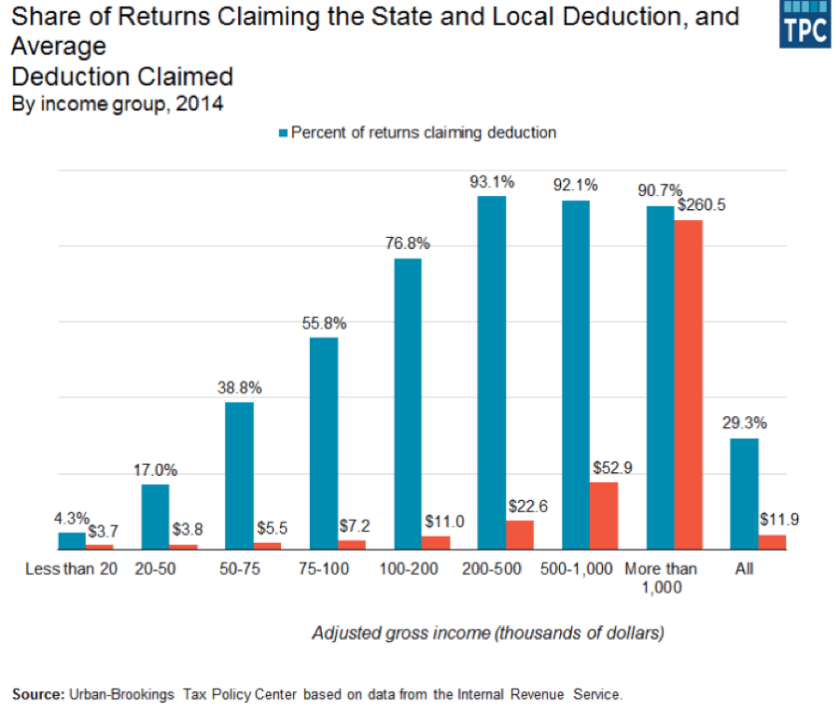
How information is presented can have a significant effect on how it is understood or viewed. How did Renae Merle and Peter Jamison of The Washington Post (see link above) report the proposed elimination of the SALT deduction? They reported that, “In San Diego County, the elimination of what is commonly called the “SALT” deduction could affect about a third of households, said Greg Cox, a member of the board of supervisors. The average middle-income resident would lose a $16,000 deduction.” They failed to note that the third of households affected are the wealthiest third. According to CNBC: “More than half of taxpayers who are earning $75,000 and above claim SALT deductions on their federal income tax returns as do more than 90 percent of taxpayers who make $200,000 or more.”

share of SALT

Furthermore, the figure $16,000 is misleading in two respects. The loss of a $16,000 deduction would increase taxes for a single person earning $200,000 annually by $5,280 at the current tax rate of 33%. However, broadening the tax base by eliminating the SALT and other deductions allows raising the same revenue with a lower tax rate. To measure the actual tax impact both effects must be combined. Current congressional proposals are to reduce the rate for the above person to 25%, which would result in an increased tax of $4,000. None of this would affect the poor directly. I assume that Renae Merle and Peter Jamison were just careless rather than letting their biases get the best of them, but you can make your own judgment.

The SALT deduction cannot be justified on either economic or fairness grounds, but there is sadly a good chance congress will cave in to the pressure from the wealthier states to keep it or at least some of it.


My Political Platform for the Nation – 2017

For me, the ideal American government would deliver its important but limited functions efficiently and effectively and would raise the money to pay for these activities with efficient, minimally distorting (neutral), and fair taxes following a principle of maximum subsidiarity (decisions made and services performed at the most local levels possible). The government should do fewer things than it does now but should do them better and should fully pay for them with taxes and fees (cyclically balanced budgets).

My unrestrained, radical platform will be presented here at a high level of general principles. Details need to be refined by a political process involving public discussion and are likely to evolve somewhat over time. Links to earlier articles provide additional details. In the very broadest terms Americans should be self reliant and free to work and play as hard as they choose with the government supporting their choices by providing security, the legal foundation and framework of private property and contracts, and an efficient safety net when individual undertakings are not feasible or fail.

The limited functions of the Federal government are enumerated in Article 1 section 8 of the U.S. Constitution. Broadly these are to:

  1. Develop and maintain our relations with other countries and international bodies and to maintain an Army, Navy and Air Force for the purposes of defending and promoting the security of the United States;
  2. Establish and enforce the rights to property and contracts and to adjudicate related disputes;
  3. Provide for public safety;
  4. Provide an efficient and effective social safety net (welfare);
  5. “Regulate commerce with foreign Nations, and among the several States;”
  6. “Coin money, regulate the value thereof, and of foreign coin, and fix the Standard of Weights and Measures;”
  7. Arrange for the provision of roads and essential infrastructure; and
  8. Tax, borrow, and levy fees and tariffs to pay for these activities.

Our Social Contract

Sovereignty resides with each individual, who have collectively ceded limited powers to government for the general welfare. Each of us is free, within legal limits on doing harm to others, to lead our own lives and build or work at whatever we choose. Thus the government’s laws apply equally to each of us without regard to our race, religion, sex, or sexual orientation. From this environment of freedom and innovation, America has built the most successful economy in the world.

When building companies or developing products, many will fail and try again. The government provides the legal framework (bankruptcy) for resolving such failures. The implicit agreement between citizens and their government is that government will provide a floor—a safety net—whenever a person’s efforts fail or when, e.g., for health reasons, a person is unable to provide for him or herself. The level of the safety net should reflect the level of the country’s income and social consensus and should be designed to achieve its objective as efficiently as possible with careful consideration of the incentives it creates.

Income redistribution: taxation and a guaranteed minimum income

All income (personal and corporate) taxes should be replaced with a comprehensive, flat, consumption tax (Value Added Tax—VAT) and limited progressivity introduced by paying every legal man, woman and child resident a guaranteed minimum income. US federal tax policy, Cayman Financial Review July 2009 Each recipient of these monthly guaranteed income payments would be required to set aside a minimum amount for health insurance (chosen by each person or family in the competitive market place) and a minimum amount for retirement (invested in qualifying retirement funds in the competitive market place). Saving social security

As the guaranteed minimum income should be at a level sufficient to minimally support life’s basic needs, supplements such as unemployment or disability insurance would not be needed or provided. However, disabilities acquired from military or public safety service should receive additional income support.

Health care

Each person will be responsible for paying for at least part of routine medical care (the copay required by the insurance they have chosen) and will thus care about its cost. The cheapest insurance policies will be limited to major medical expenses (catastrophic health insurance). As everyone will be required to contribute monthly to a health savings account from their guaranteed minimum income, most people will chose to use such funds to buy health insurance, which would not be tied to employment or an employer.

Doctors and hospitals will be required to make medical service costs transparent. On that basis, patients, in consultation with their doctors, will decide the level of care and treatments to receive. These measures will introduce normal market competition into the provision of medical care that is currently absent, which will improve its quality and lower its cost.

Education

Equal access to quality education is a critical element in maximizing opportunity for all and the wealth of our society and each person in it. The public school system has often failed in this objective. While the wealthy can afford to put their children in private schools when the neighborhood school is of poor quality, lower income families generally cannot. Every K-12 aged child will receive a tuition voucher that covers the cost of state provided education. The amount will generally vary from state to state (or school district to school district). The voucher can be used to attend the local neighborhood public school with no additional cost, or any private school the family chooses, which might incur additional costs. Schools eligible to receive such vouchers must meet minimum education standards set by the state and must disclose the performance of their students on state administered achievement tests. This information must be available to the public. The learning progress of each child is more important than the average level of achievement of each school’s students as some schools might well specialize in slow or problem learners and performance data should reflect this distinction. The neighborhood school has the advantage of being easier to get to every day and will normally be chosen by families if it provides a good education. The argument for universal tuition vouchers goes beyond providing a level playing field to all. It also introduces the competition for students that is the basis for good quality, low cost goods and services in every other area of our economy.

Access to higher education raises different issues. Those with the aptitude and desire for a college or postgraduate degree can significantly increase their lifetime incomes as a result. It would hardly be fair to tax the general public to subsidize the higher education of those who will become wealthier as a result. However, the tuition loans that may be needed by those from lower income families to make this investment would be hard to get without insurance against default. Many states also provide community (or Jr.) colleges at public expense that provide training in various trade skills as well as four year college preparatory courses. These seem to have often been successful in leveling the playing field. The optimal structuring of higher education subsidies (e.g. between insurance guarantees and tuition subsidies) needs further examination.

Monetary and Financial Policies

Government policies that affect business should be as rule based and transparent as possible. Monetary policy stands out as a particularly important area in which clearer rules are needed. A currency with stable real value (purchasing power) is an important part of the foundation of efficient free markets. At the very minimum the Federal Reserve’s mandate should be tightened as provided in the very pragmatic Federal Reserve Accountability and Transparency Act of 2014. This act would require the Fed to chose an operational rule, from which it could depart only with an explanation to Congress of its reasons. A deeper review of options is proposed by the Centennial Monetary Commission Act of 2015. I have proposed a more radical reform in the spirit of the gold standard but with tighter rules and an anchor of a large number of goods rather than just gold. The supply of this currency, which ideally would become the global currency, would be regulated by the market using currency board rules and “indirect redeemability.” A hard anchor for the dollar.

The banking and financial sector are currently smothered with detailed regulations the compliance cost of which are driving smaller banks out of business. Under the Dodd Frank law adopted after the financial crisis of 2008, the largest five American banks have grown even larger (in absolute terms and as a share of the banking sector) than they were in 2008. Regulators, despite (or because of) their detailed banking regulations have failed to make banks safer and have slowed the competitive process of producing better and cheaper services. Bank owners and market preferences should regulate risk taking by banks.

Bank regulation by the government should focus on broad principles with strong owner accountability. Bank capital requirements should be raised and the no bail out rules strengthened. Bank owners and investors should absorb any bank losses. The payment services of banks should be isolated from the rest of its lending and investing business by adopting the Chicago Plan of one hundred percent reserve requirements against current account deposits, and virtually all other regulations (other than accounting and reporting standards) should be dropped. Larger banks will develop their own risk weighted capital requirements for their internal use, but the government’s capital requirements should state the minimum required leverage ratio (ratio of core capital to total assets) and set it at a high level. Changing direction on bank regulation, Cayman Financial Review April 2015. A bill now in congress moves in this direction: The Financial Choice Act

Business activities and regulation

The government should only provide services that that private sector can’t. It should provide the legal and regulatory framework for the private economy rather than compete with it. Though the approaches to providing “public goods” such as police, courts, prisons, firemen, parks, highways, airports, etc. have varied over time, they are almost always paid for by the government (i.e. collectively by tax payers) and should be provided efficiently at the level expected by the public. Publicly funded and privately produced goods and services are often sources of hard or soft corruption. Rather than over charging for services or paying bribes to win contracts (hard corruption), soft corruption exploits influence on government to obtain contract terms or regulations favorable to particular firms (“rent seeking”). The government’s purchases of goods and services from the private sector should be governed by transparent rules that promote competition among suppliers. This is easier said than done. Open the Books

While the government is involved in and trying to do far too many things, it doesn’t do many of them very well. Of those services the government needs to provide, states generally perform better than the federal government though performance varies across states. In Maryland, where I live, I was able to register my Limited Liability Company on line in about 30 minutes start to finish. Registering my car and updating my driver’s license is quick and easy. However, it took me months to obtain a statement of my residency from the U.S. Treasury and a personal trip to the State Department to have it certified to provide to the National Bank of Kazakhstan before they could pay me for my services. Getting a passport or green card is more complicated and takes longer than they should. The government should do much less and do it much better.

Those in the government who believe they can judge better than competitive private markets how best to allocate resources (what to invest in and produce) are generally wrong. Moreover, they establish an opportunity and thus incentive for corruption.

The government’s regulation of private businesses in the interest of public safety, environmental protection, and market competition should be limited and subject to very serious cost/benefit tests. Cost/benefit analysis unavoidably reflects subjective judgments but their role should be limited to the extent possible by full transparency of the basis of any assessment. Competitive capitalism vs. the other kinds.

Foreign policy and national security

The purpose of our foreign policy is to serve American security interests and the international rule of law under which American’s can explore the world and American businesses can compete globally on a level playing field. Our security requires a strong military, but it also requires the skillful use of diplomacy. Our military must be structured for defense, not offensive wars of our choosing. Our 2003 war in Iraq and subsequent developments in the Middle East have cost many lives (some American) and treasure, undermined our moral authority, and seriously damaged our security. Our foreign policy should be one of “restraint.”

Our relations with other countries should be based on shared interests consistent with our respect for individual dignity and the rule of law. We should support and, where appropriate, lead international bodies dedicated to developing, promoting, and overseeing compliance with the rule of law internationally. Our international leadership should rest, in addition to our economic and military strength, on our commitment to broadly shared values and standards of behavior. Just as we give up limited amounts of our individual sovereignty to our own government when it serves our individual and collective interests, so should we give up limited amounts of our national sovereignty to international bodies when it serves our national and international interests.

Our economic strength depends in part on providing for a sufficiently strong military in the most economical way possible. Money spent on tanks can be spent on building other businesses and producing goods that we enjoy. The very nature of the relationship between our military and the industries that supply it, what President Eisenhower called “the military industrial complex,” makes achieving this objective very difficult. As argued above, clear rules and transparency are important tools. Our unsupportable empire

Trade

Next to the right to personal property, nothing is as central to our liberty and well being as the right to trade. It is the basis of virtually all of our enormous increase in productivity and thus our standard of living. The government impedes our right to trade with a wide range of often unnecessary or excessive regulations. Restricting our freedom to trade across national borders is also a mistake that reduces our standard of living from its potential.

Trade has destroyed some jobs while creating others. “Since 1900, the portion of the U.S. workforce in agriculture has declined from 41 percent to less than 2 percent. Output per remaining farmer and per acre has soared since millions of agricultural workers made the modernization trek from farms to more productive employment in city factories…. Manufacturing’s postwar share of the labor force peaked at about 30 percent” in 1953 and has since declined to less than 9 percent while manufacturing output continued to climb. “Of the 5.6 million manufacturing jobs lost between 2000 and 2010, trade accounted for 13 percent of job losses and productivity improvements accounted for more than 85 percent.” George Will, Washington Post.

As with domestic, competitive trade, those out-performed in competitive markets suffer, at least temporarily. The safety net for “losers” in the competitive process discussed above is an important feature in our willingness to unleash the benefits of free trade. We must insure that they are adequate. We should support the World Trade Organization (WTO) as well as regional and bilateral agreements that reduce the barriers to trade and promote freer trade. Save trade. Globalization and nationalism-good and/or bad?. Trade and globalization

Conclusion

Our government should assume that each of us is capable of and has the right to make our own decisions and lead our own lives as we see fit. Its role is to protect those rights, in part by protecting us from others, foreign and domestic, who would violate them. We are, however, part of and best flourish within broader communities. Our government should develop legal frameworks to facilitate our interactions and relationships within and across societies both business and personal. Our successful flourishing will also depend greatly on a shared culture of mutual respect and comity.

A Modest Proposal—Helicopter Money and Pension Reform

It is possible to fix the bankrupt Social Security System and the Federal Reserve’s failure to achieve its inflation target painlessly. Yes, really.

The Fed has failed to raise inflation to its 2% target because over regulated banks can’t find over regulated firms wanting to borrow and invest. As a result, the increases in the Fed’s base money from its Quantitative Easing and other efforts to stimulate the economy has piled up as bank excess reserve deposits at the Federal Reserve Banks.[1] If the Fed pushes too hard (e.g., by lowering the interest it pays on these bank reserves, potentially even to negative levels) it feeds asset price bubbles (stock and housing prices), which do great damage when they burst.[2] If the Fed just printed more money and sprinkled it around to the general public—what Milton Friedman called helicopter money—there is no doubt that the public would spend more and drive up prices.

Leaving aside whether it is really a good idea to create a steady 2% rate of inflation, there is an easy way of doing it that would also facilitate badly needed reform of the government’s retirement system. Contrary to the myth that our Social Security pensions reflect what we paid in (saved) to the system, Social Security pension payments are now fully pay as you go. This means that the revenue from payroll taxes approximately matches the outflow for current pensions, i.e. nothing is being saved for the future. As our population continues to age and the number of retired pensioners increases relative to the shrinking number of workers paying into the system, the modest amounts that have been accumulated in the Social Security “Trust Fund” will be drawn down to zero in about 15 years at which time the government will not be able to meet existing promises.[3]

The following proposal combines helicopter money sufficient to bring the inflation rate to its target with badly needed reform of our government pension system. Under this proposal all individuals will receive a minimum government guaranteed pension for life whether they paid in anything or not. This might be implemented as part of a Friedman like negative income tax and other badly needed tax reforms,[4] or stand alone. Before retirement, individuals who are working but with incomes below the poverty level (to be politically established) will not pay a wage tax as they do now. The subsequent pensions of such people will be paid with helicopter money (the Federal Reserve will print the money to buy government bonds sufficient to finance these expenditures). All workers with incomes above the poverty level will be required (as they are now) to set aside the amount of income needed to finance their minimum guaranteed pension on a fully funded basis. They are free to save more if they would like a higher pension. The funds set aside must be invested in government licensed and approved private pension funds chosen by each worker rather than in the almost fictitious Social Security Trust Fund.

This would establish the three pillars of good pension policy proposed by the World Bank in 1998: a means tested minimum pension financed by the government’s general revenue, a mandatory minimum pension paid for and privately invested by all working individuals, and additional, optional, supplemental retirement saving privately invested. Such a model was first adopted in Chile over 35 years ago with great success. Central and Eastern European countries have adopted similar models as part of their transition from centrally planned to market based economies. Financing income subsidies to the poor from general revenues (via printing money), and a user fee approach to mandatory saving (mandatory saving matched to the actuarial value of the pension received), conforms more closely to the principles of good tax policy.[5] The alternative sometimes proposed of raising the income cap on the payroll tax is closer to general revenue financing (if the government guaranteed minimum is only paid to the poor), but leaves out non-wage income and thus fails the good tax criteria.

As new workers would be truly saving for retirement, their savings would not be available to finance those currently retired, as is now the case with our pay as you go system. Thus transitional arrangements will be needed (for several decades) to deal with existing unfunded promises. If the promises remain unchanged, the money to pay for them will have to come from somewhere (higher taxes or reduced defense or other expenditures). Usually, in such cases the government spreads the burden around (burden sharing). Two simple and sensible changes to the current promises would absorb the greater part of the shortfall. The first is to adjust the pensionable retirement age to the fact that the average person lives much longer than when the current retirement ages were fixed. People are living longer and can (and most would like to and do) work longer. The other is to change the index to people’s pensions from a wage index (which generally increases pensions in real terms over time) to the cost of living (CPI), which would preserve their real value against any inflation over time.

For today, this means that the wage tax on the poor would be abolished and paid for with new Fed money that would thus be put in the hands of those who would spend it, increasing employment (though we are really at full employment now) and/or wages and prices. It would both raise inflation a bit and launch a genuine, long over due pension reform.

[1] “US Monetary Policy–QE3” Cayman Financial Review, January 2013

[2] “The D E Fs of the Financial Markets Crisis” CATO Institute, September 26, 2008.

[3] https://wcoats.wordpress.com/2008/08/28/saving-social-security/

[4] http://www.compasscayman.com/cfr/2009/07/07/US-federal-tax-policy/

[5] http://www.compasscayman.com/cfr/2013/07/12/The-principles-of-tax-reform/

Greece: What should its creditors do now?

Following Sunday’s NO vote in Greece, what ever that might have meant, it is tempting to tell Greece to get lost and be done with them. Aside from the unseemly lack of compassion for our suffering fellow man, the further collapse of the Greek economy and society that would likely follow Grexit (the Greek exit from the Euro and introduction of its own currency) would open unknown and potentially very dangerous risks to the rest of Europe from its southern periphery. However, any new deal between Greece and its creditors should be mutually beneficial for Greece and the EU in the long run and achievable and practical in the short run. What are the key elements needed for such an agreement?

Greece’s second bailout program with its creditors (the EU, ECB, and IMF) expired June 30 after a four-month extension without disbursing the final installment of around $8 billion dollars. It cannot be resurrected. Thus any further discussions between Greece and its creditors will concern a third bailout program.

Greece’s recently replaced and unmissed Finance Minister, Yanis Varoufakis’, stock speech said basically that Greece does not need or want more loans because it is bankrupt rather than illiquid. In short, it wants debt forgiveness. In fact, many European officials have acknowledged the possible need to write off (reduce the present value one way or another of) existing Greek debt but insisted that any such consideration be put off for a new program. Discussion of a new program has now arrived.

The foundation of any financial assistance program with the IMF is its assessment that the borrowing country can repay the loan. This assessment is contained in the IMF’s “Debt Sustainability Analysis.” This analysis imbeds the agreed (or assumed) level of government spending and estimated tax and other government revenue and of the level of economic activity (GDP growth) upon which it depends in a forecasting model of the deficit and debt/GDP ratios expected from implementation of the agreed policies. The IMF was badly embarrassed by its acceptance of overly optimistic assumptions about income growth government revenue in its first bailout program in 2010 with the EU and ECB. Under political pressure from the EU and ECB, these assumptions allowed the IMF to conclude that Greece’s debt would be sustainable thus avoiding the need for some debt write off favored by the IMF but opposed by Germany and France, whose banks held large amounts of that debt. The second bailout program included a write off of about 70% of the privately held Greek debt. However, this came too late and the adjustment in the Greek government’s annual deficits required by the first program proved too severe causing a much larger and longer lasting contraction in the Greek economy than expected and assumed in the IMF Debt Sustainability Analysis at that time.

On June 26, 2015 (i.e. prior to Greece’s default on its $1.7 billion payment to the IMF and to the July 5 referendum) the IMF released a draft Debt Sustainability Analysis based on the information available at that time. It concluded that “If the program had been implemented as assumed, no further debt relief would have been needed under the agreed November 2012 framework…. At the last review in May 2014, Greece’s public debt was assessed to be getting back on a path toward sustainability, though it remained highly vulnerable to shocks. By late summer 2014, with interest rates having declined further, it appeared that no further debt relief would have been needed under the November 2012 framework, if the program were to have been implemented as agreed. But significant changes in policies since then—not least, lower primary surpluses and a weak reform effort that will weigh on growth and privatization—are leading to substantial new financing needs. Coming on top of the very high existing debt, these new financing needs render the debt dynamics unsustainable…. But if the package of reforms under consideration is weakened further—in particular, through a further lowering of primary surplus targets and even weaker structural reforms—haircuts on debt will become necessary.”

In short, the Greek economy was finally beginning to recover by the end of 2014 but the reversals by the new Syriza government of some of the policies contributing to that gain and the loss of market confidence in the muddled and amateurish behavior of the new government reversed the recovery and further increased Greek deficits. In addition, increasing capital flight has been financed by short-term emergency liquidity loans from the ECB, thus adding to Greece’s over all indebtedness. Capital flight per se should not reduce banks’ capital, as they lose the same amount of assets and liabilities, as long as they are able to liquidate sufficient assets by selling them or by using them as collateral for loans from the ECB or other banks. These loans and the process of transferring Euros abroad are described in the paper I presented in Athens May 19 at the Emergency Economic Summit for Greece: http://works.bepress.com/warren_coats/32/.

Under these circumstances it would be desirable (i.e. consistent with and/or required by a European desire to keep Greece in the Euro Zone while returning it to fiscal balance and sustainability over a reasonable, if somewhat longer, period of time) for Greece’s creditors to forgive some of the debt held by the ECB and IMF and to lower the structural fiscal surpluses initially required in a follow on program for the next few years (this latter element had already been offered by the creditors before the referendum). In short, by reducing Greece’s debt service payments and lowering its primary fiscal surplus, it would endure less “austerity.” Former Finance Minister Varoufakis actually proposed a sensible risk sharing form of refinanced Greek debt indexed to the economy’s economic performance. Creditors would do better than expected on their concessional loans if the economy performed better than forecast and would suffer losses if it did worse. This would give both sides a financial incentive to get the pace and balance of fiscal adjustment right (growth maximizing). While Europe’s political leaders sort out the details, the ECB should continue to provide liquidity credit to the extent that, and as long as, Greek banks can provide realistically valued collateral.

The purpose of these adjustments by the creditors should not and must not be to throw more good money after bad allowing a continuation of decades of corruption, rent seeking and government inefficiency. Long before it joined the Euro Zone, Greece suffered poor government services by a bureaucracy overstaffed by friends and supporters of the government in power at the time. Not receiving expected government services, many Greeks have decided not to pay for what they are not getting. Hence tax evasion and a large underground economy added to Greece’s deficits. Quoting from Bret Stephens’ July 6 column: “Greeks retire earlier and live longer than most of their eurozone peers, which means they spend close to 18% of GDP on public pensions, compared with about 7% in Ireland and 5% in the U.S…. As of 2010, Greek labor costs were 25% higher than in Germany. [As a result of internal devaluation since then, this is no longer true.] A liter of milk in Greece costs 30% more than elsewhere in Europe, thanks to regulations that allow it to remain on the shelf for no more than a week. Pharmaceuticals are also more expensive, thanks to the cartelization of the economy…. Greece wanted to be prosperous without being competitive. It wanted to run a five-star welfare state with a two-star economy. It wanted modernity without efficiency or transparency, and wealth without work. It wanted control over its own destiny—while someone else picked up the check.”

Changing this behavior by Greek governments and the Greek public will not be easy if it is possible at all. The still very strong support by the Greek public for keeping the Euro suggests a strong awareness of the need for some restraints and discipline of its government’s spending. But is the desire for a truly better deal (from their own government) strong enough to overcome the resistance of the entrenched and favored interests, who would lose from liberalizing the economy and cleaning up the patronage mess and tax non compliance, etc.? The best hope is the formation of a unity government that strongly endorses a well balance program of gradual further fiscal adjustment and the continuation of the structural reforms so badly needed. Close monitoring by the creditors of Greek compliance with its promises and the phasing of financial assistance tied to such performance benchmarks, is the IMF’s standard approach to enforcing compliance with the measures the government agrees to. There are risks in agreeing to a third program and risks in not doing so and thus Grexit.

Grexit, even with total default on all external debt, will surely force more austerity on Greece than would any program now contemplated, even before taking account of the almost certain collapse of all of Greece’s already “temporarily” closed banks. The Greek government will hardly be in a position to bailout its banks suffering a surge of non-performing loans. Depositor bail-ins will need to cut all the way into “insured” deposits. The pain will be largely felt only in Greece, and unfortunately mostly by the ordinary Greek citizen.

Greece—how could they?

Today Greece is voting whether its government should accept the conditions required by the “Institutions” (EU/ECB/IMF) for the final installment of its second “bailout” package—a yes vote, or to reject them—a no vote. No one is quite sure what it all means. The program to which these conditions and the final installment of $8 billion applied expired on June 30 and those funds are no longer on offer. A yes vote would presumably indicate support by the majority of Greek voters for accepting the conditions (a modest primary budget surplus by the Greek government in coming years and structural reforms to improve the quality of government services and the productivity of Greece’s economy) likely to be offered for a third bailout program. The alternative—no more financial assistance from the Institutions—would force even greater “austerity” on the Greek government even after repudiating all of its external debt and thus saving the funds that it would otherwise needed to pay to service it. If Greek tax payers won’t cover the cost of the government’s promises and the market will no longer lend the shortfall, the government is likely to resort to augmenting its Euro tax income with IOU claims on Euros, i.e. introducing and inflating its own currency.

What were the Greek government and the Greek people thinking when they borrowed all that money in the first place, and it must be added, enjoyed spending it on an inflated, unsustainable lifestyle rather than investing it in a more productive future? But Greek politicians (and public) are hardly the only ones in the world to ignore future costs when making current promises they have no way to keep.

Take the United States, for example. For decades, the U.S. Congressional Budget Office has forecast ever-increasing deficits from American entitlement programs (Medicare, Medicaid, and Social Security) as expenditures increasingly outstripped revenue. This reflects both the growth in the generosity of these programs and demographics (increasing life expectancy and the baby boomer bulge in retired people relative to those working to pay for them—anyone who still thinks that the retired are receiving what they paid in while working just hasn’t been paying attention). I have written about this from time to time such as four years ago in: https://wcoats.wordpress.com/2011/04/23/thinking-about-the-public-debt/

The future unsustainability of Social Security promises has been the subject of public debate for at least fifty years. The “future” retirement of the WWII baby boomers and their pension expectations has been known since the end of WWII. But one congress after the other has kicked the ball down the road. Seven years ago I outlined the issues and the relatively simple solutions to Social Security deficits in: https://wcoats.wordpress.com/2008/08/28/saving-social-security/ Since then Medicare and Medicaid promises have only increased.

President Obama established the National Commission on Fiscal Responsibility and Reform (the so called Simpson-Bowles Commission) in early 2010 to develop bipartisan proposals for reducing future entitlement driven deficits. He ignored their modest proposals made in the Commission’s final report on December 1, 2010.

The Economist magazine last week reported that the assets available to cover U.S. public sector pensions covered only 75% of their obligations. In fact, the short fall is much greater than that because they are computed assuming a 7.6% return on their assets, which greatly overstates the actual experience of recent years. Private pensions are in much better shape. “But if public plans used the same discount rate as private ones, the deficit would increase to $3.9 trillion and the funding ratio fall to 45%.”

So what are our elected representatives thinking? “Deficits have eventually to be closed. That means lower benefits for the retired, bigger contributions from existing employees (a pay cut) or higher contributions from the employer—which means tax increases for state or city residents, or cuts to other services.

Why is it that our political representatives have such shorter policy horizons than does the public in general? The Economist provides a reasonable summary for the U.S..

“No wonder that no one is getting to grips with the problem. Unions do not like to draw attention to the deficits, for fear benefits will be cut. Politicians do not want to pick a fight with the unions, or increase taxes and annoy voters. Instead, states and cities tend to hope that rising markets will make the problem disappear.”

http://www.economist.com/news/finance-and-economics/21656202-betting-equities-has-not-eliminated-americas-pension-deficit-wishful-thinking?frsc=dg%7Ca

Can Washington Still Govern?

October 11, 2013

The popularity of the government is at an all time low. Different people want different things, thus none of us can have everything we want. What to do? Congress enacts laws and if they later decide that they enacted a bad one they can vote to amend or repeal it. The voting public can vote out representatives who don’t properly represent them and vote in new ones who will adopt the laws they want.  But at the end of the day compromise is required to satisfy the largest number of people.

Refusing to authorize government expenditures for existing laws and thus shutting down the government (sort of) is better described, according to Andrew Reinbach, as sedition:

“The definition of sedition says among other things that ‘If two or more persons in any State or Territory, or in any place subject to the jurisdiction of the United States, conspire… by force to prevent, hinder, or delay the execution of any law of the United States… they shall each be fined or imprisoned not more than 20 years, or both.’”

The best overview of the outrageous behavior by both the Republicans and the Democrats remains, in my judgment, the article by Charles Krauthammer that I posted earlier. “Who Shut Down Yellowstone? /2013/10/03/”.  This all came back to my mind as I drove down Clara Barton Parkway toward the District yesterday morning for an 8:30 am meeting with the Afghan delegation here for the IMF/World Bank Annual Meetings. There are a number of parking areas along the parkway. People park there to take their canoes down to the Potomac or to walk along the river. You might have thought that closing the government would have no consequences for such pullovers. At most it might leave the trash deposited in the trash cans there uncollected. Instead, the government spent the money to place concrete barriers beside the road preventing anyone from pulling off and parking there.  I am told that the same was done across the river on the Virginia side along the George Washington Memorial Parkway and no doubt in many other places as well employing the well-known government trick of making the cuts as painful as possible to the public.  This is the government we have now. The moron who made those decisions should be fired (the gentlest penalty that passed through my mind).

I have always believed that one of the things that makes America great is that it has managed to create a system in which people of different cultures and faiths, but common core values, live peaceably together. This gives our country the enriching benefits of the creative power of diverse ideas from diverse cultures without the costs of social strife. A major source of this success comes from a constitution and system of government that has limited the power of the government and does not overly interfere in the private activities of its citizens. No ones religious beliefs are imposed on anyone else, etc.

These days our political class seems to have lost the capacity of compromise, an essential aspect of living together peaceably. Many of our politicians no longer see compromise as a virtue (the fools). The problem is not a new one, of course. When farmers from the Near East moved into Central Europe 7,500 years ago they were not assimilated by the hunters-gatherers who lived there. Rather they coexisted in parallel cultures, forced by necessity to get alone.  “Stone-age Farmers-Hunters Kept Their Distance /2013/10/10/”

Fortunately, the dysfunction of our government is not reflective of our broader society, though I know there are many ugly exceptions. I was happy to read in today’s Washington Post that a heart wrenching dispute between the natural father of a four year old girl and her adopted parents who actually loved and cared for and raised her has been resolved and a mutually sensible way, keeping hope for civilization alive: “Cherokee Nation and Father of adopted 4 year old girl drop court battle for custody /2013/10/11” Veronica’s adopted parents will retain custody of her but will cooperate in making ways for her natural, Cherokee father to be involved in her life.

Using an increase in the debt ceiling as leverage to reduce the government’s deficit to sustainable rates is quite a different matter.  It has been recognized for many years by both political parties that government spending commitments in the future, given the aging of the population (i.e., the fall in the working age population relative to the retired population), could not be met. The Congressional Budget Office’s current long-term, baseline forecasts, which assume current tax and spending laws (including the reduced spending growth required by the sequester) are for the debt to grow more rapidly than income, i.e., to rise as a percent of GDP without end. One bipartisan effort after another (Bowles-Simpson commission, the Senate Gang of Six, Bipartisan Policy Center’s Debt Reduction Task Force, the Super Committee, etc.) tried to reach tax and spending compromises and failed. Yes, even with the sequester (across the board cuts in planned spending increases) the growth in debt is not sustainable. Something must change. A compromise must be agreed. Using approval of an increase in the debt ceiling as leverage to achieve such a compromise is a reasonable tactic. If not now the market will force it later (significant increases in the interest rates demanded by the market to lend to an increasingly over indebted government). Better and cheaper sooner than later. “The-sequester”  “Thinking About the Public Debt”

The Cyprus Game Changer

Early banks were established by wealthy men that depositors could trust to return their money when they wanted it. Bank owners had unlimited liability for the trust placed in them. Any losses that exceeded what the bank owed its creditors (primarily depositors) had to be made up from the personal wealth of their owners.

With the introduction of limited liability banks, bank owners invested in significant amounts of capital (the difference between the value of the bank’s assets and liabilities) to reassure depositors that the bank was safe. They also advertised the conservatism with which they lent and invested depositor money. Some countries granted bank owners a liability limited to double the capital they paid into the bank in order to increase depositor protection without tying as much money up in capital.  In the much of the nineteenth century in the United States banks held capital well above 50% of their loans.

These early experiences with banking without any deposit insurance or any expectation by depositors that someone would bail them out (repay their deposits) if the bank failed (failure was the result of the bank not having enough money to repay depositors), maximized the market’s discipline of bank risk taking. Depositors paid close attention to the safety and soundness of the bank they put their money in.

During the great depression, the U.S. and most other countries introduced limited deposit insurance for small depositors thought to be too unsophisticated to evaluate the soundness of their banks. Such deposit insurance pretty much eliminated bank runs by panicked depositors. The level of deposits covered by insurance has risen considerably in most places (in the U.S. it is $250,000 and in Europe 100,000) thus reducing market discipline to some degree.

But outside of the United States, where the Federal Deposit Insurance Corporation (FDIC) has broad intervention and resolution powers to take over insolvent banks and to keep them going (if that is the least cost resolution) by reducing shareholder, bondholder, and uninsured depositor claims, almost no country allows its banks to fail (though this has begun to change in the last decade or two). If a bank experienced large enough losses that it became unable to pay off its depositors (i.e. became insolvent), governments would almost always bail it out one way or another. Depositors never lost anything. This practice and the market expectation it created made a joke of limited deposit insurance (because ALL deposits were implicitly guaranteed) and significantly reduced market discipline of bank behavior. This required more active supervision and regulation of banks to take the place of market regulation.

After a very bad start in Cyprus last week (see my blog from last week: https://wcoats.wordpress.com/2013/03/23/cyprus-and-the-euro/) the resolution of Cyprus’ two largest banks, Cyprus Popular Bank and the Bank of Cyprus, is taking the form intended by the banking law. Rather than bailing out the bank (the Cyprus government doesn’t have the money to do so, hence its need to turn to external help –EU/IMF/ECB and to accept the conditions attached), the shareholders, bondholders, and uninsured depositors (in that order) are being bailed in to cover the losses. The insured deposits of the Cyprus Popular Bank, aka Laiki, will be transferred to the Bank of Cyprus along with good assets of equivalent value. Laiki, the “bad bank”, will be put into receivership and its uninsured depositors will receive whatever value can be realized from the sale of its remaining assets (they are expected to lose about 80% of the value of their deposits). The Bank of Cyprus, the “good bank”, will continue to operate but will be recapitalized by wiping out the shareholders, bondholders and about 40% of the value of uninsured deposits. Depositor risk and the market discipline it provides to banks has returned with a vengeance. Hopefully this will be the practice throughout Europe going forward, which could then stop ignoring its no bailout rule.

In a Financial Times interview Jeroen Dijsselbloem, the Dutch finance minister and Eurogroup chairman stated that: “If we want to have a healthy, sound financial sector, the only way is to say, ‘Look, where you take the risks, you must deal with them, and if you can’t deal with them you shouldn’t have taken them on….’ That’s an approach that I think we, now that we are out of the heat of the crisis, should consequently take.”

This is a very promising change in European attitudes. Sadly it shocked so many EU officials that Mr. Dijsselbloem had to back track by saying: “Cyprus is a specific case with exceptional challenges which required the bail-in measures we have agreed upon yesterday. Macro-economic adjustment programs are tailor-made to the situation of the country concerned and no models or templates are used.” (quoted in the March 26 WSJ “Shocked about Cyprus”) The big unknown is whether this was too rapid a restoration of market discipline. Changing the rules is always problematic and government explanations to their publics of the situation and their policies for dealing with it have been poor to date. The coming days will be interesting indeed.

The Sequester

Everyone agrees that the sequester, an $85 billion cut from the planned increase for this fiscal year, applied across the board within the broad categories of Defense ($42.5 billion) and non defense discretionary ($42.5 billion) is the worst way to allocate cuts. This is apparently why President Obama proposed it as a sort of poison pill. (See Bob Woodward: bob-woodward-obamas-sequester-deal-changer/).   Indeed it is. Little else is clear about the sequester. It is worth clarifying the facts and context of the size of the cuts and their distribution after a quick review of how we got here.

Background

Republicans want to bring federal government spending down to traditional levels, which can be fully financed with existing taxes, while Democrats want to raise taxes to finance a larger government (currently at 24.3 percent of GDP reflecting, in part, great recession related factors, and averaging 19.8 percent from 1960 to 2007).  Many efforts have been made to forge a compromise package that would be accepted by both the Republic majority House and the Democrat majority Senate. So far, none has succeeded.

Three years ago President Obama established a bipartisan budget reform commission—Bowles-Simpson commission, which in December 2010 recommended spending cuts and tax increases that would slow down the ballooning of debt over the next ten years by 4 trillion dollars, 3 trillion in spending cuts and 1 trillion in tax increases (largely from closing tax loopholes). As the base line projected increase over that period was $10 trillion, the Bowles-Simpson proposals would hold the increase in the debt to $6 trillion. Sorting out what Bowles-Simpson actually proposed became so complicated (e.g., they actually used an eight year period rather than ten and for incomes over $250,000 assumed a return to pre-Bush tax cuts rates) that even President Obama ignored the report. http://www.cbpp.org/cms/index.cfm?fa=view&id=3844

Soon thereafter (January 2011) three Republican and three Democrat Senators, the so-called gang of six, began discussions to find an acceptable compromise, eventually announcing failure in May of that year. Later that same year the Bipartisan Policy Center’s Debt Reduction Task Force co-chaired by Pete V. Domenici, former Republican U.S. Senator from New Mexico, and Alice M. Rivlin, founding director of CBO, former OMB director, and former Vice Chairman of the Board of Governors of the Federal Reserve, made similar recommendations.

On several occasions President Obama and Speaker of the House, Republican John Boehner, were close to a “grand bargain” that included some tax revenue increase and entitlement cuts. Efforts failed when Boehner concluded that he could not obtain enough Republican votes in the House. The President may have had the same problem with his party in the Senate if he had tried to present it to them. Other efforts, such as one led by Vice President Biden, met similar fates.

To avoid the sharp curtailment of government spending that would result from hitting the debt ceiling, preventing any further government borrowing in late 2011, the Budget Control Act of 2011 increased the authorized debt ceiling by $2.3 trillion and cut $841 billion from the projected deficit increase over the next ten years by capping the annual increases in discretionary spending over that period. The caps do not constrain increases in war related expenditures (Afghanistan), natural disasters, or entitlements. It also established as special joint committee of Congress charged with agreeing on an additional $1.2 trillion in deficit reduction over the next ten years with everything on the table (entitlements and defense cuts, tax increases, etc). If this so-called Super Committee was unable to reach an agreement or Congress did not approve it, the same amount would be cut according to the now infamous sequester. (Super Committee Sequestration) The sequester provision was deliberately meant by all sides to be so unpalatable that the Super Committee could not possibly fail to reach a compromise.

However, on November 20, 2011, the co-chairs of the Super Committee stated that “after months of hard work and intense deliberations, we have come to the conclusion today that it will not be possible to make any bipartisan agreement available to the public before the committee’s deadline.”

Two things were scheduled to happen if nothing changed. First, $1.2 trillion of automatic across-the-board spending cuts would kick-in on Oct 1, 2012. Second, the Bush tax cuts would expire for everyone at the end of that year. In addition, the temporary cuts in the payroll tax and the extension of unemployment benefits might not be continued. These three items constituted the infamous fiscal cliff, which was averted at the last-minute by making the Bush tax cuts permanent for everyone except those with incomes above $400,000, indexing the Alternative Minimum Tax and a few other things. The start of the sequester was delayed until January 1, 2013 and then again until March 1. This is a very simplified summary (trust me) of how we got to the sequester.

The Sequester

The sequester does not reduce total spending. Total Federal government’s spending in 2012 was $3,538 billion and planned spending (no actual budget has been approved for three years) for 2013 (which ends September 30) was (before the sequester) $3,796 billion. Reducing this amount by the $85 billion as required by the sequester still leaves an increase of $173 billion, which even after adjusting for inflation is a real increase. http://www.usfederalbudget.us/federal_budget_estimate_vs_actual

The often misleading practice in Washington of referring to reductions in increases as “cuts” is illustrated by the following statement by Sen. Bernard Sanders (I-Vt.), a member of the Budget Committee: “Some of us believe very strongly that it would be absolutely wrong to cut Social Security benefits.” He was referring to the proposal offered by President Obama to John Boehner to shift the index used to increase Social Security benefits over time to one that would increase them more slowly (the chain CPI index, which would preserve the real value of benefits).  Senate-democrats-budget-challenges-obama-on-medicare-social-security-cuts

While the sequester does not cut total spending, the way in which it is allocated does cut spending in some areas. Half of the cut comes from Defense, which was already being cut (cuts that actually reduce spending below the previous year) before the sequester. The other half of the cut falls on discretionary spending (sparing the entitlements – social security, Medicaid, etc, and the Department of Veteran’s Affairs). As such non-military discretionary spending is only about 15% of total spending, taking half of the total cut from items that are only 15% of the total is about an 8% cut. These figures apply to this year only. Like this year’s “cuts,” the sequestered spending over the next ten years are to be taken from the ever-increasing base line amounts and thus just slows down the previously planned increases.

The Budget Control Act of 2011 also specified that within the categories identified above, the cuts must be applied across-the-board (i.e. proportionally) to each Budget Account (BA), of which there are 1200, and each of which consolidates a number of programs, projects and activities (PPA).  Within each Budget Account, the executive branch of government is responsible for prioritizing the cuts, i.e. for cutting those things least valuable (most wasteful). The government rarely spends money on things that have no value at all (some of my friends will challenge me on this statement), but that is not the correct standard of judgment. The correct standard (in part) is whether the money spent on a valuable project would have produced even more value if spent on something else (whether by the government or the taxpayer).

To review, the President proposed the cross the board cuts to defense and non-defense discretionary spending and Congress accepted the idea in the Budget Control Act of 2011 believing, with the President, that it would never need to be applied. However, we are now there and the cuts must be made. But within the cuts required for each Budget Account, it is the Administration that is responsible for what to cut. Like the CEO of any company faced with limited resources, Department heads are responsible for cutting those activities of least value and preserving those of greatest value.

Smoke

Any cut hurts someone even if it benefits the economy over all. Consider, for example, the loss of four air traffic controllers at the Garden City, Kansas airport. “THE $85 BILLION in across-the-board budget cuts known as sequestration have begun to affect places like Garden City, the Kansas county seat (pop. 26,880) whose airport will lose $318,756 in Federal Aviation Administration funds that pay for four air traffic controllers. As The Post’s Stephanie McCrummen reported, Garden City Regional Airport’s control tower is one of 238 affected by sequestration, which will reduce total FAA spending in fiscal 2013 from about $16.7 billion to $16.1 billion. Small towns are lamenting the potential impact on air safety and local economies.” A Washington Post editorial on March 8 notes that of the two commercial flights that take off and land there each day one already does so when the control tower is closed (Small-town-airports-propped-up-with-200-million). The Post concludes that the $200 million a year the federal government spends to subsidize commercial flights to small lightly used airports is a waste that deserves to end.

A considerable fuss was raised about the Administration’s cutting the White house tours. Was this the least costly cut from the White House or Secret Service budget? I have no idea.  The Washington Post editorialized that: “THE DECISION to drop White House tours always had a whiff of what’s known as Washington Monument syndrome. The ham-handed tactic is employed when government is faced with budget cuts and officials go after the services that are most visible and appreciated by the public.” (Reopen-the-white-house-to-tourists) The government could not threaten to close the Washington Monument because it has already been closed for several years for repairs from earthquake damage.

On the other side of the ledger, the Administration’s release of non dangerous illegal immigrants held in federal prisons is more likely a case of doing what the Administration and many others consider the right thing to do anyway and using sequestration as an excuse (the release was weeks before the sequestration). Wasting-money-lives-through-the-detention-of-immigrants

The proposal to cut back on Congressional junkets abroad was made by a columnist, not the administration for obvious reasons. Everyone can find their own favorite wasteful spending. Budget decisions are never easy and resources are always limited so careful prioritization is a normal and essential part of the management of any organization.

Lies

Then there were the claims of cuts that never occurred. Education Secretary Arne Duncan’s false claim of pink slips for teachers earned him 4 Pinocchios (big lie) from The Washington Post’s Fact Checker. And Duncan is one of the good guys:  4-pinocchios-for-arne-duncans-false-claim-of-pink-slips-for-teachers

On March 1 at his press conference President Obama stated: “Starting tomorrow everybody here, all the folks who are cleaning the floors at the Capitol. Now that Congress has left, somebody’s going to be vacuuming and cleaning those floors and throwing out the garbage. They’re going to have less pay. The janitors, the security guards, they just got a pay cut, and they’ve got to figure out how to manage that. That’s real.” But it wasn’t. It also received 4 Pinocchios from the Fact Checker.  sequester-spin-obamas-incorrect-claim-of-capitol-janitors-receiving-a-pay-cut

The Congressional janitors seemed to be a particular concern of the administration. Gene Sperling, director of the White House economic council, on ABC News’ “This Week,” March 3, 2013 observed: “You know, those Capitol janitors will not get as much overtime. I’m sure they think less pay, that they’re taking home, does hurt.”

On March 4, White House spokesman Jay Carney observed at his news briefing: “On the issue of the janitors, if you work for an hourly wage and you earn overtime, and you depend on that overtime to make ends meet, it is simply a fact that a reduction in overtime is a reduction in your pay.”  But none of this was true and drew 4 more Pinocchios from the Post Fact Checker. Capitol-janitors-making-ends-meet-with-overtime-nope

Though the President already has the responsibility of deciding where to cut within Budget Accounts, Republicans have offered to broaden the range of his discretion to determine what to cut and what to keep. Senator Toomey (R-Penn) reported this to us at the Heritage Foundation the day after his dinner with the President at the Jefferson Hotel. He and Sen. James Inhofe (R-Okla) have introduced a bill in the Senate to this effect. The President said no thanks. If you believe that the president has the best interests of the nation at heart, this is a shocking revelation. The President seems to prefer to blame the Republicans for forcing harmful cuts on the nation because after having accepted tax increases on the wealthy they refuse to raise taxes more without some cuts in entitlement programs. This was confirmed in a revealing article by Ezra Klein How-to-fix-sequestration-without-raising-taxes

The way forward

The Budget Act of 1974 requires the president to submit a budget request to Congress on the first Monday in February. He has yet to do so (written March 14th). His recent step into the leadership role normally played by Presidents on major budget matters is welcomed and will be essential if compromise is to be achieved.

White-house-delay-budget-proposal-infuriates-republicans. For the first time in three years the Senate is on the way to adopting a budget as well. Given the budget already passed by the House (the Ryan budget), for the first time in several years the two chambers will have written proposals to negotiate, and hopefully reconcile, with each other.

Most Republicans don’t want to raise taxes or cut defense. Most Democrats don’t want to touch entitlements. Most everyone accepts that the current path is not sustainable. “Sen. Mark R. Warner (D-Va.) argued — to the “consternation” of people “on my side,” he said — that Democrats will have to do more to prevent Social Security and Medicare from bankrupting the nation as the population ages. I share the belief of even my most progressive colleagues that Medicare and Social Security are among the greatest programs ever implemented. But I also believe that the basic math around them doesn’t work anymore,” Warner said. The longer we put off this inevitable math problem,” he said, “the longer we fail to come up with a way to make sure that the promise of Medicare and Social Security is not just there for current seniors but for those 30 years out.” (in the previously cited Post article). Demographics alone will dramatically increase Social Security, Medicaid and Medicare spending even if benefits for each person are not increased as the ratio of old and retire people to working people increases dramatically over the next thirty. Increasing immigration, reducing benefits and increasing tax revenue are the only things that can help. Both sides will need to compromise.

My preference is to cut the Defense department a bit more and “cut” entitlements a lot (which would have little to no effect for a number of years but is critical for the future), and modestly increase the State Department and infrastructure repair spending. Medicare and Medicaid will be more difficult because they require structural changes that actually reduce the cost of medical care, not just arbitrary cuts that must be made up by paying customers picking up other peoples’ bills. Social Security is much easer to fix: Saving Social Security

There are many reasons for reducing the size of our government. Keep-it-lean, How-to-measure-the-size-of-government.

Whether it increases tax revenue or not our tax system needs major overhaul: “US Federal Tax Policy”. At a minimum personal income tax loopholes (deductions) should all be closed and if the corporate income tax can’t be eliminated yet, its rate should be lowered to the levels found in Europe.

But Obama won the last election. I will not get what I want. Republicans will also have to compromise. The battle should be fought over spending. The question should be what government programs and at what level are we willing to pay for with our tax revenue. Some tax increases and spending cuts have already been adopted. More are needed.  It is time for Congress and the Executive to get back to their jobs of evaluating priorities and trade offs and develop and adopt a real budget. Hopefully this time they will succeed. Much depends on it.

Our Government, or Lack There Of

Some of you thought my recent complaints against uncompromising Republicans toward the fiscal cliff were somewhat one sided. It takes two to tango in the compromise game, of course. I would like to suggest a structural change in the U.S. budgetary rules that I think will help reduce our deficits and our debt while at the same time making government more effective. It shifts the focus of the debt reduction discussion from taxation to expenditures, which is the side of the equation on which the Democrats have been irresponsible and uncompromising. The Democrat controlled Senate has not even passed our government’s budget for the last three years.

The subject of taxation divides into its structure (what is taxed and how the burden is shared among the population—these are issues of fairness and the economic consequences), and its level (how much revenue is raised). Getting the structure right is very important for economic growth and for public acceptance of and cooperation with paying the taxes chosen. My views on taxation were reviewed four years ago: https://wcoats.wordpress.com/2008/09/06/how-to-measure-the-size-of-government/ and more extensively almost 40 years ago: http://works.bepress.com/warren_coats/29/.

My proposal, which is really a bit of left over unfinished business from the Reagan administration, is that the level of tax revenue should be set to pay for all of government’s expenditures over the business cycle. Deficits would be allowed during recessions (the so called automatic stabilizers), which would have to be paid for with surpluses during booms. I would like to see a constitutional amendment that imposes this requirement in place of legislated debt ceilings. If the public really wants more government spending, taxes will need to be raised to pay for it.

The focus on taxation, and the refusal of many Republicans to raise them, has been very counterproductive. The Republicans have done a terrible job of making the case for smaller government and I blame a lot of that on their emphasis on taxes rather than spending. If we insist that Obama’s spending programs must be financed by tax revenue rather than borrowing (except for automatic stabilizers during recessions – e.g., increases in unemployment insurance and the natural fall in tax revenue when incomes fall), people would start focusing on the fact that they will have to pay for these expenditures. It would make fighting for more restrained spending easier.

The government (federal, state and local) should be involved in some areas of our lives, but we should make the case for such involvements carefully because the nature of government, if not firmly and continuously resisted, is to keep growing. The defense industry in the United States is large and powerful. It has an obvious profit interest in seeing the government’s defense expenditures increase and it has the economic means to help influence such an outcome. The taxpayers’ representatives in government need the counter pressure those taxpayers can provide to evaluate defense spending and all other government programs carefully and to apply rigorous cost benefit analysis to every proposal.

Even then, it is well known in public choice literature that it is difficult for the diverse and defused public interest of taxpayers to dominate over the individual special interests of bankers, pharmaceuticals, farmers, teachers unions, etc. If these special interests are able to gain special favors from the government (e.g., farm subsidies) they benefit greatly but the cost is spread widely over all taxpayers. These forces push government to grow into activities that can harm the economic efficiency and growth that benefits us all. But they also invariably push and ultimately cross the boundaries of honest advocacy into blatant corruption. I expounded on this dangers in (at least) two earlier blogs:

https://wcoats.wordpress.com/2009/12/23/keep-it-lean/ and http://dailycaller.com/2011/01/17/ikes-farewell-address-fifty-years-on/

Liberal (in the classical meaning defined by John Stewart Mill) and democratic societies are the exception in history. They are not easily defended.

“The price of liberty is eternal vigilance.”

Happy New Year.

Republicans and the Fiscal Cliff: What are they thinking?

Our government, whether headed by a Republican or a Democrat, governs for all of us. The Republicans lost this time around, though they still control the House of Representatives. They are in the minority. The Democrats, who control the Senate and the Executive branch, rightly expect to introduce and oversee policies that are more aligned with their view of what is best for the country than the views of the party that lost. But if they are wise and have the best interests of the country at heart they will take into account the views of the rest of the country as well. Compromise is part of the art of governing a diverse people successfully. Limiting the scope of government is another. See my comments on this theme over four years ago: “The Death of the Right?”

Many Republicans, however, are behaving as if they think they should force their views on the majority.  Not only is this unwillingness to compromise unacceptable in our democracy, it is producing worse outcomes for those of us who would like to keep government smaller. These republicans rejected a deal last year tentatively agreed between House Speaker John A. Boehner (R-Ohio) and President Obama that would have increased tax revenue by $800 billion over the next ten years in exchange for spending cuts three times that.  Without some sort of agreement by the end of this week, falling over the “fiscal cliff” will increase tax revenue by around $5,000 billion over the same period. That won’t happen, of course, as both parties want to restore the existing income tax rates for all but the wealthy. The Democrat controlled Senate has already passed such a bill, which would increase tax revenue by $700 billion over the next ten years. That would become the base line from which Obama would bargain for more tax revenue in exchange for budget cuts.

I assume that some minimalist agreement will be reached in the next week that will eliminate the worst tax effects from going over the cliff, but that will only perpetuate and prolong uncertainty over how our currently unsustainable future spending commitments will be rained in and/or financed. This uncertainty is a major factor contributing to the slow recovery of investment and the economy in general. The current impasse will continue to do great damage to the county.

According to Ezra Klein: “If Boehner had taken the White House’s deal in 2011, he could’ve stopped the tax increase at $800 billion. If he took their most recent deal, he could stop it at $1.2 trillion. But if he insists on adding another round to the negotiations — one that will likely come after the White House pockets $700 billion in tax increases — then any deal in which he gets the entitlement cuts he wants is going to mean a deal in which he accepts even more tax increases than the White House is currently demanding.

“Today, Boehner wishes he’d taken the deal the president offered him in 2011. A year from now, he might wish he’d taken the deal the president offered him in 2012.”[1] See also: “The GOPs worst cliff myth”[2]

For the sake of the country and for the sake of the principles in which many Republicans believe, they must recover (with the cooperation of Democrats) the art of governing.


[1] Ezra Klein, “Obamas small deal could lead to bigger tax increases” The Washington Post, Dec 22, 2012

[2] Ezra Klein, The Washington Post, Dec 24, 2012.