
Starting in July 1995, I led IMF technical assistance teams to Israel and the West Bank and Gaza to help implement the provisions in the Oslo Accords to establish a monetary authority (Central Bank). These visits were at the invitation of the Israeli government and began and ended with briefing meetings with officials at the Bank of Israel in Jerusalem. I later led the IMF’s Financial Stability Assessment of Israel. The last of my eleven visits was in December 2013.
Following Israel’s occupation of the West Bank and Gaza Stripe (WBGS) in 1967, it allowed Palestinian skilled workers to fill labor needs in Israel. In the mid 1980s 40% of the Palestine workforces was employed in Israel. But prior to my first visit Israel closed that door and began importing workers from North Africa to fill the resulting shortage.
Looking back, in light of Israels on going attacks on Gaza, West Bank, Lebanon, Syria and Iran, (what a Financial Times article headlined as “Israel’s Spiraling Offensive” https://www.ft.com/content/cbe18019-752f-4770-be40-fe4b2dc5abd7?d ) I am surprised at what we close our eyes to officially and unofficially.
We knew that Jewish settlements in the West Bank (and earlier in Gaza) on land stolen from Palestinians were in violation of the Fourth Geneva Convention, which prohibits the transfer of an occupying power’s civilian population into occupied territory. But in our Financial Stability Assessment of Israel, we ignored the financial implications for Israeli bank loans to setters on the grounds that the Israeli government would bail them out for any loses incurred. Looking back, I don’t really know where this judgement came from, but we understood that we were to ignore the Settlements.
During one of my missions we saw a new Jewish settlement being born before our eyes. A few dozen Jewish families had parked their trailers on Palestinian land. When Palestinians protested the theft of their land, the Settlers call on the Israeli Army for protection. Subsequently they would build permanent houses on this property.
On most of my missions to the WBGS we stayed in the famous American Colony Hotel in East Jerusalem (Laurence of Arabia had stayed there as had Peter O’Toole while later filming the movie). From there we had to drive each day to Ramallah, the headquarters of the Palestine Authority and future home of the Palestine Monetary Authority we were helping create. Two features of our daily drive confronted us with how Israel was treating the Palestinians in the territories it occupied.
Israel was building separate Jewish only highways through the West Bank and to Gaza. Most Palestinians working in Ramallah commuted each day on their own roads. There were separate entry check points for Palestinians and for Jews (and the international community such as us). We sailed through the Jewish entry, where our UN passports were quickly reviewed, while it took an hour or two for most Palestinians lined up at their check point to enter every day. I was amazed that Palestinian anger at such treatment was so subdued and seldom expressed.
Our several trips to Gaza and my meeting with Yasser Arafat and near abandonment in the desert are a fascinating story in their own right that you can read in my book: “Palestine-Oslo Accords – My Travels to Jerusalem” Hearing the explosion of a terrorist attack on a Jerusalem bus while eating breakfast in the American Colony Hotel and subsequently fleeing to Jordan across the tiny Allenby Bridge over the Jordan River are also discussed in the same book.
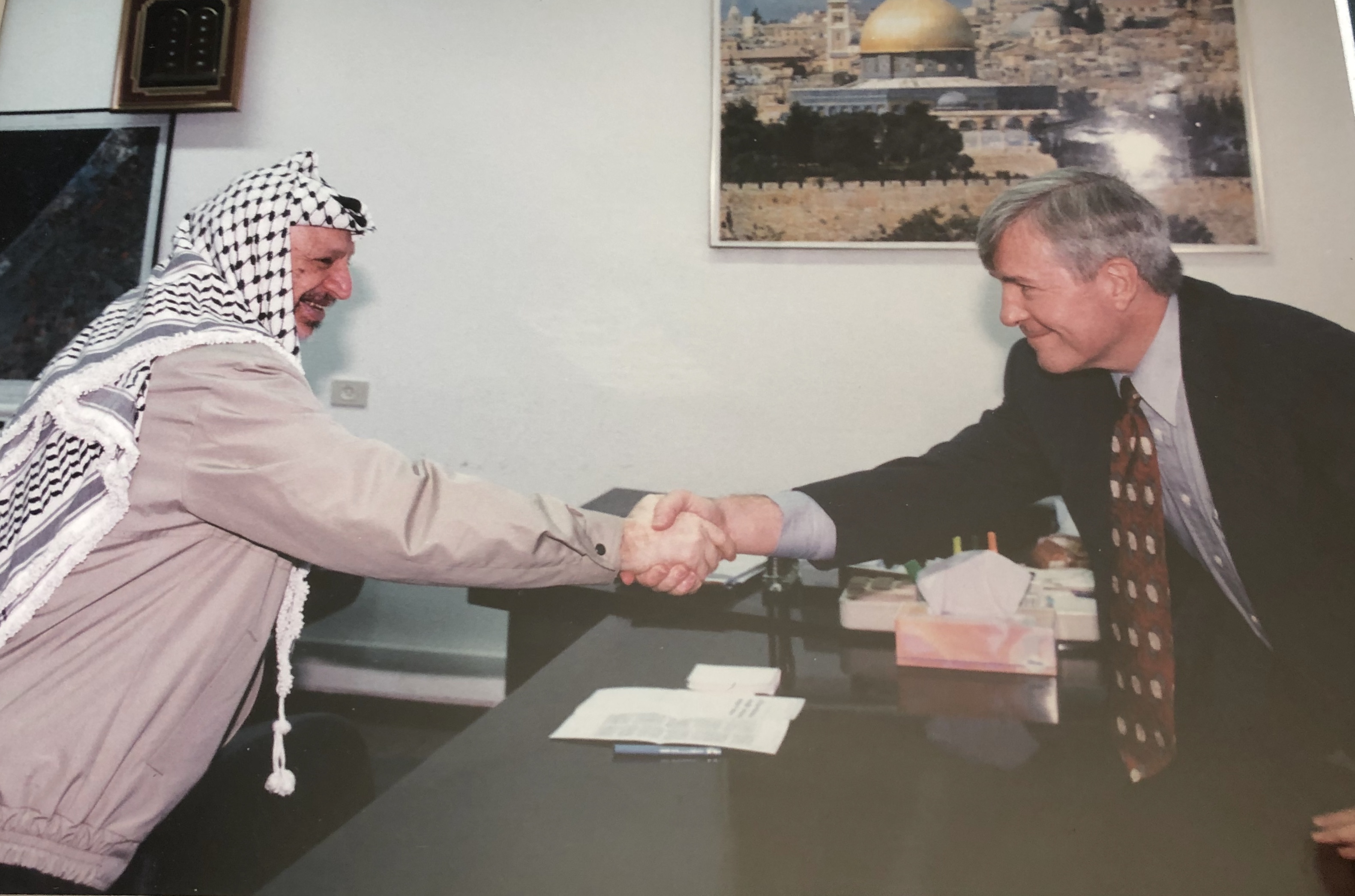 Yessar Arafat and Warren Coats in the PLO office in Gaza in February 1996.
 Warren's space