“Biden describes the China challenge as a global, ideological struggle between democracies and autocracies…. Any event from the pandemic to the Olympics will occasion commentary, particularly in the United States, of who “won,” China or America, and what it means for the epic struggle for global supremacy.” “There is no unified front against China”
I am not sure what it is that we want to win. We don’t seem to mind selling planes and bombs to other autocracies (Saudi Arabia, Qatar, etc.). Anything to keep the defense industry’s profits flowing short of yet another war seems a (relatively) good deal. And why might “global supremacy” matter?
Winning things sounds to me like rooting for our own basketball team and cheering when it wins the championship. How do we go about striving to have the best basketball team? First, we recruit the best basketball players we can find and hire the best coach to train them. Everyone must play by the agreed rules, and we win by playing the best game. In short, our efforts go into being the best team possible, not into poisoning the drinking water of the other teams.
But sporting contests are zero sum. One side wins and the other losses. Global cooperation and trade is win–win. The goods we produce and sell (for example) to China, with which to pay for the goods we buy from China make us and China both richer. The citizens of both countries benefit from this exchange. Win–win. Sharing information on the source, nature, and potential cure of a virus (which knows no borders) benefits all of us. Win–win.
The world’s output is maximized when our productive assets (labor and capital) are allocated to their most productive uses globally. That requires that market prices reflect the true productivity and value of each activity. Thus, the world as a whole benefits from rules governing government interferences in market prices and allocations. The World Trade Organization is the forum for agreeing on these rules of fair trade and enforcing them. “Econ 101- Trade in very simple terms”
The airplanes built by Boeing and Airbus benefit from government support of one sort or another. For years they have fought one another over whether this support conformed to fair trade rules. A settlement has finally been reached. “Boeing – Airbus settlement”
Trade restriction in the name of national security, while potentially legitimate, can easily cross the line into wealth reducing protectionism. Does the use of Huawei 5G equipment really threaten U.S. national security or U.S. business interests (protectionism). Some of these cases are hard to call but we must look carefully at narrow business interests in protecting their markets to the detriment of the rest of us. “Huawei ban could crush US aid efforts”
Global supremacy suggests that we would set these rules. To be successful the rules of international trade must be very broadly followed. Thus, their formulation must be a collective undertaking. It is fine for the U.S. to exert influence in setting these rules, but unfortunately, we have a poor record of even following them. We have caused the demise of the WTO dispute resolution body. We have strangely and counterproductively withdrawn from the Trans-Pacific Partnership (TPP), which was then replaced by the Comprehensive and Progressive Agreement for Trans-Pacific Partnership (CPTPP). These set high standards for more open trade that China will hopefully have to meet to join. The self-image of supremacy has corrupted U.S. behavior. Former President Trump’s protectionist tariffs on trade with China, EU, Canada, etc., which President Biden has so far failed to remove, have further reduced U.S. and world income. “Trade protection and corruption”
So, what should our policy be toward China? China has no intention or interest in attacking the United States. They care about their own economies and their own neighborhoods. We should keep our nose and military home to look after our own neighborhood. We should work with China (and Russia and others) to formulate win-win rules for international interactions and behavior. We should apply the mechanisms of the WTO and other international bodies, and diplomacy more generally, to hold China (and others) to the agreed rules. But we must abide by them as well. The rule of law is not just for others.
We should fix the problems in our own economy. We should work to make our domestic rules of commerce fair and efficient so that our economy will be the best in the world. We should work with other countries, including China, to maximize the productivity of their resources because we and everyone else will benefit (win-win).
The United States was founded on principles that have served us well providing a model that the rest of the world would do well to follow. The idea that we should (or can) impose our principles on others rather than provide an example like “a shining city on a hill,” is a violation of those very principles. We have repeatedly failed to uphold those principles, but we keep trying. We must continue trying and must try harder.
On this 20th anniversary of the 9/11 attack on America, many of us are saying “NEVER AGAIN”. What those saying it mean will determine the future of our country.
If “never again” means to you that we will never allow attacks on our homeland again, you are saying that out of your fear you chose safety over liberty. You support the authoritarian, repressive measures of the so-called Patriot Act and the related government intrusions in our privacy and liberties in the name of greater security. This is not the spirit of those Americans who continue to get into their cars to drive to work or wherever despite automobile accidents killing ten times more Americans every year as American soldiers who have died in Afghanistan in the past 20 years.
For me and thankfully for many other Americans, it means that we will never again surrender to the fear that blinded us to the tragic mistakes of American aggression in Afghanistan, Iraq, Libya, Somalia, Syria, and Uganda. Lawrence Wilkerson explains our self-destructive behavior in the following interview. COL Wilkerson was a senior official in the Bush administration when it launched the Iraq invasion. Now he calls it a mistake born of rage and fear. https://www.cnn.com/videos/tv/2021/09/10/amanpour-wilkerson-9-11.cnn
We have the most powerful military in the world. No military force could protect us at home (to the extent that our safety depends on military force) better. When it comes to its effectiveness in offensive attacks on other countries, its effectiveness is less clear and its effectiveness in efforts to rebuild the countries it has occupied…… well this fantastic three hour discussion reveals it as worse than zero https://www.youtube.com/watch?v=GkjsjBknWfo
We once revered and defended our liberty above all else and we were respected and envied around the world. We prospered. Over the last twenty years we have gradually, year by year, squandered our cherished traditions and our standing and respect in the world has declined as a result. Former President Trump signed an agreement with the Taliban promising to remove all American troops from Afghanistan by May 1 of this year. It was a bad agreement, but our departure was many years overdue. President Biden extended our stay for a few more months but has now honored Trump’s commitment. Why our military was unable to prepare properly for our withdrawal from Afghanistan with this two-year notice is a mystery we need to investigate.
The lesson of Afghanistan is not that the US is washed up as a great power. The lesson is that the US is such a great power, militarily and economically, that it is continually tempted to try hopeless things that nobody else on earth – including China – would ever attempt.David Frum
On July 8, 2021, President Biden said that: “the United States did what we went to do in Afghanistan: to get the terrorists who attacked us on 9/11 and to deliver justice to Osama Bin Laden, and to degrade the terrorist threat to keep Afghanistan from becoming a base from which attacks could be continued against the United States. We achieved those objectives. That’s why we went. We did not go to Afghanistan to nation-build.” “Remarks by President Biden on the drawdown of U.S. forces in Afghanistan”
In fact, except for killing Osama Bin Laden, we had achieved those objectives before I arrived with an IMF team in January 2002 to contribute to building a more effective government. Finding and killing Bin Laden was delayed until May 2, 2011, because of the redirection of American efforts to the ill-advised and illegal war in Iraq. So why were American troops still occupying Afghanistan until August 30, 2021?
In an August 18, 2021, interview with George Stephanopoulos, President Biden explained what happened asking: “Then what happened? Began to morph into the notion that, instead of having a counterterrorism capability to have small forces there in — or in the region to be able to take on al-Qaeda if it tried to reconstitute, we decided to engage in nation-building. In nation-building. That never made any sense to me.”“Biden’s claim that nation building Afghanistan never made any sense”
George W Bush opposed nation building in his 2000 presidential campaign. In his memoir, Decision Points, he states that “After 9/11, I changed my mind.” Already by April 2002, he stated that “We know that true peace will only be achieved when we give the Afghan people the means to achieve their own aspirations. Peace will be achieved by helping Afghanistan develop its own stable government.” He was right. However, as he noted: “Our government was not prepared for nation building.” He was right about that as well. “Bush on nation building and Afghanistan”
The U.S. officials responsible for “nation building” in Afghanistan knew little about its history and culture. They foolishly imposed an alien Western style government dropped on a diverse people as if from a drone. The US military is an excellent machinery of war. The best in the world. However, it does not have the skills required for “nation building.” Our military couldn’t even recruit the right solders or provide the training they needed to fight on their own, much less build a proper military organization. “Afghanistan combat interpreter Baktash Ahadi: U.S. cultural illiteracy” And attempting nation building at the point of a gun is bound to fail.
And why did the Afghan soldiers that Americans trained for decades not fight to defend the existing government? “Afghan forces were demoralized by neglect, corruption and ethnic bias among their superiors. Often they went without pay and ammunition, and sometimes without rations…. ‘The why is corruption, the why is poor leadership,’ John Sopko, told The Washington Post in 2017, ‘If leadership is poor, the people below don’t care, and they wonder why they have to die.’” “Afghanistan U.S. troop withdrawal”
On Sunday August 15, 2021, Taliban forces walked into Kabul and took over the government without a shot. “The Band of Brothers and Afghanistan” But what did they take over or replace? And did 20 years of so-called nation building make any difference. “Nation building” is often given a bad name because it has too often been associated with the imposition of a “government” by an occupying military force as with imperialism. Afghanistan is a very different place than it was 20 years ago. Both the nation and its government and its institutions have changed considerably. We can hope that the Taliban has changed as well.
Governments consist of ruler/decision makers, and the institutions that administer whatever it is that the government does. A nation extends beyond its government to include civil society, and social and cultural norms. The Taliban have displaced Afghanistan’s President Ashraf Ghani, who fled to Uzbekistan then to the UAE rather than step aside for a transition period as had been agreed. Afghanistan’s Chief Executive Officer, Abdullah Abdullah, remained and with former President Karzai is discussing the composition of a new government with Taliban leaders.
“Taliban co-founder Mullah Abdul Ghani Baradar will lead a new Afghan government…. Haibatullah Akhundzada, the Taliban’s supreme religious leader, will focus on religious matters and governance within the framework of Islam.
“While the Taliban have spoken of their desire to form a consensus government, a source close to the Islamist militant movement said the interim government now being formed would consist solely of Taliban members. It would comprise 25 ministries, with a consultative council, or shura, of 12 Muslim scholars, the source added.
“Also being planned within six to eight months is a loya jirga, or grand assembly, bringing together elders and representatives across Afghan society to discuss a constitution and the structure of the future government, the source said.” “Taliban co-founder Baradar will lead new Afghanistan govt”
Prior to the fall of Kabul, the government of Afghanistan consisted of the cabinet of ministers, provincial governors and the national assembly, with a democratically elected president serving as the head of state, head of government and commander-in-chief of the Afghan Armed Forces. It appears that the new government will retain the same administrative units. In addition to the central bank (DAB), which I advised, these would include functions such as Foreign Affairs, Internal Affairs, Finance, Economy, Agriculture, Energy and Water, Justice, Information and Culture, Education, Industry and Commerce, Transportation, Women’s Affairs, Public Health, Mines, and of course, National Defense. Though the U.S. did a poor job developing Afghanistan’s National Defense institutions, more experienced international agencies made considerable progress in developing more efficient and effective agencies in many other areas. Of at least equal importance, a generation of Afghan men and women have grown up expecting their place in the world to reflect their skills and accomplishments (merit) rather than who they knew.
I have written earlier about the dramatic progress in modernizing the central bank’s operations. It was achieved in the proper, traditional way of “nation” and institution building. We explained best practice for central banks derived from the experiences of established central bank and the approaches we thought would fit best with Afghanistan’s existing central bank and economy. But DAB’s management and staff made the decisions of what to embrace and how to move forward and we offered guidance on designing and implementing those decisions. “BearingPoint Afghans”
But one institution can’t develop independently of what is happening in the rest of the country. In particular, developing the rule of law is critical and difficult. An example was provided by DAB’s (the banking supervisor) confrontation with a corrupt President and Attorney General over the resolution of the insolvent and criminal Kabulbank in 2010-12. The founders and owners of Kabulbank (President Karzai’s brother Mahmood was the third largest shareholder) had rapidly grown this newly licensed local bank into the country’s largest depository and had lent almost all of its deposits to themselves. During the global financial crisis of 2008, many of Kabulbank’s owners’ investments failed and they were unable to repay their depositors. DAB’s banking supervisors were blamed for weak supervision and even arrested and jailed in disregard of the provisions of the central bank law. The scandal revealed considerable corruption, but the supervisory resolution of the bank somewhat strengthened (modestly) the rule of law in the process. “Afghan President Ghani’s attack on corruption”“The Kabul Bank Scandal”
Another huge set back to the impressive development of DAB resulted from President Ghani appointing an unqualified friend, Ajmal Ahmady, as Acting Governor of the central bank. He fired many of the best of the BearingPoint Afghans and brought in his own small group of cronies. Mr. Ahmady’s appointment was rejected by the Parliament, but he illegally remained in his post. The Taliban (???) have now appointed Haji Mohammad Idris as the Acting Governor of the central bank. “Mr. Idris was head of the Tabliban‘s finance section, but he has no formal financial training or higher education.” “Haji Mohammad Idris”
These examples are meant to illustrate the distinction between a government’s leaders and its administrators. Time will tell whether our “nation building” efforts with DAB survive the attacks on it from Afghanistan’s leaders (current and past). But as a result of the nation building efforts of many international bodies, Afghanistan is a very different and better place, and its young population has very different expectations, than twenty years ago. I hope that the Taliban leaders that have taken over the government are also very different than their repressive and brutal forebearers of twenty years ago.
While the new government will no doubt leave many of the institutional structures in place that have been developed over the last two decades, from which they and the country have benefitted, the big question is what policies and rules they will establish under the name of Sharia law, especially with regard to the rights of women. The Taliban have their own internal factions that need to be sorted out and their earlier version of Sharia was an extremely harsh interpretation not shared by most Muslims. The Taliban has pledged to treat women and others fairly, within the dictates of Sharia Law. Other Muslims will need to convince the Taliban to moderate their earlier interpretations of what that means. The United States, the EU “EU sets five conditions for future operational engagement with Taliban”, China, Russia, and the international organizations, have enormous financial and diplomatic leverage with which to encourage the Taliban government’s better behavior. They should be used vigorously to help build a better Afghanistan. Early signs are not encouraging, but these are early days. One Afghan friend changes locations every night in the hopes of not being found. Other friends are afraid to leave their homes at all.
The idea that we should refuse to cooperate with the new government and should oppose it at every turn from the outset is bone headed. Just ponder the alternatives for a second. Do not think that it is easy for me to sit here in my comfortable Bethesda home and urge us to give the Taliban a try. My days begin with heart wrenching pleas for help from Afghan friends and strangers. I challenge you to read the following account of dashed hopes without weeping: “After a university falls in Afghanistan a DC organization scrambles to keep students safe and still learning”
Efforts to achieve a better Taliban government this time around may be a long shot, but the alternatives of a return to civil war and worse yet the return of American and NATO troops are not pretty either. The U.S. intention to cooperate with the new government in countering ISIS-K is encouraging, but, like anything else in life, not without risks. “US may coordinate with Taliban to take on ISIS-K” Nation building by everyone but the U.S. government over the last 20 years has not been a waste of time. Now is not the time to give it up.
Nation building is unlikely to be successful when coerced, i.e., when it is part of a military intervention. It does not follow that nation building–sharing best practice in the design and operation of institutions public and private–is an unworthy objective and undertaking.
Sometime around 2004 or 2005, the US Agency for International Development (USAID) contracted BearingPoint (now part of Deloitte Consulting) to recruit and mentor approximately 80 young Afghan college graduates into Afghanistan’s central bank (DAB) and Finance Ministry. These young Afghans worked in DAB and the Finance Ministry for two years while being trained and mentored by BearingPoint experts. Following these two years they were offered regular jobs in these two institutions. While some moved on to higher paying jobs elsewhere most of them stayed with DAB and the MOF. Over the years that followed they rose within these institutions, and in DAB headed many of the departments including the position of Second Deputy Governor. Working with and watching the progress of these young Afghans was one of the most enjoyable and gratifying assignments in my career with the International Monetary Fund. They were smart, honest, and dedicated to improving life in their country (including their own). They were, and I hope still are, the hope for a better future for Afghanistan.
The elected Afghan government under which these BearingPoint Afghans worked has now been toppled by the Taliban, a group that harshly ruled Afghanistan from 1996 until displaced by an American-British invasion in November 2001. Back in 1996: “Gaining control over most of the country, the Taliban impose their rule, forbidding most women from working, banning girls from education, and carrying out punishments including beatings, amputations and public executions. Only three countries officially recognize the Taliban regime: Pakistan, Saudi Arabia and the United Arab Emirates.” “Afghanistan conflict timeline”
The Taliban in 1996 claimed to impose Sharia Law on Afghanistan. “Sharia” translates to ‘the way’ in Arabic and refers to a wide-ranging body of moral and ethical principles drawn from the Quran and from the sayings and practices of the Prophet Muhammad. The principles vary according to the interpretation of various scholars who established schools of thought followed by Muslims who use them to guide their day-to-day lives. Many Muslim-majority countries base their laws on their interpretation of the principles of Islamic law but, despite this, no two have identical laws.” “Taliban and Sharia Law in Afghanistan”
The Taliban imposed a very severe version of Sharia that has not been embraced by very many Muslims. It was particularly restrictive on the activities and rights of women. Twenty years later Afghanistan is a different place, and the Taliban sounds like a different organization.
“KABUL, Afghanistan (AP) — The Taliban vowed Tuesday to respect women’s rights, forgive those who fought them and ensure Afghanistan does not become a haven for terrorists as part of a publicity blitz aimed at reassuring world powers and a fearful population.
“Following a lightning offensive across Afghanistan that saw many cities fall to the insurgents without a fight, the Taliban have sought to portray themselves as more moderate than when they imposed a strict form of Islamic rule in the late 1990s. But many Afghans remain skeptical — and thousands have raced to the airport, desperate to flee the country.
“Older generations remember the Taliban’s previous rule, when they largely confined women to their homes, banned television and music, and held public executions. A U.S.-led invasion drove them from power months after the 9/11 attacks, which al-Qaida had orchestrated from Afghanistan while being sheltered by the Taliban.” “Afghanistan Taliban Kabul”
So, what should American policy be toward the forthcoming Taliban or Taliban lead government? What does the Taliban pledge to “respect women’s rights consistent with their version of Sharia Law actually mean? We should deploy every diplomatic tool possible to encourage/pressure the new government to live up to its promises. Former President Karzai, current CEO Abdullah Abdullah and others are currently in discussions with the Taliban leadership over terms for an inclusive government.
The alternative of nonrecognition, once there is a government to recognize, is to encourage and even support civil war. Or, God forbid, to send our troops back (there is not much chance that our NATO allies would be conned a second time into join us there again). And how did that work out for us last time? Our over used weapon of economic sanctions harms the public we should be trying to help. Our inhuman sanctions on Cuba and Venezuela are imposing horrible pain on the their citizens with little impact on their governments. “Evidence-costs and benefits of economic sanctions”
In a recent Washington Post oped Nikki Haley argued that we should not recognize the Taliban government no matter what. “Nikki Haley-America must not recognize Taliban” I respected Ms. Haley when she was Governor of South Carolina but I eventually got over her when she embarrassed us while Ambassador to the UN. “The future of Israel and Palestine” Her unqualified attack on the Taliban firmly ties her to those who were responsible for our Afghan disaster in the first place. The new Afghan government may turn out to be as bad as the previous Taliban government, but we should do everything possible to prevent that.
The U.S. has suspended currency shipments purchased by Afghanistan’s central bank. Afghan assets (foreign exchange reserves, etc.) deposited abroad have been frozen including “its” access to reserves at the IMF. These may appear to be rejections of a new government, but they are not. There is no new government yet and those holding Afghan assets must keep them safe until their new owners are clearly and properly identified. The situation is much like the bank in which you have deposited money, freezing your deposits when you die until the new lawful owner is determined. There is an unavoidable, awkward period of uncertainty. It is not too late to reverse our mistake in closing our Embassy and running out while at the same time accusing the Afghan Army of behaving the same way.
It is also not true that nothing was accomplished these past 20 years. Our military leaders may have failed in their task of building a reliable Afghan Army, but many others, myself included, did not waste our time by helping Afghans build better institutions (see the story of the BearingPoint Afghans I started this article with above). See the discussion of this issue by Jonathan Rauch: “The Afghanistan war was a partial success”
No one knows what the Afghan government will look like or which way it will go, but we all (except for the war mongers) have an interest in promoting its success, especially the hopeful, new generation of Afghans. “Can US work with Taliban”“What do Taliban’s really want?”
And we must resist the siren calls of those who think that we can and should impose our vision and institutions on the rest of the world. We must keep our Army home to defend our homeland rather than messing with other people’s business. Our defense industries have profited enough.
I just finished listening to the Audible version of Thinking the Twentieth Century, a discussion between Tony Judt and Timothy Snyder, recorded just before Judt died in 2010. Judt was a British-American historian, essayist and university professor who specialized in European history. Snyder is an American author and historian specializing in the history of Central and Eastern Europe and the Holocaust.
I found Judt to be a very insightful in his area of political and social history expertise but generally off base on economic issues, which is not his field. I fear that his misunderstanding of trade is widely shared so I will set out some important basics as a contribution to better public understanding. “Science” doesn’t dictate policy, but a correct understanding of the economics of trade is essential if one’s value preferences are to lead to policies that produce your desired result.
Judt describes the increase in American wages for manufacturing workers along with their health and pension benefits over the past several decades leading manufacturing firms to outsource their production to the cheaper labor in (for example) China and thus hollowing out American manufacturing. Almost everything about this description is wrong.
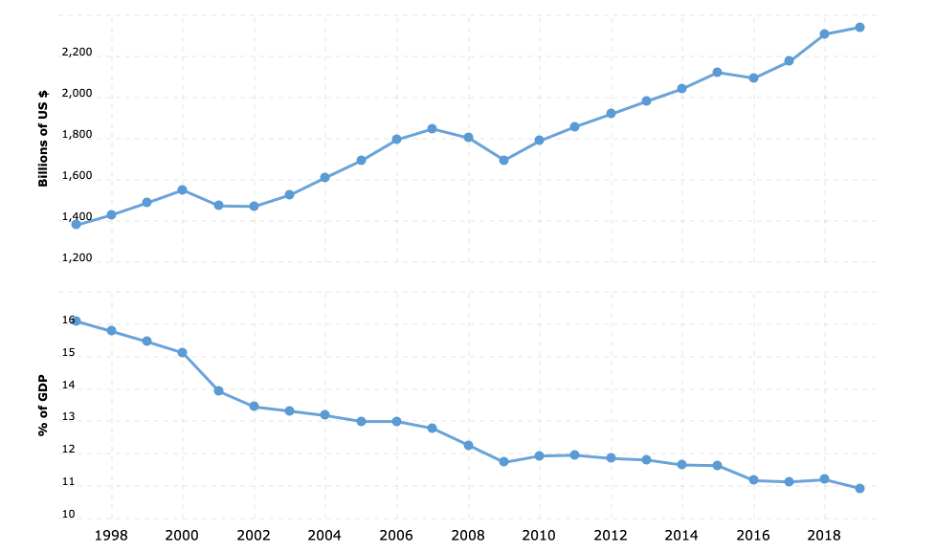
For starters manufacturing output in the U.S. is at an all-time high (prior to Covid shutdowns). Off shorting some of it has not hollowed out U.S. manufacturing. Because manufacturing output has grown more slowly than the economy overall (the upper line below), its share of GDP has fallen (the lower line). Moreover, because of increased labor productivity in manufacturing, fewer workers are needed to produce this increased output (second chart) thus freeing labor to work in other areas and increasing our overall standard of living.
But let’s take a closer look at Judt’s statement. If the U.S. shifts some manufacturing offshore, it must pay for it. Instead of paying American workers it must pay Chinese workers, and firms and shipping companies. Fundamentally, a country’s imports must be paid for by its exports (or by capital inflows from the exporting country). Let’s look carefully at each possibility. To simplify, let’s initially assume that there are no capital flows (cross border investments from one country in another) so that trade in goods and services must balance (i.e., pay for each other).
For starters whether labor is cheaper in China than in the U.S. cannot be determined without considering the exchange rate of the dollar for the Chinese Yuan. If exchange rates (not mentioned by Judt) are flexible (determined freely in the market) the fact of an increase in U.S. imports from China (i.e., the offshoring of U.S. manufacturing to China) will depreciate the dollar/Yuan exchange rate. As U.S. manufacturers sell dollars to buy Yuan with which to pay for the goods they now want to buy from China, Yuan will become more expensive (a depreciation of the exchange value of the dollar). The dollar’s depreciation will have two effects. It increases the cost of Chinese labor to U.S. companies and thus will reduce the cost advantage of Chinese labor and reduce the demand for it by U.S. firms. And it will lower the cost of U.S. exports thus making them more attractive in China. While the adjustments will take time, the dollar depreciation will continue until American exports increase and its imports from China moderate until trade balances–our increased exports pay for our increased imports.
If the exchange rates are fixed, as they were in gold standard days, the adjustment in the real effective exchange rate needed to balance trade takes a different form. The initial increase in the demand for Chinese products (outsourcing to Chinese workers) are paid for with dollars. But to preserve the fixed exchange rate, the PBRC (Chinese central bank) must buy these dollars with newly created Chinese currency. This increase in the Chinese money supply will lift prices in China making Chinese exports more expensive in the U.S. and U.S. goods cheaper in China. In short, the real exchange rate adjustment needed to balance imports and exports in this case results from a higher inflation rate in China than in the U.S. while in the first case of flexible exchange rates it results from adjustments in the nominal exchanges rates themselves.
A third possibility is for China to take the extra dollars being spent in China and invest them in the U.S. (or elsewhere) This is the capital flow case in which trade itself does not balance. This was the policy followed by China in the 2000s through 2014. The PBRC would buy the dollars being spent for outsourced Chinese labor (U.S. manufacturers payments to Chinese workers rather than to American ones for the goods they needed) and would invest them in the U.S. If the increase in the Chinese money supply resulting from those dollar purchases was more than was consistent with stable prices in China, the excess money would be sterilized–so called sterilized foreign exchange intervention (the PBRC would create Yuan to buy dollars and would repurchase some of those Yuan back with domestic Chinese securities owned by the PBRC).
To some extent this foreign exchange market intervention by the PBRC was the result of its desire to build up its FX reserves (a kind of insurance policy for exchange rate shocks). However, much of it was to prevent an appreciation of the Yuan that would reduce its exports (it was following an export led development strategy). This policy was much criticized abroad as currency manipulation and ended in 2013-4. Thus, China has financed a significant part of the U.S. governments fiscal debt. https://nationalinterest.org/feature/who-pays-uncle-sams-deficits-26417
Thus, when someone says that something is cheaper to make in China, remember that it must also be that from China’s perspective, something must be cheaper to make in the U.S. in order to pay for what China sends to us. Both sides benefit and the world grows richer.
Sunday night Ito and I finished the tenth and final episode of the WWII story of Easy Company of the 101 airborne division of the U.S. Army–The Band of Brothers. It is a moving and masterful depiction of the horrors of war, and its impact on those (often) brave men who fight them. How, I asked myself, can good people do such terrible things to each other? And why? Who benefits (that is too obvious to answer explicitly)?
I woke up that morning to the fact that the government in Afghanistan that I had been working with for the past 20 years had been replaced by the Taliban who intends to form a new government. Fingers are being pointed all over the place in the search for fault. I am afraid that this American question is of little interest to my Afghan friends. Those who have not already left the country are holed up in their homes afraid to go to work. Their question is what the new Taliban regime will look like.
Our objective now should be to join with all other nations to exert diplomatic pressure on the new government (which potentially will have the cooperation of at least former President Hamid Karzai, CEO Abdullah Abdullah, and Islamic Party leader Gulbuddin Hekmatyar) to adhere to UN standards of humanitarian treatment of its citizens and to help them administer an efficient and honest government. America’s leadership in this regard will be critical for Afghanistan’s future.
But who should we blame for, and what lessons should we learn from, Afghans fleeing the country by climbing onto the outside of planes leaving the Kabul Airport (something I have done many times but more comfortably seated)? Working backward, President Trump gave our military leaders a May 1 deadline for leaving. It rather looks like they ignored him (tempting but not appropriate).
The speed with which the Taliban took over the country with barely a shot fired surprised most of us. We had dinner at the home of Edward and Dalya Luttwak Saturday. During the conversation I passed on the statement by an Afghan friend emailed to me that afternoon that the Taliban could take Kabul by the next day or week. We all thought that would be impossible, thinking it might be as fast as a few months. In fact, they peaceably took over the city the next day (Sunday Aug 15). In fact, our Embassy and Military leaders should not have been surprised. My work in Afghanistan with its central bank did not require that I be thoroughly versed on Afghan history and customs, but that is not true for our foreign policy establishment working in and on Afghanistan.
Rather than arm, train, and support Afghan fighters in regions they cared about, we pulled together a national Army with the incentive of money. In addition, the broader Afghan public did not strongly support its corrupt government and could fairly easily change sides. “Afghanistan military collapse-Taliban” Moreover, waring tribes and political groups such as the Taliban have a long tradition of negotiating peaceful surrenders when the outcome seems clear. “Afghanistan history-Taliban collapse”
The initial blame for our failure to “build” a strong government in Afghanistan falls on George W Bush who gave in to the Cheney/Rumsfeld fantasies of American Imperialism, and abandoned the original and sensible approach of American support of the Northern Alliance war against the Taliban. “Its plan was for small teams of CIA officers, along with Green Berets and U.S. air power, to assist the indigenous Afghan resistance—the Northern Alliance.” “Afghanistan withdrawal-CIA-bin Laden-al Qaeda-Bush-Biden-Northern Alliance” Instead we took over and occupied the country.
Rather than work with and build from Afghanistan’s traditional tribal structures, we imposed an alien, centralized government that was not understood and was generally resented outside of Kabul. Rather than elevating village chiefs to govern provinces, for example, Kabul sent strangers to oversee areas they knew nothing about. Our ignorance and arrogance were mind boggling, but sadly typical. And our military—the best in the world for waging wars— is incompetent at nation building, which should be the job of others. We couldn’t even build an Afghan Army in 20 years. “How America failed Afghanistan”
This Sunday, August 15, is the 50th anniversary of President Richard Nixon’s closing of the gold window as part of the “Nixon Shock.” “Fifty years later Nixon’s August surprise still reverberates” He announced on that day that the U.S. Treasury would no longer redeem its dollars for gold at $35 an ounce. Over the subsequent few years, the world moved from national currencies whose values were anchored to the market value of gold, to currency values determined by central banks’ regulation of their supply relative to the market’s demand. The value of one currency for another floated in the foreign exchange market. Central banks have deployed various approaches to determining the supplies of their currencies and most have now settled on targeting an inflation rate (often 2% per year) in one way or another.
With the rapidly increasing interest in cryptocurrencies, some have asked whether we are on the brink of another monetary paradigm shift? Specifically, might the dollar be replaced as the dominant international reserve currency. To explore that question we need to understand how the existing monetary systems work and how the widespread use of cryptocurrencies might add to or change these systems.
In describing the existing and potential future monetary systems, we need to distinguish “money” from the “means of payment.” Money is the asset that people accept in payment of debts or for the purchase of goods and services. The U.S. dollar and the Euro are “money.” The means of payment refers to how money is delivered to the person being paid. Do you personally hand dollar bills and coins to the Starbucks cashier, write out a check (bank draft) and put it in the mail, or electronically transfer “money” from your bank account to an Amazon merchant via eWire, Zelle, Venmo, PayPal, or some other digital payment service? Or perhaps you purchase goods and services with borrowed money (Visa, MasterCard, American Express) that you pay back at the end of each month or over time. Or if you don’t have a bank account (a form of digital money) you might hand-deliver physical currency to a Hawala dealer or a MoneyGram or Western Union office to be electronically transferred to their office nearest to the person you are sending it to, potentially anywhere in the world. If you are paying in a currency that is different than the one the payee wishes to receive, your currency will be exchanged accordingly along the way in the foreign exchange market.
Discussions of cryptocurrencies include both the latest and evolving means of payment (digital payment technologies) as well as new, privately created moneys such as bitcoin, Ethereum, or Ripple. Private currencies vary enormously with regard to how their value is determined. By private currencies I do not mean privately created assets redeemable for legal tender, such as our bank accounts. When we speak, for example, of the U.S. dollar, we invariably include dollar balances in our bank accounts, dollar payments made via our Visa card, etc. These are all privately produced assets that are ultimately redeemable for Federal Reserve currency or deposits at a Federal Reserve Bank. They are credible claims on the legal tender of the United States. Most U.S. dollars are privately created.
The value of all money is determined by its supply and demand. The demand for money arises from its acceptability for payment of our obligations and the quantity of such obligations (generally closely related to our incomes). Within each country, its legal tender money (e.g., the U.S. dollar in the U.S.) must be accepted by payees. In particular, it must be accepted by the government in payment of taxes. Truly private currencies (those not redeemable for legal tender, of which there are over 11,000 at last count) have a serious challenge in this regard. Very few people or businesses will accept bitcoin, or any other such private cryptocurrency. As a result, the demand for such currencies for actual payments is very low. The demand for bitcoin, for example, is almost totally speculative–a form of gambling like the demand for lottery tickets. Such private currencies are more attractive in countries whose legal tender is rapidly inflating or has unstable value (e.g., Venezuela).
The acceptability of a currency in cross border payments raises special challenges. My currency is not likely to be the currency in general use in other countries. Someone in Mexico paying someone in Germany will generally have Mexican pesos and the recipient in Germany will want Euros. The pesos will need to be exchange for Euro in the foreign exchange market. It would be very costly for dealers in the FX market to maintain inventories of and transact in every bilateral combination of the world’s 200 or so currencies. It has proven more economical to exchange your currency for U.S. dollars and to exchange the U.S. dollars for the currency wanted by the payee. The dollar has become what is called a vehicle currency.
The economy of a so-called vehicle currency can be illustrated with languages. Two hundred and six countries are participating in the 2021 Olympic Games in Japan. To communicate with their Japanese hosts participants could all learn Japanese. It is unrealistic to expect the Japanese hosts to learn 205 foreign languages. But what about communicating with their fellow participants from the other 205 countries. For this purpose, English has become the default second language in which they all communicate. Unlike more isolated Americans, most Europeans speak several languages, but one of them is always English. English as the common language is the linguistic equivalent of the dollar as a vehicle currency.
The rest of the value of money story focuses on its supply. Bitcoin has the virtue of having a very well defined, programmatically determined gradual growth rate until its supply reaches 21 million in about 2040. The supply today (Aug 2021) is 18.77 million. See my earlier explanation: “Cryptocurrencies-the bitcoin phenomena” The other 11,000 plus cryptocurrencies each have their own rules for determining their supply, some explicit and some rather mysterious. The class of so called “stable coins” are linked to and often redeemable for a specific anchor, sometimes the U.S. dollar or some other currency. The credibility of these anchors varies.
The highly successful E-gold (from 1996-2006) is an example of a digital currency that had well-defined and strict backing and redemption for a commodity at a fixed price. “E-gold” The supply of such currencies is determined by market demand for it at its fixed price–what I have elsewhere called currency board rules. I describe how currency board rules work in my book about establishing the Central Bank of Bosnia and Herzegovina: “One currency for Bosnia-creating the Central Bank of Bosnia and Herzegovina”
The dominance of the U.S. dollar in cross border payments reflects far more than its use as a vehicle currency. Many globally traded commodities, such as oil, are priced in dollars and thus payments for such purchases are settled in dollars. Pricing a homogeneous commodity trading in the global market in a single currency makes that market more efficient (the same price for the same thing). Making cross border payments in dollars (or any other single currency) also avoids the costly need to exchange one for another in the FX market. The dollar is most often chosen because its value is relatively stable, and it has deep and liquid securities markets in which to hold dollars in reserve for use in cross border payments.
So, what are the chances that current cryptocurrency developments might precipitate a shift from the dollar to some other currency and means of payment. Several factors of U.S. policy have heightened interest by many countries in finding an alternative. Specifically, from my recent article in the Central Banking Journal on the IMF’s $650 billion SDR allocation:
“Cumbersome payment technology. Existing arrangements for cross-border payments via Swift are technically crude and outmoded.
The weaponization of the dollar. The US has abused the importance of its currency for cross-border payments to force compliance with its policy preferences that are not always shared by other countries, by threatening to block the use of the dollar.
The growing risk of the dollar’s value. The growing expectation of dollar inflation and the skyrocketing increase in the US fiscal deficit are increasing the risk of holding and dealing in dollars.” “The IMF’s 650bn SDR allocation and a future digital SDR”
Most central banks are upgrading their payment systems. But the Peoples Bank of the Republic of China (PBRC) is one of the most advanced in developing a central bank digital currency (CBDC), the e-CNY. However, it has little potential for displacing the dollar for several reasons. The Federal Reserve is also modernizing its payment technology, including exploring the design of its own CBDC, and can match China’s payment technology in the near future if necessary. More importantly, China’s capital controls, less developed Yuan financial markets, and less reliable rule of law make the Yuan an unattractive alternative to the dollar. These latter impediments do not apply to the Euro, however. “What will be impact of China’s state sponsored digital currency?”
Rather than looking for another national currency to replace the dollar, there are several advantages to using an international one. These include greater ease in making cross border payments and the reduced risk of political manipulation, or a national currency’s domestic mismanagement. Bitcoin, for example, can make payments anywhere in the world without being controlled by any one of them. The serious drawbacks of Bitcoin’s blockchain payment technology might be overcome with one or another overlaid technology. But to become a serious currency, bitcoin must be dramatically more widely accepted in payment than it is now. Widespread acceptance in payments could generate the demand to hold them for payments, which would tend to stabilize its very erratic value. This seems very unlikely. A digital gold-based currency, such as the earlier E-gold, would enjoy the advantage of an anchor that is well known and that has enjoyed a long history. However, gold’s value has been very unstable in recent years. Aluminum has enjoyed a very stable price and elastic supply and will be the anchor for Luminium Coin to be launched in the coming weeks: https://luminiumcoin.com/
But the world has already established the internationally issued and regulated currency meant to supplement if not replace the dollar, the Special Drawing Rights of the International Monetary Fund. The IMF has just approved a very large increase in its supply. “The IMF’s 650bn SDR allocation and a future digital SDR” The SDR’s value is determined by the market value of (currently) five major currencies in its valuation basket. While all five of these currencies have a relatively stable value, the value of the basket (portfolio) of these five is more stable still. The rules for determining the SDR’s value and supply, as well as its uses, are well established and transparent and governed by the IMF’s 190 member countries. In short, the SDR is truly international. However, it can only be used by IMF member countries and ten international financial institutions such as the World Bank and the Bank for International Settlements.
While the SDR has played a limited useful role in augmenting central bank foreign exchange reserves, it has failed to achieve a significant role as an international currency because of the failure of the private sector to invoice internationally traded goods and financial instruments (such as bonds) in SDRs and the absence of a private digital SDR for payments. If the IMF is serious about making the SDR an important international currency it should turn its attention to encouraging these private sector uses of the unit. “Free Banking in the Digital Age”
In the long run the IMF should issue its official SDR according to currency board rules and anchor its value to the market value of a small basket of commodities rather than key currencies: “A Real SDR Currency Board”
[1] Warren Coats retired from the International Monetary Fund in 2003 where he led technical assistance missions to the central banks of more than twenty countries (including Afghanistan, Bosnia, Egypt, Iraq, Kazakhstan, Kenya, Kyrgyzstan, Serbia, South Sudan, Turkey, and Zimbabwe). He was a member of the Board of the Cayman Islands Monetary Authority from 2003-10. He is a fellow of Johns Hopkins Krieger School of Arts and Sciences, Institute for Applied Economics, Global Health, and the Study of Business Enterprise. He has a BA in Economics from the UC Berkeley and a PhD in Economics from the University of Chicago.
Many people who lost their jobs because of Covid are not able to pay their rent until they return to work. What should we do about it? Most landlords will work out an arrangement for deferred rent with tenants that are otherwise trustworthy. Most overdue debts are handled this way. But a case can be made, and has been made, for temporary government assist. Where you think the money should come from to bridge the income gap tells a lot about your general attitudes toward our market economy. When renters lose their incomes and stop paying their rent, they are passing on part of that loss to their landlords.
The income supplement to out of work renters can come from the general taxpayers (us) or from landlords. Investing in real estate is one of the primary ways in which lower middle-income families build wealth and move up the ladder. They should not be the ones to bear the cost of this assistance. The CARES Act and subsequent programs was meant to share this burden more fairly, but its disbursements seem to have been slow. The eviction moratorium, in addition to being illegal, is immoral.
Former Secretary of Defense, Don Rumsfeld, died on June 30. I am told that he was a very nice man personally, though I only met him a few times at our annual Pumpkin Papers Irregular dinners at the University Club in Washington, DC. But I cannot forgive him for lying the United States (and Britain) into the illegal and disastrous War in Iraq. “Rumsfeld-torturer-butcher” At the end of Juan Cole’s article is a New America Foundation panel on Iraq moderated by Steve Clemons from 14 years ago. Near the end of the video you can hear me make a comment.
A war with Iraq served no U.S. interest, quite the contrary. Iraq balanced the influence of Iran, its traditional enemy. Why would we want to end that? Rumsfeld and Cheney/Bush invented the lie of weapons of mass destruction (WMD) as their excuse to attack Iraq despite the refusal of the UN Security Council to endorse such an attack. I highly recommend: “‘Official Secrets’… a 2019 British drama film based on the case of whistleblowerKatharine Gun, who leaked a memo exposing an illegal spying operation by American and British intelligence services to gauge sentiment of and potentially blackmail United Nations diplomats tasked to vote on a resolution regarding the 2003 invasion of Iraq.”https://en.wikipedia.org/wiki/Official_Secrets_(film)
Many things can solidify and sustain political leaders in power, but none so well as war. And nothing keeps the tax dollar profits flowing to the military/industrial complex as much as war or the threat of war (real or imagined). And nothing threatens our liberties as much as the perpetual fear of war; the 9/11 war on terror being the premier example.
We are quite good at bombing and fighting but piss poor at governing occupied territories. In my rather considerable post conflict country experiences, Iraq was by far the worst example of imperial American mismanagement. I have written about my experiences in Iraq in https://wcoats.blog/2020/10/11/my-travels-to-baghdad/
Trust is a critically important feature of successful relationships and of flourishing societies. Enduring trust builds on honestly and truth. I have just finished reading Jonathan Rauch’s exposition of these truths in The Constitution of Knowledge: A Defense of Truth and his enlightening exploration of how to find and defend truth in today’s challenging environment.
How can we determine what is true and what is not? Rauch’s book explores this question. In sorting out fact from fiction we must recognize the personal and social biases through which we evaluate claims and the factors that motivate them. The task is made even more difficult by the fact that there are some who deliberately propagate falsehoods for their own purposes. Whatever else might motivate them, political and other leaders act to gain or retain their power. They often have an incentive to misrepresent facts, i.e., to lie. Former President Trump and his Big Lie (and his many, many other lies) is by no means the only President to have lied to the American public. Many other Presidents have also lied.
Ken Burn’s documentary, The Vietnam War, is a brilliant expose of such lies and yesterday I watched for the first time the 2010 Goldsmith and Ehrlich directed documentary The Most Dangerous Man in American: Daniel Ellsberg and the Pentagon Papers. Lyndon Johnson and Richard Nixon almost give Trump a run for his money as liars, though I think that they thought they were lying for the benefit of our country along with their reelection (which by no means excuses it).
Our constitution provides limited, enumerated powers to our government and checks and balances of the powers between its branches and its citizens. But the power of free speech and a free press to expose lies is an indispensable check on the lies of public officials. Our republic has been defended from foreign attacks by many brave solders. But we should also be grateful for the self-sacrifices of a few brave whistleblowers for exposing government lies and thus defending our republic and the individual liberty in which we have flourished.
Wednesday, I watched Daniel Ellsberg receive the Committee for the Republic’s Defender of Liberty award. We are still meeting virtually, but the event was a fascinating discussion of the Vietnam war decision making. The discussion included the Pentagon Papers movie directors, Goldsmith and Ehrlich; the official head of the Pentagon project that wrote the Pentagon Papers history of the war, Morton Halperin; the New York Times reporter who wrote the first article on the Papers given to him by Ellsberg; and Ellsberg himself who went on at great length. It was a riveting two-hour discussion. You can watch it here: https://youtu.be/l7L3DOhakNU
I hope that we can present this award to Edward Snowden in the future.
Holding our government officials accountable for speaking the truth and for abiding by the law are critically important in preserving (or restoring) trust and in determining “the truth.” Each one of us contribute to (or detract from) those goals. But I am in awe at the personal sacrifices of Ellsberg and Snowden in the service of truth, which so badly needs defending. If there is hope of saving our fractured and disbelieving Republic, it will be because of the bravery of such people and the embrace by the rest of us of the wisdom expressed by writers like Rauch. It requires our individual commitment to truth and the institutions and norms that facilitate and incentivize finding it (filtering falsehood from truth). It requires an effective Constitution of Knowledge.


 Warren's space