Travel notes from South Sudan and Kenya

As my Kenya Airways flight climbed out of Juba, the Nile cut through the brown countryside as far as I could see. In the last month of South Sudan’s dry season, little green can be seen. In a month and a half or so after the rainy season has started it will all be green.

An hour and a half later, as we descended into Nairobi, the vast plains of Kenya surrounding the city were lushly green and the relatively vast wealth of Kenya was easily discernible even from the sky. The drive from the airport to my hotel in the city center took me past row after row of modern office buildings and import export warehouses and assembly facilities. Kenya is a relatively modern and affluent African country. It is alive with activity. It’s rapidly growing wealth is unfortunately revealed in the infamous traffic jams along its main roads. Freeway construction has not kept pace.

Today, the front page of one of Nairobi’s daily newspapers was filled with news of the winners of the national school performance examination results, a testimony to the high value Kenyan’s place on education as an essential part if its development and continental and international competitiveness. The paper lamented the continued gap between the girls’ and the boys’ performance.

Kenya has made progress toward reducing the role of tribes in business and political life. If workers are promoted and otherwise rewarded on the basis of performance (merit), economies develop and grow much faster than those (so typical of much of Africa still) that function more narrowing long tribal lines. Then the Presidential elections in December 2007, which were expected to deepen democracy’s hold, erupted into violence along political/tribal lines when incumbent President Mwai Kibaki was declared the winner and shattered this progress. His opponent Raila Odinga was widely thought to have won. Over 800 people died and over 600,000 were displaced from the violence.

Most Kenyans were shocked by the violence of those weeks. Former UN General Secretary Kofi Annan brokered a power sharing agreement that restored peace but did not succeed in overcoming the resurgent tribalism and its poisonous effect on Kenya’s public and economic life. Ever since local newspaper headlines have been dominated by on again off again efforts to bring the perpetrators of the electoral violence to justice. The debate is between those who do not believe Kenyan institutions are strong enough to expose and punish those high government officials who are guilty and thus favor having the claims adjudicated in the Hague, and those who want Kenya to handle its own investigation. This later group includes coalition government, whose Finance Minister was accused by the International War Criminal Court in the Hague as one of the perpetrators. Like Zimbabwe, it is very painful to see such a wonderful and promising country slide backward.

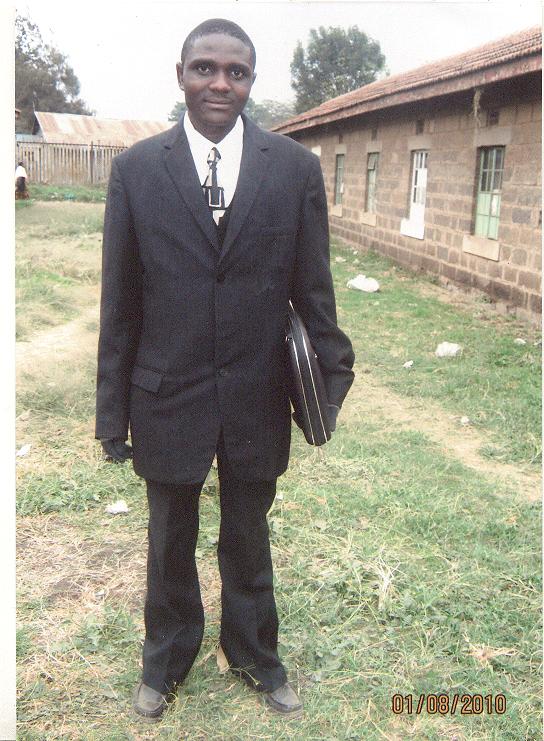
Then there is the story of Paul Oduor, pictured below. I had dinner with Paul several weeks ago in Nairobi on my way to Juba. I am still not quite sure how it came about. Several months ago I received a text message from a Kenyan phone number. I had never received an unsolicited text message from a stranger before (unlike all those messages from widows, Barristers, or bank officials in Nigeria or Benin—why Benin??—eager to deposit millions from their recently diseased husband, or client, in my bank account if I would just provided them with my account information).  He said something like, “I am a young African man, and would like to know you. Where are you?” not the usual “I am sure that you will be very surprised by this letter” favored by the fraudsters. My finger hovered over the delete button, but then I replied “I am in Washington DC. Who and where are you.” It turned out that he was in Nairobi and didn’t seem to want anything more that the adventure of connecting with someone somewhere else in the world. And, of course, I do pass through Nairobi fairly often, so we kept exchanging text messages and arranged to meet for dinner on February 18th.

Paul was a polite young man of 22 who ran a human rights organization with a partner that is affiliated with Humanists International. He was trying to educate the residence of the large squatter slum of several hundred thousand Kenyans in a square mile or so of Nairobi of their rights under the law. He gave me literature explaining the purpose of his organization. He had obviously had some training in sales, complimenting me on asking good questions. Finally I asked him how he got my phone number. He said that his mother worked in the kitchen of a hotel where we had held a workshop for some South Sudanese officials a year or two earlier and had picked up one of my papers that had the information. Maybe it was a participant list, as I don’t put my phone number on articles or other such papers. As best I can tell, Paul simply thought it would be fun to see if the far off person whose number he had acquired would respond. He never asked for money for his organization, which seemed to be a private voluntary undertaking on his part, but he did eat a hearty meal. As we parted, he said: “You are a Christian, aren’t you?” Then handed me a book called: “The Greatest Man Who Ever Lived.” Never a dull moment.

Southern Sudan votes for Independence

The independence referendum for Southern Sudan for which an estimated 2 million Sudanese have died over the last 30 years started today wherever Southern Sudanese live. I expect to return next month to continue providing technical assistance on setting up a new central bank and issuing a new currency. My Deloitte colleague Adam Wicik sent the following email this morning along with many happy pictures of which I am attaching three.

Hi,
Greeting from sunny, warm and still calm Juba. Again, there is no escaping some photos from here.
As you all know, a Referendum on the future of Southern Sudan started today and will go on for another 7 days.  Today was the first day.  As it is Sunday, with kind permission of Andy, Kate and I were able to go around and pretend to be press photographers.  We almost got arrested once for taking photos, but Deloitte ID card works like magic!
Photos fall into two groups – voting, i.e. long queues, people patiently waiting, casting their votes and immediately shouting in happiness, and having a fingers dipped in long lasting ink to stop them from voting twice.  Everything has been quiet and peaceful so far.
There was some singing, dancing, and drum beating as well.  Of course, what else could you expect on a happy day.
You will see some photos of those happy (and sleepy for some) moments too.
George Clooney is here again.  As always staying at AFEX.  Today we caught up with him at the local church.

This is all for now.  Keep your fingers crossed that the rest of this week, and the next six months, stay calm and happy.

All the best,
Adam

Happy New Year

Dear Friends,

I hope that your year is off to a good start. Like every other year that ever was, this one is full of challenges of each of us, for our country (which ever one it is) and for our world. I think that for most economies the prospects for recovery and growth are somewhat better than they were at this time last year. But for the United State and some other European countries serious public debt problems must be address sooner rather than later (actually, we are already now living in “later”).

My coming months will be largely taken up with the continuation of the work I was doing with the International Monetary Fund in Afghanistan and with Deloitte/USAID in Southern Sudan this past year. I expect to return to Kabul in a few weeks and, if all goes well with the independence referendum in Sudan starting this Sunday I will return there soon as well. For those of you interested, several articles in the Washington Post yesterday and today provide a good summary of what is going on in Sudan: “Sudan on the brink” “Sudan votes comes together after rocky Obama effort to prevent violence” Southern Sudan makes “final walk to freedom”

My role in Southern Sudan is to help them set up a new central bank and to issue a new currency and to keeps is value stable. It promises to be an active and interesting year.

My best wishes to you,

Warren

Annual Christmas Letter

Dear Friends,                                                                                                           December 8, 2010

Seasons Greetings. I hope that it has been a good year for you and those you love. It has been for me, but it remains a troubled time for western economies and for those parts of the world in which we have militarily involved ourselves and in a few in which we haven’t. Here are the highlights of my year. You can read my more extensive comments on my travels, the economy, and other things that have interested me at https://wcoats.wordpress.com/).

My first trip of the year, as usual, was to Grand Cayman Island for the quarterly board meeting of the Cayman Islands Monetary Authority (http://www.cimoney.com.ky/). My trip there for the May board meeting was my last. Although I was reappointed to the Board for a third, three-year term, I resigned during the summer effective the end of this year. I have good memories and some lasting friends from the experience (Richard Rahn, Tim Ridley, Jane Wareham, and Bill and Patricia Gilmore).

My second trip of the year was to Nairobi, Kenya for the IMF to continue my technical assistance to the Central Bank of Kenya (CBK) on how to improve its formulation and implementation of monetary policy. But this year was very special because I brought my 16-year-old grandson Bryce with me. It was Easter break for him and the CBK was closed from Good Friday through Monday, which gave us a perfect opportunity to drive to the Masia Mara game reserve near the Tanzania boarder for three days and two nights. This added some memorable pictures to my collection, which you can see on my Facebook pages.

The spring also included some fun domestic trips. My long time friend Jim Roumasset and I went to Boston at the end of April for Peter Diamond’s grand retirement party at MIT. Jim and I had had several courses from Diamond at UC Berkeley in the mid 60s. Subsequently Diamond shared this year’s Nobel Prize in Economics. Our Congress is still trying to figure out if he is qualified to be on the Board of Governors of the Federal Reserve. In mid May I flew out to my hometown of Bakersfield for my 50th high school reunion and to celebrate my shared birthday with my dad (what a birthday present he got when I was born).

In July Ito joined me for a trip to Robert Mundell’s annual gathering of economist at his home near Sienna, Italy. We stopped in London to visit Ito’s niece and in Florence to sightsee. We made friends with Bill Middendorf and his daughter Frances, who are both fascinating and enjoyable people.

In early September I was sitting in my gazebo reading about the collapse of Kabulbank, Afghanistan’s largest bank, when the IMF called to ask if I could join the mission leaving that evening for Kabul to help the authorities manage the Kabulbank crisis and to negotiate a new program with the IMF. It was an intense visit with a great IMF team providing little sleep. I traveled from Kabul on to Juba, Southern Sudan (via Dubai and Nairobi), which I did again after returning to Kabul a month later October – November). You can read about Kabulbank in the NYT or Washington Post. I continue to advise the Central Bank of Iraq from afar for the IMF.

I met with Southern Sudanese officials four times this year, once in Nairobi (June) and three times in Juba (July, September and November) after giving up my determination not to go there. As their independence referendum in January gets closer they are paying more and more attention to the issues we (Deloitte/USAID) are advising on (setting up a new post independence central bank and issuing and managing a new currency). On our last visit (November) we were finally meeting with the actual decision makers and we are hoping to convince them to adopt currency board rules for their new currency.

Between my September and November trips to Kabul/Juba, I also managed to attend my nephew Scott Naninga’s wedding in Santa Rosa California, and visit Daylin and Brandon and my grandkids in North Bend, WA and Vancouver, WA while on my way to the Mont Pelerin Society meetings in Sidney, Australia, all in October.

In mid November while I was in Juba my father tripped and fell and sprained his shoulder in Bakersfield and for a few days I feared that I would have to cancel another Thanksgiving dinner, but he is doing fine. My final trip of the year will be to Paris Dec 9-12 for a conference on “The International Monetary System: Old And New Debates,” to discuss the SDR as an international reserve asset.

Ito continues to draw/paint, play the piano and violin, and write while searching for the cure to cancer on the frontiers of molecular biology research at the National Cancer Institute in Fredrick Maryland, thus providing some stability and continuity to the family. So life at home is good when I am there.

Best wishes,

Warren

Return to Juba

Greetings from Juba, Southern Sudan

I am back in Juba for the third time since July continuing to discuss with various decision makers monetary policy regime options and negotiating positions with the North for dividing monetary assets and liabilities of the Central Bank of Sudan when the South becomes independent next year, and preparations for establishing a new central bank.

My residence in Afex Camp by the Nile continues to improve and is almost approaching what you could call, African adjusted, nice. The main paths from our bungalows to the open air dinning area by the Nile have been improved with relatively fine gravel, which lets the water drain when it rains and keeps the dust down when it doesn’t. Some quit attractive gardens have been planted on either side of some of these paths. The dinning pavilion, as before, has a high ceiling with ceiling fans that attempt to keep the insect kingdom from invading our food and faces. Its view of the Nile 10 meters away is as lovely as ever.

A unique feature of our dinning area is that everything is covered with saran wrap (plates, glasses, flat ware and of course the food) in order to keep the jungle creatures at bay. It seems to work well and dinners are quite pleasant. Next to our dinning pavilion is an open air (but also covered) bar that would be the envy of any such hang out. I have never had the time to sit there and enjoy it but it is nice to know that it is there.

My two room plus bathroom and toilet room bungalow is in fact quite nice as well, dramatically better, in fact, than my rooms in the IMF guesthouse in Kabul from which I have just come. On this visit I am staying in Zambia 2. On previous visits I stayed in Sudan 1 and Niger 1. My apartment is well air-conditioned and the mosquito net over my bed has no holes. It even has a TV with satellite station access (I am told as I have never tried to turn it on), and Internet access without which I really would feel deprived and isolated.

The evening of my arrival, the Deloitte project manager (my boss) called to say that the North South negotiators had just come to an agreement in Khartoum on the division of the assets and liabilities of the central bank (the currency and the assets that back it) between the North and South in preparations for the South’s independence next year (referendum is January 9 and independence day is scheduled to be July 9th).  This was one of the topics I came to advise on so this was quite a surprise. The project manager was trying to arrange for me to fly up to Khartoum the next day to review what was going on, but had to give up as my Sudanese visa had been stamped in Juba when I arrived and thus would be unacceptable in the North. Not only would they not permit me entry, he learned, but they would not let me return to the South (Juba) either. The next day while waiting for the new agreement to be faxed or emailed to us, we learned that none of it was true—just another one of the rumors that circulated from time to time. This was an adrenaline stimulating start to my visit.

Juba, Southern Sudan

Sudan’s long history has been closely tied with Egypt’s on its Northern border. The British control of Sudan from 1899 – 1956 was motivated largely by its desire to safeguard its planned irrigation damn at Aswan by controlling the Nile, which flows North through Sudan and Egypt into the Mediterranean. For the Nile, down river is north, the opposite of all the big rivers I have known of.  The British effectively ruled the largely Arabic, Muslim North and the Black African Animist/Christian South separately. When Sudan became independent from Egypt and the UK on January 1, 1956, it was the largest country in Africa geographically but with a modest population of only 42 million.

A civil war between Northern and Southern Sudan broke out the year before independence and lasted for 17 years. The war resulted from Southern concerns over Northern domination and a variety of personal ambitions. Following a ten-year hiatus, war resumed when the North attempted to impose Islamic law on all of Sudan, contrary to the terms of the Addis Ababa Agreement of 1972 than ended the first civil war.  This second civil war raged until a Comprehensive Peace Agreement (CPA) was signed in January 2005. The Sudan People’s Liberation Army (SPLA), which now rules Southern Sudan, was formed at the beginning of this second civil war. Omar al-Bashir of the National Congress Party (NCP) is President of Sudan, ruling from the capital of Khartoum in the North. The International Criminal Court in The Hague indicted al-Bashir for war crimes on March 4, 2009.

The per capita income of Sudan is one of the lowest in the world at $2,380, which includes substantial oil revenue going to the government, and much lower for the South.  A census in 2008 counted 8.3 million people in the South, though some think the actual number is significantly larger. The two civil wars resulted in the deaths of 2.5 million Southern Sudanese, massive destruction, and infrastructure neglect in the South.

The Comprehensive Peace Agreement under which the country is now governed was designed to “Make Unity Work” by granting considerable autonomy to the “Government of Southern Sudan” (GOSS) in Juba, which oversees regional (state) governments and participates in the national government in Khartoum, sharing oil revenue with the South (where most of the oil fields are located), and other sharing arrangements. The CPA also established the Bank of Southern Sudan (BOSS) in Juba as a branch of the Central Bank of Sudan in Khartoum, though it operates somewhat independently. Very importantly the CPA provides for a referendum in the South in January 2011 of whether it wants to
become an independent country. The wide spread view in the South (I am told) is
that the North has not dealt and shared fairly with the South and that it will vote for independence.

I am working there to help the GOSS chose an appropriate monetary regime and to prepare it to issue and manage its own currency, if, as expected, Southern Sudan does become independent next year. In this capacity I am working for Deloitte Consulting under a USAID contract. My first two sets of meetings with the management of BOSS were in Nairobi last month and in 2007. My most recent meetings were in Juba a week and a half ago. While we have advised that the conditions for the successful launch of a new currency would be better after several years of dollarization, the Southern Sudanese want
their own currency as soon as possible. The management of the BOSS with whom I
work has agreed with us that such a currency should be issued under currency board rules (see my book about the currency board I helped establish in Bosnia, “One Currency for Bosnia”). I am now working with my Deloitte colleagues on drafting a new central bank law and an establishment plan for a new central bank, both to be discussed and finalized when I return to Juba in September.

I was not allowed to travel outside of Juba for security reasons. Juba, itself is a garrison city of refuge for hundreds of thousands of Southern Sudanese from years of war. Since the peace agreement in 2005 Juba’s population has exploded from 160,000 to over 1.1 million today. The capital city has few paved roads and I never imagined that the hills and valleys of rutted city roads could be so deep. Malaria is a problem. A scattering of huts surrounds
our relatively lovely camp on the banks of the White Nile. Our driver was proud to live in one such hut, which, he explained, has a real bed (off the ground with a mattress). Apparently that is all that it has. My colleague Adam, who has been in Juba for over a year, described a father and his four little sons who emerge every morning from their hut neatly dressed and with smiles on their faces. Adam asked the father, why they smile so brightly each morning. “Because we know we will have food today,” he replied.

These good and long suffering people deserve better. I don’t really know whether independence or Making Unity Work will be better for them. But I am happy to contribute what I can to at least improving the prospects of their having a stable currency if they issue one.

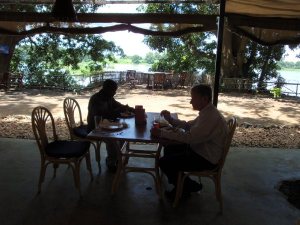
I am reluctant to photograph people in such poverty, so below you see two of my colleagues breakfasting at our lovely Camp by the White Nile.

Guns and things

Sorry to dwell on guns and traffic, but they are the two
most conspicuous features of Kabul along with the utter poverty and collapsed
structures everywhere. I just came back from a little walk up and down my
street and a few side streets. They are all enclosed at either end with
barricades and armed guards. My street, on which sits the IMF guesthouse, has
six barricades spaced out from one end to the other, two with zig zig concrete
approaches, a dozen armed pillboxes and about 50 or 60 armed guards. Behind the
sand bags and high concrete walls are houses like mine, the Canadian Embassy,
the British Embassy, the World Bank and a few others. You can’t see any of them
from the street. The side streets are even more cluttered with barriers. The
guards find my strolls amusing, I think, as they wave me on through their
respective checkpoints with a smile. The weather out today is wonderful. The
nearby Himalayan Mountains—the other most conspicuous feature of Kabul—were
shining beautifully in the sun.

Guns—AK 47s mainly—are everywhere, inside the central bank
and out. You just get used to it. Driving between the IMF guesthouse and the
central bank we always pass a number of pickup trucks with three or four guys
in the back with machine guns. Some are police. Some are dressed in black with
black masks covering their entire faces (not just their mouths cowboy style).
It can be kind of spooky. The masked ones are not as usual.

As usual, there are several Canadians staying in our
guesthouse. These guys are preparing for a major irrigation/farming project
near Kandahar that involves repairing a damn and levies, introducing more
efficient irrigation techniques and equipment, training maintenance people, working
with farmers to introduce new crops (poppies don’t need much water so this
opens up broader options), adjustments in processing plants, establishing markets
for the new crops and transportation to get them there, and political
negotiations with the surrounding village chiefs to obtain their buy in and
cooperation (some of the land along the waterway is owned by Taliban). My
Canadian friends commented how shockingly large a share of the project’s costs
went for security (one of their cars had already been hit by gun fire). I
replied that five years from now a congressional (Parliamentary) inquiry would
notice and refer to the large and wasteful payments to securities contractors
who made big profits (if they survived). Did someone think we could have a war cheaply? A private American security company has gotten into trouble here recently. I hope this does not give outsourcing a bad name because it is generally a very good and efficient thing to do.

Traffic has gone from bad to worse. The economy is
growing rapidly (around 10 percent per year for the last seven years) and
people keep buying more cars. But as security has deteriorated, more and more
roads are closed to regular traffic or more checkpoints erected, so more cars
are trying to travel fewer roads. Those still moving their commerce by donkey
cart and wheel borrow have an advantage. The IMF has three heavy armored cars
with three very skilled drivers. In my seven and a half years of coming here
never once have they hit or even grazed anything (or anyone). Thus I guess I
can still believe in miracles.

Edinburgh to Kabul


Following
the regional meeting of the Mont Pelerin Society in Stockholm from August 16 –
20 I waited out the go ahead to proceed to Kabul in Edinburgh. Afghanistan’s
elections took place on the 20th and our security people wanted to
see how conditions in Kabul developed in the week following before approving my
travel. Thus I spent a week enjoying the Edinburgh Festival in the midst of a
month long orgy of music, dance, and drama. Combining the International
Festival with the Fringe Festival, there are thirty to forty performances every
day to choose from.


Edinburgh
is a beautiful old European city located in the lushly green rolling hills of
central eastern Scotland. The heavens watered the countryside several times
every day I was there. I was the guest of a fellow Cayman Islands Monetary
Authority director and former dean of the University of Edinburgh Law School,
whose house is in the tree lined, stately neighborhood of The Grange and close
enough to the center to walk to all of the Festival events.


Like
all of the U.K., Scot’s drive on the left hand side of the road. Usually that
means that pedestrians also walk on the left side of walking paths, but I could
not detect such a habit in Edinburgh. In addition to thoroughly enjoying the
Festival and walking past the flowering yards of Gothic and Georgian homes
built centuries ago, I was confused and amused by the fact that the backs of
buses liked very much like their fronts, making it all the more difficult to
figure out which way they were going, adding to my confusion over driving on
the left. Another “amusement” was the fondness of taxi drivers, like their
London counterparts, for making as many turns as possible between any two
points.


Twenty-four
hours after leaving Edinburgh early Thursday morning I was in Kabul (which
included a seven hour stop over in Delhi) to continue my technical assistance
to the central bank in formulating and implementing monetary policy. Delhi was
an interesting bridge between the developed West and the utterly impoverished
Afghanistan. India has been growing rapidly for almost two decades but
continues to house hundreds of millions of extremely poor people. If it can
continue to grow, this will continue to change for the better. But India
remains the most overly bureaucratized country I have ever been in. Twenty-five
or so years ago, I counted 12 checkpoints from the entrance to the Delhi
airport to the plane. This involved rechecking and rechecking the same two or
three items. Today, post 9/11 where they have new things to check for (such as
the souvenir match book in my computer case—discovered at the last check while
boarding the plane) the number of check points has been greatly reduced (to
five or six—I lost track) but still employed several dozen people just to check
me and my carry on.


Kabul
is a different world all together. It seems a time two thousand years earlier
and after several decades of war totally devoid of any of the simple charm it
might have once had. Though Kabul has change a lot since my first visit in
January 2002—this is my 9th visit since then—it has not been rebuilt
as much as it should have been over the past seven and a half years. You can
see earlier pictures and earlier notes at www.facebook.com/wcoats. It does
finally have a new international air terminal and a few new buildings downtown,
but is characterized by dust, ruble, and trash.


My
security briefing this time was longer and more restrictive than earlier. The
Table of Contents of my Briefing Notes includes, for example, “Immediate
Actions on Rocket Explosions, heavy small arms fire” and “Earthquake emergency
procedures” which seems to cover a broad range of possibilities. It includes Security
Advisory No.3, which begins with: “You will see, below, that a security
advisory has been sent out by the CSA on behalf of the DO to the SMT members
and ASCs.” ????


Enhanced
security is event everywhere. The security around the central bank and the car
entrance has been dramatically strengthened. I am no longer allowed to got out
of my armored car outside the gates and walk in. To enter the Governor’s office
within the bank, my brief case is now thoroughly search and I must surrender my
Blackberry and two-way radio to armed guards for the duration of my visit with
him. On the other hand a new building on the central bank grounds has been
completed and occupied and the courtyard cleaned up. It actually looks quit
nice. The old water well pump is still there and still used but now looks more
out of place.


During
our first meeting of this visit, the Governor, who returned from exile in the
U.S. to again lead the central bank just one week ahead of my own first arrival
in January 2002, reminisced about those early “post” Taliban days. “Everything
was so hopeful then,” he said. “Your country made a tragic mistaken to leave
Afghanistan to fight Iraq. Now look where we are.” His central bank, on the
other hand, is becoming a stronger more professional institution with every passing
year.


Dinner
conversations on this visit have been dominated by discussions of the still
unknown outcome of the Presidential elections held here August 20th. The
results (whether President Karzai will win out right or be required to face
Abdullah Abdullah, a former Foreign Minister, in a run off) will not be known
until after I have left. At a dinner at the Canadian Embassy (the new Canadian
Ambassador is my old friend Bill Crosbie), Mina Sherzoy made the interesting
observation that despite many allegations of significant voting fraud and
irregularities, this election represents significant progress in the
development of democratic institutions in Afghanistan. She said that the
televised sight of the President having to defend himself in debates with other
candidates and open public discussions among the population would have been
unthinkable a few years ago. Mina was born in Kabul, fled to the U.S. during
Soviet occupation and returned in 2002. She is the founder of World
Organization for Mutual Afghan Network (WOMAN), founder of Afghan Women
Business Association (AWBA) in Afghanistan, the founder of Afghan Women
Business Federation (AWBF), and a beautiful woman. She allows some of us to
hope.

A note from Wolfie

After living in Europe for
many years, my friend
Ernest McCall
returned to the U.S. in May for a few months to test whether he wanted to relocate
back to North America. For the time being his answer is no. I asked him why and
here is his reply. His letters are always fun to read.


Hi from Amalfi…   we
took the hydrofoil here yesterday morning from Capri.


Im sitting in our
hotel’s lobby, the cloister of a convent founded in the 1200s by St. Francis,
using Anton’s MacBook (the one I gave him when I got back from DC).


To answer your
question, not very succinctly I fear: after 14 yrs. in Europe (3 in high
school, 1984-87, and then continuously since 1998), I feel as comfortable or
more comfortable here than in the US.  Better food, nicer architecture,
more educated people (not the elite, just the average guy on the street),
better public transport, longer history, a bit more realism or maybe cynicism
about human creation/accomplishment, blah blah blah.


I don’t want to rent two
places, e.g., here and in the US (DC or SF are my first choices, Portland or LA
or San Diego would be second choices), because everyone I know with two homes
spends most of their time in one or the other, as opposed to going to new
places.  I have a friend who has rented an apartment in St. Moritz for
about ten years, and needless to say, he never skis anywhere else.  My
brother has a house on a little island in the San Juans (Wash. State), he can
fly his family up there easily from Portland and their cabin backs onto the
landing strip, but again, they then end up hardly going anywhere else.  I
do not feel rich enough to maintain two homes (where rented or owned) and then
to spend another 3-4 months elsewhere.  And I don’t want (yet?) to spend
all my time in the same two places, no matter how different (another friend, a
painter, lives between an apartment on 56th St. just off Fifth Ave. and a tiny
Umbrian hill town).  So, if the choice is staying in Europe or coming back
to the US…   I dunno…   maybe it’s just inertia/laziness.
 Like most people, I *hate* moving, esp. internationally.  I can always
come back to the US whenever I want, right? It’s probably cheaper and much
easier to pay a lot more per month for a fully furnished apartment through an
agency like pied-a-terre, for three months here or four months there, than to
in fact move to DC and sign a long-term lease, sign up for utilities, etc.,
esp. if I don’t want to give up my apartment in Europe.


Then there’s always the
thought of moving somewhere else, e.g., Berlin or Paris or Rome or whatever.
 For a variety of reasons – subject of another drawn-out email, ha ha ha –
I’ve decided not to do that for now, I plan on renewing my lease in October of
this year.  I pay annually and in advance (my landlady loves me), so maybe
next summer, I’ll start whining about this matter again, where oh where in this
big wide world to live???  Basically, I get tired of certain things about Istanbul
at times, but when I’m gone, I miss it, esp. my panoramic view of the
Bosphorus, the wonderful seafood, my funny & entertaining group of friends,
the level of service / low cost of labor, etc.  And I am old enough to
know the grass is not greener, etc., I would get very sick of certain aspects
of Berlin or Paris or Rome, too.


I think the real problem is
that we die.  It sounds silly, but I’m being serious.  My dad totally
understands, i.e., not enough time for that spring in Seville and that summer
in Siberia and that autumn in Amsterdam and so forth.  He once asked me
about going somewhere or other, and I told him, "oh, you should go there
in October, the weather’s lovely then," to which he replied, "Ernest,
the weather’s lovely *everywhere* in October… in our mid-70s, your mother
& I need more Octobers in our lives, dammit!"


OK, off with Anton to the
saltwater pool + diving area, sort of built into the cliffs below the hotel.
 We just toured the oldest paper factory in Europe this morning. I didn’t
know that Amalfi was a center of papermaking since the 10th century.  It
was also – hard to believe for such a tiny place – a real rival to Venice and
Genoa and Pisa. These four cities still today hold an annual Regatta dei
Quattro Reppublichi (it changes location each year, i.e., each city gets it
every four years). Amalfi had ambassadors in Constantinople [Istanbul] and all
around the Arab world, it had 80,000 people at its peak, but most of them slid
into the sea in an earthquake in 1350 or so…   bummer.  Today the
town itself (without the surrounding villages) has about 3,000 people, so told
us the boy who sold Anton a belt this morning.


Renting a motorboat tomorrow
and going to Positano, some sort of local festa with fireworks, and then it
becomes a techno-rave-party on the beach, no doubt full of GORGEOUS tanned
Italian teenagers, our mouths hang open as we walk around these little towns.


OK, that’s enough for now.


Enjoy your time in Scotland
and London, good luck in Delhi and Kabul.


Wolfie


Las Vegas

For the second year in a row I participated in Mark Skousen’s FreedomFest here in Las Vegas. This year I spoke on “Inflation, Hyperinflation, and Will We Have One” and I debated “Fed up with the Fed: Should We Abolish it?” (John Fund and I vs Gene Epstein and Tom Woods) televised on C-SPAN.

Las Vegas itself deserves some comment. Its airport (the second busiest destination airport in the U.S.) has 16 baggage carousels (Dulles has 8) and can load 21 cabs at a time. The so called Strip (on the edge of town and seen in the picture) has 5 of the worlds 7 largest hotels. They are enormous. People still smoke inside here. Outside it gets to 110 plus degrees every day during the summer but the air is dry and you can see forever. We took a day trip to Hoover Dam about an hour away.

IMG00010-20090709-1539

The image of Vegas as a dessert oasis of bright lights and ever clanging slot machines is well deserved. You have to walk through the gigantic, cavernous, gaming rooms to go anywhere and the bells and whistles and whirling never stop. But Vegas is also THE CITY of SHOWS. It puts Broadway, with its cramped West End London like theaters, to absolute shame. The performance spaces are stunning and the productions spectacular. On this trip I took my daughter and two grand kids to see “LOVE,” the Cirque du Soleils’ tribute to the Beatles as only it could do it. It was just breath taking. Cirque du Soleil has at least five different shows permanently housed along the Strip. The Strip is lined with spectacular shows (not just the usual Jerry Seinfeld, Bette Midler, and magic shows that you would expect). Every Paris and Broadway shop of note is here as well (not that I would care). You can walk for blocks down the streets of Paris, Venice, the Village, etc without going outside (which is usually a good thing).

Now on to Bakersfield to help move my parents into an assisted living unit in their retirement complex (another painful downsizing).