
Nation Building in Afghanistan

The lesson of Afghanistan is not that the US is washed up as a great power. The lesson is that the US is such a great power, militarily and economically, that it is continually tempted to try hopeless things that nobody else on earth – including China – would ever attempt.  David Frum

On July 8, 2021, President Biden said that: “the United States did what we went to do in Afghanistan: to get the terrorists who attacked us on 9/11 and to deliver justice to Osama Bin Laden, and to degrade the terrorist threat to keep Afghanistan from becoming a base from which attacks could be continued against the United States.  We achieved those objectives.  That’s why we went.
We did not go to Afghanistan to nation-build.” “Remarks by President Biden on the drawdown of U.S. forces in Afghanistan”

In fact, except for killing Osama Bin Laden, we had achieved those objectives before I arrived with an IMF team in January 2002 to contribute to building a more effective government. Finding and killing Bin Laden was delayed until May 2, 2011, because of the redirection of American efforts to the ill-advised and illegal war in Iraq. So why were American troops still occupying Afghanistan until August 30, 2021?

In an August 18, 2021, interview with George Stephanopoulos, President Biden explained what happened asking: “Then what happened? Began to morph into the notion that, instead of having a counterterrorism capability to have small forces there in — or in the region to be able to take on al-Qaeda if it tried to reconstitute, we decided to engage in nation-building. In nation-building. That never made any sense to me.”  “Biden’s claim that nation building Afghanistan never made any sense”

George W Bush opposed nation building in his 2000 presidential campaign. In his memoir, Decision Points, he states that “After 9/11, I changed my mind.” Already by April 2002, he stated that “We know that true peace will only be achieved when we give the Afghan people the means to achieve their own aspirations. Peace will be achieved by helping Afghanistan develop its own stable government.” He was right. However, as he noted: “Our government was not prepared for nation building.” He was right about that as well.  “Bush on nation building and Afghanistan”

The U.S. officials responsible for “nation building” in Afghanistan knew little about its history and culture. They foolishly imposed an alien Western style government dropped on a diverse people as if from a drone. The US military is an excellent machinery of war. The best in the world. However, it does not have the skills required for “nation building.” Our military couldn’t even recruit the right solders or provide the training they needed to fight on their own, much less build a proper military organization. “Afghanistan combat interpreter Baktash Ahadi: U.S. cultural illiteracy”  And attempting nation building at the point of a gun is bound to fail.

And why did the Afghan soldiers that Americans trained for decades not fight to defend the existing government? “Afghan forces were demoralized by neglect, corruption and ethnic bias among their superiors. Often they went without pay and ammunition, and sometimes without rations….  ‘The why is corruption, the why is poor leadership,’ John Sopko, told The Washington Post in 2017, ‘If leadership is poor, the people below don’t care, and they wonder why they have to die.’” “Afghanistan U.S. troop withdrawal”

On Sunday August 15, 2021, Taliban forces walked into Kabul and took over the government without a shot.  “The Band of Brothers and Afghanistan”   But what did they take over or replace? And did 20 years of so-called nation building make any difference.  “Nation building” is often given a bad name because it has too often been associated with the imposition of a “government” by an occupying military force as with imperialism.  Afghanistan is a very different place than it was 20 years ago. Both the nation and its government and its institutions have changed considerably. We can hope that the Taliban has changed as well.

Governments consist of ruler/decision makers, and the institutions that administer whatever it is that the government does. A nation extends beyond its government to include civil society, and social and cultural norms. The Taliban have displaced Afghanistan’s President Ashraf Ghani, who fled to Uzbekistan then to the UAE rather than step aside for a transition period as had been agreed. Afghanistan’s Chief Executive Officer, Abdullah Abdullah, remained and with former President Karzai is discussing the composition of a new government with Taliban leaders.

“Taliban co-founder Mullah Abdul Ghani Baradar will lead a new Afghan government….  Haibatullah Akhundzada, the Taliban’s supreme religious leader, will focus on religious matters and governance within the framework of Islam.

“While the Taliban have spoken of their desire to form a consensus government, a source close to the Islamist militant movement said the interim government now being formed would consist solely of Taliban members. It would comprise 25 ministries, with a consultative council, or shura, of 12 Muslim scholars, the source added.

“Also being planned within six to eight months is a loya jirga, or grand assembly, bringing together elders and representatives across Afghan society to discuss a constitution and the structure of the future government, the source said.”  “Taliban co-founder Baradar will lead new Afghanistan govt”

Prior to the fall of Kabul, the government of Afghanistan consisted of the cabinet of ministers, provincial governors and the national assembly, with a democratically elected president serving as the head of state, head of government and commander-in-chief of the Afghan Armed Forces. It appears that the new government will retain the same administrative units. In addition to the central bank (DAB), which I advised, these would include functions such as Foreign Affairs, Internal Affairs, Finance, Economy, Agriculture, Energy and Water, Justice, Information and Culture, Education, Industry and Commerce, Transportation, Women’s Affairs, Public Health, Mines, and of course, National Defense. Though the U.S. did a poor job developing Afghanistan’s National Defense institutions, more experienced international agencies made considerable progress in developing more efficient and effective agencies in many other areas. Of at least equal importance, a generation of Afghan men and women have grown up expecting their place in the world to reflect their skills and accomplishments (merit) rather than who they knew.

I have written earlier about the dramatic progress in modernizing the central bank’s operations. It was achieved in the proper, traditional way of “nation” and institution building. We explained best practice for central banks derived from the experiences of established central bank and the approaches we thought would fit best with Afghanistan’s existing central bank and economy. But DAB’s management and staff made the decisions of what to embrace and how to move forward and we offered guidance on designing and implementing those decisions. “BearingPoint Afghans”

But one institution can’t develop independently of what is happening in the rest of the country. In particular, developing the rule of law is critical and difficult. An example was provided by DAB’s (the banking supervisor) confrontation with a corrupt President and Attorney General over the resolution of the insolvent and criminal Kabulbank in 2010-12. The founders and owners of Kabulbank (President Karzai’s brother Mahmood was the third largest shareholder) had rapidly grown this newly licensed local bank into the country’s largest depository and had lent almost all of its deposits to themselves. During the global financial crisis of 2008, many of Kabulbank’s owners’ investments failed and they were unable to repay their depositors. DAB’s banking supervisors were blamed for weak supervision and even arrested and jailed in disregard of the provisions of the central bank law. The scandal revealed considerable corruption, but the supervisory resolution of the bank somewhat strengthened (modestly) the rule of law in the process.  “Afghan President Ghani’s attack on corruption”    “The Kabul Bank Scandal”

Another huge set back to the impressive development of DAB resulted from President Ghani appointing an unqualified friend, Ajmal Ahmady, as Acting Governor of the central bank. He fired many of the best of the BearingPoint Afghans and brought in his own small group of cronies. Mr. Ahmady’s appointment was rejected by the Parliament, but he illegally remained in his post.  The Taliban (???) have now appointed Haji Mohammad Idris as the Acting Governor of the central bank. “Mr. Idris was head of the Tabliban‘s finance section, but he has no formal financial training or higher education.”  “Haji Mohammad Idris”

These examples are meant to illustrate the distinction between a government’s leaders and its administrators. Time will tell whether our “nation building” efforts with DAB survive the attacks on it from Afghanistan’s leaders (current and past). But as a result of the nation building efforts of many international bodies, Afghanistan is a very different and better place, and its young population has very different expectations, than twenty years ago. I hope that the Taliban leaders that have taken over the government are also very different than their repressive and brutal forebearers of twenty years ago.

While the new government will no doubt leave many of the institutional structures in place that have been developed over the last two decades, from which they and the country have benefitted, the big question is what policies and rules they will establish under the name of Sharia law, especially with regard to the rights of women. The Taliban have their own internal factions that need to be sorted out and their earlier version of Sharia was an extremely harsh interpretation not shared by most Muslims. The Taliban has pledged to treat women and others fairly, within the dictates of Sharia Law. Other Muslims will need to convince the Taliban to moderate their earlier interpretations of what that means. The United States, the EU  “EU sets five conditions for future operational engagement with Taliban”, China, Russia, and the international organizations, have enormous financial and diplomatic leverage with which to encourage the Taliban government’s better behavior. They should be used vigorously to help build a better Afghanistan. Early signs are not encouraging, but these are early days. One Afghan friend changes locations every night in the hopes of not being found. Other friends are afraid to leave their homes at all.

The idea that we should refuse to cooperate with the new government and should oppose it at every turn from the outset is bone headed. Just ponder the alternatives for a second. Do not think that it is easy for me to sit here in my comfortable Bethesda home and urge us to give the Taliban a try. My days begin with heart wrenching pleas for help from Afghan friends and strangers. I challenge you to read the following account of dashed hopes without weeping: “After a university falls in Afghanistan a DC organization scrambles to keep students safe and still learning”   

Efforts to achieve a better Taliban government this time around may be a long shot, but the alternatives of a return to civil war and worse yet the return of American and NATO troops are not pretty either. The U.S. intention to cooperate with the new government in countering ISIS-K is encouraging, but, like anything else in life, not without risks.  “US may coordinate with Taliban to take on ISIS-K”  Nation building by everyone but the U.S. government over the last 20 years has not been a waste of time. Now is not the time to give it up.

Nation building is unlikely to be successful when coerced, i.e., when it is part of a military intervention. It does not follow that nation building–sharing best practice in the design and operation of institutions public and private–is an unworthy objective and undertaking.
BearingPoint Afghans

Sometime around 2004 or 2005, the US Agency for International Development (USAID) contracted BearingPoint (now part of Deloitte Consulting) to recruit and mentor approximately 80 young Afghan college graduates into Afghanistan’s central bank (DAB) and Finance Ministry. These young Afghans worked in DAB and the Finance Ministry for two years while being trained and mentored by BearingPoint experts. Following these two years they were offered regular jobs in these two institutions. While some moved on to higher paying jobs elsewhere most of them stayed with DAB and the MOF. Over the years that followed they rose within these institutions, and in DAB headed many of the departments including the position of Second Deputy Governor. Working with and watching the progress of these young Afghans was one of the most enjoyable and gratifying assignments in my career with the International Monetary Fund. They were smart, honest, and dedicated to improving life in their country (including their own). They were, and I hope still are, the hope for a better future for Afghanistan.

The elected Afghan government under which these BearingPoint Afghans worked has now been toppled by the Taliban, a group that harshly ruled Afghanistan from 1996 until displaced by an American-British invasion in November 2001.  Back in 1996: “Gaining control over most of the country, the Taliban impose their rule, forbidding most women from working, banning girls from education, and carrying out punishments including beatings, amputations and public executions. Only three countries officially recognize the Taliban regime: Pakistan, Saudi Arabia and the United Arab Emirates.”  “Afghanistan conflict timeline”

The Taliban in 1996 claimed to impose Sharia Law on Afghanistan. “Sharia” translates to ‘the way’ in Arabic and refers to a wide-ranging body of moral and ethical principles drawn from the Quran and from the sayings and practices of the Prophet Muhammad. The principles vary according to the interpretation of various scholars who established schools of thought followed by Muslims who use them to guide their day-to-day lives. Many Muslim-majority countries base their laws on their interpretation of the principles of Islamic law but, despite this, no two have identical laws.”  “Taliban and Sharia Law in Afghanistan”

The Taliban imposed a very severe version of Sharia that has not been embraced by very many Muslims. It was particularly restrictive on the activities and rights of women. Twenty years later Afghanistan is a different place, and the Taliban sounds like a different organization.

“KABUL, Afghanistan (AP) — The Taliban vowed Tuesday to respect women’s rights, forgive those who fought them and ensure Afghanistan does not become a haven for terrorists as part of a publicity blitz aimed at reassuring world powers and a fearful population.

“Following a lightning offensive across Afghanistan that saw many cities fall to the insurgents without a fight, the Taliban have sought to portray themselves as more moderate than when they imposed a strict form of Islamic rule in the late 1990s. But many Afghans remain skeptical — and thousands have raced to the airport, desperate to flee the country.

“Older generations remember the Taliban’s previous rule, when they largely confined women to their homes, banned television and music, and held public executions. A U.S.-led invasion drove them from power months after the 9/11 attacks, which al-Qaida had orchestrated from Afghanistan while being sheltered by the Taliban.”  “Afghanistan Taliban Kabul”

So, what should American policy be toward the forthcoming Taliban or Taliban lead government? What does the Taliban pledge to “respect women’s rights consistent with their version of Sharia Law actually mean? We should deploy every diplomatic tool possible to encourage/pressure the new government to live up to its promises. Former President Karzai, current CEO Abdullah Abdullah and others are currently in discussions with the Taliban leadership over terms for an inclusive government.

The alternative of nonrecognition, once there is a government to recognize, is to encourage and even support civil war. Or, God forbid, to send our troops back (there is not much chance that our NATO allies would be conned a second time into join us there again). And how did that work out for us last time? Our over used weapon of economic sanctions harms the public we should be trying to help. Our inhuman sanctions on Cuba and Venezuela are imposing horrible pain on the their citizens with little impact on their governments. “Evidence-costs and benefits of economic sanctions”

In a recent Washington Post oped Nikki Haley argued that we should not recognize the Taliban government no matter what. “Nikki Haley-America must not recognize Taliban” I respected Ms. Haley when she was Governor of South Carolina but I eventually got over her when she embarrassed us while Ambassador to the UN. “The future of Israel and Palestine” Her unqualified attack on the Taliban firmly ties her to those who were responsible for our Afghan disaster in the first place. The new Afghan government may turn out to be as bad as the previous Taliban government, but we should do everything possible to prevent that.

The U.S. has suspended currency shipments purchased by Afghanistan’s central bank. Afghan assets (foreign exchange reserves, etc.) deposited abroad have been frozen including “its” access to reserves at the IMF. These may appear to be rejections of a new government, but they are not. There is no new government yet and those holding Afghan assets must keep them safe until their new owners are clearly and properly identified. The situation is much like the bank in which you have deposited money, freezing your deposits when you die until the new lawful owner is determined. There is an unavoidable, awkward period of uncertainty. It is not too late to reverse our mistake in closing our Embassy and running out while at the same time accusing the Afghan Army of behaving the same way.

It is also not true that nothing was accomplished these past 20 years. Our military leaders may have failed in their task of building a reliable Afghan Army, but many others, myself included, did not waste our time by helping Afghans build better institutions (see the story of the BearingPoint Afghans I started this article with above). See the discussion of this issue by Jonathan Rauch: “The  Afghanistan war was a partial success”

No one knows what the Afghan government will look like or which way it will go, but we all (except for the war mongers) have an interest in promoting its success, especially the hopeful, new generation of Afghans. “Can US work with Taliban”    “What do Taliban’s really want?”

And we must resist the siren calls of those who think that we can and should impose our vision and institutions on the rest of the world. We must keep our Army home to defend our homeland rather than messing with other people’s business. Our defense industries have profited enough.

The Band of Brothers and Afghanistan

Sunday night Ito and I finished the tenth and final episode of the WWII story of Easy Company of the 101 airborne division of the U.S. Army–The Band of Brothers. It is a moving and masterful depiction of the horrors of war, and its impact on those (often) brave men who fight them.  How, I asked myself, can good people do such terrible things to each other?  And why?  Who benefits (that is too obvious to answer explicitly)?

I woke up that morning to the fact that the government in Afghanistan that I had been working with for the past 20 years had been replaced by the Taliban who intends to form a new government. Fingers are being pointed all over the place in the search for fault. I am afraid that this American question is of little interest to my Afghan friends. Those who have not already left the country are holed up in their homes afraid to go to work. Their question is what the new Taliban regime will look like.

Our objective now should be to join with all other nations to exert diplomatic pressure on the new government (which potentially will have the cooperation of at least former President Hamid Karzai, CEO Abdullah Abdullah, and Islamic Party leader Gulbuddin Hekmatyar) to adhere to UN standards of humanitarian treatment of its citizens and to help them administer an efficient and honest government. America’s leadership in this regard will be critical for Afghanistan’s future.

But who should we blame for, and what lessons should we learn from, Afghans fleeing the country by climbing onto the outside of planes leaving the Kabul Airport (something I have done many times but more comfortably seated)? Working backward, President Trump gave our military leaders a May 1 deadline for leaving. It rather looks like they ignored him (tempting but not appropriate).

The speed with which the Taliban took over the country with barely a shot fired surprised most of us. We had dinner at the home of Edward and Dalya Luttwak Saturday. During the conversation I passed on the statement by an Afghan friend emailed to me that afternoon that the Taliban could take Kabul by the next day or week.  We all thought that would be impossible, thinking it might be as fast as a few months. In fact, they peaceably took over the city the next day (Sunday Aug 15).  In fact, our Embassy and Military leaders should not have been surprised. My work in Afghanistan with its central bank did not require that I be thoroughly versed on Afghan history and customs, but that is not true for our foreign policy establishment working in and on Afghanistan.

Rather than arm, train, and support Afghan fighters in regions they cared about, we pulled together a national Army with the incentive of money. In addition, the broader Afghan public did not strongly support its corrupt government and could fairly easily change sides. “Afghanistan military collapse-Taliban”  Moreover, waring tribes and political groups such as the Taliban have a long tradition of negotiating peaceful surrenders when the outcome seems clear.  “Afghanistan history-Taliban collapse”

The initial blame for our failure to “build” a strong government in Afghanistan falls on George W Bush who gave in to the Cheney/Rumsfeld fantasies of American Imperialism, and abandoned the original and sensible approach of American support of the Northern Alliance war against the Taliban. “Its plan was for small teams of CIA officers, along with Green Berets and U.S. air power, to assist the indigenous Afghan resistance—the Northern Alliance.” “Afghanistan withdrawal-CIA-bin Laden-al Qaeda-Bush-Biden-Northern Alliance” Instead we took over and occupied the country.

Rather than work with and build from Afghanistan’s traditional tribal structures, we imposed an alien, centralized government that was not understood and was generally resented outside of Kabul. Rather than elevating village chiefs to govern provinces, for example, Kabul sent strangers to oversee areas they knew nothing about. Our ignorance and arrogance were mind boggling, but sadly typical. And our military—the best in the world for waging wars— is incompetent at nation building, which should be the job of others. We couldn’t even build an Afghan Army in 20 years. “How America failed Afghanistan”  

Those who are most loudly criticizing Biden’s troop withdrawal are those most responsible for creating this mess to begin with.   “Afghanistan disaster started with withdrawals most ardent critics”  See my account of my work with the central bank in Kabul:  “My travels to Afghanistan”

Trust

Trust is a critically important feature of successful relationships and of flourishing societies. Enduring trust builds on honestly and truth.  I have just finished reading Jonathan Rauch’s exposition of these truths in The Constitution of Knowledge: A Defense of Truth and his enlightening exploration of how to find and defend truth in today’s challenging environment. 

How can we determine what is true and what is not? Rauch’s book explores this question. In sorting out fact from fiction we must recognize the personal and social biases through which we evaluate claims and the factors that motivate them. The task is made even more difficult by the fact that there are some who deliberately propagate falsehoods for their own purposes. Whatever else might motivate them, political and other leaders act to gain or retain their power. They often have an incentive to misrepresent facts, i.e., to lie. Former President Trump and his Big Lie (and his many, many other lies) is by no means the only President to have lied to the American public. Many other Presidents have also lied.

Ken Burn’s documentary, The Vietnam War, is a brilliant expose of such lies and yesterday I watched for the first time the 2010 Goldsmith and Ehrlich directed documentary The Most Dangerous Man in American: Daniel Ellsberg and the Pentagon Papers. Lyndon Johnson and Richard Nixon almost give Trump a run for his money as liars, though I think that they thought they were lying for the benefit of our country along with their reelection (which by no means excuses it).

Our constitution provides limited, enumerated powers to our government and checks and balances of the powers between its branches and its citizens. But the power of free speech and a free press to expose lies is an indispensable check on the lies of public officials. Our republic has been defended from foreign attacks by many brave solders. But we should also be grateful for the self-sacrifices of a few brave whistleblowers for exposing government lies and thus defending our republic and the individual liberty in which we have flourished.

Wednesday, I watched Daniel Ellsberg receive the Committee for the Republic’s Defender of Liberty award. We are still meeting virtually, but the event was a fascinating discussion of the Vietnam war decision making. The discussion included the Pentagon Papers movie directors, Goldsmith and Ehrlich; the official head of the Pentagon project that wrote the Pentagon Papers history of the war, Morton Halperin; the New York Times reporter who wrote the first article on the Papers given to him by Ellsberg; and Ellsberg himself who went on at great length. It was a riveting two-hour discussion. You can watch it here: https://youtu.be/l7L3DOhakNU

I hope that we can present this award to Edward Snowden in the future.  

Holding our government officials accountable for speaking the truth and for abiding by the law are critically important in preserving (or restoring) trust and in determining “the truth.” Each one of us contribute to (or detract from) those goals. But I am in awe at the personal sacrifices of Ellsberg and Snowden in the service of truth, which so badly needs defending. If there is hope of saving our fractured and disbelieving Republic, it will be because of the bravery of such people and the embrace by the rest of us of the wisdom expressed by writers like Rauch. It requires our individual commitment to truth and the institutions and norms that facilitate and incentivize finding it (filtering falsehood from truth). It requires an effective Constitution of Knowledge.

Do what we say and not what we do

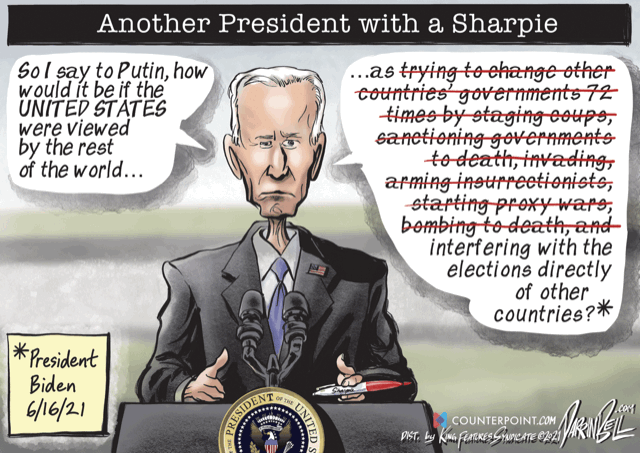
In his meeting with President Putin, President Biden is thought to have proposed red lines against the use of cyber weapons such as ransomware. The idea of shutting down something like Colonial Pipeline with a computer hack is surely repugnant. I seem to remember that many of us cheered when the U.S. (and Israel?) damaged the Iranian uranium enrichment facility at Natanz with a malicious computer worm called Stuxnet. Nor were many of us much bothered when U.S. financed coups topped unfriendly governments, or when we attacked Afghanistan, Iraq, Libya, Haiti, Nigeria, Syria, to name but a few.

“The supreme international crime according to 2017 U.S. media reporting is interfering nonviolently in a democratic election — at least if Russia does it. William Blum, in his book Rogue State, lists over 30 times that the United States has done that. Another study, however, says 81 elections in 47 countries.”  https://davidswanson.org/warlist/

While this is hard to swallow, our bad behavior differs from that of Russia’s or of other autocrats. I will not go to jail for writing this. Most Americans (I like to believe) condemn such behavior contrary to our founding principles when they learn of it. Our press is happy to expose such breaches when they discover them. In short, while our government often violates our principles of individual rights and the rule of law and lies regularly about it, public scrutiny and outrage tend to check bad behavior and move us back toward conformity with our principles. We never get there but it is very important that we keep trying.  

All Volunteer Military

In May 1967, The New Guard magazine published an article by Milton Friedman on “The Case for a Voluntary Army.”  It was a compelling case and was adopted when the U.S. suspended its military draft in January 1972. But was it correct? “45 years later Nixon-Gates commission”

In the 1960s, the drafting of 18 year old’s to fight in Vietnam was avoided by those able to go to college. This was rightly challenged as discriminatory against the poor and college deferments were replaced with a lottery system that started in 1970, which picked the birthdates at random that would then be first in line to be drafted each year. I was granted the last of the college deferments.  “Draft lottery (1969)”

While a student of Friedman’s at the University of Chicago from 1965-70, I joined with several other libertarian classmates to form the Council for a Volunteer Military to promote Friedman’s call for an end to the draft. The Directors of the Council were: James Powell, National Director; Henry Regnery, Treasurer; myself, Executive Secretary; Danny Boggs, national Filed Secretary; and David Levy, Publications Editor. Our sponsors were: Yale Brozen, Bruce K. Chapman, Richard C. Cornuelle, James Farmer, David Franke, Milton Friedman, Sanford Gottlieb, Eugene Groves, Karl Hess, and Norman Thomas: an impressively diverse group.

In 1969 President Richard Nixon establish the Gates Commission to advise him on established an all-volunteer military and appointed Friedman to the commission.  Based on the Commission’s recommendations, President Nixon signed a law in 1971 that ended the draft in January 1973.

A Rand Corporation report on the All-Volunteer Force (AVF) by Bernard D. Rostker stated that: “Although the country had conscripted its armed forces for only 35 of its 228 years — nearly all in the 20th century — the American people were generally willing to accept this practice when service was perceived as universal. However, in the 1960s, that acceptance began to erode. There were five major reasons:

  • Demographics. The size of the eligible population of young men reaching draft age each year was so large and the needs of the military so small in comparison that, in practice, the draft was no longer universal.
  • Cost. Obtaining enough volunteers was possible at acceptable budget levels.
  • Moral and economic rationale. Conservatives and libertarians argued that the state had no right to impose military service on young men without their consent. Liberals asserted that the draft placed unfair burdens on the underprivileged members of society, who were less likely to get deferments.
  • Opposition to the war in Vietnam. The growing unpopularity of the Vietnam war meant the country was ripe for a change to a volunteer force.
  • The U.S. Army’s desire for change. The Army had lost confidence in the draft as discipline problems among draftees mounted in Vietnam.”

At the time Crawford H. Greenewalt, another member of the Commission, wrote to Gates that “while there is a reasonable possibility that a peacetime armed force could be entirely voluntary, I am certain that an armed force involved in a major conflict could not be voluntary.”

“Rand research briefs”

The AVF matched or exceeding the high expectations for it. The professionalism of our Army improved. We fought 13 wars with our volunteer force: Lebanon (1982-4), Grenada (1983), Panama (1089-90), Gulf War (Iraq, Kuwait, Saudi Arabia and Israel 1990-91), Somalia (1992-5), Bosnian War (1992-95), Haiti (1994-5), Kosovo War (1998-99), Afghanistan War (2001-21), Iraq War (2003-11, 2014-2020), Somali Civil War (2007-21), Libya intervention (2011, 2015-20), and Syria (2014-present). Each was limited enough not to exhaust the supply of volunteers needed.

But a different criticism of our all-volunteer force was raised that gave me pause. Our costly and futile war in Vietnam from 1955-75 was finally ended (without admitting the defeat it surely was) in response to the growing protests in the U.S.  No such protests were raised for our imperial adventures since then. Some observers began to point their fingers at the absence of a draft and thus a military/industrial complex better sheltered from public criticism. When we campaigned for the end of the draft and an all-volunteer military, we assumed that we needed to maintain an Army for our defense. Instead, our military was deployed all over the planet (800 bases around the world) with sufficient restraint (generally) to avoid strong public push back.  “National defense”  If the average middle class family’s children were not being drafted to fight unnecessary wars in far off places, they were not as likely to complain about the billions of their taxpayer’s money being pumped into the military/industrial complex.  This was an unanticipated side effect of ending the draft that we had not anticipated.

Both former President Trump and President Biden expressed their intentions to end our forever wars and, at least in the case of Biden, to strengthen our capacity to deal with the world with diplomacy. We should wish him well. And we should urge Congress to reinstate the Weinberger Doctrine, which limited the use of U.S. forces to when vital U.S. interests were at stake, and only as a last resort. “A Biden doctrine starts to take shape”

You can read my experiences in Iraq in my book: “My travels to Baghdad” and my experiences in Afghanistan in my book: “My travels to Afghanistan”.

PS. Some how I forgot that I had written on this before with a somewhat different proposal: https://wcoats.blog/2015/01/23/the-all-volunteer-military-unintended-consequences-and-a-modest-proposal/

National Defense

American military strength (an important aspect of our national security) depends on the size, training, and equipment (weapons) of our military, which is very much dependent on the size and efficiency of our economy, which pays for it.  Devoting more of our productive capacity to the military reduces our economic capacity. Getting the balance right between military and nonmilitary uses of our resources is very important.  Knowing what military capacity we need to insure our defense requires assessing the sources of threats to our national security and what motivates their deployment.

The cold war was a confrontation with international communism, most heavily concentrated in the Soviet Union. This was an ideological enemy of free market, capitalist countries, whose goal was to spread its ideology to the entire world. There is no such ideological enemy today. The Chinese government wants to be strong and prosperous and doesn’t care whether anyone else follows their model or not. They do want the rules for global trade and interactions to permit their own domestic model. We need to engage China fairly in establishing international rules that serve everone.

Historically wars were generally about territory and political control, usually about moving boarders a bit this way or that.  The Mogul, Roman, Persian, British, Ottoman and other empires existed largely to extract economic gain from the territories they ruled, something more peacefully enjoyed today via free (or freer) trade.  The mere threat of war and the creation and maintenance of potential enemies is also a useful device for rallying countries around their leaders and for keeping the money flowing to their “defense” industries–think of Mr. Putin, Xi Jinping and the U.S. military/industrial complex.

American defense today requires military strength sufficient to deter any country from successfully attacking the United States. It does not require the 800 military bases that we maintain around the world.  It did not require and was not enhanced by our many wars that followed the infamous and very damaging Viet Nam war (Lebanon 1982-4, Grenada 1983, Panama 1989-90, Gulf War 1990-91, Somali 1992-5, Bosnia 1992-5, Haiti 1994-5, Kosovo 1998-9, Afghanistan 2001-date, Iraq 2003-11, 2014-date, Somali 2007-21, Libya 2011, 2015-20, Syria 2014-date, War on Terror in various places). War with China would be quite a different matter. “The delusions of high tech warfare”

Fareed Zakaria unloaded on our war industry last month: “Defense Secretary Lloyd Austin outlined his key concern. ‘China is our pacing threat,’ he said. He explained that for the past 20 years, the United States had been focused on the Middle East while China had been modernizing its military. ‘We still maintain the edge,’ he noted, ‘and we’re going to increase the edge going forward.’ Welcome to the new age of bloated Pentagon budgets, all to be justified by the great Chinese threat.

“What Austin calls America’s ‘edge’ over China is more like a chasm. The United States has about 20 times the number of nuclear warheads as China. It has twice the tonnage of warships at sea, including 11 nuclear-powered aircraft carriers compared with China’s two carriers (which are much less advanced). Washington has more than 2,000 modern fighter jets compared with Beijing’s roughly 600, according to national security analyst Sebastien Roblin. And the United States deploys this power using a vast network of some 800 overseas bases. China has three. China spends around $250 billion on its military, a third as much as the United States.”  “The Pentagon is using China as an excuse for huge new budgets”  As noted above, over-investing in the military results in a smaller economy overall.

The latest debate is whether we should make our commitment to go to war with China to defend the independence of Taiwan explicit or leave it implied and ambiguous. In 1979 the U.S. recognized the People’s Republic of China as the sole legal Government of China and acknowledged that Taiwan was part of China (slightly fuzzy diplomatic language). So would American national security be enhanced by an explicit credible commitment to go to war with China, if necessary, to preserve the independence of Taiwan? China is a nuclear power. Going to war with China (World War III if we could get anyone else to join us) would inflect enormous damage on the U.S. whether it became nuclear or not, even if we won. In my opinion it would be simply insane to take such risks.

Would the U.S. deter China by being tough enough?  As Doug Bandow put it: “America’s antagonists saw something very different than weakness…. Stupidity and arrogance. Poor judgment. Refusal to admit mistakes. An almost demented willingness to sacrifice America’s future in a desperate attempt to redeem the nation’s tragic past. A better way not to show weakness would be to stop doing ‘stupid shit,’ as Obama suggested.

“China’s Xi Jinping and his colleagues in Zhongnanhai likely have a far more objective and practical take on U.S. policy: Endless wars by Washington are good for Beijing. The Chinese would love to see the US pour trillions more dollars and thousands more lives into new conflicts. Invade Iran? Please! Maybe occupy Syria too? Lebanon also needs fixing. Don’t forget the need to redeem Afghanistan. Then there is the problem of Russia in Ukraine, Syria, and elsewhere: go for it!”  https://original.antiwar.com/doug-bandow/2021/03/23/the-failure-of-huff-and-puff-foreign-policy/

But China (and Russia in Ukraine) has been behaving badly–claiming this little island in the China Sea and that one as its own, not to mention the ever-present risk of invading Taiwan. Even if the forced takeover of Taiwan by the PRC would not threaten our national defense, shouldn’t we care? Shouldn’t we care about the abhorrent genocide by the Chinese government against its Uighur Muslim minority in its western province of Xinjiang? Of course, we should, but we should reject the presumption of our neocon friends and the military/industrial complex we keep fat and rich that these and other interests can only be addressed militarily. See my experiences in Iraq and Afghanistan: “My Travels to Baghdad”

The creation of the United Nations and Bretton Woods institutions and other international cooperative agreements and institutions after World War II were meant to provide dispute resolution mechanisms other than wars. President Biden is committed to rebuilding these neglected institutions and strengthening and reenergizing our diplomatic institutions and initiatives. We can confront China more effectively and more realistically together with most of the rest of the world using the tools of diplomacy rather than of war. If the people of Taiwan chose to integrate their governance more fully with that of the PRC, that is their choice and their business. But if China invades Taiwan or otherwise forces such an integration, China should know the economic and political price they would pay. In my opinion, such a declaration would be far more effective in deterring such behavior by China than a fuzzy uncertain threat of war. It is encouraging that Congress seems on the verge of reclaiming its War Powers provided by the Constitution.

It is worth remembering the words of Dr. Martin Luther King, Jr. against our war in Vietnam delivered April 4, 1967. https://kingandbreakingsilence.org/

My Travels to Baghdad

Iraq: An American Tragedy, My Travels to Baghdad

Warren Coats (2020)

Kindle and paperback versions available at: Iraq-American-Tragedy-My-Travels-Baghdad

From the corkscrew landing at Saddam International Airport (now the Baghdad International Airport) to adventures in the Green Zone and beyond, this recounting of my experiences helping the Central Bank of Iraq develop modern market tools of monetary policy exposes the disfunction of the U.S. lead Coalition Provisional Authority (CPA) in its attempt to govern and rebuild post Saddam Iraq, following one of America’s more foolish and damaging military adventures. The existence of weapons of mass destruction was a lie. American skill at imperial rule–from disbanding the Iraqi Army to De-Ba’athification of the Iraqi bureaucracy– was a myth. 

Regime changes usually don’t involve changes in the monetary system. However, the toppling of Saddam Hussein’s government and the occupation of Iraq and the takeover of its government by the United States and a few allies in the name of the Coalition Provisional Authority (CPA) was accompanied by the replacement of the so-called Saddam dinar and modernization of Iraq’s monetary and financial system. The Iraq war was launched with “shock and awe” on March 20, 2003 and President George W Bush declared “mission accomplished” on May 1 a month and a half later. But when I retired from the International Monetary Fund and took up residence in Baghdad to advise the Central Bank of Iraq on developing Iraq’s financial markets and managing its new currency, the fighting was not over on many fronts. I lived in Baghdad the last two months of the CPA (May-June 2004) and made four two-week visits between then and December 2005

In this book, much of it written in diary form at the time, I share the challenges of advising the staff and management of the Central Bank of Iraq from my office in the central bank and of navigating the U.S. interagency rivalry from my office in Saddam’s Republican Palace in Baghdad’s Green Zone.  Security was always a challenge, producing many adventures. But the wisest advice I received was from a colleague in the CPA, who told me to “be careful who you talk to here (CPA headquarters in the Republican Palace), your worst enemies are in this building.” Over my 26 years in the International Monetary Fund and the technical assistance missions I lead to some 20 countries, many of them post conflict countries, I have never encountered the disfunction and resulting ineptitude of the U.S. led Coalition Provisional Authority in Iraq.

Previous Books

One Currency for Bosnia: Creating the Central Bank of Bosnia and Herzegovina

by Warren Coats (2007)    Hard cover: One Currency for Bosnia

FSU: Building Market Economy Monetary Systems–My Travels in the Former Soviet Union

By Warren L Coats (2020)  Kindle and paperback versions available at: FSU-Building-Economy-Monetary-Systems

Afghanistan: Rebuilding the Central Bank after 9/11 — My Travels to Kabul

By Warren Coats (2020)  Kindle Edition:  “Afghanistan-Rebuilding the Central Bank after 9/11”

Zimbabwe: Challenges and Policy Options after Hyperinflation

by Warren L. Coats (Author), Geneviève Verdier (Author)  Format: Kindle Edition

Zimbabwe-Challenges and Policy Options after Hyperinflation-ebook

Money and Monetary Policy in Less Developed Countries: A Survey of Issues and Evidence

by Warren L. Coats (Author, Editor), Deena R. Khatkhate (Author, Editor)  Format: Kindle Edition

Money and Monetary Policy in LDCs-ebook

The Basis of American World Leadership

Since the end of World War II, the United States has played a disproportionately large role in guiding world affairs. It has unquestionably been the most powerful nation on earth. Its dominance reflects a number of factors including economic and military strength. But in addition to these, most countries have been happy, or at least willing, to accept American leadership because it was largely seen as guided by broad principles of fair play and the rule of law.  American leadership was the least of evils. The United States has benefited a great deal from this good will.

But as the old saying goes: power tends to corrupt, etc.  Being able often to bend other countries to our will (as long as others still saw us as driven by widely shared principles of fair play), the U.S. increasingly exploited this influence to encompass policies or actions others were not so happy to comply with.  To take a fairly recent example, the wisdom of President Trump’s withdrawal from the Joint Comprehensive Plan of Action (JCPOA or the Iran Deal) to stop Iran’s development of its nuclear capabilities for at least ten years was not shared by the other parties to the agreement (the P5+1–the permanent members of the UN Security Council: the United States, the United Kingdom, Russia, France, and China, plus Germany–and the European Union).  All signers of the agreement except the United States continued to abide by it. But the U.S. dollar is the primary currency used for international payments and the U.S. threatened to punish (cut off from the use of the dollar and trade with the U.S.) any country that did not observe its unilateral trade sanctions on Iran. The non-U.S. signers attempted to set up alternative ways for paying for trade with Iran that did not use the dollar but found the reach of American threats hard to avoid. On January 5, 2020 Iran announced that it would stop complying with the agreement and resume its nuclear development program. It is not clear why Trump considers this better for American security than the (at least) ten-year suspension in the Iran Deal he tore up.  See: Economic-Sanction

President Trump has also used up a lot of “good will capital” with his Trade wars. He began by withdrawing the U.S. from the 12-member Trans-Pacific Partnership or TPP (Australia, Brunei, Canada, Chile, Japan, Malaysia, Mexico, New Zealand, Peru, Singapore, Vietnam, and the United States). The TPP further reduced tariff and non-tariff restrictions on trade, while expanding and modernizing coverage for the digital world. As, or perhaps more, importantly, the TPP provided a model and positive encouragement to China to adopt Western trading rules as a condition of joining the TPP in the future.  The remaining signatories went forward with a Comprehensive and Progressive Agreement for Trans-Pacific Partnership, which went into effect a year ago with the U.S.

But Trump’s counterproductive trade strategies didn’t stop there by a long shot. In addition to economically harmful tariff protection of inefficient American industries (e.g. steel, washing machines, etc.), Trump has angered many of our friends in Europe, Japan and elsewhere by threatening tariffs in situations that do not seem to be justified by the World Trade Organization’s rules. In the process he is ignoring and weakening the WTO, which has played such an important role in the gradual trade liberalization that has dramatically lifted living standards around the world following WWII. He even tore up the North American Free Trade Agreement (NAFTA) and replaced with a new agreement that is not unambiguously better.  See: The-shriveling-of-US-influence

But once bullies taste their power, their appetites tend to grow. While elected with promises to end our forever wars and reduce our military commitments around the world, Trump has done neither.  This is not the occasion for exploring why (I don’t doubt Trump’s sincere desire to achieve both of those goals, but his ignorance of history seems to have made him vulnerable to flipflopping in the face of pressure from the neocons, such as Secretary of State Pompeo, he has surrounded himself with). Rather it is to review his rapid descent into a major bully, to the detriment of American influence and security.

On January 3, President Trump ordered the assassination of Maj. Gen. Qassem Soleimani, the leader of Iran’s paramilitary Quds Force in retaliation for an attack a week earlier on an Iraqi air base in Kirkuk that killed a U.S. civilian contractor and injured four U.S. soldiers and two Iraqis.

The drone that launched two missiles that killed Gen. Soleimani at the Baghdad International Airport also killed the Iraqi leader of the PMU, Abu Mahdi al-Muhandis, a close Soleimani associate, and eight other Iraqis.  According to the Pentagon, “General Soleimani was actively developing plans to attack American diplomats and service members in Iraq and throughout the region,”  According to Adil Abdul-Mahdi, Prime Minister of Iraq, Soleimani was on his way to see the PM in order to discuss moves being made to ease the confrontation between Shia Iran and Sunni Saudi Arabia.

The White House stressed that Soleimani’s planned attack was “imminent” thus justifying it without having to first inform Congress. Bruce Ackerman argues that Trump’s failure to obtain Congressional authorization for the attack justifies a third article of impeachment.  See: Trump-war-against-Iran-impeachable-offense  Iraqi PM Mahdi claimed that the attack on Iraqi soil was a violation of Iraqi sovereignty and a violation of the agreement between the U.S. and Iraq for stationing American forces in Iraq. Though Congress was not informed in advance, the Israeli government was told of the planned attack, according to some reports. In these circumstances, it is very difficult to know which reports are authentic and which are deliberate (or sometimes inadvertent) fake news.

In order to assess the likely impact of all this on our standing and support in the rest of the world, I like to evaluate American actions from how they might seem standing in someone else’s shoes. How would Americans react, for example, if our government had invited, say, French troops for training in the U.S., and the French Army blew up a Russian general on his way to meetings at the UN (or reverse the roles between the French and the Russians) without our permission?

But this note is not about whether this assassination was legal or good policy. For that see the following article from The Economist: Was-Americas-assassination-of-Qassem-Suleimani-justified?  It’s about the rise of American bullying in the world and its impact on our standing and ability to influence friends and enemies in ways that serve our national interest. What followed in the days after Soleimani’s assassination is mind boggling.

Keep in mind that following America’s invasion of Iraq that started on March 20, 2003, the U.S. and its coalition partners returned sovereignty to the Iraqi government at the end of June 2004. I was there as part of the Coalition Provisional Authority (I was the Senior Monetary Policy Advisor to the Central Bank of Iraq reporting to the U.S. Treasury). As we boarded helicopters to waiting planes at the Baghdad International Airport (of recent fame) many of us recalled images of the last American helicopter lifting off the roof of the American Embassy in Saigon when the U.S. ended its participation in the Vietnam War. Over the next seven years American and coalition troops remained in Iraq under terms agreed to in a Status of Forces agreement with the Iraqi government.  Following the ups and downs of troop surges and draw downs American forces were kicked out after Blackwater security contractors killed 17 Iraqis in Nisour Square in 2010.

With the rise of the Islamic State (ISIS) American troops were invited back under new, less formal terms. “Instead, the current military presence is based on an arrangement dating from 2014 that’s less formal and ultimately based on the consent of the Iraqi government, which asked the parliament on Sunday to pass urgent measures to usher out foreign troops…. ‘If the prime minister rescinds the invitation, the U.S. military must leave, unless it wants to maintain what would be an illegal occupation in a hostile environment,’” said Ramzy Mardini, an Iraq scholar at the U.S. Institute of Peace.  Getting-us-troops-out-of-iraq-might-not-be-that-hard-say-experts

And how did POTUS, the great negotiator, respond to the Iraqi Parliament’s vote: “President Donald Trump threatened to impose deep sanctions on Iraq if it moves to expel U.S. troops…. ‘We’ve spent a lot of money in Iraq,’ Trump told reporters aboard Air Force One as he returned to Washington after spending the holidays at his Florida resort, Mar-a-Lago. ‘We have a very extraordinarily expensive air base that’s there. It cost billions of dollars to build. … We’re not leaving unless they pay us back for it.’” Trump-threatens-iraq-sanctions-expel-us-troops

However, the Pentagon promptly announced that it was repositioning its troops in preparation for withdrawing them. Reuters released a copy of a letter on US Department of Defense letterhead addressed to the Iraqi Defense Ministry by US Marine Corps Brigadier General William H. Seely III, the commanding general of Task Force Iraq, which read in relevant part: “In deference to the sovereignty of the Republic of Iraq, and as requested by the Iraqi Parliament and the Prime Minister, CITF-OIR will be repositioning forces over the course of the coming days and weeks to prepare for onward movement…. We respect your sovereign decision to order our departure.”  reuters.com/article/

Within hours, the Pentagon stated that no decisions had been taken and that the letter had been sent by mistake. “U.S. Army General Mark Milley, chairman of the Joint Chiefs of Staff, said on Monday that a leaked letter from the U.S. military to Iraq that created impressions of an imminent U.S. withdrawal was a poorly worded draft document meant only to underscore an increased movement of forces.”  Iraq-security-pm  Or maybe they forgot to consult POTUS or maybe he changed his mind.  Are you confused yet? See: Amid-confusion-and-contradictions-Trump-white-house-stumbles-in-initial-public-response-to-Soleimanis-killing

In response to Iran’s threat to retaliate for killing General Soleimani “Trump tweeted on Saturday that the United States has targeted 52 sites for possible retaliation, including “some at a very high level & important to Iran & the Iranian culture.” The outcry over this clear war crime was immediate. “Secretary of Defense Mark Esper… put himself at odds with President Trump on Monday night by definitively telling reporters that the U.S. military will not target cultural sites inside Iran on his watch, even if hostilities continue to escalate in the wake of the U.S. drone strike that killed Maj. Gen. Qasem Soleimani at the Baghdad airport last week. ‘We will follow the laws of armed conflict….’” See: Esper’s-split-with-trump-over-targeting-iranian-cultural-sites-is-a-nod-to-the-laws-of-armed-conflict  Trump quickly backed down. Perhaps discussing these decisions with his staff before twitting them would be a good idea.

These are but a few examples of a bully on the loose. “Foreign Minister Mohammed Javad Zarif told NPR that he was scheduled to deliver an address when the U.N. Security Council meets Thursday [Jan 9] but that he was told the State Department had informed the U.N. that there was not enough time to process his request for a visa, which he said he first submitted 25 days ago.” Iran-foreign-minster-javad-zarif-denied-visa   Under the 1947 U.N. headquarters agreement, “the United States is generally required to allow access to the United Nations for foreign diplomats.”  Once again, we are violating our commitments. Iran is demanding that all future meetings of international bodies be held outside the US.  The IMF and World Bank are also headquartered in the U.S.

The American and coalition partners now in Iraq are there to support its fight against ISIS. This benefits us, our partners, and Iraq. The traditional tools of diplomacy (persuasion), rather than the threats of a bully, would ultimately be more effective.  The respectful consideration traditionally given to the views and positions of the United States in international bodies –such as global satellite spectrum allocation–global warming agreements–security agreements–or any other multilateral agreement in which we have an interest, is rapidly vanishing.  Assuming that the Trump administration can de-escalate the current tensions with Iran, something quite possible with sufficient diplomatic skill–see: The-soleimani-killing-could-draw-the-us-deeper-into-the-mideast-but-it-doesnt-have-to–our general loss of good will is the real cost of excessive bullying and it will hurt us considerably.


Nation Building in Afghanistan

Ambassador Crocker rightly calls the American role in “rebuilding” Afghanistan, “complicated.”  “I-served-in-Afghanistan-no-its-not-another-Vietnam”  I first met Ambassador Crocker in January 2002 when he was servicing as America’s chargé d’affaires to Afghanistan. We met in the American Embassy that had just been reopened after a decade or so of abandonment.  A decade’s worth of dust still covered the embassy floor several inches deep. Its newly returning employees were sleeping in cots along the hallways.

Following al-Qaeda’ 9/11 attacks in the U.S., I supported NATO’s UN sanctioned attack on Afghanistan’s Taliban regime as a necessary measure to deprive al-Qaeda of its sanctuary there. I wept when we abandoned that objective unfinished in order to pursue another war in Iraq, which I strongly opposed. The Washington Post just published Defense Department documents evaluating America’s 18-year war in Afghanistan and finding it a costly failure. https://www.washingtonpost.com/graphics/2019/investigations/afghanistan-papers/afghanistan-war-nation-building/

“Former defense secretary Jim Mattis defended American efforts to rebuild Afghanistan as part of the 18-year-old U.S. war there, saying Friday that ‘we had to try to do something in nation-building, as much as some people condemn it, and we probably weren’t that good at it.’  Speaking to journalists at The Washington Post, he cited an increase in the number of Afghan women who are educated, the development of Afghan diplomats and the inoculation of civilians against disease.

“Mattis, who oversaw the war as the four-star head of U.S. Central Command from 2010 to 2013, said violence in Afghanistan is ‘so heartbreaking that it can blind you to the progress,’ and he acknowledged that the United States made a strategic mistake by not paying enough attention to the country as the administration of George W. Bush launched the war in Iraq in 2003.  ‘That we didn’t do things right, I mean, I’m an example of it,’ Mattis said, recalling that as a one-star general, he was pulled out of Afghanistan in the spring of 2002, promoted and told to prepare for war in Iraq.

“’I was dumbfounded,’ he said. ‘But we took our eye off of there.’” “Mattis-Afghanistan-papers-we-probably-werent-that-good-nation-building”

But should we have remained as military occupiers and then as peace guarantors for another 18 years and counting?  I have spent a lot of time in Afghanistan over those 18 years, most intensively as a member of the IMF team addressing the Kabul Bank scandal from 2010-14 (22 visits after that first one in January, 2002).   “The Kabulbank Scandal–Part I” Cayman Financial Review, January 2015  “The Kabulbank Scandal–Part-II” Cayman Financial Review, April 2015  “The Kabulbank scandal–Part-III” Cayman Financial Review, July 2015

I have worked with many wonderful, mainly young, patriotic Afghans and have grown to care a great deal about their conditions and their future. We (the U.S., IMF, World Bank, EU) have a lot to teach them about the institutions of capitalism and they have been very eager to learn. However, the United States has rarely been very good at “building” modern nations that it conquered militarily.  Our Generals and Ambassadors, who rotate in and out every two to three years, rarely understand the cultures and histories they are trying to deal with.  With our military on the ground it is too easy to attempt to impose our institutions on societies unfamiliar with them without more patiently growing more modern institutions from what is in place that are thus better adapted to their traditions and thus more likely to function successfully.

Nation building at the point of a gun has not and is unlikely ever to work for us or for them. https://wcoats.blog/2009/11/16/afghan-national-army/https://wcoats.blog/2012/10/23/our-unsupportable-empire/.

My hope for the future of Afghanistan rests with its young, dedicated and increasingly well-educated young people. Our advice can be valuable, especially if filtered and adapted by Afghans themselves. After centuries of relative isolation, the modern world of the Internet, offers them the knowledge of the world. We need to get our troops and our billions of corrupting dollars out of their way.