My friend Michael Lind has pinned a brilliant attack on the pledge of allegiance as un-American. Enjoy: http://www.salon.com/news/opinion/feature/2009/11/16/pledge_of_allegiance.

One of the more annoying things we all tend to do is toss
out suggestions that our government do this or that without the slightest clue
what might be involved or even whether it is possible. Here are a few examples
of the thinking I am talking about.
The government should
be able to spot people like Maj. Nidal M. Hasan (the Army psychologist who
murdered and injured dozens of people in Ft Hood) before they go crazy.
Really? How? What would be required and at what cost to our liberties?
We should double the
number of our solders in Afghanistan and really get on top of the Taliban insurgency.
Really? Where will they come from? We have already called up most of our
reserves. How can we equip them properly and build the housing they will need
in Afghanistan (where winters are brutal)? How will they get the training
needed to deal with local Afghans in a way that brings them to our side rather
than turns them into our enemy?
Afghans should defend
themselves. They should quickly expand their Army and we will help train them.
This is a sensible goal, but what would it involve. Our military wants the
Afghan National Army (ANA) of 93,000 to grow to 134,000 over the next year. In a
fascinating discussion of building an effective ANA, Jeff Haynes, a recently
retired Colonel in the United States Marine Corps, argues that the existing ANA
could do the job with better leadership and better equipment. Rapidly expanding
the ANA will only make its weak leadership weaker by spreading it more thinly.
Good military leaders cannot be “produced” with six weeks, or six months (or
even six years) of intensive training. They are not sitting on the self just
waiting to be deployed. Many of the ANA senior leaders reflect their Soviet
training and style. Little is delegated. Promotions often reflect tribal
connections or other forms of favoritism, demoralizing the more capable solders
who then leave for more promising jobs, etc. In short, we are dealing with real
people, leading real lives in the midst of a real history. Change is needed and
change is never quick or easy. More of the same but larger will not do the job.
Col Haynes provides a very knowledgeable understanding of the situation and
offers very specific recommendations. His article is well worth reading: http://www.fpri.org/enotes/200911.haynes.reformingafghannationalarmy.html
*******************
Dear Alex,
I found the Russian President’s "state of the union" address this week very encouraging. I hope that
he can follow up effectively.
Warren
******************
Dear Warren,
I agree. The speech indeed was very encouraging and optimistic. It was well composed too (and I’m pretty sure was delivered to public in an outstanding and professional manner! Unfortunately I didn’t get to listen to it. But it’s available in Russian as well as in English languages on the Kremlin’s official website: http://eng.kremlin.ru/speeches/2008/11/05/2144_type70029type82917type127286_208836.shtml).
Sure enough there was A LOT of psychology involved. Whoever put it all together did a great job. Russians heard exactly what they wanted to hear. For example, in the first few minutes of the "address" Mr. Medvedev briefly mentioned two major disasters that the nation had faced during the year 2009 – the financial crisis and the Georgian conflict (or "…the barbaric attack on South Ossetia"). Immediately he puts the blame for all that on the government of the USA! Now tell me if it isn’t the best way to win the support of the majority of Russian population, which (due to either the lack of education or plain jealousy or even both at the same time) still express negativity towards the U.S. … and what a shame that is!!
Shame on the people for being so ignorant. Shame on the government for taking advantage of the fact instead of trying to fix it. The good thing is the situation has improved over the past several years.
Well, anyways… How did I end up discussing politics again? I generally try to avoid that. Last time my neighbor and I were discussing politics we got carried away just to find ourselves in the midst of a conversation at three o’clock in the morning on my porch 🙂
Have a great weekend!
Alex
As always many of my friends have made interesting comments
on my latest note on Afghanistan. I start with an exchange with an Afghan
friend, which was not a response to my November 3 note. He is a business student
in Kabul and I omit his name for security reasons.
November 2, 2009
Dear Sir,
Nowadays there might be some unexpected changes in our
country.
Hamid Karzai has won the first election and the American
government would like to renounce the election process. So, the people of our
country are of the view that the America government is making Karzai accept the
conditions they are giving him in order to stay more in Afghanistan and to
follow up or achieve their long term goals and strategy.
Our people are very concern about Swine Flu, which is
nowadays seen in Afghanistan; therefore government announced Holliday for 15
days in Afghanistan for All schools and Universities.
Your friend,
XXXX
*******
Dear XXXX,
Thanks for your reply. It was not the American government
that "renounce the election process", but Abdullah
Abdullah and hundreds of Afghans who submitted complaints to the UN Electoral
Complaints Commission. That Commission, headed by a Canadian (I had dinner with
him at the Canadian Embassy), investigated all serious complaints and
recommended throwing out certain ballot boxes as a result of its finding. This
reduced Mr. Karzai’s votes to less than fifty percent. The American government
pressured Mr. Karzai and the Afghan election board appointed by President
Karzai to accept the findings of the UN Commission.
Do you think that President Karzai’s government is effect
and reasonably honest?
Warren
********
Dear Sir,
You are absolutely right; the situation I have discussed is
what the people think.
As I am here; and had contact with different people of our
regions, before starting the election process Mr. Abdullah Abdullah spent a lot
of money in 34 province of Afghanistan to win the election as well as Hamid
Karzai with the groups of his party Ministers, commanders and elders like Rasool
Sayaaf, Fahim Qaseem, Kareem Khalili, Mohaqeq, Dostom and others who are
nowadays working in good positions and spent a lot of money (like a billion
dollars) to win the election process for Hamid Karzai. They have even given
bribes in the election branches in the provinces.
Actually, all these elders are working for the benefits of
different countries.
For your question regarding Karzai: We have more than 5
ethnic groups like Pashtons have 60% of the population, Tajik have 25% of the population
and living in the north who have most of key positions in government (ministries
and Parliament), Hazara have 10% and karzai pays attention to them because most
of the votes karzai got in the previous election were from Hazara, Uzbak and
others. Hamid Karzai has given government positions mostly to the Tajik and
Hazara, which is causing these bad war situations
Pashton People are 60% of the population and mostly
live in the west and most of our presidents were from that province of
Kandahar. So people think they know better about how to run the
government. And because of that they have given their vote to Karzai, as I
think Karzai is better than Abdullah but the people who are nowadays
working together with him are not good and they are the big Mafia even in
neighboring countries.
Regards,
XXXX
****************
Dear Warren, I agree with most of what you bring forward,
and who am I, sitting here safely behind my desk in The Hague…
But the one question that keeps buzzing me is what do we do
after we leave and the Taliban takes over again?
best,
René (former Economics Minister of the Royal Netherlands
Embassy in Washington DC)
*********************
Warren,
Seems persuasive to me.
This is really radical, but in the long run I think that the
borders in that area should be redrawn by secession to reflect ethnic nations.
The problem is there are too many nationalities and (thanks to the Brits) not
enough states. The Pashtuns, Baluches and Sinds in the long run like the
Kurds should have their own countries. Why not? Slovenia and Serbia
and Croatia are no longer part of Yugoslavia, Azerbaijan and Kazahkstan are no
longer part of the USSR. We Americans used to favor national
independence, but since we became the hegemon we view all natural divorces as
leading to “instability” and thus we have committed ourselves to trying to
create artificial countries in order to preserve borders drawn by long-dead
British, French and Russian imperial administrators.
This is heresy, but I am convinced I will be vindicated in
the long run. I don’t believe that Pakistan or Afghanistan will exist in
2100; there will be more countries where there now are two. China is an
ethnic nation-state (minus Tibet and Xiinjiang) but I’m not sure India can
survive as an entity forever.
Michael Lind (New America Foundation, Washington DC whose
latest book is The American Way of Strategy: U.S. Foreign Policy and the
American Way of Life)
**************************
The Afghan economy has been growing rapidly for over the
last five years.[1] Security
over the past few years has been deteriorating almost as fast. I no longer
think it is possible to “win,” the “war” in Afghanistan by any reasonable
definition of what winning might mean.
As General McChrystal has rightly said, one of the essential
components of “winning” is a credible and minimally effective government for
NATO forces to support. Even doubling or tripling NATO forces to 400,000 or
600,000 would fall far short of what is needed to provide reasonable security
throughout Afghanistan, if they are not supported and assisted by the vast
majority of Afghans. I think that the General’s counterinsurgency strategy is
broadly right (though success or failure is always in the details), but the
conditions he lists as essential do not exist and are falling further and
further short by the day (the run off of Presidential election is now likely to
involve just one candidate—making even more transparent what was already a
sham).
To defeat the Taliban (there are hardly any Al Qaeda left in
Afghanistan) most Afghans must side with and assist the alternative to the
Taliban. But the Kabul government of President Karzai is as much the enemy to
many Afghans as is the Taliban. Recent electoral developments hold out almost
no hope that this will change in the foreseeable future. If this assessment is
correct, NATO’s best course is to pull back (perhaps to assist Afghan police defend
the major cities) now rather than later. We should cut our losses and prepare
our departure.
Those of us at the IMF preparing in November and December
2001 for the aftermath of the NATO invasion of Afghanistan were dismayed that
the conference in Bonn Germany in December 2001 that produced the Agreement on Provisional Arrangements in
Afghanistan Pending the Re-Establishment of Permanent Government Institutions, tended
to impose a centralized political structure on Afghanistan. Rather than
building on existing traditions of village and tribal governance, the West
imposed a “strong” centralized structure on what have become an unwilling
people. The level of corruption increased significantly under this structure.
For example, villagers cannot rely on fair and honest resolution of disputes
from the often corrupt officials appointed by the Karzai government for its own
political purposes. The Taliban often offer what these people need even if they
also bring with them a narrow and sever version of Sharia law (canonical interpretations
of the teachings of the Koran). Many villagers turn to the Taliban as the
lesser of evils. How can we expect our solders, however honorable and brave, to
“win” the support of the Afghan people in these circumstances (i.e., as
defenders of the Karzai government)?
Plans to establish and train a large Afghan Army seem to be
cut from the same mold. Who are the invaders the Army is to fight? The Taliban
are Afghans. The Afghan government will NEVER be able to finance such a large
Army. Afghanistan needs well trained and honest policemen more than solders. We
should stop disarming villagers and allow them to defend themselves from the
Taliban insurgents. Unlike an Army, village militia can return to producing
things when they do not need to fight. What we have been trying to do in
Afghanistan reflects big governments trying to impose big government approaches
on a country with a long history of more decentralized village and tribal
structures. If we want to support “modernizers,” we should at least try to
build up from the people rather than trying to cram something down on them from
the top. Most Afghans are illiterate. Let’s train teachers. We have built a lot
of classrooms but there are not nearly enough teachers to use them. The statist
mentality is hard to keep in check. Our superb military is a reflection of and
an instrument of that mentality. We need to use it more sparingly and
carefully.
Our mission in Afghanistan has expanded dramatically from
our initial goal of degrading Al Qaeda and punishing the Taliban government
that harbored them. Our current mission, still under review by President Obama,
has become unrealistic and far too costly to serve American interests. Those of
us who want to help the Afghan people, and it is a goal the international
community should accept, should do so without the intervention of foreign
armies.
David Ignatius, whose opinions I highly respect, presents
the opposite case in "On
the War’s Front Lines", The
Washington Post, Oct 30, 2009,
[1] Robert B.
Zoellick, "What
We Can Achieve in Afghanistan", The
Washington Post, October 30, 2009.
Warren, this is a serious and well considered evaluation,
and I regret that American politicians have not faced up to these issues in the
way you suggest. I wish somebody would make a public address raising these
points. But you have done your part.
Mark [Falcoff, AEI, Washington DC]
*********************
As long as Americans do not associate the costs of war with
a war, we will be mired in these stupid wars. I liked it when Johnson
added a Vietnam war surcharge to tax bills It brought home the costs of
the war to every American. If every taxpayer saw what it was costing them
to perpetuate these military forays into strange lands, I suspect we would be
doing far less of them. At least during Vietnam, the draft kept the
personal costs in focus. Now, even that is limited to a few.
[Although I must say the shift to relying on National Guard units to
supplement military strength rather than a larger standing army was a good
move. The Guard had become a country club for men who like to play
soldier. Now they earn their extra salaries and pensions from the Guard.
Of course, it would be better if we could do with less of both, a Guard
and standing army.]
Always enjoy your insights, my friend.
Peter Ilchuk [Key West]
(currently in Rio for three months….)
**********************
Warren–
Regarding your piece on Afghanistan, why are you writing if
you do not have any idea what to do? That is a cop out. You write
as if you were writing for the New York Times. You are even politically
correct writing concerning our "men and women soldiers" etc.
How many women soldiers have died in combat? What I don’t get about the
"elite" in which I include you, is how they can discuss Afghanistan
without discussing the Pashtun, their historic role in Afghanistan,
Pashtunwali, etc. If you know about these things, why do you persist in
talking about the "Afghan government." Karzai is a Pashtun
figurehead on a Northern Alliance (TAjik Army). If you do not know about
these things, then how are you qualified to discuss the matter? You have
to discuss the tribes and warlords of Afghanistan, to know the players and how
they fit together.
I suggest you revisit your piece and acknowledge that
1) there can be no martial victory in Afghanistan, and 2) we need to fashion an
exit strategy. 3) Europe will NOT continue to support our folly and
misadventures. Each day costs us another 187 million dollars we don’t
have but have to borrow from the Chinese.
Your friend,
Bill [Hulsy, Southern California]
*******************
Bill,
Thanks for your comments. My main political message was that
Afghanistan is an unpromising place for foreigners to fight wars even if they
think they have good reason to. I stated my views on what we should have
done in late 2001 in my #3. Fulfill our military objective (kill Ben Laden).
Though as we ran out the Taliban government, we did have an obligation
under international law to provide security until a new government was in place
to do so. Of course I know the ethnic divisions in Afghanistan (check out some
of my earlier notes). We pressed an inappropriate, overly centralized
government structure and constitution on Afghanistan back in 1382 (2003), but
that is a different subject to what we should do now. I accept General
McChrystal’s plan if its conditions can be met as our best hope at this point.
Those conditions include a credible partner (Afghan government). We don’t have
that now, but it is not impossible to establish one in the coming months. Maybe
I am copping out, but I can’t pretend to have clear, magic answers when I
don’t. I don’t think that means that I have no light to shed on the subject
however. I basically agree with your four concluding points.
And by the way, there are a lot of women in the American military
in Iraq and Afghanistan, though not many casualties as not many are assigned to
combat. The Washington Post publishes the name and (when they can get
it) picture of every American solder killed in Iraq and Afghanistan. From a
visual scan there are few women. The Post allows you to search on these
listings by name, age, home state, military branch, theater of death, and date
of death, but not sex. This reminds me of a conversation I had last month in
Kabul with an Australian personnel policy advisor to the Afghan civil service
about the tribal ethnic problems in employment. Personal records do not
indicate ethnicity on the grounds that that kept hiring "color
blind." He argued (correctly surely) that every one knew the tribe (chain)
everyone else belonged to and that omitting that information from personnel
records only made it easier to hid gross discrimination in employment (each
ministry tends to be one or another). He was pressing hard to have the
information added.
Your old Bakersfield/Berkeley friend,
Warren
*****************
Warren–
Now that’s the punchy insider info laden stuff that I like
to hear from you. I think that the Pashtunwali honor code precluded
turning over "old friend and ally" Ben Laden to the Americans by
Mullah Omar and the Taliban, and we knew it. We didn’t want Ben Laden, we
wanted to project power there Their offer to turn him over to a third
country (where of course he could have done no harm) for trial whould have been
an honorable compromise. I think our demand was pretextual, so that
we could involve ourselves in saving the Northern Alliance which was down to 1%
of the Afganistan land space. But we did intervene. Now, what to
do? Al Quaeda is gone (essentially). Did you ever think that in the
days of the Blatt that you would end up a player in the international
scene? Wow. I do enjoy you reportage. I like the real stuff
like the pictures of the sandbags up and down the walls of your office,
etc. Also, the real stories of the Green Zone. Could you become a
reporter (perhaps under an assumed name) consistent with your duties to
your clients? You have your blog. Why not a column? Instead
of being "embedded" with the military, you would be embedded with the
foreign governments. Just an idea. Lots of money in getting the
real story on Iraq out now that the dying (by our troops) has ended.
Your jealous friend,
Bill [Hulsy]
*****************
Bill,
Thanks so much for your nice comments. It happens that I
just sent my only copy of the Special Issue of The Weekly Blatt on the Berlin
Wall (building it not tearing it down) to the Bakersfield College Archives.
They promise to keep it safe forever. I appreciate your suggestion that I do a
real column. The fact is, I derive enough pleasure from my notes hearing
that they are occasionally enjoyed and informative. If I turned them into a
regular column, it would become work with deadlines, etc. Writing something
when I feel like it and think that I might have something interesting to share
is perfect for me.
Your friend and frat brother,
Warren
*****************
I think we should stop trying to take credit for getting
things done and intensify the use of our technological and training advantage
to increase narrowly targeted attacks on problem people/facilities, etc that
present legitimate threats to national security.
There’s an old saying that you can achieve anything in this
world if you don’t need to claim the credit for it.
[David Garland, Roanoke, VA]
Between January 2002 and September of this year I have
visited Afghanistan nine times to provide technical assistances to its central
bank. I do so because I have training and experience that can help monetary
authorities reorient their operations to function within and to help promote
the development of market economies. I believe that working to help make the
world a better place is also a gift to myself and to my children and
grandchildren. I believe that healthier, happier, freer people and nations
contribute to a safer and more prosperous America as well. So what do I think
about U.S. policies in Afghanistan?
1. Democracy,
human dignity, and well-being are almost never promoted by war, though it has
often been necessary to defend them by fighting aggressors.[1]
The massive efforts by the developed democracies and international
organizations such as the IMF and the World Bank to help the former Soviet
Republics and former captive nations of Central and Eastern Europe transform
into democratic, market economies, has largely succeeded spectacularly because
military force was not involved. These countries owned their reform process and
built the domestic support needed to make it work. The countries in these areas
I have worked in as an employee of the IMF (Bulgaria, Croatia, Czech Republic,
Hungary, Kazakhstan, Kyrgyzstan, Moldova, Slovakia and Serbia) have enjoyed
varying degrees of success. But they are in a different class than the post
conflict countries I have worked in (Bosnia and Herzegovina, Kosovo,
Afghanistan, and Iraq). Of these, Bosnia was the only one in which foreign
“conquerors” never ruled. Nation building in Bosnia may still fail but at least
has a reasonable prospect of success.
2. America’s
large military size with 700 bases in over 120 countries weakens our security.
It does so by sapping our economic strength, which is the foundation of our
security and influence in the world, by encouraging our allies and friends
abroad to a free ride under the American security umbrella, and by tempting us
into foolish and costly adventures. Even our NATO allies refuse to carry their
share of the burden in Afghanistan. Sock it to rich Uncle Sam; he can afford
it. It reminds me of the short sighted attitude of those who think we can pay
for more government by socking it to the wealthy (who already pay for far more
than their share of it).
3. Elective
wars are almost always unwise and reduce our security. It is broadly agreed
that Iraq exemplifies this point. But what about Afghanistan, which President
Obama called "a war of necessity"? The world supported our attack on
Afghanistan after its Taliban government refused to turn over Osama Bin Laden.
In my opinion and the opinion of many others, attacking Afghanistan with the
goal of capturing or killing Bin Laden after the attacks on the United State on
September 11, 2001 was an appropriate response at the time. We foolishly turned
to Iraq and failed to achieve our objective in Afghanistan. The Taliban have
returned and strengthened. What should we do now?
4. I
am humbled by the difficulty of the policy choices in Afghanistan. Subjugation
by foreign troops is very unpromising now as it has always been (ask the Brits
and the Russians). Watching pictures of 19-year-old American boys and girls
smash down doors of village huts in the rugged mountains of Afghanistan turns
my stomach. We should have tried to help Afghanistan rebuild via the
well-established methods of international assistance and left our solders at
home. But that is not what we did and here we are again in a mess that is
sapping our nation’s energy and credibility. General McChrystal’s “integrated
counterinsurgency strategy focused on protecting the Afghan population,
building up the Afghan national security forces and improving Afghan
governance…,”[2] seems the
most promising approach to me if there is a credible government in Afghanistan
to work with. Unfortunately there isn’t. President Obama is right, in my view,
to carefully review our options with a view to matching the necessary resources
to attainable goals that the American public and our international partners are
willing to support. I am concerned that the President has already promised too
much (no troop reductions in the near term).
5. I
am glad that I don’t have to decide our policy going forward. My heart is with
the wonderful Afghan people I have met. I hope that they will have better lives
in the future. It is impossible not to be moved by the plea for continued
American support by a very courageous Afghan woman in today’s Washington Post.[3]
My heart goes out to all abused people in the world (in Sudan, Somalia,
Uzbekistan, Palestine, Iran, Zimbabwe, etc.), but I am not willing to sacrifice
American boys and girls to fight their battles and their governments. I must
think of my own country’s well-being and security first. Plus, the track record
of actually improving the well being of others via war is not very good.
President Obama’s policy review maximizes our leverage with the ineffective and
corrupt Karzai government.[4]
In my opinion we should use this leverage to demand that Karzai appoint an
interim government of honest and competent technocrats until a run off election
can be properly organized and held in the spring. If Afghanistan does not have
a government that deserves international support, McChrystal’s strategy, as he
himself proclaims, will not succeed no matter how many American lives we
sacrifice trying. In that case, we had better accept that fact and adjust our
strategy accordingly (perhaps along the lines proposed by the Vice President)
sooner rather than later.
[1] Whether necessary or not in
the broader scheme of things, the so-called “war on terrorism” has, like all
wars, reduced our liberties.
[2] Ike Skelton and Joe
Lieberman, "Don’t
Settle for Stalemate in Afghanistan", The Washington Post,
October 18, 2009. This article is typical in my opinion of the mindless babble
for war and more war.
[3] Wazhma Frogh, "Risking
a Rights Disaster", The
Washington Post, October 18, 2009.
[4] Jim Hoagland, "Obama’s
Afghan Squeeze Play", The
Washington Post, October 18, 2009.
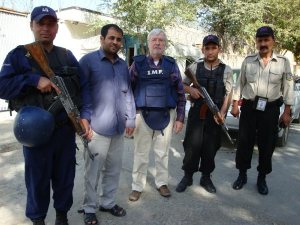
Background
Guards and driver Wahid and I outside IMF guesthouse in Kabul
Foreign Wars
“Damned if you do, damned if you don’t,” says my friend Bob Gregorio with reference to the NATO bombing near Kunduz of two hijacked fuel tankers that may have killed 120
people including maybe two dozen civilians (the numbers keep changing). This
observation contains a profound lesson for those contemplating foreign wars and
no place more so than here in Afghanistan.
An Afghan friend here in Kabul gave me two videos to watch
and then spent over an hour downloading all the viewers and right CODEXes to
make sure I could watch it on my laptop. So I felt obligated to watch all two
hours of “The Road to Guantanamo” about three British Pakistani boys who flew
from London to Karachi to get married, traveled into Afghanistan to see if they
could help their Taliban “brothers” in November 2001, were captured by the
Northern Alliance forces (largely Tajik Afghans fighting Pashtun Taliban) in
December 2001 (a few weeks before I arrived in Kabul), were turned over to
American forces and spent the next four years in Guantanamo before being
released with no charges every having been made against them. If that didn’t
leave me sickened, the other, thankfully shorter, video certainly did. In it a
female journalist travels with a U.S. Army unit (I forgot its name) north of
Kandahar through remote villages looking for Taliban. Working with local
village chiefs they do their best. The journalist then returns on her own to
the same villages for further interviews. While I do not find the claims of the
villagers that American solders abused them credible (demanding that men strip,
face the wall, and then groped them), just seeing the American invasions of
their homes from the eyes of humiliated, poor Afghanis, even if used for
propaganda purposes, tells us a lot about the futility and foolishness of
bringing democracy to foreign lands by force. How can our 19, 20 year old
solders, with their human strengths and weaknesses, possibly succeed (at what?)
in such environments. Damned if you do and damned if you don’t, indeed.
I really cringe when I hear well-meaning Americans praising
our brave boys overseas. How dare we send them into such bewildering and
foolish danger? These fellow American’s have no idea what they are asking. If
they did, they wouldn’t do it. President Bush, for all of his faults, at least
had a clear purpose in attacking Afghanistan—to kill Ben Laden. Too bad he
failed so miserably as a result of the disastrous Iraqi diversion. My respected
friend Robert Schadler (a senior official in the Reagan administration’s now
defunct United States Information Agency) makes some important observations
about such situations in response to my earlier note on this bombing:
Dear Warren,
My sense, without ever having traveled there, is that our notion of “who they are” is
very different than their own.
We say: “Saddam viciously committed genocide on his own people.” He says, “They
were Kurds and Shi’a. None were from Tikrit. They were not “my people”; they were my enemies.”
Similarly, the Afghans who are pleased with the bombings [in Kunduz] probably don’t view those who were killed as “fellow Afghans” but some barbarous tribe who happen to also live in a place called Afghanistan.
That’s only one layer. Western analysts are trained, by Aristotle, Anselm and others, to avoid obvious contradictions in thinking and feeling. As a counter, I recall a story that
baffled and amused my mother for most of her life. She had lived in Turkey during the last days of Ataturk. A rather sophisticated neighbor of hers, a Turk, was very proud of the fact that Turkey had such a strong leader — not like the weak-kneed European leaders at the time. Yet, minutes later, she said she expected Allah to strike down Ataturk for his vicious efforts to rid Turkey of various traditional Islamic practices — Arabic script, Friday holidays, forbidding the fez, etc.
Another layer yet is telling the powerful — and Westerners are often deemed powerful and the conquerors — what they want to hear or, more accurately, what they think the Westerners want to hear.
As for the policy shift in Afghanistan: the US had about half a million “boots on the
ground” to push Saddam out of Kuwait — a very small country. Figuring out who was who and where Kuwait ended and Iraq began did not require a lot of sophisticated intelligence and cultural awareness.
Protecting Afghans — from all mean, vicious and armed thugs or just the Taliban-inspired ones — means at lot more than another 20K or 30K troops. Training the
Afghans to police themselves …. Training them is the minor problem. Getting them to view members of other tribes and themselves as Afghans first and foremost is the tough challenge. And it’s one I’m dubious our Marines, however fine they may be, is something they signed up to do and have been properly trained to accomplish.
The political problem at home is only somewhat related. The original mission in Afghanistan was to kill or capture bin Laden. This mission was an utter failure. It needed to be done quickly, in any case, to send the message that attacks such as 9/11 have dire
consequences. The message now received is that these attacks can be carried out and, with a little cleverness and close loyalties, can escape punishment. There was virtually no dissent over the goal of killing or capturing bin Laden. Had the Taliban government “given him up” the US would not have gone into Afghanistan.
Today, the mission cannot be clearly stated. I heard Gen. Zinni last week (at the New
America Foundation). While he was against going into Iraq, he is against pulling out of Afghanistan — for reasons of credibility. He agreed al Qaeda is no longer in Afghanistan. “Protecting the Afghan people” is hardly a policy — given the dozens of the 192 countries have populations that need “protection.” “Keeping Karzai in power” or “Keeping the Taliban out of power” would be palatable only if it could be connected to some larger, important, America-centric purpose. And if the costs were plausible vs other uses of those resources.
Bush was famously inarticulate, but “bin Laden dead or alive” was vivid, clear and
arguably worthwhile. Obama, famously articulate, has said, “Afghanistan is a war of necessity” and the “important war”. But it is doubtful he’ll make his reasoning plausible. For that reason, it is deemed he was saying these things simply because he wanted to avoid being a “weak on security, McGovernite Democrat”. And that mission was
accomplished — at least during the pre- election period.
Best,
Bob
I believe in the value and virtues of “nation building.” That is why I am here and why I worked in such places as Iraq, Serbia, Bosnia, Croatia, Kosovo, Zimbabwe, to name a few. By “nation building” I mean sharing the accumulated wisdom of successful, productive, and human societies with those not yet as successful for their people. It only works as a long slow process of education and persuasion within the context of the existing social
and political structures, even when the goal is to change them. Our solders don’t help. We should keep them home and spend the money and lives saved on keeping our economy and society strong (the source and basis of our military strength). How best to withdraw from the messes we have created and are now in is another and more complicated matter. It will involve a lot of Damned if you do, damned if you don’t. And damned those who seem to like sending our youth on fools’ errands with little understanding or regard for the lives disrupted or destroyed around the world, all with good intention, of course.
It has not escaped my attention that I am leaving
Afghanistan on 9/11.

