Libya: Further down the slippery slope

It is not easy to find the right balance between our relationships with sometimes repressive and always undemocratic (in the narrow sense of voting) regimes in the Middle East and the dissidents among their citizens who criticize them. But statecraft and diplomacy are the right tools not military force (e.g. drones). Defense Secretary Gates said as much when cautioning against imposing a no fly zone in Libya a week before we under took them. Now the pundits are chattering that we have not done enough. Gaddafi is still there. President Obama is inarticulately and ineffectively trying to resist further sliding down the slippery slope to another messy engagement with another Muslim country. But the odds are against him. When will we ever learn, when will we ever learn.

The Washington Post published two thoughtful op-eds on the subject today that are well worth reading.  The first by Michael Chertoff and Michael V. Hayden is called: “What happens after Gaddafi is removed”. The other by Sarah Sewall and Anthony Zinni is called: “The military interventions we don’t plan for–those to protect civilians”

China

I arrived today in Nanjing China for a “High-Level Seminar on the International Monetary System” organized by the G-20. The one-day seminar tomorrow will be opened by Vice Premier of the People’s Republic of China Wang Qishan and French President Nicolas Sarkozy. As one of the (relatively large number of) “lead speakers” I will discuss an enhanced role for the IMF’s SDR in the International Monetary System. The session I will speak in is:

Global liquidity management issues (including global financial safety nets and the role of the SDR):

Chair: Christian Noyer (Governor of the Bank of France)

Moderator: George Osborne (Minister of Finance of the United Kingdom)

Lead speakers: Alexei Kudrin (Minister of Finance of Russia), Yung Chul-Park (Seoul University), Olli Rehn (European Commissioner for Economic and Monetary Affairs), Hélène Rey (London Business School), Elena Salgado (Minister of Finance of Spain), Wang Jianye (Exim Bank chief economist), Kim Choong-Soo (Governor of the Bank of Korea), Jim O’Neill (Chairman of Goldman Sachs Asset Management), Obaid Al Tayer (Minister of State for Financial Affairs of UAE), Volker Wieland (Goethe University Frankfurt), Martin Crisanto EBE MBA (Minister of Finance of Equatorial Guinea), Warren Coats (Chicago economist and former IMF official).

Other speakers during the day include Dominique Strauss-Kahn, the Managing Director of the IMF, Timothy Geithner (US Secretary of the Treasury), Robert Mundell (Columbia University), Jean-Claude Trichet (President of the ECB—European Central Bank). I will try hard to sleep tonight in my new time zone and to stay awake tomorrow.

China is amazing. Nanjing is only the third Chinese city I have visited and I will not really see it until after the conference which is being held at a lake resort in the countryside outside of Nanjing (The Purple Palace). It was the capital of the Ming and several other Dynasties and with many interesting things to see. Driving through Nanjing this evening I could have been in LA on the freeway system or in Boston in the long tunnels under the city (though the quality of construction is better here in China). The skyline is beautiful with every effective use of lighting. They even apply capitalist pricing to the highways (toll roads), which are magnificent. Beijing, which I have seen more fully, is typical of a number of major cities in China, of which Shanghai is the most famous, in their impressive, modern buildings and infrastructure. I have described Beijing as what New York City might look like if it were modern (i.e., not old and run down). To be fair to NYC, its charm and attraction is not (any longer) its buildings but its vibrant and very diverse cultural life. I am not able top judge that aspect of life in China’s major cities.

Walking through Beijing Capital International airport for my connecting flight to Nanjing, it was like any other modern international airport (Terminal 5 of Heathrow, Dubai International, etc). Well organized, efficient, clean and full of familiar shops. Very unlike the old, deteriorating, and unattractive terminals at JFK.

Chinese people strike me as more like us than most any other people (including Europeans) I have met. And who do I mean by “us?” I don’t mean Anglo Saxons like myself. I mean the hard working, innovative, entrepreneur types who are creating most of the wealth in this country like Google founders, Larry Page (American born Jew) and Sergey Brin (Russian born Jew), or Steve Jobs, who was born in San Francisco to a Syrian father and German-American mother, and, of course, also includes many Anglo Saxons like myself.

China’s dramatic growth over the past 30 years resulted from the Chinese government gradually freeing the economy from the bottom up, starting with agriculture. The state got out of the way and let individuals make profits if they could. And the Chinese proved to be very entrepreneurial. They are willing to work very hard and innovatively to make money. China’s real output has grown more than 10 percent per year on average since these reforms began and it came almost totally from the rapid growth of the private sector, largely individuals and very small firms that grew larger in the space the government allowed. What the government has done is provide the infrastructure (road, power, etc) that has allowed private entrepreneurs to get their products to market efficiently. They excel in every society they live in.

The Chinese (English language) newspaper given to me on the plane earlier today had an amazing article about problems with illegal immigrants coming to China from Africa, the Middle East and elsewhere for better jobs and pay and more opportunity than then can get at home. I found that amazing. The good thing about people working hard to get ahead is that it is not a zero sum game. They add to overall wealth and everyone gains.

Another Long War?

Today’s headlines are: LONG ROAD AHEAD Top French Official: Intervention Could Last ’Awhile’.. Gaddafi Vows ’Long War’

Two days ago I posted the following blog: https://wcoats.wordpress.com/2011/03/19/a-new-war/ reproduced below:

“So the next war has started. At least we are not acting alone, though we seemed to have followed more than lead. Try to remember the emotions that led us into it. Natural sympathy for the rebels/insurgents/freedom fighters—for the under dogs is one of the reasons. And disgust for the mad man Gaddafi is another. And of courage there is the American testosterone charged swagger that we can squash the villain so why not.  Hold those thoughts, as it seems to you now looking forward with only a few bombs dropped so far. Try to remember it six months from now, two years from now, five years from now (We have been fighting in Afghanistan for over nine years and have been in Iraq for seven).

“Looking back it will seem very different. We will know by then who the new guys are and whether they are better or worse than Gaddafi. We will not know whether we were right to side with the Sunnis or the Shias (which ever it turns out to be). Some of us will say that it was not wise to take sides in this great intra Muslim struggle. We will have poured more billions into someone else’s economy at a time when we MUST cut back our government’s spending of money it doesn’t have thus forcing us to cut domestic spending even more than otherwise.

“I have no idea how this will go (which is one of the compelling reasons why we are being very fooling to undertake it), but I do know that it will all look very different looking back.”

It is instructive to compare events in Egypt with those in Libya. Egypt has a significant middle class and a significant and deepening civil society. The prospects for Egyptian democracy are hopeful following its homegrown protests that started less than two months ago and resulted in the ouster of long ruling President Mubarak. Yet these events took decades to mature and even in Egypt the final outcome remains uncertain. Egyptian protesters where united in their demands for Mubarak’s ouster. But then what? Many different visions of his replacement and of the future regime are in conflict with each other. The Economist printed an excellent brief on the struggles between different interests now under way in Egypt. “The Arab Uprisings: Democracy’s Hard Spring” March 10, 2011. But Egypt has a foundation from which to build and the outcome is hopeful. Libya will look more like Afghanistan and Iraq. It only took us a few months to forget the hard lessons of Iraq.

Two weeks ago I feared that we might do this. You can review my earlier warnings at my blog: “Libya and the drums of war” March 10; “More on Libya” March 12; and “Libya: Let’s not make it our war” March 13, 2011.

A New War

So the next war has started. At least we are not acting alone, though we seemed to have followed more than lead. Try to remember the emotions that led us into it. Natural sympathy for the rebels/insurgents/freedom fighters—for the under dogs is one of the reasons. And disgust for the mad man Qaddafi is another. And of courage there is the American testosterone charged swagger that we can squash the villain so why not.  Hold those thoughts, as it seems to you now looking forward with only a few bombs dropped so far. Try to remember it six months from now, two years from now, five years from now (We have been fighting in Afghanistan for over nine years and have been in Iraq for seven).

Looking back it will seem very different. We will know by then who the new guys are and whether they are better or worse than Qaddafi. We will not know whether we were right to side with the Sunnis or the Shias (which ever it turns out to be). Some of us will say that it was not wise to take sides in this great intra Muslim struggle. We will have pored more billions into someone else’s economy at a time when we MUST cut back our government’s spending of money it doesn’t have thus forcing us to cut domestic spending even more than otherwise.

I have no idea how this will go (which is one of the compelling reasons why we are being very fooling to undertake it), but I do know that it will all look very different looking back.

Libya: Let’s not make it our war

More voices are being raised to urge caution before sliding into yet another war. General Wesley K Clark’s reflections deserve careful reading and reflection, before the old cold warriors, still looking for new causes, seduce an empathetic public and their representatives into another economically and politically draining war. “Libya doesn’t meet the test for U.S. military action”

What we do need to do is redouble our support (directly to the extent it is accepted and via international organizations) to the new governments of Arab countries to build and strengthen institutions that support the rule of law, the rights of individuals, a free press, and other checks and balances on the exercise of political power. We should encourage the development of the legal framework and institutions that promote entrepreneurship, justice, and tolerance of religious and other differences. The Arab Spring can be the beginning of a positive transformation of a backward part of the world or another false start. It is not up to us, but we can contribute to a more promising outcome if we choose to.

More on Libya

Here are some sensible thoughts from my friend Steve Clemons

Dear Friends and Colleagues:

There is a big rush by some to impose a no-fly zone over Libya.  Bill Clinton’s voice has joined others like Senators John McCain, John Kerry, and Joseph Lieberman as well as former New Mexico Governor Bill Richardson in calling for NATO and the US to impose a no fly zone.

I think this is a mistake — and is more of an emotional impulse than one that really helps the Opposition in Libya.  The blowback costs could be huge — and there are other options, perhaps much better ones, to try and help those trying to rid themselves of Moammer Gaddafi’s rule.

My thoughts are here:

http://www.thewashingtonnote.com/archives/2011/03/no-fly_zone_ove/
No-Fly Zone Over Libya Could Backfire & Undermine Protests in Middle East

All best,

Steve Clemons

Libya and the Drums of War

Once again the drums of war are beating. President Obama has said that “President Gaddafi must go” with no obvious plan for removing him. Indeed, we would all like to see him go and it would be painful to watch him attach his own citizens. But many distasteful things happen in life that we can do nothing about or choice to do nothing about for reasons of prudence. We are not (yet) at war with Libya. Libya has not attacked us or our interests. We would be extraordinarily foolish to attack Libya.

We should support the principles our nation was founded upon and operates under. These include “that all men are created equal, that they are endowed by their Creator with certain unalienable Rights, that among these are Life, Liberty and the pursuit of Happiness.” We should support in appropriate ways those in the world, including Libya, who share these values. This does not include war or measures that would suck us down a slippery slope to war.

Two recent Washington Post articles sound the right warnings and ask the right questions. They are well worth reading: Anne Applebaum “The Arab World Isn’t Clamoring for Our Help” and George Will “Then What?”


Travel notes from South Sudan and Kenya

As my Kenya Airways flight climbed out of Juba, the Nile cut through the brown countryside as far as I could see. In the last month of South Sudan’s dry season, little green can be seen. In a month and a half or so after the rainy season has started it will all be green.

An hour and a half later, as we descended into Nairobi, the vast plains of Kenya surrounding the city were lushly green and the relatively vast wealth of Kenya was easily discernible even from the sky. The drive from the airport to my hotel in the city center took me past row after row of modern office buildings and import export warehouses and assembly facilities. Kenya is a relatively modern and affluent African country. It is alive with activity. It’s rapidly growing wealth is unfortunately revealed in the infamous traffic jams along its main roads. Freeway construction has not kept pace.

Today, the front page of one of Nairobi’s daily newspapers was filled with news of the winners of the national school performance examination results, a testimony to the high value Kenyan’s place on education as an essential part if its development and continental and international competitiveness. The paper lamented the continued gap between the girls’ and the boys’ performance.

Kenya has made progress toward reducing the role of tribes in business and political life. If workers are promoted and otherwise rewarded on the basis of performance (merit), economies develop and grow much faster than those (so typical of much of Africa still) that function more narrowing long tribal lines. Then the Presidential elections in December 2007, which were expected to deepen democracy’s hold, erupted into violence along political/tribal lines when incumbent President Mwai Kibaki was declared the winner and shattered this progress. His opponent Raila Odinga was widely thought to have won. Over 800 people died and over 600,000 were displaced from the violence.

Most Kenyans were shocked by the violence of those weeks. Former UN General Secretary Kofi Annan brokered a power sharing agreement that restored peace but did not succeed in overcoming the resurgent tribalism and its poisonous effect on Kenya’s public and economic life. Ever since local newspaper headlines have been dominated by on again off again efforts to bring the perpetrators of the electoral violence to justice. The debate is between those who do not believe Kenyan institutions are strong enough to expose and punish those high government officials who are guilty and thus favor having the claims adjudicated in the Hague, and those who want Kenya to handle its own investigation. This later group includes coalition government, whose Finance Minister was accused by the International War Criminal Court in the Hague as one of the perpetrators. Like Zimbabwe, it is very painful to see such a wonderful and promising country slide backward.

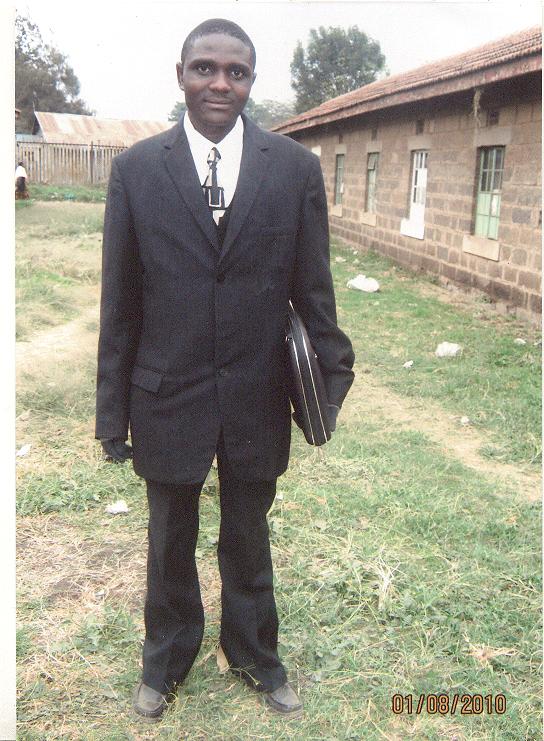
Then there is the story of Paul Oduor, pictured below. I had dinner with Paul several weeks ago in Nairobi on my way to Juba. I am still not quite sure how it came about. Several months ago I received a text message from a Kenyan phone number. I had never received an unsolicited text message from a stranger before (unlike all those messages from widows, Barristers, or bank officials in Nigeria or Benin—why Benin??—eager to deposit millions from their recently diseased husband, or client, in my bank account if I would just provided them with my account information).  He said something like, “I am a young African man, and would like to know you. Where are you?” not the usual “I am sure that you will be very surprised by this letter” favored by the fraudsters. My finger hovered over the delete button, but then I replied “I am in Washington DC. Who and where are you.” It turned out that he was in Nairobi and didn’t seem to want anything more that the adventure of connecting with someone somewhere else in the world. And, of course, I do pass through Nairobi fairly often, so we kept exchanging text messages and arranged to meet for dinner on February 18th.

Paul was a polite young man of 22 who ran a human rights organization with a partner that is affiliated with Humanists International. He was trying to educate the residence of the large squatter slum of several hundred thousand Kenyans in a square mile or so of Nairobi of their rights under the law. He gave me literature explaining the purpose of his organization. He had obviously had some training in sales, complimenting me on asking good questions. Finally I asked him how he got my phone number. He said that his mother worked in the kitchen of a hotel where we had held a workshop for some South Sudanese officials a year or two earlier and had picked up one of my papers that had the information. Maybe it was a participant list, as I don’t put my phone number on articles or other such papers. As best I can tell, Paul simply thought it would be fun to see if the far off person whose number he had acquired would respond. He never asked for money for his organization, which seemed to be a private voluntary undertaking on his part, but he did eat a hearty meal. As we parted, he said: “You are a Christian, aren’t you?” Then handed me a book called: “The Greatest Man Who Ever Lived.” Never a dull moment.

Egypt: American Values and Foreign Policy

Dubai – American foreign policy should aim to support American interests. Those interests—security of American lives and property, free and open trade and movement, and human dignity—are not independent of American values—respect for the rights and responsibilities of each individual, free press, etc. I have written on this theme from time to time, e.g. https://wcoats.wordpress.com/2009/09/10/outside-imf-guesthouse-kabul-afghanistan/ or https://wcoats.wordpress.com/2010/06/23/a-south-african-hero/ or https://wcoats.wordpress.com/2010/06/15/kyrgyzstan-in-crisis/ .

What does it say about what our policy should be toward the regime and events now underway in Egypt? I am sure that, like me, most American’s are cheering for the Egyptians in Tahrir Square in Cairo to throw the tyrant Mubarak out and establish a democratic government. Several questions and issues arise.

We are citizens of a free country and can cheer for whomever we like. We cheered the Hungarians rising up against their Soviet oppressors in 1956.  But when the U.S. government seemed to urge them on via Radio Free Europe and the Voice of American, many Hungarians felt betrayed when America did not come to their aid. Imagine for a moment, as glorious as it might have seemed at the time (at the beginning), if we had sent troops to Budapest to fight the Soviets. No one can know how that might have come out, but it is pretty certain that the most peaceful collapse of an empire—the Evil Soviet Empire—between 1989-91 never would have occurred peacefully.

While our private cheering comes easily—too quick and easy sometimes—our government must worry about whether a change in the status quo is likely to result in a better arrangement for the average Egyptian and for our own security and that of our allies in the area (Israel). Our government is not as free as you and I are to publicly express its opinions about the rulers it prefers to see in other countries. The United States had good reasons for developing good relations with the Egyptian government. With billions of dollars in aid and diplomacy we bought considerably enhanced security for Israel. With the signing of the 1979 Israeli-Egyptian peace treaty Egypt became the first Arab nation to recognize the state of Israel ending the state of war that existed between them. Egypt has been a good partner with the U.S. in promoting acceptance of Israel and peace in the area.

But while we can and should cooperate with Egypt and other governments in areas that promote peace and security, we should never turn our backs on our underlying values of human rights and democracy. This is not always an easy balance to maintain and the Obama administration has been doing a reasonably decent job of it. Mubarak has displayed the bad habit of almost all dictators of imposing increasingly nasty measures to remain in power. The popular uprising in Egypt justifies America’s pressure on Mubarak to step down and allow fair elections. While Israel’s current attacks on the United States for its betrayal of Mubarak can be understood from the perspective of Israel’s perceived, but shortsighted, security interest, it provides a vivid example of the fact that though America is rightly committed to the military defense of Israel, Israel’s interests are not always identical with ours.

The American government is also right to worry that replacing a corrupt and repressive government does not automatically result in a better one. It needs to use its diplomatic influence to guide the process toward a peaceful, orderly change in government with open and fair elections in September. It must not repeat President George W Bush’s mistake of insisting on elections in the West Bank and Gaza and then refusing to recognize the results when they favored Hamas. That sad episode made a mockery of American’s commitment to democracy. Democracy does not always produce good results (results that are consistent with the rule of law and human rights that are core American values) and we should not always push for it when conditions are not promising.

Egypt, like Turkey, is a relatively secular, largely Islamic country. The mildly outlawed Muslim Brotherhood (MB) is very unlikely to dominate a new government unless we badly misplay our cards. According to Daniel Levy, an Israeli now at the New America Foundation: “The ability to use the Islamist boogieman to fuel US fears draws on a combination of unfamiliarity and ignorance, cultural arrogance, and real policy differences on regional issues, notably on Israel. That Arab publics left to their own devices should freely choose to support religious conservatives should largely be none of our business: Americans in many states make a similar choice at the ballot box. That American policymakers have so few links into the MB or serious channels of communication is simply a failure of American policy.” “Complicating the Transition in US – Egyptian Relations” Foreign Policy”

The Obama administration should pressure Mubarak to make changes to the Egyptian constitution that will allow fair elections, appoint a technocratic caretaker government until the September elections, and encourage the Egyptian military, which receives about $1.2 billion a year in U.S. assistance, to maintain security in a politically neutral way. Obama should tell Mubarak firmly that it is time for him to go, as President Reagan did to Ferdinand Marcos in the Philippines in 1986.

The groundswell for reform from Tunisia, to Egypt, to Sanna and beyond opens opportunity for positive change in the Middle East.  Such events cannot be controlled but they can certainly be influenced for better or worst. The United State must remain rooted in its core believes and values while supporting the strengthening of the rule of law and the rights of individuals.

Eisenhower’s farewell address 50 years later

Exactly 50 years ago President Eisenhower delivered his famous warning about the risks of a large standing Army supported by an equally large military-industrial complex. His warning is more obvious and prescient today even than it was then. For my further thoughts on Ike’s warning please see: http://dailycaller.com/2011/01/17/ikes-farewell-address-fifty-years-on/