Their Turkey and Ours

“Recep Tayyip Erdogan believes high interest rates are the cause of inflation, not the remedy for it”  The Economist May 19, 2018 “How-turkey-fell-from-investment-darling-to-junk-rated-emerging-market”

During the 1990s the inflation rate in Turkey averaged around 80% per annum varying between 60% and 105%.  Over that period interest rates on its 3-month treasury bills averaged about 30% above the inflation rate reaching almost 150% in 1996.  The economy grew rapidly in real terms with real GDP growth averaging 8% per annum between 1995-7.  But growth depended heavily on borrowing abroad in foreign currencies.  Banks were poorly regulated, and heavily exposed to foreign exchange risk and to government debt.  Obviously, Turkey’s nominal exchange rate depreciated at about the same rate as its inflation rate in order to preserve a stable real exchange rate.

In the wake of the Asian and Russian debt crises in 1997 and 1998 foreign investors became more risk averse and capital inflows into Turkey were reduced sharply slowing down economic growth from 7.5% in 1997 to 2.5% in 1998.  A serious earthquake in Turkey’s industrial heartland in August 1999 further deteriorated Turkey’s economic performance.  The combined impact of the two pushed the economy into a deep recession, shrinking GDP by 3.6% in 1999.

With support from the International Monetary Fund (IMF) in 1999-2003 the Turkish government reigned in its spending and monetary growth and reduced its inflation rate to 10% by 2004. I was a member of the IMF’s Turkey team at that time and remember the long sleepless nights very well. Turkey’s interest rates followed inflation down and, in fact, its real interest rates (nominal interest rate minus its inflation rate) fell from 30% to negative rates as the economy stabilized. During this transition, a number of state owned enterprises were privatized, 18 insolvent banks were intervened, and debt and the financial sector were restructured and strengthened.  Within a few (rough) years the economy was growing rapidly with low inflation and low interest rates.  In 2017 real GDP grew 7.0% though inflation had crept back up to 11.1%.

Following Turkey’s and the rest of the world’s recession in 2009 the country reverted back to its bad old ways.  “Recep Tayyip Erdogan signed a decree easing access to foreign-exchange loans for Turkish companies.  The new rules lifted restrictions that barred companies without revenue in hard currencies from doing such borrowing—as long as the loans exceeded $5 million.”  How Erdogan’s push for endless growth brought Turkey to the Brink

Erdogan observed the low interest rates, low inflation, and high growth and apparently concluded that low interest rates caused low inflation rather than the other way around. Every economist knows that interest rates incorporate the market’s expectation of inflation over the period of a loan in order to establish a market clearing real rate of interest.  In 1996 when a borrower was willing to pay 130% interest and a lender was not willing to accept less it was because they expected 80% to 90% inflation per annum over the life of the loan.  The very high real rate (130% – 80% = 50%) reflects the risk premium of getting it wrong.

Central banks can, if inflation expectations adjust slowly, push real rates down temporarily by lowering nominal market rates below their equilibrium rate.  Doing so, however, increases the rate at which the money supply grows eventually increasing inflation and forcing nominal interest rates higher than they would otherwise have been.

Under political pressure from Erdogan, the central bank of Turkey has kept interest rates lower (and thus money supply growth greater) than are consistent with its inflation target of 5%.  In the last few years inflation has drifted up reaching 11.1% in 2017.  Markets have grown uneasy about the economic situation in Turkey and when the Central Bank failed to increase its policy interest rate last month from 17.75% investors began selling off Turkish bonds and withdrawing funds from the country.  Its exchange rate plummeted.  From January of this year the Turkish lira depreciated from 11.7 per dollar to 16 lira/USD at the beginning of July and to 21 lira/USD on the 22ndof August. Erdogan’s wrong-headed misunderstanding of the role of interest rates is pushing Turkey over the precipice of bankruptcy.

Meanwhile here in the United States, President Trump apparently attended the same school as Erdogan. After breaking a several decades old protocol against commenting on or interfering with the Federal Reserve’s monetary policy when he stated last month that he didn’t want to see the Fed increase its policy interest rate, he did it again a few days ago. “Trump-escalates-attacks-federal-reserve”  Trump’s advice is wrong. The Federal Reserve needs to continue raising its policy rate back toward normal levels (3% to 4%) before inflation momentum becomes any stronger. Real interest rates are still negative (less than the inflation rate).  The Fed should have started increasing rates several years earlier.

Feeding the Swamp

During his filibuster leading to last week’s brief government shutdown, Sen. Rand Paul (R-Ky.) stated that: “When Republicans are in power, it seems there is no conservative party…. The hypocrisy hangs in the air and chokes anyone with a sense of decency or intellectual honesty.” He was protesting the compromise two-year budget just passed by the Senate and awaiting passage in the House. This budget, now signed into law by President Trump, adds over $300 billion in additional government spending this year alone on top of the $1 trillion dollar deficit created by the recently passed tax cut. “Why-did-the-GOP-vote-for-a-budget-busting-spending-bill-because-voters-dont-seem-to-care”

A few congressmen reacted with more principle. “’I’m not only a ‘no.’ I’m a ‘hell no,’ ” quipped Rep. Mo Brooks (R-Ala.), one of many members of the Tea Party-aligned Freedom Caucus who left a closed-door meeting of Republicans saying they would vote against the deal.

“It’s a “Christmas tree on steroids,” lamented one of the Freedom Caucus leaders, Rep. Dave Brat (R-Va.).” “Right-revolts-on-budget-deal”

Why should we worry about adding to the public debt? The “deficit” is the shortfall of tax revenue below expenditures in one year. This is now forecast to average about one trillion dollars in each of the next two years. “Bipartisan-budget-act-cements-return-trillion-dollar-deficits”. Each year these annual deficits add to the outstanding U.S. national “debt” currently at $20.6 trillion dollars. Even before the recent tax cuts and last week’s expenditure increases, the Congressional Budget Office projected Federal debt held by the public at $25.5 trillion or 91.5% of GDP by 2027. But that figure omits debt held by the Federal Reserve, Social Security “trust” fund, and other government entities, which must also be serviced and repaid. When these are included as they should be, gross federal debt is projected to be $30.7 trillion or 110% of GDP by 2027 and 150% of GDP in thirty years and climbing. And to repeat, this is before the recent tax cuts and budget increases.

As our economy grows so does the government’s capacity to carry and service (pay the interest on) the debt. But on the basis of existing laws and policies our debt will grow faster than the economy forever. But of course that is impossible. At some point taxes must be increased or expenditures cut, or the government defaults on its debt. In fact the problem is worse than these figures suggest because they fail to include the future taxes or borrowing needed to cover unfunded government liabilities. These are commitments, such as future Social Security pension payments, for which existing financing falls short. For example, Social Security payments already exceed its annual revenue from the wage taxes of current workers and the so-called trust fund will run dry in fifteen years. That will add still more to the deficit and the debt.

Indeed, there are times when deficits are ok and even helpful. When the economy goes into recession the government should allow the deficit that naturally results from falling tax revenue and increasing safety net spending. These are referred to as automatic stabilizers. However, we are currently not now in that phase of the business cycle. We are now at its peak and if the government is to achieve fiscal balance over the cycle it must run budget surpluses at the peak to pay for the deficits during the slumps. The U.S. should now have a budget surplus and not the huge deficit presently experienced and projected. The White House’s announcement today (Monday) that it is giving up on the traditional Republican goal of a balanced budget in ten years is hardly a surprise when we are starting with a large deficit at the peak of the business cycle. https://www.washingtonpost.com/business/economy/white-house-budget-proposes-increase-to-defense-spending-and-cuts-to-safety-net-but-federal-deficit-would-remain/2018/02/12/f2eb00e6-100e-11e8-8ea1-c1d91fcec3fe_story.html?utm_term=.514757e9c8de&wpisrc=al_news__alert-politics–alert-national&wpmk=1

Senator Paul was rightly angry that not only was the need to face and correct this untenable future kicked down the road yet again, but the process of doing so was corrupt. Votes were bought by sticking in special tax and spending breaks for the constituents and friends of individual congressmen—the old earmarks by another name. “Budget-deal-retroactively-extend-several-expired-tax-provisions”. While it is true that the bipartisan budget deal wouldn’t have passed without these bribes, it shouldn’t have passed. Instead of draining the swamp the Republicans have joined with the Democrats to feed it. “In-big-reversal-new-trump-budget-will-give-up-on-longtime-republican-goal-of-eliminating-deficit”. And more repulsive is the fact that these are the same Republicans who rallied against spending during the Obama years. This is the hypocrisy Senator Paul lamented.

Congress has failed yet again to prioritize it’s spending to match the resources that taxpayers are willing to pay. The moral corruption of this way of doing business was reestablished and reinforced. As another example of blatant corruption, Presidents have rewarded (paid off) large contributors with Ambassadorships to nice places like London, Paris, and Rome (to name a few) for decades. This is pure corruption for which the country pays with lower quality representation and diplomacy than would be provided by Foreign Service professionals. Unfortunately we have grown used to it and barely notice it. This is dangerous.

All individual government expenditures and programs look worthwhile to at least some people, but at the expense of what? What do taxpayers or investors or other government programs give up to finance them. These are not easy choices and decisions but it is the job of our representatives to make these judgments in the best interests of the country as a whole. That is probably expecting more than they are capable of delivering, but it is their job. Those of you of Generation X, Y and Z will have to pay for this so you are the ones with an incentive to do something about it. We need more Rand Pauls. “The-5-biggest-losers-from-the-2018-budget-deal-are…”

SALT—More press nonsense on tax reform

The elimination of State and Local Tax (SALT) deductions from the proposed tax reforms working their way through Congress has become a hot topic. Fine, but please keep the discussion honest. Sadly my local newspaper, The Washington Post, is not setting a good example: “In-towns-and-cities-nationwide-fears-of-trickle-down-effects-of-federal-tax-legislation”

First a word about tax reform vs tax reduction. We are now in the 9th year of economic recovery, one of the longest on record. It won’t go on forever. Ideally the Federal government’s budget should balance its expenditures and revenue over the business cycle. That allows for aggregate demand stimulating deficits during business downturns. These deficits result from so called automatic stabilizers—the fall in tax revenue from the fall in taxable income plus increased transfer payments to the unemployed. But a cyclically balanced budget also requires budget surpluses during the business expansion phase. The U.S. economy is now fully employed (in fact, unfilled vacancies exceed those looking for work). The Federal Reserve has finally increased inflation to its target rate of 2%. We should now have budget surpluses to make room for the deficits that will follow during the upcoming downturn.

But our fiscal situation is much worse than that. The large increase in “entitlement” expenditures for my greedy generation as we retire (greatly increasing unfunded social security and health benefits) will push our fiscal debt held by the public, now at 77% of our Gross Domestic Product (GDP), to over 150% of GDP within 30 years if current laws remain unchanged. See the figure below.

Taxes will either need to be increased (not reduced) or entitlement expenditures reduced (which means increased less than current law provides). My point is that reducing tax revenue at this time is irresponsible without at least matching expenditure cuts. The proposed tax reforms now in congress would increase the debt by $1,500 billion dollars over the next ten years on a static forecast basis, meaning without taking into account the increased growth and thus tax revenue that might result from the tax reforms, which no one expects to wipe out all of the static forecast of $1,500 billion.

Fed debt      Congressional Budget Office forecasts

While it is irresponsible to cut tax revenue at this time, it is highly desirable to reform how that revenue is raised. The existing taxes distort the economy and thus reduce our incomes in a number of ways. They grant favors to many special interest groups via allowing them to deduct specific expenditures from their taxable incomes (i.e. from the tax base). These so called tax subsidies encourage activities over what the private economy would otherwise under take. One very damaging example is the deduction of interest payments by businesses and individuals, which has encouraged excessive borrowing and indebtedness. The most popular of these is the mortgage interest deduction by homeowners. This tax subsidy benefits homeowners relative to renters, i.e. it benefits the wealthier at the expense of the poor. How well meaning middle and upper income American’s can justify this with a straight face is beyond me.

But what about the SALT deductions? By eliminating such deductions, i.e. by broadening the tax base, the same revenue can be raised with a lower tax rate. Other things equal (such as revenue), lower tax rates are good because they influence taxpayer decisions less. For example, companies are more likely to invest in the U.S. rather than abroad if the corporate tax rate is reduced from its current 35%, virtually the highest in the world, to 20%, which is closer to the rate in most developed countries.

Reducing tax subsidies to state and local governments is also good because it reduces an artificial encouragement for larger state and local government expenditures. If Californians are willing to pay more state taxes for larger state expenditures they are welcome to do so. But there can be no justification for transferring federal tax revenue from states with lower expenditures and matching taxes to California and other high spending states. To a large extent the existing SALT deductions transfer income from poorer states to wealthier ones. Who can support that with a straight face?

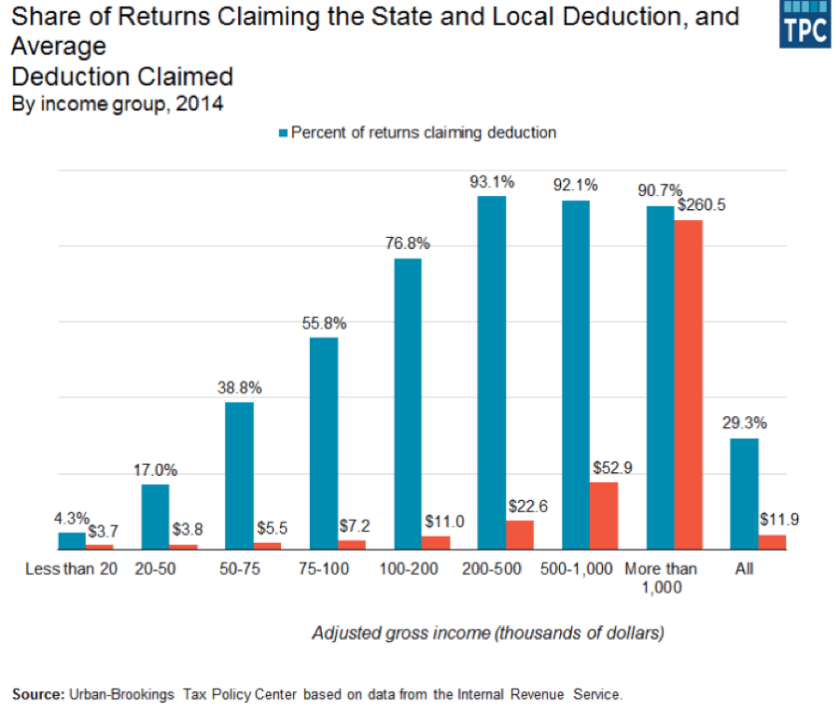
How information is presented can have a significant effect on how it is understood or viewed. How did Renae Merle and Peter Jamison of The Washington Post (see link above) report the proposed elimination of the SALT deduction? They reported that, “In San Diego County, the elimination of what is commonly called the “SALT” deduction could affect about a third of households, said Greg Cox, a member of the board of supervisors. The average middle-income resident would lose a $16,000 deduction.” They failed to note that the third of households affected are the wealthiest third. According to CNBC: “More than half of taxpayers who are earning $75,000 and above claim SALT deductions on their federal income tax returns as do more than 90 percent of taxpayers who make $200,000 or more.”

share of SALT

Furthermore, the figure $16,000 is misleading in two respects. The loss of a $16,000 deduction would increase taxes for a single person earning $200,000 annually by $5,280 at the current tax rate of 33%. However, broadening the tax base by eliminating the SALT and other deductions allows raising the same revenue with a lower tax rate. To measure the actual tax impact both effects must be combined. Current congressional proposals are to reduce the rate for the above person to 25%, which would result in an increased tax of $4,000. None of this would affect the poor directly. I assume that Renae Merle and Peter Jamison were just careless rather than letting their biases get the best of them, but you can make your own judgment.

The SALT deduction cannot be justified on either economic or fairness grounds, but there is sadly a good chance congress will cave in to the pressure from the wealthier states to keep it or at least some of it.


Trust and False News

January 26, 2017

The quality and extent of interactions among people (neighbors, companies, governments) profoundly affect our quality of life. Trust is a critically important element of such interactions and of “The Wealth of Nations,” to quote Adam Smith. No society, beyond (perhaps) the family and relatives, enjoys total trust. The willingness to and low cost of dealing with others in such a society would surely make it the richest one on earth. The more distant our relationship with someone, however, e.g., hiring a contractor to add a room to the house, the more formal our understandings need to be. But the deeper and more reliable is trust within a society, the simpler such contracts and their enforcement can be. This goes well beyond the obvious costs (effectively taxes) of doing business of security guards and surveillance cameras at department stores. More Trust frees up resources to produce the goods and services that we really want.

As part of its attack on Europe and the United States, Russia for some time has systematically worked to undermine trust in the West. For example, it generates and distributes “false news” in a variety of ways. It has become more difficult to judge when news is true or deliberately made up. As a result, the public’s trust in public institutions and performance is eroded to some, hopefully still limited, extent. As I argued above, a decline in the level of trust in Western societies reduces their economic efficiency and output.

False news must be distinguished from biased reporting and from disputed facts, unfortunately labeled “alternative facts”, by Trump senior advisor Kelly Anne Conway. Bias, or priors as we economists put it, reflects our inner beliefs and tentative understandings about what is true and can influence what a reporter chooses to report or emphasize. It does not reflect a willingness to report or repeat knowingly false information. The strange case of the size of the viewing audience for Trump’s inauguration ceremony illustrates bias and a few other things on all sides.

Trump was angry that the press reported mediocre attendance to his inauguration. The highly respected conservative economist Tyler Cowen provided an interesting analysis of why he thinks Trump forced his poor press secretary Sean Spicer to launch an attack on the Press for its “misreporting” of this matter: Why trump’s staff is lying. During his first official press conference on January 23, Spicer stated very clearly several times that his assessment that Donald Trump had the largest audience for his inauguration in history referred to total viewers “both in person and around the globe”. After apologizing for having reported the previous Saturday incorrect numbers for subway ridership he proceeded to present his estimate of TV and Internet viewers along with mall attendants and asked the press to correct them if wrong. USA Today reported that “On that point, Spicer may be correct…. But there is no comprehensive measurement available that would prove or disprove this claim.” The attending press persisted in referring to the size of the crowd on the mall. That reflects bias by the Press to the point of blindness. That Trump felt compelled to speak out about the size of his audience is sad evidence that he has not yet properly transitioned from candidate to President (that the thin skinned, megalomaniac we watched during the campaign has not yet grown up).

Alternative facts abound and refer to a lack of consensus on what the facts are. These are the bread and butter of scientific investigation and debate. Whether global temperatures last year were higher or lower than the year before depends on the measurement instruments used (surface instruments of one type or another, satellite systems, etc.), their location (country side, urban areas, ocean, etc.), frequency of measurements (daily, hourly, etc.), etc. Meteorologists debate this “fact”.

Candidate Trump lied so frequently and so freely during his campaign that I can only assume that he did so deliberately as a part of a general disinformation campaign. His claim, for example, that President Obama was not native born was so irrefutably disproved that Trump eventually (but very late in the game) withdrew it. President Trump sadly continues the practice by following up his ludicrous claim that he won by a landslide, with the claim for which there is no factual support at all of wide spread voter fraud. Trumps-disregard-for-the-truth-threatens-his-ability-to-govern.

Poor Sean Spicer was forced to announce Trump’s voter fraud lie to the press. When asked for evidence he cited “A 2012 Pew study [that] found that about 1.8 million deceased people were still on the rolls and that 2.75 million people were registered in two states. The study called for states to clean up their voter rolls but did not draw conclusions about voter fraud.” Trumps-voter-fraud-claims-undermine-the-voting-system-and-his-presidency/2017/01/24/. In fact, Trump’s Chief Strategist Stephen Bannon is registered in both New York and Florida, Treasury Secretary Steven Mnuchin is registered in New York and California, and Trump’s daughter Tiffany is registered in both Philadelphia and New York though neither voted twice. Bannon-was-registered-to-vote-in-two-states. Recidivism-watch-Spicer-uses-repeatedly-debunked-citations-for-trumps-voter-fraud-claims.

Trump’s lies, whether he believes them himself or not, along with false news perpetrated by Russia and others, are increasingly undermining public trust in the information so freely available on the Internet and elsewhere. This is bad for our democracy. It is not obvious what motivates him.

“Is Trumpism a scam? And if so, whom is Donald Trump scamming?

“Or is the country confronting something even more troubling: a president unhinged from any realities that get in the way of his impulses, unmoored from any driving philosophy and willing to make everything up as he goes along, including “alternative facts”?

“Of course, there’s another possibility: that there’s a method in all of this.” E. J. Dionne, Jr. What’s-the-method-in-trumps-madness/2017/01/25/

It is one thing to disagree with the President’s policy proposals—we can discuss and debate the reasons for our differences—and quite another when we cannot trust the integrity of the President or his administration. When the President proclaims over and over that he will insure that we “Buy American and hire American” (so much for shifting power from Washington to the people), rather than explaining why this is such a bad policy—save-trade—we turn immediately to the President’s hypocrisy rather than the substance of his policy. In Trump’s own business dealings he buys his materials where they are cheapest—steel and aluminum from China (Newsweek), furnishings for his new Hotel in Washington DC from China (The-new-Trump-hotel-in-D-C-hotel-is-filled-top-to-bottom-with-goods-made-in-China), the clothing for his signature Donald J. Trump Collection from Mexico (Trumps-hypocrisy-on-trade-he-outsources-and-invests-globally-but-doesnt-want-Ford-to-do-the-same/), and the long list goes on (Trump products).

Trump’s business career is full of shady dealings (The-myth-and-the-reality-of-Donald Trumps-business-empire). Why would we have expected him to be different as POTUS? Trump the terrible. Lying has worked for Donald Trump—so why should he stop now? Why Trump lies.

Trump is very quickly running out of time to save his administration. His tweet this morning stated: “The U.S. has a 60 billion dollar trade deficit with Mexico. It has been a one-sided deal from the beginning of NAFTA with massive numbers… of jobs and companies lost. If Mexico is unwilling to pay for the badly needed wall, then it would be better to cancel the upcoming meeting.” As a result, the Mexican President cancelled his planned visit. Our current account deficit with Germany in 2015, by the way, was $285.2 billion, about the same as with China. Putting his economic ignorance (or blatant lying) aside, his conduct of foreign policy, trade or otherwise, is simply dangerous. We must stand up and yell STOP. STOP!!!

A glimmer of hope is offered by the fact (a real one) that orders for George Orwell’s classic novel of tyranny “1984” have soared in recent weeks.

A Modest Proposal—Helicopter Money and Pension Reform

It is possible to fix the bankrupt Social Security System and the Federal Reserve’s failure to achieve its inflation target painlessly. Yes, really.

The Fed has failed to raise inflation to its 2% target because over regulated banks can’t find over regulated firms wanting to borrow and invest. As a result, the increases in the Fed’s base money from its Quantitative Easing and other efforts to stimulate the economy has piled up as bank excess reserve deposits at the Federal Reserve Banks.[1] If the Fed pushes too hard (e.g., by lowering the interest it pays on these bank reserves, potentially even to negative levels) it feeds asset price bubbles (stock and housing prices), which do great damage when they burst.[2] If the Fed just printed more money and sprinkled it around to the general public—what Milton Friedman called helicopter money—there is no doubt that the public would spend more and drive up prices.

Leaving aside whether it is really a good idea to create a steady 2% rate of inflation, there is an easy way of doing it that would also facilitate badly needed reform of the government’s retirement system. Contrary to the myth that our Social Security pensions reflect what we paid in (saved) to the system, Social Security pension payments are now fully pay as you go. This means that the revenue from payroll taxes approximately matches the outflow for current pensions, i.e. nothing is being saved for the future. As our population continues to age and the number of retired pensioners increases relative to the shrinking number of workers paying into the system, the modest amounts that have been accumulated in the Social Security “Trust Fund” will be drawn down to zero in about 15 years at which time the government will not be able to meet existing promises.[3]

The following proposal combines helicopter money sufficient to bring the inflation rate to its target with badly needed reform of our government pension system. Under this proposal all individuals will receive a minimum government guaranteed pension for life whether they paid in anything or not. This might be implemented as part of a Friedman like negative income tax and other badly needed tax reforms,[4] or stand alone. Before retirement, individuals who are working but with incomes below the poverty level (to be politically established) will not pay a wage tax as they do now. The subsequent pensions of such people will be paid with helicopter money (the Federal Reserve will print the money to buy government bonds sufficient to finance these expenditures). All workers with incomes above the poverty level will be required (as they are now) to set aside the amount of income needed to finance their minimum guaranteed pension on a fully funded basis. They are free to save more if they would like a higher pension. The funds set aside must be invested in government licensed and approved private pension funds chosen by each worker rather than in the almost fictitious Social Security Trust Fund.

This would establish the three pillars of good pension policy proposed by the World Bank in 1998: a means tested minimum pension financed by the government’s general revenue, a mandatory minimum pension paid for and privately invested by all working individuals, and additional, optional, supplemental retirement saving privately invested. Such a model was first adopted in Chile over 35 years ago with great success. Central and Eastern European countries have adopted similar models as part of their transition from centrally planned to market based economies. Financing income subsidies to the poor from general revenues (via printing money), and a user fee approach to mandatory saving (mandatory saving matched to the actuarial value of the pension received), conforms more closely to the principles of good tax policy.[5] The alternative sometimes proposed of raising the income cap on the payroll tax is closer to general revenue financing (if the government guaranteed minimum is only paid to the poor), but leaves out non-wage income and thus fails the good tax criteria.

As new workers would be truly saving for retirement, their savings would not be available to finance those currently retired, as is now the case with our pay as you go system. Thus transitional arrangements will be needed (for several decades) to deal with existing unfunded promises. If the promises remain unchanged, the money to pay for them will have to come from somewhere (higher taxes or reduced defense or other expenditures). Usually, in such cases the government spreads the burden around (burden sharing). Two simple and sensible changes to the current promises would absorb the greater part of the shortfall. The first is to adjust the pensionable retirement age to the fact that the average person lives much longer than when the current retirement ages were fixed. People are living longer and can (and most would like to and do) work longer. The other is to change the index to people’s pensions from a wage index (which generally increases pensions in real terms over time) to the cost of living (CPI), which would preserve their real value against any inflation over time.

For today, this means that the wage tax on the poor would be abolished and paid for with new Fed money that would thus be put in the hands of those who would spend it, increasing employment (though we are really at full employment now) and/or wages and prices. It would both raise inflation a bit and launch a genuine, long over due pension reform.

[1] “US Monetary Policy–QE3” Cayman Financial Review, January 2013

[2] “The D E Fs of the Financial Markets Crisis” CATO Institute, September 26, 2008.

[3] https://wcoats.wordpress.com/2008/08/28/saving-social-security/

[4] http://www.compasscayman.com/cfr/2009/07/07/US-federal-tax-policy/

[5] http://www.compasscayman.com/cfr/2013/07/12/The-principles-of-tax-reform/

Greece: What should its creditors do now?

Following Sunday’s NO vote in Greece, what ever that might have meant, it is tempting to tell Greece to get lost and be done with them. Aside from the unseemly lack of compassion for our suffering fellow man, the further collapse of the Greek economy and society that would likely follow Grexit (the Greek exit from the Euro and introduction of its own currency) would open unknown and potentially very dangerous risks to the rest of Europe from its southern periphery. However, any new deal between Greece and its creditors should be mutually beneficial for Greece and the EU in the long run and achievable and practical in the short run. What are the key elements needed for such an agreement?

Greece’s second bailout program with its creditors (the EU, ECB, and IMF) expired June 30 after a four-month extension without disbursing the final installment of around $8 billion dollars. It cannot be resurrected. Thus any further discussions between Greece and its creditors will concern a third bailout program.

Greece’s recently replaced and unmissed Finance Minister, Yanis Varoufakis’, stock speech said basically that Greece does not need or want more loans because it is bankrupt rather than illiquid. In short, it wants debt forgiveness. In fact, many European officials have acknowledged the possible need to write off (reduce the present value one way or another of) existing Greek debt but insisted that any such consideration be put off for a new program. Discussion of a new program has now arrived.

The foundation of any financial assistance program with the IMF is its assessment that the borrowing country can repay the loan. This assessment is contained in the IMF’s “Debt Sustainability Analysis.” This analysis imbeds the agreed (or assumed) level of government spending and estimated tax and other government revenue and of the level of economic activity (GDP growth) upon which it depends in a forecasting model of the deficit and debt/GDP ratios expected from implementation of the agreed policies. The IMF was badly embarrassed by its acceptance of overly optimistic assumptions about income growth government revenue in its first bailout program in 2010 with the EU and ECB. Under political pressure from the EU and ECB, these assumptions allowed the IMF to conclude that Greece’s debt would be sustainable thus avoiding the need for some debt write off favored by the IMF but opposed by Germany and France, whose banks held large amounts of that debt. The second bailout program included a write off of about 70% of the privately held Greek debt. However, this came too late and the adjustment in the Greek government’s annual deficits required by the first program proved too severe causing a much larger and longer lasting contraction in the Greek economy than expected and assumed in the IMF Debt Sustainability Analysis at that time.

On June 26, 2015 (i.e. prior to Greece’s default on its $1.7 billion payment to the IMF and to the July 5 referendum) the IMF released a draft Debt Sustainability Analysis based on the information available at that time. It concluded that “If the program had been implemented as assumed, no further debt relief would have been needed under the agreed November 2012 framework…. At the last review in May 2014, Greece’s public debt was assessed to be getting back on a path toward sustainability, though it remained highly vulnerable to shocks. By late summer 2014, with interest rates having declined further, it appeared that no further debt relief would have been needed under the November 2012 framework, if the program were to have been implemented as agreed. But significant changes in policies since then—not least, lower primary surpluses and a weak reform effort that will weigh on growth and privatization—are leading to substantial new financing needs. Coming on top of the very high existing debt, these new financing needs render the debt dynamics unsustainable…. But if the package of reforms under consideration is weakened further—in particular, through a further lowering of primary surplus targets and even weaker structural reforms—haircuts on debt will become necessary.”

In short, the Greek economy was finally beginning to recover by the end of 2014 but the reversals by the new Syriza government of some of the policies contributing to that gain and the loss of market confidence in the muddled and amateurish behavior of the new government reversed the recovery and further increased Greek deficits. In addition, increasing capital flight has been financed by short-term emergency liquidity loans from the ECB, thus adding to Greece’s over all indebtedness. Capital flight per se should not reduce banks’ capital, as they lose the same amount of assets and liabilities, as long as they are able to liquidate sufficient assets by selling them or by using them as collateral for loans from the ECB or other banks. These loans and the process of transferring Euros abroad are described in the paper I presented in Athens May 19 at the Emergency Economic Summit for Greece: http://works.bepress.com/warren_coats/32/.

Under these circumstances it would be desirable (i.e. consistent with and/or required by a European desire to keep Greece in the Euro Zone while returning it to fiscal balance and sustainability over a reasonable, if somewhat longer, period of time) for Greece’s creditors to forgive some of the debt held by the ECB and IMF and to lower the structural fiscal surpluses initially required in a follow on program for the next few years (this latter element had already been offered by the creditors before the referendum). In short, by reducing Greece’s debt service payments and lowering its primary fiscal surplus, it would endure less “austerity.” Former Finance Minister Varoufakis actually proposed a sensible risk sharing form of refinanced Greek debt indexed to the economy’s economic performance. Creditors would do better than expected on their concessional loans if the economy performed better than forecast and would suffer losses if it did worse. This would give both sides a financial incentive to get the pace and balance of fiscal adjustment right (growth maximizing). While Europe’s political leaders sort out the details, the ECB should continue to provide liquidity credit to the extent that, and as long as, Greek banks can provide realistically valued collateral.

The purpose of these adjustments by the creditors should not and must not be to throw more good money after bad allowing a continuation of decades of corruption, rent seeking and government inefficiency. Long before it joined the Euro Zone, Greece suffered poor government services by a bureaucracy overstaffed by friends and supporters of the government in power at the time. Not receiving expected government services, many Greeks have decided not to pay for what they are not getting. Hence tax evasion and a large underground economy added to Greece’s deficits. Quoting from Bret Stephens’ July 6 column: “Greeks retire earlier and live longer than most of their eurozone peers, which means they spend close to 18% of GDP on public pensions, compared with about 7% in Ireland and 5% in the U.S…. As of 2010, Greek labor costs were 25% higher than in Germany. [As a result of internal devaluation since then, this is no longer true.] A liter of milk in Greece costs 30% more than elsewhere in Europe, thanks to regulations that allow it to remain on the shelf for no more than a week. Pharmaceuticals are also more expensive, thanks to the cartelization of the economy…. Greece wanted to be prosperous without being competitive. It wanted to run a five-star welfare state with a two-star economy. It wanted modernity without efficiency or transparency, and wealth without work. It wanted control over its own destiny—while someone else picked up the check.”

Changing this behavior by Greek governments and the Greek public will not be easy if it is possible at all. The still very strong support by the Greek public for keeping the Euro suggests a strong awareness of the need for some restraints and discipline of its government’s spending. But is the desire for a truly better deal (from their own government) strong enough to overcome the resistance of the entrenched and favored interests, who would lose from liberalizing the economy and cleaning up the patronage mess and tax non compliance, etc.? The best hope is the formation of a unity government that strongly endorses a well balance program of gradual further fiscal adjustment and the continuation of the structural reforms so badly needed. Close monitoring by the creditors of Greek compliance with its promises and the phasing of financial assistance tied to such performance benchmarks, is the IMF’s standard approach to enforcing compliance with the measures the government agrees to. There are risks in agreeing to a third program and risks in not doing so and thus Grexit.

Grexit, even with total default on all external debt, will surely force more austerity on Greece than would any program now contemplated, even before taking account of the almost certain collapse of all of Greece’s already “temporarily” closed banks. The Greek government will hardly be in a position to bailout its banks suffering a surge of non-performing loans. Depositor bail-ins will need to cut all the way into “insured” deposits. The pain will be largely felt only in Greece, and unfortunately mostly by the ordinary Greek citizen.

Greece—how could they?

Today Greece is voting whether its government should accept the conditions required by the “Institutions” (EU/ECB/IMF) for the final installment of its second “bailout” package—a yes vote, or to reject them—a no vote. No one is quite sure what it all means. The program to which these conditions and the final installment of $8 billion applied expired on June 30 and those funds are no longer on offer. A yes vote would presumably indicate support by the majority of Greek voters for accepting the conditions (a modest primary budget surplus by the Greek government in coming years and structural reforms to improve the quality of government services and the productivity of Greece’s economy) likely to be offered for a third bailout program. The alternative—no more financial assistance from the Institutions—would force even greater “austerity” on the Greek government even after repudiating all of its external debt and thus saving the funds that it would otherwise needed to pay to service it. If Greek tax payers won’t cover the cost of the government’s promises and the market will no longer lend the shortfall, the government is likely to resort to augmenting its Euro tax income with IOU claims on Euros, i.e. introducing and inflating its own currency.

What were the Greek government and the Greek people thinking when they borrowed all that money in the first place, and it must be added, enjoyed spending it on an inflated, unsustainable lifestyle rather than investing it in a more productive future? But Greek politicians (and public) are hardly the only ones in the world to ignore future costs when making current promises they have no way to keep.

Take the United States, for example. For decades, the U.S. Congressional Budget Office has forecast ever-increasing deficits from American entitlement programs (Medicare, Medicaid, and Social Security) as expenditures increasingly outstripped revenue. This reflects both the growth in the generosity of these programs and demographics (increasing life expectancy and the baby boomer bulge in retired people relative to those working to pay for them—anyone who still thinks that the retired are receiving what they paid in while working just hasn’t been paying attention). I have written about this from time to time such as four years ago in: https://wcoats.wordpress.com/2011/04/23/thinking-about-the-public-debt/

The future unsustainability of Social Security promises has been the subject of public debate for at least fifty years. The “future” retirement of the WWII baby boomers and their pension expectations has been known since the end of WWII. But one congress after the other has kicked the ball down the road. Seven years ago I outlined the issues and the relatively simple solutions to Social Security deficits in: https://wcoats.wordpress.com/2008/08/28/saving-social-security/ Since then Medicare and Medicaid promises have only increased.

President Obama established the National Commission on Fiscal Responsibility and Reform (the so called Simpson-Bowles Commission) in early 2010 to develop bipartisan proposals for reducing future entitlement driven deficits. He ignored their modest proposals made in the Commission’s final report on December 1, 2010.

The Economist magazine last week reported that the assets available to cover U.S. public sector pensions covered only 75% of their obligations. In fact, the short fall is much greater than that because they are computed assuming a 7.6% return on their assets, which greatly overstates the actual experience of recent years. Private pensions are in much better shape. “But if public plans used the same discount rate as private ones, the deficit would increase to $3.9 trillion and the funding ratio fall to 45%.”

So what are our elected representatives thinking? “Deficits have eventually to be closed. That means lower benefits for the retired, bigger contributions from existing employees (a pay cut) or higher contributions from the employer—which means tax increases for state or city residents, or cuts to other services.

Why is it that our political representatives have such shorter policy horizons than does the public in general? The Economist provides a reasonable summary for the U.S..

“No wonder that no one is getting to grips with the problem. Unions do not like to draw attention to the deficits, for fear benefits will be cut. Politicians do not want to pick a fight with the unions, or increase taxes and annoy voters. Instead, states and cities tend to hope that rising markets will make the problem disappear.”

http://www.economist.com/news/finance-and-economics/21656202-betting-equities-has-not-eliminated-americas-pension-deficit-wishful-thinking?frsc=dg%7Ca

The All Volunteer Military: Unintended consequences and a modest proposal

America’s war in Vietnam, its longest before Afghanistan, relied on the obligatory military service of its young men if drafted. When we turned 18, we were required to enroll with the Selective Service System and those of us who did not volunteer lived in terror for about ten years of eligibility that we would be “called up.” To protect the education of our more talented youth, deferments from the draft were given to those of us in college. Not surprisingly this did not go down well with those who could not or chose not to go to college and the fairness of the system was challenged. Thus, college deferments for anyone older than I was (lucky me) were ended and replaced with a lottery at the beginning of each year based on the selective service numbers we received when we first enrolled. Those whose numbers where at the top of the list were sure to be drafted and those closer to the bottom were sure not to be.

Because of the draft the majority of American families with sons were emotionally involved and connected to the war and as it became more and more unpopular this broad connection helped finally bring it to an end.

In 1967, a group of libertarian University of Chicago students and I founded the Council for a Volunteer Military to publicize the inequities of the draft and the benefits of an all volunteer military. We were not subject to the draft ourselves as our college deferments were grandfathered, and thus we were purely motivated by our sense of fairness and believe in the superior effectiveness of a volunteer Army. The Council’ directors were Jim Powell, Henry Regnery, myself as Executive Secretary, Danny Boggs, and David Levy (the one who is now a Professor of Economics at George Mason U). Our Sponsors included my teacher, Milton Friedman, as well as Yale Brozen, Richard Cornuelle, David Franke, James Farmer, Karl Hess and socialist Norman Thomas.

President Richard Nixon appointed Professor Friedman to a commission to study the viability of an all volunteer military headed by Thomas S. Gates, Jr. This led to Nixon’s replacement of the draft with higher pay and other employment conditions that made it possible to man our military with hired professionals. The result was a more expensive (the draft was effectively a tax on those drafted, who tended to be poorer to begin with) but significantly more effective military. After some years adjusting to the new approach, even the Generals praised the great success of our all-volunteer force.

As our military adventurism of recent decades has resulted in more and more American troops fighting and dying abroad, some observers have noted that the volunteer force left most American families unaffected directly by these wars thus undercutting the opposition they might otherwise express. This was obviously an unintended and negative aspect of the All-Volunteer Force (AVF). If there were no way to compensate for this negative consequence, the AVF would still be the best and fairest approach to manning our military. However, there is a simple way to help mitigate this negative feature, which has much merit in its own right.

Since 2001 our wars have cost us $1.6 trillion dollars ($10.5 million dollars per hour). This is just the direct budgetary cost and does not take account of the lives lost and other indirect costs and distortions to the economy, worsened relations abroad, etc. While the top 20-30 percent of income earners in the United States provide almost none of their sons and now daughters to fight these wars and thus might be more inclined to support them, they do provide almost one hundred percent of the taxes raised to finance our government. (In 2012, the latest income tax data available, about half of American families reported taxable income of which the top 50% paid 97.2% of all income tax revenue in that year. The top 5% of tax payers earned 36.8% of total adjusted gross income reported that year and paid 58.9% of total income taxes received.) None of the costs of these wars have been paid for by raising taxes or cutting other spending (except within the Defense Department, where equipment and weapons development expenditures suffered). The funds were borrowed from those buying U.S. treasury securities, adding to our debt that will have to be paid by our children.

My modest proposal, echoing one made a few years ago by U.S. Congressman David Obey, D-Wis., who on Nov. 19, 2010 introduced H.R. 4130, the “Share the Sacrifice Act of 2010,” is that any budget supplemental appropriations to cover the costs of fighting abroad must be paid for fully by an income tax surcharge. See Bruce Bartlett’s discussion of this issue: http://www.forbes.com/2009/11/25/shared-sacrifice-war-taxes-opinions-columnists-bruce-bartlett.html. By explicitly putting the cost on income taxes, any war and its financing will get the attention it deserves from the wealthier members of society who pay that tax. Taxing to pay for wars has the double benefit of adhering to principles of sound finance (properly paying for whatever the government spends), and of bringing the costs (at least the budgetary costs) of war to the pocket books of American voters.

Can Washington Still Govern?

October 11, 2013

The popularity of the government is at an all time low. Different people want different things, thus none of us can have everything we want. What to do? Congress enacts laws and if they later decide that they enacted a bad one they can vote to amend or repeal it. The voting public can vote out representatives who don’t properly represent them and vote in new ones who will adopt the laws they want.  But at the end of the day compromise is required to satisfy the largest number of people.

Refusing to authorize government expenditures for existing laws and thus shutting down the government (sort of) is better described, according to Andrew Reinbach, as sedition:

“The definition of sedition says among other things that ‘If two or more persons in any State or Territory, or in any place subject to the jurisdiction of the United States, conspire… by force to prevent, hinder, or delay the execution of any law of the United States… they shall each be fined or imprisoned not more than 20 years, or both.’”

The best overview of the outrageous behavior by both the Republicans and the Democrats remains, in my judgment, the article by Charles Krauthammer that I posted earlier. “Who Shut Down Yellowstone? /2013/10/03/”.  This all came back to my mind as I drove down Clara Barton Parkway toward the District yesterday morning for an 8:30 am meeting with the Afghan delegation here for the IMF/World Bank Annual Meetings. There are a number of parking areas along the parkway. People park there to take their canoes down to the Potomac or to walk along the river. You might have thought that closing the government would have no consequences for such pullovers. At most it might leave the trash deposited in the trash cans there uncollected. Instead, the government spent the money to place concrete barriers beside the road preventing anyone from pulling off and parking there.  I am told that the same was done across the river on the Virginia side along the George Washington Memorial Parkway and no doubt in many other places as well employing the well-known government trick of making the cuts as painful as possible to the public.  This is the government we have now. The moron who made those decisions should be fired (the gentlest penalty that passed through my mind).

I have always believed that one of the things that makes America great is that it has managed to create a system in which people of different cultures and faiths, but common core values, live peaceably together. This gives our country the enriching benefits of the creative power of diverse ideas from diverse cultures without the costs of social strife. A major source of this success comes from a constitution and system of government that has limited the power of the government and does not overly interfere in the private activities of its citizens. No ones religious beliefs are imposed on anyone else, etc.

These days our political class seems to have lost the capacity of compromise, an essential aspect of living together peaceably. Many of our politicians no longer see compromise as a virtue (the fools). The problem is not a new one, of course. When farmers from the Near East moved into Central Europe 7,500 years ago they were not assimilated by the hunters-gatherers who lived there. Rather they coexisted in parallel cultures, forced by necessity to get alone.  “Stone-age Farmers-Hunters Kept Their Distance /2013/10/10/”

Fortunately, the dysfunction of our government is not reflective of our broader society, though I know there are many ugly exceptions. I was happy to read in today’s Washington Post that a heart wrenching dispute between the natural father of a four year old girl and her adopted parents who actually loved and cared for and raised her has been resolved and a mutually sensible way, keeping hope for civilization alive: “Cherokee Nation and Father of adopted 4 year old girl drop court battle for custody /2013/10/11” Veronica’s adopted parents will retain custody of her but will cooperate in making ways for her natural, Cherokee father to be involved in her life.

Using an increase in the debt ceiling as leverage to reduce the government’s deficit to sustainable rates is quite a different matter.  It has been recognized for many years by both political parties that government spending commitments in the future, given the aging of the population (i.e., the fall in the working age population relative to the retired population), could not be met. The Congressional Budget Office’s current long-term, baseline forecasts, which assume current tax and spending laws (including the reduced spending growth required by the sequester) are for the debt to grow more rapidly than income, i.e., to rise as a percent of GDP without end. One bipartisan effort after another (Bowles-Simpson commission, the Senate Gang of Six, Bipartisan Policy Center’s Debt Reduction Task Force, the Super Committee, etc.) tried to reach tax and spending compromises and failed. Yes, even with the sequester (across the board cuts in planned spending increases) the growth in debt is not sustainable. Something must change. A compromise must be agreed. Using approval of an increase in the debt ceiling as leverage to achieve such a compromise is a reasonable tactic. If not now the market will force it later (significant increases in the interest rates demanded by the market to lend to an increasingly over indebted government). Better and cheaper sooner than later. “The-sequester”  “Thinking About the Public Debt”