
Travel notes from South Sudan and Kenya

As my Kenya Airways flight climbed out of Juba, the Nile cut through the brown countryside as far as I could see. In the last month of South Sudan’s dry season, little green can be seen. In a month and a half or so after the rainy season has started it will all be green.

An hour and a half later, as we descended into Nairobi, the vast plains of Kenya surrounding the city were lushly green and the relatively vast wealth of Kenya was easily discernible even from the sky. The drive from the airport to my hotel in the city center took me past row after row of modern office buildings and import export warehouses and assembly facilities. Kenya is a relatively modern and affluent African country. It is alive with activity. It’s rapidly growing wealth is unfortunately revealed in the infamous traffic jams along its main roads. Freeway construction has not kept pace.

Today, the front page of one of Nairobi’s daily newspapers was filled with news of the winners of the national school performance examination results, a testimony to the high value Kenyan’s place on education as an essential part if its development and continental and international competitiveness. The paper lamented the continued gap between the girls’ and the boys’ performance.

Kenya has made progress toward reducing the role of tribes in business and political life. If workers are promoted and otherwise rewarded on the basis of performance (merit), economies develop and grow much faster than those (so typical of much of Africa still) that function more narrowing long tribal lines. Then the Presidential elections in December 2007, which were expected to deepen democracy’s hold, erupted into violence along political/tribal lines when incumbent President Mwai Kibaki was declared the winner and shattered this progress. His opponent Raila Odinga was widely thought to have won. Over 800 people died and over 600,000 were displaced from the violence.

Most Kenyans were shocked by the violence of those weeks. Former UN General Secretary Kofi Annan brokered a power sharing agreement that restored peace but did not succeed in overcoming the resurgent tribalism and its poisonous effect on Kenya’s public and economic life. Ever since local newspaper headlines have been dominated by on again off again efforts to bring the perpetrators of the electoral violence to justice. The debate is between those who do not believe Kenyan institutions are strong enough to expose and punish those high government officials who are guilty and thus favor having the claims adjudicated in the Hague, and those who want Kenya to handle its own investigation. This later group includes coalition government, whose Finance Minister was accused by the International War Criminal Court in the Hague as one of the perpetrators. Like Zimbabwe, it is very painful to see such a wonderful and promising country slide backward.
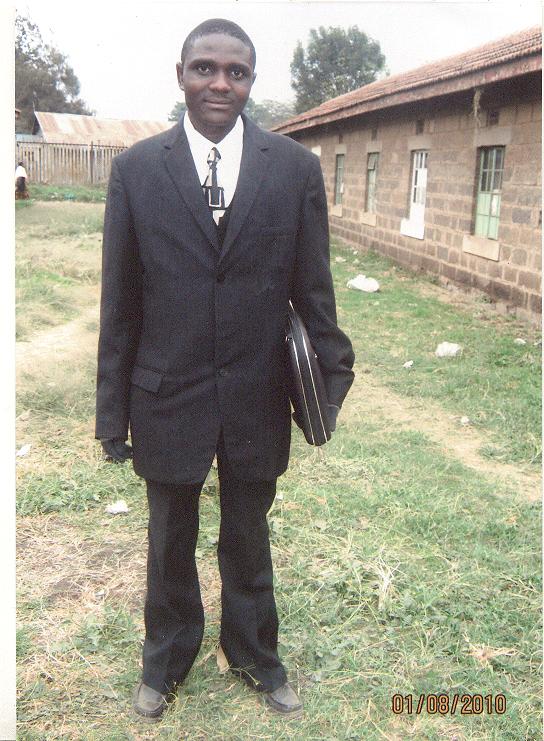
Then there is the story of Paul Oduor, pictured below. I had dinner with Paul several weeks ago in Nairobi on my way to Juba. I am still not quite sure how it came about. Several months ago I received a text message from a Kenyan phone number. I had never received an unsolicited text message from a stranger before (unlike all those messages from widows, Barristers, or bank officials in Nigeria or Benin—why Benin??—eager to deposit millions from their recently diseased husband, or client, in my bank account if I would just provided them with my account information).  He said something like, “I am a young African man, and would like to know you. Where are you?” not the usual “I am sure that you will be very surprised by this letter” favored by the fraudsters. My finger hovered over the delete button, but then I replied “I am in Washington DC. Who and where are you.” It turned out that he was in Nairobi and didn’t seem to want anything more that the adventure of connecting with someone somewhere else in the world. And, of course, I do pass through Nairobi fairly often, so we kept exchanging text messages and arranged to meet for dinner on February 18th.

Paul was a polite young man of 22 who ran a human rights organization with a partner that is affiliated with Humanists International. He was trying to educate the residence of the large squatter slum of several hundred thousand Kenyans in a square mile or so of Nairobi of their rights under the law. He gave me literature explaining the purpose of his organization. He had obviously had some training in sales, complimenting me on asking good questions. Finally I asked him how he got my phone number. He said that his mother worked in the kitchen of a hotel where we had held a workshop for some South Sudanese officials a year or two earlier and had picked up one of my papers that had the information. Maybe it was a participant list, as I don’t put my phone number on articles or other such papers. As best I can tell, Paul simply thought it would be fun to see if the far off person whose number he had acquired would respond. He never asked for money for his organization, which seemed to be a private voluntary undertaking on his part, but he did eat a hearty meal. As we parted, he said: “You are a Christian, aren’t you?” Then handed me a book called: “The Greatest Man Who Ever Lived.” Never a dull moment.

Egypt: American Values and Foreign Policy

Dubai – American foreign policy should aim to support American interests. Those interests—security of American lives and property, free and open trade and movement, and human dignity—are not independent of American values—respect for the rights and responsibilities of each individual, free press, etc. I have written on this theme from time to time, e.g. https://wcoats.wordpress.com/2009/09/10/outside-imf-guesthouse-kabul-afghanistan/ or https://wcoats.wordpress.com/2010/06/23/a-south-african-hero/ or https://wcoats.wordpress.com/2010/06/15/kyrgyzstan-in-crisis/ .

What does it say about what our policy should be toward the regime and events now underway in Egypt? I am sure that, like me, most American’s are cheering for the Egyptians in Tahrir Square in Cairo to throw the tyrant Mubarak out and establish a democratic government. Several questions and issues arise.

We are citizens of a free country and can cheer for whomever we like. We cheered the Hungarians rising up against their Soviet oppressors in 1956.  But when the U.S. government seemed to urge them on via Radio Free Europe and the Voice of American, many Hungarians felt betrayed when America did not come to their aid. Imagine for a moment, as glorious as it might have seemed at the time (at the beginning), if we had sent troops to Budapest to fight the Soviets. No one can know how that might have come out, but it is pretty certain that the most peaceful collapse of an empire—the Evil Soviet Empire—between 1989-91 never would have occurred peacefully.

While our private cheering comes easily—too quick and easy sometimes—our government must worry about whether a change in the status quo is likely to result in a better arrangement for the average Egyptian and for our own security and that of our allies in the area (Israel). Our government is not as free as you and I are to publicly express its opinions about the rulers it prefers to see in other countries. The United States had good reasons for developing good relations with the Egyptian government. With billions of dollars in aid and diplomacy we bought considerably enhanced security for Israel. With the signing of the 1979 Israeli-Egyptian peace treaty Egypt became the first Arab nation to recognize the state of Israel ending the state of war that existed between them. Egypt has been a good partner with the U.S. in promoting acceptance of Israel and peace in the area.

But while we can and should cooperate with Egypt and other governments in areas that promote peace and security, we should never turn our backs on our underlying values of human rights and democracy. This is not always an easy balance to maintain and the Obama administration has been doing a reasonably decent job of it. Mubarak has displayed the bad habit of almost all dictators of imposing increasingly nasty measures to remain in power. The popular uprising in Egypt justifies America’s pressure on Mubarak to step down and allow fair elections. While Israel’s current attacks on the United States for its betrayal of Mubarak can be understood from the perspective of Israel’s perceived, but shortsighted, security interest, it provides a vivid example of the fact that though America is rightly committed to the military defense of Israel, Israel’s interests are not always identical with ours.

The American government is also right to worry that replacing a corrupt and repressive government does not automatically result in a better one. It needs to use its diplomatic influence to guide the process toward a peaceful, orderly change in government with open and fair elections in September. It must not repeat President George W Bush’s mistake of insisting on elections in the West Bank and Gaza and then refusing to recognize the results when they favored Hamas. That sad episode made a mockery of American’s commitment to democracy. Democracy does not always produce good results (results that are consistent with the rule of law and human rights that are core American values) and we should not always push for it when conditions are not promising.

Egypt, like Turkey, is a relatively secular, largely Islamic country. The mildly outlawed Muslim Brotherhood (MB) is very unlikely to dominate a new government unless we badly misplay our cards. According to Daniel Levy, an Israeli now at the New America Foundation: “The ability to use the Islamist boogieman to fuel US fears draws on a combination of unfamiliarity and ignorance, cultural arrogance, and real policy differences on regional issues, notably on Israel. That Arab publics left to their own devices should freely choose to support religious conservatives should largely be none of our business: Americans in many states make a similar choice at the ballot box. That American policymakers have so few links into the MB or serious channels of communication is simply a failure of American policy.” “Complicating the Transition in US – Egyptian Relations” Foreign Policy”

The Obama administration should pressure Mubarak to make changes to the Egyptian constitution that will allow fair elections, appoint a technocratic caretaker government until the September elections, and encourage the Egyptian military, which receives about $1.2 billion a year in U.S. assistance, to maintain security in a politically neutral way. Obama should tell Mubarak firmly that it is time for him to go, as President Reagan did to Ferdinand Marcos in the Philippines in 1986.

The groundswell for reform from Tunisia, to Egypt, to Sanna and beyond opens opportunity for positive change in the Middle East.  Such events cannot be controlled but they can certainly be influenced for better or worst. The United State must remain rooted in its core believes and values while supporting the strengthening of the rule of law and the rights of individuals.

Eisenhower’s farewell address 50 years later

Exactly 50 years ago President Eisenhower delivered his famous warning about the risks of a large standing Army supported by an equally large military-industrial complex. His warning is more obvious and prescient today even than it was then. For my further thoughts on Ike’s warning please see: http://dailycaller.com/2011/01/17/ikes-farewell-address-fifty-years-on/

The President’s speech

One of America’s great strengths is its critical introspection, which invariably reacts to and corrects excesses once they become clear. This seems to be happening with the nasty tone and character assassination focus of too much of our so-called public debate of policy issues. This reaction is epitomized by the President’s Tucson speech: “President Obama’s Tucson memorial speech” and a Washington Post op-ed by Senator John McCain, “After the shootings, Obama reminds the nation of the golden rule”. If your heart was not moved by the President’s words, you don’t have one. The outcry for more civility offers hope that future debates (at least for a while) will focus on real issues rather than caricatures. We face serious policy issues that demand serious and constructive debate.

PC, Politeness and Candor

Three cheers for the likes of Bruce Fleming “He was fired over his videos, but Capt. Owen Honors did the right thing,” and Kathleen Parker “Leave Twain alone.” In quite different ways each has illuminated the importance of candor when discussing important community issues and the difference between candor smothering Political Correctness (PC) and traditional politeness.

I watched the video produced four years ago by Owen Honors, then the second in command of the USS Enterprise, for the entertainment of his crew while deployed in support of the Iraqi war. A great public outcry over the vulgarity (“jokes about masturbation, sex in the showers and over-reliance on the f-bomb”) and insensitivity of the videos led me to see for myself. Given that the videos were made by Navy men for sailors (that saves me from having to say Navy men and women), I didn’t find anything really offensive. A few references to gay guys didn’t really offend me. What in the world was all of the fuss about? Capt. Honors, now (or at least last week) Captain of the Enterprise, has been removed from command as a result. It all struck me as a big over reaction.

Bruce Fleming has put all of this in a very different light and his commentary in the Washington Post is well worth reading. Captain Honors, he argues, was helping his crew confront and deal with the challenges of close quarters for men, women, the third sex, GLBT, etc where the usual outlet for youthful sexual energy of masturbation is difficult if not impossible. “It’s not homophobic to point out that most people are more comfortable being naked around strangers whom they think (perhaps wrongly) have no sexual interest in them. That’s why we have single-sex bathrooms in public places…,” he notes. One of the first things we tend to do when confronted with tragedies or lesser challenges is make jokes about them. It is a healthy and constructive outlet that can defuse the pain or the awkwardness. Remember all those horrible, sickly, but funny jokes we told following the explosion of the Space Shuttle Columbia that killed its seven astronauts?

Fleming “think[s] Honors realized that problems everybody talks about privately become worse if the command structure pretends they don’t exist. He’s like a parent who decided to make clear to his kids that he knew they were thinking about sex and drugs, and to take control of the topic. He should get a medal for being proactive….   Do we think they’re unaware of the problems of same-sex or mixed-sex or mixed-sexual-orientation intimacy that the closed quarters of ships, submarines, showers or sleeping quarters can create? They deal with these issues by joking about masturbation, gay sex, having things shoved up their rectums – all the subjects that their executive officer was showing them they could joke about and move on.”

In a very different corner of our misplaced and stifling insistence on political correctness, Kathleen Parker has lambasted the dishonesty of replacing “Niger” in a new edition of Twain’s Huckleberry Finn with “slave.” The N word, as she calls it, is a truly nasty and rude word these days. The polite word as I was growing up in California where we new better was Negro. Negro later fell into disrepute and polite people replaced it with Black, which was subsequently replaced by African Americans. The wonderful and thoughtful Washington Post columnist William Raspberry, himself negro, black, or an African American, complained that periodic changes it what blacks (if I may stick with that) thought was the properly respectful way of being addressed, tended to settle for form rather than substance and thus contributed nothing to resolving genuine problems (or issues as we now call them).

Parker’s complaint is of dishonesty and the slippery slop. “While on Earth, let me add my voice to the chorus of those who, in the name of all that is hallowed, object to the alteration of literature for the benefit of illiterates…. And no one would argue that the word in question isn’t emotionally charged and, in certain contexts, highly offensive. The issue here isn’t whether the word is good or bad (I personally despise it), but whether one should rewrite another’s literary work.” She is also making the same point as Fleming’s that the mere avoidance of some offensive words can too easily contribute to the avoidance of serious and honest discussion of bigotry, or of differences that any civilized and humane society should strive to understand and accommodate if not embrace. Vive la différence.

But then we have the opposite extreme from both ends of the political spectrum, but mainly the extreme right these days, of using the most inflammatory language they can find to describe and condemn those they disagree with. Believing that our society’s greatness derives very importantly from our freedom and thus the need to be responsible for our own and our own family’s well being to a larger extent than most other societies, I was often critical of extensions of the federal government under George W and Barak Obama into our economy and our lives. But when public figures and TV pundits say (they more often shout) that Obama is a socialist, for example, I reflexively join his side in reaction.  Are these people simply ignorant of what socialism is, or what? In reality they don’t seem interested in a reasoned discussion of whatever the issue is. I am not interested in being lectured to (shouted at) by such people of whatever political persuasion. But more importantly, the shouters impede healthy and badly needed public debate of the merits of this policy or that.

And now we have the tragic murders in Tucson Arizona of Federal Judge John Roll and five other worthy souls, and the critical wounding of U.S. Congresswoman Giffords by Jared Lee Loughner, a deranged 22 year old loner. While the extremist shouters, who claim to be toning it down, are pointing fingers of blame at each other, the more sober voices of George Will (“Charlatans” blame game” The Washington Post) and Michael Gerson  (“Small man, terrible act” The Washington Post) have pointed us in a different direction. Our free society is based, among other things, on the myth that we are each fully responsible for our own acts. Without such personal accountability freedom would not be possible. I have called it a myth, not because it is not true to some or even a large extent, and certainly not because it is not an important and useful principle. Rather it is a myth because the actions we take are in fact influenced by many things: from our genes, moral up bringing and beliefs, the society in which live and act, the morning news, the afternoon’s radio commentary, and what we ate for breakfast. But as free men and women we must take responsibility and be held accountable for our choices and acts whatever collection of factors may have influenced them.

But the quality of our freedom does certainly depend on the society we live in and the behavior of our neighbors. I do not respect people who are dishonest or mean spirited. I enjoy and benefit from spirited debate of the pros and cons of this or that if the debaters are honestly seeking the truth even if they have different visions of it. I am uncomfortable, to put it mildly, around people who seek to humiliate, or otherwise harm others. If someone has done something wrong, let him pay the price society has set for that wrong and move on. We pride ourselves as a second chance nation.

For large numbers of people to live peacefully and fruitfully together, many compromises are needed. They are more likely to be achieved out of careful, thoughtful evaluations and discussions of the issues than by the shouting of extremists. In addition to civility, a very important factor contributing to public harmony is that our constitution and public consensus have minimized the number of things that must be collectively agreed to. It is much easier to agree, for example, that religion is a private matter and that we are each free to believe what we want, than to agree that we must all be Catholics, Baptists, Jews, or Muslims (or keep quiet).

Rudeness is, well, rude, to put it politely. Politeness is a virtue we should all strive for and teach our children, but politeness does not call for a lack of candor and honesty in stating what we think and what we feel and subjecting our views and reasoning and biases to honest challenge and debate.

Southern Sudan votes for Independence

The independence referendum for Southern Sudan for which an estimated 2 million Sudanese have died over the last 30 years started today wherever Southern Sudanese live. I expect to return next month to continue providing technical assistance on setting up a new central bank and issuing a new currency. My Deloitte colleague Adam Wicik sent the following email this morning along with many happy pictures of which I am attaching three.

Hi,
Greeting from sunny, warm and still calm Juba. Again, there is no escaping some photos from here.
As you all know, a Referendum on the future of Southern Sudan started today and will go on for another 7 days.  Today was the first day.  As it is Sunday, with kind permission of Andy, Kate and I were able to go around and pretend to be press photographers.  We almost got arrested once for taking photos, but Deloitte ID card works like magic!
Photos fall into two groups – voting, i.e. long queues, people patiently waiting, casting their votes and immediately shouting in happiness, and having a fingers dipped in long lasting ink to stop them from voting twice.  Everything has been quiet and peaceful so far.
There was some singing, dancing, and drum beating as well.  Of course, what else could you expect on a happy day.
You will see some photos of those happy (and sleepy for some) moments too.
George Clooney is here again.  As always staying at AFEX.  Today we caught up with him at the local church.

This is all for now.  Keep your fingers crossed that the rest of this week, and the next six months, stay calm and happy.

All the best,
Adam

Happy New Year

Dear Friends,

I hope that your year is off to a good start. Like every other year that ever was, this one is full of challenges of each of us, for our country (which ever one it is) and for our world. I think that for most economies the prospects for recovery and growth are somewhat better than they were at this time last year. But for the United State and some other European countries serious public debt problems must be address sooner rather than later (actually, we are already now living in “later”).

My coming months will be largely taken up with the continuation of the work I was doing with the International Monetary Fund in Afghanistan and with Deloitte/USAID in Southern Sudan this past year. I expect to return to Kabul in a few weeks and, if all goes well with the independence referendum in Sudan starting this Sunday I will return there soon as well. For those of you interested, several articles in the Washington Post yesterday and today provide a good summary of what is going on in Sudan: “Sudan on the brink” “Sudan votes comes together after rocky Obama effort to prevent violence” Southern Sudan makes “final walk to freedom”

My role in Southern Sudan is to help them set up a new central bank and to issue a new currency and to keeps is value stable. It promises to be an active and interesting year.

My best wishes to you,

Warren

Annual Christmas Letter

Dear Friends,                                                                                                           December 8, 2010

Seasons Greetings. I hope that it has been a good year for you and those you love. It has been for me, but it remains a troubled time for western economies and for those parts of the world in which we have militarily involved ourselves and in a few in which we haven’t. Here are the highlights of my year. You can read my more extensive comments on my travels, the economy, and other things that have interested me at https://wcoats.wordpress.com/).

My first trip of the year, as usual, was to Grand Cayman Island for the quarterly board meeting of the Cayman Islands Monetary Authority (http://www.cimoney.com.ky/). My trip there for the May board meeting was my last. Although I was reappointed to the Board for a third, three-year term, I resigned during the summer effective the end of this year. I have good memories and some lasting friends from the experience (Richard Rahn, Tim Ridley, Jane Wareham, and Bill and Patricia Gilmore).

My second trip of the year was to Nairobi, Kenya for the IMF to continue my technical assistance to the Central Bank of Kenya (CBK) on how to improve its formulation and implementation of monetary policy. But this year was very special because I brought my 16-year-old grandson Bryce with me. It was Easter break for him and the CBK was closed from Good Friday through Monday, which gave us a perfect opportunity to drive to the Masia Mara game reserve near the Tanzania boarder for three days and two nights. This added some memorable pictures to my collection, which you can see on my Facebook pages.

The spring also included some fun domestic trips. My long time friend Jim Roumasset and I went to Boston at the end of April for Peter Diamond’s grand retirement party at MIT. Jim and I had had several courses from Diamond at UC Berkeley in the mid 60s. Subsequently Diamond shared this year’s Nobel Prize in Economics. Our Congress is still trying to figure out if he is qualified to be on the Board of Governors of the Federal Reserve. In mid May I flew out to my hometown of Bakersfield for my 50th high school reunion and to celebrate my shared birthday with my dad (what a birthday present he got when I was born).

In July Ito joined me for a trip to Robert Mundell’s annual gathering of economist at his home near Sienna, Italy. We stopped in London to visit Ito’s niece and in Florence to sightsee. We made friends with Bill Middendorf and his daughter Frances, who are both fascinating and enjoyable people.

In early September I was sitting in my gazebo reading about the collapse of Kabulbank, Afghanistan’s largest bank, when the IMF called to ask if I could join the mission leaving that evening for Kabul to help the authorities manage the Kabulbank crisis and to negotiate a new program with the IMF. It was an intense visit with a great IMF team providing little sleep. I traveled from Kabul on to Juba, Southern Sudan (via Dubai and Nairobi), which I did again after returning to Kabul a month later October – November). You can read about Kabulbank in the NYT or Washington Post. I continue to advise the Central Bank of Iraq from afar for the IMF.

I met with Southern Sudanese officials four times this year, once in Nairobi (June) and three times in Juba (July, September and November) after giving up my determination not to go there. As their independence referendum in January gets closer they are paying more and more attention to the issues we (Deloitte/USAID) are advising on (setting up a new post independence central bank and issuing and managing a new currency). On our last visit (November) we were finally meeting with the actual decision makers and we are hoping to convince them to adopt currency board rules for their new currency.

Between my September and November trips to Kabul/Juba, I also managed to attend my nephew Scott Naninga’s wedding in Santa Rosa California, and visit Daylin and Brandon and my grandkids in North Bend, WA and Vancouver, WA while on my way to the Mont Pelerin Society meetings in Sidney, Australia, all in October.

In mid November while I was in Juba my father tripped and fell and sprained his shoulder in Bakersfield and for a few days I feared that I would have to cancel another Thanksgiving dinner, but he is doing fine. My final trip of the year will be to Paris Dec 9-12 for a conference on “The International Monetary System: Old And New Debates,” to discuss the SDR as an international reserve asset.

Ito continues to draw/paint, play the piano and violin, and write while searching for the cure to cancer on the frontiers of molecular biology research at the National Cancer Institute in Fredrick Maryland, thus providing some stability and continuity to the family. So life at home is good when I am there.

Best wishes,

Warren

Return to Juba

Greetings from Juba, Southern Sudan

I am back in Juba for the third time since July continuing to discuss with various decision makers monetary policy regime options and negotiating positions with the North for dividing monetary assets and liabilities of the Central Bank of Sudan when the South becomes independent next year, and preparations for establishing a new central bank.

My residence in Afex Camp by the Nile continues to improve and is almost approaching what you could call, African adjusted, nice. The main paths from our bungalows to the open air dinning area by the Nile have been improved with relatively fine gravel, which lets the water drain when it rains and keeps the dust down when it doesn’t. Some quit attractive gardens have been planted on either side of some of these paths. The dinning pavilion, as before, has a high ceiling with ceiling fans that attempt to keep the insect kingdom from invading our food and faces. Its view of the Nile 10 meters away is as lovely as ever.

A unique feature of our dinning area is that everything is covered with saran wrap (plates, glasses, flat ware and of course the food) in order to keep the jungle creatures at bay. It seems to work well and dinners are quite pleasant. Next to our dinning pavilion is an open air (but also covered) bar that would be the envy of any such hang out. I have never had the time to sit there and enjoy it but it is nice to know that it is there.

My two room plus bathroom and toilet room bungalow is in fact quite nice as well, dramatically better, in fact, than my rooms in the IMF guesthouse in Kabul from which I have just come. On this visit I am staying in Zambia 2. On previous visits I stayed in Sudan 1 and Niger 1. My apartment is well air-conditioned and the mosquito net over my bed has no holes. It even has a TV with satellite station access (I am told as I have never tried to turn it on), and Internet access without which I really would feel deprived and isolated.

The evening of my arrival, the Deloitte project manager (my boss) called to say that the North South negotiators had just come to an agreement in Khartoum on the division of the assets and liabilities of the central bank (the currency and the assets that back it) between the North and South in preparations for the South’s independence next year (referendum is January 9 and independence day is scheduled to be July 9th).  This was one of the topics I came to advise on so this was quite a surprise. The project manager was trying to arrange for me to fly up to Khartoum the next day to review what was going on, but had to give up as my Sudanese visa had been stamped in Juba when I arrived and thus would be unacceptable in the North. Not only would they not permit me entry, he learned, but they would not let me return to the South (Juba) either. The next day while waiting for the new agreement to be faxed or emailed to us, we learned that none of it was true—just another one of the rumors that circulated from time to time. This was an adrenaline stimulating start to my visit.

The Great Game: Afghanistan

I returned home from Kabul and Juba last week to three
nights of six one-act plays each evening by twelve playwrights at the
Shakespeare Theater under the title “The Great Game: Afghanistan.” I just can’t
get away from it. I landed at 2:00 Wednesday afternoon and at 7:30 pm the same
day was watching actors play British troops in Afghanistan at the turn of the
century. The second evening of one acts covered to Soviet occupation era and
the final evening the American occupation, which is to say the current era.

“The Great Game,” the plays, isn’t real history. The authors
knew what they wanted to say about “history” from today’s perspective, but it
rings true to me. Basically the large message is that Afghanistan is a complex
place ungovernable by foreigners and no one seems to learn that. The British
ruled it for 90 years then failed, the Soviets for a decade then failed and we
have been at it for almost as long (nine years) and are failing. We did not
really go there in order to rule as did the British or the Russians, but we have
been trying none-the-less to impose our way of doing things, enlightened as
they are, on a reluctant Afghan population. No one seems to have learned the
lessons of their predecessors. The viewing of these plays was very painful at
many levels.

Many of the episodes invite the audience to see Afghanistan’s
many invasions from an Afghan perspective. In the second episode of the first
evening – the British period from 1842-1930—four frightened British Army
buglers looking into the dark for enemies are approached by an Afghan of some
wit. They demand of him “Stop! Who are you? And why are you here?” He stares
intensely back at them and says: “The real question is who are you and why are
you here?”

The opening play of the second evening—the Soviet period
from 1979 – 1989—presents the welcoming speech to his troops by a new Soviet
commander in 1987. He sets out the rather hapless goals for continued Soviet
occupation of Afghanistan that reflect the emptiness and futility of the
undertaking. The next scene is a somewhat more upbeat speech by his Soviet predecessor
as he takes command two years earlier in 1985. This is followed by the opening
addresses of earlier commanders in 1984 and 1982, each more ambitious and
upbeat than the previous (i.e. later) one. The goals of building schools and hospitals
etc., sound remarkably like American goals twenty years later.

The third and final evening—the American period from 2001 –
20??—ended with an American solder watching TV in the middle of the night when
his wife asks him to please come to bed. An intense exchange ensues in which he
speaks of the need to return and protect poor Afghan children from the terrors
of Taliban oppression and his wife speaks of the need for him to look his own
child in the eyes and engage him. This is not just or even one of the many
collateral damages of war politicians too easily and readily forget when
sending our young men to far off wars. This young man suffers deeper problems
having nothing to do with this or any other war. Blaming his dysfunction on the
war is rather like blaming Jimmy McNulty’s neglect of his family to his all
consuming battle against crime on crime in “The Wire.”  There, I found another chance to plug TV’s best series of the last decade.