The Band of Brothers and Afghanistan

Sunday night Ito and I finished the tenth and final episode of the WWII story of Easy Company of the 101 airborne division of the U.S. Army–The Band of Brothers. It is a moving and masterful depiction of the horrors of war, and its impact on those (often) brave men who fight them.  How, I asked myself, can good people do such terrible things to each other?  And why?  Who benefits (that is too obvious to answer explicitly)?

I woke up that morning to the fact that the government in Afghanistan that I had been working with for the past 20 years had been replaced by the Taliban who intends to form a new government. Fingers are being pointed all over the place in the search for fault. I am afraid that this American question is of little interest to my Afghan friends. Those who have not already left the country are holed up in their homes afraid to go to work. Their question is what the new Taliban regime will look like.

Our objective now should be to join with all other nations to exert diplomatic pressure on the new government (which potentially will have the cooperation of at least former President Hamid Karzai, CEO Abdullah Abdullah, and Islamic Party leader Gulbuddin Hekmatyar) to adhere to UN standards of humanitarian treatment of its citizens and to help them administer an efficient and honest government. America’s leadership in this regard will be critical for Afghanistan’s future.

But who should we blame for, and what lessons should we learn from, Afghans fleeing the country by climbing onto the outside of planes leaving the Kabul Airport (something I have done many times but more comfortably seated)? Working backward, President Trump gave our military leaders a May 1 deadline for leaving. It rather looks like they ignored him (tempting but not appropriate).

The speed with which the Taliban took over the country with barely a shot fired surprised most of us. We had dinner at the home of Edward and Dalya Luttwak Saturday. During the conversation I passed on the statement by an Afghan friend emailed to me that afternoon that the Taliban could take Kabul by the next day or week.  We all thought that would be impossible, thinking it might be as fast as a few months. In fact, they peaceably took over the city the next day (Sunday Aug 15).  In fact, our Embassy and Military leaders should not have been surprised. My work in Afghanistan with its central bank did not require that I be thoroughly versed on Afghan history and customs, but that is not true for our foreign policy establishment working in and on Afghanistan.

Rather than arm, train, and support Afghan fighters in regions they cared about, we pulled together a national Army with the incentive of money. In addition, the broader Afghan public did not strongly support its corrupt government and could fairly easily change sides. “Afghanistan military collapse-Taliban”  Moreover, waring tribes and political groups such as the Taliban have a long tradition of negotiating peaceful surrenders when the outcome seems clear.  “Afghanistan history-Taliban collapse”

The initial blame for our failure to “build” a strong government in Afghanistan falls on George W Bush who gave in to the Cheney/Rumsfeld fantasies of American Imperialism, and abandoned the original and sensible approach of American support of the Northern Alliance war against the Taliban. “Its plan was for small teams of CIA officers, along with Green Berets and U.S. air power, to assist the indigenous Afghan resistance—the Northern Alliance.” “Afghanistan withdrawal-CIA-bin Laden-al Qaeda-Bush-Biden-Northern Alliance” Instead we took over and occupied the country.

Rather than work with and build from Afghanistan’s traditional tribal structures, we imposed an alien, centralized government that was not understood and was generally resented outside of Kabul. Rather than elevating village chiefs to govern provinces, for example, Kabul sent strangers to oversee areas they knew nothing about. Our ignorance and arrogance were mind boggling, but sadly typical. And our military—the best in the world for waging wars— is incompetent at nation building, which should be the job of others. We couldn’t even build an Afghan Army in 20 years. “How America failed Afghanistan”  

Those who are most loudly criticizing Biden’s troop withdrawal are those most responsible for creating this mess to begin with.   “Afghanistan disaster started with withdrawals most ardent critics”  See my account of my work with the central bank in Kabul:  “My travels to Afghanistan”

A shift in monetary regimes?

By Warren Coats[1]

This Sunday, August 15, is the 50th anniversary of President Richard Nixon’s closing of the gold window as part of the “Nixon Shock.” “Fifty years later Nixon’s August surprise still reverberates”  He announced on that day that the U.S. Treasury would no longer redeem its dollars for gold at $35 an ounce. Over the subsequent few years, the world moved from national currencies whose values were anchored to the market value of gold, to currency values determined by central banks’ regulation of their supply relative to the market’s demand. The value of one currency for another floated in the foreign exchange market. Central banks have deployed various approaches to determining the supplies of their currencies and most have now settled on targeting an inflation rate (often 2% per year) in one way or another.

With the rapidly increasing interest in cryptocurrencies, some have asked whether we are on the brink of another monetary paradigm shift? Specifically, might the dollar be replaced as the dominant international reserve currency. To explore that question we need to understand how the existing monetary systems work and how the widespread use of cryptocurrencies might add to or change these systems.  

In describing the existing and potential future monetary systems, we need to distinguish “money” from the “means of payment.” Money is the asset that people accept in payment of debts or for the purchase of goods and services. The U.S. dollar and the Euro are “money.” The means of payment refers to how money is delivered to the person being paid. Do you personally hand dollar bills and coins to the Starbucks cashier, write out a check (bank draft) and put it in the mail, or electronically transfer “money” from your bank account to an Amazon merchant via eWire, Zelle, Venmo, PayPal, or some other digital payment service? Or perhaps you purchase goods and services with borrowed money (Visa, MasterCard, American Express) that you pay back at the end of each month or over time. Or if you don’t have a bank account (a form of digital money) you might hand-deliver physical currency to a Hawala dealer or a MoneyGram or Western Union office to be electronically transferred to their office nearest to the person you are sending it to, potentially anywhere in the world. If you are paying in a currency that is different than the one the payee wishes to receive, your currency will be exchanged accordingly along the way in the foreign exchange market.

Discussions of cryptocurrencies include both the latest and evolving means of payment (digital payment technologies) as well as new, privately created moneys such as bitcoin, Ethereum, or Ripple.  Private currencies vary enormously with regard to how their value is determined. By private currencies I do not mean privately created assets redeemable for legal tender, such as our bank accounts. When we speak, for example, of the U.S. dollar, we invariably include dollar balances in our bank accounts, dollar payments made via our Visa card, etc. These are all privately produced assets that are ultimately redeemable for Federal Reserve currency or deposits at a Federal Reserve Bank. They are credible claims on the legal tender of the United States. Most U.S. dollars are privately created.

The value of all money is determined by its supply and demand. The demand for money arises from its acceptability for payment of our obligations and the quantity of such obligations (generally closely related to our incomes). Within each country, its legal tender money (e.g., the U.S. dollar in the U.S.) must be accepted by payees. In particular, it must be accepted by the government in payment of taxes.  Truly private currencies (those not redeemable for legal tender, of which there are over 11,000 at last count) have a serious challenge in this regard. Very few people or businesses will accept bitcoin, or any other such private cryptocurrency. As a result, the demand for such currencies for actual payments is very low. The demand for bitcoin, for example, is almost totally speculative–a form of gambling like the demand for lottery tickets. Such private currencies are more attractive in countries whose legal tender is rapidly inflating or has unstable value (e.g., Venezuela). 

The acceptability of a currency in cross border payments raises special challenges. My currency is not likely to be the currency in general use in other countries. Someone in Mexico paying someone in Germany will generally have Mexican pesos and the recipient in Germany will want Euros. The pesos will need to be exchange for Euro in the foreign exchange market. It would be very costly for dealers in the FX market to maintain inventories of and transact in every bilateral combination of the world’s 200 or so currencies. It has proven more economical to exchange your currency for U.S. dollars and to exchange the U.S. dollars for the currency wanted by the payee. The dollar has become what is called a vehicle currency.

The economy of a so-called vehicle currency can be illustrated with languages. Two hundred and six countries are participating in the 2021 Olympic Games in Japan. To communicate with their Japanese hosts participants could all learn Japanese. It is unrealistic to expect the Japanese hosts to learn 205 foreign languages. But what about communicating with their fellow participants from the other 205 countries. For this purpose, English has become the default second language in which they all communicate. Unlike more isolated Americans, most Europeans speak several languages, but one of them is always English. English as the common language is the linguistic equivalent of the dollar as a vehicle currency.  

The rest of the value of money story focuses on its supply. Bitcoin has the virtue of having a very well defined, programmatically determined gradual growth rate until its supply reaches 21 million in about 2040. The supply today (Aug 2021) is 18.77 million. See my earlier explanation: “Cryptocurrencies-the bitcoin phenomena”  The other 11,000 plus cryptocurrencies each have their own rules for determining their supply, some explicit and some rather mysterious. The class of so called “stable coins” are linked to and often redeemable for a specific anchor, sometimes the U.S. dollar or some other currency. The credibility of these anchors varies.

The highly successful E-gold (from 1996-2006) is an example of a digital currency that had well-defined and strict backing and redemption for a commodity at a fixed price. “E-gold”  The supply of such currencies is determined by market demand for it at its fixed price–what I have elsewhere called currency board rules. I describe how currency board rules work in my book about establishing the Central Bank of Bosnia and Herzegovina:   “One currency for Bosnia-creating the Central Bank of Bosnia and Herzegovina”

The dominance of the U.S. dollar in cross border payments reflects far more than its use as a vehicle currency. Many globally traded commodities, such as oil, are priced in dollars and thus payments for such purchases are settled in dollars. Pricing a homogeneous commodity trading in the global market in a single currency makes that market more efficient (the same price for the same thing).  Making cross border payments in dollars (or any other single currency) also avoids the costly need to exchange one for another in the FX market. The dollar is most often chosen because its value is relatively stable, and it has deep and liquid securities markets in which to hold dollars in reserve for use in cross border payments.

So, what are the chances that current cryptocurrency developments might precipitate a shift from the dollar to some other currency and means of payment. Several factors of U.S. policy have heightened interest by many countries in finding an alternative.  Specifically, from my recent article in the Central Banking Journal on the IMF’s $650 billion SDR allocation:

Cumbersome payment technology. Existing arrangements for cross-border payments via Swift are technically crude and outmoded.

The weaponization of the dollar. The US has abused the importance of its currency for cross-border payments to force compliance with its policy preferences that are not always shared by other countries, by threatening to block the use of the dollar.

The growing risk of the dollar’s value. The growing expectation of dollar inflation and the skyrocketing increase in the US fiscal deficit are increasing the risk of holding and dealing in dollars.”  “The IMF’s 650bn SDR allocation and a future digital SDR”

Most central banks are upgrading their payment systems. But the Peoples Bank of the Republic of China (PBRC) is one of the most advanced in developing a central bank digital currency (CBDC), the e-CNY. However, it has little potential for displacing the dollar for several reasons. The Federal Reserve is also modernizing its payment technology, including exploring the design of its own CBDC, and can match China’s payment technology in the near future if necessary. More importantly, China’s capital controls, less developed Yuan financial markets, and less reliable rule of law make the Yuan an unattractive alternative to the dollar. These latter impediments do not apply to the Euro, however. “What will be impact of China’s state sponsored digital currency?”

Rather than looking for another national currency to replace the dollar, there are several advantages to using an international one. These include greater ease in making cross border payments and the reduced risk of political manipulation, or a national currency’s domestic mismanagement.  Bitcoin, for example, can make payments anywhere in the world without being controlled by any one of them. The serious drawbacks of Bitcoin’s blockchain payment technology might be overcome with one or another overlaid technology. But to become a serious currency, bitcoin must be dramatically more widely accepted in payment than it is now. Widespread acceptance in payments could generate the demand to hold them for payments, which would tend to stabilize its very erratic value. This seems very unlikely. A digital gold-based currency, such as the earlier E-gold, would enjoy the advantage of an anchor that is well known and that has enjoyed a long history. However, gold’s value has been very unstable in recent years. Aluminum has enjoyed a very stable price and elastic supply and will be the anchor for Luminium Coin to be launched in the coming weeks: https://luminiumcoin.com/

But the world has already established the internationally issued and regulated currency meant to supplement if not replace the dollar, the Special Drawing Rights of the International Monetary Fund. The IMF has just approved a very large increase in its supply.  “The IMF’s 650bn SDR allocation and a future digital SDR”  The SDR’s value is determined by the market value of (currently) five major currencies in its valuation basket. While all five of these currencies have a relatively stable value, the value of the basket (portfolio) of these five is more stable still. The rules for determining the SDR’s value and supply, as well as its uses, are well established and transparent and governed by the IMF’s 190 member countries. In short, the SDR is truly international. However, it can only be used by IMF member countries and ten international financial institutions such as the World Bank and the Bank for International Settlements.

While the SDR has played a limited useful role in augmenting central bank foreign exchange reserves, it has failed to achieve a significant role as an international currency because of the failure of the private sector to invoice internationally traded goods and financial instruments (such as bonds) in SDRs and the absence of a private digital SDR for payments. If the IMF is serious about making the SDR an important international currency it should turn its attention to encouraging these private sector uses of the unit. “Free Banking in the Digital Age”

In the long run the IMF should issue its official SDR according to currency board rules and anchor its value to the market value of a small basket of commodities rather than key currencies: “A Real SDR Currency Board”


[1] Warren Coats retired from the International Monetary Fund in 2003 where he led technical assistance missions to the central banks of more than twenty countries (including Afghanistan, Bosnia, Egypt, Iraq, Kazakhstan, Kenya, Kyrgyzstan, Serbia, South Sudan, Turkey, and Zimbabwe). He was a member of the Board of the Cayman Islands Monetary Authority from 2003-10. He is a fellow of Johns Hopkins Krieger School of Arts and Sciences, Institute for Applied Economics, Global Health, and the Study of Business Enterprise.  He has a BA in Economics from the UC Berkeley and a PhD in Economics from the University of Chicago.

Eviction Moratorium

Many people who lost their jobs because of Covid are not able to pay their rent until they return to work. What should we do about it?  Most landlords will work out an arrangement for deferred rent with tenants that are otherwise trustworthy. Most overdue debts are handled this way. But a case can be made, and has been made, for temporary government assist. Where you think the money should come from to bridge the income gap tells a lot about your general attitudes toward our market economy. When renters lose their incomes and stop paying their rent, they are passing on part of that loss to their landlords.  

But landlords are people with financial needs as well.  As noted by George Will: “As of June, landlords were owed $27.5 billion in unpaid rents. Almost half of landlords, who include many minorities, own only one or two rental units. They continue paying mortgages, property taxes, insurance and utilities while the CDC requires them to house nonpaying people or risk jail. Landlords can plausibly argue that the moratorium is a “taking.”  https://www.washingtonpost.com/opinions/2021/08/04/eviction-moratorium-exacerbated-americas-institutional-disarray/

The income supplement to out of work renters can come from the general taxpayers (us) or from landlords.  Investing in real estate is one of the primary ways in which lower middle-income families build wealth and move up the ladder. They should not be the ones to bear the cost of this assistance.  The CARES Act and subsequent programs was meant to share this burden more fairly, but its disbursements seem to have been slow.  The eviction moratorium, in addition to being illegal, is immoral.

The Iraq War of 2003

Former Secretary of Defense, Don Rumsfeld, died on June 30. I am told that he was a very nice man personally, though I only met him a few times at our annual Pumpkin Papers Irregular dinners at the University Club in Washington, DC. But I cannot forgive him for lying the United States (and Britain) into the illegal and disastrous War in Iraq. “Rumsfeld-torturer-butcher”  At the end of Juan Cole’s article is a New America Foundation panel on Iraq moderated by Steve Clemons from 14 years ago. Near the end of the video you can hear me make a comment.

A war with Iraq served no U.S. interest, quite the contrary. Iraq balanced the influence of Iran, its traditional enemy. Why would we want to end that? Rumsfeld and Cheney/Bush invented the lie of weapons of mass destruction (WMD) as their excuse to attack Iraq despite the refusal of the UN Security Council to endorse such an attack. I highly recommend: “‘Official Secrets’… a 2019 British drama film based on the case of whistleblower Katharine Gun, who leaked a memo exposing an illegal spying operation by American and British intelligence services to gauge sentiment of and potentially blackmail United Nations diplomats tasked to vote on a resolution regarding the 2003 invasion of Iraq. https://en.wikipedia.org/wiki/Official_Secrets_(film)

Many things can solidify and sustain political leaders in power, but none so well as war. And nothing keeps the tax dollar profits flowing to the military/industrial complex as much as war or the threat of war (real or imagined). And nothing threatens our liberties as much as the perpetual fear of war; the 9/11 war on terror being the premier example.

We are quite good at bombing and fighting but piss poor at governing occupied territories. In my rather considerable post conflict country experiences, Iraq was by far the worst example of imperial American mismanagement. I have written about my experiences in Iraq in https://wcoats.blog/2020/10/11/my-travels-to-baghdad/

Trust

Trust is a critically important feature of successful relationships and of flourishing societies. Enduring trust builds on honestly and truth.  I have just finished reading Jonathan Rauch’s exposition of these truths in The Constitution of Knowledge: A Defense of Truth and his enlightening exploration of how to find and defend truth in today’s challenging environment. 

How can we determine what is true and what is not? Rauch’s book explores this question. In sorting out fact from fiction we must recognize the personal and social biases through which we evaluate claims and the factors that motivate them. The task is made even more difficult by the fact that there are some who deliberately propagate falsehoods for their own purposes. Whatever else might motivate them, political and other leaders act to gain or retain their power. They often have an incentive to misrepresent facts, i.e., to lie. Former President Trump and his Big Lie (and his many, many other lies) is by no means the only President to have lied to the American public. Many other Presidents have also lied.

Ken Burn’s documentary, The Vietnam War, is a brilliant expose of such lies and yesterday I watched for the first time the 2010 Goldsmith and Ehrlich directed documentary The Most Dangerous Man in American: Daniel Ellsberg and the Pentagon Papers. Lyndon Johnson and Richard Nixon almost give Trump a run for his money as liars, though I think that they thought they were lying for the benefit of our country along with their reelection (which by no means excuses it).

Our constitution provides limited, enumerated powers to our government and checks and balances of the powers between its branches and its citizens. But the power of free speech and a free press to expose lies is an indispensable check on the lies of public officials. Our republic has been defended from foreign attacks by many brave solders. But we should also be grateful for the self-sacrifices of a few brave whistleblowers for exposing government lies and thus defending our republic and the individual liberty in which we have flourished.

Wednesday, I watched Daniel Ellsberg receive the Committee for the Republic’s Defender of Liberty award. We are still meeting virtually, but the event was a fascinating discussion of the Vietnam war decision making. The discussion included the Pentagon Papers movie directors, Goldsmith and Ehrlich; the official head of the Pentagon project that wrote the Pentagon Papers history of the war, Morton Halperin; the New York Times reporter who wrote the first article on the Papers given to him by Ellsberg; and Ellsberg himself who went on at great length. It was a riveting two-hour discussion. You can watch it here: https://youtu.be/l7L3DOhakNU

I hope that we can present this award to Edward Snowden in the future.  

Holding our government officials accountable for speaking the truth and for abiding by the law are critically important in preserving (or restoring) trust and in determining “the truth.” Each one of us contribute to (or detract from) those goals. But I am in awe at the personal sacrifices of Ellsberg and Snowden in the service of truth, which so badly needs defending. If there is hope of saving our fractured and disbelieving Republic, it will be because of the bravery of such people and the embrace by the rest of us of the wisdom expressed by writers like Rauch. It requires our individual commitment to truth and the institutions and norms that facilitate and incentivize finding it (filtering falsehood from truth). It requires an effective Constitution of Knowledge.

Bitcoin Excitement

Interest in bitcoin is growing. Its promotors are generally good guys wanting to provide the world a better payment system. Its users are often bad guys happy to move their ill gotten money pseudo anonymously (though the Feds tracked down and recovered some of the ransomware paid in bitcoin by Colonial Pipeline). 

Ezra Fieser reports in Bloomberg on a fascinating effort in the El Salvadorian village of El Zonte to expand the use of Bitcoin for making payments.  [“World’s biggest bitcoin experiment is a surf town in El Salvador”]  On June 9th, El Salvador approved President Nayib Bukele’s proposal to add Bitcoin to the U.S. dollar as legal tender in the country (El Salvador does not have its own currency).  El Zonte has no bank, thus storing money and making payments of it from a smart phone wallet would be very attractive.

Michael Peterson is the acknowledged father of efforts to establish bitcoin in El Zonte. The requirements for its use are apps for acquiring, storing, and paying bitcoin on smart phones and the proliferation of people and merchants with such apps willing and able to deal in bitcoin. Peterson “used Wallet of Satoshi, one of the many existing smartphone apps created for small transactions using Bitcoin, which is notoriously impractical—expensive and slow—for everyday purchases.  As more stores began asking how they could accept Bitcoin, Peterson decided El Zonte needed its own app. The Bitcoin Beach Wallet, which launched in September, similarly uses technology that allows for small transactions.” [Bloomberg, ibid]

Bitcoin ownership and transactions are recorded on blockchains that are replicated thousands of times around the world and publicly accessible. Blockchain is a slow and expensive approach to record keeping, but avoids the so called “trusted third party” of, say, a bank account ledger. Thus, work arounds have been developed for small payments that can be spent without the slow and cumbersome mining that prevents double spending for digital currencies on distributed ledgers (e.g., blockchain).  Despite the touted attraction of avoiding a “trusted third party”, most bitcoin users hold them with exchanges such as CoinDesk. These exchanges also facilitate finding sellers for those wishing to buy bitcoin and buyers for those wishing to sell them. Bitcoin traders no longer gather in park meetings that brought buyers and sellers together. [“The future of bitcoin exchanges”]

But the value of bitcoin has been highly unstable. On April 15 Bitcoin traded at $64,829.14, rising unevenly from virtually nothing starting in July 2010. On May 23, it traded for $31,248.42 and as I write this it is trading at $34,616.24, not exactly a stable value.

Thus, bitcoin has not been used to fulfill one of the key functions of money, i.e., to set prices. Though a growing (but still relatively small) number of establishments in El Zonte will accept bitcoin, they all price their goods and services in U.S. dollars. Thus, before bitcoin can be used for payment, an exchange rate (bitcoin equivalent of the required dollar amount) must be agreed. 

To succeed and be widely accepted and used as a currency, the value of bitcoin will need to become much more stable. In fact, to be competitive with the dollar or other sovereign currencies, bitcoin will need to become more stable than its competitors. Improving payment technology can be used for the dollar or any other currency, so the issue is the currency itself rather than the technology for paying it.  See the very successful example of M-Pesa in Kenya. That technology is very unlikely to rely on the clunky blockchain. Even Facebook’s Libra (now called Diem) only pretended to use blockchain, stating that it intended to switch to blockchain in the future. [“Bitcoin, cybercurrencies, and blockchain”]

As explained in my first article on bitcoin written over seven years ago [“Cryptocurrencies-the bitcoin phenomena”] the value of bitcoin or any other currency results from the matching of its supply with its demand at a particular value. Achieving that equilibrium requires either an adjustment in its supply or in its value. Widespread use of bitcoin for payments (rather than just speculative investments) will create demand to hold it for future payments. Bitcoin’s supply is totally predictable. It is growing gradually to a maximum of 21 million units by the year 2040. The supply is currently 18.74 million. Thus, its value depends on what happens to its demand for payments.

While the demand for money (dollars or whatever) tends to be relatively stable in relation to income over moderate periods of time, it is subject to seasonal and other temporary short-term fluctuations.  In the search for a rule based monetary policy, Milton Friedman proposed that the money supply should grow at a constant rate (e.g., 3 to 5%) over time to match the increase in the demand for money as income grows.  But short-term (even day to day) fluctuations in money demand would have resulted in very volatile interest rates in order to keep money demand in line with the steadily increasing supply. Central banks around the world have generally targeted interest rates instead to allow short run adjustments in supply to short-run changes in demand. But setting and adjusting the policy interest rate can be tricky as well.

The ideal monetary regime is to fix the value of currency to something (such as gold, or a basket of currency as in the case of the IMF’s SDRs, or a small basket of widely traded commodities) and then allow the public to adjust the supply to match its changing demand for that fixed value. Such a system follows currency board rules. The central bank passively supplies or redeems its currency in response to the public’s demand at the fixed price. Such a system has been adopted by several countries as is described in detail in my book on the creation of the Central Bank of Bosnia and Herzegovina.  [“One Currency for Bosnia-Creating the Central Bank of Bosnia and Herzegovina”]

Even under the most favorable conditions of widespread use for payments, bitcoin would suffer the weakness of the Friedman rule. With no elasticity to its supply, a holder of bitcoin wanting to sell some would have to offer a price that another holder would be willing to accept and visa versa. Its value would remain volatile (though less so). It is hard to imagine bitcoin ever succeeding as a widely used currency. https://www.economist.com/finance-and-economics/2021/06/10/cryptocoins-are-proliferating-wildly-what-are-they-all-for?frsc=dg%7Ce

Do what we say and not what we do

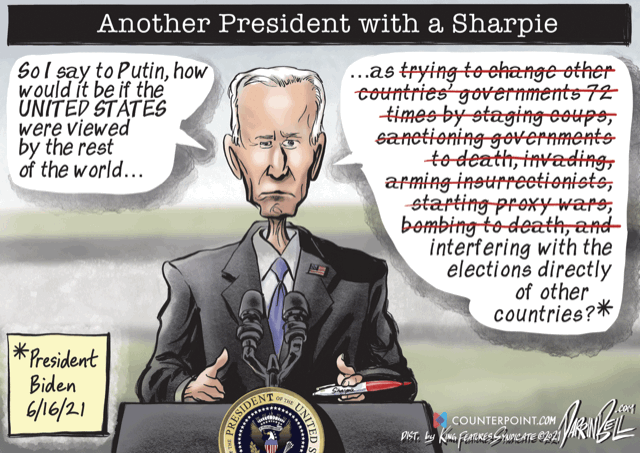
In his meeting with President Putin, President Biden is thought to have proposed red lines against the use of cyber weapons such as ransomware. The idea of shutting down something like Colonial Pipeline with a computer hack is surely repugnant. I seem to remember that many of us cheered when the U.S. (and Israel?) damaged the Iranian uranium enrichment facility at Natanz with a malicious computer worm called Stuxnet. Nor were many of us much bothered when U.S. financed coups topped unfriendly governments, or when we attacked Afghanistan, Iraq, Libya, Haiti, Nigeria, Syria, to name but a few.

“The supreme international crime according to 2017 U.S. media reporting is interfering nonviolently in a democratic election — at least if Russia does it. William Blum, in his book Rogue State, lists over 30 times that the United States has done that. Another study, however, says 81 elections in 47 countries.”  https://davidswanson.org/warlist/

While this is hard to swallow, our bad behavior differs from that of Russia’s or of other autocrats. I will not go to jail for writing this. Most Americans (I like to believe) condemn such behavior contrary to our founding principles when they learn of it. Our press is happy to expose such breaches when they discover them. In short, while our government often violates our principles of individual rights and the rule of law and lies regularly about it, public scrutiny and outrage tend to check bad behavior and move us back toward conformity with our principles. We never get there but it is very important that we keep trying.  

A One State “Solution”

I have long been an admirer and supporter of the Oslo Accords, which set out a step-by-step roadmap for establishing peaceful relations between Israel and the West Bank and Gaza–a so called “Two State Solution.” The new HBO film, “Oslo” premiers today. Continuing the work started by my IMF colleague, Arne Petersen, I spent two years leading IMF technical assistance missions to Israel/WBGS to develop the Palestine Monetary Authority. “My travels to Jerusalem”  A growing consensus has concluded that the two-state solution is dead, and sadly I reluctantly agree. It has failed because of poor Palestinian leadership, Israeli governments (especially Benjamin Netanyahu’s) that were happy with the stalled status quo, and American governments that allowed the Israeli government to get away with it.

Israel has behaved like most other colonial powers of the last century and in many ways worse. It has populated its Occupied Territories with illegal Jewish settlements and has carved up the West Bank with walled off, exclusively Jewish highways that make normal life for the Palestinians impossible.  It is small wonder that Palestinian youth are fed up and revolting. It is either ignorance or dishonesty to blame the tensions on Hamas, the bad guys in Gaza–the Israeli prison of Palestinians between Egypt, the Mediterranean and Israel proper, and cut off from the rest of the West Bank. “How Israel lost the culture war”

But of course, Palestinians outnumber Jews in the land of Canaan despite seven decades of effort by Zionists to attract Jews from around the world to the new Israel. This threatens the Zionist dream of a democratic Jewish homeland. The starting point for a one-state or any other solution should be the insistence that Israel honor the human rights of all inhabitances of the land it controls, i.e., from the Mediterranean to the Jordan River. A recent report of the Human Rights Watch concludes that Israel is an Apartheid state. Large numbers of Jews around the world are offended by Israel’s treatment of the Palestinians as second-class citizens. The United States has embarrassed itself and undermined its moral standing by supporting the Israeli government’s behavior.  Fareed’s Global Briefing”

One state with a constitution that protects all of its residents equally should protect Jews as well as Palestinians to live and worship as they see fit. Such rights should not depend on having Jewish governments.  More Jews live in the United States than in Israel and such an arrangement works well for them here.

I remember well being driven from Gaza to Jerusalem in 1995 by an Arab Israeli cab driver. As we chatted about the situation in the area, he volunteered that “you know, the Palestinians and Jews are cousins.” I replied that “maybe they are even brothers.” He paused and replied: “No, brothers would not treat each other this way.”  “The Economist: Two States or One?

Compromise

We are a country of citizens with a range of views on how our community should guide and regulate our interactions. But we are all anchored in our commitment to our Constitution and its Bill of Rights. What is the nature of the compromises that enable us to live, work and flourish together?

Views on the proper role of government in supporting and improving our lives are dangerously widening. To simplify the discussion with stereotypes and not always appropriate labels I will characterize Republicans as more interested in individual freedom and Democrats as more interested in helping the poor. The two parties want both but there are clear differences in emphasis and approaches. “The great divide-who decides?”

Everyone wants to help families. But consider the difference in the approach of the Democrats with Bidens American Families Plan and the Republicans with Mitt Romney’s Family Security Act. Among many other benefits, Biden’s “plan will provide a government-paid family leave program for employees who need extended paid time off for family issues… will help working families by providing government-subsidized child care… [and] will provide free universal government-run preschool, which it claims will help children academically far into the future.” These would be run by the government or pursuant to detailed government regulations. “The American Families Plan will do more harm than good”

“Romney’s Family Security Act would replace the Child Tax Credit with a $3,000 yearly benefit per child — $4,200 for kids under the age of 5 — spread out in monthly installments that begin four months before a child’s due date,…” “Romney child care benefit democrats”

The overriding difference between Biden’s and Romney’s family plans is who makes the decisions about how the assistance is used. The same overriding difference can be seen in Democrat and Republican approaches to financing education. Charter schools and, even more so, tuition vouchers favored by Republicans leave the power of choice with parents rather than public school districts (government).  Democrats distrust the judgement of individual families to decide how best to use government assistance and want to impose conditions that insure (in their minds) that it is well spent.

How can these two conflicting approaches be reconciled? Each side will need to give up something to gain what is most important to them. Democrats want to help the poor. Republicans want to protect their freedom of choice. If Democrats are willing to give up their regulation and control of how their financial assistance is used (i.e., set aside their distrust of the poor’s ability to make wise decisions for themselves) and if Republicans are willing to give up their commitment to self-sufficiency that keeps the social safety net as small as possible, Democrats can gain a more generous safety net and Republicans can gain greater freedom of choice by coming together to enact a Universal Basic Income (UBI) in place of the large number of specific government controls assistance programs.  “Our social safety net”

In addition to allowing individual recipients to determine how best to use this assistance, two broad differences between a UBI and the existing approach stand out. The first is the difference in the financial incentive to work. Unemployment insurance, for example, ends when a recipient takes a job. Most welfare programs, such as food stamps, end when the recipient’s income increases beyond some minimal level. The incomes of many now helped by Covid-19 support programs will fall if and when they return to work. A UBI is paid to everyone whether they are working or not, so any extra income earned in any way adds fully to their income. There is no financial disincentive to work.

The second major difference is the lower administrative cost and greater simplicity of a UBI compared to those of the multitude of assistance programs with their qualification criteria that it would replace. Consider the administrative challenges faced when sending checks to those qualifying under the CARES Act as part of the Covid-19 assistance. Some intended recipients were missed. Some who were not meant to receive payments received them. It took time to set up the system of payments. But with UBI monthly payments are made to everyone without further question or investigation once they are enrolled in the system (most likely administered through the Social Security System).

My proposal would also replace all income taxes (personal and corporate) with a uniform consumption tax. This combination of UBI and consumption taxation would result in the financing of government that is progressive relative to income and would resolve the dilemma of how to tax companies operating globally. For more details see my earlier blog:  “Replacing Social Security with a universal basic income”

Democrats would gain more efficient and extensive help to the poor but would have to give up oversight and control over how that help is used. Republicans would increase their control over how they live, but would have to relax their insistence on self-sufficiency. This is a compromise whose time has come.

All Volunteer Military

In May 1967, The New Guard magazine published an article by Milton Friedman on “The Case for a Voluntary Army.”  It was a compelling case and was adopted when the U.S. suspended its military draft in January 1972. But was it correct? “45 years later Nixon-Gates commission”

In the 1960s, the drafting of 18 year old’s to fight in Vietnam was avoided by those able to go to college. This was rightly challenged as discriminatory against the poor and college deferments were replaced with a lottery system that started in 1970, which picked the birthdates at random that would then be first in line to be drafted each year. I was granted the last of the college deferments.  “Draft lottery (1969)”

While a student of Friedman’s at the University of Chicago from 1965-70, I joined with several other libertarian classmates to form the Council for a Volunteer Military to promote Friedman’s call for an end to the draft. The Directors of the Council were: James Powell, National Director; Henry Regnery, Treasurer; myself, Executive Secretary; Danny Boggs, national Filed Secretary; and David Levy, Publications Editor. Our sponsors were: Yale Brozen, Bruce K. Chapman, Richard C. Cornuelle, James Farmer, David Franke, Milton Friedman, Sanford Gottlieb, Eugene Groves, Karl Hess, and Norman Thomas: an impressively diverse group.

In 1969 President Richard Nixon establish the Gates Commission to advise him on established an all-volunteer military and appointed Friedman to the commission.  Based on the Commission’s recommendations, President Nixon signed a law in 1971 that ended the draft in January 1973.

A Rand Corporation report on the All-Volunteer Force (AVF) by Bernard D. Rostker stated that: “Although the country had conscripted its armed forces for only 35 of its 228 years — nearly all in the 20th century — the American people were generally willing to accept this practice when service was perceived as universal. However, in the 1960s, that acceptance began to erode. There were five major reasons:

  • Demographics. The size of the eligible population of young men reaching draft age each year was so large and the needs of the military so small in comparison that, in practice, the draft was no longer universal.
  • Cost. Obtaining enough volunteers was possible at acceptable budget levels.
  • Moral and economic rationale. Conservatives and libertarians argued that the state had no right to impose military service on young men without their consent. Liberals asserted that the draft placed unfair burdens on the underprivileged members of society, who were less likely to get deferments.
  • Opposition to the war in Vietnam. The growing unpopularity of the Vietnam war meant the country was ripe for a change to a volunteer force.
  • The U.S. Army’s desire for change. The Army had lost confidence in the draft as discipline problems among draftees mounted in Vietnam.”

At the time Crawford H. Greenewalt, another member of the Commission, wrote to Gates that “while there is a reasonable possibility that a peacetime armed force could be entirely voluntary, I am certain that an armed force involved in a major conflict could not be voluntary.”

“Rand research briefs”

The AVF matched or exceeding the high expectations for it. The professionalism of our Army improved. We fought 13 wars with our volunteer force: Lebanon (1982-4), Grenada (1983), Panama (1089-90), Gulf War (Iraq, Kuwait, Saudi Arabia and Israel 1990-91), Somalia (1992-5), Bosnian War (1992-95), Haiti (1994-5), Kosovo War (1998-99), Afghanistan War (2001-21), Iraq War (2003-11, 2014-2020), Somali Civil War (2007-21), Libya intervention (2011, 2015-20), and Syria (2014-present). Each was limited enough not to exhaust the supply of volunteers needed.

But a different criticism of our all-volunteer force was raised that gave me pause. Our costly and futile war in Vietnam from 1955-75 was finally ended (without admitting the defeat it surely was) in response to the growing protests in the U.S.  No such protests were raised for our imperial adventures since then. Some observers began to point their fingers at the absence of a draft and thus a military/industrial complex better sheltered from public criticism. When we campaigned for the end of the draft and an all-volunteer military, we assumed that we needed to maintain an Army for our defense. Instead, our military was deployed all over the planet (800 bases around the world) with sufficient restraint (generally) to avoid strong public push back.  “National defense”  If the average middle class family’s children were not being drafted to fight unnecessary wars in far off places, they were not as likely to complain about the billions of their taxpayer’s money being pumped into the military/industrial complex.  This was an unanticipated side effect of ending the draft that we had not anticipated.

Both former President Trump and President Biden expressed their intentions to end our forever wars and, at least in the case of Biden, to strengthen our capacity to deal with the world with diplomacy. We should wish him well. And we should urge Congress to reinstate the Weinberger Doctrine, which limited the use of U.S. forces to when vital U.S. interests were at stake, and only as a last resort. “A Biden doctrine starts to take shape”

You can read my experiences in Iraq in my book: “My travels to Baghdad” and my experiences in Afghanistan in my book: “My travels to Afghanistan”.

PS. Some how I forgot that I had written on this before with a somewhat different proposal: https://wcoats.blog/2015/01/23/the-all-volunteer-military-unintended-consequences-and-a-modest-proposal/