
Fixing Palestine

In 1995 and 6 I led IMF technical assistance teams to Israel to establish the Palestine Monetary Authority as called for by the Oslo Accord. We were excited by the prospects of contributing to peace between the Arab and Jewish populations who had occupied the area for millennia (as well as new arrivals). We spoke, as did many others, of the Oslo Peace Process establishing a two-state solution to the struggles between the Palestinians and Jews since the establishment of Israel in 1948. In fact, we should have referred to the Oslo Accords as establishing only a step, a rather small one at that, toward a two-state solution—two independent states following Israel’s occupation of the West Bank and Gaza Strip in 1967.

I wrote about these experiences in “Palestine-The Oslo Accords Before and After-My Travels to Jerusalem” Our work was greatly facilitated by the fact that the governors of the Bank of Israel, Stan Fischer, and of the newly created Palestine Monetary Authority, George Abed, had been IMF colleagues. I asked each if they would write the foreword to my book. Stan declined saying that it was too sensitive a topic and George declined saying that my book was unfair to the Palestinians.

I have just finished reading a new account of the efforts to find peace in the area by two insiders with much wider exposure than I had had:  “Tomorrow is Yesterday-Life, Death and the Pursuit of peace in Israel/Palestine” by  Hussein Agha and Robert Malley. And I concluded that George Aben had been right about my account.

The two authors had been intimately involved in the many efforts to find agreement between the relevant parties. Drawing on their experience advising the Palestinian leadership (Arafat and Abbas) and US presidents (Clinton, Obama, and Biden) and their participation in secret talks over decades, Agha and Malley expose the weaknesses of those efforts and point to the potential of a very different approach. “They stress that the two-state solution became a global goal only when it was no longer viable; that U.S. officials preferred technical schemes to a frank reckoning with the past; that Hamas’s onslaught [on Oct 7, 2023] and Israel’s war of destruction were not historical exceptions but historical reenactments; and that the gaps separating Israelis and Palestinians have less to do with territorial allocation than with history and emotions.” From Amazon Books website.

Robert Malley was the United State Special Envoy for Iran in 2021-23 and as Special Assistant to President Clinton from 1998 to 2001, he was a member of the U.S. peace team and helped organize the 2000 Camp David Summit. Hussein Agha, a Lebanese, is a senior associate of Oxford University’s St. Antony’s College was a senior associate fellow at Chatham House.

Malley and Agha stress the diversity of players in the search for peace—ultra orthodox to nonreligious Jews—Palestinian groups that spent more energy fighting one another than fighting Jews. Selecting Israeli prime minister Ehud Barak and Palestinian Authority chairman Yasser Arafat for US lead negotiations at the Camp David summit left out most groups and many relevant issues. The authors end with the somewhat encouraging call to return to the beginning (1948 and before) and seating all Jewish and Palestinian groups at the table to take on the fundamental issues of history head on if there is any chance of finding the compromises needed to live together in peace with one, two, or more states as options.  https://wcoats.blog/2024/01/19/one-state-solution-for-palestine-israel/   Their narrative is a very enlightening account. 
My Blogs

From the time I could vote (1964) I have indevoured to evaluate each president’s policies on their merits (as seem by me of course). Thus, at one time or another I have praised or criticize policies of LBJ, Richard Nixon, Gerald Ford, Jimmy Carter, Ronald Reagan (my favorite president), George H.W. Bush, Bill Clinton, George W Bush, Barack Obama, Joe Biden, and Donald Trump. I often condemned a policy but not the President promoting it, in the belief that each President thought his policy was for the welfare of our country even if I disagreed. The exception is Donald Trump. 

Unique in my lifetime, we have a President whose primary interest is in seeing his name on things (Kennedy Center, Peace Institute, maybe Dulles Airport), filling the White House with gold to look like a palace, being praised by strong men (Putin, Orban, Mohammed bin Salman), dropping bombs where ever he chooses (having given up begging for the Nobel Peace Prize) and throwing his weight around (bullying), irrespective of the considerable damaging he is doing to our country. Now he wants his name on US currency (not to mention his likeness on gold coins).

Since 1861 the US treasurer’s signature has appeared on bank notes, along with the likeness of a deceased President.  In 1866, Congress passed what is commonly called the Thayer Amendment, which forbids the likeness of any living person from appearing on U.S. securities and currency. “Donald Trump is set to become the first sitting US president to have his signature on US banknotes, the treasury department has announced…. Trump’s signature will appear alongside Treasury Secretary Scott Bessent, an unprecedented move that the department said would mark America’s 250th anniversary…. The first $100 bills with the signatures of Trump and Bessent will be printed in June, with others to follow.  Notes currently being printed bear the signatures of former President Joe Biden’s Treasury Secretary, Janet Yellen, and Treasurer Lynn Malerba.” Just in case you didn’t know that we have a Treasurer in addition to the Secretary of the Treasury https://www.bbc.com/news/articles/cz0el909yp3o  

Trump is an egoist with the tastes and desires of a spoiled child. Unfortunately, as President of the United States his childish behavior is doing great damage to the U.S. and global order.

America Alone

Donald Trump campaigned on a pledge to end “forever wars” and to put American interests first. In office, he has done the opposite.

In the first year of his second term Trump has bombed seven countries and 50 speed boats killing 159 people. His joint war with Israel on Iran is threatening global recession. None of these were authorized by the American Congress as required by our Constitution and violate international law as well. He has threated one an all even more freely (e.g. Canada, Greenland).

If this were not bad enough, Trump has insulted and alienated our friends and allies resulting in the refusal of most EU and Nato countries (Germany, France, UK, Spain, Italy) and Australia and Japan to agree to Trump’s plea for help in defending the Staits of Hormuz.

These measures have isolated and weakened the U.S.  Trump’s policies have not put America First–they have made a weakened America Alone.

Deploying his bully substitute for diplomacy, Trump, with help from JD Vance, Trump accused the EU of “extraterritorial censorship of Americans” through EU content‑moderation and hate‑speech rules. At the Munich Security Conference in February 2025, Vance warned that “across Europe, free speech…is in retreat,” This is from the same administration that repeatedly labeled critical media “fake news” and “the enemy of the people.” Currently he and senior officials have accused outlets critical of his Middle East war policy of undermining the country, with allies at the media regulator warning that broadcasters risked losing licenses if they spread “fake news.”

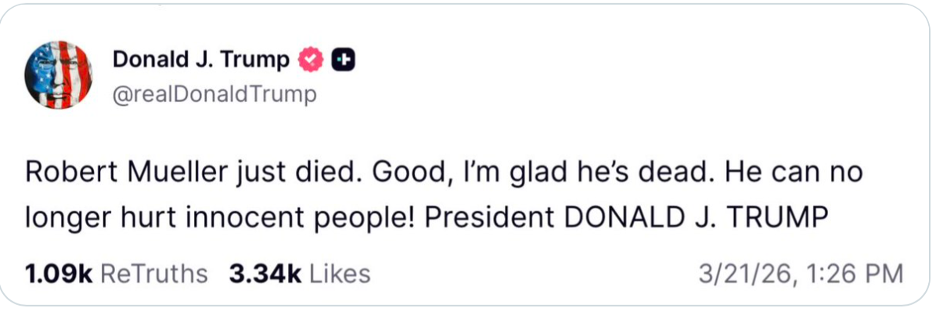
Condemning the opposition as enemies rather than challenging the policies of opponents is a sign of weakness and typical of tyrants. Trump attacks his domestic enemies as fiercely as foreign ones. Note the childish hate in Trump’s tweet today about the death of the man who investigated his misbehavior at the bottom of this blog:

The administration has backed or initiated high‑dollar defamation lawsuits against critical outlets (for example, a multibillion‑dollar suit against the Wall Street Journal). The Department of Justice has revived policies to subpoena reporters’ phone records to identify leakers, and Homeland Security officials have publicly boasted about catching sources for journalists—moves described by the Committee to Protect Journalists as “terrifying” and chilling to newsgathering.

The White House has at times revoked or restricted press credentials for reporters and outlets seen as adversarial, most famously CNN’s Jim Acosta. New, more restrictive rules for White House press passes have been criticized as targeting critical journalists and limiting independent coverage.

The unfunny clown who heads our Department of War has driving away most honest reporters by require department review of their prospective reports. A federal district court in Washington, D.C., just struck down key parts of the Pentagon’s new press-access and reporting restrictions. In a suit brought by The New York Times challenging the Defense Department’s 2025 press policy the judge ruled that the Pentagon’s policy limiting reporters’ access and conditioning accreditation on pledges not to gather or publish information without official approval violated the First Amendment and also raised due process concerns under the Fifth Amendment.

We have historically relied on the strength of our constitution and the separation of powers it establishes between the three major branches of government to contain abuses of government power. Generally, our institutions have served us well. But Trump has stretched executive power weakened its guardrails, for example by firing all Inspector Generals and failing to seek congressional support.

Trump and his repulsive advisor Stephen Miller’s immigration/deportation policies via the masked ICE agents who have killed two American citizens on public streets, have unleashed terror and abuse of power never seen in my life time. Last year 32 people died in ICE custody and in just the first weeks of 2026, at least 6 more people died in ICE detention.

The list goes on and on. From his reelection to his second term (2024) to early 2026, Trump’s estimated wealth has increased on the order of 2–4 billion dollars. Forbes reported his net worth at about 7.3 billion dollars by September 2025, calling it the most lucrative year of his career. In the realm of pure childish ego, he has added his name to the Kennedy Center now to be closed in two months, and the Institute of Peace, rebuilding the White House, and threatening to rename Dulles Airport. On top of that he wants his image on a gold coin. His administration proposing both a commemorative gold coin and a circulating $1 coin.

None of these are serving America’s interests.  Various indices of freedom/authoritarianism report a steep decline by the U.S.  Freedom House, which scores countries (0–100) on political rights and civil liberties and categorizes them as Free, Partly Free, or Not Free reports that the U.S. score is now at its lowest level since they adopted the 100‑point scale, while still rated “Free.”   The democracy watchdog, Martin Gelin reports that “Trump is aiming for dictatorship”. But we can still stop him if we wake up and yell STOP.

Kurdistan

Though large numbers of Jews were scattered around the world for two thousand years, Palestine has always retained a significant number of them. Of the almost 11.3 million Jews in 1900, most were in Europe (9 million), Russia (3.9 million) and the United States (1.5 million). At the beginning of the WWII the global population of Jews had grown to 15.4 million of which one third were in the US.

Even before the holocaust there were movements to reestablish a Jewish homeland in Palestine. The 1917 Belfour Declaration from British Foreign Secretary Arthur Balfour to Lord Walter Rothschild, pledged British support for a “national home for the Jewish people” in Palestine. The local Christian and Muslim community of Palestine, who constituted almost 90% of the population, strongly opposed the declaration.

What became known as Zionism (as formalized by Theodor Herzl, it aimed to secure a safe haven for Jews fleeing persecution and to revive Jewish culture and language) took many forms. For example, the question who is Jewish continues to be debated. Following World War I, Britian ruled the Lavant (Palestine). On September 3, 1947, the UN adopted the boundaries (green line) to divide the British mandate between a state of Israel and the rest. Israel was given 56% and Jerusalem (an important Christian, Jewish, and Muslim shrine) was made international. When Britten ended its Mandate, Israel declared its independence.

Most Zionists sought a democratic Jewish state. Upon its founding in 1947, Israel was roughly 60% Muslim, 40% Jewish and 10% Christian. That was an unacceptable problem for those wanting a democratic Jewish state. From the Nakba of 1948 (Jewish ethnic cleaning of over half of the Palestinians then living in Israel) Israel was about 90% Jewish in 1949. Currently the population of Israel is about 10 million, of which 73% are Jewish, and 20% are Muslims. Finding peace with the rest of Palestine has remained a challenge to this day. Are the prospects for a peaceful Kurdistan very different.

The Kurdish population worldwide is estimated to be between 40 and 45 million, making them one of the largest ethnic groups without a sovereign state. However, about 30 million of them live within what would be the sovereign state of Kurdistan should it be allowed to exist, made up of chunks of Turkey, Iraq, Iran and Syria.

Kurdish military forces have fought for territory but largely in pursuit of claims to rule what they considered home ground. It is extremely unlikely that the Kurds in this area would have any interest in expanding their territory. None the less Iraq, Iran, Syria and Turkey have generally been hostile to any effort of the Kurds to rule themselves. The formation of a Kurdistan raises the questions whether that would bring greater peace to the wider region and whether the “internal” politics would support domestic rule that would properly serve the Kurdish people (or all residents of the area). Intense opposing political views exist within Kurdistan, particularly in Iraq, where the Kurdistan Democratic Party (KDP) and the Patriotic Union of Kurdistan (PUK) compete for control, often leading to governance deadlocks, separate security forces, and split zones of control.

In addition, we must ask whether the Iraqi Kurds, Iranian Kurds, Turkish Kurds, and Syrian Kurds feel more loyal to the country they are located in or to their fellow Kurds in the surrounding countries. Does a nation function better toward the interests of its citizens when based on ethnic and/or religious commonality or when based on common principals of governance and rights?

Israel is an example of the first option—Jewishness. As a classical liberal (libertarian) I support the American approach of rights and laws applied equally without regard to ethnicity or personal religious beliefs. For Kurdistan, the question with whether the Kurds of Turkey, Iraq, Iran or Syria feel greater loyalty to other Kurds or to the country they live in.

I started this blog expecting to build the case for a Kurdistan. I have talked myself out of it.