
America’s Trump style Foreign Policy

The world benefits from rules of interaction that provide peace and cooperation. Rather than building more weapons of war, we could build more temples of beauty. Championing rules most countries respect and aspire to and being the largest (or perhaps second largest) economy in the world, the United States has naturally led such an international order. Retaining that role would be jeopardized if the U.S. did not diplomatically fashion such rules that were embraced and respected by most other countries and if the U.S. did not itself abide by the rules it had championed.

America’s leadership role is being jeopardized by our hypocrisy, such as condemning Russia’s invasion of Ukraine while given a blank check and American weapons for Israel’s invasion of Gaza and Lebanon and ignoring its abuse of its occupied territories in the West Bank of Palestine. America’s embrace of the International Criminal Court’s (ICC’s) arrest warrant for Vladimir Putin for Russia’s invasion of Ukraine and America’s condemnation of the ICC’s arrest warrant for Israel’s PM Benjamin Netanyahu’s and its former Defense Minister Yoav Gallant is the very definition of hypocrisy.  

President elect Donald Trump’s style of negotiating international agreements reflects more the behavior of a bully than a diplomat. Last Monday Trump threatened to levy a 25% percent tariff on all imports from Mexica and Canada, despite the large economic harm to the US as well as Mexica and Canada and despite the laws and agreements it would violate, if they did not stop the illegal drugs and aliens entering the US across their borders. WC: “tariffs”

“Trump’s threat spurred outrage across the northern and southern U.S. borders, prompting backlash and warnings of retaliatory tariffs from both Mexico and Canada.”  The Hill: “Takeaways from trumps new tariff threat”

“Donald Trump’s angry threat to impose 25 percent tariffs on all U.S. imports from Mexico… is widely being depicted as a bluff….

“But amid all this parsing of Trump’s intentions, a crucial fact about his new move is getting lost: At the center of it is a lie. This lie is hiding in plain sight: It’s the underlying suggestion that Mexico is not doing anything to stop migrants from coming and that Trump’s threat of tariffs is needed to change that….

“All this is laid bare by the sharp response to Trump’s threat that new Mexican President Claudia Sheinbaum issued Tuesday. Her statement is getting attention for its barbed claim that American guns trafficked to Mexico are fueling crime and violence there among gangs supplying U.S. markets with drugs. ‘Tragically, it is in our country that lives are lost to the violence resulting from meeting the drug demand in yours,’ Sheinbaum noted acidly, suggesting that the two countries’ interrelated national challenges underscore the need for cross-border cooperation rather than Trumpian confrontation.”

She further noted that: “You may not be aware that Mexico has developed a comprehensive policy to assist migrants from different parts of the world who cross our territory en route to the southern border of the United States. As a result, and according to data from your country’s Customs and Border Protection (CBP), encounters at the Mexico-United States border have decreased by 75% between December 2023 and November 2024….

“What this polite (and euphemistic) language says is that Mexico is already acting extensively to thwart migrants who travel through that country—originating south of Mexico—so they don’t reach our own southern border. As Sheinbaum notes, this is partly why border apprehensions in the United States have dropped sharply of late.” New Republic: “Mexico’s Sheinbaum responds to Trump tariffs”

So, what did our bully in chief do next?  “President-elect Donald Trump has said he had a “wonderful” conversation with Mexico’s President Claudia Sheinbaum, in an apparent easing of the tensions raised this week over trade tariffs….  After Wednesday’s phone call, both leaders described the conversation in positive terms. Trump said on Truth Social, his social media platform, that it was a ‘very productive conversation’ and thanked Mexico for its promised efforts.”

Perpetuating his original lie, “Trump indicated that Sheinbaum would stop migration through Mexico, ‘effectively closing the southern border’.

“Sheinbaum said she had explained her country’s efforts to deal with migrants and that her position would ‘not be to close borders but to build bridges’”.  https://on.ft.com/49czcol

Trump may or may not be a good negotiator (6 of his businesses have filled for bankruptcy) but his approach is that of a bully. Given America’s dominant status in the world, bullying rather than leading and negotiating in the search for mutually beneficial compromises will hasten American decline from leadership.
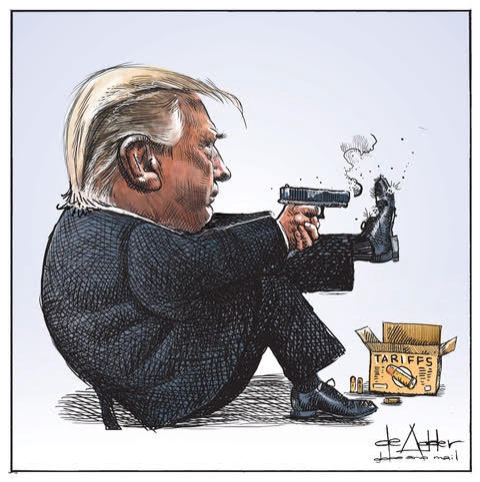
Tariffs

“Posting on his Truth Social platform, Trump said [Monday] that on the first day of his presidency he will charge Mexico and Canada a 25% tariff on all products coming into the U.S. He added in a separate social-media post that he would impose an additional 10% tariff on all products that come into the U.S. from China,… That would come on top of existing tariffs the U.S. has already imposed on Chinese goods.

“’This Tariff will remain in effect until such time as Drugs, in particular Fentanyl, and all Illegal Aliens stop this Invasion of our Country!’ Trump wrote.” WSJ: Trump pledges tariffs on Mexico Canada and China”

A tariff is a tax on an import. They are permitted by the World Trade Organization when leveed on goods receiving state subsidies in order to create a level playing field for trade. Such global trade has made an enormous contribution to the standard of living around the world.  “Ernie Tedeschi, former chief economist for President Joe Biden’s Council of Economic Advisers, said the North American tariffs would cost the typical American household almost $1,000 per year.” WP: “Trump tariffs-China Mexico Canada”

The normal expectation is that the tariff will reduce U.S. demand for the taxed import and encourage its domestic production. But the US labor force is fully employed and can only increase domestic production of the targeted goods by shifting workers from the production of goods the US has a comparative advantage in thus reducing our overall income. Though employment of manufacturing workers has declined in the US, manufacturing output has not because worker productivity has increased. In fact, our imports have not shipped American jobs overseas as increasing productivity has resulted in reduced manufacturing employment most everywhere in the world, including China, surely a good thing. WC: “Trade protection and corruption”

Immediately after Trump’s tariff announcement, the exchange rate of the dollar strengthened. A stronger dollar reduces the cost of imports (but increases the cost to foreigners of our exports), thus undoing to some extent the demand reducing impact of the tariff. But it hurts our exports because of their higher price to foreign purchaser and reduces our overall standard of living.

China and others hit with this tax are likely to retaliate with their own tariffs. “Under the United States-Mexico-Canada Agreement (USMCA), which took effect in 2020, goods moving among the three North American nations cross borders on a duty-free basis. ‘Obviously, unilaterally imposing a 25 percent tariff on all trade blows up the agreement,’ said John Veroneau, a partner at Covington & Burling in Washington.”  WP: “Trump tariffs-China Mexico Canada”

Should Trump actually impose these tariff’s he would (again) be violating the law, which only allows the President to impose tariffs without Congressional approval for national security reasons: WC: “Tariff abuse”

Trump’s threatened tariffs are not even leveed on the goods he wants to restrict (drugs and illegal aliens). Thus, unlike traditional tariffs they would be leveed to pressure Mexico and Canada to take other actions Trump wants. They are bargaining ploys. So at the cost of raising prices and lowering incomes in the US, weakening the global trading rules from which we have benefited so much, and weakening the checks and balances limiting an over extended executive branch, Trump may be playing his bargaining game again. But in my opinion the cost to us and the world trading system is too high.

War

My many visits to Sarajevo, Mostar, and Banja Luka in 1996-7 exposed me to the devastation of war, as did my multiple visits to Pristina in 1999-2000, and my 23 visits to Kabul between 2002-13.  My two months in Bagdad as part of the Coalition Provisional Authority in 2004 and five, two week follow up visits added live fire to my “post” war experiences that left me jumpy for many months after returning home.  None of these came close to the front-line experiences of reporter Robert Fisk, whose accounts are reproduced in his thick book “The Great War for Civilization: The Conquest of the Middle East,” though he reported from the same countries I had worked in.

Fisk’s reports on his interviews with actual people and his viewing of their butchered bodies and mass graves in the dessert confronts his readers with the real victims of war. To characterize his accounts as heart wrenching doesn’t come close to the true tragedies he reports. The deceptions and lies of all sides, add to the immense tragedies of our post WW wars, which have accomplished nothing but death and destruction.

The current Middle East wars (Israel’s slaughter of men, women and child in Gaza, West Bank, and Lebanon), following decades of Israel’s abusive rule over Palestinian territories, is beyond belief and too many Americans remain silent.  But no side has been “pure.” Our illegal and lie filled invasion of Iraq in 2003 followed years of American and British bombing of Iraq following the Gulf War in 1991 (Desert Storm). Our sanctions of Iraq over that period staved to death 1.5 million Iraqi’s, mainly children (despite the Food for Oil program), and the U.S. military’s use of depleted uranium munitions in that war dramatically increased Iraqi cancer cases and birth defects in the years that followed. Fisk reports on these and US and UK efforts to keep it all quiet.

Some of Iraq’s health problems were also aggravated by Iraq’s use of chemical warfare agents such as mustard gas and sarin during the Iran-Iraq war of 1980-88. The United States, being on Iraq’s side at that time, ignored its use of these chemicals, which remain in the soil today.  American leadership, which is desired by much of the world, is undermined by such double standards. Our government lies to its own citizens about its illegal behavior as well. Edward Snowden is paying a very high price for exposing some of it. We owe him a lot.

American interference in other countries’ affairs (other than by being the beacon on the hill) has rarely served our national interest. While we have blindly assumed that we would be welcomed as liberators in Panama (1989-90), Iraq (1991, and 2003), Somalia (1993, 2007, and 2010), Haiti (1994), Bosnia (1994), Afghanistan (1998, and 2001), Serbia (1999), Libya (1986, and 2011) and Syria (2014)–(need I mention Vietnam?), we failed to understand that peoples of most every country hate invaders no mater who they are. Moreover, our ignorance and arrogance made us very inept occupiers.

In Ukraine and Israel our interference stops short of sending our solders (almost). But Russia’s invasion of Ukraine could have easily and sensibly been avoided if the U.S. had encouraged the negotiations Russia sought in December 2021 “Ukraine’s and  dead and  war”.  Following Russia’s invasion, we tragically threw cold water on the agreement almost reached between Ukraine and Russia in the March 2022 negotiations in Turkey. ‘Peace negotiations in the Russian invasion of Ukraine”  So onward to the last Ukrainian. The final outcome is very likely to be identical to the March 2022, Istanbul Communiqué but with 120,000 dead and 600,000 wounded Russians and 70,000 dead soldiers and 10,000 dead civilians and 140,000 wounded Ukrainians and 500 billions of dollars’ worth of property destruction. In other words, Russia and Ukraine paid a huge price (with our help) for nothing.

Fisk gives human faces to the real people who pay the price for our aggressions. This horrible cost in lives and property has contributed nothing to our national security. America has much to offer the world and has contributed much to the quality of life around the world. But it has done so with its example, trade, and diplomacy, not its army. The principles and institutions on which American was founded and has flourished have served us well when we have remained faithful to them.

President elect Trump has nominated Tulsi Gabbard to become his Director of National Intelligence. When she left the Democratic party two years ago and endorsed Trump for President this August she praised Trump for “having the courage to meet with adversaries, dictators, allies and partners alike in the pursuit of peace, seeing war as a last resort” and condemned the Biden administration for the U.S. “facing multiple wars on multiple fronts in regions around the world and closer to the brink of nuclear war than we ever have been before.”

“In 2022, she also faulted the Biden administration for failing to address Russian concerns as it invaded Ukraine.

“’This war and suffering could have easily been avoided if Biden Admin/NATO had simply acknowledged Russia’s legitimate security concerns regarding Ukraine’s becoming a member of NATO, which would mean US/NATO forces right on Russia’s border,’

Following a 2017 trip to visit Syrian leader Bashar al-Assad, Gabbard defended meeting with an American enemy by saying:

“I think we should be ready to meet with anyone if there’s a chance it can help bring about an end to this war, which is causing the Syrian people so much suffering,”  “The Hill–Tulsi Gabbard-Trump Nomination — 11/14/24”

 I hope that she still thinks this way.

Save Israel

To save Israel, U.S. standing in the world, and the lives of thousands of innocent Palestinian men, women and children, Israel must end its wars against the Palestinian territories it occupies in the West Bank, Gaza, and it war in Lebanon immediately. U.S. support is already in violation of U.S. law and must top immediately.  “David Ignatius–Biden Should withhold weapon to Israel”  Israel’s publicly stated objective is to rid the land from the River to the Sea of as many Palestinians as possible in order to establish a democratic, Jewish state over the entire area.

While Israel’s Defense Minister Yoav Gallant stated that Israel had achieved its military objectives and should end the fighting, Israeli Prime Minister, Benjamin Netanyahu disagreed and recently fired Gallant. Israel’s wars have seriously eroded its support in the world and the United States has become isolated by its continued support of what most of the world now calls Israel’s genocide of Palestinians.

According to recent reports, the Israel-Hamas war that began in October 2023 has resulted in a staggering number of casualties:

Over 43,000 Palestinians in Gaza have been killed

  • This includes at least 11,000 children and 6,000 women
  • An estimated 99,013 Palestinians have been injured

Israeli casualties:

  • Approximately 1,200-1,700 Israelis have been killed
  • This includes at least 36 children
  • Around 5,431 Israelis have been injured

These figures are estimates and the true toll may be higher. Some sources suggest the total death toll in Gaza could reach up to 186,000 when accounting for both direct and indirect deaths due to the conflict.

President elect Trump announced Tuesday that he’d nominated former Arkansas Governor Mike Huckabee, a proponent of Israeli annexation of the West Bank, to be the US ambassador to Israel. “I am pleased to announce that the Highly Respected former Governor of Arkansas, Mike Huckabee, has been nominated to be The United States Ambassador to Israel…. Mike has been a great public servant, Governor, and Leader in Faith for many years. He loves Israel, and the people of Israel, and likewise, the people of Israel love him. Mike will work tirelessly to bring about Peace in the Middle East!” Trump said in a statement.

What must Huckabee or anyone else who loves Israel do to bring peace to Israel and the Middle East? He must convince the Israeli government to end its abusive treatment of the peoples whose land it has taken and rules. Since expelling approximately 700,000 Palestinians in the 1948 war at Israel’s founding, 134,000 Palestinians have been killed and more than 5 million driven from their homes into refugee status in the surrounding countries.

Israel has rejected a so called two state solution in which the West Bank and Gaza Strip would become an independent country. Thus, Israel must give up its apartheid status for the Palestinians in a one state Israel providing them with full citizenship and equal treatment to Israel’s Jewish citizens and must stop killing or driving them away. “One State Solution for Palestine-Israel”

But I support the immediate end of these wars and the establishment of equal treatment and justice for everyone not only because I care about Israel, but also because American support of Israel’s genocide is damaging my own country. It makes a mockery of the high principles upon which America was founded and has isolated us from the rest of the world’s condemnation of Israel’s misconduct.

Econ 101:  Money

My Ph.D. in economics from the University of Chicago dealt with a monetary policy issue. My five years as an Assistant Professor of Economics at the University of Virginia allowed me to lecture extensively about monetary policy and my 26 years at the International Monetary Fund were largely devoted to providing technical assistance to member (primarily post conflict) county central banks (including Afghanistan, Bosnia, Croatia, Egypt, Iraq Israel, Kazakhstan, Kenya, Kosovo, Kyrgyzstan, Moldova, Serbia, South Sudan, Turkey, West Bank and Gaza, and Zimbabwe). In case you didn’t know, central banks issue the currency (money) of their respective countries. So, I know a lot about “money” and like talking about it.

And it’s not that I haven’t already written a lot about the subject. For a few examples see: “Econ 101-the Value of Money”   “Money”  “A Libertarian Money”

A lot of interesting things are happening these days in the monetary area, but they pertain to payments (transferring money from one person to another via PayPal, Venmo, Zelle, Visa, etc.) rather than money itself. I want to talk to you about “money” (not payments) as I might with my granddaughter. Money is what is transferred in payment.

Money exists because none of us are self-sufficient and must trade what we produce with others who produce the other things we want. I will skip the presumably well-known story of barter trade and its challenge of the double coincidence of wants (you have what I want, and I have what you want so we trade). Giving you a commonly accepted asset, that you can hold until you want to buy something from someone else and can “pay” for it by passing that asset on to the next seller is the essence of money. In addition, it becomes the unit of account (the unit for stating prices). Thus, money is a unit of account, means of payment and store of value.

But now dear granddaughter, lets dig deeper to discuss where this money comes from and its key features in today’s modern electronic (digital) world. First of all, I can’t pay you with any old asset equal in value to your sale price (the barter problem). I must pay you with “money,” an asset universally accepted within the country. To cut to the bottom line, money is the asset issued by our central bank (any of our twelve Federal Reserve Banks) or creditable claims on the Fed’s monetary liability—the U.S. dollar. Until 1933 these dollars could be redeemed for gold at $20.67 per once. Now the U.S. government accepts them in payment of our taxes denominated in dollars, which insures their ultimate value.

Federal Reserve notes (dollar bills) are the most direct manifestation of our money. But almost 90% of our money (the asset with which we can pay for things) is in the form of deposits at American banks, and credit unions. These figures can be a bit misleading because over 60% of our currency is held abroad.

When you pay someone with cash, they receive a direct claim on the Federal Reserve. When you pay with your bank deposit, your bank’s deposit with (claim on) a Federal Reserve bank is transferred to the payee’s bank, which credits the payee’s bank account with the designated amount. The asset paid and received is still ultimately a claim on the Fed.

But our demand deposits with our banks amount to 15.9 trillion dollars, while the reserves that our banks keep with the Federal Reserve Banks amount to only $3.3 trillion reflecting our “fractional reserve” system. What is going on here? How did banks create more of our money (ultimate claims on the central bank) than it backs with its reserves at the Fed?

When teaching money and bank at the U. of Virginia I loved walking the class through the money/banking multiplier that resulted from our fractional reserve backing system. It has become fashionable for some to claim that banks create deposits (money) by making loans. When you received a mortgage loan from your bank, they say it creates the deposits placed in our deposit account. This is sort of true and sort of not true. Your bank actually pays your mortgage loan to the account of the person selling their home and their account is almost surely in another bank. That means that your bank must have sufficient reserve balances at the Fed to transfer to the seller’s bank.

I will leave the details of the bank money multiplier to the Money and Banking class you will hopefully take when you go to college, but the fact that your deposits are only partially backed with reserves at the Fed (the rest of the backing being the bank’s loans and other financial assets, is what lies behind the occasional bank runs we saw in the movies before deposit insurance was introduced to assure depositors that they could get the money back even if their bank failed. If enough bank borrowers default on their loans, the bank could become insolvent. Only the first to withdraw their deposits will be able to get their money back. The potential risk of such runs on a bank only partial backing your deposits with reserves at the central bank motivated the Chicago Plan of 100% reserve banking. “Protecting Bank Deposits”

If bank deposits of US dollars are money, what about cybercurrencies? What are they ultimately claims on? Bitcoin, as you hopefully know, is not a claim on anytime. They can’t be redeemed for anything. It is not unit of account or means of payment for hardly anything—it is not money. It is a speculative “asset” for those who like to speculate (gamble). “Cryptocurrencies-the bitcoin phenomena”  “The future of bitcoin exchanges”  “Bitcoin-Cybercurrencies and Blockchain”  “The difference between bitcoin and FTX”

But there is a class of cryptocurrencies that claim to be redeemable for money, such as US dollars—so called stable coins. The validity of this claim, as with your bank re your deposits there, depend on the details of its contract and the faithfulness of its adherence to that contract. Tether and USD Coin are the most popular US dollar stable coins.

But to use a stable coin for making payments, the person or firm you are paying must have the software or card reader needed to use the cryptocurrency you want to use. You might remember (probably not you, dear granddaughter) when not so many stores could accept visa, or MasterCard (or the Shell Oil, or Texico gas cards). Payment technology has continued to evolve and improve, but if it is not transferring money (US dollars in our case)—i.e. an asset ultimately redeemable for the Federal Reserve’s liability, it will not get you very far.

Other than handing someone cash, paying with your bank account requires a messaging and authorization system. Do you still write checks occasionally—so sorry. A check both indicates the amount to be paid and authorizes its transfer. Almost all payment instructions and authorizations are made electronically these days. Many central banks are considering introducing digital cash in place of or along side their currency notes (Central Bank Digital Currency). When offered through a bank, a CBDC would have the advantage of 100% reserve backing (it would be a direct claim on the Fed). On the other hand, modern electronic means of payment leave little room for further improvement as might be offered by CBDCs. “Econ 101-Retail Central Bank Digital Currency-CBDCs”

To make payments, or send money, abroad, your money must be exchanged for the money of the recipient. I regularly send dollars to Afghanistan, which are received as Afghani. A massive foreign exchange market in which the exchange rate of one currency for another is determined exists for that purpose. Such payments can be made more quickly and cheaply if both parties are willing to use the same currency. Thus, the US dollar is rather widely accepted for cross border payments. “The Dollar Again”  The Special Drawing Right (SDR) of the International Monetary Fund serves this purpose for governments but is not widely used. “What are SDRs?” Stable coins redeemable for gold provide another promising potential unit given golds historical importances. The best existing example is e-gold by Global Standard (to which I am an advisor).

But not all monies behave the same. The behavior of the value of each (its inflation rate) depends on how its issuing central bank manages its supply. Some central bank’s supply whatever their government needs, generally resulting in high inflation rates. Some, such as our Federal Reserve, regulate its money’s supply in an attempt to maintain an inflation target (in the US the target is 2%). Others follow currency board rules that leave to the market the determination of a supply that keeps the currency’s value consistent with that of another currency (The Euro in the case of the Bosnian dinar or the Bulgaria lev). So dear granddaughter there are many interesting things to study about money.

Why don’t you pop over and let’s discuss it more over lunch? Oh, I forgot that you are in the West Coast Washington (state) while I am near the East Coast Washington (DC). Well at least we can meet on FaceTime or Zoom (or even the old fashion telephone). But I would love to meet one way or the other.

P.S. In 2002 as Patrick Honohan and I were finishing up the Bank-Fund Financial Stability Assessment of Egypt (Patrick led the World Bank team and I led the IMF team) I said in an email “Patrick, why don’t you just come across the street and discuss this over tea?” Patrick replied: “Warren, I am in Dublin. I moved here several months ago.” He later became the Governor of the Central Bank of Ireland.