And So here we are…

And now the Republican’s own it. What ever happens, whether their doing or not, the Republicans own what ever happens on their watch. It is filled with opportunity to turn our country away from an ever growing government rule over our personal lives back to greater personal freedom with a limited government safety net rather than an ever more extensive rulebook of what we can and cannot do. Donald Trump has demonstrated over his life that he ruthlessly pursues what benefits him with little to no regard for those he tramples on and little hesitation to use the powers of government for his personal gain. This history is set out in the attached article that I wrote thinking we were saying good-bye to Trump.

Hopefully some of Trump’s promises (deporting 11 million illegal aliens, blocking entry to Muslim’s, high tariffs on China—all of which would be devastating to our economy as well as illegal) will simply be forgotten. Some other promises (respectable Supreme Court appointments, reducing corporate income tax rate and other badly needed tax reforms, a more restrained foreign policy) would be very beneficial and should be adopted. Many promises were contradictory. David Ignatius reported in today’s Washington Post that: “A Trump foreign policy, based on his statements, will bring an intense “realist” focus on U.S. national interests and a rejection of costly U.S. engagements abroad…. Trump also promised repeatedly that he would step up the U.S. military campaign against the Islamic State and replace U.S. generals who were insufficiently combative. But he has been vague about what he plans to do in Iraq and Syria.” Let’s hope that we get the first Trump rather than the second one.

My hope (I am always inclined by nature to be hopeful) is that Congress—a Republican controlled Congress—will reassert its proper constitutional role and roll back the extensions of executive power we have suffered under George W and Obama. Trump’s “strong man, leave it to me” impulses risk abuses of executive authority every bit as much as Obama has or Hillary might have. My other hope is that Trump’s transition team, with sound thinking people like Ed Feulner, will staff Trump’s administrative departments with good people with good ideas. Trump is smart but ignorant of most conservative thinking about economic policy issues. Hopefully he rejects his earlier claim that he is his own advisor and listens to his government as well as David Ignatius’s admonition that: “Undoing globalization isn’t possible. But undermining America’s leadership in that system would be all too easy.”

Hillary Clinton’s beautiful concession speech could have been given by Ronald Reagan. http://www.usatoday.com/story/news/politics/elections/2016/2016/11/09/watch-live-hillary-clinton-addresses-supporters-after-defeat/93532872/. She said nothing that President Trump should disagree with and I wish him and his future administration the very best.

The Ugly Face of Capitalism

Capitalism is an economic system in which people, individually or in groups, can keep the fruits of their labor and in so doing can invest and deploy what they save from it to increase their output and thus income. In short, capitalists create value– things other people want– in order to improve their own incomes. The absolutely amazing accomplishment of capitalism can be glimpsed from the following, which I wrote two years ago: “World per capita income didn’t change much from the time of Christ to the founding of the United States ($444 to $650 in 1990 dollars), a period of 1,790 years. But in the following 320 years it jumped to $8,080. And about half of that jump came over the last 50 years.” https://wcoats.wordpress.com/2014/12/18/free-markets-uber-alles/

Capitalism involves relationships between people that we might call win-win. You make money when you produce something others want and will pay you for. Donald Trump presents another face of capitalism. Rather than a value creator, Trump prides himself on being a great bargainer. He was often playing a zero sum game. Rather than increasing the pie, he focused on increasing his share of the pie, thus reducing someone else’s share. As Andrew Sullivan put it: “[Trump] has no concept of a non-zero-sum engagement, in which a deal can be beneficial for both sides. A win-win scenario is intolerable to him, because mastery of others is the only moment when he is psychically at peace. (This is one reason why he cannot understand the entire idea of free trade or, indeed, NATO, or the separation of powers.)” http://nymag.com/daily/intelligencer/2016/11/andrew-sullivan-trump-america-and-the-abyss.html

But Trump has not just bargained for better deals for himself, he has also often stolen them. It is not unusual, nor even necessarily a black mark, to fail in business and then to pick up and try again. Trump has many failures under his belt: Trump Shuttle, Trump: The Game, Trump Magazine, GoTrump.com, Trump Mortgages, Trump Steaks, Trump Super Premium Vodka, Trump University (over which he is being sued for fraud) and several Trump Casinos. Four Trump owned casinos in Atlantic City filed for bankruptcy: Trump Taj Mahal, 1991; Trump Castle Associates, 1992; Trump Hotel & Casino Resorts, 2004; and Trump Entertainment Resorts, 2009. But Trump was clever enough to generally lose other people’s investments rather than his own. He even claimed to make charitable contributions that were actually other people’s money and spent other people’s charitable contributions on himself. He probably has not paid federal income taxes for many years, but we cannot know for sure because he has not released his federal income tax returns.

More disturbing to the property rights foundation of capitalism is Trump’s use of the government’s right to seize property for “public” use under its eminent domain powers. When he was unable to convince private owners of property to sell it to him, he did not hesitate to turn to government to force them to: See the excellent article by Cato’s David Boaz: https://www.theguardian.com/commentisfree/2015/aug/19/donald-trumps-eminent-domain-nearly-cost-widow-house as well as the article by John R. Lott, Jr. in the National Review: http://www.nationalreview.com/article/431005/trump-eminent-domain.

According to USA Today: “Donald Trump often portrays himself as a savior of the working class who will ‘protect your job.’ But a USA TODAY NETWORK analysis found he has been involved in more than 3,500 lawsuits over the past three decades — and a large number of those involve ordinary Americans.

“At least 60 lawsuits, along with hundreds of liens, judgments, and other government filings reviewed by the USA TODAY NETWORK, document people who have accused Trump and his businesses of failing to pay them for their work. Among them: a dishwasher in Florida. A glass company in New Jersey.  A carpet company. A plumber. Painters. Forty-eight waiters. Dozens of bartenders and other hourly workers at his resorts and clubs, coast to coast. Real estate brokers who sold his properties. And, ironically, several law firms that once represented him in these suits and others.

“Trump’s companies have also been cited for 24 violations of the Fair Labor Standards Act since 2005 for failing to pay overtime or minimum wage, according to U.S. Department of Labor data. That includes 21 citations against the defunct Trump Plaza in Atlantic City and three against the also out-of-business Trump Mortgage LLC in New York.  Both cases were resolved by the companies agreeing to pay back wages.

“In addition to the lawsuits, the review found more than 200 mechanic’s liens — filed by contractors and employees against Trump, his companies or his properties claiming they were owed money for their work — since the 1980s.  The liens range from a $75,000 claim by a Plainview, N.Y., air conditioning and heating company to a $1 million claim from the president of a New York City real estate banking firm. On just one project, Trump’s Taj Mahal casino in Atlantic City, records released by the New Jersey Casino Control Commission in 1990 show that at least 253 subcontractors weren’t paid in full or on time, including workers who installed walls, chandeliers and plumbing….

Trump’s comment on his unpaid bills was that: “If a company or worker he hires isn’t paid fully it’s because The Trump Organization was unhappy with the work.”[1]

That Donald Trump received the Republic nomination for President and a large number of American votes despite his immoral behavior, rude comments about women, Hispanic, Muslims, threats of torture, and bombing the families of terrorists, etc., has damaged the United State’s image abroad. But he has damaged the image of capitalism as well. Trump’s business activities have been bullyish and exploitive and have not added value to the world as the counterpart to his wealth in the normal and laudable tradition of capitalism. The damage from Trump’s campaign is wide indeed.

[1] Steve Reilly, USA Today, 06/09/2016 http://www.usatoday.com/story/news/politics/elections/2016/06/09/donald-trump-unpaid-bills-republican-president-laswuits/85297274/

Making sense of Trump

With the latest scandals and polls dropping, Trump’s defeat becomes ever more certain. But rather than broadening his appeal to the undecided Trump has instead doubled down with his hard-core base and declared the election “rigged.” What is he thinking? What is his strategy? The generous interpretation was given by veteran GOP strategist Mike Murphy: “’I think Trump is right: The shackles have been released, but they were the shackles of reality. Trump has now shifted to a mode of complete egomaniacal self-indulgence.’” http://wapo.st/2ef3vmQ This interpretation states that Trump is only making excuses for his defeat to save his damaged ego.

Maybe. But few observers claim that Trump is dumb. This implies that he knows what he is doing. His repeated claims that the establishment (press, elites, corporate America) has rigged the elections is so treasonous that Republic House leader Paul Ryan spoke out against them Saturday: “’Our democracy relies on confidence in election results, and the speaker is fully confident the states will carry out this election with integrity,’ Ryan’s press secretary, AshLee Strong, said in a statement sent to several media outlets.” http://www.theblaze.com/stories/2016/10/15/paul-ryan-pushes-back-against-trumps-claims-that-the-election-is-rigged/

“The people who speak for Donald Trump’s presidential campaign on Sunday tried to walk back his incendiary comments about a ‘rigged’ election, with vice presidential candidate Mike Pence saying that Trump was only referring to media bias and vowing that ‘we will absolutely accept the result of the election.’… And literally hours after those media appearances, Trump was back on Twitter ― making clear that, yes, he thought voter fraud was a real threat to the election’s legitimacy.” http://www.huffingtonpost.com/entry/trump-rigged-election_us_5803876de4b0162c043c7d1f

Poor Mike Pence who seemed a generally decent guy. He is in an even worse position than Paul Ryan being dragged along through Trump’s seditious muck. What does Trump want or expect his hard-core supporters to do when he losses in a rigged election? He doesn’t seem to be pumping them up to just hang their heads and go home. Trump seems not to care who or what he destroys as befits his disgusting model of zero sum capitalism in which he profits (wins) by gaining better terms in deals with counterparties and/or stiffing business partners with his bankruptcies. No win win for Trump.

The real concern, as expressed strongly by Fareed Zzkaria Friday, is that along with destroying the Republican Party, Trump will destroy America as well. http://wapo.st/2dWNmQe

Trump has gone from evil to seriously dangerous, not because he has changed any—he hasn’t—but because there are so many people who have been willing to support his ugly, incoherent, ranting candidacy. I understand their anger at an ever larger, more intrusive government that has in the nature of things been captured for the benefit of crony (rather than real, competitive) capitalists. But Trump only promises to expand government further and to manipulate it more skillfully, for the benefit of….??? I will vote for Gary Johnson and William Weld.


Emigration and Immigration

During the height of the Cold War, the Berlin Wall was built to keep the citizens of East Germany from leaving. We cheered as it and similar barriers to emigration from the Soviet to the Free World fell in 1989. But the right to leave awkwardly confronts the right of countries to choose who may or may not enter. The right to leave has little meaning if you have no place to go.

Immigration, especially in the U.S. and Europe, has become a very divisive and difficult public policy issue. Individual freedom and economic efficiency call for the free movement of people. The common market of Europe (the European Economic Community) requires the free movement of labor, capital, goods, and services among its members. This is a desirable and worthy goal, but in typically “take no prisoners” fashion, the European Union has applied this requirement without serious attention to the needs and sensitivities of recipient countries with regard to who enters and works in their country.

During the cold war, when our sympathies were with those behind the Iron Curtain wanting to get out, the East-West participants in the CONFERENCE ON SECURITY AND CO-OPERATION IN EUROPE in Helsinki in 1975 agreed to:

“Make it their aim to facilitate freer movement and contacts, individually and collectively, whether privately or officially, among persons, institutions and organizations of the participating States, and to contribute to the solution of the humanitarian problems that arise in that connection,

Declare their readiness to these ends to take measures which they consider appropriate and to conclude agreements or arrangements among themselves, as may be needed,…”[1]

The emphasis at that time was on “cultural exchange” and cross border employment. The right to emigrate, however, was a step too far.

Aside from the political dimension of a “right to migrate,” there are clear economic efficiency benefits from the free movement of labor, supplementing those of the free movement of goods and capital.[2] Leaving aside the special case of war refugees, people generally move, whether within their own country or to a new one, in order to take better jobs. One exception is the Brits who vacation or retire to sunnier parts of Southern Europe. They obviously bring their pension incomes with them. The Polish plumbers in England and the Filipina nurses throughout the world increase their own incomes but fill worker needs in their host countries as well. In short, immigration is generally a win win scenario.

Within the overall annual limits the U.S. has placed on immigration, the number of H-B1 work visas (those requiring high skills or education) has been squeezed by preferences to extended family members of existing green card holders, thus depriving American industries of the skilled workers they need. If foreign workers are not allowed to immigrate here, capital will tend to move abroad in order to produce what is needed overseas and import it. Opposition to immigrants by workers who fear that they will lose their own jobs are generally misinformed or motivated by other concerns.

Immigration can also ease the economic problems associated with an aging and shrinking population. Japan’s population is now smaller than it was in 2000 but more problematic is that it is also older. The percentage of those over 65 in Japan’s total population has increased from 17% in 2000 to 24% now. Its working age population has declined 9%. As a result, a growing share of income from those working is required to support those who have retired. This problem has been partially addressed by an increase in the number of Japanese women entering the labor force, but it has not been enough. Relaxing Japan’s very restrictive immigration laws would also help. As a general rule most Japanese are quite insular and not comfortable living and working with foreigners. According to The Economist: “The country has remained relatively closed to foreigners, who make up only 2% of the population of 127m, compared with an average of 12% in the OECD.”[3] But Japan’s demographic crisis is leading to a gradual liberalization of immigration requirements.

Workers who worry about immigrants taking their jobs are generally confusing the impact of technology on some existing jobs and job skills, and to a lesser extent the impact of increases in cross border trade. The disruptive, but income enhancing, impact of ever changing technologies does impose costs on those who must learn new skills, but it is the relative openness of Americans to such innovation and growth that has made America the wealthy country that it is.

However, there are limits to the pace of change (and the pace of immigration) that societies can comfortably absorb. The backlash of public concern with immigration, which played an important role in Britain’s recent vote to leave the EU, seems to reflect the upsurge in the pace of immigration in recent years. It also seems to have reflected misinformation about the extent of British control over that pace. While EU membership carried an obligation to accept the free flow of labor into the UK from other EU member countries, only half of the UK’s immigration was from that source. The UK government fully controlled the other half.

Donald Trump has linked his anti-immigration rhetoric to public concern with terrorism. His campaign website states that: “Trump is calling for a total and complete shutdown of Muslims entering the United States until our country’s representatives can figure out what is going on.”[4] This statement, dated December 7, 2015, has been followed by increasingly nuanced (if that word can be used for Trump) formulations of Trump’s anti-terrorist immigration “policy” proposals. On April 16, 2016, “Donald Trump’s speech on foreign policy Monday focused in large part on his proposal to suspend immigration from dangerous parts of the world and impose a new system of ‘extreme vetting’ that would subject applicants to questions about their personal ideology.

“We should only admit into this country those who share our values and respect our people,” said Trump, proposing what he called an “ideological screening test.”[5]

Typical of Trump’s campaign, he is either ignorant of existing visa requirements or deliberately misleading his audience. At least since 9/11, visa applications from all but a few countries, whether work or tourist, require an extensive background check.[6] All green card recipients swear to uphold the American Constitution and its laws. These are reasonable and appropriate requirements and they have been in place for a long time.

And then there are concerns about the preservation of a country’s culture, a legitimate goal. And then there is plain old racism and protectionism (the protection of monopoly returns to jobs from entry restrictions via closed shop unions or licensing requirements and to firms from import tariffs).

So what should a country’s immigration policy be? Aside from war refugees, whom the U.S. and most countries have taken a moral/humanitarian obligation to accept,[7] a country’s immigration policies should serve the economic needs of the country and respect the cultural traditions and security concerns of its citizen’s. The United States has benefited enormously and famously by accepting all people seeking a better life who are committed to our laws and values. However, pragmatism calls for regulating the rate of immigration to numbers that can be readily assimilated and limiting it to people of good character committed to abiding by our laws and values.[8]

U.S. immigration laws suffer from a number of defects. The overall number of immigrants permitted per year has not kept pace with the growth in our population and economy. But more important, as noted earlier, the number of actual workers, and especially high skilled workers, has been seriously crowded out by a preference for extended family members of existing residents (not core family, but extended family).

The U.S. has a special problem because of a relatively large number of illegal immigrants who have become an important part of our labor force for some time. It is important for our laws to effectively limit immigration to legal channels while enlarging those channels. It is also essential to resolve and normalize the status of those who came here illegally in the past. Several years ago a bipartisan group of U.S. Senators, the so-called Gang of Eight, fashioned immigration reform legislation that addressed these issues. Border Security, Economic Opportunity, and Immigration Modernization Act of 2013 No one was happy with every provision of the draft law but it enjoyed broad support as a compromise and was passed by the Senate. It was never brought up in our dysfunctional House of Representatives.

The Senate immigration bill is a good basis upon which to renew the discussion of immigration reform in the U.S. Hopefully, following the November elections in the United States its Congress can return to the important business of fashioning laws that promote economic growth, well being, and fairness. This should include adopting a comprehensive immigration reform law.

[1] CONFERENCE ON SECURITY AND CO-OPERATION IN EUROPE FINAL ACT concluded in Helsinki, Finland, August 1, 1975, Page 38.

[2] https://wcoats.wordpress.com/2016/08/03/trade-and-globalization/

[3] The Economist, August 20, 2016, page 31.

[4] https://www.donaldjtrump.com/press-releases/donald-j.-trump-statement-on-preventing-muslim-immigration

[5] The Washington Post: https://www.washingtonpost.com/national/trumps-immigration-plan-raises-many-unanswered-questions/2016/08/16/754fba76-6382-11e6-b4d8-33e931b5a26d_story.html

[6] Some countries, such as England and German and other parts of Europe do not require a US visa to enter the US, though they should have criminal checks when applying for a Passport in their own country.

[7] Of the 4,812,993 Syrian refugees registered outside of Syria (several million displaced Syrians remain inside Syria) as of March 2016, only 7,123 have settled in the U.S as of July 2016. Germany has accepted 600,000 and about 4.5 million have been registered in Turkey, Lebanon, and Jordan. It is estimated that there are an additional 2 million Syrian refugees that are unregistered. https://en.wikipedia.org/wiki/Refugees_of_the_Syrian_Civil_War

[8] Six years ago I wrote these proud words about our immigrants. Please note the last sentence: https://wcoats.wordpress.com/2010/06/10/a-nation-of-immigrants/ My comments on Syrian refugees almost a year ago are also worth rereading (in my humble opinion): https://wcoats.wordpress.com/2015/11/19/what-to-do-about-syrian-refugees/ as are my comments on immigrants and terrorists two months ago: https://wcoats.wordpress.com/2016/06/11/the-challenges-of-change-globalization-immigration-and-technology/

Trade and Globalization

Specialization and the accompanying astounding development of productive technologies have lifted the standard of living around the world to unbelievable heights over the last three centuries. Trade—selling what we specialize in making and exchanging them for the wide range of things we need and want to consume—has made this possible. The pace of wealth creation and poverty reduction has accelerated in the last half century as the size of the markets in which we trade have expanded rapidly with falling costs and barriers to global trade. https://wcoats.wordpress.com/2014/12/18/free-markets-uber-alles/

But new technologies that displace older ways of doing things require workers and firms to adapt. New skills must be learned to replace the old, no longer needed, ones. Americans have been particularly adept at such flexible adjustments and thus have experienced greater increases in wealth and living standards than most other countries. No pain, no gain, as we might say.

Workers and firms have tried from time to time to defend their positions from the competition of other workers and from firms with newer and better technologies. Protectionist tariffs enacted to “protect” American jobs in 1930 deepened and prolonged the Great Depression. The closed shop autoworkers unions in Detroit seriously damaged the American auto industry. But generally Americans pushed aside these restraints on free markets and trade to the huge benefit of the population as a whole.

Nonetheless, such competitive advancements in our ability to produce more and more did require those with outmoded skills to acquire new ones. When the pace of innovation was measured, the required adjustments by workers and firms were easier to make. Younger workers would acquire the new skills from the outset while older ones would eventually retire. The turn over of firms, even very large and well established ones (Dell, Polaroid, Kodak, Motorola, Chrysler, Yahoo, etc.) has always been large in the U.S., continually making way for new and better ones.

The last half century has seen a rapid increase in the expansion of markets – globalization. While this increased competition and innovation has reduced poverty in the world at a never before seen rate, it has also increased the numbers of workers having to give up the skills they had refined and acquire new ones generally requiring a higher level of education. These adjustments have often been difficult for those having to make them, especially for middle aged and older workers. We seem to be experiencing a backlash from those forced to adjust.

“The experience of the past quarter century suggests strongly that the central factors of our era are not nationalism or militarism, but rather the two periods of radical change stimulated by technology and innovation during not one but two Industrial Revolutions. The first one began 175 years ago; the second, the information age, has now lasted about four decades.”[1]

Immigration is an aspect of globalization and the wealth creating impact of free trade. It raises similar but even more challenging tensions between freedom and progress and security and protection of the status quo. It also calls for careful management of the pace of immigration to soften the anxieties of potentially affected workers.

More liberal trade agreements facilitate globalization. Ironically President Obama, who opposed the trade agreements on the table when he first ran for the Presidency is now fighting for the adoption of the Trans-Pacific Partnership (TPP), while Hillary Clinton, never one to put the national interest above her own, who as Secretary of State helped start the TPP negotiations, now opposes it. And Donald Trump, who shouts out what ever passes through his mind at the moment, is currently strongly protectionist (i.e. protecting the status quo).

Rapidly increasing globalization has enabled an incredible lifting of living standards but has also increased the insecurity and costs to those displaced and needing to seek out new employment. We need to provide more effective assistance to these people. This should be the focus of our policy discussions, not closing off progress (protectionism).

[1] John Kornblum, “The Amerexit,” The American Interest, July 25, 2016

The challenges of change: Globalization, Immigration, and Technology

“Future shock is the shattering stress and disorientation that we induce in individuals by subjecting them to too much change in too short a time.”  Alvin Toffler 1970

Some people welcome change as a challenge and embrace the adventures it provides, while others resist it as threatening and disruptive. In addition to differences in temperament, some people gain from specific changes while others lose. Starting with the industrial revolution in the mid eighteenth century, the worlds’ economic life has undergone dramatic changes that continue to this day. As a result the average family’s material well-being has sky rocketed to unbelievable heights. But in the process equally troublesome changes were imposed on almost everyone. To maintain (or regain) public support for the policies that allow these beneficial but disruptive changes, we need to carefully consider what policies would ease or compensate for the costs that often accompany them.

Across the world the standard of living saw virtually no change for thousands of years. Starting with the industrial revolution 250 years ago incomes and individual welfare have exploded. From $712 in 1820, world annual GDP per person shot up to $7,814 by 2010 (in 1990 dollars). The number of people living in extreme poverty, which peaked at 2.2 billion in 1970, has been cut in half since then. The percent of the world’s population living on less than $2 a day has plunged from 61% in 1980 to 13% in 2012.[1]

These dramatic gains are the result of increases in what each person was able to produce. Individual output has dramatically increased in the last several centuries because trade has allowed more specialized and productive ways of organizing work to serve larger markets (factories, etc) supported by new technologies (including improvements in public health and medicine) and better transportation infrastructure. We might summarize these factors as expansions of product markets because of cheaper and freer trade, improved labor output from freer labor mobility to move to the best paying jobs and better tools from investments in technical innovation. If we extend these factors across national boundaries we call these “globalization,” “immigration” and “technical innovation.”

On average, the world’s population has benefited enormously from each of these, i.e., from “globalization,” “immigration” and “technology.” But each of these has also disrupted the status quo, imposing sometimes-painful adjustments on business owners and workers whose products or skills are no longer wanted or needed, not to mention many misstarts and failure along the way.

Those who have lost jobs to technical innovations, cheaper imports, or immigrants are understandably unhappy at the changes, though in the longer run better, higher paying jobs may have been created in the process. Donald Trump’s promise of a Mexican wall and high tariffs on Chinese imports seem to resonate with many of these people. Given the enormous, widely shared benefits from globalization, immigration and technology, it is very desirable to adopt policies and approaches to promoting these activities that minimize and mitigate their damage to specific individuals. I will lightly touch on this need with regard to globalization and technology as a prelude to the particularly challenging issue of immigration.

Technology: While displaced workers have long complained about the hardships imposed on them by improved technology (though manufacturing output in the U.S. is at an all time high, improved productivity has resulted in a continual decline in manufacturing employment), the benefits to society as a whole are so obvious that few would propose freezing or slowing technological progress in order to protect their jobs. Of course, the adoption of new technologies concerns more than its impact on employment (e.g. public safety) but the case for allowing such progress basically makes itself. Instead we attempt to ease the transition to the skills needed for newer jobs through adapting educational programs and adopting retraining programs to the changing employment needs (though firms tend to do a better job providing such training themselves than does the government) while providing temporary unemployment compensation.

Globalization: The impact of freer and more extensive cross border trade on employment is similar to the impact of technology and the policy approaches are similar. The freer mobility of capital aspect of globalization will not be discussed here while the freer mobility of labor is discussed under the heading of immigration. While the benefits from trade are enormous and those from further liberalization of trade are still worth the effort, these benefits are less obvious to the general public than are the costs to a limited number of individuals. While strengthening those programs that help displaced workers find and qualify for the new jobs created (essentially the same programs needed for adjusting to technical improvements) is desirable, we also need to make a more convincing case for the benefits of trade. All studies of the Trans-Pacific Partnership (TPP) agreement forecast increases in American income from its adoption (and obviously in the incomes of our trading partners as well), but such projections are more abstract and thus carry less emotional and political impact than would examples of the specific industries and firms that would benefit from increased exports (though it is not always possible to anticipate what these will be).

The benefits of trade and globalization are not just economic. Countries that trade with each other and companies that operate around the globe are less likely to go to war with each other. Robert Samuelson noted that “If there was an organizing principle to U.S. foreign policy after the Cold War, it was globalization.” Balancing China’s growing influence in Asia is clearly an important motivation for TPP. /us-presidential-candidates-shouldnt-put-globalization-in-retreat/2016/06/05/

Immigration: The issues raised by immigration are much more complex and challenging. Capital and labor mobility are necessary for maximizing the output of existing labor and capital resources (deploying each where its marginal product is highest). But along with the immigration of hard working people looking for better opportunities and greater freedom, the United States has enjoyed the extra benefit of attracting to its shores the world’s “best and brightest.” This has been true from its founding to this very day. Nonetheless, immigrants sometimes displace existing workers from their jobs, who most often (but not always) move to better ones.

The flaws of the U.S. immigration laws (preference for extended family is crowding out the quotas for badly needed skilled workers, the status of the undocumented MUST be resolved, etc.) are well known. The bill passed by the U.S. Senate in 2013 (S-744), which was drafted by the bipartisan gang of eight (which included Marco Rubio back when he cared about legislating in the American interest) deserves serious consideration.

The economic/jobs aspect of immigration is only part of the challenges it raises, however. Our genetic clannishness, which arouses our fear and hostility toward “others” can be softened and overcome by our genetic curiosity. Exposure to other peoples and cultures can be exciting and enriching. Deriving the economic as well as the cultural benefits of immigration both depend on the success with which immigrants are assimilated into the economy and culture of their new home. The host population needs to be confident that new arrivals embrace its laws and culture. With its more liberal labor laws and active civil society support, the United States has been more successful at assimilating immigrants than have most other countries. British complaints a few years back about a flood of Polish plumbers have largely faded away. In fact, the hard working Polish plumbers proved to be very advantageous for Britain.

The flood of war refugees into Europe and fear of terrorism are adding a new element to the fears of immigrants. The Western world, especially Europe, faces serious challenges to accommodate the rapid inflows of refugees, which we all have a moral and legal obligation to house and protect, and immigrants seeking a better life from the predominantly Muslim Middle East and North Africa at a time when a fringe of the Muslim world (ISIS, Al-Qaeda, Boko Haram, etc.) has declared war on the rest of us. Thus the fear of terrorist attacks, especially following the 9/11 attacks in the U.S., has become a real factor in public attitudes toward immigrants. Donald Trump and right wing nationalist parties across Europe have attracted growing support exploiting these fears.

Western fears of Muslim immigrants are not limited to the fear of admitting terrorist. Donald Trump’s recommendation to stop all Muslim’s at the border “until we figure out what is going on” either reflects ignorance of the exhaustive process such visitors must go through to get visas and the much easier ways for terrorist to enter the country if they are not here already, or deliberate exploitation of public fears. With Trump it is probably both of these. https://wcoats.wordpress.com/2015/11/19/what-to-do-about-syrian-refugees/ These fears also concern whether the prescriptions and doctrine of Islam are compatible with liberal, western, democratic values. /2016/03/24/fighting-terrorists-part-ii/

Some statements in the Koran seem to be incompatible with “Western Values” just as are some statements in the Christian bible. Muslims, like Christians, have developed different interpretations of the meaning and requirements of their faith in today’s world. Some American’s and Europeans worry that the Salafi (Wahhabi), fundamentalist interpretations of Muhammad’s teachings and some of the provisions of one or the other versions of Sharia (Islamic law) that are incompatible with the American constitution, laws and traditions, will come to dominate Muslim beliefs and that they will attempt to impose them on the rest of us. These are serious concerns and are shared by many Muslims as well. Immigrants and residence of any faith should only be welcomed if they accept the laws of their host country. Mainstream Christians are not generally blamed for the fanatical and racist beliefs of the Ku Klux Klan. Quoting from Wikipedia: “Although members of the KKK swear to uphold Christian morality, virtually every Christian denomination has officially denounced the KKK.” The same should be true for Muslims, though they need to make a bigger effort to distance themselves from their minority of radical jihadists than they seem to have so far.

The growing fear of Islam has begun to take on a form and tone reminiscent of the anti-Semitism of Nazi Germany: /trump-like-opposition-to-islam-is-growing-in-europe/2016/06/06/. The key question is what to do about it. Just as the overwhelming benefits of globalization and technical progress were not enough by themselves to win broad public support without addressing the accompanying costs, the benefits of immigration and the moral obligations to house and protect refugees, will not be enough by themselves to over come the growing public fear of immigrants (especially of Muslims). Attempting to push immigration on a reluctant public seems to be creating the backlash that we are now seeing in America and Europe.

The Supreme Court’s Roe vs. Wade abortion decision short-circuited the state-by-state process of liberalization that was already moving in the same direction. Forcing a mother’s legal right to an abortion on states that had not yet come to that view has been counter productive and created a protracted debate that most likely would have faded away long ago. The partisan forcing of Obama Care on Americans without a broad consensus on its new directions provides another example of ill-advised legislation lacking broad support. The Court’s decisions striking down restrictions on interracial marriages (Loving vs. Virginia) and more recently extending equal protection of the law to same sex marriages (United States vs. Windsor and Obergefell vs. Hodges), were only taken after a much wider public acceptance of these freedoms had developed. They have been accepted with far less controversy. What are the lessons for our immigration policies?

The previous waves of immigrants in the U.S., generally concentrated from particular geographical areas, have always complained about the next one, generally concentrated from a different geographical area, and there have often been religious tensions and concerns. What is new this time (in addition to terrorist concerns) is the fear that Muslim immigrants seek to overturn our laws and customs with those of a radical fundamentalist understanding of Islam that is incompatible with liberal Western values. To address these concerns the United States (it will be more difficult in Europe) needs to update its immigration laws (as in the Senate bill already passed) and continue to build on its previous successes in assimilating immigrants, and Muslim communities need to more clearly differentiate and separate themselves and their beliefs from those of the radical jihadist. The U.S. and Europe need to undertake a frank and reasoned discussion of the rules for immigration that best serve the needs and interests of each country. It will not do to force more immigrants on an unwilling public even if it is to their benefit in the long run.

The bottom line here is that the clear benefits to society at large of globalization, immigration and technology are not sufficient to insure their continued support. Though the flow of economic immigrants have been responsive to economic needs, open borders are unfortunately not likely to be acceptable to the general public yet. Despite the racist comments of Donald Trump, between 2009 to 2014, 140,000 more Mexicans left the U.S. than came, largely to reunite with their families in the face of a drop in the demand for their labor in the U.S. There has been no net immigration from Mexico between 2007 and 2014. Most immigration in recent years has been from south of Mexico, East and South Asia and to a lesser extent from Africa and the Middle East. Important public policy decisions should be openly, frankly and thoughtfully discussed with the goal of gaining broad public support. The costs that fall on some in the course of broad gains for the many should be minimized, and fears should be honestly addressed. It is critically important in this regard that mainline Muslims distance themselves from the radical Islamists.

[1] http://humanprogress.org

Fairness or Envy?

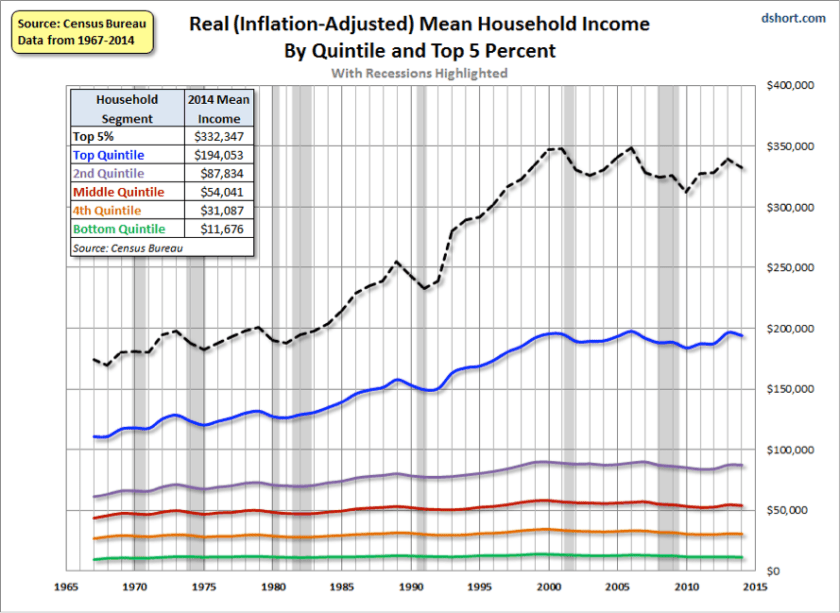
After many decades of impressive and relatively steady increases in the standard of living (increases in real per capital income) of all quintiles of the American income distribution, since 2000 all quintiles have lost ground. In the run up to 2000 incomes in the top quintile increased more rapidly than those in the lower quintiles resulting in a less equal distribution income.

Mean income

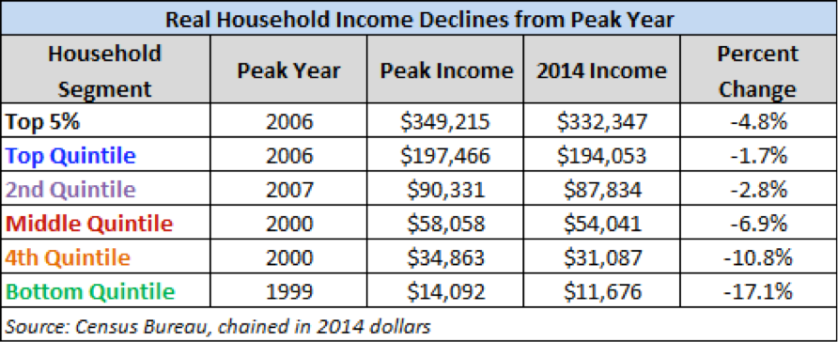
The mean real incomes of each quintile are lower now (2014) than they were in 2000. However, the percentage decline has been larger for the middle and lower income quintiles (see table below) leaving the more unequal income distribution in place. Some of the relative gains of the top quintile are attributed to the growing premium for higher education, but as claimed by the Occupy Wall Street demonstrators, some have not been earned by providing higher valued products.

Income table

Most of us do not resent and in fact are grateful for those whose wealth resulted from inventing and giving us products we greatly enjoy. However, we are rightly angry at both political parties for increasingly supporting crony capitalists—those who benefit from their connection with and influence on the government—who benefit at the expense of the rest of us. They are capturing economic rents at the expense of the rest of us rather than enjoying the fruits of greater productivity.

The broad political consensus in the United States that we are each entitled to the wealth we each create, but must fairly share in the cost of providing our national defense, public goods and a satisfactory safety net for the poor, seems to be falling apart. In the economic sphere, the left increasingly favors one group, the working class represented by labor unions, against the professional and entrepreneurial classes. Classical liberals (i.e., economic conservatives) champion fairness – a level playing field – and the freedom to get rich if you work harder, or create a better product, or a more efficient way of producing what people want. They champion measures that facilitate entrepreneurship and economic growth without much regard for its impact on income distribution. Trade – globalization – is an essential part of promoting economic efficiency and thus growth, allowing, if not forcing, firms to shift resources into goods for export in which they are relatively more efficient in order to pay for the cheaper imports enjoyed by the average middle class consumer.

The Republican Party more so than the Democratic Party, though not by much, has increasingly been failing to preserve a level playing field in various areas (Wall Street, defense industry etc.). But the embrace of protectionism offered by Donald Trump reflects either class warfare or ignorance of globalization’s enormous contribution to our standard of living. The big trade and industrial unions of old—think of the United Auto Workers in Detroit—followed a different drummer. They were not interested in fairness but rather fought to bring economic rents (monopoly returns) to themselves at the expense of other workers via a deal with their employers to create, defend, and share monopoly returns. This worked with the auto industry, where auto workers earned at least double the prevailing wages for nonunion workers with comparable skills as long as GM, Ford and Chrysler could hold off competition from German and Japanese (plus a growing list) auto producers via a combination of tariffs and safety standards. Globalization gradually destroyed this monopoly arrangement and almost killed the American automobile industry until U.S. automakers relocated to southern, non-union states.

While good working conditions are win win for workers and employers, pushing up wages above their competitive level either drives firms to other locations (non union states or abroad) or kills them all together. Voters supporting protectionist policies either don’t understand that they lower the standard of living for most people (here and abroad) by lowering the overall productivity of workers or they seek to exploit monopoly rents for themselves at the expense of other workers.

Such thinking was dramatically illustrated by the recent strike of workers at Tesla Motor’s giga battery factory project in Nevada. As reported in the Washington Post on March 2: “On Monday, hundreds of workers walked off their jobs at the giant battery factory that Tesla Motors is building in the desert outside Reno, Nevada. It wasn’t your typical picket: They weren’t protesting bad working conditions, or making a show of force around contract negotiations. Rather, they were protesting other workers — specifically, the fact that they were from somewhere else.” Their complaint was that workers from out side Nevada were willing to work for less than the $35 per hour that members of the local union were making. These were not “foreign” workers from South of the border. These were workers from Arizona and New Mexico. The out of state workers obviously found their “low” wages with Tesla in Nevada better than the wages they would receive staying at home so they were better off coming to Reno.

The Post further reported: “That dispute explains an important debate underway right now in all sorts of skilled trades: Builders say there’s a labor supply problem, which needs to be fixed by bringing more people into the field from across the country and across the border. Worker groups say there isn’t a supply problem — it’s just that builders aren’t paying enough to make the jobs worth someone’s while.”

Trump’s pledge to protect America workers from cheap Chinese and other imports so they can produce them in the U.S. at a higher cost, is bad economics and bad policy. He is pledging to benefit one group of workers at the expense of other workers and at the expense of the standard of living more generally. This is not what the Republican Party has stood for in the past and not what it should stand for now. It should stand for fairness and equal opportunity for workers and entrepreneurs to benefit from doing things better and thereby raising their incomes and the income of the nation. The principle of fairness is widely held in the United States but has always had to battle for dominance against the temptation of the zero sum claims of special interests for government to serve their interests at the expense of others and at the expense of fairness. Donald Trump and Bernie Sanders are appealing to special rather than general interests at the expense of fairness.