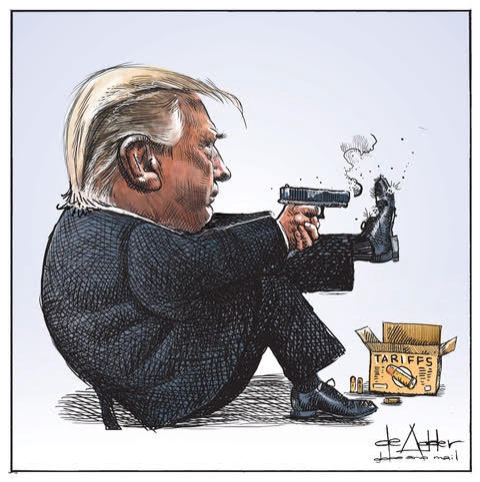
Tariffs

“Posting on his Truth Social platform, Trump said [Monday] that on the first day of his presidency he will charge Mexico and Canada a 25% tariff on all products coming into the U.S. He added in a separate social-media post that he would impose an additional 10% tariff on all products that come into the U.S. from China,… That would come on top of existing tariffs the U.S. has already imposed on Chinese goods.

“’This Tariff will remain in effect until such time as Drugs, in particular Fentanyl, and all Illegal Aliens stop this Invasion of our Country!’ Trump wrote.” WSJ: Trump pledges tariffs on Mexico Canada and China”

A tariff is a tax on an import. They are permitted by the World Trade Organization when leveed on goods receiving state subsidies in order to create a level playing field for trade. Such global trade has made an enormous contribution to the standard of living around the world.  “Ernie Tedeschi, former chief economist for President Joe Biden’s Council of Economic Advisers, said the North American tariffs would cost the typical American household almost $1,000 per year.” WP: “Trump tariffs-China Mexico Canada”

The normal expectation is that the tariff will reduce U.S. demand for the taxed import and encourage its domestic production. But the US labor force is fully employed and can only increase domestic production of the targeted goods by shifting workers from the production of goods the US has a comparative advantage in thus reducing our overall income. Though employment of manufacturing workers has declined in the US, manufacturing output has not because worker productivity has increased. In fact, our imports have not shipped American jobs overseas as increasing productivity has resulted in reduced manufacturing employment most everywhere in the world, including China, surely a good thing. WC: “Trade protection and corruption”

Immediately after Trump’s tariff announcement, the exchange rate of the dollar strengthened. A stronger dollar reduces the cost of imports (but increases the cost to foreigners of our exports), thus undoing to some extent the demand reducing impact of the tariff. But it hurts our exports because of their higher price to foreign purchaser and reduces our overall standard of living.

China and others hit with this tax are likely to retaliate with their own tariffs. “Under the United States-Mexico-Canada Agreement (USMCA), which took effect in 2020, goods moving among the three North American nations cross borders on a duty-free basis. ‘Obviously, unilaterally imposing a 25 percent tariff on all trade blows up the agreement,’ said John Veroneau, a partner at Covington & Burling in Washington.”  WP: “Trump tariffs-China Mexico Canada”

Should Trump actually impose these tariff’s he would (again) be violating the law, which only allows the President to impose tariffs without Congressional approval for national security reasons: WC: “Tariff abuse”

Trump’s threatened tariffs are not even leveed on the goods he wants to restrict (drugs and illegal aliens). Thus, unlike traditional tariffs they would be leveed to pressure Mexico and Canada to take other actions Trump wants. They are bargaining ploys. So at the cost of raising prices and lowering incomes in the US, weakening the global trading rules from which we have benefited so much, and weakening the checks and balances limiting an over extended executive branch, Trump may be playing his bargaining game again. But in my opinion the cost to us and the world trading system is too high.

Trust but Verify

Trust in our institutions and each other is a hugely important factor in a society’s wellbeing. The lack of it can cost billions of dollars and inconveniences in airports and other security measures and in the extreme can lead to physical attacks on our government such as the January 6 attack on the U.S. Congress.

Russia has produced and helped disseminate fake news about U.S. government responses to recent hurricanes (“Russia amplified hurricane disinformation to drive Americans apart”,  “Covert war on American minds”) and destruction of mail-in ballets for next week’s elections (“Pennsylvania ballots video by Russia”). Donald Trump continues to deny that he lost the 2000 elections despite knowing otherwise according to his staff. “Indictment claims Trump knew he lost”  

Responding to government incentives, pharmaceutical companies developed COVID vaccines in amazingly quick time during Trump’s administration, which then lost public trust as a result of Anthony Fauci’s lie about the lack of need for face masks (“Noble lies-covid-Fauci-CDC-masks”) and mixed messages from the American public health establishment. While the government’s understanding of the COVID virus and how best to protect ourselves from it evolved as more information was analyzed, their communications with the public did not give confidence that they were sharing what they knew and what they didn’t. Temporary lock downs might have been justified as the government geared up to respond, but each of us should have been given more freedom thereafter to make our own risk assessments based on the best available information. School closings have done permanent harm to a generation of children.

America has flourished because we are free and relatively unrestrained to live and innovate as we please within public institutions we trust. These facts—President Reagan’s “Beacon on the Hill”—have attracted the admiration of much of the world. But our record is not pure and the more we depart from these principles the more the world will come to distrust us. The current example is America’s complicity with Israel’s genocidal wars in Gaza, West Bank, and Lebanon.  “Warnings of Israel’s UNRWA ban will collapse aid efforts in Gaza”   The UN has condemned Israel’s attacks and blocking of food and medical aid to Gaza, and bombing schools and hospitals. “List of United Nations resolutions concerning Israel and the annexation of Jerusalem”. U.S. law forbids providing aid to countries guilty of such acts, but we continue providing it none the less.  “Two governments linked by lies and bloodshed”

But our complicity with Israeli atrocities is not the first or only example of such behavior. Our ally, then enemy, Iraq used chemical weapons (nerve gas and mustard gas) during the Iran-Iraq War, starting in 1983 and continuing until the war ended in 1988. We closed our eyes and said nothing.

Even the Reagan administration, whose détente with the Soviet Union helped end the cold war, violated its principles and public trust with the Iran-Contra Affair. “Iran Contra Affair”

Such violations of our principles damage public trust at home and abroad. Beyond being despicable in their own right, they undermine trust in our institutions at home and abroad and threaten the life we have always expected to enjoy. This is not something Russia is doing to us, we are doing it to ourselves.

Be sure to vote next week and happily or graciously accept the outcome.

Trump’s second go

JPMorgan CEO Jamie Dimon recently stated that:  “I don’t think people are voting for Trump because of his family values. If you just take a step back and are honest, he’s kind of right about NATO, kind of right on immigration, he grew the economy quite well, tax reform worked. He was right about some of China….  I don’t like how Trump said things, but he wasn’t wrong about those critical issues. That’s why they’re voting for him. People should be more respectful of our fellow citizens. When you guys have people up here [on a CNBC panel] you always ask them why — not like it’s a binary thing that you’re supporting Trump or you’re not supporting him– but why are you supporting him.” “Jamie Dimon on Trump

In addition, during Trump’s administration many excessive regulations were revoked or reduced. Secretary of Education Betsy DeVos promoted school choice and restore due process to college rape cases. Andrew Wheeler, Trump’s administrator of the United States Environmental Protection Agency (EPA) reduced greenhouse gas emissions, improved water quality, and cleaned up contaminated sites while strengthening cost benefit assessments of environmental regulations. And much more.

His administration did many bad things as well.  His advisors Stephen Miller and Peter Navarro implemented protectionist, buy American trade policies that hurt our economy. His crazy withdrawal from the Trans Pacific Partnership was an ill advised gift to China. He Imposed a travel ban on citizens from seven Muslim-majority countries, rescinded the Deferred Action for Childhood Arrivals (DACA) Program, separated families at the US-Mexico border and withdrew from the Paris Climate Agreement and the Iran Deal (Joint Comprehensive Plan of Action), which was designed to prevent Iran from developing nuclear weapons.

Trump’s promise to leave Afghanistan was not kept (and was later very badly executed by President Biden). His initial love affairs with North Korea’s President Kim Jong Un and China’s Xi Jinping exploded into hostility. If reelected Trump promises revenge against his enemies. He promises to strip tens of thousands of career employees of their civil service protections in order to dismantle the “deep state.” He promises to impose tariffs on all imported good and to revoke the visas of students studying in the U.S. who are critical of the U.S. None of these is keeping with the traditions and policies that have helped make America great.

On the other hand, I hope that he would keep his promise not to send American soldiers to Taiwan should China attack it militarily, which would be insane. Whether we would get the better or worse policies under another Trump administration would also depend on the team that he would bring with him.

Trump’s small-minded pettiness, dishonesty, vindictiveness, and egotism are on daily display. He is not someone I would invite into my home. But we are right to look at the policies he pledges and is likely to pursue if elected President again in 2024. As with his previous administration, his next one, if reelected, will depend on those who join and run his administration.

My expectation is that Trump will be more careful next time to choose loyalists rather than the most capable. It is also likely that the most capable people would refuse to be part of another Trump administration. I expect the worst.

How to destroy the U.S.

The United States has the largest economic output (GDP) of any country on earth and the eighth highest income per capita at $59,939, below Luxembourg, Macao, Ireland, Switzerland, Norway, Iceland and Qatar. The world average per capita income is $17,100. The factors contributing to America’s prosperity would require volumes to fully explain. But the essence of our flourishing can be summarized in a few sentences.

Americans, individually or together in companies, have produced more than the citizens of other countries, because they trust in and rely on well defined and honestly enforced property and other individual rights that enable them to profit from their efforts—they believe in and follow the rule of law. That profit includes the freedom to live as they choose. We don’t always agree on which rules and laws would best facilitate our rights and interactions, but we trust in the process of public debate, adoption and enforcement of such rules.

Someone wanting to weaken American would attempt to undermine our trust in the above (trust in the institutions that formulate and enforce the rule of our agreed laws). Don’t confuse criticisms of weaknesses in our laws and their enforcement meant to strengthen and improve them with attacks on their legitimacy and fundamental honesty meant to undermine and discredit them. The former are from patriots and the later from our enemies. Look around you and see who is trying to improve American who is trying to tear it down and weaken it.

Competing with China

China is now our main economic and political rival. Our proper and honorable response should be to strengthen our side—to be the best that we can be—in the way that one athletic team would fairly compete with another. Instead, we seem to be following the Michael Corleone—God Father—script of knee capping the enemy. Worse still, rather than pulling China into compliance with the international rules of commerce, we are moving toward their failing system of central guidance (industrial policy) of investment.

Deng Xiaoping, who served as the “paramount leader” of the People’s Republic of China (PRC) from December 1978 to November 1989, ended Mao’s repressive economic policies thus freeing up much of the economy under policies dubbed “socialism with Chinese characteristics.” Deng became known as the “Architect of Modern China.” “Since China began to open up and reform its economy in 1978, GDP growth has averaged almost 10 percent a year, and more than 800 million people have lifted themselves out of poverty.” When Xi Jinping took the throne in 2013, China’s annual GDP growth rate was 7.8%. As he increasingly reversed Deng’s economic liberalizations, China’s growth rate has steadily declined and is expected to average 2.8% in 2022. “World Bank – China”

The dramatic economic growth around the world since the start of the industrial revolution is founded in private property and trade. Trade enables individuals (and families) to specialize in what they have a comparative advantage in producing and trade it for what their neighbors are better at. Both are wealthier as a result. “Econ-101-Trade in very simple terms”    “Benefits of free trade”

Following President Richard Nixon’s page turning first visit to the Peoples Republic of China in 1972, when China’s total exports had drifted down from 4.3% of China’s GDP in 1960 ($2.6 billion) to 3.25% ($3.7 billion), until the U.S. formally established full diplomatic relations with the PRC under Deng in 1979, when its total exports were 5.16% of its GDP ($9.2 billion), exports remained a small part of China’s economic output. U.S. diplomatic recognition opened the door to increased trade with China.

At the time, a friend asked me what China could possibly produce that we would want to buy (I swear). While Chica’s exports changed little over those 19 years as a share of its GDP, it increased threefold in dollar value as a result of Chica’s overall economic growth.

Over the next 19 years (1979-1998) following Deng’s economic liberalization, China’s exports rose to 18.34% of its GDP and to $188.8 billion in absolute terms (over 20 times its exports in 1979). Income growth in developing countries normally reflect investment in capital, but in China’s case the larger share of its spectacular growth after its liberalization resulted from the improved efficiency of its resource allocations (increased labor and capital productivity). According to an IMF study “Analysis of the pre- and post-1978 periods indicates that the market-oriented reforms undertaken by China were critical in creating this productivity boom…. Prior to the 1978 reforms, nearly four in five Chinese worked in agriculture; by 1994, only one in two did. Reforms expanded property rights in the countryside and touched off a race to form small nonagricultural businesses in rural areas.” “Why Is China Growing So Fast”

But to maximize the win-win feature of trade, each person/firm must make its decisions about what to produce and trade without distorting outside interference (taxes, subsidies, buy American, etc.). Thus, communities develop rules and norms for “fair” trade. When trade extended beyond the community to the entire world, individuals and countries could maximize the mutual benefits of trade by extending such rules internationally. The U.S. had high protective tariffs on some Chinese goods under the Smoot–Hawley Tariff Act of 1930 (the Reciprocal Trade Agreements Act of 1934 allowed the US President to negotiate bilateral tariff reductions). China had many restrictions on foreign investments in China and a variety of government interventions in its export markets. These restrictive measures needed to be addressed as part of granting China membership in the World Trade Organization (WTO).

From joining the WTO at the end of 2001, China’s $272.1 billion in exports exploded to almost $3,550 billion over the next 19 years (2020), an increase of 13 times (essentially the same share of its GDP as the result of its extraordinary growth in total output). China’s imports followed a similar, but modestly lower, path, raising from 4.4% of GDP ($2.6 billion) to 17.42% of GDP ($3.090 billion) in 2020.  Prior to China’s admission into the WTO what had historically been generally balanced trade (imports and exports generally balanced) rose to a trade surplus of 4.45% in 1997. China sold more abroad than it bought from abroad and bought U.S. debt and property with the resulting surplus. It was hoped and expected that China’s pursuit of an export promotion policy based on an undervaluation of its exchange rate would be reined in by its adoption of WTO rules.

The Peoples Bank of China requested technical assistance from the IMF with complying with WTO requirements. In July 2002 the IMF sent me to discuss and organize the assistance for what was one of my most enjoyable missions (VIP tours of the Great Wall and the Forbidden City and some fabulous dinners). They wanted an American banking supervisor. One of my conditions was that he be given an office with an open door with the rest of the Chinese supervisors. The Deputy Governor approved our agreement, but the Governor vetoed it reflecting the existence of conflicting views on China’s way forward. The primary difference with the officials I talked to was how fast China should liberalize. They all agreed on the direction. The IMF report cited above stated that: “By welcoming foreign investment, China’s open-door policy has added power to the economic transformation. Cumulative foreign direct investment, negligible before 1978, reached nearly US$100 billion in 1994; annual inflows increased from less than 1 percent of total fixed investment in 1979 to 18 percent in 1994.” Direct foreign investment in 1994 was $34 billion and in 2020 it was $253 billion.

China’s gradual liberalization of its restrictions on capital outflows have resulted in larger outflows than inflows since early 2020. Between February and July of this year (2022), China suffered a record net outflow of US$81 billion via the Stock Connect and Bond Connect mechanisms, according to data from the Institute of International Finance (IIF). 

As developing countries catch up to the developed country leaders, their growth rates are expected to slow. But China’s continued heavy government direction of investment, while producing impressive high-speed trains and many thousands of high-rise apartments, and the resulting level of wasteful malinvestment is increasingly taking its toll. After speaking at a People’s Bank of China and Reinventing Bretton Woods conference in Hangzhou in 2014, I continued West to participate in the Astana Economic Forum, in Astana, Kazakhstan, stopping overnight in Urumqi, China, to celebrate my 72 birthday and change planes. Driving from the airport into a lovely Sheraton Hotel in downtown Urumqi, I passed row upon row of empty high-rise apartments (it was evening, and they were all dark) now the source of a major real estate crisis.

When Xi Jinping took over as China’s leader in 2013, the unfinished project of economic liberalization was stopped and put into reverse. The slowing of China’s growth rate accelerated. Clyde Prestowitz reported that: “The CCP [Chinese Communist Party] has long operated the economy on the basis of five year plans. In 2015, the new five year plan included the objective of: Made in China 2025. It listed a range of hi technology items with a target for making them in China by the year 2025. Semiconductors were high on the list, and as an advisor at the time to Intel, I can say that China exerted enormous pressure on that company and many others to move their production of semiconductor chips to China” “Tom Friedman has Biden and China Backward”

We are competing with China just as every firm competes with every other firm. It is mutually advantageous for both economies to grow. It is win win. But neither of us fully plays by the rules of fair trade. What should we do? While adopting policies to strengthen our own economy, we should encourage China to fulfil its WTO obligations. We are doing the opposite. We are taking the God Father mobster approach. As Edward Luce put it in the Financial Times: “Imagine that a superpower declared war on a great power and nobody noticed. Joe Biden this month launched a full-blown economic war on China — all but committing the US to stopping its rise — and for the most part, Americans did not react”  “Containing China is Biden’s Explicit Goal”

German Chancellor Olaf Scholz declared that “Globalisation has been a success story that enabled prosperity for many people. We must defend it…. Decoupling is the wrong answer…. 

We don’t have to decouple from some countries,… I say emphatically we must continue to do business with China.” “Decoupling China wrong answer says German leader”

“Mr. Xi and President Biden should focus their efforts on the future they seek, rather than the one they fear…. If a peaceful — if competitive — coexistence is the ultimate objective, Washington and Beijing do not need to knock each other out to win.” Jessica Chen Weiss in NY Times

We are restricting and reducing trade rather than encouraging its expansion. Not only has President Biden left former President Trump’s unjustified and damaging steel and aluminum tariffs in place (including on Canada) on national security grounds, but we have also directly knee-capped Chinese industries (Huawei, semiconductor chip supplies, etc.). “On 7 October, the Biden administration imposed a sweeping set of export controls that included measures to cut China off from certain semiconductor chips and chip-making equipment. Under these rules, US companies must cease supplying Chinese chipmakers with equipment that can produce relatively advanced chips unless they first obtain a licence.” “What do US curbs on selling microchips to China mean for the global economy”

Historically, such measures, as well as tariffs and bans on certain imports, have been motivated by protecting domestic firms or industries. “The Reign of Polite Protectionism”  The Jones Act of 1917, which forbids shipping goods between US ports in anything other than US built ships, is one of the most useless and embarrassing such laws (ask Puerto Rico). Banning the sale of some items to China can have a military justification but drawing the line between justifiable security concerns and the protection of uncompetitive domestic firms can be difficult. Trump’s 25% tariff on Canadian steel was (but cannot honestly be) justified on national security grounds. Whither justified or not, such restrictions make China and the U.S. (and the rest of the world) poorer. “Next salvo in Biden’s tech war on China expected to aim at quantum computing parts and artificial intelligence software.”  “US mulling bans to stunt China’s quantum computing”  Such restriction are examples of the knee-capping approach to competing with our rivals. “Trade protection and corruption”

But worse still we are now increasingly adopting China’s approach to economic management by the state—so called industrial policy. The recently adopted Inflation Reduction Act, for example, along with measures to reduce carbon omissions, subsidizes the domestic production of solar panels, wind turbines, batteries, and the processing of some critical minerals. A good economic case can be made for encouraging the use of low or non-carbon emitting sources of energy such as with the carbon taxes imposed in Europe. But there is no good case for incurring the higher cost of subsidizing the manufacture of low carbon emitting energy sources in the U.S. The same applies to subsidizing the domestic production of semiconductor chips as is established in this Act. The historical experience with government selection and support of particular products or technologies is not good to say the least. The Trump administration’s promise to buy successful Covid vaccines was a much better and very successful approach to encouraging the private sector.

“French President Emmanuel Macron slammed US trade and energy policies for creating “a double standard” with Europe…. He complained that ‘they allow state aid going to up to 80% on some sectors while it’s banned here — you get a double standard…. It comes down to the sincerity of transatlantic trade….’ The EU has been chafing over the US stimulus package known as the Inflation Reduction Act, which provides subsidies for electric cars made in North America.” “Macron accuses US of trade double standard amid energy crunch”

The financial incentive for corruption in obtaining government financial support is obvious. But even without it, government agents are at best just as good at determining and funding the best new and promising technologies for the future as are private entrepreneurs. The difference is that the private entrepreneurs are risking their own money and the government is risking yours and my money. The vast majority of such undertakings fail. When funded by the government, however, there is less financial pressure to fold and move on when outcompeted by better products. The government landscape is littered with white elephants.  “Questioning industrial policy”

Our China related policies have become damaging to the US and the West in almost every respect. “The China Initiative, launched in 2018 by the administration of former US president Donald Trump, aimed to fight suspected Chinese theft of technical secrets and intellectual property as competition between the two countries intensified…. At least 1,400 US-based ethnic Chinese scientists switched their affiliation last year from American to Chinese institutions,… The US had been ‘losing talent to China for a while and particularly after the China Initiative’,” “1400 US based ethnic Chinese scientists exited American institutions”  Not only do they return with Western technical knowledge but they also return with a fondness for Western values and freedom. Many Chinese retain that fondness and the desire to import more of it into China. We should not kill off those desires.

Doug Bandow offers sound advice: “There is still much for the West to do. The future is not set, and contra Xi’s boastful rhetoric, freedom still is the better bet for the world. Washington should start by addressing its own weaknesses. Free and allied states can constrain the PRC when necessary while cooperating with Beijing when possible, addressing Chinese abuses without adopting the PRC’s authoritarian and collectivist strategies. Americans should continue to engage the Chinese people, especially the young, showing respect for a great civilization while making the case for a free rather than totalitarian society. America can remember the crises she has overcome in the past, and confidently confront the China challenge today.” “Xi plays Mao without the madness”

The Mar-a-Lago Raid

Former President Trump is under investigation for a number of possible crimes—e.g., tax evasion, attack on the Capital on Jan. 6, illegal removal or destruction of federal government records. This note, written together with Odell Huff, deals only with the possible crimes in relation to which the FBI raided Trump’s home at Mar-a-Lago. The FBI obtained the search warrant for Mar-a-Lago as part of an investigation into Trump’s handling of presidential documents. The search warrant listed three federal criminal statutes:

  • violations of the Espionage Act regarding unauthorized retention of national defense information;
  • destroying or concealing records “with the intent to impede obstruct or influence” federal government activity;
  • illegal removal or destruction of federal government records (without respect to cause).

See Wikipedia’s extensive report: “FBI search of Mar-a-Lago.[1]

An immediate outcry from Donald Trump asked why such a raid was needed, claiming it was political, and called for a comparison of the mistreatment of government emails by then Secretary of State Hillary Clinton.

In Hillary Clinton’s case, which is reviewed in more detail in the second half of this note, her improper use of her personal computer for State Department messages, many of which she destroyed, was, in essence, forgiven. The FBI Director James Comey concluded (inappropriately, as it was properly a decision for the Justice Department to make) that: “Although there is evidence of potential violations of the statutes regarding the handling of classified information, our judgment is that no reasonable prosecutor would bring such a case.”[2]

Donald Trump

Was the raid on a former President justified and should Donald Trump be charged for the crimes he committed?

Executive Summary of Trump’s Document Handling

All documents and communications of American Presidents must be preserved and are the property of the National Archives and Records Administration (NARA). “The Presidential Records Act (44 USC §22) establishes that presidential records belong to the United States and must be surrendered to the Archivist of the United States at the end of a president’s term of office (or second term of office, if consecutive). Unauthorized removal and retention of classified information of the United States government is a criminal offense under U.S. federal law; it has been a felony since the enactment of the FISA Amendments Reauthorization Act of 2017, which was signed into law by President Donald Trump in January 2018 and increased the maximum term of imprisonment for this offense from one year to five years.”[3]

In violation of the Presidential Records Act, “Trump regularly shredded ‘both sensitive and mundane’ papers while at the White House, at Mar-a-Lago, and on Air Force One.”[4] Moreover, upon leaving the White House at the end of his term, Trump sent two vans full of White House material to Mar-a-Lago in what White House aides described as a chaotic rush (as if he didn’t think he would really be leaving).

In May 2021 NARA realized that they had not received all the documents they were required to preserve and began discussions with Trump’s documents team to get them. “Trump reportedly went through the boxes at Mar-a-Lago at the end of 2021…. In January 2022, NARA retrieved 15 boxes of documents, gifts, and other government property from Mar-a-Lago…. From these 15 boxes, archivists and federal agents determined that 184 unique documents (totaling 700 pages) had classification markings, of which 25 documents were marked ‘top secret’, 92 ‘secret’ and 67 ‘confidential’….

Among the more than 11,000 government documents recovered since January 2022, over 100, and possibly over 320, were classified and some included nuclear-related material. The seized documents also included FBI, CIA, and NSA information about national security interests. Two-thirds of the recovered classified material was obtained in the first half of 2022, while the rest (103 documents) was seized in the August search of Mar-a-Lago.”[5]

In short, Trump’s promises to return all of the documents he had illegally taken where not honored and the raid on Mar-a-Lago was a last resort effort to obtain them. It proved to be the only way of obtaining them and was thus necessary and justified.[6]

Trump has clearly violated the Presidential Records Act. He is also guilty of the unauthorized removal and retention of classified information of the United States government. With regard to the second of these crimes—unauthorized removal and retention of classified information—Trump’s claim that he had declassified everything is without merit. “A sitting president has broad Constitutional powers to classify (and declassify) information. However, stemming from claims by former President Trump that documents at Mar-a-Lago were declassified, a Congressional Research Service policy paper on the Mar-a-Lago search warrant highlights that the declassification process is bound by regulations: per 32 CFR §2001.25, it requires markings that are ‘uniformly and conspicuously applied to leave no doubt about the declassified status of the information and who authorized the declassification.’”[7]

We do not yet know whether Trump’s possession of Top Secret and Secret documents has jeopardized our national security.

Should Trump be charged for these crimes?

Donald Trump should be held to the same standards as was Hillary Clinton, who was not charged for her crimes.Clinton’s use of her own computer clearly violated State Department rules and procedures and her resistance and delay in turning over what phone records she didn’t destroy does not reflect well on her to say the least. According to The Washington Post’s Fact Checker, Glenn Kessler, “Clinton, in her tweet, suggests none of her emails were marked classified. That’s technically correct…. Clinton has good reason for making a distinction with Trump.” [8] However, both Kessler and Clinton are technically incorrect because at least three emails were marked with, according to FBI Director Comey, “portion markings,” and another “110 messages contained information that was classified at the time it was sent.”[9]

Nevertheless, Trump’s violations of record keeping requirements were dramatically more numerous and serious. The government-owned documents Trump sent to his Mar-o-Lago residence contained hundreds of conspicuously marked Top Secret, Secret, and Confidential documents, some of which could jeopardize American security and the security of allies (at this writing the official assessment of such potential damage has not been completed). These violations of the law were of an entirely different magnitude than those of Hillary Clinton.

Surely Trump should be indicted for these crimes (separately from whether he should be indicted for his efforts to overturn the election of 2020, Trump University fraud, and/or tax fraud). Equal treatment under the law seems to demand it. Former Presidents should not be above the law. The Justice Department would have to present its case and evidence in a court of law in front of a jury where Trump could defend himself under oath (if he chose to). Especially given the political overtones of the case and the fact that the Attorney General was appointed by Trump’s successor, the case would need to be strong enough to convince the vast majority of American’s that Trump was being treated fairly. 

The pros and cons of charging Trump are explored in more detail in the attached articles.[10],[11]

So Garland has a dilemma: Indict or don’t indict. Risk losing or decline to prosecute and let Trump walk away. In concluding that “Donald Trump Is Not Above the Law” and should be indicted, The New York Times acknowledged last month, “Pursuing prosecution of Mr. Trump could further entrench support for him and play into the conspiracy theories he has sought to stoke. It could inflame the bitter partisan divide, even to the point of civil unrest. If viewed as illegitimate, a trial could also further undermine confidence in the rule of law, whatever the eventual outcome.”[12]

Such a trial runs the risk of provoking significant civil unrest (yes, we seem to have sunk so low). It is not impossible that one of the twelve jurors would refuse to convict Trump. Thus, an alternative suggestion is to hold a Grand Jury hearing in which all of the evidence is laid out for all to see, leaving it to voters to determine Trump’s ultimate fate. We would personally prefer to see this dangerous man behind bars.

Chronology

The following is excerpted from the CNN published timeline of the case.[13]

May 2021

An official from NARA contacts Trump’s team after realizing that several important documents weren’t handed over before Trump left the White House. The missing documents include some of Trump’s correspondence with North Korean leader Kim Jong Un, as well as the map of Hurricane Dorian that Trump infamously altered with a sharpie pen.

Fall 2021

NARA grows frustrated with the slow pace of document turnover after several months of conversations with the Trump team. NARA reaches out to another Trump attorney to intervene. The archivist asks about several boxes of records that were apparently taken to Mar-a-Lago during Trump’s relocation to Florida. NARA still doesn’t receive the White House documents they are searching for.

January 2022

After months of discussions with Trump’s team, NARA retrieves 15 boxes of Trump White House records from Mar-a-Lago. The boxes contained some materials that were part of “special access programs,” known as SAP, which is a classification that includes protocols to significantly limit who would have access to the information. NARA says in a statement that some of the records it received at the end of Trump’s administration were “torn up by former President Trump,” and that White House officials had to tape them back together. Not all the torn-up documents were reconstructed, NARA says.

February 9, 2022

News outlets, including CNN, report that NARA asked the Justice Department to investigate Trump’s handling of White House records and whether he violated the Presidential Records Act and other laws related to classified information. The Presidential Records Act requires all records created by a sitting president to be turned over to the National Archives at the end of their administration.

April and May 2022

On April 7, NARA publicly acknowledges for the first time that the Justice Department is involved, and news outlets report that prosecutors have launched a criminal probe into Trump’s mishandling of classified documents. Around this time, FBI agents quietly interview Trump aides at Mar-a-Lago about the handling of presidential records as part of their widening investigation.

April 11, 2022

The FBI asks NARA for access to the 15 boxes it retrieved from Mar-a-Lago in January. The request was formally transmitted to NARA by President Joe Biden’s White House Counsel’s office, because the incumbent president controls presidential documents in NARA custody.

April 29, 2022

The Justice Department sends a letter to Trump’s lawyers as part of its effort to access the 15 boxes, notifying them that more than 100 classified documents, totaling more than 700 pages, were found in the boxes. The letter says the FBI and US intelligence agencies need “immediate access” to these materials because of “important national security interests.” Also on this day, Trump lawyers ask NARA to delay its plans to give the FBI access to these materials. Trump’s lawyers say they want time to examine the materials to see if anything is privileged, and that they are making a “protective assertion of executive privilege” over all the documents.

May 10, 2022

Debra Steidel Wall, the acting Archivist of the United States, who runs NARA, informs Trump’s lawyers that she is rejecting their claims of “protective” executive privilege over all the materials taken from Mar-a-Lago, and will therefore turn over the materials to the FBI and US intelligence agencies. In a four-page letter, Wall says she reached this decision after consulting with top lawyers from the Justice Department and the White House Counsel’s office.

May 11-12, 2022

The Justice Department subpoenas Trump, seeking documents with classification markings that are still at Mar-a-Lago. Trump directs his staff to search for any remaining classified material, to comply with the subpoena, according to a lawsuit he later filed.

News outlets report that investigators subpoenaed NARA for access to the classified documents retrieved from Mar-a-Lago. The subpoena, which is part of the process to allow investigators to take possession of the documents from the NARA, is the first public indication of the Justice Department using a grand jury in its investigation.

June 2-3, 2022

According to a lawsuit the former President later filed, Trump invites FBI officials to come to Mar-a-Lago to retrieve the subpoenaed materials.

Four investigators, including a top Justice Department counterintelligence official, visit Mar-a-Lago seeking more information about classified material that had been taken to Florida. The four investigators meet with Trump’s attorneys and look around the basement room where the documents are being stored. Trump briefly stops by the meeting to say hello to the officials, but he does not answer any questions. During the meeting, the federal officials deal with the grand jury subpoena for some of the sensitive national security documents on the premises, and they take away the subpoenaed documents. At some point later in June, a Trump lawyer sends a letter to the Justice Department inaccurately asserting that there aren’t any more classified documents at Mar-a-Lago.

June 8, 2022

Trump’s attorneys receive a letter from federal investigators, asking them to further secure the room where documents are being stored. In response, Trump aides add a padlock to the room in the basement of Mar-a-Lago.

June 24, 2022

Federal investigators serve a subpoena to the Trump Organization, demanding surveillance video from Mar-a-Lago. Trump’s company complies with the subpoena and turns over the footage. CNN has reported that this was part of an effort to gather information about who had access to areas at the club where government documents were stored.

August 8, 2022

The FBI executes a search warrant at Mar-a-Lago—a major escalation of the classified documents investigation. The search focused on the area of the club where Trump’s offices and personal quarters are located. Federal agents remove boxes of material from the property. The search was the first time in American history that a former president’s home was searched as part of a criminal investigation.

August 11, 2022

Trump sends a message through one his lawyers to Attorney General Merrick Garland, saying he has “been hearing from people all over the country about the raid” who are “angry,” and that “whatever I can do to take the heat down, to bring the pressure down, just let us know,” according to a lawsuit he later filed. Hours later, after three days of silence, Garland makes a brief public statement about the investigation. He reveals that he personally approved the decision to seek a search warrant, and that the Justice Department will continue to apply the law “without fear or favor.” Garland also pushes back against what he called “unfounded attacks on the professionalism of the FBI and Justice Department.” Garland also announces that the Justice Department will ask a judge to unseal some of the search warrant documents, for the sake of transparency.

August 12, 2022

Federal Magistrate Judge Bruce Reinhart approves the unsealing of the Mar-a-Lago search warrant and its property receipt, at the Justice Department’s request and after Trump’s lawyers agree to the release. The warrant reveals the Justice Department is looking into possible violations of the Espionage Act, obstruction of justice and criminal handling of government records, as part of its investigation.

August 22, 2022

Trump files a federal lawsuit seeking the appointment of a third-party attorney known as a “special master” to independently review the materials that the FBI seized from Mar-a-Lago. In the lawsuit, Trump’s lawyers argue that the Justice Department can’t be trusted to do its own review for potentially privileged materials that should be siloed off from the criminal probe.

August 27, 2022

Federal District Judge Aileen Cannon, a Trump appointee who is presiding over Trump’s civil lawsuit, announces her “preliminary intent” to appoint a special master to examine the seized Mar-a-Lago materials.

September 1, 2022

Federal prosecutors clash with Trump’s lawyers at a high-stakes court hearing in Palm Beach, Florida, as part of Trump’s lawsuit seeking the special master appointment.

September 5, 2022

In a major ruling, Cannon grants Trump’s request for a special master to review the seized materials from Mar-a-Lago. She says the special master will have the power to look for documents covered under attorney-client privilege and executive privilege. The outcome is a major victory for Trump.

September 8, 2022

The Justice Department appeals Cannon’s decision in the special master case. Prosecutors also ask Cannon to temporarily block two key parts of her ruling while their appeal plays out: First, the part where she blocked the Justice Department from using any of the seized materials in their criminal probe while the materials were being reviewed by the special master, and second, the part of her ruling that required the Justice Department to hand over classified documents to the special master.

Hillary Clinton

Executive Summary of Hillary Clinton Email Controversy

During her tenure as United States Secretary of State (2009-2013) and later as the 2016 Democratic Presidential Candidate, Hillary Clinton drew controversy by using a private email server while Secretary of State for public communications rather than using official State Department email accounts maintained on federal servers. Clinton’s server was found to hold over 100 emails containing classified information, including 65 emails deemed “Secret” and 22 deemed “Top Secret.” An additional 2,093 emails not marked classified were retroactively designated confidential by the State Department.[14]

At the very beginning of her tenure as Secretary, the Bureau of Diplomatic Security had warned Clinton about the vulnerabilities of her use of a BlackBerry along with a private server, but Clinton ignored it and the Bureau took no action. While members of the Administration knew that Clinton used a private email address (clintonemail.com), no one outside of the State Department, certainly not President Obama, knew that she was using a private server maintained in her home by a private computer services firm. In October 2014, the State Department asked all previous Secretaries of State for all documents related to their time in office. Clinton responded in December 2014 by delivering 55,000 printed pages of emails that had been housed only on her server and its privately maintained backups (but with no copies of such correspondence in State Department records, as required by policy and by law). Omitted were over 30,000 emails she decided were personal. Federal rules required Clinton to preserve work emails before she left office, but she did not turn over her emails until 21 months after she left office. That Clinton used her private server exclusively for official work was not made public until March 2015 (more than two years after she left office), when The New York Times reported that the House Select Committee on Benghazi made the discovery.

The inspector general of the intelligence community reviewed the hardcopies delivered by Clinton and found “hundreds of potentially classified emails.” A “security referral” (but not criminal), to the Justice Department was made in late July 2015. Clinton and her private computer services companies finally relinquished the actual hardware servers and thumb drives to the FBI in August 2015. Clinton’s lawyer David E. Kendall said that emails, and all other data stored on the server, had earlier been erased prior to the device being turned over to the authorities.

Clinton repeatedly stated that her private server was “allowed by the State Department,” and that she never handled anything marked classified through her server. She repeatedly stated during her campaign that turning over 55,000 printed pages and then the hardware to the government “shows that I have been as transparent as I could.”

In May 2016, the Department’s Office of the Inspector General Steve A. Linick released an 83-page report about the State Department’s email practices. Aside from security risks, the report stated that “[Clinton] did not comply with the Department’s policies that were implemented in accordance with the Federal Records Act.” Each of these findings contradicted what Clinton and her aides had been saying up to that point. The FBI, through statements by Director Comey, later determined “Although there is evidence of potential violations of the statutes regarding the handling of classified information, our judgment is that no reasonable prosecutor would bring such a case.”

My own conclusion is that while Secretary of State, Hillary Clinton deliberately and knowingly violated State Department policy by exclusively using a private server to conduct public as well as private business. While there is no evidence her intention was to specifically mishandle classified information, the clear intent was to retain control (delete forever) anything that could be harmful to her expected campaign for president, classified or not. By submitting 55,000 printed pages of official emails, after having deleted over 30,000 emails she alone decided were personal, and then not turning over the (totally erased) hard drives and thumb drives until almost a year later, she successfully circumvented both FOIA and the Presidential Records Act in order to advance and protect her campaign. The world will never know what she erased, only some of which was only partially recovered after forensic analysis of the scrubbed hardware.

Chronology

The following chronology focuses on requests for cooperation with the investigation of her email practices from Secretary and then Presidential Candidate Clinton and her responses. This review largely draws on the cited Wikipedia article and includes other sourced information.

2009 – 2013

At the outset of her tenure as Sec of State, setting up a secure desktop computer in her office was suggested, but Clinton was unfamiliar with their use and opted for the convenience of her BlackBerry, not the State Department and government protocol of a secured desktop computer. Efforts to find a secure solution were “abandoned by Clinton,” and she was warned by State Department security personnel about the vulnerability of an unsecured BlackBerry to hacking. She affirmed her knowledge of the danger, and was reportedly told that the Bureau of Diplomatic Security had obtained intelligence about her vulnerability while she was on a trip to Asia, but continued to use her BlackBerry outside her office. For the first two months of its use – January 2009 through March 29, 2009 – the web page [sign-in portal for users to access the server] was reportedly not secured with a TLS certificate, meaning that information transmitted using the service was unencrypted and may have been vulnerable to interception.

December 2012 – March 2013

Near the end of Clinton’s term, a nonprofit group called Citizens for Responsibility and Ethics in Washington (CREW), filed a FOIA request seeking records about her email. CREW received a response in May 2013: “no records responsive to your request were located.” Emails sent to Clinton’s private clintonemail.com address were first discovered in March 2013, when a hacker named “Guccifer” widely distributed emails sent to Clinton from former President Bill Clinton aide Sidney Blumenthal, which Guccifer obtained by illegally accessing Blumenthal’s email account. The emails dealt with the 2012 Benghazi attack and other issues in Libya and revealed the existence of her clintonemail.com address.

October – December 2014

In October 2014, the State Department sent letters to Clinton and all previous Secretaries of State back to Madeleine Albright requesting emails and documents related to their work while in office. On December 5, 2014, Clinton lawyers delivered 12 file boxes filled with printed paper containing more than 30,000 emails rather than their easier to analyze original electronic version. Clinton withheld almost 32,000 emails deemed to be of a personal nature. Datto, Inc., which provided data backup service for Clinton’s email, agreed to give the FBI the hardware that stored the backups.

March 2015

A March 2, 2015, New York Times article broke the story that the Benghazi panel had discovered that Clinton exclusively used her own private email server rather than a government-issued one throughout her time as Secretary of State, and that her aides took no action to preserve emails sent or received from her personal accounts as required by law.

After the existence of the server became publicly known on March 2, 2015, the Select Committee on Benghazi issued a subpoena for Benghazi-related emails two days later. Clinton chief of staff Cheryl Mills sent an email to PRN [Clinton’s computer services provider, Platte River Networks] on March 9 mentioning the committee’s retention request. The PRN technician then had what he described to the FBI as an “oh shit moment,” realizing he had not set the personal emails to be deleted as instructed months earlier. The technician then erased the emails using a free utility, BleachBit, sometime between March 25 and 31.

At a March 10, 2015 press conference, Clinton said all personal emails were deleted from her server, and she rejected the suggestion that she turn her server over to an “independent arbiter” to prove that she did not destroy any work-related emails and that “the server will remain private.”[15] The Clinton campaign said that she complied with NARA regulations because “more than 90% of those emails should have already been captured in the State Department’s email system before she provided them with paper copies.”

On March 27, 2015, Republican Congressman Trey Gowdy, Chairman of the Select Committee on Benghazi, asserted that sometime after October 2014, Clinton “unilaterally decided to wipe her server [which remained in her possession at that time] clean” and “summarily decided to delete all emails.” Clinton’s attorney, David E. Kendall, said that day that an examination showed that no copies of any of Clinton’s emails remained on the server. Kendall said the server was reconfigured to only retain emails for 60 days after Clinton lawyers had decided which emails needed to be turned over.

April 2015

Dan Metcalfe, a former head of the Justice Department’s Office of Information and Privacy, said this [exclusive use of a private server] gave her even tighter control over her emails by not involving a third party such as Google and helped prevent their disclosure by Congressional subpoena. He added: “She managed successfully to insulate her official emails, categorically, from the FOIA, both during her tenure at State and long after her departure from it—perhaps forever,” making it “a blatant circumvention of the FOIA by someone who unquestionably knows better.” (According to State Department spokesperson Marie Harf, use by government officials of personal email for government business is permissible under the Federal Records Act, so long as relevant official communications, including all work-related emails, are preserved by the agency.)

June – August 2015

On June 22, 2015, the Benghazi panel released emails between Clinton and Sidney Blumenthal, who had been recently deposed by the committee. Committee chairman Gowdy issued a press release criticizing Clinton for not providing the emails to the State Department. Clinton had said she provided all work-related emails to the State Department, and that only emails of a personal nature on her private server were destroyed. The State Department confirmed that 10 emails and parts of five others from Sidney Blumenthal regarding Benghazi, which the committee had made public on June 22, could not be located in the Department’s records, but that the 46 other, previously unreleased Libya-related Blumenthal emails published by the committee, were in the Department’s records. In response, Clinton campaign spokesman Nick Merrill, when asked about the discrepancy said: “She has turned over 55,000 pages of materials to the State Department, including all emails in her possession from Mr. Blumenthal.” Republican Committee members found emails that Clinton failed to produce. Clinton campaign staff accused Gowdy and Republicans of “clinging to their invented scandal.”

A June 29, 2015, memorandum from the Inspector General of the State Department, Steve A. Linick, said that a review of the 55,000-page email release found “hundreds of potentially classified emails.” A July 17, 2015, follow-up memo, sent jointly by Linick and the Intelligence Community (IC) inspector general, I. Charles McCullough III, to Under Secretary of State for Management Patrick F. Kennedy, stated that they had confirmed that several of the emails contained classified information that was not marked as classified, at least one of which was publicly released. On July 24, 2015, Linick and McCullough said they had discovered classified information on Clinton’s email account. Investigators from their office, searching a randomly chosen sample of 40 emails, found four that contained classified information that originated from U.S. intelligence agencies, including the Central Intelligence Agency (CIA) and the National Security Agency (NSA). Their statement said that the information they found was classified when sent, remained so as of their inspection, and “never should have been transmitted via an unclassified personal system.” Clinton’s presidential campaign and the State Department disputed the letter, and questioned whether the emails had been over-classified by an arbitrary process. According to an unnamed source, a secondary review by the CIA and the National Geospatial-Intelligence Agency endorsed the earlier inspectors general findings concluding that the emails (one of which concerned North Korea’s nuclear weapons program) were “Top Secret” when received by Clinton through her private server in 2009 and 2011, a conclusion also disputed by the Clinton campaign.

The inspector general of the intelligence community said her emails contained classified information and made a “security referral” to the Justice Department in late July 2015. Clinton directed her campaign in mid-August to turn over her computer server to the FBI. Clinton said her personal email account was “allowed by the State Department.” Federal rules required Clinton to preserve work emails before she left office, but she did not turn over her emails until 21 months after she left office. Clinton said “turning over my server” to the government shows “I have been as transparent as I could” about her emails.

Clinton’s IT contractors turned over her personal email server to the FBI on August 12, 2015, as well as thumb drives containing copies of her emails. In a letter describing the matter to Senator Ron Johnson, Chairman of the Senate Homeland Security Committee, Clinton’s lawyer David E. Kendall said that emails, and all other data stored on the server, had earlier been erased prior to the device being turned over to the authorities, and that both he and another lawyer had been given security clearances by the State Department to handle thumb drives containing about 30,000 emails that Clinton subsequently also turned over to authorities.

September 2015

Bloomberg News reported in September 2015 that the FBI had recovered some of the deleted emails. Since this episode, Clinton critics have accused her or her aides of deleting emails that were under subpoena, alleging the server had been “bleached” or “acid-washed” by a “very expensive” process in an effort to destroy evidence.

October 2015

On October 22, 2015, Clinton testified before the committee and answered the Select Committee on Benghazi members’ questions for eleven hours before the Committee in a public hearing. The New York Times reported that “the long day of often-testy exchanges between committee members and their prominent witness revealed little new information about an episode that has been the subject of seven previous investigations … Perhaps stung by recent admissions that the pursuit of Mrs. Clinton’s emails was politically motivated, Republican lawmakers on the panel for the most part avoided any mention of her use of a private email server.”

February 2016

Clinton maintained she did not send or receive any confidential emails from her personal server. In a Democratic debate with Bernie Sanders on February 4, 2016, Clinton said, “I never sent or received any classified material.” This statement was false, as had been clearly stated earlier by the inspector general of the security community in July 2015.

May 2016

In May 2016, the Department’s Office of the Inspector General Steve A. Linick released an 83-page report about the State Department’s email practices. Aside from security risks, the report stated that “she did not comply with the Department’s policies that were implemented in accordance with the Federal Records Act.” Each of these findings contradicted what Clinton and her aides had been saying up to that point. The report also stated that Clinton and her senior aides declined to speak with the investigators, while the previous four Secretaries of State did so.

June – July 2016

In various interviews, Clinton has said that “I did not send classified material, and I did not receive any material that was marked or designated classified.” However, in June and July 2016, a number of news outlets reported that Clinton’s emails did include messages with some paragraphs marked with a “(c)” for “Confidential.” The FBI investigation found that 110 messages contained information that was classified at the time it was sent. Sixty-five of those emails were found to contain information classified as “Secret;” more than 20 contained “Top-Secret” information. Three emails, out of 30,000, were found to be marked as classified, although they lacked classified headers and were only marked with a small “c” in parentheses, described as “portion markings” by FBI Director Comey. Comey added it was possible Clinton was not “technically sophisticated” enough to understand what the three classified markings meant which is consistent with Clinton’s claim that she wasn’t aware of the meaning of such markings.

In a Meet the Press interview on July 2, 2016, she stated: “Let me repeat what I have repeated for many months now, I never received nor sent any material that was marked classified.”

On July 5, 2016, FBI Director Comey announced in a statement he read to press and television reporters at FBI headquarters in Washington, DC, that the FBI had completed its investigation and was referring it to the Justice Department with the recommendation “that no charges are appropriate in this case.” He added, “Although there is evidence of potential violations of the statutes regarding the handling of classified information, our judgment is that no reasonable prosecutor would bring such a case.” With regard to mishandling of classified information, Comey said, “there is evidence that they [Clinton and her team] were extremely careless in their handling of very sensitive, highly classified information.” The investigation found 110 emails that should have been regarded as classified at the time they were sent; another 2,000 emails were retroactively classified which means they were not classified at the time they were sent. Comey said that “any reasonable person in Secretary Clinton’s position, or in the position of those government employees with whom she was corresponding … should have known that an unclassified system was no place for that conversation.”

June 2017

On June 23, 2017, several members of the Senate Judiciary Committee opened a bipartisan inquiry into whether former Attorney General Lynch interfered in the FBI’s investigation into Hillary Clinton’s use of a private email server. The investigation found Clinton’s use of personal email server increased the risk of compromising State Department information, but “there was no persuasive evidence of systemic, deliberate mishandling of classified information.”


[1] Wikipedia contributors, “FBI search of Mar-a-Lago,” Wikipedia, The Free Encyclopedia, https://en.wikipedia.org/w/index.php?title=FBI_search_of_Mar-a-Lago&oldid=1109931185 (accessed September 10, 2022).

[2] Wikipedia contributors, “Hillary Clinton email controversy,” Wikipedia, The Free Encyclopedia, https://en.wikipedia.org/w/index.php?title=Hillary_Clinton_email_controversy&oldid=1104229653 (accessed August 10, 2022).

[3] Op. cit. Wikipedia, “FBI Search of Mar-a-Lago.”

[4] Ibid.

[5] Ibid.

[6] CNN, “Bill Barr ‘skeptical’ Trump declassified Mar-a-Lago papers,” YouTube video, 6:38, Sept. 3, 2022, https://www.youtube.com/watch?v=5zJUge5hdzo.

[7] Wikipedia, “FBI Search of Mar-a-Lago.”

[8] Kessler, Glen. “Hillary Clinton’s claim that ‘zero emails’ were marked classified,” Sept. 8, 2022, The Washington Post, https://www.washingtonpost.com/politics/2022/09/08/hillary-clintons-claim-that-zero-emails-were-marked-classified/.

[9] Wikipedia, “Hillary Clinton email controversy.”

[10] Linker, Damon, “The Case Against Prosecuting Donald Trump,” Persuasion, Sept. 2, 2022, https://www.persuasion.community/p/the-case-against-prosecuting-donald?utm_source=email.

[11] Shugerman, Jed, and Rozenshtein, Alan Z., “The Case for Prosecuting Donald Trump,” Persuasion, Aug. 31, 2022, https://www.persuasion.community/p/the-case-for-prosecuting-donald-trump?utm_source=email.

[12] Zurin, James D., “Indict Trump Over the Mar-a-Lago Documents? Don’t Indict? There’s a Third Option.” Washington Monthly, Sept. 7, 2022, https://washingtonmonthly.com/2022/09/07/indict-trump-over-the-mar-a-lago-documents-dont-indict-theres-a-third-option/.

[13] Cohen, Marshall et al, “Timeline: The Justice Department criminal inquiry into Trump taking classified documents to Mar-a-Lago,” CNN, Sept. 8, 2022, https://www.cnn.com/2022/08/09/politics/doj-investigation-trump-documents-timeline/index.html.

[14] Wikipedia, “Hillary Clinton email controversy.”

[15] Kiely, Eugene. “More Spin on Clinton Emails.” FactCheck.org, 8 September 2015. www.factcheck.org/2015/09/more-spin-on-clinton-emails/. Accessed 13 August 2022.

President Biden Attacks Internal Enemies

President Biden addressed the nation on September 1 from the site of America’s founding. In many respects it was a positive, uplifting speech reminiscent of Ronald Reagan’s wonderful speeches. Though I disagree with many of the details of his recent policy victories, it is normal for a president to promote them. But there was another part of his speech that has become very controversial.

“When President Biden stood before Independence Hall in Philadelphia on Thursday night, he warned that American democracy stands at the precipice… — one that, he said, comes from within the country’s borders. ‘Donald Trump and the MAGA Republicans represent an extremism that threatens the very foundations of our republic,’ Biden said.”  “Biden-danger within us”

The President of the United States is both the leader and head of state for the entire country and the head of his political party. Did President Biden cross the line between defending the country from serious attacks and partisanship when he made his speech? Biden was not criticizing Trump’s protectionist, isolationist policies as I have done (and I have praised Trump’s tax reform and reduction of excessive regulations). Those are partisan political issues. If we don’t like someone’s policies, we can vote against them. Biden was making a much more serious charge. He clarified that:

 “’I don’t consider any Trump supporter to be a threat to the country. I do think anyone who calls for the use of violence, fails to condemn violence when it’s used, refuses to acknowledge that an election has been won, insists on changing the way in which you count the votes — that is a threat to democracy.’ Yet Trump supporters generally do all of those things, backing the former president’s calls to overturn the 2020 election and elect candidates who vow to rewrite election rules, and supporting his promise to pardon those who attacked the U.S. Capitol on Jan. 6, 2021….

“Rep. Marjorie Taylor Greene (R-Ga.) [stated that], ‘Joe Biden just declared all of us enemies of the state.’”  “Biden-danger within US”

The critical question is who does Rep. Green mean by “all of us?” All Republicans or all who believe and promote what she does? And what does Rep. Green believe?

“Last month [Aug 2020] , The New York Times reported on Greene’s past statements referring to Q as a “patriot” and pushing the idea that Q was working to take down a supposed cabal of Satan-worshipping pedophiles.

“QAnon is a far-right conspiracy theory that falsely claims, among other things, that an individual known only as Q with supposed “Q-Level” government security clearance has been leaking high-level information. The theories allege a global network of child sex traffickers is orchestrating a plot against President Trump. QAnon followers believe Democrats are behind the plot.” Rep Green more recently said that she has changed her mind about QAnon. “Marjorie Taylor Greene has several ties to conspiracy hate groups”

Wikipedia’s summary includes that “Greene has promoted far-right, white-supremacist, and antisemitic conspiracy theories, including the white genocide conspiracy theoryQAnon, and Pizzagate, as well as other extremist conspiracy theories “Marjorie Taylor Greene”

So, if President Biden means those like Marjorie Taylor Greene, then I fully agree with him that they don’t support American values. But are they dangerous? We don’t generally get too agitated by nut cakes who believe that the Earth is flat (there truly are such people out there on the loose) or that we are being visited by space travelers.

Several things make those like MTG very dangerous and justify President Biden’s warning. The primary danger is Donald Trump himself and the significant number of his True Believers. Trump tried in various ways to overturn the results of his losing Presidential race against Biden climaxing with the attack of the Capitol on Jan 6, 2021, in a final attempt to overturn the elections, which Trump continues to claim he won. He has not, does not, and presumably will not adhere to the rule of law. While we have already seen considerable evidence of his crimes, we must await the final judgement of the Justice Department whether to formally charge him.

“Trump told a right-wing radio host that, if he returns to power, he plans “full pardons with an apology to many” who attacked the Capitol. He also claimed he is ‘financially supporting’ some of those charged in the insurrection to defend them from ‘sick’ prosecutors and ‘nasty’ judges. Oath Keepers? Proud Boys? Unclear.”  “Kevin McCarthy – Joe Biden-semi-fascism – Trump”

Trump’s people have used violence before, as Trump quietly watched, and are threatening to use it again. Former Senator John McCain friend Sen Lindsey Graham, now a Trump worshiper, said on Fox News that “there will be riots in the streets” if the Justice Department indicts former president Donald Trump on charges related to his stashing classified documents in his Palm Beach, Fla., home.” If that doesn’t frighten you for the future of our country, read Jonathan Rauch’s account of what Trump’s reelection could look like: “Trump 2024 reelection-Viktor Orban Hungary”

The second reason for serious concern is that the Republican Party has either given in to Trump or gone silent. Given some of the Trump supported candidates the Republican Party is offering in the November general elections, it could be in serios trouble. More recently, Trump has turned his attack directly on Republicans who do not bow to him.

“Trump (who doesn’t do subtle or even not-so-subtle) blasted McConnell as a “broken down hack” who isn’t doing enough to help Republicans win.”  “Will Trump topple Mitch McConnell”

Trump further stated that: “The party is furious at [Mitch]. We have to put up with him for a period of time, but eventually, he’ll be gone. He’s bad news.”  “Trump rages about GOP” 

In a statement posted to Truth Social on [August 27], Trump criticized McConnell for a statement he made that week about the crop of GOP Senate hopefuls, before making a dig at Chao, McConnell’s wife of 29 years, calling her ‘crazy.’

‘Chao served as Transportation secretary during the Trump administration for nearly four years, resigning one day after the Jan. 6, 2021, attack on the Capitol. In a letter to Transportation Department staff, she called the riot “entirely avoidable” and said she was ‘deeply troubled’ by the event.

“Chao previously served eight years as Labor Department secretary under former President George W. Bush.

I waited in vail for the Republican (real Republicans) backlash. “Senate Minority Leader Mitch McConnell (R-Ky.) on Tuesday said he does not have a reaction to former President Trump’s statement over the weekend that labeled his wife, former Trump administration Transportation Secretary Elaine Chao, ‘crazy.’

“Asked in Kentucky if he had any reaction to Trump’s statement, McConnell responded simply, ‘no.’”  “McConnell asked if he has reaction to Trump’s attack on wife Elaine Chao says no”

If the Republican Party does not stand up and defend its principles and those of our constitution and country, I will be worried. Very worried. As should everyone else who believes in America’s constitutional democracy. “Republican Rep Adam Kinzinger says we have no leadership”

If we can keep it

From the founding of the American republic, we have had different views on policies to improve our “more perfect union.” That we have lived and flourished together is the result of several important features of American society that we should never take for granted.

The first is a constitution that establishes a limited government that provides maximum scope for each of us to live our individual lives as we see fit. The potential frictions from our different views are thus minimized.

But the individual freedom structure of our government and its accompanying laws are not enough to explain our relative success. Civil society can only flourish within that structure if our values are virtuous and our cultural norms support tolerance and cooperation. Such norms derive from tradition but evolve with experience of what works. This was the insight of Fusionism—the need for both freedom (limited government and free markets) and good values. “Popularizer [William F] Buckley and politician [Ronald] Reagan took the productive tension between freedom and heritage and translated it into political action under the term “fusionism.” “Conservative nationalist or fusionist manque”

“As far as viewing individual freedom as the supreme principle, Mr. Fusionism Frank Meyer explained in his “Western Civilization,” that freedom did rank first politically, as what he called the ‘criterion principle, the guide.’ But ‘the application of principle to circumstances demands a prudential art’ derived from ‘the intricate fibers of tradition and civilization, carried in the minds of men from generation to generation…. The compelling, if secondary, claims of other principles, though not decisive to judgment in the political sphere in the way that freedom is, do nevertheless bear upon every concrete political problem.’ So, practical action requires balancing freedom and beliefs.” 

Culture informs how we use our freedom. Our personal survival and flourishing (self-interest) naturally have priority. But our cultural and moral values help inform our behavior toward ourselves and toward our neighbors that best serve our flourishing and happiness. Our personal welfare also depends on how we treat others.  In the fusionist spirit, two of the critical elements of successful societies are trust in the institutions that govern them and respect for those with whom they disagree.

Political debate in America today is too often merely finger pointing and damning the other side as disingenuous—treating them as enemies rather than partners in brainstorming sessions to find the best solution to opposing views. The pros and cons of proposals and an understanding of the sincere needs and concerns of the other side and the development of compromises and consensus are not possible in such an environment. Our defense of free speech is critical but of limited value if we are just shouting at each other and forget that listening is an important part of a productive conversation.

More deeply disturbing and dangerous is the widespread loss of confidence in our institutions. How best to protect ourselves and our families and our community from Covid-19, for example, should not be a political issue. We should be able to rely on the best advice coming from our public health agencies as they gather and evaluate the evidence. But these institutions bent to political pressures and lost public confidence. “Should you get vaccinated for covid-19”   “The unnecessary fight over covid-19”

More disturbing still is former President Donald Trump’s persistent lies to his supporters that he actually won the 2020 election, thus undermining trust in our elections. That Trump makes such claims is less surprising than that so many of his supporter believe it despite the almost total failure of any evidence presented in court (thus under oath) to establish voter fraud or miscounting, and the rejection of such claims by Trump’s campaign manager, Bill Stepien, and  Trump’s appointed Attorney General, William Barr, who called the claims “BS.” There is no way anyone really seeking the truth can still believe Trump’s claim of a stolen election. But a lot of people still seem to.

Unfortunately, it gets worse. We all listened to Trump’s failed effort to persuade George Secretary of State Brad Raffensperger to find 11,780 more votes for him. “Trump-Raffensperger call transcript on Georgia vote”   When such efforts were exhausted, Trump explored ways to overturn the election results in Congress with the help of “legal” advice from John Eastman and Rudy Giuliani. The final desperate plan was to convince Vice President Mike Pence to reject the Electoral College vote and declare Trump President. The scheme was illegal. The Vice President’s legal adviser, Greg Jacob, explained the illegal nature of the plan to its author, John Eastman, and to the Vice President as did Judge Michael Luttig. VP Pence refused Trump’s pressure to overturn the election, for which we must all be very grateful.

In response to Pence’s refusal to violate the law, “Trump tweeted that Pence ‘didn’t have the courage to do what should have been done,’ prompting rioters Trump had sent to the Capital to “chant ‘hang Mike Pence’ and erect mock gallows.  Committee Vice Chair Liz Cheney has described testimony from Trump aides saying he responded by saying Pence ‘deserves it.’” “How did Trump respond when mob chanted hang Mike Pence?”

The mob that attacked the Capital on Jan 6, 2021 was sent by Donald Trump. “Five people died during the attack or in the immediate aftermath.”  “January 6 attack on capitol-guide to what we now know”  “A grand jury has accused Proud Boys leader Enrique Tarrio and four associates with seditious conspiracy tied to the Jan. 6 attack on the Capitol.” “Proud Boys leader charged with seditious conspiracy related to Jan 6”   “Stewart Rhodes, the founder and leader of the far-right Oath Keepers militia group, and 10 other members or associates have been charged with seditious conspiracy in the violent attack on the U.S. Capitol.”  “Stewart Rhodes arrested-Oath Keepers-Jan 6 insurrection” Two of them have pleaded guilty so far.

Trump’s behavior on Jan 6, such as his long delay in taking any action, remains somewhat cloudy because some of the key Republicans involved that day have refused the subpoenas to testify before the Jan 6 Commission:

“Those gaps are largely the result of the refusal of key Trump allies to participate in the investigation, a list that includes his former chief of staff Mark Meadows as well as his most prominent defenders on Capitol Hill: GOP Reps. Kevin McCarthy (Calif.), Jim Jordan (Ohio), Scott Perry (Pa.), Andy Biggs (Ariz.) and Mo Brooks (Ala.), all of whom have rejected congressional subpoenas to appear before the panel” “Jan 6 committee is telling a story but plenty of gaps remain”

This is an outrage. It is disrespectful to those of us, hopefully all Americans, who want and deserve to know the full truth of what happened that day (and before).

What if Trump is allowed to run again in 2024 and claims that he has won even if he hasn’t?  Will our institutions and public trust in them withstand the better trained and better prepared Trump insurgents next time. Judge Luttig issued a strong “warning to a country whose democracy, he said, is on ‘a knife’s edge.’”

 “Ignoring Jan 6 hearings Michael Luttig explains why you shouldn’t”   “Read Luttig statement”

Trump seems to be preparing for such an event.  “Speaking during a Faith and Freedom event in Nashville, Tenn., Trump said [of] the defendants charged in the Capitol riot… if I become president, someday if I decide to do it, I will be looking at them very, very seriously for pardons. Very, very seriously….” “Trump-says-he-would-look-very-very-seriously-at-pardons-for-jan-6-defendants-if-reelected”

I hope that he won’t be allowed to run:  “The criminal case against Donald Trump”

China and the United States

“Biden describes the China challenge as a global, ideological struggle between democracies and autocracies…. Any event from the pandemic to the Olympics will occasion commentary, particularly in the United States, of who “won,” China or America, and what it means for the epic struggle for global supremacy.” “There is no unified front against China”

I am not sure what it is that we want to win. We don’t seem to mind selling planes and bombs to other autocracies (Saudi Arabia, Qatar, etc.). Anything to keep the defense industry’s profits flowing short of yet another war seems a (relatively) good deal. And why might “global supremacy” matter?

Winning things sounds to me like rooting for our own basketball team and cheering when it wins the championship. How do we go about striving to have the best basketball team? First, we recruit the best basketball players we can find and hire the best coach to train them. Everyone must play by the agreed rules, and we win by playing the best game. In short, our efforts go into being the best team possible, not into poisoning the drinking water of the other teams.

But sporting contests are zero sum. One side wins and the other losses. Global cooperation and trade is win–win. The goods we produce and sell (for example) to China, with which to pay for the goods we buy from China make us and China both richer. The citizens of both countries benefit from this exchange. Win–win. Sharing information on the source, nature, and potential cure of a virus (which knows no borders) benefits all of us. Win–win.

The world’s output is maximized when our productive assets (labor and capital) are allocated to their most productive uses globally. That requires that market prices reflect the true productivity and value of each activity. Thus, the world as a whole benefits from rules governing government interferences in market prices and allocations. The World Trade Organization is the forum for agreeing on these rules of fair trade and enforcing them. “Econ 101- Trade in very simple terms”

The airplanes built by Boeing and Airbus benefit from government support of one sort or another. For years they have fought one another over whether this support conformed to fair trade rules. A settlement has finally been reached. “Boeing – Airbus settlement”

Trade restriction in the name of national security, while potentially legitimate, can easily cross the line into wealth reducing protectionism. Does the use of Huawei 5G equipment really threaten U.S. national security or U.S. business interests (protectionism). Some of these cases are hard to call but we must look carefully at narrow business interests in protecting their markets to the detriment of the rest of us. “Huawei ban could crush US aid efforts”

Global supremacy suggests that we would set these rules. To be successful the rules of international trade must be very broadly followed. Thus, their formulation must be a collective undertaking. It is fine for the U.S. to exert influence in setting these rules, but unfortunately, we have a poor record of even following them. We have caused the demise of the WTO dispute resolution body. We have strangely and counterproductively withdrawn from the Trans-Pacific Partnership (TPP), which was then replaced by the Comprehensive and Progressive Agreement for Trans-Pacific Partnership (CPTPP). These set high standards for more open trade that China will hopefully have to meet to join. The self-image of supremacy has corrupted U.S. behavior. Former President Trump’s protectionist tariffs on trade with China, EU, Canada, etc., which President Biden has so far failed to remove, have further reduced U.S. and world income. “Trade protection and corruption”

So, what should our policy be toward China? China has no intention or interest in attacking the United States. They care about their own economies and their own neighborhoods. We should keep our nose and military home to look after our own neighborhood. We should work with China (and Russia and others) to formulate win-win rules for international interactions and behavior. We should apply the mechanisms of the WTO and other international bodies, and diplomacy more generally, to hold China (and others) to the agreed rules. But we must abide by them as well. The rule of law is not just for others.

We should fix the problems in our own economy. We should work to make our domestic rules of commerce fair and efficient so that our economy will be the best in the world. We should work with other countries, including China, to maximize the productivity of their resources because we and everyone else will benefit (win-win).

The United States was founded on principles that have served us well providing a model that the rest of the world would do well to follow. The idea that we should (or can) impose our principles on others rather than provide an example like “a shining city on a hill,” is a violation of those very principles. We have repeatedly failed to uphold those principles, but we keep trying. We must continue trying and must try harder.

Never Again

On this 20th anniversary of the 9/11 attack on America, many of us are saying “NEVER AGAIN”. What those saying it mean will determine the future of our country.

If “never again” means to you that we will never allow attacks on our homeland again, you are saying that out of your fear you chose safety over liberty. You support the authoritarian, repressive measures of the so-called Patriot Act and the related government intrusions in our privacy and liberties in the name of greater security. This is not the spirit of those Americans who continue to get into their cars to drive to work or wherever despite automobile accidents killing ten times more Americans every year as American soldiers who have died in Afghanistan in the past 20 years.

For me and thankfully for many other Americans, it means that we will never again surrender to the fear that blinded us to the tragic mistakes of American aggression in Afghanistan, Iraq, Libya, Somalia, Syria, and Uganda. Lawrence Wilkerson explains our self-destructive behavior in the following interview. COL Wilkerson was a senior official in the Bush administration when it launched the Iraq invasion. Now he calls it a mistake born of rage and fear. https://www.cnn.com/videos/tv/2021/09/10/amanpour-wilkerson-9-11.cnn

We have the most powerful military in the world. No military force could protect us at home (to the extent that our safety depends on military force) better. When it comes to its effectiveness in offensive attacks on other countries, its effectiveness is less clear and its effectiveness in efforts to rebuild the countries it has occupied…… well this fantastic three hour discussion reveals it as worse than zero https://www.youtube.com/watch?v=GkjsjBknWfo

We once revered and defended our liberty above all else and we were respected and envied around the world. We prospered. Over the last twenty years we have gradually, year by year, squandered our cherished traditions and our standing and respect in the world has declined as a result. Former President Trump signed an agreement with the Taliban promising to remove all American troops from Afghanistan by May 1 of this year. It was a bad agreement, but our departure was many years overdue. President Biden extended our stay for a few more months but has now honored Trump’s commitment. Why our military was unable to prepare properly for our withdrawal from Afghanistan with this two-year notice is a mystery we need to investigate.  

Never again should mean that we never again act out of fear. https://wcoats.blog/2021/09/05/nation-building-in-afghanistan-2/