Tariffs

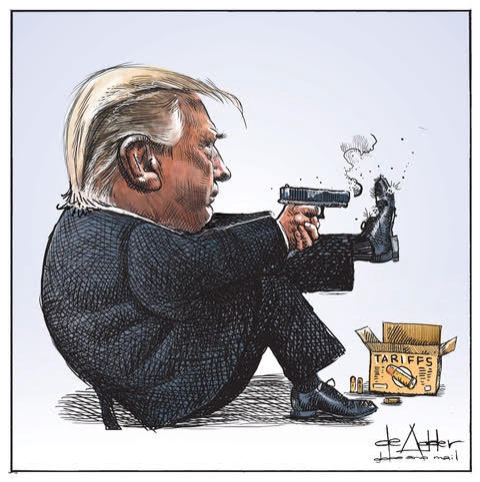
“Posting on his Truth Social platform, Trump said [Monday] that on the first day of his presidency he will charge Mexico and Canada a 25% tariff on all products coming into the U.S. He added in a separate social-media post that he would impose an additional 10% tariff on all products that come into the U.S. from China,… That would come on top of existing tariffs the U.S. has already imposed on Chinese goods.

“’This Tariff will remain in effect until such time as Drugs, in particular Fentanyl, and all Illegal Aliens stop this Invasion of our Country!’ Trump wrote.” WSJ: Trump pledges tariffs on Mexico Canada and China”

A tariff is a tax on an import. They are permitted by the World Trade Organization when leveed on goods receiving state subsidies in order to create a level playing field for trade. Such global trade has made an enormous contribution to the standard of living around the world.  “Ernie Tedeschi, former chief economist for President Joe Biden’s Council of Economic Advisers, said the North American tariffs would cost the typical American household almost $1,000 per year.” WP: “Trump tariffs-China Mexico Canada”

The normal expectation is that the tariff will reduce U.S. demand for the taxed import and encourage its domestic production. But the US labor force is fully employed and can only increase domestic production of the targeted goods by shifting workers from the production of goods the US has a comparative advantage in thus reducing our overall income. Though employment of manufacturing workers has declined in the US, manufacturing output has not because worker productivity has increased. In fact, our imports have not shipped American jobs overseas as increasing productivity has resulted in reduced manufacturing employment most everywhere in the world, including China, surely a good thing. WC: “Trade protection and corruption”

Immediately after Trump’s tariff announcement, the exchange rate of the dollar strengthened. A stronger dollar reduces the cost of imports (but increases the cost to foreigners of our exports), thus undoing to some extent the demand reducing impact of the tariff. But it hurts our exports because of their higher price to foreign purchaser and reduces our overall standard of living.

China and others hit with this tax are likely to retaliate with their own tariffs. “Under the United States-Mexico-Canada Agreement (USMCA), which took effect in 2020, goods moving among the three North American nations cross borders on a duty-free basis. ‘Obviously, unilaterally imposing a 25 percent tariff on all trade blows up the agreement,’ said John Veroneau, a partner at Covington & Burling in Washington.”  WP: “Trump tariffs-China Mexico Canada”

Should Trump actually impose these tariff’s he would (again) be violating the law, which only allows the President to impose tariffs without Congressional approval for national security reasons: WC: “Tariff abuse”

Trump’s threatened tariffs are not even leveed on the goods he wants to restrict (drugs and illegal aliens). Thus, unlike traditional tariffs they would be leveed to pressure Mexico and Canada to take other actions Trump wants. They are bargaining ploys. So at the cost of raising prices and lowering incomes in the US, weakening the global trading rules from which we have benefited so much, and weakening the checks and balances limiting an over extended executive branch, Trump may be playing his bargaining game again. But in my opinion the cost to us and the world trading system is too high.

Trump’s second go

JPMorgan CEO Jamie Dimon recently stated that:  “I don’t think people are voting for Trump because of his family values. If you just take a step back and are honest, he’s kind of right about NATO, kind of right on immigration, he grew the economy quite well, tax reform worked. He was right about some of China….  I don’t like how Trump said things, but he wasn’t wrong about those critical issues. That’s why they’re voting for him. People should be more respectful of our fellow citizens. When you guys have people up here [on a CNBC panel] you always ask them why — not like it’s a binary thing that you’re supporting Trump or you’re not supporting him– but why are you supporting him.” “Jamie Dimon on Trump

In addition, during Trump’s administration many excessive regulations were revoked or reduced. Secretary of Education Betsy DeVos promoted school choice and restore due process to college rape cases. Andrew Wheeler, Trump’s administrator of the United States Environmental Protection Agency (EPA) reduced greenhouse gas emissions, improved water quality, and cleaned up contaminated sites while strengthening cost benefit assessments of environmental regulations. And much more.

His administration did many bad things as well.  His advisors Stephen Miller and Peter Navarro implemented protectionist, buy American trade policies that hurt our economy. His crazy withdrawal from the Trans Pacific Partnership was an ill advised gift to China. He Imposed a travel ban on citizens from seven Muslim-majority countries, rescinded the Deferred Action for Childhood Arrivals (DACA) Program, separated families at the US-Mexico border and withdrew from the Paris Climate Agreement and the Iran Deal (Joint Comprehensive Plan of Action), which was designed to prevent Iran from developing nuclear weapons.

Trump’s promise to leave Afghanistan was not kept (and was later very badly executed by President Biden). His initial love affairs with North Korea’s President Kim Jong Un and China’s Xi Jinping exploded into hostility. If reelected Trump promises revenge against his enemies. He promises to strip tens of thousands of career employees of their civil service protections in order to dismantle the “deep state.” He promises to impose tariffs on all imported good and to revoke the visas of students studying in the U.S. who are critical of the U.S. None of these is keeping with the traditions and policies that have helped make America great.

On the other hand, I hope that he would keep his promise not to send American soldiers to Taiwan should China attack it militarily, which would be insane. Whether we would get the better or worse policies under another Trump administration would also depend on the team that he would bring with him.

Trump’s small-minded pettiness, dishonesty, vindictiveness, and egotism are on daily display. He is not someone I would invite into my home. But we are right to look at the policies he pledges and is likely to pursue if elected President again in 2024. As with his previous administration, his next one, if reelected, will depend on those who join and run his administration.

My expectation is that Trump will be more careful next time to choose loyalists rather than the most capable. It is also likely that the most capable people would refuse to be part of another Trump administration. I expect the worst.

What to do about China?

China’s much anticipated post-pandemic recovery appears to have flopped, with signs of a significant slowdown after decades of supercharged growth and data flashing warning signs.” Bloomberg “China’s failing recovery”

“Signs of deflation are becoming more prevalent across China, heaping extra pressure on Beijing to reignite growth or risk falling into an economic trap it could find hard to escape.”

What, if anything, should the U.S. response be? That depends on whether we see China as a competitor or an enemy. That should depend on our assessment of China’s objectives. Does China want to expand its territory one way or another, or to expand its influence in the global order? China’s behavior might support either assessment.

China claims sovereignty over almost the entire South China Sea, including the Paracel and Spratly islands, which are also claimed by Vietnam, the Philippines, Malaysia, Brunei, and Taiwan. In 1947 China asserted its claims with a map depicting a U-shaped line covering almost 70 percent of the South China Sea, known as the nine-dash line. In 2016, an Arbitration Tribunal rejected many of China’s maritime claims as lacking a basis in international law.

The UK returned Hong Kong to China July 1, 1997, with the understanding that it would be self-governed independently of the Peoples Republic of China for fifty years. China violated this agreement with its full takeover in 2020.

In 1972 President Richard Nixon confirmed that Taiwan was part of the People’s Republic of China but would continue to govern itself independently until it agreed to merge its government with the mainland’s. In the Taiwan Relations Act of 1979, the U.S. committed to providing defensive weapons to Taiwan to defend itself from invasion (as opposed to the volunteer absorption into the Peoples Republic envisioned in the One China Act). What we provided instead were heavy weapons irrelevant to Taiwan’s defense but prized by America’s defense industries. “Taiwan-China policy assurances military” The U.S. has more recently seemed to even question its commitment to the One China agreement.

These aggressive moves by China are better seen as solidifying its borders (much in the same way the US worries about its borders with Cuba) than military expansions. On the other hand, China joining the World Trade Organization, pressing for representation in the IMF and World Bank that is more reflective of its economic size, and its Belt and Road, Asian Infrastructure Bank and BRICS initiatives reflect China’s desire to gain status in the global system comparable to that of the U.S. In short, they reflect the behavior of a rising economic competitor.

We seem to be treating China as an enemy rather than the trade and economic competitor they see themselves as. Among sportsmen, competition takes the form of doing your best—of being the best you are capable of. Within our economy we rightly see competition as good and healthy. With fair competition, both sides benefit. The world is made wealthier. Kneecapping our competition is the approach of bad guys. I explored this more fully in my blog “Competing with China”

But China is not competing fairly either. We would be wiser to use the mechanisms of the global system of rules to push and pull them into compliance. We should end our own tariff—industrial policy violation of these rules as well. We might start by restoring the dispute resolution body of the WTO. While there will be genuine security justifications for trade restrictions, they should be very limited.  They should not include taxing steel purchased from Canada. Trade is win, win.

A recent G-7 statement clarified that: “We are not decoupling or turning inwards. At the same time, we recognize that economic resilience requires de-risking and diversifying.” US Treasury Secretary Janet Yellen stressed this message during her recent visit to China. We should facilitate and encourage China’s economic rise as it contributes to our own. The opposite direction—treating China as an enemy—ends in war.

America’s Unipolar period has corrupted us. We demand that others follow rules that we violate ourselves when we don’t find them convenient. We have become a bully. My hope is that we adjust to the fact that we are no longer the world’s sole superpower by strengthening the rules we helped develop and competing fairly under them: “Goodbye unipolar world and good riddance”

Goodbye Unipolar World, and Good Riddance

“Power tends to corrupt and absolute power corrupts absolutely.” Lord Acton. The United States has accomplished a lot—a lot of it good—as the world’s indispensable nation.  But as Lord Acton said, power tends to corrupt and as the time of American dominance has gone on its diplomatic skills have eroded. It behaves more and more like a bully that expects to get its way. It is in our interest to recognize and adjust to our diminished relative power and to rebuild our diplomatic, soft power skills of persuasion. It will help us better adhere to the values and rules we preach to others but increasingly ignore ourselves.

In the July, 2023 issue of Foreign Affairs, Justin Winokur offers an excellent review of the adjustments we need to make in The Cold War Trap How the Memory of America’s Era of Dominance Stunts U.S. Foreign Policy “Cold war trap-America foreign policy”

These days our most important international challenge is our relationship with China. While each sovereign nation is entitled to its own approach to its internal governance, its interactions with the rest of the world require mutual understandings and/or agreements. Following World War II, the rules for such cross border interactions have generally been developed by international organizations to which all or most countries are members, such as the UN and its many agencies, the World Bank and regional development banks, and the IMF. To take but one example, the skies full of telecommunications satellites would not be able to serve anyone properly without the rules and spectrum allocations via the International Telecommunications Union.

It is in America’s interest, as well as the interest of most countries, to draw China more fully into the international organizations established after World War II—the Bretton Woods and UN Institutions. “Chinese competition-Asia stability-institutional balancing”  But China is increasingly going its own way and creating its own international organizations. BRICS, China’s Belt and Road Initiative, Asian Development Bank, The Shanghai Cooperation Organization, Asian Infrastructure Investment Bank. Why?

Why have we failed to convince China that its interests are also serviced by joining and cooperating with the liberal international order? When China was admitted to the World Trade Organization on December 11, 2001, and requested help from the IMF with how best to satisfy the WTO’s rules, the IMF sent me. The officials I met with in China told me over and over that there was no differences of opinion in China over where it wanted to go (in joining the liberal international order). The debate was only over how fast to get there. In recent years this has changed. It has changed, in my view, in part because the U.S. has abused its dominance in the world and failed to yield (balance) appropriate power to China.

As I have spent most of my professional life with the International Monetary Fund, let me illustrate these points with the determination of IMF quota’s which is meant to reflect its members voting strength and financial contribution to world trade. A member country’s quota reflects its size and position in the world economy. The basic formula, which provided the base line for quota decisions is:  Quota = (0.50*GDP + 0.30*Openness+ 0.15*Variability  +0.05*Reserves)^K.

But when the IMF was created, the US wanted to ensure that it would dominate it. It insured that some important decisions could only be taken with super majorities. A few even required an 85% majority, such as to adjust quotas, or amend the IMF’s Article of Agreement.  The U.S. was initially given a quota well above that 15% that gave it veto power over these limited policies. As the rest of the world has grown, the size of the US economy relative to the whole world’s output has fallen from 40% in 1960 to 24% in 2019. “US share of global economy over time”  China’s GDP relative to world GDP, on the other hand, rose from 4.5% in 1960 to 16.3% in 2020. Thus, a strict adherence to the IMF’s quota formula should have significantly increased China’s quota and reduced the US quota.

Quoting from Wikipedia: “China has been trying to expand its political and decision-making power within the IMF. The IMF’s voting system weights each country’s vote based on the amount of that country’s monetary contribution to the Fund. China has been trying to raise its quota. In May 1980, the Chinese government appealed to adjust its IMF quota. With approval from the IMF board, the quota of China was increased from 1.2 billion SDRs to 1.8 billion SDRs. China also obtained a single-country seat on the IMF executive board, which expanded the number of IMF directors to 22 members. As of 2017 the quota of China in the IMF was 30.5 billion SDRs, giving it 6.09% of the total vote.

“To further rebalance power in the IMF, China appealed for changes that would transfer voting power to developing economies.[5] In 2010, the Chinese executive director of the Fund, Zhou Xiaochuan, addressed the board and asserted that giving more power to the emerging economies was critical for the group’s legitimacy, accountability and long-term health.” China and the International Monetary Fund – Wikipedia

Currently the IMF quota for the US is 17.43%, remaining well above the critical 15% needed to retain its veto power, while those of other larger economies are China 6.40%, Canada 2.31%, Germany 5.59%, Japan 6.47%, and UK 4.23%. This is not in keeping with the IMF’s base line quota formula.

This exploitation of American dominance is driving China away and dividing global cooperation to the detriment of the whole world, including the U.S. The current U.S. approach to “competing” with China is not consistent with our values nor our long run interest. “Competing with China”

Our economic and political success—the beacon on the hill that has attracted the best and the brightest to our shores—is the result of our individual freedom and rule of law, not our coercive power and its bullyish use. I hope that we wake up before it is too late. “Why do we promote growth in other countries?”

The politics of Trade

The post WWII history of international trade and the World Trade Organization has been one of gradual liberalization, i.e., a gradual roll back of tariffs and other trade restrictions. Each side offering freer imports in exchange for freer exports. But the game can work in revers as well. The U.S. has restricted –actually banned—the export to China of high end semiconductors that it fears might have military uses in China. China has responded by banning the export to the U.S. of rare materials needed to produce these chips. It sounds a bit like a joke—a bad joke.

Poor Janet Yellen, who is now visiting China. The Secretary is as sharp as they come but is in the middle of this impossible game.

“U.S. Treasury Secretary Janet Yellen criticized China during a visit to Beijing for imposing export controls on critical metals, expanding subsidies for state-owned firms, and imposing punitive measures on foreign businesses. Her harsh remarks spotlight the gulf between the U.S. and China, and the difficulty of translating calls for improved ties into actual improved ties. A top Chinese official told China Daily that the curbs on metals exports were “just the beginning” of efforts to combat U.S. restrictions on China’s semiconductor sector, and warned that Beijing could yet “escalate” if Washington were to toughen its rules further, a move it is reportedly considering” Semafor Flagship July 7, 2023

But as reported by Bloomberg she had more positive things to say as well:

“Yellen Says US-China Rivalry Not ‘Winner-Take-All’ Situation (Bloomberg)

U.S. Treasury Secretary Janet Yellen said competition between the world’s biggest economies is not a “winner-take-all” situation, and called for both sides to manage their rivalry with a fair set of rules. Yellen’s comments were delivered today during a meeting with Chinese Premier Li Qiang as she made a long-anticipated trip to Beijing, aimed at finding some common ground between the two superpowers. “We seek healthy economic competition that is not winner-take-all but that, with a fair set of rules, can benefit both countries over time,” the Treasury chief told China’s No. 2 official, adding that U.S. actions to protect national security should be “targeted.” Li also struck a note of optimism, telling Yellen he believed bilateral ties would eventually see a “rainbow,” after going through a period of “wind and rain.” He also urged Chinese entrepreneurs to brace themselves for “hardships” and “look further to the horizon.” From IMF News Report, July 7, 2023

Yes, these are from the same trip. How it turns out is anyone’s guess. But a return to freer trade is in everyone’s best interest—win win as we say. National security can be a legitimate (sensible) reason for restricting trade. But it must be very carefully applied if it is not to degenerate into counterproductive protectionism.

Independence Day

Six years ago, Ito and I celebrated the 4th of July at the American Ambassador’s residence in Rome as the guest of our friend David Zimov (Economic Councilor at the American Embassy in Rome). It was a very fun event with lots of hamburgers and hot dogs, beer, and a concert by the US Marine Band. The cost of this extravaganza to us taxpayers was truly trivial compared to the cost of one day of our many wars (or our “special military operations” as Russia likes to call its wars). And the benefit to America in the form of international good will, far exceeds any American benefit from our wars, if there is any.

Janet Yellen’s upcoming trip to China will also cost a small drop in the bucket compared to sending the Sixth Fleet with a benefit for American security and wellbeing many times greater. At the same time, the US Senate continues to stall the confirmation of nominees to critical diplomatic positions. Go figure.

We seem to favor military spending over diplomacy to the detriment of our security and to our wellbeing more generally. In testimony before the UN Security Council Max Blumenthal recently stated that “The Biden Administration knows that ‘it is escalating a proxy war against the world’s largest nuclear Power. Why are we tempting nuclear annihilation by flooding Ukraine with advanced weapons and sabotaging negotiations at every turn?’  For those US officials who personally benefit financially, ‘a negotiated settlement to this territorial dispute means an end to the cash cow of close to $150 billion in US aid to Ukraine.’”  https://expose-news.com/2023/07/03/us-officials-benefitting-from-ukraine-war/  

When I noticed that the small handheld American flags we were all given at the Embassy’s 4th of July party was made in China (they had a very conspicuous “made in China” tag on the handle) the person sitting next to us was appalled. I explained to him why he should celebrate a feature of American life that has helped make us freer and more prosperous: 1. Our tax dollars were prudently spent in buying the cheapest flags; 2. The money the government saved could be spent on other government priorities (or—God forgive—returned to us taxpayers); 3. The American workers who otherwise would have been diverted to make these flags at higher cost; would remain in their current more productive activities raising our standard of living; 4. The larger volume of world trade strengthened America’s standing in the world. Though I don’t know how the American Embassy was able to avoid the shortsighted “Buy American” requirement, I was glad that it had.

Why do we promote growth in other countries?

The world’s twenty largest economies give around $100 billion in aid to poorer countries each year, about 40% of which is to promote economic development. Promoting economic development and growth in other countries is not just charity or to buy peace. More prosperous countries, those that produce more, contribute to our own prosperity more directly as well. 

It is easiest to understand this fact if we think of growth within our own country or state or town. https://wcoats.blog/2023/01/22/trade-once-again/  When you sell something you made and/or own, you benefit from the sale or you wouldn’t have undertaken it. Similarly, the buyer benefits or it wouldn’t have made the purchase. As you have heard or read me and other economists state over and over again, trade is win-win.

But the benefits go beyond the win-win benefits of the transaction itself. Being able to buy some of what I need from others rather than having to make it myself frees up my time to specialize in producing for sale to others what I am best at. In short, and forgive me for repeating this for the umpteen time, world out increases from the specialization that trade enables. As the result of trade world GDP skyrocketed in just 50 years from $1.3 trillion in 1971 to $96.5 trillion in 2021. https://wcoats.blog/2018/03/03/econ-101-trade-in-very-simple-terms/

We benefit from the inventions of entrepreneurs anywhere in the world and should encourage such developments. Pfizer’s Covid vaccine was developing in Germany by BioNTech, with whom Pfizer partners to produce to large quantities demanded. China’s incredible growth over the last thirty years has contributed to our own growth as well. In 1991 the US exported to China $5.2 billion worth of goods, which had grown to $151.i billion in 2021. In 1991 the US imported $12.7 billion worth of goods, which had grown to $506.4 billion in 2021. Following Nixon’s famous trip to and recognition of China in 1972, I remember well a friend who asked “what would we possibly want to buy from China?” We should cheer the fact that China’s economy has grown dramatically to the benefit of us all.

In general, we should welcome and encourage the economic growth of all countries around the world. The exceptions might be for countries that threaten war on their neighbors or us. We might well block the export of our products and related technologies with clear military applications to countries that might pose a military threat. And we might be cautious not to rely on such products from such countries. While these would be sensible policies, they are also easily abused by domestic industries wanting to be protected from competition.

When I was in China in the summer of 2002 to help its compliance with the requirements of the World Trade Organization, those I met were excited about growing into the world trading system. China was a rising power, most certainly not an enemy. How did they become an enemy, if indeed they are. In a word, Taiwan. But I can see nothing China has done to violate their agree with the US about Taiwan as part of One China. If China has become an enemy—a threat to the US—we are largely responsible in my opinion by raising doubts about our commitment to the One China policy.

This is not to say that China has always behaved according to the rule. I and many others were there to help them move in the right direction. Now we have pushed them backward for no good reason. Hopefully the Biden administration is beginning to recognize this and we will return to promoting China’s growth rather than repressing it.   https://wcoats.blog/2022/10/23/competing-with-china/

The Dollar (again)

Any country selling its goods abroad could price and collect payment for them in its own currency. Foreign purchasers would have to buy the sellers currency in the foreign exchange market (a whole nether story) in order to make such payments.

To communicate with each other they could also learn each other’s language. To communicate with everyone in their own language would require learning 7,000 languages. The economy of everyone adding English as a second language to their own is self-evident.

Rather than each trader dealing with several hundred currencies, there is huge economy in everyone dealing in one intermediary (so called vehicle) currency for pricing and payments of their cross-border transactions. But what currency?

When an exporter gives up pricing its products in the currency it pays its workers, it takes on a valuation risk. The choice of its invoicing currency and currency of payment needs to be attractive to potential buyers and of minimal risk to itself. The currency needs to have a relatively stable value for a large number of goods. The U.S. economy is large, and its goods are priced in dollars, which has a relatively good track record of price stability.

But to pay for imports with someone else’s currency the importer must have some of it. He must either take the risk of buying it in the foreign exchange market at whatever its current exchange rate might be or keeping some in reserve. Keeping a reserve of the international pricing and payment currency requires having safe assets with stable values in that currency, with deep and liquid markets in which they can be bought and sold. Currently the US dollar wins hands down. The Empire and the Dollar – Warren’s space (wcoats.blog)

The militarization of the dollar to serve U.S. foreign policy objectives increases the risk to others of holding and using dollars. How much that potentially undermines the dollar’s reserve currency status depends on how broadly the foreign policy objectives of the U.S. are shared and how well alternative currencies measure up to the value and market advantages of the dollar.

Trade once again

Everyone understands that without trade they would be dirt poor. If everyone had to be self-sufficient, they would be lucky to survive. It’s almost as obvious that the wider we can trade the more we can specialize in our comparative advantage raising the incomes of everyone. Where many stumble is at their national borders (though within national borders of large countries some regions restrict trade with other national regions to protect otherwise less efficient enterprises thus lowering incomes in general).

Why should trade be restricted across national borders? Three reasons stand out: two legitimate and one not. A potentially legitimate reason concerns national security. Requiring that products necessary for defense be domestically produced, even at greater cost, reduces the risk of supply chain disruptions. The risk is that this excuse is easily abused to the extent that such protection can turn illegitimate or corrupt.

A second legitimate reason also concerns resilience. The most efficient allocation of productive resources must take account of the risks of disruption to supply chains. We buy insurance for many assets and activities, thus incurring a certain cost, to protect our incomes from risks (large or small) of interruption and potentially larger losses. When buying goods or inputs from cheaper producers located far away, we are exposed to larger risks of supply interruptions. American manufacturers, for example, take these risks into account in deciding where to produce and purchase inputs to their products sold in the U.S.

A government bestowed financial favor on a firm or industry (trade protection, industrial policy) is always part of a quid pro quo. The firm delivers favors to the politicians who favor it.  Government protection of otherwise uncompetitive firms increases their viability and profits but at the expense of lower income for the rest of us. Countries that heavily indulge in such protection have suffered lower levels of income. “Trade protection and corruption”

Following World War II, and the establishment of what became the World Trade Organization, barriers to trade (domestic protectionism) were gradually reduced via bilateral and multilateral trade agreements. In the 62 years from 1959 to2021, real United States’ per capita personal income, when measured in constant 2012 dollars to adjust for inflation, increased 297.1%, from $13,971 in 1959 to $55,477 in 2021. This huge increase is the result of increased productivity per worker. But such productivity gains are only possible because of trade (within or across national borders).  “The case for trade”

Weaknesses in government programs to facilitate worker adjustments that are a necessary part of a dynamic, growing economy and other geopolitical factors are undermining the freest and most efficient trade (domestic and global) that our prosperity has depended on. “Geo Economic Fragmentation and the Future of Multilateralism”  “End globalization?”

The Economist magazine has argued that: “One problem [with protectionism and industrial policies] is their extra economic costs. The Economist estimates that replicating the cumulative investments of firms in the global tech-hardware, green-energy and battery industries would cost $3.1trn-4.6trn (3.2-4.8% of global gdp). Reindustrialisation will raise prices, hurting the poor most. Duplicating green supply chains will make it costlier for America and the world to wean themselves off carbon. History suggests that vast amounts of public money could go to waste…. Yet rescuing the global order will require bolder American leadership that once again rejects the false promise of zero-sum thinking. ”  “The destructive new logic that threatens globalisation”

Misinformation and corruption are undermining the basis of our incredible prosperity just when we need to pull together to deal with global warming. We must resist and fight back to restore and preserve our efficient market economies.  They would not exist without trade.

We are shrinking

It seems that many Gen Xers and Gen Zs do not understand the huge benefits of free markets and trade that have lifted millions out of poverty. As someone who cares about the poor and about my own liberty and well-being, I do my best to help educate them. Here are two of my blogs on trade:  “Tony Judt on trade”   “Trade protection and corruption” 

Unfortunately, the Trump and Biden administrations have increasingly moved us in the wrong direction of “protecting” American producers from foreign competition. See for example the following report from the excellent news aggregator and reporter Semafor  https://www.semafor.com/

A transatlantic EV trade dispute

President Joe Biden’s Inflation Reduction Act threatens Europe’s electric car industry, according to the EU. One concern is the introduction of tax credits for U.S. EV manufacturers. The EU says this will harm overseas automakers such as Germany’s Volkswagen. South Korean officials have similar concerns for Hyundai’s exports. A few weeks ago, French President Emmanuel Macron suggested a “Buy European Act” to counteract U.S. and Chinese protectionism, while his finance minister said that the entire “level playing field between the United States and Europe” is at stake.”

With the excuse of national defence, we are playing dirty in our competition with China. We are giving up some of the win win benefits of trade to protect relatively inefficient domestic producers. We should not let our government and the crony capitalists it is protecting get away with such short sighted corruption. “Competing with- China”