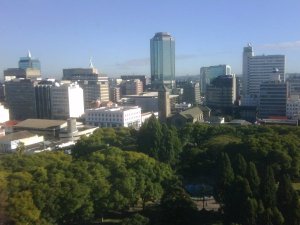
I am here as part of an IMF technical assistance team to the Finance Ministry and central bank specifically authorized by the IMF’s Executive Board to begin the IMF’s re engagement with Zimbabwe. Zimbabwe is a resource rich country and Harare is a beautiful city. (Top picture: Skyline with Reserve Bank of Zimbabwe prominently in the center. Second picture: Me, Finance Minister Biti, and Ken Sullivan at a “casual Sunday” morning meeting) I am impressed with the intelligence and skills of its professional class. What has happened in this country in recent years is a huge and shocking tragedy.
Our first day here The Harald’s front page headline in big letters read: “IMF technical team expected today.” Our second day the front page of the business section carried an article titled: “IMF team to assess payment system,” while the front page of the paper carried the headline “Man fights off crocodile in 6-hour battle.” On our third day the newspaper didn’t mention us at all, thank God. Our team of five (from the Netherlands, Denmark, Canada, New Zealand and myself) is here at the request of the Minister of Finance to advise the government on the governance of the central bank (the Reserve Bank of Zimbabwe), the efficiency of interbank and retail payment systems, the safety and soundness of the banking system following the collapse of Zimbabwe’s currency after the world’s second worst hyperinflation in history and to begin discussions of a future monetary regime. Most of our work was in the Reserve Bank, whose Governor (a close alley of President Mugabe) the Finance Minister would like to replace. We wished to be as inconspicuous as possible.
These missions, as the IMF calls them, draw upon and test every bit of knowledge and skills we have accumulated over our lifetimes. To appreciate the enormity and difficulty of our task, you need to understand a bit of Zimbabwe’s recent history. Please bear in mind in reading what follows that I hope to return to Harare and nothing is private anymore.
Zimbabwe, formerly known as Rhodesia, became independent of British rule in 1980, much later than most other African colonies. President Robert Mugabe has headed the government one way or another since then.[1] Mugabe became a national hero leading the guerrilla fighters in the Bush War (1964–1979) that overthrew the white-minority government ruling Rhodesia leading to its independence. He is/was revered throughout Africa.
Guided by the Lancaster House Agreement that provided for the transition from white to black rule of Zimbabwe, to which Mugabe was a signatory, Zimbabwe prospered. Over the past ten years, however, Mugabe became impatient with the pace of his people empowerment programs (“reallocating” property from white Zimbabweans to black ones). His “Fast Track Land Reform”, which abandoned the land reform agreement among Zimbabwean stakeholders at Lancaster House, confiscated farm land from white corporate farmers and redistributed it to “poor’ blacks. In reality the redistribution largely enriched Mugabe’s political supporters. Every employee of the Reserve Bank, for example, was given land taken from its owners. Agricultural output plummeted.[2] Mugabe’s “social” policies have bankrupted this beautiful and once prosperous country. The IMF reports “an estimated 14 percent fall in real GDP in 2008, on top of a 40 percent cumulative decline during the period of 2000–07.”[3]
The greed and corruption of Zimbabwe’s ruling classes diverted the government’s resources. The Reserve Bank was increasingly called upon to lend to various government projects (i.e. print money) to cover the difference. Inflation (annual percent change in the CPI) averaged around 20 percent in the 1990 and gradually rose to 239 percent in 2005, over 1,000 percent in 2006, and 10,000 percent in 2007. In 2008 it exploded and “is estimated to have peaked in September 2008 at about 500 billion percent. This incomprehensible rate of inflation means that in September prices were doubling every 11½ days. Are you surprised that a 100 percent increase in 11½ days if continued at that rate for one year will result in a 500 billion percent increase? This is the magic of compounding.
When the Zimbabwe Stock Exchange stopped trading the ZIM dollar in Nov 2008, the exchange rate of the ZIM dollar to the U.S. dollar was estimated by the UN to be 35 quadrillion (35 x 1015). This the rate generally used for 2008 year end financial statements. This is after 9 zeros had already been dropped from the currency last summer and three had been dropped earlier. The largest note issued before its collapse (and after the removal of the 12 zeros) was for 100 trillion ZIM dollars (100,000,000,000,000). The largest note I was able to get was for 20 trillion. The old notes are hard to find because Zimbabweans threw them away in disgust. As the currency collapsed, angry Zimbabweans came to the Reserve Bank to throw their notes at the building (this was the explanation given to me for why the sidewalk in front of the Bank was still roped off.
It is difficult to comprehend such rates and the impact on Zimbabwean economic life was devastating. The economy spontaneously dollarized, which was formally recognized by the new “inclusive” government in February.[4] Thus for the time being inflation is over (prices—now in U.S. dollars—have actually declined since the first of the year.)
Under the conditions of last year economic calculation becomes impossible. Over a year before the collapse of the currency many firms had already established financial accounts in U.S. dollars for internal management purposes. In real terms the banking sector today is little more than a quarter of its size in 2004. Banks are well capitalized today because they invested all they could in real estate and the stock market rather than lending in order to protect the real value of their assets. As a result, however, they now have very little lendable resources.
Two of my team members were here in December 2006. At that time, the shelves in the shops were empty and there were long lines for gasoline. The Reserve Bank couldn’t print new currency notes fast enough to keep up with the demand as people spent ZIM dollars faster and faster before prices went up even more. This is what happens in hyperinflations. The velocity of circulation of money accelerates reflecting raising expectations for further inflation with the result that the real value of the money supply shrinks. The total amount of ZIM dollars currency in circulation at the end of 2008 was 22,400,000,000,000,000. Its value in U.S. dollars is 64 cents, yes 64 cents. The Zimbabwean people and economy have been brutally raped. The governor of the Reserve Bank drives a Lamborghini.
Because the Reserve Bank could not keep up with the demand for currency, it imposed a limit on the amount of cash depositors could take out of their bank accounts at one time. At one point this amount was not enough to pay for a gas tank fill up, thus multiple trips to the bank were required. Zimbabwean’s can write checks on their bank accounts, but paying for gasoline with a check would entail a much higher price reflecting the inflation expected over the several days it would take the gas station to collect the money via check.
To help their customers pay for gasoline, wholesalers issued coupons denominated in litters of gasoline. These were purchased months before the holder intended to use them to pay for gasoline and locked in the real gasoline value of the later actual purchase of gasoline. Some firms bought large quantities and used these coupons to pay their employees. The coupons circulated as currency. The early sale of coupons for cash and its immediate use to pay for imported gasoline protected the wholesaler just as well as holding the inventory of gasoline for subsequent sale at a higher ZIM dollar price.
Restaurants put prices of menu items on a sheet at the back that could be replace every day with new prices and some stated prices in “units” where the ZIM dollar value of a unit was updated ever day. These few examples barely scratch the surface of the brutal attack on Zimbabweans by their government. I have not mentioned the murders and arrests of political opposition party members and many other forms of voter intimidation.
While the shops are full again and you can order almost everything on the menu, the practice of listing menu prices on a separate sheet perseveres still. With dollarization (the USD or the South African Rand), thus no more ZIM dollar, and stripping the powers of the Reserve Bank to the minimum needed to perform its remaining core functions of banking and payment system supervision (as we have proposed), hyperinflation is no longer possible.
This is made possible by ending government borrowing thus limiting its disbursements to cash on hands as tax revenues are received. However, for some time this means that many obligations cannot be honored. Government employees cannot be paid their salaries (all receive month stipends of $100 for the time being). The Reserve Bank cannot repay all depositors, etc. The economy can only earn USD by exporting and many of its industries are operating at one third capacity because they do not have the money to pay for electricity and other imported inputs needed to operate. Private banks cannot lend to them because significant amounts of their money is deposited with the Reserve Bank which cannot repay it at the moment. This policy is not sustainable without a recovery of the economy and the tax revenue that will accompany it and/or foreign assistance.
The private sector here is amazing and is rebuilding its positions quickly. But if the Reserve Bank is not bailed out by the government (which has no money with which to do so without international support), it will not be able to repay money owed to the private banks, which is owed ultimately to private firms and house holds. These failures could and very likely would bring down the new inclusive government. Aid in the past has helped keep corrupt governments in power (I will avoid names while I am still here in Harare). But at times it is critical. I met with the economic advisor in the U.S. Embassy here yesterday and she said that they are debating this dilemma and the right balance every day. The official U.S. position (but it is up to Congress) is that sanctions will not be lifted until at least the Governor goes. In the mean time Bob’s (Mugabe’s) friends have levied what are almost certainly trumped up charges against 4 of the MDC’s (Tsvangirai’s party) members of Parliament. Convictions would return control of Parliament to Mugabe’s friends (Bob is now largely a puppet under the control of his military leaders). This is but one instance of a very dirty game.Everyone has very tough choices.
Our parting gift was this mornings headline, “Cabinet gives nod to amend RBZ Act…,which will see the central bank revert to its core functions. Finance Minister Tendai Biti said…, This will ensure the central bank becomes a clean and legitimate institution.” We will see.
[1] The early days of independence were marked by infighting between Maoist leaning Mugabe, whose support came largely from his Shona-speaking homeland in the north, and pro Soviet Joshua Nkomo, whose support came largely from the Ndebele-speaking south.
[2] Eddie Cross, “The Cost of Zimbabwe’s Continuing Farm Invasions”, Cato Foundation, Economic Development Bulletin no. 12, May 18, 2009
[3] Zimbabwe—Staff Report for the 2009 Article IV Consultation, International Monetary Fund, April 20, 2009.
[4] In general elections held March 29, 2008 Mugabe’s party, the ZANU-PF, lost its majority in the Parliament, and informal returns indicated that Mugabe had lost the Presidency to Morgan Tsvangirai of the MDC, whose party in coalition with a relatively small party (MDC-M) now has a majority of Parliament. Mugabe refused to concede and won an uncontested run off in the midst of considerable violence as Tsvangirai refused to participate in the run off to protect his party members from violence. A coalition government was finally formed in February 2009 with Mugabe as President and Tsvangirai as Prime Minister and the Ministries divided up.


 Warren's space