
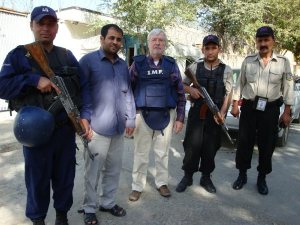
Outside IMF Guesthouse, Kabul, Afghanistan


Background

Guards and driver Wahid and I outside IMF guesthouse in Kabul

Foreign Wars

“Damned if you do, damned if you don’t,” says my friend Bob Gregorio with reference to the NATO bombing near Kunduz of two hijacked fuel tankers that may have killed 120
people including maybe two dozen civilians (the numbers keep changing). This
observation contains a profound lesson for those contemplating foreign wars and
no place more so than here in Afghanistan.

An Afghan friend here in Kabul gave me two videos to watch
and then spent over an hour downloading all the viewers and right CODEXes to
make sure I could watch it on my laptop. So I felt obligated to watch all two
hours of “The Road to Guantanamo” about three British Pakistani boys who flew
from London to Karachi to get married, traveled into Afghanistan to see if they
could help their Taliban “brothers” in November 2001, were captured by the
Northern Alliance forces (largely Tajik Afghans fighting Pashtun Taliban) in
December 2001 (a few weeks before I arrived in Kabul), were turned over to
American forces and spent the next four years in Guantanamo before being
released with no charges every having been made against them. If that didn’t
leave me sickened, the other, thankfully shorter, video certainly did. In it a
female journalist travels with a U.S. Army unit (I forgot its name) north of
Kandahar through remote villages looking for Taliban. Working with local
village chiefs they do their best. The journalist then returns on her own to
the same villages for further interviews. While I do not find the claims of the
villagers that American solders abused them credible (demanding that men strip,
face the wall, and then groped them), just seeing the American invasions of
their homes from the eyes of humiliated, poor Afghanis, even if used for
propaganda purposes, tells us a lot about the futility and foolishness of
bringing democracy to foreign lands by force. How can our 19, 20 year old
solders, with their human strengths and weaknesses, possibly succeed (at what?)
in such environments. Damned if you do and damned if you don’t, indeed.

I really cringe when I hear well-meaning Americans praising
our brave boys overseas. How dare we send them into such bewildering and
foolish danger? These fellow American’s have no idea what they are asking. If
they did, they wouldn’t do it. President Bush, for all of his faults, at least
had a clear purpose in attacking Afghanistan—to kill Ben Laden. Too bad he
failed so miserably as a result of the disastrous Iraqi diversion. My respected
friend Robert Schadler (a senior official in the Reagan administration’s now
defunct United States Information Agency) makes some important observations
about such situations in response to my earlier note on this bombing:

Dear Warren,

My sense, without ever having traveled there, is that our notion of  “who they are” is
very different than their own.

We say: “Saddam viciously committed genocide on his own people.” He says, “They
were Kurds and Shi’a. None were from Tikrit. They were not “my people”; they were my enemies.”

Similarly, the Afghans who are pleased with the bombings [in Kunduz] probably don’t view those who were killed as “fellow Afghans” but some barbarous tribe who happen to also live in a place called Afghanistan.

That’s only one layer. Western analysts are trained, by Aristotle, Anselm and others, to avoid obvious contradictions in thinking and feeling. As a counter, I recall a story that
baffled and amused my mother for most of her life. She had lived in Turkey during the last days of Ataturk. A rather sophisticated neighbor of hers, a Turk, was very proud of the fact that Turkey had such a strong leader — not like the weak-kneed European leaders at the time. Yet, minutes later, she said she expected Allah to strike down Ataturk for his vicious efforts to rid Turkey of various traditional Islamic practices — Arabic script, Friday holidays, forbidding the fez, etc.

Another layer yet is telling the powerful — and Westerners are often deemed powerful and the conquerors — what they want to hear or, more accurately, what they think the Westerners want to hear.

As for the policy shift in Afghanistan: the US had about half a million “boots on the
ground” to push Saddam out of Kuwait — a very small country. Figuring out who was who and where Kuwait ended and Iraq began did not require a lot of sophisticated intelligence and cultural awareness.

Protecting Afghans — from all mean, vicious and armed thugs or just the Taliban-inspired ones — means at lot more than another 20K  or 30K troops. Training the
Afghans to police themselves ….  Training them is the minor problem. Getting them to view members of other tribes and themselves as Afghans first and foremost is the tough challenge. And it’s one I’m dubious our Marines, however fine they may be, is something they signed up to do and have been properly trained to accomplish.

The political problem at home is only somewhat related. The original mission in Afghanistan was to kill or capture bin Laden. This mission was an utter failure. It needed to be done quickly, in any case, to send the message that attacks such as 9/11 have dire
consequences. The message now received is that these attacks can be carried out and, with a little cleverness and close loyalties, can escape punishment. There was virtually no dissent over the goal of killing or capturing bin Laden. Had the Taliban government “given him up” the US would not have gone into Afghanistan.

Today, the mission cannot be clearly stated. I heard Gen. Zinni  last week (at the New
America Foundation). While he was against going into Iraq, he is against pulling out of Afghanistan — for reasons of credibility. He agreed al Qaeda is no longer in Afghanistan. “Protecting the Afghan people” is hardly a policy — given the dozens of the 192 countries have populations that need “protection.” “Keeping Karzai in power” or “Keeping the Taliban out of power” would be palatable only if it could be connected to some larger, important, America-centric purpose. And if the costs were plausible vs other uses of those resources.

Bush was famously inarticulate, but “bin Laden dead or alive” was vivid, clear and
arguably worthwhile. Obama, famously articulate, has said, “Afghanistan is a war of necessity” and the “important war”. But it is doubtful he’ll make his reasoning plausible. For that reason, it is deemed he was saying these things simply because he wanted to avoid being a “weak on security, McGovernite Democrat”.  And that mission was
accomplished — at least during the pre- election period.

Best,

Bob

I believe in the value and virtues of “nation building.”  That is why I am here and why I worked in such places as Iraq, Serbia, Bosnia, Croatia, Kosovo, Zimbabwe, to name a few. By “nation building” I mean sharing the accumulated wisdom of successful, productive, and human societies with those not yet as successful for their people. It only works as a long slow process of education and persuasion within the context of the existing social
and political structures, even when the goal is to change them. Our solders don’t help. We should keep them home and spend the money and lives saved on keeping our economy and society strong (the source and basis of our military strength). How best to withdraw from the messes we have created and are now in is another and more complicated matter. It will involve a lot of Damned if you do, damned if you don’t. And damned those who seem to like sending our youth on fools’ errands with little understanding or regard for the lives disrupted or destroyed around the world, all with good intention, of course.

It has not escaped my attention that I am leaving
Afghanistan on 9/11.


Fighting the Taliban

Saturday, September 5, 2009

U.S. strategy in Afghanistan has wisely refocused on
protecting Afghans rather than killing Taliban and increasing the resources for
training and equipping Afghan solders and policemen (vastly cheaper than
financing additional NATO forces, though they will be needed for a while as
well). This means exposing NATO solders to increased risks as they hunt down
the Taliban in order to reduce the prospects of killing innocent civilians.
General support of the population is obviously essential if the NATO backed
government is to gain and maintain control of the country.

Thus the apparent death of about 70 Afghanis, which may have
included a significant number of civilians, in the northern city of Kunduz on
Friday seems a set back for the new strategy. The story reported here in Kabul
was that one of the two NATO fuel tanker truck hijacked by Taliban became stuck
crossing a river. The local villagers rushed to fill cans and bottles with the
fuel so that when German NATO troops in the area call for a U.S. air strike,
local villagers where killed along with many Taliban. According to an AP report
today it is still “unclear how many were militants and how many were villagers
who had rushed to the scene to siphon fuel from the trucks.”

I was discussing this with my Afghan driver on the way in to
the central bank this morning when he surprised me with the following comments
(as well as I can remember them): “Bombing that tanker and the Taliban was a
good thing. If villagers were killed along with Taliban they deserved it. Good
Muslims don’t steal – especially during Ramadan.” Ramadan is a month long
period for spiritual purification achieved through (day time) fasting,
self-sacrifice and prayers

The AP report goes on to say: “At least one local official
supported the allied bombing, saying it would help drive the insurgents from
the area. ‘If we did three more operations like we did yesterday morning, the
Kunduz situation would be peaceful and stable,’ said Ahmadullah Wardak, a
provincial council chief.”

I have no idea.

Lockerbie Bomber – Comments

I received very interesting comments about the Lockerbie
bomber from some of you. Thanks. I should add that my Edinburgh host lost a
student on that fight and one of my IMF colleagues missed it and thus is still
with us. He is a Lebanese Palestinian and no he didn’t miss it on purpose.


Warren,

In 1988 I was serving as a flight attendant for Pan Am,
regularly crossing the Atlantic on flights from Washington.  I had
joined the company in January of that year, and during training had met and
befriended an extraordinary young woman whose (short term) goals were the same
as mine – take advantage of a rare opportunity to go places and see things that
we might not have otherwise have been able to do. 

She opted to transfer to the London base in the fall of
that year, and, as fate would have it, decided to work Pan Am 103 on December
21st – a flight she was not originally scheduled to work.

I do not know whether Mr. Al-Megrahi is guilty or
not.  Nor can I know whether he was truly released for humanitarian
reasons.

What I can say is that when I think back to that December
day I remember the wonderful woman I met, thought so fondly of, and
whose bright life was stopped tragically short….along with so many people
just like her.  


Bill (Moore, Falls Church, Va)


****************

Hi Warren,


Interesting.  I had
forgotten about the Iranian airliner.  But you piqued my interest in
suggesting Libya had no motive for bombing the Pan Am.  The link below may
be of interest.  It includes the other hostile actions between US-Libya,
notably, the US bombing of Tripoli, which killed one of Gadafi’s children and
injured two others.  Two years later the Pan Am was bombed.  http://en.wikipedia.org/wiki/Bombing_of_Libya


Regards,

Bob (Gregorio, Arlington Va)


***************************

Pretty disgusting is what I make of it. Really no shame.
If the Scots wanted to be humanitarian they could have flown in his friends and
relatives for the final weeks of his life. How humanitarian were the Libyans by
holding on totally trumped up charges these French and Bulgarian nurses for I
don’t know how long?


Jan Willem van der Vossen (IMF colleague)


****************************

A very nice man
therefore. Oddly enough I heard about Megrahi many years before Lockerbie from
my Milano friend. Ing. Franco Giugovaz was a contractor in Libya who fell out
with his local partner, who called in his secret police friends, in the usual
way. Megrahi threatened to have him killed if he did not leave the country
& all his equipment behind. Megrahi also personally took Franco’s
hand-made 4×4  desert SUV with all sorts of gadgets. It is still parked in
front of his house. Do pay a call on Megrahi when next there and ask him where
he got it from.


Edward (Luttwak, Washington,
DC)


*****************************

No doubt there is plenty more to the investigation than
a history of clothing, but it makes me wonder if a man should be nervous should
clothing go missing from his wardrobe, and whether a man should ever give used
clothing to charity for fear that a stray hair will make him the object of
enthusiastic detectives.


David (Garland, Roanoke, Va)


*******************************

Bravo, Warren, for a bit of level-headed commentary.
When one considers that the circumstantial evidence which led to al-Megrahi’s
conviction was supplied by a Maltese shopkeeper who was paid for his evidence
by the Americans and taken fishing by the Scottish police afterwards, the
security of the conviction does indeed become questionable. And the witness
statement that the baggage room at Heathrow was entered, and, possibly, another
case added, was never admitted to the court for examination. Much has been made
by the “guiltyists”, to coin a term, of the fact that he has never expressed
any remorse. Well, he has always maintained his innocence, so why should he? No
one is arguing that he is a nice guy, but it seems plain, as you suggest, that
our dear governments have been busy with something else in the background.

Cheers


Martin (Anderson, A Scotsman living in London)


*******************************


Warren–


That is a very thoughtful and balanced letter.  It
should be run in the LA TIMES and San Francisco Comical.  You might have
mentioned how unreliable eye witness testimony is, as well.  Forensic
evidence is no better than eye witness testimony when it is coupled (as here)
with it.  I hope that the covered up evidence of the "railroad"
is forthcoming.


Bill (Hulsy, Santa Anna, CA)


Lockerbie bomber – Where is she?

The sight of the convicted Lockerbie bomber arriving home in
Tripoli to a hero’s welcome is repugnant to anyone who believes Mr. al-Megrahi
is guilty. My friend Tom Lauria asks: “What are we to make of al-Megrahi’s
official hero’s welcome? It is so offensive to me for Libyans to be cheering
the murderer of 270 innocent people. I will never comprehend the Arabist
mentality.” Be careful. Why assume that Libyan’s were cheering someone they
thought was a murderer? Most of the families of the victims here in Britain think
Megrahi is innocent and are angry that the killer(s) have never been brought to
justice. Here is a BBC interview of the father of one of those who died over Lockerbie:
http://news.bbc.co.uk/1/hi/uk/8212475.stm.
In this context did Libyans behave any differently than American’s would if,
say, the Iranian’s released an American we believed to be innocent?  

Lockerbie bomber

I arrived in Edinburgh yesterday to the news that the
Scottish government was about to release Abdelbaset Ali al-Megrahi, convicted
of killing 270 people when Pan Am Flight 103 blew up over Lockerbie in 1988, on
compassionate grounds. Mr. Megrahi is expected to die of cancer within three
months. I am staying here in Edinburgh with the former dean of the Law school
of the University of Edinburgh and his medical doctor wife. To my surprise my
law Professor friend had been involved in the Megrahi case. He provided me with
the most fascinating background and speculations on the case and these most
recent developments. They provide a very different picture than gained from the
headlines.


The explosion of Pan Am 103 over Lockerbie precipitated the
largest criminal investigation in British history. Impressive forensic investigations
traced clothing in the suitcase carrying the bomb to a shop in Malta. The
identification of Megrahi from pictures by the Maltese shop keeper many months
later as the person who bought the clothing—the primary evidence against him—has
been the subject to much debate. When the U.S. and Brittan issued indictments
against Mr. Megrahi he was home in Tripoli. Libya refused requests to extradite
Mr. Megrahi for trial in the U.S. or U.K. on the grounds that, as is the case
of all civil law countries, its constitution and practice did not permit it to
extradite its citizens for trail abroad. President Gaddafi offered to try
Megrahi in Libya. This offer was refused and the West imposed economic sanctions
on Libya for its “lack of cooperation.” My host became involved as a result of
the growing dissatisfaction of western commercial interests and of Middle
Eastern government’s with the economic sanctions and isolation of Libya. Every
one wanted to find a face saving way to allow Megrahi to be tried in a way all
sides could agree to. My host developed a plan that Gaddafi indicated he would
accept for a trail conducted in the Hague by the International War Crimes
Tribunal. As the crime had occurred over Scotland, Scottish courts had jurisdiction.
My hosts too easy and too cheap plan was rejected in favor of a $200 million
plan to build a court on an unused Scottish air base in the Netherlands and try
Megrahi there (technically on Scottish soil from the Scottish perspective)—I am
not making any of this up. Mr. Megrahi was convicted by a court of judges rather
than a jury of peers but his alleged accomplice was acquitted on the grounds of
insufficient evidence.


One of many problems with the conviction of one and the acquittal
of the other was that Libya had no motive for such a crime. The most plausible alternative
scenario involves Iran outsourcing the crime to Syrians in Damascus as revenge
for the American Air Force shooting down an Iranian commercial passenger plane
and killing all (several hundred) passengers under the mistaken belief that the
plane was military and heading toward an American ship—surely one of our bigger
embarrassments. The British families of those killed in the crash largely
believe that Mr. Megrahi is innocent and the American families largely believe
the opposite.  


My host pointed out that Mr. Megrahi’s second appeal was
underway. He is of the view that the appeal was likely to reveal very embarrassing
improprieties in the investigation and efforts of the authorities to obtain a
conviction. If Mr. Megrahi died in prison the appeal would have to go forward.
However, as part of Mr. Megrahi’s release the appeal was dropped. If the facts
would have been embarrassing, the American and British authorities will now be
spared that embarrassment forever. His release may have had nothing to do with
compassion. Today’s The Times (of
London) states on its front page: “Last week, al-Megrahi abandoned his appeal
against conviction amid allegations that a top-level cover-up had been agreed
to prevent the exposure of a grave miscarriage of justice.” 


I think it is time to go enjoy the Festival. The Lady Boys
of Thailand are performing in the park near by next to the tent of the Moscow
Circus.

Living with Bias

One of the many factors that have contributed to America’s success is its ability to accommodate people with different religious beliefs and cultural practices. This has been an important factor in attracting the world’s best and brightest to our shores, thus keeping us ahead in an increasingly globalized and competitive world economy. To be sure, while accommodating diversity, we also require a broad consensus on the need to respect the rights of others and the separation between the private and public spheres. But within that broad consensus, people worship as they chose, celebrate the holidays and festivals of their choice, and abide by the behavioral norms of their choice. Debates have occurred throughout our history about where the boundary between the public and private spheres should be, but our success resides, in part, in our agreement to leave many very important issues to the private sphere. I have commented on this issue a number of times but there are several recent examples that bring to the fore again the debate over the proper dividing line between public and private spheres.

Our religious and cultural preferences are biases. They are beliefs we hold for whatever reason or choices that we make about values we chose to adopt because we believe them to be superior or at least the most appropriate for guiding our own actions. Muslims, Jews, and Catholics, chose to cluster together with their own kind on Fridays, Saturdays and Sundays respectively without the rest of us being much bothered. It would be foolish for Catholics to extend this clubiness to which restaurants and shops they patronize, but if that is their choice, what is the harm compared with the harm of restricting their freedom to choose? For better or worse a preference (bias) for “our own kind” is part of our human nature. The social costs of forcing a Catholic to shop in a Jewish or Muslim owned shop would be enormous and would strike American’s as ridiculous. Fortunately, the free market itself discourages such biased and economically irrational behavior because the indulgence in such biases comes with a cost. Limiting your shopping and dinning (or employment) to your own kind, limits choice (be definition) and competition and thus almost always increases the cost you must pay to indulge your biases.

Social acceptance of the right of people to indulge their personal biases in broad areas of our lives, allows people with different beliefs can live peaceably together. It is when we try to force our own beliefs and rules on others beyond the truly essential values needed to live together that series strains and social turmoil can result. Here are some recent examples.

Afghanistan just passed a law that moved the boundary between public and private spheres far too far in favor of public religion. “The law, which was approved by parliament and signed by President Hamid Karzai [in March], codifies proper behavior for Shiite couples and families in the most intimate detail. It requires women to seek their husband’s permission to leave home, except for "culturally legitimate" purposes such as work or weddings, and to submit to their sexual demands unless ill or menstruating.

“Initially seen as a political gesture to the country’s Shiites, who make up 20 percent of the population and have long sought legal recognition of their religious beliefs, the law has become a political nightmare for a government struggling to balance conflicting pressures from traditional and modernizing forces at home and abroad…. I could not keep silent any longer," said Foreign Minister Rangin Dadfar Spanta…. The Shiite law, he said, had a ‘totalitarian orientation that does not accept the difference between what is private and public. It identifies some Afghan citizens not as human beings but as slaves.’

“‘The law… was supposed to be an achievement: to recognize Shias’ legal rights so Hanafi [Sunni] laws would not be imposed on them,’ said Sima Samar, a Shiite woman who chairs the Afghan Independent Human Rights Commission. ‘But it was also used by a few leaders who want to put chains around half the population. It is good to have rules for marriage and divorce, but if I want my wife to wear pink lipstick and she wants to wear red, why should that be a matter of law?’”[1]

Islamic states or Islamic dominated states differ dramatically over the issue of whether to separate church and state. In Turkey and Indonesia they are separate and in Iran they are not. The Islamic Republics (Afghanistan, Iran, Mauritania, and Pakistan) may offer a purer choice for Muslims but are bound to pay the price of bias discussed above. Contrast Afghanistan’s approach to that taken by British Archbishop of Canterbury, Dr Rowan Williams, in which he argued that British law should accommodate Islamic practice for those wanting to adhere to it (rather than incorporating it into the law as was done in Afghanistan). His comment precipitated a laud public debate and illustrates how difficult it is to reconcile some of these issues.

As I mentioned in an earlier note American Muslims who could afford it are able to effectively achieve by contract the rights and obligations of second, third and fourth wives as permitted by Islam while observing the American limit to one wife (at a time). The observance of the practice in some Islamic countries of subordination of wives to the practices just adopted into law in Afghanistan would require the voluntary agreement of the wife in the U.S. Some conflicts in values and practices are simply not resolvable within America’s legal system, but the number of conflicts can and generally are minimized by leaving many things to custom and contract. Oxford University Islamic scholar Professor Tariq Ramadan stated that: “I really think we, as Muslims, need to come up with something that we abide by the common law and within these latitudes there are possibilities for us to be faithful to Islamic principles.”[2]

Our founding fathers did not come here to establish a religious state (at least the wiser of them did not). They came here to escape religious states that did not allow them to worship according to their own beliefs. They came here to be free to worship as they wished and that required that they allow others to worship as others wished. Thus they wrote the separation of church as state into our constitution leaving religion to the private sphere. Those who wish to brake down that barrier are doing a dangerous thing.

There are also some alarming recent examples in which private citizens are being forced by law to comply with preferences of others. Laws that command actions are generally more invasive and repulsive than those that prohibit them. A month ago it was reported that: “President Barack Obama will rescind a Bush Administration rule that granted protection to doctors, nurses, pharmacists, and other health care workers who refuse to perform or assist in abortions, sterilizations, and other contraceptive procedures on moral grounds. The rule was issued by the Department of Health and Human Services late in Bush’s term, and applied to any hospital or clinic receiving federal funds.”[3] This would be a bad move. "’I will do nothing against my conscience in the practice of medicine ever regardless of what any law is at any time,’ Sen. Tom Coburn told FOX News” and rightly so.[4]

The Washington Post recently reported a number of court cases in which the rights of individuals were violated for one or another “social interest:”

“– A Christian photographer was forced by the New Mexico Civil Rights Commission to pay $6,637 in attorney’s costs after she refused to photograph a gay couple’s commitment ceremony.

— A psychologist in Georgia was fired after she declined for religious reasons to counsel a lesbian about her relationship.

— Christian fertility doctors in California who refused to artificially inseminate a lesbian patient were barred by the state Supreme Court from invoking their religious beliefs in refusing treatment.

— A Christian student group was not recognized at a University of California law school because it denies membership to anyone practicing sex outside of traditional marriage.”[5]

These are dangerous (to public harmony) trends. Gay and Lesbian Americans deserve to have every right enjoyed by any other American (marriage, adoption, inheritance, etc.). But I don’t think I should have the right to demand that you work for me in whatever capacity whether you want to or not. Why in the world would a lesbian want to hire a psychologist to council her on her relationship whose unloving and misguided religion thought lesbians were evil? I can’t imagine that a reluctant shrink would be worth the money.

Let’s keep the public private boundary more in favor of the private sector. Let’s prohibit only that behavior that truly harms us (stealing our property, harming our person, etc) and not force others to do what we want them to do. Address “bad” behavior with education and the market cost of bias. There will always be difficult boundary issues but the less the state interferes in matters that can and should be left to individual briefs and customs the richer, healthier, and more peaceful we will all be.


[1] Pamela Constable, "Afghan Law Ignites Debate on Religion, Sex" , The Washington Post, April 11, 2009, Page A01.

[2] "Sharia law row: Archbishop is in Shock…" September 2, 2008, London Evening Standard.

[3] Mark Impomeni, "Obama Scraps Protections for Abortion Objectors" Political Machine, Feb 28th 2009.

[4] "Obama to Repeal Bush Abortion Regulation" Fox News.com, March 3, 2009

[5] Jacqueline L. Salmon, "Faith Groups Increasingly Loss Gay Rights Fights" The Washington Post, April 10, 2009, Page A04.

Comments on Obama’s lost opportunity

Hi from Nairobi Kenya

Last week I communicated my disappointment that President Obama had lost the moral high ground by standing by several appointees to his cabinet who have violated tax laws and my relief that he acknowledge that he had goofed. Here are some interesting comments from some of you.

Warren

You are giving them too much credit.

RWR (Richard Rahn, Great Falls, VA)

*****************************

Dear Warren,

He may have confessed to screwing up, but he still didn’t withdraw the nomination of Geitner. 

And now he’s limiting compensation to $500,000 for execs.  This reminds me of the notorious $1 million limit on tax-deductible exec pay in the early 1990s, which caused the crazy stock option boom (unintended consequences). 

There’s no free lunch.

Best wishes, AEIOU,

Mark (Skousen, Freedom Fest, Los Vegas)

***********************

Warren:

I like the idea of the Rangel Rule for other Americans … a loophole for the ordinary.

Bill (Crosbie, Canadian Foreign Ministry, Ottawa)

************************

This was said AFTER the Secreatry of Treasury was confirmed WITH tax issues.

Donna (Wiesner-Keene, Alexandria, VA)

*************************

Enjoy the warm breezes.

I agree and share the outrage and dismay at public figures — in the financial world, so they have to know better–assuming they are above the tax laws, while we the sheep dutifully calculate our pittance and pay up.  Obama (and the Pope, in his sphere)  need to listen up.  Regards,

Dorothy (McManus, Alexandria, Va)

********************

Warren:
I have a bit different take on it.  The indiscretions were minor in my opinion, but Obama made such a thing during the campaign about style and process (change you can count on; doing things differently in DC; no lobbyists in government) he has now been caught on his own campaign rhetoric.  When substance should matter ("Hey! I really need him for the health agenda"), he has no choice but to dump Daschle because he told people to watch the style and process, not the substance, of his administration.  So…we’re watching.
Jim (Kolbe, former U.S. Representative from Arizona)

**********************

I am a fan of President Obama but, frankly, it’s a bit creepy to have a Secretary of the Treasury who’s a tax cheat.  TOM (Lauria, Arlington, VA)

*****************************

Yes, a pity that he had to do that within the first few days of his administration.  After all he has to rely on his advisors to check things out for him who obviously let him down.  Great that he still accepted responsibility instead of passing the buck to his juniors.  I trust the American public will see that.

I see your "retirement" is a busy one….

Cheers, Sam (Alfreds, Victoria, Australia)

***************************

Warren,

Geithner and Daschle were trapped in a sudden tectonic cultural perception shift, Daschle with greater negative impact.  This was accurately and hilariously identified by David Brooks in his excellent op-ed item in the Feb. 3 New York Times.  q.v.:

http://www.nytimes.com/2009/02/03/opinion/03brooks.html

I was watching Lehrer’s News Hour a week or so ago, and some Wall Street type seemed perplexed about the massive bonuses provided to high level employees of various failing banks and financial houses.  "It’s been done that way for years," he said (or words to that effect), thus revealing the cluelessness of the malefactors of great wealth.  As Talleyrand said of the Bourbons, "They have forgotten nothing and learned nothing."  The same is true, I might add, of the Democrat Caucus in the House.  They are permanently stuck, like a fly in amber, in about 1978.

Enjoy the Caymans — it’s utterly frigid here.  Dinner when you return?

Tom (Neale, Washington, DC)

*************************

Warren,

I too was pleased with Obama’s mea culpa, and the limousine liberal’s withdraw – but wonder why he was first so willing to fall into the typical cover-up and fight mode.

I also think this salary cap is a bunch of smoke and mirrors nonsense.

All in all, the groundwork is being laid for quite the ambitious administration. 

Rob (Teir, Houston, Texas)

"I think that God in creating Man somewhat overestimated his ability."

-Oscar Wilde

****************************

Hi Cayman Warren,
you have probably seen the enormous assault on health care "reform" by the Obama administration.
Do something, please …
And hope to see you in DC or Paris before long.
Very best, J. (Jacob Arfwedson, Paris, France)

A lost opportunity

President Obama promised that he wanted to change the way Washington does business. He wants and more open and honest government. By turning a blind eye to the new Treasury Secretary’s failure to pay his social security taxes for 2001 and 2002 (until he was nominated to head the Treasury Department, which included the Internal Revenue Service), the President missed an important opportunity to demonstrate the seriousness of his commitment to the integrity of his administration. Treasury Secretary Timothy Geithner has risen quickly through the ranks to high position, is highly respected, and will most likely make an excellent Treasury Secretary. However, after being audited by the IRS in 2006 and found to have mistakenly failed to pay his social security taxes for 2003 and 2004, any misunderstanding he might have had about his need to pay these taxes were surely removed. Yet he did not pay the unpaid social security taxes for 2001 and 2002 until his nomination by Obama to his current position at which time he paid an additional $25, 970 in back taxes and interest penalties.[1] No person is indispensable and the failure of the President to sacrifice his first choice for the position looks more like business as usual than a new page of integrity.

The slippery slope has been greased and viola, down the slope we go with the revelation that Sen. Tom Daschle (S.D.), President Barack Obama‘s nominee to head the Health and Human Service Department had not paid more than $128,000 in back taxes over several years. Is that over the line, or should we forgive him as well?

In the interest of fairness and to reestablish the principle that the law applies to every one, Congressmen John Carter’s office issued the following press release:

“IRS Penalties and Interest Eliminated for All U.S. Taxpayers under new “Rangel Rule” Legislation

“(WASHINGTON, DC) – All U.S. taxpayers would enjoy the same immunity from IRS penalties and interest as House Ways and Means Chairman Charles Rangel (D-NY) and Obama Administration Treasury Secretary Timothy Geithner, if a bill introduced today by Congressman John Carter (R-TX) becomes law.

“Carter, a former longtime Texas judge, today introduced the Rangel Rule Act of 2009, HR 735, which would prohibit the Internal Revenue Service from charging penalties and interest on back taxes against U.S. citizens. Under the proposed law, any taxpayer who wrote “Rangel Rule” on their return when paying back taxes would be immune from penalties and interest.

“We must show the American people that Congress is following the same law, and the same legal process as we expect them to follow,” says Carter.  “That has not been done in the ongoing case against Chairman Rangel, nor in the instance of our new Treasury Secretary Timothy Geithner. If we don’t hold our highest elected officials to the same standards as regular working folks, we owe it to our constituents to change those standards so everyone is abiding by the same law.  Americans believe in blind justice, which shows no favoritism to the wealthy or powerful.”

“Carter also said the tax law change will provide good economic stimulus benefits, as it would free many taxpayers from massive debts to the IRS, restoring those funds to the free market to help create jobs.”

Alan Reynolds of the Cato Institute promptly noted that: “The bill also needs a Tom Daschle amendment to also provide immunity from criminal prosecution for outright tax evasion, such as not bothering to report $83,000 a year from consulting fees, or pretending that being given the use of a free limo with driver (a payolamobile) is not really income but simply "a generous offer from a friend." 

This all sounds sadly familiar.


[1] http://finance.senate.gov/press/Bpress/2009press/prb011309d.pdf