The Iraq War of 2003

Former Secretary of Defense, Don Rumsfeld, died on June 30. I am told that he was a very nice man personally, though I only met him a few times at our annual Pumpkin Papers Irregular dinners at the University Club in Washington, DC. But I cannot forgive him for lying the United States (and Britain) into the illegal and disastrous War in Iraq. “Rumsfeld-torturer-butcher”  At the end of Juan Cole’s article is a New America Foundation panel on Iraq moderated by Steve Clemons from 14 years ago. Near the end of the video you can hear me make a comment.

A war with Iraq served no U.S. interest, quite the contrary. Iraq balanced the influence of Iran, its traditional enemy. Why would we want to end that? Rumsfeld and Cheney/Bush invented the lie of weapons of mass destruction (WMD) as their excuse to attack Iraq despite the refusal of the UN Security Council to endorse such an attack. I highly recommend: “‘Official Secrets’… a 2019 British drama film based on the case of whistleblower Katharine Gun, who leaked a memo exposing an illegal spying operation by American and British intelligence services to gauge sentiment of and potentially blackmail United Nations diplomats tasked to vote on a resolution regarding the 2003 invasion of Iraq. https://en.wikipedia.org/wiki/Official_Secrets_(film)

Many things can solidify and sustain political leaders in power, but none so well as war. And nothing keeps the tax dollar profits flowing to the military/industrial complex as much as war or the threat of war (real or imagined). And nothing threatens our liberties as much as the perpetual fear of war; the 9/11 war on terror being the premier example.

We are quite good at bombing and fighting but piss poor at governing occupied territories. In my rather considerable post conflict country experiences, Iraq was by far the worst example of imperial American mismanagement. I have written about my experiences in Iraq in https://wcoats.blog/2020/10/11/my-travels-to-baghdad/

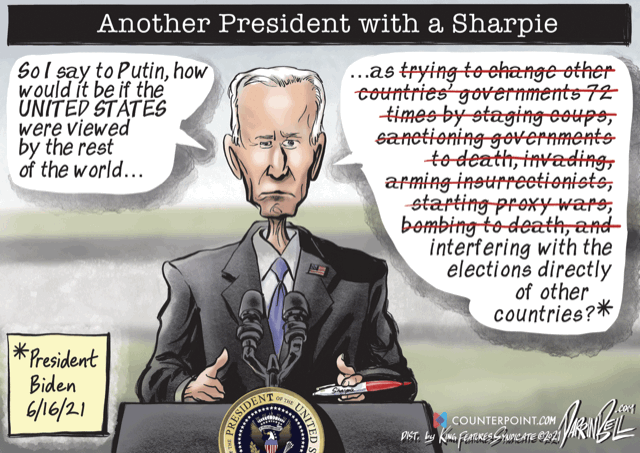
Do what we say and not what we do

In his meeting with President Putin, President Biden is thought to have proposed red lines against the use of cyber weapons such as ransomware. The idea of shutting down something like Colonial Pipeline with a computer hack is surely repugnant. I seem to remember that many of us cheered when the U.S. (and Israel?) damaged the Iranian uranium enrichment facility at Natanz with a malicious computer worm called Stuxnet. Nor were many of us much bothered when U.S. financed coups topped unfriendly governments, or when we attacked Afghanistan, Iraq, Libya, Haiti, Nigeria, Syria, to name but a few.

“The supreme international crime according to 2017 U.S. media reporting is interfering nonviolently in a democratic election — at least if Russia does it. William Blum, in his book Rogue State, lists over 30 times that the United States has done that. Another study, however, says 81 elections in 47 countries.”  https://davidswanson.org/warlist/

While this is hard to swallow, our bad behavior differs from that of Russia’s or of other autocrats. I will not go to jail for writing this. Most Americans (I like to believe) condemn such behavior contrary to our founding principles when they learn of it. Our press is happy to expose such breaches when they discover them. In short, while our government often violates our principles of individual rights and the rule of law and lies regularly about it, public scrutiny and outrage tend to check bad behavior and move us back toward conformity with our principles. We never get there but it is very important that we keep trying.  

My Travels to Baghdad

Iraq: An American Tragedy, My Travels to Baghdad

Warren Coats (2020)

Kindle and paperback versions available at: Iraq-American-Tragedy-My-Travels-Baghdad

From the corkscrew landing at Saddam International Airport (now the Baghdad International Airport) to adventures in the Green Zone and beyond, this recounting of my experiences helping the Central Bank of Iraq develop modern market tools of monetary policy exposes the disfunction of the U.S. lead Coalition Provisional Authority (CPA) in its attempt to govern and rebuild post Saddam Iraq, following one of America’s more foolish and damaging military adventures. The existence of weapons of mass destruction was a lie. American skill at imperial rule–from disbanding the Iraqi Army to De-Ba’athification of the Iraqi bureaucracy– was a myth. 

Regime changes usually don’t involve changes in the monetary system. However, the toppling of Saddam Hussein’s government and the occupation of Iraq and the takeover of its government by the United States and a few allies in the name of the Coalition Provisional Authority (CPA) was accompanied by the replacement of the so-called Saddam dinar and modernization of Iraq’s monetary and financial system. The Iraq war was launched with “shock and awe” on March 20, 2003 and President George W Bush declared “mission accomplished” on May 1 a month and a half later. But when I retired from the International Monetary Fund and took up residence in Baghdad to advise the Central Bank of Iraq on developing Iraq’s financial markets and managing its new currency, the fighting was not over on many fronts. I lived in Baghdad the last two months of the CPA (May-June 2004) and made four two-week visits between then and December 2005

In this book, much of it written in diary form at the time, I share the challenges of advising the staff and management of the Central Bank of Iraq from my office in the central bank and of navigating the U.S. interagency rivalry from my office in Saddam’s Republican Palace in Baghdad’s Green Zone.  Security was always a challenge, producing many adventures. But the wisest advice I received was from a colleague in the CPA, who told me to “be careful who you talk to here (CPA headquarters in the Republican Palace), your worst enemies are in this building.” Over my 26 years in the International Monetary Fund and the technical assistance missions I lead to some 20 countries, many of them post conflict countries, I have never encountered the disfunction and resulting ineptitude of the U.S. led Coalition Provisional Authority in Iraq.

Previous Books

One Currency for Bosnia: Creating the Central Bank of Bosnia and Herzegovina

by Warren Coats (2007)    Hard cover: One Currency for Bosnia

FSU: Building Market Economy Monetary Systems–My Travels in the Former Soviet Union

By Warren L Coats (2020)  Kindle and paperback versions available at: FSU-Building-Economy-Monetary-Systems

Afghanistan: Rebuilding the Central Bank after 9/11 — My Travels to Kabul

By Warren Coats (2020)  Kindle Edition:  “Afghanistan-Rebuilding the Central Bank after 9/11”

Zimbabwe: Challenges and Policy Options after Hyperinflation

by Warren L. Coats (Author), Geneviève Verdier (Author)  Format: Kindle Edition

Zimbabwe-Challenges and Policy Options after Hyperinflation-ebook

Money and Monetary Policy in Less Developed Countries: A Survey of Issues and Evidence

by Warren L. Coats (Author, Editor), Deena R. Khatkhate (Author, Editor)  Format: Kindle Edition

Money and Monetary Policy in LDCs-ebook