The Market vs. the State

It is in our natures to serve our personal interests first and those of others second. The interests of others include not only those around us in need but also our children and future generations in general, which are served by far sighted policies that might entail short-run and immediate sacrifices. Communities and societies that have instilled in each generation the values that promote and serve such longer-run interests will flourish relative to those with more narrowly “selfish” values.

Adam Smith famously explained in The Wealth of Nations how an individual’s pursuit of his personal gain benefits society at large. In the marketplace the fruits of our labors enjoy the greatest profit the better they meet the desires and needs of our customers at the lowest possible cost. While we might like to cut corners and raise our prices if we could get away with it, competition in the market prevents us from doing so.

Free trade and the international agreements that promote it is an example of the trade off between personal and community or national interests that I am raising. The Trans-Pacific Partnership (TPP) and the Transatlantic Trade and Investment Partnership (TTIP) will further extend the freedom to trade among the countries signing up to them while raising the standards for working conditions, intellectual property protection, and conflict resolution.

I began an article on free trade written a year and a half ago with: “World per capita income didn’t change much from the time of Christ to the founding of the United States ($444 to $650 in 1990 dollars), a period of 1,790 years. But in the following 320 years it jumped to $8,080. And about half of that jump came over the last 50 years. What explains this fairly recent explosion of well being? Many things, of course, but central to this explosion of wealth was trade.” free-markets-uber-alles As the most disheartening and distressing U.S. presidential campaign in my lifetime has made clear, the huge gains from freer trade as with the huge gains from technical advances have not been evenly shared thus highlighting the trade off between personal and community interests I am exploring.

We have long accepted that economic progress should not be stopped because it would make a particular set of skills or tools less valuable. When someone developed cheaper and better ways of providing us with music than the old 78 inch vinyl record—itself an amazing technological feat in its time—those producing the old records were forced to learn new skills. We should debate whether society (family, church, community governments, etc.) should help those adversely affected by technological progress and how best to do it, but few would want to prevent such progress from which almost everyone in the world has eventually benefited enormously.

Government, which represents an exercise of our collective will, is meant in part to give primacy to our concerns for the interests of others and/or the long run over our individual, immediate personal well being. The American constitution was all about trying to do that without the government becoming captive of the self-interest of those running it. Our natures, whether we operate as private individuals constrained by the market place or as public officials constrained by the law and a broadly agreed public purpose, remain a mix of self-interest and public interest. The fundamental difference between our behavior as private citizens or public servants is in the external constraints that impact our behavior. Our natures otherwise remain the same.

The power of government can be exploited to thwart the discipline of competitive markets on the dominance of self-interest over the common interest. Preventing government from being captured by the self-interest of those running it or those who seek special privileges from it is no easy task. To that end our constitution strictly limited what government could do (the enumerated powers) and encumbered it with checks and balances. The dangers of such capture posed by the military industrial complex of which President Eisenhower warned, is well known and real (e.g. $400 billion F-35 Joint Strike Fighter that few believe we need), but the same is true of most other intrusions of government into private affairs, such as all of our many wars (on drugs, terror, poverty, etc.) as well.

Sadly our government has expanded well beyond its necessary functions into every nook and cranny of our personal lives with increasingly pernicious and alarming results. The abuses of its ever-expanding powers for personal and partisan benefits are exemplified by the scandal of asset forfeiture,the-abuse-of-civil-forfeiture/, which alarmingly continues, the long and bipartisan history of political abuse of the IRS, irs-tea-party-political, and most recently the legal attack on companies questioning the climate change forecasts of the Intergovernmental Panel on Climate Change (IPCC) by the AGs United for Clean Power using the Racketeer Influenced and Corrupt Organizations (RICO) Act in an effort to silence criticisms of UN climate studies. prosecuting-climate-chaos-skeptics-with-rico. Such a blatant government attack on free speech is truly shocking. These are but a few examples of growing government tyranny and corruption.

The most effective defenses against such corruption are to limit the scope of government as much as possible (i.e. subject individual actions to the discipline of the market as much as possible) and to strengthen public insistence on adherence to the rule of generally applicable law. As trade has moved beyond the village and nation, so must the rule of law.

Following World War II the United States led the establishment of international arrangements and laws governing trade (WTO) and financial (IMF and WB) and diplomatic (UN, NATO) relations among nations. The U.S. was the natural leader of this globalized world not only because it had the largest economy and the largest military, but because it was generally respected for its commitment to the rule of law. More than any other country the U.S. was seen as committed to the longer run prosperity of the world above short run tactical benefits for itself.

In an April 12, 2016 interview by Steve Clemons in The Atlantic, U.S. Treasury Secretary Jacob Lew observed that “In the 21st century, the world needs the United States to be a North Star. The world wants us to be the North Star. I really do believe that. I am amazed at how other countries want to hear our advice and what we think makes sense. Sometimes we may have the habit of lecturing too much. We have to be careful not to do that.”

In recent years American leadership has been slipping. Rather than draw China more tightly into the global rule based trading system, we have pushed them away. After the United States convinced the IMF’s European members to accept a reduction in their share of votes in the IMF in order to bring the voting shares of China, India, and some other emerging economies more in line with their economic size, it took the U.S. Congress more than five years before it approved the amendments to the IMF Articles of Agreement needed to implement this agreement. In the mean time China set up its own international lending organization. US-leadership-and-the-Asian-Infrastructure-Investment-Bank

Rather than strengthen cooperative, diplomacy based relationships the U.S. has launched a series of generally failed wars to promote “democracy,” (Gulf War 1990-91, Somalia 1992-5, Haiti 1994-5, Bosnia 1994-5, Kosovo 1998-99, Afghanistan 2001 – to date, Iraq 2003-11, Libya 2011). These have weakened respect for American leadership.

On the economic front the United States has imposed hugely costly anti-money laundering (AML) and global tax reporting (FACTA) requirements on the rest of the world without regard for their cost and despite the lack of any evidence of benefits.  Operation Choke Point   These are serious abuses of American leadership that will produce a growing backlash. But it is not just misguided arrogance that is undermining our role in the world, it is the growing perception that our leadership is increasingly motivated by the selfish personal interests of crony capitalists rather than the high principles that have serviced us and world so well in the past.

Consider the example of the FATCA (Foreign Account Tax Compliance Act). Badly designed corporate and income tax laws in the United States have pushed an increasing number of companies and wealthy people out of the U.S. Rather than clean up its tax laws, the U.S. attempts to tax the income of Americans where ever they earn it and where ever they might live. The only escape is to renounce U.S. citizenship. The Obama administration is now proposing an exit wealth tax for American’s giving up their citizenship. It reminds me of the measures the Soviet Union took to prevent its citizens from leaving. Have we really fallen so low?

The use of off shore, tax minimizing structures by American companies and individuals (i.e. legal tax planning measures) as well as illegal efforts to hide income have been met by increasingly intrusive efforts by the U.S. to find and tax such income. Quoting from the introduction of the Wikipedia article on FATCA: “The Foreign Account Tax Compliance Act (FATCA) is a 2010 United States federal law to enforce the requirement for United States persons including those living outside the U.S. to file yearly reports on their non-U.S. financial accounts to the Financial Crimes Enforcement Network (FINCEN). It requires all non-U.S. (foreign) financial institutions (FFI’s) to search their records for indicia indicating U.S. person-status and to report the assets and identities of such persons to the U.S. Department of the Treasury.”

As the world attempts to comply with American extra territorial demands, the United States itself is not. Such reporting requires knowledge of the beneficial owners of companies. Most companies established in the United States, such as those incorporated in Delaware, are not required to provide the identities of beneficial owners. The U.S. seems to have no intention of requiring its companies to comply with what it demands from other countries.

The decline and fall of the “American Empire” seems to be underway. It doesn’t need to be.
Work-Leisure Choice and growth

A recent dinner companion inquired whether an economy that was not growing was necessarily a problem. What she had in mind was whether people choosing more leisure to enjoy their incomes rather than continuing to work the same or longer hours created an economic problem. The short answer is no. I will explore that issue further and then make a point about the propriety of governments making work/leisure choices for us rather than leaving the choice to us.

Our incomes grow when we work longer hours, acquire improved skills, work with more tools, or work with better tools. The economy as a whole grows without individual incomes necessarily increasing when more people work (i.e., when the population grows). Unless you are very pessimistic about the prospects for continued innovation and technical improvements in each worker’s productivity, our incomes will continue to increase even if we don’t work longer hours.

Over the last 65 years the average annual hours worked by employed Americans dropped from 1,910 to 1,710 while real disposable personal income per capita (in 2009 dollars) increased from $10,000 to over $38,000. Over the longer period of a century or two the drop in hours worked and the increase in per capital income have been much more dramatic. This dramatic increase in income reflects better skills, more capital (tools) and better capital. But it is less than in would have been if people had not chosen to enjoy that income by working less and playing more. The over all economy can adjust to any of these – growing, stagnate, or shrinking income.

While Bernie Sanders may think that the best way to increase the standard of living for the poor is to redistribute to them some of the high income of the wealthy, most everyone else would agree that only economic growth has and can continue to lift large numbers of the poor out of poverty. Global poverty (per capita income below $1.25 per day) dropped from 50% in 1980 to 20% in 2011, an astonishing achievement totally beyond what any amount of redistribution could have accomplished. Most of us think that the proper purpose of redistributing income is for the better off to finance a safety net floor for those unable to work. This dramatic increase in income was the result of improvements in worker productivity (i.e., better skills and more and better capital) not working longer hours.

But what about the choices workers have made and are making about the hours they work vs. the hours they play with the proceeds of that work once they are well above poverty? Over time as most people’s incomes have grown they have generally reduced the long hours worked six or more days a week. Employers and workers strike deals that maximize the profits of the firm and the happiness and well-being of employees. Why then do many governments feel that they need to legislate the matter? Why, for example, did French Socialists feel compelled to legislate a 35-hour workweek a few years ago?

In limited cases, a public safety argument might make sense to over ride the preferences of workers and their employers, for example, if truck drivers felt included to push themselves more hours than they could safely stay awake at the wheel. Mr. Hollande’s French government is now proposing to remove the 35-hour limit and relax other labor market restrictions. I hope they succeed, as leaving more of such decisions with the people themselves will result in happier workers and a more productive economy.

This issue came up a few years ago in connection with the Greek financial crisis. Here are two of my blogs written three years apart on the situation in Greece: https://wcoats.wordpress.com/2012/02/26/saving-greece-austerity-andor-growth/,     https://wcoats.wordpress.com/2015/02/08/greece-debt-and-parenting/ To over generalize, it is often the case that people living in temperate climates (such as Greece and the Southern cone of the EU) work less and have lower incomes. If they are freely choosing to enjoy more leisure in the lovely climate in which they live, they are no doubt happier and better off because of it. Greece’s problem was not that its many Zorba’s had a great zest for life and played more than they worked. Its problem was that after getting away with playing on other peoples’ work/money, they thought they should be entitled to continue doing so. The balancing of work and leisure that is optimal is a person-by-person decision. The economy will be fine and will adjust to whatever these preferences are. People at different income levels and/or different preferences within the same economy will likely make different choices. There is no justification for the government to impose its notion of what is optimal uniformly on everyone. This is just another example of government over stepping its proper role.


Fairness or Envy?

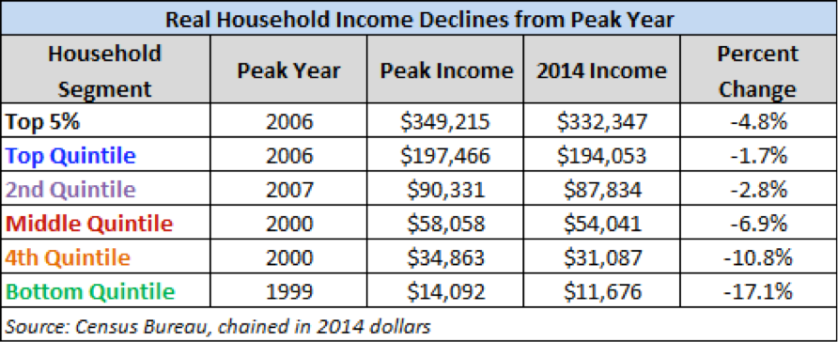
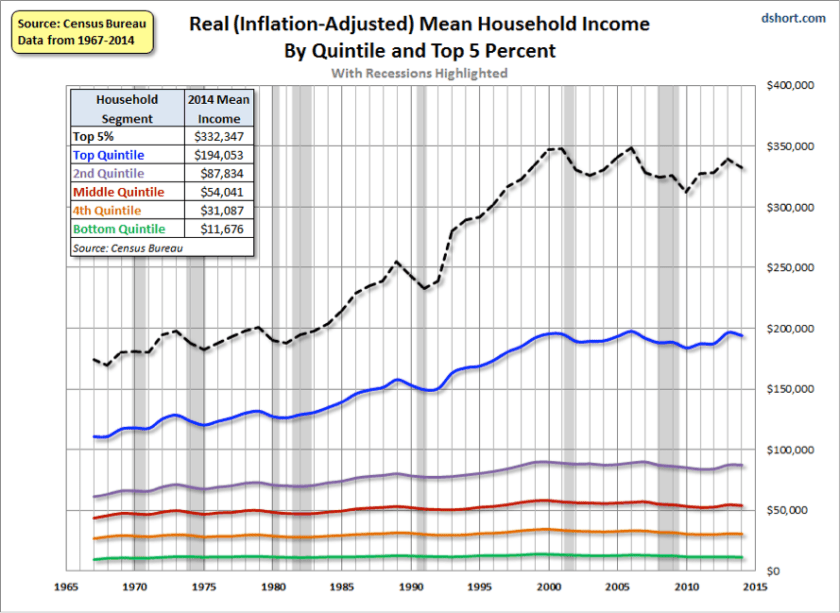
After many decades of impressive and relatively steady increases in the standard of living (increases in real per capital income) of all quintiles of the American income distribution, since 2000 all quintiles have lost ground. In the run up to 2000 incomes in the top quintile increased more rapidly than those in the lower quintiles resulting in a less equal distribution income.

Mean income

The mean real incomes of each quintile are lower now (2014) than they were in 2000. However, the percentage decline has been larger for the middle and lower income quintiles (see table below) leaving the more unequal income distribution in place. Some of the relative gains of the top quintile are attributed to the growing premium for higher education, but as claimed by the Occupy Wall Street demonstrators, some have not been earned by providing higher valued products.

Income table

Most of us do not resent and in fact are grateful for those whose wealth resulted from inventing and giving us products we greatly enjoy. However, we are rightly angry at both political parties for increasingly supporting crony capitalists—those who benefit from their connection with and influence on the government—who benefit at the expense of the rest of us. They are capturing economic rents at the expense of the rest of us rather than enjoying the fruits of greater productivity.

The broad political consensus in the United States that we are each entitled to the wealth we each create, but must fairly share in the cost of providing our national defense, public goods and a satisfactory safety net for the poor, seems to be falling apart. In the economic sphere, the left increasingly favors one group, the working class represented by labor unions, against the professional and entrepreneurial classes. Classical liberals (i.e., economic conservatives) champion fairness – a level playing field – and the freedom to get rich if you work harder, or create a better product, or a more efficient way of producing what people want. They champion measures that facilitate entrepreneurship and economic growth without much regard for its impact on income distribution. Trade – globalization – is an essential part of promoting economic efficiency and thus growth, allowing, if not forcing, firms to shift resources into goods for export in which they are relatively more efficient in order to pay for the cheaper imports enjoyed by the average middle class consumer.

The Republican Party more so than the Democratic Party, though not by much, has increasingly been failing to preserve a level playing field in various areas (Wall Street, defense industry etc.). But the embrace of protectionism offered by Donald Trump reflects either class warfare or ignorance of globalization’s enormous contribution to our standard of living. The big trade and industrial unions of old—think of the United Auto Workers in Detroit—followed a different drummer. They were not interested in fairness but rather fought to bring economic rents (monopoly returns) to themselves at the expense of other workers via a deal with their employers to create, defend, and share monopoly returns. This worked with the auto industry, where auto workers earned at least double the prevailing wages for nonunion workers with comparable skills as long as GM, Ford and Chrysler could hold off competition from German and Japanese (plus a growing list) auto producers via a combination of tariffs and safety standards. Globalization gradually destroyed this monopoly arrangement and almost killed the American automobile industry until U.S. automakers relocated to southern, non-union states.

While good working conditions are win win for workers and employers, pushing up wages above their competitive level either drives firms to other locations (non union states or abroad) or kills them all together. Voters supporting protectionist policies either don’t understand that they lower the standard of living for most people (here and abroad) by lowering the overall productivity of workers or they seek to exploit monopoly rents for themselves at the expense of other workers.

Such thinking was dramatically illustrated by the recent strike of workers at Tesla Motor’s giga battery factory project in Nevada. As reported in the Washington Post on March 2: “On Monday, hundreds of workers walked off their jobs at the giant battery factory that Tesla Motors is building in the desert outside Reno, Nevada. It wasn’t your typical picket: They weren’t protesting bad working conditions, or making a show of force around contract negotiations. Rather, they were protesting other workers — specifically, the fact that they were from somewhere else.” Their complaint was that workers from out side Nevada were willing to work for less than the $35 per hour that members of the local union were making. These were not “foreign” workers from South of the border. These were workers from Arizona and New Mexico. The out of state workers obviously found their “low” wages with Tesla in Nevada better than the wages they would receive staying at home so they were better off coming to Reno.

The Post further reported: “That dispute explains an important debate underway right now in all sorts of skilled trades: Builders say there’s a labor supply problem, which needs to be fixed by bringing more people into the field from across the country and across the border. Worker groups say there isn’t a supply problem — it’s just that builders aren’t paying enough to make the jobs worth someone’s while.”

Trump’s pledge to protect America workers from cheap Chinese and other imports so they can produce them in the U.S. at a higher cost, is bad economics and bad policy. He is pledging to benefit one group of workers at the expense of other workers and at the expense of the standard of living more generally. This is not what the Republican Party has stood for in the past and not what it should stand for now. It should stand for fairness and equal opportunity for workers and entrepreneurs to benefit from doing things better and thereby raising their incomes and the income of the nation. The principle of fairness is widely held in the United States but has always had to battle for dominance against the temptation of the zero sum claims of special interests for government to serve their interests at the expense of others and at the expense of fairness. Donald Trump and Bernie Sanders are appealing to special rather than general interests at the expense of fairness.

A Modest Proposal—Helicopter Money and Pension Reform

It is possible to fix the bankrupt Social Security System and the Federal Reserve’s failure to achieve its inflation target painlessly. Yes, really.

The Fed has failed to raise inflation to its 2% target because over regulated banks can’t find over regulated firms wanting to borrow and invest. As a result, the increases in the Fed’s base money from its Quantitative Easing and other efforts to stimulate the economy has piled up as bank excess reserve deposits at the Federal Reserve Banks.[1] If the Fed pushes too hard (e.g., by lowering the interest it pays on these bank reserves, potentially even to negative levels) it feeds asset price bubbles (stock and housing prices), which do great damage when they burst.[2] If the Fed just printed more money and sprinkled it around to the general public—what Milton Friedman called helicopter money—there is no doubt that the public would spend more and drive up prices.

Leaving aside whether it is really a good idea to create a steady 2% rate of inflation, there is an easy way of doing it that would also facilitate badly needed reform of the government’s retirement system. Contrary to the myth that our Social Security pensions reflect what we paid in (saved) to the system, Social Security pension payments are now fully pay as you go. This means that the revenue from payroll taxes approximately matches the outflow for current pensions, i.e. nothing is being saved for the future. As our population continues to age and the number of retired pensioners increases relative to the shrinking number of workers paying into the system, the modest amounts that have been accumulated in the Social Security “Trust Fund” will be drawn down to zero in about 15 years at which time the government will not be able to meet existing promises.[3]

The following proposal combines helicopter money sufficient to bring the inflation rate to its target with badly needed reform of our government pension system. Under this proposal all individuals will receive a minimum government guaranteed pension for life whether they paid in anything or not. This might be implemented as part of a Friedman like negative income tax and other badly needed tax reforms,[4] or stand alone. Before retirement, individuals who are working but with incomes below the poverty level (to be politically established) will not pay a wage tax as they do now. The subsequent pensions of such people will be paid with helicopter money (the Federal Reserve will print the money to buy government bonds sufficient to finance these expenditures). All workers with incomes above the poverty level will be required (as they are now) to set aside the amount of income needed to finance their minimum guaranteed pension on a fully funded basis. They are free to save more if they would like a higher pension. The funds set aside must be invested in government licensed and approved private pension funds chosen by each worker rather than in the almost fictitious Social Security Trust Fund.

This would establish the three pillars of good pension policy proposed by the World Bank in 1998: a means tested minimum pension financed by the government’s general revenue, a mandatory minimum pension paid for and privately invested by all working individuals, and additional, optional, supplemental retirement saving privately invested. Such a model was first adopted in Chile over 35 years ago with great success. Central and Eastern European countries have adopted similar models as part of their transition from centrally planned to market based economies. Financing income subsidies to the poor from general revenues (via printing money), and a user fee approach to mandatory saving (mandatory saving matched to the actuarial value of the pension received), conforms more closely to the principles of good tax policy.[5] The alternative sometimes proposed of raising the income cap on the payroll tax is closer to general revenue financing (if the government guaranteed minimum is only paid to the poor), but leaves out non-wage income and thus fails the good tax criteria.

As new workers would be truly saving for retirement, their savings would not be available to finance those currently retired, as is now the case with our pay as you go system. Thus transitional arrangements will be needed (for several decades) to deal with existing unfunded promises. If the promises remain unchanged, the money to pay for them will have to come from somewhere (higher taxes or reduced defense or other expenditures). Usually, in such cases the government spreads the burden around (burden sharing). Two simple and sensible changes to the current promises would absorb the greater part of the shortfall. The first is to adjust the pensionable retirement age to the fact that the average person lives much longer than when the current retirement ages were fixed. People are living longer and can (and most would like to and do) work longer. The other is to change the index to people’s pensions from a wage index (which generally increases pensions in real terms over time) to the cost of living (CPI), which would preserve their real value against any inflation over time.

For today, this means that the wage tax on the poor would be abolished and paid for with new Fed money that would thus be put in the hands of those who would spend it, increasing employment (though we are really at full employment now) and/or wages and prices. It would both raise inflation a bit and launch a genuine, long over due pension reform.

[1] “US Monetary Policy–QE3” Cayman Financial Review, January 2013

[2] “The D E Fs of the Financial Markets Crisis” CATO Institute, September 26, 2008.

[3] https://wcoats.wordpress.com/2008/08/28/saving-social-security/

[4] http://www.compasscayman.com/cfr/2009/07/07/US-federal-tax-policy/

[5] http://www.compasscayman.com/cfr/2013/07/12/The-principles-of-tax-reform/

The Asian Infrastructure Investment Bank and the SDR

By Warren Coats and Dongsheng Di

Jin Liqun, President of the new Asian Infrastructure Investment Bank (AIIB) announced on January 17, 2016 that all of its loans would be in U.S. dollars, “signaling that Beijing will not use the development bank as a platform to promote renminbi internationalization.”[1] In this note we argue that the AIIB should make all of its loans in SDRs. Doing so would make a major contribution to promoting the replacement/supplementation of the U.S. dollar for international payments that was called for by People’s Bank of China’s Governor, Zhou Xiaochuan in 2009.[2] As the SDR valuation basket will include the Chinese renminbi after October 1, 2016[3] it will also contribute, but more modestly, to the international use of the renmimbi.[4]

As the AIIB is a Chinese initiative and is headquartered in China, it was initially thought by some that its operations would be denominated in RMB. However, denominating its loans in RMB and actually disbursing RMB would suffer several disadvantages for the AIIB and for its loan recipients. There was concern by some that the use of the RMB might further strain the already complicated US-China bilateral relationship. In might also force the pace of China’s financial and capital account liberalization faster than other conditions warrant. Moreover, with greater exchange rate volatility of late, loan recipients would be exposed to greater exchange rate risk. The AIIB’s choice of the U.S. dollar avoids these risks but continues to subject its borrows to exchange risks associate with the dollar, which has varied considerably over the years. For these reasons the IMF, for example, denominates its loans and other financial operations in its Special Drawing Right (SDR), whose value is based on the market value of specific amounts of the five freely useable currencies in its valuation basket.[5] Thus for most countries, the international value of the SDR is more stabile than is the value of the dollar or another of the other currencies in its valuation basket. This logic applies fully to the operations of the AIIB and other development banks. The case for creating “private” SDRs to disburse to AIIB loan recipients rests on the contribution it would make toward developing the SDR issued by the IMF into a global reserve asset to supplement or replace the U.S. dollar, Euro and other national currencies in countries foreign exchange reserves.

The development and use of private SDRs, SDR denominated bank liabilities, is described in detail in an article one of us wrote over thirty four years ago in the IMF Staff Papers.[6] The AIIB would establish SDR denominated deposits with its bank (e.g., the BIS) and instruct its loan recipients to establish SDR accounts with their banks. AIIB loans would be disbursed by transferring the appropriate amounts of its SDR balances at the BIS to the recipients’ account at its banks. The dollar value of these SDRs would be determined in the same way as is the IMF’s official SDR. Following the procedures used by the IMF when disbursing its SDR denominated loans, recipients could request to receive their loans in the equivalent value of a freely usable currency of their choice (or in any or all of the five currencies in the valuation basket). In the first instance, AIIB loan recipients are likely to be governments with accounts in their central banks. Thus these central banks would need, in addition to their SDR accounts with the IMF, to establish (private) SDR accounts for their governments and commercial banks. If the loan recipient is able to spend these SDRs (pay its contractors and suppliers) directly it would do so, but most often it would need to exchange them for the currency wanted the ultimate recipients. This exchange would most likely be executed by its bank providing the SDR deposit.

Cross border private SDRs payments would be cleared and settled in the same general way as are U.S. dollar payments. Net outflows of SDRs from the banks of one country via their central bank to another country via its central bank, would be settled by the transfer of official SDRs on the books of the SDR Department of the IMF. Alternative clearinghouse arrangements are also possible has suggested by Peter Kennan in his comments on the 1982 IMF Staff Papers article. When such loans are repaid, if the repaying government (or other loan recipient) doesn’t have sufficient balances in its private SDR account with its central bank to transfer to the AIIB’s account with the BIS it would use other currencies to buy additional private SDRs. It might also use its official IMF allocated SDRs to either buy private ones or to transfer directly to the AIIB (assuming that like most other development banks and the BIS it has become an “other holder” of official SDRs). Private and official SDRs would have essentially the same relationship with each other as do base money and bank money in national currencies.

China and the AIIB are in a strong position, working through the IMF or bilateral discussions, to urge central banks to open private SDR accounts for their governments and their commercial banks toward the fulfillment of their obligation under the IMF’s Articles of Agreement to make the SDR “the principal reserve asset in the international monetary system” (IMF Article XXII). Through their representatives at the World Bank, Asian Development Bank, and their New BRICS Development Bank they could press these institutions to disburse in SDRs (private and/or official) as well. As an important purchaser of oil and other globally traded commodities they could encourage their pricing in SDRs. In the first instance, many loan recipients would choose to convert their SDRs into one or more of its basket currencies. But as private SDRs and supporting clearing and settlement arrangements proliferated, holding and using SDRs for international transactions would become more convenient and would potentially grow rapidly. This is an opportunity that should not be missed.

References

Coats, Warren, 1982   “The SDR as a Means of Payment,” IMF Staff Papers, Vol. 29, No. 3 (September 1982) (reprinted in Spanish in Centro de Estudios Monetarios Latinoamericanos Boletin, Vol. XXIX, Numero 4, Julio–Agosto de 1983).

1983, “The SDR as a Means of Payment, Response to Colin, van den Boogaerde, and Kennen,” IMF Staff Papers, Vol. 30, No. 3 (September 1983).

2009, “Time for a New Global Currency?” New Global Studies: Vol. 3: Issue.1, Article 5. (2009).

2011, “Real SDR Currency Board”, Central Banking Journal XXII.2 (2011), also available at http://works.bepress.com/warren_coats/25

2014, “Implementing a Real SDR Currency Board”

_____. Dongsheng Di, and Yuxaun Zhao, 2016, Why the World needs a Reserve Asset with a Hard Anchor, http://works.bepress.com/warren_coats/34/

Footnotes

Dr. Warren Coats retired from the International Monetary Fund in 2003 where he led technical assistance missions to more than twenty countries (including Afghanistan, Bosnia, Egypt, Iraq, Kenya, Serbia, Turkey, and Zimbabwe). He was Chief of the SDR Division of the Finance Department from 1982-88. His PhD from the University of Chicago was supervised by Milton Friedman. He was part of the IMF’s program team for Afghanistan from 2010-2013 and is a U.S. citizen. Wcoats@aol.com

Dr. Dongsheng DI is an associate professor of International Political Economy with School of International Studies, Renmin University of China and also a Research fellow with International Monetary Institute of RUC. In 2015 he is a visiting researcher at Edmund A. Walsh School of Foreign Service of Georgetown University. His research interests include the political economy of global monetary affairs, RMB internationalization, and Chinese Domestic Reforms. He is also a policy advisor to NDRC and China Development Bank and is a citizen of the People’s Republic of China. didongsheng@vip.sina.com

[1] China’s New Asia Development Bank will lend in US dollars, Financial Times Jan 17, 2016 http://www.ft.com/intl/cms/s/0/762ce968-bcee-11e5-a8c6-deeeb63d6d4b.html#axzz3xWiTvQZD

[2] Zhou Xiaochuan, “Reform the International Monetary System”, Website of the People’s Bank of China, March 23, 2009;

[3] The amount of the China currency in the SDR valuation basket will be determined on September 30, 2016 such that its weight in the basket on that day is 10.92% of the total value of one SDR.

[4] Banks offering SDR denominated deposits will generally balance them with SDR denominated assets or assets in the five currencies in the SDR’s valuation basket similarly weighted.

[5] The RMB will be added to the existing basket of four currencies—USD, Euro, GBP, JPY—from October 1, 2016.

[6] Warren Coats, “The SDR as a Means of Payment,” IMF Staff Papers, Vol. 29, No. 3 (September 1982); “The SDR as a Means of Payment, Response to Colin, van den Boogaerde, and Kennen,” IMF Staff Papers, Vol. 30, No. 3 (September 1983).

Keystone XL pipeline madness

By his own admission President Obama’s rejection of the Keystone XL pipeline project is political rather than scientific.

Two environmental concerns have been raised. The first is that the emissions of greenhouse gases are about 17% higher for oil from oil sands compared to conventional sources. However, the rejection of the pipeline proposal will not materially change the production and consumption of Canada’s oil shale crude, which will now be transported to market by more expensive means. “Rail transport has expanded to carry oil sands to the United States, soaring from just 16,000 barrels in 2010 to 51.2 million barrels in 2014 before dropping somewhat this year. But rail transport is more expensive than pipeline transport…. Royal Dutch Shell’s chief executive, Ben van Beurden, said last year that the company had bid for space on another pipeline to move its oil-sands crude to Canada’s east coast and from there to world markets, including Gulf Coast refiners. ‘We’re covered. I’m good,’ he said in an interview. He said that ‘the argument that Keystone is a bad idea because it will somehow enable development of resources in Canada is to some extent flawed,’ adding that other alternatives would emerge.” (This and other quotes are from today’s Washington Post in the article linked below)

The second environmental concern arises from the possibility of oil spills from breaks in the pipeline. This possibility needs to be compared with the possibility of spills from rail accidents or breaks in alternative pipelines.

Because the pipeline would cross international boundaries it must be approved by the State Department. As the application was being reviewed, then Secretary of State Hillary Clinton stated on October 15, 2010 that the department was “inclined” to approve project. “We’re either going to be dependent on dirty oil from the Gulf or dirty oil from Canada,” she said. On August 26, 2011 the State Department issued its final environmental impact statement determining “there would be no significant impacts to most resources along the proposed project corridor.” And again on March 1, 2013 the State Department issued another environmental review that raised no major objections to the Keystone XL oil pipeline saying that other options to get the oil from Canada to Gulf Coast refineries were worse for climate change.

Canada’s new liberal Prime Minister, Justin Trudeau, supported the project. “TransCanada’s president and chief executive, Russ Girling, issued a statement saying his company was ‘disappointed. Today, misplaced symbolism was chosen over merit and science — rhetoric won out over reason,’ Girling said…. Terry O’Sullivan, general president of the Laborers’ International Union of North America, said Friday that ‘Obama has also solidified a legacy as a pompous, pandering job killer.’” (same Post article).

“As Obama rode from the White House to the campus [Georgetown on June 25, 2013, he], said he would approve Keystone XL only ‘if it does not significantly exacerbate the climate problem.’” But his own State Department found that it does not. So what is going on?

“By late 2013, Obama and Kerry had concluded that the pipeline failed their climate test — not because blocking it would guarantee that Canada’s fossil fuels would remain in the ground, but because denying the permit would strengthen America’s position in international climate negotiations…. ‘The reality is that this decision could not be made solely on the numbers — jobs that would be created, dirty fuel that would be transported here, or carbon pollution that would ultimately be unleashed,’ Kerry said in a statement. ‘The United States cannot ask other nations to make tough choices to address climate change if we are unwilling to make them ourselves.’”

In short the President lied (not an uncommon practice among politicians, but we might hope for a higher standard from American Presidents). But apparently not. The Obama administration has authorized the selling of coal owned by the U.S. government that would not meet our C02 emission standards to third world countries, which helps our emission record but not the world’s. https://www.washingtonpost.com/world/us-exports-its-greenhouse-gas-emissions–as-coal-profitable-coal/2015/10/08/05711c92-65fc-11e5-bdb6-6861f4521205_story.html

“The Washington Post’s editorial on the pipeline today began: “President Obama rejected the Keystone XL oil pipeline on Friday, ending an unseemly political dispute marked by activist hysteria, GOP hyperbole, presidential weakness and a general incapability of various sides to see the policy question for what it was: a mundane infrastructure approval that didn’t pose a high threat to the environment but also didn’t promise much economic development. The politicization of this regulatory decision, and the consequent warping of the issue to the point that it was described in existential terms, was a national embarrassment, reflecting poorly on the United States’ capability to treat parties equitably under law and regulation.”

https://www.washingtonpost.com/blogs/post-partisan/wp/2015/11/06/obama-ditches-evidence-to-capitulate-on-keystone-xl/

https://www.washingtonpost.com/news/post-politics/wp/2015/11/06/obama-set-to-reject-keystone-xl-project-citing-climate-concerns/

Two approaches to American governance–The case of higher education financing

Hillary Clinton deserves credit for setting out her positions on individual policy issues so that we can have an intelligent discussion of their pros and cons. She is nothing if not a tireless policy wonk. Think of her exhaustive but failed effort to “fix the provision of health care in America” during her husband’s presidency. While the Clinton’s are Democratic Party centrist, they still embrace a top down government/regulatory approach to dealing with many of societies challenges/problems. Mrs. Clinton’s plans to make college affordable provide a recent example of this approach. It is thoughtful and balanced from a left of center, regulatory approach perspective. I prefer a difference, right of center, more market oriented approach.

I have not read Mrs. Clinton’s detailed proposal and rely completely on the following Washington Post summary: http://www.washingtonpost.com/news/wonkblog/wp/2015/08/10/clinton-proposes-a-350-billion-plan-to-make-college-affordable/

Background

Americans believe in equality of opportunity rather than equality of outcomes. We are not egalitarians. There is nothing we can do about the fact that each person is born with different predispositions and capabilities. But it has been a long-standing, broadly shared principle that everyone should have access to the education she is capable of. We have lived up to this goal very imperfectly. Tuition vouchers and school choice are moving us closer to this goal for K-12 by making the state’s financial contribution to education more equal for each student and subjecting schools to greater competition in producing good results. Unlike primary and secondary education, however, which in the United States is financed by the states (generally by municipalities), college is not for everyone. An important public policy issue is who should pay for higher education for those who do go.

When the government began to supplement private universities and colleges with state run, public ones, it generally funded the cost from tax payers charging only nominal tuitions, if any, to those attending. Milton Friedman and others pointed out that this resulted in a perverse redistribution of income from lower to higher income people. University graduates enjoy incomes two or three times the average of non-college graduates. In response to this criticism, state colleges and universities in recent decades have raised their tuitions in order to finance more of the cost of the education by its beneficiaries.

It is desirable for those from low-income families with the intelligence and desire to pursue careers requiring a college education to have that opportunity. This accords with our belief in providing an equal opportunity to all and increases our individual and national wealth by facilitating the maximum productivity of every citizen. But how can we best accomplish this goal without perversely redistributing taxpayers’ money to the better off? Along with higher tuitions, many universities offer financial assistance to such students in order to attract and graduate the best students. Having the best graduates enhances their reputations. A number of private organizations provide fellowship to promising low-income students. America is renowned for its extensive private charities. Many companies do the same, generally for the children of their employees. These have the substantial advantage over government bureaucrats of being closer to the beneficiaries of their largesse and thus better able to determine who in their communities will benefit the most from such assistance.

Determined students often work while studying and/or borrow from their families and friends (this was my approach). In business, future benefits from current investments are normally financed with borrowed money or by giving investors a stake in the outcome (selling shares in the hoped for profits). Unless they are family or friends, lending to someone with potential future human capital as collateral (i.e. lending to a student based on the expectation that she can repay out of higher future income) is a riskier proposition than, say lending to someone with a job to buy a car or a house (both of which can be use as collateral). So bank lending to college students was rather limited and expensive (interest rates high enough to cover the higher risks to the lender) until the government began to guarantee such loans.

Solutions

To address this problem, and building on the experience with financing college for veterans of World War II in the “GI Bill” of 1944, Congress adopted what became known as Pell Grants, financial aid to low-income students in undergraduate college programs, in the Higher Education Act of 1965. This Act also provided limited government loans, which over time expanded in various ways to include students from middle-income families (Middle Income Student Assistance Act of 1978) and studies at graduate and professional schools. Over time the scope and terms of government assistance continued to expand. Grad PLUS was added by that spend thrift George W Bush in 2006 to help finance graduate education. “For the first time, it gave professional and graduate-school students unlimited access to below-market-rate loans from the government, which, of course, borrows the money to begin with.”[1]

This has enabled more American’s to go to college– a potentially good thing. The increased demand for places in colleges is likely to increase the cost of supplying more (higher salaries for college professors in order to attract more into teaching), but hardly justifies what has happened. According to The Economist “Tuition fees have doubled in real terms in the past 20 years. Student debt has trebled in the past decade, to $1.2 trillion.” Seventeen percent of these loans are now in default or seriously delinquent. Many of these students have dropped out of school or not found the jobs they were trained for.

The government (Secretary of Education Arne Duncan) has established a number of programs to help and Hilary Clinton “proposes capping the repayment of college loans at a maximum of 10% of income over 20 years. If a loan is not paid off by then the government will pick up the tab. The estimated bill for her scheme…, comes to $350 billion over ten years.”[2] This may be sensible within the context of government aid. But this top down government approach suffers from a number of weaknesses. One is the propensity for such programs to grow as different special interests succeed in getting added to the list: “Despite all the talk about the government’s $1.1 trillion student loan portfolio, and the burden it represents for college students, some 40 percent of the money is owed by graduate and professional school students — who make up only 16 percent of all student-loan borrowers.”[3] Another is the inferior ability of government bureaucrats, with no financial stake in the outcome, to evaluate the appropriateness of each individual loan or grant. A third is the limited incentive for government to find new innovative ways to deal with the problems that invariably arise.

The policy challenge in my view is to bring more effective competitive pressure on colleges and universities to deliver more for less, to facilitate more careful and better informed decisions by potential students of what education they need and will benefit from and the best place for them to get it, and insuring at the same time that initial poverty does not prevent them from getting it.

Leaving the GI Bill aside as a special case, the arrangements for financing college and advanced degrees that existed prior to the Federal government’s involvement worked pretty well. Those of us needing financial assistance paid a great deal of attention to the cost and value of the educations we sought. We were also more careful about whether and what sort of higher education would benefit us. I have no doubt that the incipient revolution of on-line courses, perhaps supplemented with class room discussions, will dramatically reduce the cost of higher education without significantly sacrificing its quality. Everyone’s professors can be the best that exist. Universities will be forced by such competition to exploit these new technological tools to dramatically reduce the costs of their offerings. The very best students will still pay the premium to attend the University of Chicago’s of the world (pardon my bias). Hopefully they will be the best and not just the wealthiest.

Market based financing innovations are also more likely to come from basically private funding of education. The suggestion made by Milton Friedman in 1955[4] and repeated in Capitalism and Freedom in 1962 for sharing the risk of investing in higher education between the borrowing student and the lender is now being explored in the private sector. “Enter income-share agreements ( ISAs ), which are essentially equity instruments for human capital. Investors finance a student’s college education in return for a percentage of their future income over a fixed period. ISAs are not loans and there is no outstanding balance. If students earn more than expected, they will pay more, but they also will pay less—or nothing—if their earnings do not materialize.”[5] Sharing the risk in this way insures a financial interest by both borrowers and lenders that collage choices maximize the expected return to both. A lender, (especially loans made or guaranteed by the government) is not well placed to determine the career intentions of the borrower leading to what economists call adverse selection. Income sharing agreements overcome this problem because the student being financed has a large stake in making the best choices.

Government always has an important role to play. The issue is what the nature of that role should be. Private contracts such as loans or the ISAs described above require a legal framework of enforcement. Such framework for ISAs is currently rather unclear. Sen. Marco Rubio (R., Fla.) and Rep. Tom Petri (R., Wis.) recently introduced the Investing in Student Success Act, which would set basic standards for ISA contracts. In addition their bill would provide for the collection and publishing of information on the cost and average earnings of graduates of different colleges and fields, which would help students choose where and how to invest in their futures.

Clinton’s and Rubio’s approaches represent very different concepts of how government can most constructively contribute to our flourishing. I prefer the approach of a more limited, legal framework role for government.

[1] Charles Lane, Washington Post Aug 26, 2015 https://www.washingtonpost.com/opinions/how-student-loans-help-keep-expensive-schools-in-business/2015/08/26/e7d7f83a-4c11-11e5-902f-39e9219e574b_story.html

[2] The Economist, August 22, 2015.

[3] Charles Lane op. cit.

[4] Milton Friedman, “The Role of Government

in Education,” in Economics and the Public Interest ,

  1. Robert Solo, (Rutgers: Rutgers University

Press, 1955).

[5]   Miguel Palacios And Andrew P. Kelly, “A Better Way to Finance That College Degree” WSJ April 13, 2015, http://www.wsj.com/news/articles/SB10001424052702303456104579485801253355622

Cayman Financial Review, Q3 2015

Dear Friends,

The Third Quarter issue of the Cayman Financial Review is now available on the web: http://www.compasscayman.com/cfr/. I am on the Editorial Board and have two articles in this issue that might interest you. The first discusses the continued decline of U.S. world leadership exemplified in the case of the new Asian Infrastructure Investment Bank located in China: http://www.compasscayman.com/cfr/2015/08/19/US-leadership-and-the-Asian-Infrastructure-Investment-Bank/

The second is the final installment of my series on the Kabul Bank scandal. The failure of Kabul Bank in Afghanistan was probably the biggest bank failure and fraud in history on a per capital basis.  As this final article looks at some of the legal issues and developments in recovering stolen assets held abroad and Afghanistan’s uneven struggle to strengthen its criminal justice system, Gary Gegenheimer, a lawyer who also worked in Afghanistan, joined me to write this third installment: http://www.compasscayman.com/cfr/2015/08/19/The-Kabulbank-scandal–Part-III/

I hope that you enjoy them.

Best wishes,

Warren

Greece: What should its creditors do now?

Following Sunday’s NO vote in Greece, what ever that might have meant, it is tempting to tell Greece to get lost and be done with them. Aside from the unseemly lack of compassion for our suffering fellow man, the further collapse of the Greek economy and society that would likely follow Grexit (the Greek exit from the Euro and introduction of its own currency) would open unknown and potentially very dangerous risks to the rest of Europe from its southern periphery. However, any new deal between Greece and its creditors should be mutually beneficial for Greece and the EU in the long run and achievable and practical in the short run. What are the key elements needed for such an agreement?

Greece’s second bailout program with its creditors (the EU, ECB, and IMF) expired June 30 after a four-month extension without disbursing the final installment of around $8 billion dollars. It cannot be resurrected. Thus any further discussions between Greece and its creditors will concern a third bailout program.

Greece’s recently replaced and unmissed Finance Minister, Yanis Varoufakis’, stock speech said basically that Greece does not need or want more loans because it is bankrupt rather than illiquid. In short, it wants debt forgiveness. In fact, many European officials have acknowledged the possible need to write off (reduce the present value one way or another of) existing Greek debt but insisted that any such consideration be put off for a new program. Discussion of a new program has now arrived.

The foundation of any financial assistance program with the IMF is its assessment that the borrowing country can repay the loan. This assessment is contained in the IMF’s “Debt Sustainability Analysis.” This analysis imbeds the agreed (or assumed) level of government spending and estimated tax and other government revenue and of the level of economic activity (GDP growth) upon which it depends in a forecasting model of the deficit and debt/GDP ratios expected from implementation of the agreed policies. The IMF was badly embarrassed by its acceptance of overly optimistic assumptions about income growth government revenue in its first bailout program in 2010 with the EU and ECB. Under political pressure from the EU and ECB, these assumptions allowed the IMF to conclude that Greece’s debt would be sustainable thus avoiding the need for some debt write off favored by the IMF but opposed by Germany and France, whose banks held large amounts of that debt. The second bailout program included a write off of about 70% of the privately held Greek debt. However, this came too late and the adjustment in the Greek government’s annual deficits required by the first program proved too severe causing a much larger and longer lasting contraction in the Greek economy than expected and assumed in the IMF Debt Sustainability Analysis at that time.

On June 26, 2015 (i.e. prior to Greece’s default on its $1.7 billion payment to the IMF and to the July 5 referendum) the IMF released a draft Debt Sustainability Analysis based on the information available at that time. It concluded that “If the program had been implemented as assumed, no further debt relief would have been needed under the agreed November 2012 framework…. At the last review in May 2014, Greece’s public debt was assessed to be getting back on a path toward sustainability, though it remained highly vulnerable to shocks. By late summer 2014, with interest rates having declined further, it appeared that no further debt relief would have been needed under the November 2012 framework, if the program were to have been implemented as agreed. But significant changes in policies since then—not least, lower primary surpluses and a weak reform effort that will weigh on growth and privatization—are leading to substantial new financing needs. Coming on top of the very high existing debt, these new financing needs render the debt dynamics unsustainable…. But if the package of reforms under consideration is weakened further—in particular, through a further lowering of primary surplus targets and even weaker structural reforms—haircuts on debt will become necessary.”

In short, the Greek economy was finally beginning to recover by the end of 2014 but the reversals by the new Syriza government of some of the policies contributing to that gain and the loss of market confidence in the muddled and amateurish behavior of the new government reversed the recovery and further increased Greek deficits. In addition, increasing capital flight has been financed by short-term emergency liquidity loans from the ECB, thus adding to Greece’s over all indebtedness. Capital flight per se should not reduce banks’ capital, as they lose the same amount of assets and liabilities, as long as they are able to liquidate sufficient assets by selling them or by using them as collateral for loans from the ECB or other banks. These loans and the process of transferring Euros abroad are described in the paper I presented in Athens May 19 at the Emergency Economic Summit for Greece: http://works.bepress.com/warren_coats/32/.

Under these circumstances it would be desirable (i.e. consistent with and/or required by a European desire to keep Greece in the Euro Zone while returning it to fiscal balance and sustainability over a reasonable, if somewhat longer, period of time) for Greece’s creditors to forgive some of the debt held by the ECB and IMF and to lower the structural fiscal surpluses initially required in a follow on program for the next few years (this latter element had already been offered by the creditors before the referendum). In short, by reducing Greece’s debt service payments and lowering its primary fiscal surplus, it would endure less “austerity.” Former Finance Minister Varoufakis actually proposed a sensible risk sharing form of refinanced Greek debt indexed to the economy’s economic performance. Creditors would do better than expected on their concessional loans if the economy performed better than forecast and would suffer losses if it did worse. This would give both sides a financial incentive to get the pace and balance of fiscal adjustment right (growth maximizing). While Europe’s political leaders sort out the details, the ECB should continue to provide liquidity credit to the extent that, and as long as, Greek banks can provide realistically valued collateral.

The purpose of these adjustments by the creditors should not and must not be to throw more good money after bad allowing a continuation of decades of corruption, rent seeking and government inefficiency. Long before it joined the Euro Zone, Greece suffered poor government services by a bureaucracy overstaffed by friends and supporters of the government in power at the time. Not receiving expected government services, many Greeks have decided not to pay for what they are not getting. Hence tax evasion and a large underground economy added to Greece’s deficits. Quoting from Bret Stephens’ July 6 column: “Greeks retire earlier and live longer than most of their eurozone peers, which means they spend close to 18% of GDP on public pensions, compared with about 7% in Ireland and 5% in the U.S…. As of 2010, Greek labor costs were 25% higher than in Germany. [As a result of internal devaluation since then, this is no longer true.] A liter of milk in Greece costs 30% more than elsewhere in Europe, thanks to regulations that allow it to remain on the shelf for no more than a week. Pharmaceuticals are also more expensive, thanks to the cartelization of the economy…. Greece wanted to be prosperous without being competitive. It wanted to run a five-star welfare state with a two-star economy. It wanted modernity without efficiency or transparency, and wealth without work. It wanted control over its own destiny—while someone else picked up the check.”

Changing this behavior by Greek governments and the Greek public will not be easy if it is possible at all. The still very strong support by the Greek public for keeping the Euro suggests a strong awareness of the need for some restraints and discipline of its government’s spending. But is the desire for a truly better deal (from their own government) strong enough to overcome the resistance of the entrenched and favored interests, who would lose from liberalizing the economy and cleaning up the patronage mess and tax non compliance, etc.? The best hope is the formation of a unity government that strongly endorses a well balance program of gradual further fiscal adjustment and the continuation of the structural reforms so badly needed. Close monitoring by the creditors of Greek compliance with its promises and the phasing of financial assistance tied to such performance benchmarks, is the IMF’s standard approach to enforcing compliance with the measures the government agrees to. There are risks in agreeing to a third program and risks in not doing so and thus Grexit.

Grexit, even with total default on all external debt, will surely force more austerity on Greece than would any program now contemplated, even before taking account of the almost certain collapse of all of Greece’s already “temporarily” closed banks. The Greek government will hardly be in a position to bailout its banks suffering a surge of non-performing loans. Depositor bail-ins will need to cut all the way into “insured” deposits. The pain will be largely felt only in Greece, and unfortunately mostly by the ordinary Greek citizen.

Greece—how could they?

Today Greece is voting whether its government should accept the conditions required by the “Institutions” (EU/ECB/IMF) for the final installment of its second “bailout” package—a yes vote, or to reject them—a no vote. No one is quite sure what it all means. The program to which these conditions and the final installment of $8 billion applied expired on June 30 and those funds are no longer on offer. A yes vote would presumably indicate support by the majority of Greek voters for accepting the conditions (a modest primary budget surplus by the Greek government in coming years and structural reforms to improve the quality of government services and the productivity of Greece’s economy) likely to be offered for a third bailout program. The alternative—no more financial assistance from the Institutions—would force even greater “austerity” on the Greek government even after repudiating all of its external debt and thus saving the funds that it would otherwise needed to pay to service it. If Greek tax payers won’t cover the cost of the government’s promises and the market will no longer lend the shortfall, the government is likely to resort to augmenting its Euro tax income with IOU claims on Euros, i.e. introducing and inflating its own currency.

What were the Greek government and the Greek people thinking when they borrowed all that money in the first place, and it must be added, enjoyed spending it on an inflated, unsustainable lifestyle rather than investing it in a more productive future? But Greek politicians (and public) are hardly the only ones in the world to ignore future costs when making current promises they have no way to keep.

Take the United States, for example. For decades, the U.S. Congressional Budget Office has forecast ever-increasing deficits from American entitlement programs (Medicare, Medicaid, and Social Security) as expenditures increasingly outstripped revenue. This reflects both the growth in the generosity of these programs and demographics (increasing life expectancy and the baby boomer bulge in retired people relative to those working to pay for them—anyone who still thinks that the retired are receiving what they paid in while working just hasn’t been paying attention). I have written about this from time to time such as four years ago in: https://wcoats.wordpress.com/2011/04/23/thinking-about-the-public-debt/

The future unsustainability of Social Security promises has been the subject of public debate for at least fifty years. The “future” retirement of the WWII baby boomers and their pension expectations has been known since the end of WWII. But one congress after the other has kicked the ball down the road. Seven years ago I outlined the issues and the relatively simple solutions to Social Security deficits in: https://wcoats.wordpress.com/2008/08/28/saving-social-security/ Since then Medicare and Medicaid promises have only increased.

President Obama established the National Commission on Fiscal Responsibility and Reform (the so called Simpson-Bowles Commission) in early 2010 to develop bipartisan proposals for reducing future entitlement driven deficits. He ignored their modest proposals made in the Commission’s final report on December 1, 2010.

The Economist magazine last week reported that the assets available to cover U.S. public sector pensions covered only 75% of their obligations. In fact, the short fall is much greater than that because they are computed assuming a 7.6% return on their assets, which greatly overstates the actual experience of recent years. Private pensions are in much better shape. “But if public plans used the same discount rate as private ones, the deficit would increase to $3.9 trillion and the funding ratio fall to 45%.”

So what are our elected representatives thinking? “Deficits have eventually to be closed. That means lower benefits for the retired, bigger contributions from existing employees (a pay cut) or higher contributions from the employer—which means tax increases for state or city residents, or cuts to other services.

Why is it that our political representatives have such shorter policy horizons than does the public in general? The Economist provides a reasonable summary for the U.S..

“No wonder that no one is getting to grips with the problem. Unions do not like to draw attention to the deficits, for fear benefits will be cut. Politicians do not want to pick a fight with the unions, or increase taxes and annoy voters. Instead, states and cities tend to hope that rising markets will make the problem disappear.”

http://www.economist.com/news/finance-and-economics/21656202-betting-equities-has-not-eliminated-americas-pension-deficit-wishful-thinking?frsc=dg%7Ca