
USAID

“When Marco Rubio testified during his confirmation to become Secretary of State, he said that one of the things that frustrated him the most about the U.S. Agency for International Development was that it didn’t ‘brag’ enough to show other countries ‘what the United States is doing to help their societies.’

“The comment followed years of praise from Rubio for the billions of dollars in lifesaving aid that USAID distributed overseas to boost America’s image and counter the influence of rivals such as China.”  “Washington Post: Marco Rubio on USAID”

From my own experience, I agree with Rubio. After retiring from the International Monetary Fund in 2003, I had a contract from USAID from May 2004  – Sept 2005 to help the Central Bank of Iraq establish financial markets important for monetary policy as well as its capacity to formulate and implement monetary policy. Under this contract I reported to and was supervised by the US Treasury. I have also worked closely with USAID banking supervision contractors (BearingPoint and Deloitte) in Afghanistan, Bosnia, Kosovo, and South Sudan, all post conflict countries. They did an outstanding job, and I am sure that I was well worth the money I earned as well.

Quite aside from the insanity of suspending payments and projects in midair, wasting millions of dollars (and lives) in the process, the proper question of our government is whether these projects (or which of these projects) serve American interests and do so more effectively than would alternative uses of the same money. “As Secretary of State Marco Rubio has said, ‘Every dollar we spend, every program we fund, and every policy we pursue must be justified with the answer to three simple questions: Does it make America safer? Does it make America stronger? Does it make America more prosperous?’” “State Department: Implementing the president’s executive order on reevaluating and realigning United States foreign aid”

A proper answer to those three objectives should take a long run perspective. America is safer and more prosperous when the rest of the world (our trading partners) is also more prosperous. We are stronger when we have earned the rest of the world’s respect and cooperation. USAID, by providing humanitarian and development assistance to other countries, gains their respect and gratitude, which promotes their cooperation. When President John F Kennedy established the USAID in 1961 he made this case calling it American soft power. Following Congress’s adoption of the Foreign Assistance Act in September1961, Kennedy consolidated several foreign aid agencies into the USAID in order to improve coordination and efficiency.  It is fair to ask whether this is the most efficient way of packaging these activities and coordinating them with other departments. https://www.youtube.com/watch?v=QLzwsc3XGNA

USAID has missions in over 100 countries. Congress authorizes USAID’s programs in the Foreign Assistance Act, which Congress supplements through directions in annual funding appropriation acts and other legislation. As an official component of U.S. foreign policy, USAID operates subject to the guidance of the president, Secretary of State, and the National Security Council.

Of USAID’s total budget of almost $8 billion in 2001 and $34 billion in fiscal 2024 (less than 1% of total federal budget), one third goes to public health and the rest to disaster relief, and economic and government capacity building. Its programs to treat HIV and malaria have saved millions of lives, largely in Africa, over the last two decades. It played a major role in implementing George W Bush’s “President’s Emergency Plan for AIDS Relief (PEPFAR) which saved over 25M lives globally. “State Department: About US PETFAR” It played an important role in ending smallpox and increasing global literacy.

When I asked several USAID staff what they considered the agency’s greatest successes they sighted South Korea which is now a major US trading partner, and Columbia which has risen from a failed state to a secure middle-income country and a major US trading partner. But we can no longer access the details of these programs as USAID’s website was taken down February 1.   

Those lives saved, plus the technical assistance in governance, infrastructure, and building stronger economies has raised incomes in these countries and their sales to and purchases from the US and other countries abroad (trade). As the U.S. benefits economically from these stronger economics, American citizens are also kept safer.  With stronger economies comes stability for citizens to live peaceful, prosperous lives, turning away from the perils of extremism and increasing security on the ground. Thus, American aid has not only gained respect, good will, and cooperation from the aid recipients but increased trade, income, and security in the US as a result. In a statement made by then U.S. Senator Marco Rubio, he highlighted that six of the United States’ ten largest trading partners had graduated from assistance provided by the U.S. Agency for International Development (USAID). In a 2015 Senate Foreign Relations Committee hearing, for instance, Rubio said USAID “not only is doing what is right, but we are also furthering our national interests.” “Washington Post: Marco Rubio USAID”

The mean average managed foreign assistance disbursed in the fiscal years 2001 to 2024 by USAID was $22.9 billion in inflation adjusted to 2023 dollars; 2023 was an exceptional year because of an extra $16 billion of funds for Ukraine. America’s military budget over this period was almost $850 billion dollars per year. Since 9/11, the United States has spent an estimated $8 trillion on wars and counterterrorism efforts globally. This figure includes direct military operations in Afghanistan, Iraq, Syria, and other countries, as well as related costs like veteran care and interest on borrowed funds to finance the wars. Over 7,000 American servicemen died in these wars and deaths many multiples of that were suffered by our allies and our enemies over that period. Total Defense Department expenditures over this period were $14 trillion compare with USAID’s expenditures of 0.6 trillion with many lives saved and almost none lost. The State Department’s annual budget ranged from $50 to $60 billion over the same period. Soft power is clearly a bargain for the American taxpayers seeking a safer, stronger, more prosperous America. Why does President Trump want to shut it down?

Not all projects have been successful in achieving their objectives. But many claims of waste and corruption are not supported by facts:

“In 2025, the Trump administration accused USAID of ‘wasting massive sums of taxpayer money’ over several decades, including during Trump’s first presidency from 2017 to 2021. The administration highlighted a list of twelve projects, totaling approximately $400 million—less than 1% of USAID’s annual budget—dating back to 2005. Among the examples cited were $1.5 million for LGBT workplace inclusion in Serbia, $2.5 million to build electric vehicle chargers in Vietnam, $6 million for tourism promotion in Egypt, and ‘hundreds of millions of dollars’ (the largest item) purportedly allocated to discourage Afghanistan farmers from growing poppies for opium, which allegedly ended up supporting poppy cultivation and benefiting the Taliban. Fact checkers found that these claims were largely false, ‘highly misleading,’ or wrong.” “Wikipedia: United States Agency for International Development” 

For another example, claims that USAID funded major media organizations like Politico or BBC News were false. Payments were for subscriptions or grants to independent media projects, not direct funding of news operations. 

But neither USAID nor any other government agency is perfect. Some functions should be eliminated and others automated or streamlined and oversight strengthened. But in order to properly review its programs and operations most operations should continue until a broad consensus is achieved on what reforms are desirable how they can must efficiently be executed. For functions that survive: “’The end goal is replacing much of the human workforce with machines,’ said a U.S. official closely watching DOGE activity. ‘Everything that can be machine-automated will be. And the technocrats will replace the bureaucrats.’”  “Washington Post: DOGE Musk goals” These are worthy goals.

This “convinced Democratic lawmakers and financial columnists, who have long promoted the analogy between citizens and consumers, that DOGE could be a good idea. ‘Streamlining government processes and reducing ineffective government spending should not be a partisan issue,’ announced Congressman Jared Moskovitz (D-FL) when he joined the DOGE caucus in December. ‘If Doge can actually unleash digital reform in the US government, and in a non-corrupt manner, that would be an unambiguously good thing,’ Gillian Tett wrote last month in the Financial Times.”   “Speed-up-the-breakdown”

But suddenly suspending programs and payment while undertaking a review is the wrong approach. To take but one example, Trump’s foreign aid freeze is having unintended effects in Latin America, including halting programs aimed at stopping the flow of fentanyl. Trump has vowed to impose tariffs unless Mexico stops the trafficking of fentanyl, a major killer of young adults in the US, but the aid freeze has halted funding that Mexican authorities rely on to destroy clandestine labs, Reuters reported. Countries across Latin America are scrambling to respond to the cuts, which have dealt a blow to humanitarian programs designed to slow migration to the US — which Trump has also promised to crack down on — as well as conservation efforts in Brazil and coca eradication in Peru.

USAID’s budget and the projects it finances generally arise from the recommendations of USAID Missions in the countries it operates in accordance with the development objectives captured by the respective Country Development Cooperation Strategy (CDCS) created in concert with the host government and civil society. Almost two-thirds of its employees are locally employed staff, many from the upper echelons of the political and social classes of that country, which means stronger ties and partnerships for USAID and the host country government political figures. Some of these local staff go on to join the host country government as Members of Parliament, establishing connections between the USG and the host country government that are unmatched in terms of influence. USAID operates with an understanding of the local institutions and culture that is deep and strongly influences the projects it recommends. These recommendations are reviewed and vetted by multiple entities, including USAID regional bureaus, the State Department Office of Foreign Assistance, the Office of Management and Budget, and by the House and Senate Foreign Affairs and Operations Committees.  These oversight tools include USAID answering inquiries sent directly to regional USAID Bureaus by individual members of Congress  and through the Congressional Notification process, where every USAID project and dollar is reviewed through Hill briefings and questioning of USAID officials by Congress for its approval, which has full oversight of their execution, and gives Congress the ability to place “holds” on funding preventing obligations of funds to take place before answering their inquiries.

As with other government agencies USAID’s operations are reviewed by an independent Inspector General. USAID Inspector General Paul Martin was officially fired on February 11, one day after his office issued a critical report warning that nearly $500 million in food was about to go bad due to President Donald Trump’s freeze on the agency. Rather than the announcement coming from Secretary of State Marco Rubio, the current acting director of the USAID, it was announced by the White House Office of Presidential Personnel. Martin’s office published a six-page report the day before that argued that the recent pause on foreign assistance programs and the slashing of USAID staff has prompted ‘risks and challenges’ to the safeguarding and distribution of the $8.2 billion in humanitarian assistance. Among other things confidence in America health aid in many cases was shattered by its sudden suspension thus undermining its benefit to the US.

“One U.S. official credited Rubio with pushing for the 10,000-person agency to keep on the job roughly 600 staffers as essential workers instead of the 290 suggested by some Trump officials.” .”  “Washington Post: Marco Rubio on USAID”  Whether that is the right number or not (i.e. the staff needed to perform the functions that best serve American interests) the sledgehammer being swung by DOGE is not the right, and certainly not the cheapest, approach to determining it.

Conclusion

The government does more than is best for the country and many programs should be ended or reformed. Freezing them in order to undertake a review is the wrong approach. Lasting positive reforms must be a careful consultative process. The debate over a big bang vs a more gradual approach following the collapse of the Soviet Union is illuminating. Anyone who thinks they can work with a “blank slate” is a fool. Such an approach has never been successful.

The USAID has generally been very successful and should not be “shut down.” To date the DOGE approach has done harm to American standing, safety and prosperity and reduced taxpayer safeguards of who their money is spent rather than strengthened them. The USAID website has been removed thus eliminating the transparency of its operation to public scrutiny. The USAID’s Inspector General has been fired thus eliminating independent oversight, though the Supreme Court may overturn this executive action. The overall approach of DOGE to reform with worries about conflicts of interest is doing more harm than good.
Checks and Balances

Americans have flourished under the freedoms and rules of community life provided by a government with limited enumerated powers that are divided between legislative, executive, and judicial branches to provide checks and balances against abuse of power and a civic culture of mutual respect. As a result, America itself has flourished. In 1900 median American income, valued in 2024 dollars was approximately $18,000 and 40% of the population lived in poverty. In 2024 median American income was $80,020 and 11.1% lived in poverty.  

The share of government spending (Federal, state and local) in the US was approximately 5.5% in 1900 and 37.5% in 2024. Following WWII GDP growth rate declined as government spending rose as a share of GDP. During the 34 years from 1950 – 1984 GDP growth averaged 3.5% per annum while over the next 34 years from 1984-2019 average annual growth rate fell to 2.5%. But the lower growth rate also reflects the burden of increased regulation.

The incoming Trump administration is claiming, with good justification, that the slowing of economic growth reflects excessive government spending and regulation. It has assigned Elan Musk and his new Department of Government Efficiency (DOGE) to reduce Federal government spending and counterproductive regulations.

Some government programs violate or at least stretch its powers as enumerated in the Constitution.  Some regulations fail to pass the cost/benefit test and thus reduce incomes. To identify waste and fraud, DOGE employees have been given access to confidential employee and or beneficiary data bases. “Late Friday, a federal judge in Washington declined to block DOGE access to Labor Department data but expressed concern about young DOGE staffers who ‘never had any training with respect to the handling of confidential information’ accessing ‘the medical and financial records of millions of Americans.’ And on Saturday, a federal judge in New York temporarily blocked DOGE staff from accessing sensitive payment systems at the Treasury Department, citing the risk of ‘irreparable harm.’

“After the New York ruling, Musk defended DOGE methods, tweeting that his team had sought to add routine information to outgoing Treasury payments to help spot fraud — “super obvious and necessary changes” that “are being implemented by existing longtime career government employees, not anyone from @DOGE.”   “Washington Post – DOGE and Musk goals”

 I support modernizing administrative systems to improve government employee’s productivity (i.e. reduce the number of employees needed for a task) and I support eliminating functions that exceed government’s enumerated powers or do not serve a clear need that can only be met by government, and I support eliminating regulations that fail cost/benefit criteria. Examining these functions and systems and associated databases are surely part of such a careful determination.  But what if Musk and Trump have other objectives such as driving out or punishing their enemies?

“The Trump administration is giving hints it may ignore a federal judge’s ruling restricting Elon Musk and his associates in DOGE, the Department of Government Efficiency, from accessing the Treasury Department’s critical payment systems. In his decision, U.S. District Judge Paul Engelmayer warned about the ‘disclosure of sensitive and confidential information and the heightened risk that the systems in question will be more vulnerable than before to hacking.’ Vice President JD Vance responded to the ruling by writing on social media that ‘judges aren’t allowed to control the executive’s legitimate power.’ Elon Musk also called for the judge to be impeached.”   “Democracy Now – constitutional crisis Trump admin hints it will ignore judge’s ruling to block Musk from Treasury records”

Trump has been issuing executive orders that ignore Congress’s authority (such as the adoption of tariffs, and impounding congressionally authorized expenditure). A federal judge in Rhode Island, John J. McConnell Jr., has ordered the Trump administration to immediately restore federal funds that were frozen under a controversial directive. This followed evidence that the administration failed to comply with a prior temporary restraining order (TRO) issued in January, which prohibited freezing federal grants and assistance programs. The funding freeze, initiated by a memo from the Office of Management and Budget (OMB), affected programs tied to the Inflation Reduction Act and bipartisan infrastructure law, as well as initiatives like Head Start and health research grants.

While the legality of Trump’s executive actions in these areas is doubtful, its wisdom is totally lacking. Collective (i.e. government) action requires broad consensus which is obtained by public discussion in which all views are aired. Cutting off programs and expenditure in the middle of existing contracts bound to be harmful to those involved and to generate public outrage quite unnecessarily. It’s probably illegal as well as just bad policy.

Each administration has the right to put managers in place who support its programs. But the pure execution of administrative functions is not, or should not be, a partisan matter. In the earlier years of our republic working for the government was often a way of rewording family or party members. The resulting quality of the services performed was often poor.

The Pendleton Civil Service Reform Act, signed into law by President Chester A. Arthur on January 16, 1883, marked a turning point in U.S. federal employment practices. It was enacted to dismantle the corrupt “spoils system,” which awarded government jobs based on political loyalty rather than merit.

  • The act required certain federal positions to be filled through competitive examinations, ensuring that candidates were selected based on their qualifications rather than political connections.
  • It prohibited the firing or demotion of employees for political reasons and banned mandatory political contributions (known as “assessments”) from federal workers.
  • The act established the Civil Service Commission to oversee the implementation of merit-based hiring and enforce its provisions.

Initially, only about 10% of federal jobs were covered, but presidents were allowed to expand its reach. By 1980, over 90% of federal positions fell under its protections. President Trump intends to roll back such protection to make more political appointment. Is this to insure that he can appoint managers committed to the faithful execution of his policies? Why then have many of his cabinet appointments been so unqualified to care out their responsibilities? An even bigger question is why the Republican controlled Congress has silently approved their appointments and why have they remained silent in the face of Trump’s many violation of law?

Kash Patel, Trump’s nominee to head the FBI, has publicly outlined plans to go after individuals he perceives as part of the “deep state,” including journalists, Democrats, and former Trump allies. Trump has asked for the names of all FBI agents who work on the investigation of his violations of the law and he threatens to fire them. This sound more like an administrative coup than putting a strong team in place to “make America Great again.”

To take one example of executive actions that undermine rather than serve America interests, consider his strong support of Israel’s war against Palestinians, which even goes beyond Biden’s “blank check” support for Israel. After his threats to Mexico, Canada, Greenland, and Panama, he now plans to take control of Gaza, displace its two million Palestinian residents, and transform the area into a U.S. owned resort-like destination. In interviews, Trump described Gaza as having the potential to become “the Riviera of the Middle East” and suggested relocating Palestinians to neighboring countries like Jordan and Egypt, citing safety and redevelopment needs. He emphasized that Palestinians would not have a right to return under this plan, claiming they would be resettled in “better housing” elsewhere. Thus, Trump would join Israel’s ethnic cleansing of Palestinians directly.

On February 11, when meeting with Trump at the White House, Jordanian King Abdullah II was told that Jordan risked billions of dollars in U.S. foreign aid that Amman receives every year if he did not back Trump’s Gaza displacement plan and admit millions of displaced Palestinians. Later Trump softened but did not withdraw his threat.

Trump has taken a number of other measures that signal his supporters will be exempt from the law. He pardoned approximately 1,500 people connected with the Jan 6 attack on the capital. “Rod Blagojevich and Eric Adams got off because they played the Trump card. Is that how justice now works in America?  “Trump-Rod Blagojevich-Eric Adams lawfare corruption pardon”

“In a further jaw-dropping move…, Trump issued an Executive Order that suspends the Foreign Corrupt Practices Act (FCPA) for 180 days, giving a greenlight to megabanks on Wall Street and other U.S. corporations to bribe officials in foreign countries to get business deals approved.”  “Trump gives the greenlight to Goldman Sachs and JPMorgan Chase to return to bribing foreign officials”

To express his anger at what he considered disloyalty by former Trump administration officials such as Mike Pompeo, Brian Hook, John Bolton, and Mark Esper, Trump terminated their security protection.

All of these reflect Trump’s willingness to punish those who cross him. This provides a possible explanation for why Republicans have remained silent in the face of Trump’s violations of Congress’s laws and quietly approved unqualified cabinet appointments. They are afraid of his retribution.

So what do we do about DOGE’s freezing projects and payments and accessing confidential data bases. Is it for good or evil?

Checks and balances should be supplemented by independent inspectors and auditors. But Trump recently fired 17 Inspectors General from various federal agencies. All members of DOGE given access to confidential data should receive security clearances. Edward Coristine, a 19-year-old member of Elon Musk’s Department of Government Efficiency (DOGE), launched an image-sharing website called tesla.sexy in 2021. The site featured custom “shitposting” web addresses that redirected to content hosted on his platform. Some of these URLs referenced inappropriate and illegal content, including child sexual abuse material and racist themes.  He was recently appointed as a senior adviser to the State Department’s Bureau of Diplomatic Technology without a security clearance!!!

I am perplexed. I would like DOGE to identify waste and fraud and help reduce the scope of government and make what remains more efficient and effective. Understaffing air traffic control under Biden didn’t work out so well for the 67 people who died when a helicopter crashed into a passenger plane at Reagan National. Proper government functions should be properly performed.  But I do not want it to become a weapon of a thin-skinned bully punishing those who oppose him. Among other things the president should not be able to remove oversight inspectors or otherwise weaken independent scrutiny.

Say what?

During his very busy first few days President Trump did some things I liked and some things I didn’t like.

Among the many executive orders I liked were: a) DEI rollback in federal agencies; b) Plan to reduce US troops in Europe by 20,000; c) Freeze on Federal hiring (hopefully reviewing where more employees are needed and where fewer are needed; and d) Delay in TikTok ban (though I doubt he can legally override Congress with an executive order).

Among those I disliked were: a) Pardoning  over 1,500 convicted of storming the Capital on Jan 6 in an effort to overturn the election results; b) Joining Israel’s genocide of Palestinians by lifting American sanctions on illegal Jewish settlements in the West Bank “Trump-Israeli settlers in West Bank”; c) Halting Afghan refugee application processing and canceling flights for refugees approved to resettle in the U.S. This decision impacted thousands of refugees, including over 1,600 Afghans who had already been cleared for resettlement. “Refugee flights canceled”; and d) dropping government security protection for some of Trump’s enemies ( John Bolton, Mike Pompeo, Anthony Fauci, etc.)—This in America!!!

But in Trump’s address to the World Economic Forum in Davos on Thursday he said that the US is back under new management and “open for business”, turbo-charged by the “largest deregulation campaign in history”. In the same speech he warmed our trading partners to “come make your product in America” or face more tariffs. Aside from the direct contradiction between these two statements the shocking ignorance (or Trump babble) of the second statement left me (almost) speechless. “Trump’s Davos speech”

For starters the US work force is fully employed. Though some German cars, for example, are already assembled in the US, to produce Porsche here would require taking workers from whatever they are now producing (perhaps those producing exports to Germany that Germany would no long be able to afford). Or we could increase legal immigration (badly needed already anyway as birth rates fall and our aging population increases retirees relative to workers) and bring German workers here to build their cars. If Trump really meant what he said, it would not benefit the US (America First) or anyone else. We do not enjoy a high standard of living because we are self-sufficient but because we trade globally for the best deals. But Trump doesn’t seem to believe in free markets.

https://wcoats.blog/2018/03/03/econ-101-trade-in-very-simple-terms/  

Trump

President Reagan pointed to our beacon on the hill as the foundation of our relationship and leadership with the rest of the world. Soon to be President Trump’s approach is to threaten and bully the rest of the world.

US President-elect Donald Trump’s trade policy challenges the post-war global trading system. By rejecting the World Trade Organization’s principles of non-discrimination and reciprocity, Trump proposes a power-based approach that would fundamentally alter international economic relations, risking the predictability and fairness that have underpinned global trade for seven decades.”  “How Trump threatens the world trading system”

But he hasn’t stopped there.  Though promising to end our “forever wars” and restraint in our international relations, Trump is coming on as the most aggressive President in memory:

“Many people have been understandably astonished by Donald Trump’s recently proclaimed desires to “take back” the Panama Canal “in full, quickly and without question” and to take over the self-governing Danish territory of Greenland.

“While Trump has written that “For purposes of National Security and Freedom around the world, the United States feels that the ownership and control of Greenland is an absolute necessity,” he would at least appear to be willing to pay Denmark for Greenland, as the U.S. paid Denmark for the Danish West Indies, renamed the U.S. Virgin Islands, in 1917.” “A thought on the Panama Canal and Greenland”

A bully, who forces rules on others that he disregards himself, will not serve America’s nor the worlds interests. We all want America to be safe, prosperous, and free. Thus, we must hope for and where possible promote a successful term for this and any other President. An important role can be, and hopefully will be played by the Republicans in Congress, starting with careful vetting of Trumps cabinet nominations. “Trump-bully-world-America-foreign-policy”

FIRE: Foundation for Individual Rights and Expression

“Free Speech Makes Free People

“The Foundation for Individual Rights and Expression’s mission is to defend and sustain the individual rights of all Americans to free speech and free thought — the most essential qualities of liberty…. FIRE defends and promotes the value of free speech for all Americans in our courtrooms, on our campuses, and in our culture.”   “F.I.R.E.”

The above words headline FIRE’s website and purpose. Free speech is so fundamental and essential to the vibrancy and health of American society that I have blogged in its defense on many occasions and will not repeat those argues here: “Freedom of speech-final thoughts for a while at least”   “Do we really need free speech”  It should not surprise you that I was on the Free Speech Council at the U of Cal Berkeley in 1964  “Joan Baez”

Attacks have come from both sides of the political spectrum, but the current risks are from the MAGA right and the Jewish lobby. 

In commenting on the Palestinian-Israeli wars, criticism of Israel’s vicious attacks on Gaza, West Bank, Lebanon and now Syria have too often led to University repression of speech if it is critical of Israel and even firing of staff. “The alternative to war”   “Palestine”  Pro Palestinian demonstrators have too often been suppressed.

The US government has increasingly flexed its muscle to silence criticism as well. A Free Press headline claimed: “A Mom Asked for Public School Board Records. They Charged Her $33 Million.”  Free Press: “Mom asks for public school records”

But serious concerns are being raised by President elect Donald Trump’s actions to punish or silence opponents. Kash Patel, Trump’s nominee to lead the FBI, stated last year that:

 “’We’re going to come after the people in the media who lied about American citizens, who helped Joe Biden rig presidential elections,’ Patel said. The same applies for supposed ‘conspirators’ inside the federal government, he said.”  AP “FBI Trump Patel”

In an equally, if not more, disturbing attack on the press “Trump filed the suit in March, days after Stephanopoulos said multiple times in an interview with Rep. Nancy Mace (R., S.C.) on ABC’s Sunday morning news show “This Week” that Trump had been found civilly liable for raping writer E. Jean Carroll. A federal jury determined he was liable for sexual abuse, but not rape.”  Rather than correct its minor misstatement, Disney, the owner of ABC News, settled out of court and agree to pay $15 million to Trump’s future presidential foundation and museum, and $1 million in legal fees to Trump’s lawyer. WSJ: “Disney Trump lawsuit with ABC News” The dampening impact on press reporting is huge.

The following is not from the Onion:

 “The MAGA cult leader took time out of his very busy presidential transition schedule to sue a pollster and newspaper in Des Moines, Iowa, for a poll he didn’t like prior to the election. Seriously. Trump’s vindictiveness has very little to due with polling in Iowa, of course. These actions are designed to scare the mainstream media into obsequence when his wrecking ball of second term actually gets under way”  USA Today: “Trump sues Des Moines Register over election poll”

While this may look like a joke, its dampening impact on free speech is serious and we must fight it.

The first Amendment to the U.S. Constitution states that:

“Congress shall make no law respecting an establishment of religion, or prohibiting the free exercise thereof; or abridging the freedom of speech, or of the press; or the right of the people peaceably to assemble, and to petition the Government for a redress of grievances.”

America’s tradition of free speech extends far beyond these legal protections from government. It embodies a tradition of open (and hopefully civil) public debate and expression of our view. We must defend it.

Econ 101: Our standard of living

In 1900, US income (GDP) was $4,096 per capita in 2023 dollars, while in 2023 it was $81,695. The US poverty rate fell from 56% to 11.1% over the same period. How was such a dramatic increase in our widely shared standard of living possible? The answer (without explaining how it came about) is increased labor productivity. Each worker has been able to produce more and more and hence earned a higher income.

Putting this differently, more and more people were automated out of their old jobs allowing them to find new ones and produce new things increasing overall output/incomes. Such dynamism does carry the temporary cost of finding new jobs and developing new skills. At any point over the last century that cost could have been prevented by freezing productivity improvements, but that would also have ended the growth in our incomes. Thank heavens such crazies did not win out. But it seems they never stop trying.

The International Longshoremen’s Association (ILA), the union that represents some 47,000 dockworkers, is threatening to strike if the United States Maritime Alliance (USMX), which oversees port operations, goes forward with plans to automate more of these port activities.

“’There has been a lot of discussion having to do with ‘automation’ on United States docks,’ Trump wrote in his post Thursday. ‘I’ve studied automation, and know just about everything there is to know about it. The amount of money saved is nowhere near the distress, hurt, and harm it causes for American Workers, in this case, our Longshoremen. Foreign companies have made a fortune in the U.S. by giving them access to our markets.’

“’For the great privilege of accessing our markets, these foreign companies should hire our incredible American Workers, instead of laying them off, and sending those profits back to foreign countries,” Trump wrote.” “WP: Trump – port-strike-automation”

Whether out of ignorance or deliberate obfuscation, Trump again misstates who gains and who pays. When foreign ships are unloaded in American ports it is the American consumers who benefit from any cost savings at the ports.  Trump also claims (though he surely knows better) that China would pay for his high tariffs on imports from China.

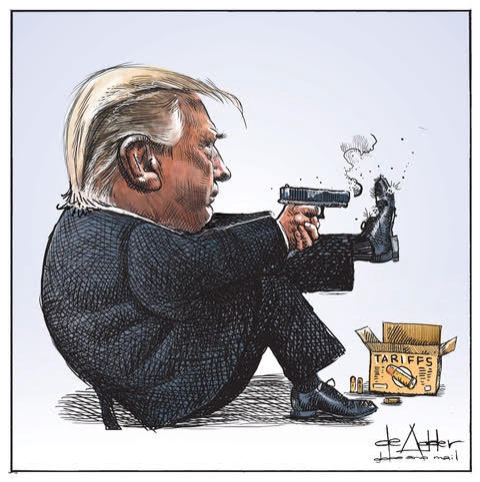
A tariff, of course, is a tax the US levies at our borders on goods we import from abroad. It’s paid in the first instance by the American importers. Like any other tax, it is added to the price of selling these imports to the American public. It’s very purpose is to reduce domestic demand for such imports in order to encourage (more expensive and less efficient) domestic production of such goods. Please, let’s not stop technical progress and the higher income it enables.

The Bitcoin Act

“With the introduction of the BITCOIN Act this summer, Senator Cynthia Lummis (R-Wyo.) called for the creation of a strategic Bitcoin reserve with the goal of reducing the government’s near-$36 trillion national debt. But can this kind of reserve actually solve our debt crisis?”  FREOPP: “Can a bitcoin reserve save the US?”

Wow. This is one of the dumbest ideas I have seen in a long time.

For starters, sovereign reserve funds consist of investments of foreign currencies earn from a country’s exports (usually oil) that it did not chose to spend on imports, i.e. the result of a trade surplus. The U.S. has a trade deficient (we buy more from abroad than we sell) not a surplus and thus have no extra foreign currency to invest. The US would need to borrow the money to invest in bitcoin when the US government is all ready $36 trillion in debt. But if it were a relatively sure way of earning more than the cost of borrowing it, it could help reduce the national debt.

Is bitcoin such an investment? As I write this, bitcoin is selling at $96,479, a 146% increase from one year ago. Not bad to say the least. If instead the bitcoin fund had purchased bitcoin in 2013 (at about $450) and sold it at the end of 2016 ($434) it would have earned a bit less than nothing. But if it purchased it at the beginning of 2018 at $13,657 it would have lost its shirt by the end of the year at $3,709. In short bitcoin prices have been all over the map. They are not redeemable for anything, cannot be used to pay for anything with rare exceptions, and are thus a purely speculative form of gambling. WC: “Bitcoin”   WC: “Bitcoin2”

Creating a bitcoin reserve would be beyond stupid.

But in the currency area there is competition for destructive stupidity.  The US dollar is by far the most used currency for international transactions for good economic reasons. The US recently has been making the dollar less attractive by freezing Russian and Afghan dollar accounts: WC: “The dollar again” But rather than focusing on measures that would preserve or restore the dollar’s attractiveness (Make the Dollar Great Again), president elect Trump has threatened any country that does not use it with 100% tariffs. Such bullying is enough to embarrass even the worst bullies. WP: “Trudeau Trump tariffs”

America’s Trump style Foreign Policy

The world benefits from rules of interaction that provide peace and cooperation. Rather than building more weapons of war, we could build more temples of beauty. Championing rules most countries respect and aspire to and being the largest (or perhaps second largest) economy in the world, the United States has naturally led such an international order. Retaining that role would be jeopardized if the U.S. did not diplomatically fashion such rules that were embraced and respected by most other countries and if the U.S. did not itself abide by the rules it had championed.

America’s leadership role is being jeopardized by our hypocrisy, such as condemning Russia’s invasion of Ukraine while given a blank check and American weapons for Israel’s invasion of Gaza and Lebanon and ignoring its abuse of its occupied territories in the West Bank of Palestine. America’s embrace of the International Criminal Court’s (ICC’s) arrest warrant for Vladimir Putin for Russia’s invasion of Ukraine and America’s condemnation of the ICC’s arrest warrant for Israel’s PM Benjamin Netanyahu’s and its former Defense Minister Yoav Gallant is the very definition of hypocrisy.  

President elect Donald Trump’s style of negotiating international agreements reflects more the behavior of a bully than a diplomat. Last Monday Trump threatened to levy a 25% percent tariff on all imports from Mexica and Canada, despite the large economic harm to the US as well as Mexica and Canada and despite the laws and agreements it would violate, if they did not stop the illegal drugs and aliens entering the US across their borders. WC: “tariffs”

“Trump’s threat spurred outrage across the northern and southern U.S. borders, prompting backlash and warnings of retaliatory tariffs from both Mexico and Canada.”  The Hill: “Takeaways from trumps new tariff threat”

“Donald Trump’s angry threat to impose 25 percent tariffs on all U.S. imports from Mexico… is widely being depicted as a bluff….

“But amid all this parsing of Trump’s intentions, a crucial fact about his new move is getting lost: At the center of it is a lie. This lie is hiding in plain sight: It’s the underlying suggestion that Mexico is not doing anything to stop migrants from coming and that Trump’s threat of tariffs is needed to change that….

“All this is laid bare by the sharp response to Trump’s threat that new Mexican President Claudia Sheinbaum issued Tuesday. Her statement is getting attention for its barbed claim that American guns trafficked to Mexico are fueling crime and violence there among gangs supplying U.S. markets with drugs. ‘Tragically, it is in our country that lives are lost to the violence resulting from meeting the drug demand in yours,’ Sheinbaum noted acidly, suggesting that the two countries’ interrelated national challenges underscore the need for cross-border cooperation rather than Trumpian confrontation.”

She further noted that: “You may not be aware that Mexico has developed a comprehensive policy to assist migrants from different parts of the world who cross our territory en route to the southern border of the United States. As a result, and according to data from your country’s Customs and Border Protection (CBP), encounters at the Mexico-United States border have decreased by 75% between December 2023 and November 2024….

“What this polite (and euphemistic) language says is that Mexico is already acting extensively to thwart migrants who travel through that country—originating south of Mexico—so they don’t reach our own southern border. As Sheinbaum notes, this is partly why border apprehensions in the United States have dropped sharply of late.” New Republic: “Mexico’s Sheinbaum responds to Trump tariffs”

So, what did our bully in chief do next?  “President-elect Donald Trump has said he had a “wonderful” conversation with Mexico’s President Claudia Sheinbaum, in an apparent easing of the tensions raised this week over trade tariffs….  After Wednesday’s phone call, both leaders described the conversation in positive terms. Trump said on Truth Social, his social media platform, that it was a ‘very productive conversation’ and thanked Mexico for its promised efforts.”

Perpetuating his original lie, “Trump indicated that Sheinbaum would stop migration through Mexico, ‘effectively closing the southern border’.

“Sheinbaum said she had explained her country’s efforts to deal with migrants and that her position would ‘not be to close borders but to build bridges’”.  https://on.ft.com/49czcol

Trump may or may not be a good negotiator (6 of his businesses have filled for bankruptcy) but his approach is that of a bully. Given America’s dominant status in the world, bullying rather than leading and negotiating in the search for mutually beneficial compromises will hasten American decline from leadership.

Tariffs

“Posting on his Truth Social platform, Trump said [Monday] that on the first day of his presidency he will charge Mexico and Canada a 25% tariff on all products coming into the U.S. He added in a separate social-media post that he would impose an additional 10% tariff on all products that come into the U.S. from China,… That would come on top of existing tariffs the U.S. has already imposed on Chinese goods.

“’This Tariff will remain in effect until such time as Drugs, in particular Fentanyl, and all Illegal Aliens stop this Invasion of our Country!’ Trump wrote.” WSJ: Trump pledges tariffs on Mexico Canada and China”

A tariff is a tax on an import. They are permitted by the World Trade Organization when leveed on goods receiving state subsidies in order to create a level playing field for trade. Such global trade has made an enormous contribution to the standard of living around the world.  “Ernie Tedeschi, former chief economist for President Joe Biden’s Council of Economic Advisers, said the North American tariffs would cost the typical American household almost $1,000 per year.” WP: “Trump tariffs-China Mexico Canada”

The normal expectation is that the tariff will reduce U.S. demand for the taxed import and encourage its domestic production. But the US labor force is fully employed and can only increase domestic production of the targeted goods by shifting workers from the production of goods the US has a comparative advantage in thus reducing our overall income. Though employment of manufacturing workers has declined in the US, manufacturing output has not because worker productivity has increased. In fact, our imports have not shipped American jobs overseas as increasing productivity has resulted in reduced manufacturing employment most everywhere in the world, including China, surely a good thing. WC: “Trade protection and corruption”

Immediately after Trump’s tariff announcement, the exchange rate of the dollar strengthened. A stronger dollar reduces the cost of imports (but increases the cost to foreigners of our exports), thus undoing to some extent the demand reducing impact of the tariff. But it hurts our exports because of their higher price to foreign purchaser and reduces our overall standard of living.

China and others hit with this tax are likely to retaliate with their own tariffs. “Under the United States-Mexico-Canada Agreement (USMCA), which took effect in 2020, goods moving among the three North American nations cross borders on a duty-free basis. ‘Obviously, unilaterally imposing a 25 percent tariff on all trade blows up the agreement,’ said John Veroneau, a partner at Covington & Burling in Washington.”  WP: “Trump tariffs-China Mexico Canada”

Should Trump actually impose these tariff’s he would (again) be violating the law, which only allows the President to impose tariffs without Congressional approval for national security reasons: WC: “Tariff abuse”

Trump’s threatened tariffs are not even leveed on the goods he wants to restrict (drugs and illegal aliens). Thus, unlike traditional tariffs they would be leveed to pressure Mexico and Canada to take other actions Trump wants. They are bargaining ploys. So at the cost of raising prices and lowering incomes in the US, weakening the global trading rules from which we have benefited so much, and weakening the checks and balances limiting an over extended executive branch, Trump may be playing his bargaining game again. But in my opinion the cost to us and the world trading system is too high.

War

My many visits to Sarajevo, Mostar, and Banja Luka in 1996-7 exposed me to the devastation of war, as did my multiple visits to Pristina in 1999-2000, and my 23 visits to Kabul between 2002-13.  My two months in Bagdad as part of the Coalition Provisional Authority in 2004 and five, two week follow up visits added live fire to my “post” war experiences that left me jumpy for many months after returning home.  None of these came close to the front-line experiences of reporter Robert Fisk, whose accounts are reproduced in his thick book “The Great War for Civilization: The Conquest of the Middle East,” though he reported from the same countries I had worked in.

Fisk’s reports on his interviews with actual people and his viewing of their butchered bodies and mass graves in the dessert confronts his readers with the real victims of war. To characterize his accounts as heart wrenching doesn’t come close to the true tragedies he reports. The deceptions and lies of all sides, add to the immense tragedies of our post WW wars, which have accomplished nothing but death and destruction.

The current Middle East wars (Israel’s slaughter of men, women and child in Gaza, West Bank, and Lebanon), following decades of Israel’s abusive rule over Palestinian territories, is beyond belief and too many Americans remain silent.  But no side has been “pure.” Our illegal and lie filled invasion of Iraq in 2003 followed years of American and British bombing of Iraq following the Gulf War in 1991 (Desert Storm). Our sanctions of Iraq over that period staved to death 1.5 million Iraqi’s, mainly children (despite the Food for Oil program), and the U.S. military’s use of depleted uranium munitions in that war dramatically increased Iraqi cancer cases and birth defects in the years that followed. Fisk reports on these and US and UK efforts to keep it all quiet.

Some of Iraq’s health problems were also aggravated by Iraq’s use of chemical warfare agents such as mustard gas and sarin during the Iran-Iraq war of 1980-88. The United States, being on Iraq’s side at that time, ignored its use of these chemicals, which remain in the soil today.  American leadership, which is desired by much of the world, is undermined by such double standards. Our government lies to its own citizens about its illegal behavior as well. Edward Snowden is paying a very high price for exposing some of it. We owe him a lot.

American interference in other countries’ affairs (other than by being the beacon on the hill) has rarely served our national interest. While we have blindly assumed that we would be welcomed as liberators in Panama (1989-90), Iraq (1991, and 2003), Somalia (1993, 2007, and 2010), Haiti (1994), Bosnia (1994), Afghanistan (1998, and 2001), Serbia (1999), Libya (1986, and 2011) and Syria (2014)–(need I mention Vietnam?), we failed to understand that peoples of most every country hate invaders no mater who they are. Moreover, our ignorance and arrogance made us very inept occupiers.

In Ukraine and Israel our interference stops short of sending our solders (almost). But Russia’s invasion of Ukraine could have easily and sensibly been avoided if the U.S. had encouraged the negotiations Russia sought in December 2021 “Ukraine’s and  dead and  war”.  Following Russia’s invasion, we tragically threw cold water on the agreement almost reached between Ukraine and Russia in the March 2022 negotiations in Turkey. ‘Peace negotiations in the Russian invasion of Ukraine”  So onward to the last Ukrainian. The final outcome is very likely to be identical to the March 2022, Istanbul Communiqué but with 120,000 dead and 600,000 wounded Russians and 70,000 dead soldiers and 10,000 dead civilians and 140,000 wounded Ukrainians and 500 billions of dollars’ worth of property destruction. In other words, Russia and Ukraine paid a huge price (with our help) for nothing.

Fisk gives human faces to the real people who pay the price for our aggressions. This horrible cost in lives and property has contributed nothing to our national security. America has much to offer the world and has contributed much to the quality of life around the world. But it has done so with its example, trade, and diplomacy, not its army. The principles and institutions on which American was founded and has flourished have served us well when we have remained faithful to them.

President elect Trump has nominated Tulsi Gabbard to become his Director of National Intelligence. When she left the Democratic party two years ago and endorsed Trump for President this August she praised Trump for “having the courage to meet with adversaries, dictators, allies and partners alike in the pursuit of peace, seeing war as a last resort” and condemned the Biden administration for the U.S. “facing multiple wars on multiple fronts in regions around the world and closer to the brink of nuclear war than we ever have been before.”

“In 2022, she also faulted the Biden administration for failing to address Russian concerns as it invaded Ukraine.

“’This war and suffering could have easily been avoided if Biden Admin/NATO had simply acknowledged Russia’s legitimate security concerns regarding Ukraine’s becoming a member of NATO, which would mean US/NATO forces right on Russia’s border,’

Following a 2017 trip to visit Syrian leader Bashar al-Assad, Gabbard defended meeting with an American enemy by saying:

“I think we should be ready to meet with anyone if there’s a chance it can help bring about an end to this war, which is causing the Syrian people so much suffering,”  “The Hill–Tulsi Gabbard-Trump Nomination — 11/14/24”

 I hope that she still thinks this way.