
Here is my latest op-ed in The Daily Caller: http://dailycaller.com/2010/03/05/give-bankruptcy-a-chance/
Year: 2010
Comments on my Torture note
As usual friends sent some interesting comments on my note
on torture. Here are two of them with a further comment from me.
*********************
Dear Warren,
As always, I enjoy your deliberations.
It would please me no end to agree fully with you — not so
much to be in agreement with you (that’s only a bonus) but to have a firm
conclusion about a difficult and unseemly issue.
These are among my difficulties:
It doesn’t work argument: As best I can tell, a wide variety
of torture has been used, probably every year, for thousands of years. All
kinds and manner of men. Has it been used by so many and so different people,
only because they are ignorant that it doesn’t work and because they "feel
good" torturing people? That seems most unlikely. Is there any comparable
practice, that spans most cultures and civilizations over centuries, that
continues to be done despite "never working"?
Might one think that torture is a specialized case to
terrorism. The use of violence, not for its own sake, but to change the
political/psychological dynamics. One would hardly argue that "terrorism
never works" repugnant though it is.
The military: the military has another reason for avoiding
torture — the belief that their military personnel are more likely to be
tortured if they are believed to torture. This seems true in some
circumstances, but not others (depending who the opponent is), but it seems
important for them to make this part of their creed. The FBI and the military
seem pretty vocal, but the CIA seems not to share their aversion.
The Geneva Accords: It’s my understanding that it applies
primarily or exclusively to standard "wars" with disciplined military
under state control.
I am very troubled by the lost of standing the U.S. has
suffered over the past decade or more. The lack of disciplinary action after
Abu Ghraib is particularly damaging and disgusting. But I wonder, of the nearly
200 countries, which of them would not have been tempted to waterboarding three
people had that country suffered something comparable to 9/11 and had very
likely suspects in hand? That is, I suspect almost all the governments would
have done something comparable if they were in comparable circumstances. That’s
a version of the argument above that most everyone thinks it works, but also an
argument that there is a certain disingenuosness going on here.
One might, of course, argue that even if it does work, and
even if most everyone else does do it, the U.S. should not — that the U.S. is
more moral than all other countries and should conduct itself as truly
"exceptional" — even if it means risking more terrorist attacks than
would otherwise be the case. An appealing argument but considerably less
persuasive.
All this from someone who was very against the Iraq invasion
— and continues to think it arguably the biggest blunder the US has made in at
least half a century — and that the biggest costs may well be in the future.
The the Patriot Act was a terrible piece of legislation. That Yoo’s argument
for a "unitary" executive a very shoddy and self-serving concoction.
That said, I think we are still at sea, as a nation, on how
to react to the challenge of terrorism. It is distinct from simple criminality
and traditional war. Does the phenomenon need distinct institutions and
structures to accommodate it into a constitutional and rule of law framework?
Bush II worked on this but failed to engage the rest of the country which is
desperately necessary for an enduring consensus to be formed. It looks as if
the challenge of terrorism, or at least the Islamic version, may fade before we
wrestle with the larger issues. Releasing terrorists, (like sex molesters,
criminally insane and other such) seems mistaken yet holding them indefinitely
violates something very fundamental, to cite but one example. Judicial
oversight, with legislative guidance, is needed together with speed and secrecy
in many cases. Etc.
As always, my best,
Bob [Robert Schadler, former Director of the Office of
International Visitors and Chief of Staff to the Director of former U.S.
Information Agency in the Reagan Administration]
*********************
My reply:
Dear Bob,
Thanks for your thoughtful comments. As you note, both
morality and effectiveness matter. As you imply, torture seems to works some
times or it wouldn’t have such a long history. The statements last year by Adm.
Dennis Blair (Ret), the Director of National Intelligence, are
interesting in this regard. His comments were in relation to the controversy
over the use of torture by the Bush W administration.
“High value information came from interrogations in which
those methods [“enhanced interrogation”] were used and provided a deeper
understanding of the al Qa’ida organization that was attacking this country…."
"The information gained from these techniques was
valuable in some instances, but there is no way of knowing whether the same
information could have been obtained through other means. The bottom line is
these techniques have hurt our image around the world, the damage they have
done to our interests far outweighed whatever benefit they gave us and they are
not essential to our national security," Blair concluded[1]
Best wishes,
Warren
*****************
Warren, A good and unfortunately still a timely message that
bears repeating for future generations. I personally thought we as a
country had finally learned, back in my law school days in justice torn
Mississippi, that if we don’t adhere to the rule of law we can not expect
anyone else to do so. Now we’re in the very sad situation of having other
countries in both the developed and developing world use our illegal and
counterproductive behavior in the torture arena as an excuse to engage in even
worse behavior — all in the name of fighting terrorism and promoting
"national security." While it is one thing for us to have lost our
moral and legal standing in the world, which is something we will hopefully
eventually overcome, it is another to think about all of the additional people
now being imprisoned and "legally" tortured around the world under US
legal cover. I would say thank you for nothing Messenger Yoo; I sincerely
hope that one day you will see the light and that you will find a way to ask
all of the detainees who have and will suffer under your own
"tortured" legal machinations for forgiveness.
Hope to see you soon!
Keith [Henderson, anticorruption consultant]
[1] Peter Baker,
"Banned
Techniques Yielded ‘High Value Information,’ Memo Says", New York
Times, April 21, 2009.
Torture is Immoral and doesn’t work
The New America Foundation and Slate sponsored a fascinating seminar this morning on “Manhunt: From Saddam to bin Laden; What Social Networks Mean for Modern
Warfare.” The presenters included Colonel Jim Hickey,
Commander of the 1st Brigade Combat Team, Fourth Infantry Division, U.S. Army that caught Saddam; “Matthew Alexander” (a pseudonym),
the Air Force interrogator of the captive who lead to the location and killing of Abu Musab al-Zarqawi (leader of Al-Qaeda in Iraq); and Scott Helfstein, PhD, Associate, Combating Terrorism Center, Assistant Professor, Department of Social Sciences, United States Military Academy.
All of them stressed the importance of intelligence and of knowledge of the population in
which the military is operating for the success of counterterrorism/insurgency operations. Thus historical and cultural knowledge and relevant language skills are essential for understanding the population and gaining its trust and cooperation, and thus obtaining useful intelligence. Along with being the best equipped with military hardware, America’s military is one of the best trained. Significant delegation of authority to well-trained field commanders permits flexible reactions to conditions on the ground. I have always been highly impressed by the intelligence and quality of the American military officers I have met and this seminar underscored how critical the human capacity of our military is to its success.
The skills and knowledge needed in the field cannot be trained into or found in one person—a super soldier. Thus collaboration and information sharing among a number of people with different skills is essential. More resources should be devoted to
recruiting and training interpreters, for example. The interagency turf fighting and personality clashes between the Departments of Defense and State in Iraq, for example, undermined our effectiveness there.
Most fascinating for me were the comments by Mr. “Alexander,” whose interrogation of an
al-Zarqawi associate led to Mr. al-Zarqawi’s elimination as the leader of al-Qaeda in Iraq. He expressed frustration that some political demagogues (my words not his) continue to call for “enhanced interrogation” techniques (torture) despite the generally held conclusion by the military (reflected in its field manual on interrogation) and interrogators like himself that such techniques are not effective in obtaining useful information not to mention in violation of the Geneva Conventions to which the U.S. is formally committed. He declared the call for the use of enhanced interrogation methods an insult to the skills of trained interrogators. “Imagine,” he said, “that American solders were told to use poison gases in their attack on the enemy. The suggestion that they could only succeed by violating international standards of warfare would be an insult to their skills.
By the way, the Justice Department’s Office of Professional Responsibility’s investigation of John Yoo, the drafter of the Justice Department’s memo claiming to justify some forms of torture (sleep deprivation, water boarding, etc) found that he was guilty of “professional
misconduct” with regard to his advise on this matter (which could lead to his disbarment).
Earlier this week, that judgment was softened by the Justice Department’s David Margolis to “poor judgment.” I leave to legal scholars to debate the most appropriate characterization of the legal quality of Mr. Yoo’s conduct of his duties. The sad fact is that his ignorance of the substantive (as opposed to legal and moral) aspects of the subject he was advising on, so called “enhanced interrogation,” has done great harm to the United States. We are seen by much of the rest of the world and by many American’s as violating our treaty commitments and our standards of morality and we have in those limited cases
where such techniques were actually used, diminished our capacity to obtain useful information from interrogation.
Can we avoid a debt crisis?
The rapidly raising U.S. Federal Government debt will reach levels sometime in the next decade that are not sustainable, yet this and the previous congress and administrations have not seriously addressed it. A conference this morning built around the recommendations of the Peterson-Pew Commission on Budget Reform http://budgetreform.org/ explored approaches to overcoming the political deadlock before it is too late. My op-ed article on the same subject also appeared today in the Daily Caller: http://tinyurl.com/yjos2ed. Please rate it (the stars at the end of the article) to let them know that you visited the DC? Thanks.
Snowmageddon

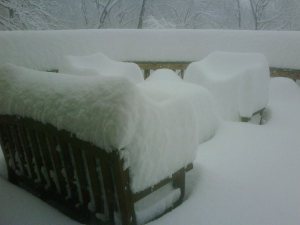
The Mother of all Snowstorms Followed by the Mother of all Snowstorms
Known here as the “Snowmageddon”
A week before Christmas we got 18
inches of snow, an all time record for the month of December. It messed up a
lot of Christmas parties. Most of the snow had melted by January 30 as I packed
for the quarterly Board meeting of the Cayman Islands Monetary Authority.
However, another storm that night canceled my Cayman flight and I arrived a day
late in Grand Cayman, missing two subcommittee meetings.
I returned home from Cayman
Thursday evening (Feb 4) to the news that we were expecting the mother of all
snowstorms starting the next day. Friday I called our neighbor and friend Susan
Fiester and told her that we were canceling our plans to meet her in New York
City Saturday to see David Mamet play “Race.”
When I got up around 3:00am
Saturday to visit the bathroom—something older people do—I noticed that the
electricity was off and it was getting chilly in the house. By the time the
snow stopped falling Saturday evening 28 inches had fallen in our area (32
inches were recorded at Dulles Airport across the Potomac in Virginia). These
occasional power outages generally don’t last more than a few hours, but by
Saturday evening power had not been restored and the temperature in the house
continued to fall.
Certain that the power would come
on “any time soon,” we nonetheless buttoned up the beach room, lit a fire in
its fireplace, and moved in. For dinner Ito heated up in the fireplace the beef
chilly he had prepared the day before. We dug out thermal underwear and dragged
down two big feather comforters, played a game of chess, and spent the night on
the sofa and the fold out bed feeding logs to the fire. With no regular
telephone/internet access to the outside world, my Blackberry became a
psychological and practical lifeline. Our neighborhood association President
and other neighbors kept us all up to date on any and all developments (or lack
there of). I husbanded my Blackberry’s battery carefully—“text or email only
please.” One bit of news was that some trees had fallen across our street
further down the hill.
With daybreak we were still without
power and our street, which is the access to and from the outside world for our
community of 64 homes, had not yet been plowed. Susan called from New York,
which had received no snow, and asked if Ito could walk up to her house to
check if her generator had turned on properly and invited us to move in with
her if we still didn’t have power when she returned that evening. On Ito’s way
back from Susan’s, our next-door neighbor Martin grabbed him to join a few
chainsaw-armed neighbors heading down the hill to remove the fallen trees from
the road so that it could be plowed.
As the sun set and we lit the
candles we decided to stick it out another night, certain that the power would
be restored soon. Ito made lentil soap over the fireplace fire. This campfire
routine in our family room was less “special” the second time around, but the
soup tasted good. I read Niall Ferguson’s “The Ascent of Money,” a very
disappointing book, by candlelight and thought of Abraham Lincoln. By morning
(Monday) the huge stack of firewood in the garage that I had expected to last
all winter was down to a dozen logs and we moved to Susan’s. Not only was her
home warm, a very welcomed change for us, but it was also a beautiful sunny
day. The neighborhood association hired someone to plow our streets as the
county plows had given up when they encountered the fallen trees the day
before, so at last we were able to get out if we needed to. We decided to have
dinner in Potomac Village at Renato’s. Our friend Ken walked over from his
cousin’s house near by and joined us. The four of us enjoyed a wonderful
dinner, two bottle of wine, and several hours of Internet access via Starbuck’s
wifi next door until the waiter politely informed us that they were closing.
Tuesday we went grocery shopping to
stock up for the next storm expected to start that evening and dump another
8-12 inches on us. Many of the shelves in Safeway were almost bare. Fearing
they might not get to the remaining items first, some people behaved rudely. It
was quite shocking really. Those waiting in the long checkout lines could
afford to be and were generally more relaxed and philosophical about the
situation. While there we started getting emails from neighbors that their
power had been restored. Hallelujah. We returned home and set the thermostat at
76 degrees.
The storm has had interesting
consequences for our neighborhood. Its members are decent people whose lives
generally revolve around work activities and circles outside our neighborhood.
The cell phone communications brought us closer together, foreshadowing an even
nicer Christmas/Hanukkah/Ramadan/Kwanzaa neighborhood association party next
year. Susan advertised to everyone in the neighborhood via email that she had a
generator and anyone was welcome to stop by and warm up and charge their cell
phones. At the other end of the spectrum, a neighbor at the far end of the main
street who is home alone during these storms had the following conversation
with her neighbor when they walked their dog past her as she shoveled the snow
off her driveway. “You look cold” they said. “I am cold, very cold,” she said,
“I have no heat in the house, not even a fireplace.” “Oh,… we have a generator
and are nice and warm.” Period! End of conversation!! Our friend at the far end
of the street understands that she did not pay twenty to thirty thousand
dollars for a generator while her neighbor did. She understands that our
choices do and need to have consequences. But the inhumanity of her neighbors’
words and attitude shocked her. I know of no magic wisdom or solution for this
or hundreds of similar situations. It is quite proper that they are left to the
individual encounters of our and other neighborhoods, however. They find their
resolutions, if at all, in cultural and moral training and understanding
without which our neighborhoods and communities will be very unpleasant places.
The next storm started slowly on
schedule Tuesday evening and continued all day Wednesday (today) dumping
another 10 inches on us but this time with gusting winds. But the snow is
almost over now and I am hoping that no more trees will fall on power lines, or
roads, or my roof, which is now holding up three feet of snow. So perhaps it is
over. If you never hear from me I again I was wrong.
Too Big to Fail
My op-ed on the above topic appears today in Tucker Carlson’s new on-line newspaper The Daily Caller: http://tinyurl.com/yguvz5c
Afghanistan: Village by village
An important element of U.S. strategy to stabilize Afghanistan and contain and preempt the Taliban is the empowerment of village militia in their own defense. I wrote about the virtue of this approach in November in http://tinyurl.com/ybmbfv3 in the context of a broader discussion of our strategic mistake in imposing an overly centralized government on Afghanistan in their new constitution we helped prepare. See http://tinyurl.com/yhq9ctx and http://tinyurl.com/yk8temx.
Today’s Washington Post publishes an important and balanced discussion of value and risks of this policy: http://tinyurl.com/ydl73mr
The U.S. dollar and the SDR as international reserve currencies
My latest article on the U.S. dollar’s role as an international reserve currency and the SDR has just been published in the latest Cayman Financial Review (Jan 2010):
http://www.compasscayman.com/cfr/2010/01/05/Do-we-need-a-new-global-currency-/
Post Scripts on Yemen
Correctly assessing the enemy’s motives is essential to
combating him effectively. If radical Muslim fundamentalists hate American
freedom, etc., they are at war with us in our homeland and we would be in a
very different situation requiring a very different strategy than I think we
are actually in. The suicide bomber who killed seven American CIA agents in
Afghanistan December 30 adds further evidence that such claims are false. A
U.S. drone attack in Pakistan killed the important terrorist leader Baitullah
Mehsud in August. “In a chilling videotape released posthumously Saturday by
the Pakistani Taliban and broadcast on regional TV channels, bomber Humam
Khalil Abu-Mulal al-Balawi, 32, called on Muslim holy warriors worldwide to
avenge Mehsud’s death by attacking U.S. targets. ‘We will never forget the
blood of our emir Baitullah Mehsud," Balawi said on the tape, using the
title that means leader of the Muslim faithful. "We will always demand
revenge for him inside America and outside.’"[1]
What the bomber hates is America’s
intrusion into his part of the world and its attacks on his brothers, not the
American way of life.
War is always the enemy of liberty, even when trying to
defend it. Our constitution and common sense gives our president essentially
unlimited powers to defend the nation in times of war. Liberty has been
preserved by limiting the wars we fight and keeping them short. These days we
invoke the imagery of war (the war on drugs, crime, terror, etc.) far too often
and too easily for those of us who love liberty and the checks and balances on
government power that are a critical tool for persevering liberty. As Vice
President, Dick Cheney relentlessly pressed for more and more Presidential
power to fight terrorists in the mistaken belief that that was the only way to
win the war against al-Qaeda and Islamic terrorists. Even today he persists in
this dangerous, fundamentally un-American view. His fellow traveler in the Bush
Justice Department, John Yoo (the bad guy would wrote the opinions justifying torture
and other expansions of Presidential power) makes the case for the Imperial
Presidency explicit in his latest book “Crisis and Command.”[2]
This bears on the issues of trying terrorists in regular or military courts,
the use of warrantless wiretaps and similar powers.
Anyone who thinks that I am expressing isolationist views
has totally misunderstood me. My professional career at the IMF has been
devoted to sharing the cumulated wisdom of the developed world with regard to
monetary policy with the central banks of other less developed countries. This
includes explicit “nation building” in places like newly independent (from the
USSR) countries like, Kazakhstan, Kyrgyzstan, and Moldova, and post conflict
countries like Afghanistan, Bosnia, Croatia, Kosovo, Iraq, and Serbia. I
strongly believe that it is in America’s self interest and the interest of
every other peace loving country in the world to contribute to the building of
more law abiding, successful, and prosperous countries freely trading with one another.
I believe in this kind of “nation building.” I do not think this better world
can be promoted at the end of a gun or as part of an empire of the old or the
new American type neocons seem to want. President Bush was right to say that
Democracy is ultimately the best way to govern peaceful prosperous countries
that respect the just rights of individuals and their neighbors, and that
promoting democracy is thus in America’s interest. But his neocon friends are
wrong to think that viable democracy, as we understand that term, can be
promoted at the point of a gun. Many internal conditions are required before
democracy is likely to improve governance. The Imperial Presidency and the new
American Empire advocated by the Dick Cheney’s of the world are a bigger threat
to our liberties and well being than al-Qaeda.
[1] Pamela
Constable and Haq Nawaz Khan, "CIA
bomber calls for attacks on U.S. in vidio", The Washington Post, January 10, 2010, Page A01.
[2] Reviewed by
Jack Rakove, "John
Yoo on why the president is king", The
Washington Post, January 10, 2010, Page B01.
Is Yemen Next?
With the benefit of hindsight after eight years of war in
Afghanistan and almost seven years of war in Iraq, hundreds of billions of
dollars gone up in smoke (per year), and the loss of thousands of American and
many more non American lives, many of us have doubted that it was in America’s interest
to undertake these wars. No one can seriously argue that they made us stronger
and/or more secure. As a result, American troops are now stationed in several
more countries, the primary reason for terrorist attacks against America (the
idea that they attack us because they resent our freedom and decadence is
laughable on the face of it).[1]
The two or more trillion dollars we have paid for these two wars could have
been spent to strengthen investment in American infrastructure and productive
capacity, which is ultimately the basis of our military and political strength
in the world. Afghanistan’s complex regional and tribal make up was poorly
understood and our plans to rebuild a more centralized government in
Afghanistan were ill conceived, facing us with high probability of failing to establish
an environment that serves any ones interests very well. And Al Qaeda can and
has easily moved elsewhere and we don’t have enough young men and women to send
to die in too many more places. But it is easier to look back and see our
mistakes, than to evaluate similar situations in advance. Enter Yemen.
Al Qaeda is once again operating in Yemen (remember the bombing
of the U.S.S. Cole October 12, 2000?). What should we do about it? Looking
ahead we see the dangers to us of Al Qaeda operating recruiting and training
areas in Yemen more clearly than we see the dangers of further stretching our
military into a country whose government is deeply hated by at least half of
the country creating an incentive to attack us (the foreign invader) that does
not now exist. We need to try hard to evaluate the costs and benefits of our
future involvement in Yemen with equal attention to both types of risks.
The Republic of Yemen occupies the Southern end of the
Arabian Peninsula. Somalia, the land of pirates and another potential haven for
Al Qaeda, is a short distance way to the South across the Gulf of Aden. Its
size and population (0.20 million square miles and 23 million people) are
similar to those of Afghanistan (0.25 million square miles and 30 million
people). Its largely Arabic population is overwhelmingly Muslim almost equally
divided between Sunni and Shi’a. However, its Sunni and Shi’a population are
very unevenly distributed with most Sunnis in the South and most Shi’as in the
North. South Yemen, which only gained its independence from Britain in 1967,
was only united with North Yemen, which gained its independence from the
Ottoman Empire in 1918, in 1990.
Enhanced U.S. involvement in Yemen to eliminate or contain
Al Qaeda might take the form of intelligence gathering with or without the participation
of the Yemen government, military cooperation with and support to the Yemen
government (equipment, training, etc), or a military invasion ala Afghanistan
and Iraq. In evaluating the costs and benefits of these options, we don’t need
to wait to be surprised that the Yemen government is very unpopular with a
large segment of the population and that we would be taking its side against an
existing insurgency. We already know that. There has already been one civil war
between the north and south (1994). “Southerners contend that the government
has denied them their share of oil revenue, and has dismissed many southerners
from military and government jobs. A wave of protests has roiled the south,
prompting a government crackdown. Many members of the Southern Movement, a
loosely knit coalition, now demand secession. ‘We no longer want our rights
from the government. We want a separate north and south,’ said Ahmed Kassim, a
secessionist leader….”[2]
“Al-Qaeda militants… are shielded
by tribal alliances and codes in religiously conservative communities that do
not tolerate outside interference, even from the government.”[3]
In short, in Yemen we would face many of the same sorts of problems we are now
facing in Afghanistan. Thus the cost of any significant involvement, especially
direct military involvement, in Yemen would be very high.
Limiting our Yemen activities to enhanced intelligence gathering,
whether covert or overt, would greatly reduce the costs and risk of our
activities. Occasional drone attacks on carefully vetted al-Qaeda personnel and
facilities in Yemen (though a few mistake are inevitable) would be no less
effective toward the objective of eliminating or containing al-Qaeda than the
full military invasion and continued operations in Afghanistan have been there.
Addressing the issues causing the insurgency, or “nation building” more
broadly, is a desirable long run strategy but is not promoted by the presence
of foreign military (ours or anyone else’s). An invasion would increase the
cost enormously with no clear increase in benefits. “‘If there is direct
intervention by the United States, it will strengthen al-Qaeda,’ warned Rashad
al-Alimi, Yemen’s deputy prime minister for security and defense. ‘We cannot
accept any foreign troops on Yemeni territory.’”[4]
There is substantial evidence that the presence of foreign troops on their home
soil is the most significant motivation for almost all suicide bomber attacks.[5]
We should not introduce that reason for Yemeni insurgents to attack the United
States, which is not now the source of their discontent.
But what about al-Qaeda? Shouldn’t we go after them in Yemen
(Afghanistan, Iraq, Somalia, etc) with everything we’ve got? If we do, they
will just move somewhere else. . We bare the cost with no benefit. We will
better defend ourselves from al-Qaeda and the small number of other fanatical terrorist
who wish to punish the U.S. (rather than their own domestic enemies): by
improving our intelligence and its use to detect and deter terrorist plots,
strengthening our borders, and reducing our irritating and costly interference
in the lives of others.
[1] While Ben
Laden had previously listed the presence of American forces on Saudi soil as a
prime motivation for al Qaeda’s attacks on the U.S., in the first public
statement in which he explicitly acknowledged responsibility for the 9/11
attacks (three years after the event in a video broadcast on Al-Jazeera) “bin
Laden said he did so because of injustices against the Lebanese and
Palestinians by Israel and the United States…. In the video, bin Laden accused
Bush of misleading Americans by saying the attack was carried out because Al
Qaeda ‘hates freedom.’ The terrorist leader said his followers have left alone
countries that do not threaten Muslims. ‘We fought you because we are free …
and want to regain freedom for our nation. As you undermine our security we
undermine yours,’ bin Laden said. He said he was first inspired to attack the
United States by the 1982 Israeli invasion of Lebanon in which towers and
buildings in Beirut were destroyed in the siege of the capital. ‘While I was
looking at these destroyed towers in Lebanon, it sparked in my mind that the
tyrant should be punished with the same and that we should destroy towers in
America, so that it tastes what we taste and would be deterred from killing our
children and women,’ he said…. ‘Any state that does not mess with our security,
has naturally guaranteed its own security.’” Foxnews.com October 30, 2004.
[2] Sudarsan
Raghavan,
"Yemen’s
internal divide complicates U.S. efforts against al-Qaeda", The Washington Post, January 8, 2010,
Page A12.
[3] Ibid.
[4] Sudarsan Raghavan,
"Yemen
warns of limits to its cooperation", The Washington Post, January 8, 2010, Page A12.
[5] Robert Anthany
Pape, “Dying to Win: the Strategic Logic of Suicide Terrorism” Random House,
2005.
 Warren's space